Life is more about emotion than logic sometimes
The sphere of human affairs that is influenced by facts, cause and effect, logic and well-argued, more or less persuasive positions, is like the visible part of an iceberg.
Invisible in the water is the far greater bulk of the iceberg, the visible part being only a small fraction of the iceberg. Emotion in human affairs is like all the stuff below the water line and plays a gigantic role in keeping the whole thing afloat and upright. We may not be able to see that vast bulk without an underwater camera, but without that giant underwater part, there’s no iceberg. No living, sentient head without the much larger, deeply feeling body to carry it.
It’s the same way with our emotions, they carry us. And when they’re inflamed, no amount of logic alone can touch them, let alone soothe them.
The seemingly logical question needed to solve a conflict “what do you need from me? how can I heip?” cannot be asked or answered by someone whose emotions are clenched in childhood terror. They’re simply impossible questions to form when we are upset that somebody seems angry at us.
Filibuster again protects democracy
Yesterday, after the Senate parliamentarian did her thing, it was put to a vote whether private insurance companies would also be required to cap insulin payments at $35 a month (and presumably lose a mountain of money). 43 Republicans voted no, effectively a filibuster.
When the entire Inflation Reduction Act, the skinny, almost unrecognizable, reconciliation-ready version of Build Back Better ( filibustered quite effectively with the assistance of two rogue Democrats), came up for a vote, those same seven bipartisan Republican senators voted with the other 43 against the entire bill. That’s called party discipline and loyalty to an angry base.
So we wound up with a fraction of what the vast majority of Americans actually want, but it is much better than zilch. Until we can fix it, that’s democracy in the age of Koch, Trump, Barr and the likes of Ginni Thomas and friends like Mark Meadows and fervent midievalist [1] Snarlin’ Sam Alito.
That said, congratulations to us all and to this poor, magnificent earth we have long been such negligent stewards of.
[1] To save you a click on Google: One who sympathizes with the spirit and principles of the middle ages: often with the sense of one who is antiquated or behind the times.
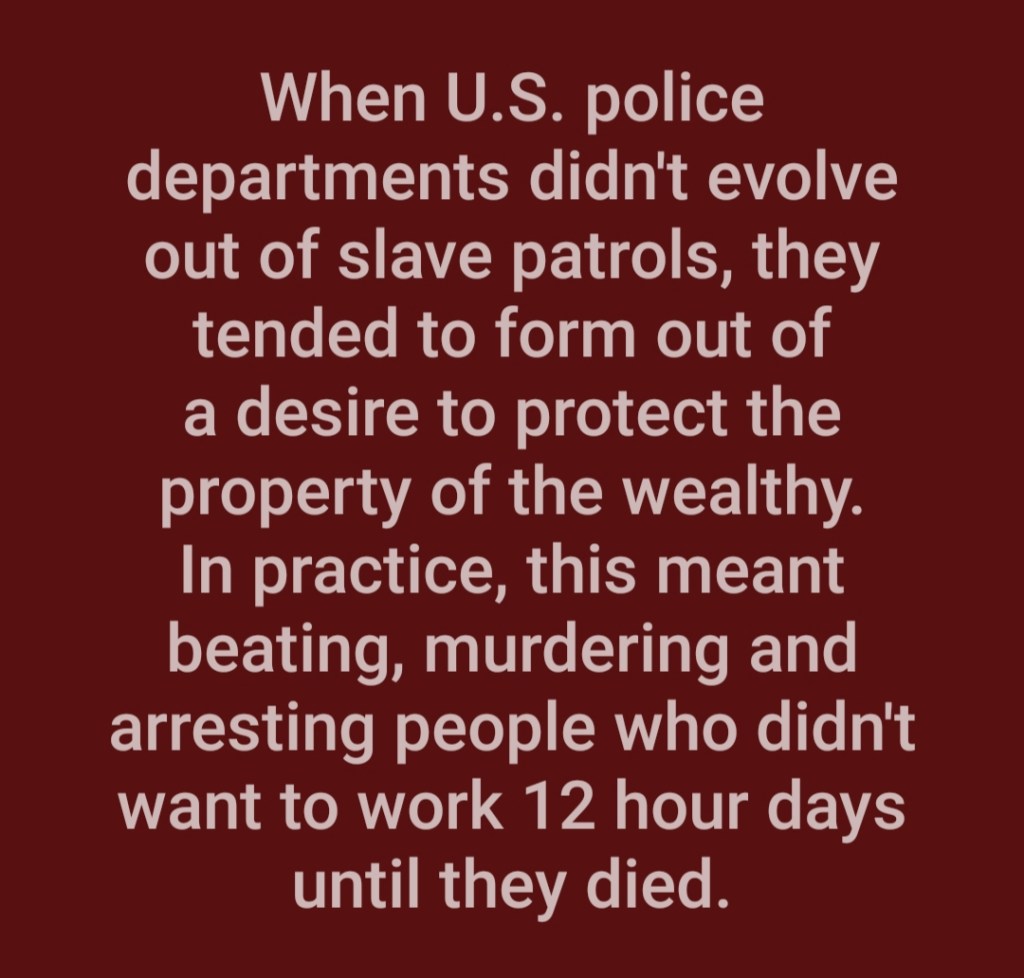
The origins of policing in the USA
From the very worthwhile series on the development of policing in the US, Behind the Police, by Robert Evans with co-host Propaganda.
How do I make it stop?
When you are in a brutal conflict that will not stop, when every move anybody makes (or doesn’t make) to try to solve it twists the knot tighter and tighter, and the standoff seems increasingly hopeless, how do you begin to resolve a mutually painful and desperate impasse?
Fuck if I know, though one thing I’ve learned is that no solution to any painful interpersonal battle comes from the application of logic. I’ve also learned that Reason, once everybody’s pain is inflamed, is sometimes entirely irrelevant.
Paradoxically, the more reason is on your side, sometimes, the harder the other party, now accused of being unreasonable on top of everything else, will have to resist and the worse it will go for you, for everyone.
Sometimes you will turn an emotional corner for reasons you can’t completely understand in that moment but your emotions will tell you something true and important that you need to do immediately and you can do that, and sometimes that may help.
It will certainly help more than being stuck on the senselessness of placing all blame on one person, alone responsible for putting a world of trauma on loved ones. The exact reason for your emotional pivot may be revealed to you afterwards, if you puzzle over it long enough, though that reason also doesn’t matter.
Fucking humans, man, no wonder this planet is always at war.
$580,000,000 sound like a fair price for a reliable 6-3 Supreme Court?
You get what you pay for. Another excellent and important presentation by Sheldon Whitehouse, number 17 in his series The Scheme, which is about the “Libertarian” billionaire industrialists’ scheme to control the regulatory state, the entire government, society and culture by controlling the Supreme Court. And a dirty little billion dollar scheme it is.
Animation by four or five women working together
All of these women were actively battling or recovering from battles with various cancers. All of this creative animation was done in four two-hour sessions. A very nice 8 hours, indeed.
Nothing whatsoever to see, or smell, here
From a recent Washington Bezos exclusive:
Prospective jurors in [Roger] Stone’s trial had completed confidential questionnaires that asked for their views on Trump, Stone and others caught up in Mueller’s investigation. Stone’s lawyers agreed to keep the responses confidential, and no details had been disclosed publicly. Questionnaires completed by those selected as jurors were later leaked to right-wing operatives, prompting an FBI investigation. No findings were ever publicly disclosed.
Practice for an animation demo
Striving, belatedly, to be a mensch
The Yiddish word mensch, (a word European Jews took from the German word for “man” [1]) refers to a person who acts the way we all recognize everybody should act. A world populated by mensches, with mensches in charge of governments and communities, would be much different, and much fairer, than the one we live in now.
When a mensch makes a mistake she doesn’t justify it, or blame someone else, she rectifies it as quickly as she can. When a mensch sees somebody being attacked, she steps in to try to prevent harm. When a mensch sees you’re hurt, she comforts you. You can be confident taking a mensch’s word they will do what they say, knowing they’ll do everything they can to keep a promise. Here’s google’s first hit when you ask for a definition of mensch:
mensch
- A person of integrity and honor.
- Alternative spelling of mentch.
- a decent responsible person with admirable characteristics
It is my experience that most people consciously try to be a mensch, challenging though it is in many situations. We all do what we believe is right, we try to treat others in ways that wouldn’t be hurtful to ourselves, we try to extend understanding to loved ones who hurt us.
The hardest part of being a mensch is when we are hurt, especially if we are blamed for being hurt. In that situation it can suddenly be impossible to act according to your better nature, your pain blocks the way. You can find yourself isolated in an emotional dead-end with no way out, unless your hurt is acknowledged by the person who hurt you. That situation can be a mensch-trap, since hurt caused accidentally is very hard to take responsibility for. Hurt you actually, objectively, didn’t cause, though insistently blamed for it, is almost impossible to acknowledge or seek forgiveness for, because, truthfully, what am I expected to apologize for?
I put somebody I love in this position recently, for a long time, blamed her for an impossible, almost year-long stand-off and couldn’t see the unfairness of my position until yesterday, when I finally wrote a chronology that helped me see her role in a very difficult situation differently. She is not to blame for any of this ugly shit, she and I actually worked out what we needed to on the phone almost a year ago.
I feel awful for blaming her and will try my best to get her to accept my apology, express my understanding of why she had every right to be upset with me, why it was wrong of me to demand an apology for her doing the best she could under circumstances so emotionally tangled that right now I can’t imagine how to explain them to her at the moment without making things worse. I’ll stick to making amends. She would be perfectly within her rights to still be mad at me, but I hope she won’t be.
Trying my best to belatedly fix things with somebody I hurt doesn’t make me a mensch, but it hopefully makes me less of a schmuck. If I can manage to reassure her of my love without bringing in too much of the impossible tangle (not her fault) that may need a professional’s help to untangle, I will have done the best day’s work in a long time. I hope she’ll be able to forgive me.
[1] A certain generation of Germans refined this term to classify menschen by category, there were menschen, regular guys, ubermenschen — supermen — and üntermentschen, subhuman, contemptible excuses for humans that needed to be dealt with as harshly as possible to avoid contamination of the rest of the population.
 gratuitousblahg