As much as we need connection to others, attachment, to live full, healthy lives, we also need to be authentic — to act in accordance with our deepest needs and beliefs. If you can’t be honest with people you are attached to, you are in a vise that, eventually, will squeeze the life out of you.
So if you need to express something that may affect your attachment to people close to you, and you’re aware that the expression will place pressure on the relationship, you might as well just express the full thing as clearly as you can. If you try to hedge, be polite, respect the feelings of people who can’t accept you as you actually are, well, you’re probably already being sucked toward that treacherous waterfall anyway.
If you say gently that you’re having a hard time living with certain untruths that have been told, you are already gently assenting to your own punishment which is as sure to follow as night follows day. If someone is lying to you and expecting you to silently agree that the lie is necessary and proper, there’s not much point being attached to someone like that.
So whether you gently object, or make your objection as plainly and unmistakably as you can, the effect will be the same. Someone who knowingly lies will not tolerate a word like “untruth”. Anodyne expressions like “debatable”, “questionable” or “not necessarily true” will strike them as forcefully as the proper word, adorned or unadorned, a fucking lie.
In the end, no matter what you do, you cannot convince someone who has already decided that you are dead that there is really no reason to kill your memory too. There is every reason to! You are coming in after the conversation is finished, as you yourself are also finished. Nothing infuriates righteous killers more than when the accursèd dead insist on fucking speaking.
What I needed from my old friends was just to be heard. That was a lot to ask, apparently, and the united, principled voice of the group is like the voice of Switzerland circa 1942 — there is nothing to talk about here, we take no sides, we love and respect everybody, and if only you Gypsies, Jews and Reds would stop making such a racket we could all go on with our lives in peace.
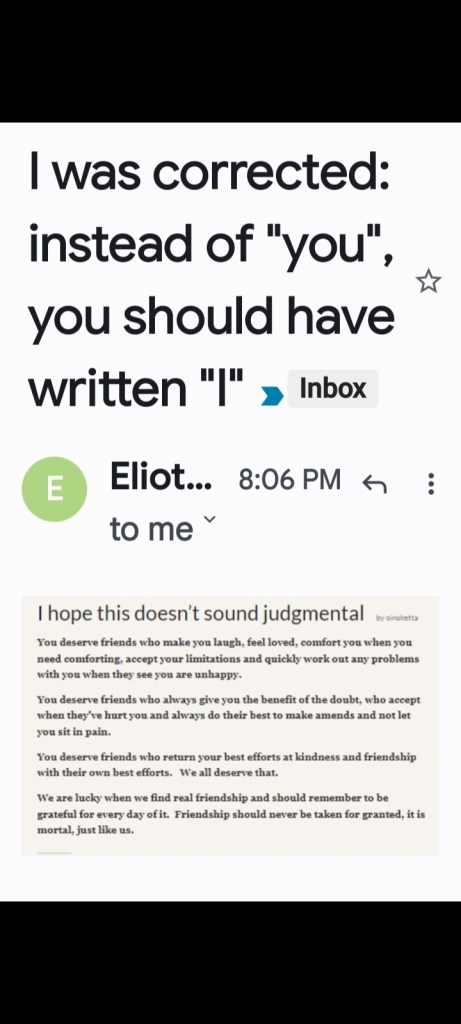
I like it better as “you” because then this description of close friendship pertains to everybody. I was told I’d used the wrong word with “you,” that I should have used “I” , Lets see how that actually changes it, not much, really, though it does work as a chilling epitaph for that particular friendship:
I deserve friends who make me laugh, feel loved, comfort me when I need comforting, accept my limitations and quickly work out any problems with me when they see I am unhappy.
I deserve friends who always give me the benefit of the doubt, who accept when they’ve hurt me and don’t let me sit in pain.
I deserve friends who return my best efforts at kindness and friendship with their own best efforts. We all deserve that.
We are lucky when we find real friendship and should remember to be grateful for every day of it. Friendship should never be taken for granted, it is mortal, just like us.
To my dismay, I had another email lecture from that friend in Israel. (Part 1 is here) She told me she was my friend, and loved me, no matter what I thought, though she couldn’t force me to be friends with her. She told me if I was looking for a judge, she was not the right person. She accused me of trying to make an enemy of her. She told me again that I need professional help. She assured me that she did not take sides in this “divorce” from my old friends. She wrote “WTF!” followed by an indignant protestation that her characterization of me and what I need to do, and have, according to her, refused to do thus far, was not in the least bit judgmental. She asked, as if I hadn’t explained it in detail a few times already, why I was so angry.
I took a few breaths, and a day and a half, and sent her this. Hopefully the last thing I’ll have to write any of these righteous, loving, dear, judgmental former longtime friends. Their need for attachment to each other, and identity in the group, has short circuited their ability to reason or be in the least bit objective, it would appear. I wrote:
Sure I’d like to remain friends, that’s why I sent you the best explanations I could write about my painful banishment from a group of lifelong friends based on these old friends all accepting the false narrative that I am the irrationally angry, unforgiving aggressor in the falling out with my “bosom buddy” and “the community that came with him”, as you put it. I’m not looking for, or seeking to make, enemies, I’m looking for basic fairness from my friends, the same thing they rightfully expect from me.
You ask why I’m angry. Look up “reactive abuse” online and you’ll get a taste of what I was subjected to for a year, before I finally saw what I was up against and took myself off the wheel of implacable mistreatment. Is it really so mysterious that someone would be hurt that a group of his oldest friends would all assume that he is deluded by anger and that people who have lied about his actions are telling the truth? That this innocent little cherem caused by an unresolvable conflict with two of the members is justified by how upset I seem to remain about it after total war was declared against me and blamed 100% on me?
Shocking, traumatic and difficult as it was to grasp that my two closest friends are unable to take responsibility for their actions or resolve conflicts and resort to making up and spreading an inflammatory story about my ongoing rage to justify their anger, my life is a hundred percent better without them in it. To the extent it’s possible, in the times we are living in, I’m pretty much at peace with most things in my life, outside of a group of my oldest friends believing this kind of slander about my character, seemingly out of tribal loyalty to the prom king and queen from high school. I’m almost over that too, though it’s taken a lot of painful work (such as writing the pages you read, without understanding anything but how much pain I was in).
I don’t need a judge, or a referee. I appreciate that you wrote what you wrote out of a desire to help and will be talking to a dispassionate professional for the first session in a couple of hours. What I needed from my old friends was just to be heard. That was a lot to ask, apparently, and the united, principled voice of the group is like the voice of Switzerland circa 1942 — there is nothing to talk about here, we take no sides, we love and respect everybody, and if only you Gypsies, Jews and Reds would stop making such a racket we could all go on with our lives in peace.
If you read your original reply again you may understand why it struck me as so judgmental. You’ll see that you concluded that I carry my childhood pain around like an albatross that encumbers all of my relationships (every one of them, apparently), leaving me friendless, and that my need to be right poisons my life (how would you know that one way or another? was I vicious as I consoled your gentle brother during the shiva visit? have you ever personally known me to be mean, or to lie, to anyone?) that I refuse to look at my own faults and have never done the hard work to overcome a painful childhood and become a better person, preferring to blame others and take petulant refuge in my “rightness”, as you chided me. Again, how would you know any of that about me, except via a false story told by other hurt, angry one-time friends? And how is any of that not a harsh moral judgment? That it’s all based on lies my former closest friends have spread about me makes it worse still.
So you give me earnest, reasonable advice motivated by your deep concern and love for me, which just happens to accord with the common understanding of the group. The innocent, stressed out X and the noble, persecuted Y have spread their story of my insane, unappeasable anger in our circle, and I’ve been repeatedly moralized to and now excluded from that intimate little group. Everybody has made it clear to me, often indignantly, that they love me and they take no side, though they all clearly have (as your email indicated — pointing out very clearly that the real problem here seems to be my pathological need to cling to unresolved childhood pain, and my readiness to judgmentally hurt people who’ve done nothing to me but, uh, maybe judge me a tiny bit unfairly).
I know a fatal falling out with Y and X would never happen to you, but can you imagine how it would feel if I — and everyone else we knew in common — told you it only happened because you’re immature and clinging to childhood pain?
Your friend (Redacted II) has been quite insistent, the two or three times I’ve spoken to her in the last six months, that I am the only one in the loving group who has a problem “forgiving”, a view echoed in your email. Apparently, I’m insane to think the group has any opinion, has taken anyone’s side or has excluded me — and that I’ve only been excluded because I am so insanely angry that nobody wants to be around my crazy rage. Again, see “reactive abuse”.
I was hurt at being told, gently, firmly, every single time, with perfect moral uprightness, by everyone, the humanistic rabbi, Redacted II, you, silent V, silent W, before that X & Y themselves, to swallow what I feel happened to necessitate the painful end of a cherished, fifty year friendship that nobody but me could fix because the only thing wrong with it, apparently, is my own inability to forgive. If I was upset, I had no right to be, it’s my problem alone, because I’m an angry baby who can’t face his own demons and just wants to inflict his pain on and try to change everybody else. No moral judgment there?
A main feature of friendship is listening to a friend who is in pain, that box is conspicuously unchecked by my righteous old comrades. By “taking no side” and requiring me to be quiet, and urging me to get professional help to look into my own heart for why I alone am so hurt to be harshly judged, the sides you all deny taking are drawn quite clearly. With not one of you seemingly able to put yourself in my position for a moment to imagine how painful it is to be treated this way, or to extend to me the benefit of the doubt friends give each other, like I extended it to X and Y time after time while trying to work things out with them.
Here is the short description of friendship that X told me I’d used the wrong word in. She said “you should have written ‘I’ instead of ‘you’.” That observation was spontaneously made when I called to make amends with her, after a long WhatsApp negotiation, last August. friendship
Here’s a quick one about how most of us tend to listen to people in pain, even if we don’t know them. the human need to be heard
It’s one zen koan inside another. We can’t forgive somebody who can’t forgive. Your hurt and anger, Eliot, are both completely irrational, though we refuse to hear or consider any points you’re making because you’re so irrationally hurt and angry — from your childhood and completely unrelated to how you claim your two closest friends, people we all love dearly and unconditionally, may have treated you for more than a year during which you claim you consistently, patiently tried to make amends with them. We don’t judge you for being a bitter, childish, angry, unforgiving, defensive, lying, other-blaming asshole, why do you judge us so harshly merely for being imperfect human friends?
We are, every one of us, damaged in some ways by life, Redacted. Some of us strive to be mensches and some just damage others and constantly justify it, while performing virtue and victimhood. Responding to slanders about oneself does not make one the aggressor, unforgiving or obsessed with being ‘right’ at all costs. Calculated lies about your character, and moral lectures based on those lies, from people who claim to love you, are intolerable, no matter how lovingly you’d like to spin it. If you can’t see that after my several long explanations, I don’t know what to tell you. Pass this email on to Zebediah, I guess, he may be able to be more objective.
Outside of that, as you say, zehu.(Hebrew for “that’s all” or “done”)
“instead of ‘you,’ you should have written ‘I,’ ” she said, confidently.
It goes without saying, she said with that terse, global editorial improvement, that only a weak, needy person like me would require this type of hyper-empathetic friend. It takes one to know one, if you know what I’m saying, darling.
And as for why it’s so hard to get over this kind of thing, which happened almost a year ago — the intolerable shock comes back again and again because it’s so hard to internalize that someone you loved, someone who loved you, could decide, for all the world, that you are fucking dead.
I am about fifty pages into trying to put this real-life horror movie into book form, this story of cooties in the kindergarten playground, dictated to me, with an air of inevitability I can now almost taste, by a group of old friends, every detail exactly perfect as it happened. If by perfect we mean “beautiful” in the sense certain Ukrainian Jews used to use the word beautiful.
One example of this special use of “beautiful” was the explanation given to a Ukrainian Jew, in 1942, about why a Ukrainian policeman had to shoot a young Jew who had stolen bread. The Jew, who saw the policeman leading the boy away at gunpoint, had sought to save the kid’s life. He tried to convince the policeman, a man he knew, to punish him in a less extreme way, perhaps a beating and a fine. The Jew described how the policeman explained himself, “in a beautiful way.”
“Let’s say I fine him,” said the policeman, “and he can’t pay the fine. And we both know he can’t pay the fine, that’s why he stole bread. So if I let him go with a fine that he can’t pay, am I really doing him any kind of favor? Things will go very badly for him in a very short time, with the SS, and I’ll also be in trouble. So by shooting him, I’m actually performing a kind of mercy, it’s better all around, for everybody.”
When I describe the story that a group of my lifelong friends have dictated to me as beautiful, this is the sense in which I mean beautiful.
I got your letter yesterday and after trying to read the whole thing a few times, I stopped and just slept on it.
I tried to think about why you were writing it and why to me.
I can’t say I was able to make sense of it, but my heart clearly understood.
I felt how much pain you are in and how deep your suffering goes. It obviously didn’t begin with the event that triggered your divorce from your bosom buddy and the community that came with him. It began way back within your own family and all the unfinished business you carry like an albatross throughout all your relationships and life.
The letter was more like a purge than an invitation to a conversation.
I also don’t believe there’s anything I can say to you that will assuage yoursuffering. If you’re willing to unpack it all, you have to see a professional. I can tell you that Ilan found his peace many many years ago through meditation. I can attest to the change the man internalized over the years and the impact it has had on our life together.
If you’re comfortable with just being ‘right’ you’ll spend your life brewing and it will take it to the grave. If you want to find your peace, you know what you have to do. If you want to face your demons you have to find a neutral setting and do all the hard painful work that it takes. You can’t change all the people in your world, but you can change yourself and heal.
Think about it Elliot [sic]. Do you want to throw away the remainder of your years by being angry, by being ‘right’ or do you want to find your peace.
Only you have the answer.
With much love,
Redacted
I replied with more explanation of why I’d been so hurt and so forth. That night I had a call from the Flying Monkey, Redacted’s best friend and confidant. After that loving chat, I had no choice but to amend my reply:
Oh, one last thing. You asked why I sent you the pages you could make no sense of. A reason I forgot to mention in my previous email is that I consider you perhaps the sharpest and most perceptive person in the circle. I was hoping for understanding, which, clearly, you could not provide.
In replying to you a few days ago I made the same stupid mistake I’ve been making all along, since that hideous year bookended by two angry Yom Kippurs. I tried to use reason to persuade someone who had clearly made up her mind, based on the other party to my ugly “divorce” from X/Y having already persuaded everyone we know in common that they behaved perfectly and Eliot is, alone in the history of divorce and every other conflict, entirely to blame for everything that happened. When he’s frustrated he says the fucking f-word! And worse!
It was very clear from your moralistic response that you follow that interpretation, only one party has behaved aggressively and immaturely (from my point of view, I am not that party, of course – and I have the receipts, if anyone who has judged me unworthy of friendship were interested in being fair, or empathetic).
Consider for a second: if I was the enraged person you portrayed in your pitying judgment, would I have reacted as mildly as I did to what can fairly be seen as the judgment of someone who feels infinitely superior to me? Based on a false account imparted during a successful attempt to assassinate my good name among people I have long loved, listened to, made laugh? No feelings I might have about being unfairly judged and banished by an entire group of old friends, most of whom I never had a hint of a quarrel with, are appropriate — except as manifestations of a need for intensive psychiatric work?
When someone you care about is upset, you ask them what happened, you listen to them. You offer to help, if you can.
When someone is upset and you tell them they have no right to be upset, that they are wrong, and immature, and irrationally clinging to childhood pain, and unable to get past their previous abuse, are aggressively angry, unforgiving, hellbent on being right at all costs and trying to change everyone in the world but themselves, and are unwilling to do the hard work everyone else in pain has presumably done to become more fully human — well, you really shouldn’t sign that kind of message “much love,” darling.
I’ll leave our dear friend the final word on this ugliness (well, me, actually, but you know how I am).
The only way to flush these hard feelings, dear Seedj, is by having the last word in a quiet battle with self-righteous, toxically clannish pinheads.
Gabor Maté, in The Myth of Normal, points out that we have a primary need for attachment, that it is impossible to survive as infants or live healthily without close attachment to others.
Our other primary need is authenticity, being true to ourselves, being in touch with what we most deeply need. When these things are in conflict… watch out.
As Maté writes “for many people these attachment circuits powerfully override the ones that grant us rationality, objective decision making or conscious will, a fact that explains much of our behavior across multiple realms.”


 gratuitousblahg