Living In My Own Head

An imaginary application to participate in TED talks as a 2013 TED Fellow:

TELL US ABOUT YOURSELF

We take this portion of the application very seriously. Please take the time to answer the questions thoughtfully, with enough detail to help us understand who you are. 

All responses are limited to 1500 characters except where noted.

What is your current primary activity? *


I am the facilitator of a child-run animation workshop and the Creative Director of the nonprofit wehearyou.net.  Our mission is to carefully listen to the children’s ideas and concerns and to encourage them to express these things in animation.   And they do.  The children set up the camera stand and lights for each session, create the animation, shoot all the frames, input them to a computer, edit the frames, make the soundtrack.   There is virtually no creative input from adults, whose role is to keep an eye on the clock and make sure things run smoothly.  Being this hands-off is hard work, too, and requires a high degree of calmness, alertness, discipline, attentiveness and humor.  Also, perhaps most importantly, flexibility on the fly.    

In addition to my work as lead facilitator of the workshop I am also the organization’s Director of Development, recruiter, fundraiser, corresponding secretary, trainer, marketing and branding officer, writer, webmaster, social media director, head of outreach, bookkeeper.   I also do the final edit of the weekly animations and mix the soundtracks.   (1,068 characters)


What are you best known for? *

Oddly enough, cool under fire, sang froid.  I’m aided in this by an overdeveloped sense of irony acquired during constant warfare in the contentious family of my childhood.   I am known for several skills and talents that I’ve made no efforts to exploit financially, to the puzzlement of many.  I am considered an inventive draftsman, I play guitar and keyboards and arrange, I’m a clear, concise and sometimes moving writer.  I am also known for dreaming and my many ideas, which I have never hesitated to share.  Also for a sometimes uncanny memory. 

In the professional realm, I am best known for variations on the above.  As a subsistence lawyer I was probably best known for my deadpan style, quickness of tongue and odd grace dancing before judges, especially when they were being disrespectful.   As a teacher I was probably best known for my easy rapport with children, candor and quickness of retort.  I also gave a high priority to the students’ creativity and took pains not to pour water on any idea they expressed.  Parents and colleagues often remarked on how creative my classes were.

As a young man I was probably best known for my angry words.   I have been transforming myself into a more deliberate, milder person.   A quick, cutting response may be fun to make, and satisfying in the moment, but one learns (with luck) that it does little to advance a real conversation.  I am known for being someone you can have a meaningful conversation with.  I place a high value on real conversation.


What other achievements (not only academic) would you like to share? *

As hinted at above, my achievements are difficult to quantify, in worldly terms.   My biggest achievement to date has been my ongoing dedication to my beliefs as embodied in wehearyou.net.  My creation of and involvement with this program, which I consider radical and sorely needed, has necessitated many positive changes in my thinking and action.  

I’ve come to understand that most people are mostly preoccupied most of the time and that the modern attention span is very short.  I’ve had to learn things I’d never thought about.   I’ve had to learn, for example, that most people don’t give a rat’s ass about whether or not poor children in Harlem make animation.   I am, after a long digestive period, able to keep those perceptions in mind without letting them deter me or slow my progress.

My mission is to encourage people to listen to and respond to each other gently.  It’s a life-affirming thing for a child to be listened to attentively by an adult, to have a moment to dream out loud uninterrupted.  While this is a sadly rare thing (for anyone of any age) in our hyper digital world of virtual connection and overloaded distraction, the program and I have made some very encouraging first steps in this direction.


Beyond your work and studies, what are you passionate about? (e.g. hobbies, causes, activities, issues — please do not talk about your work in this section) *

I am passionate about playing music, listening and preserving the spaces in music that are where the action is.   I am passionate about improvising and helping to bring out the creativity of others.   I play the guitar, mostly, and am always most pleased when another musician comments on how much space I leave for other people’s ideas.  I also enjoy accompanying singers.

I am passionate about justice, which is one reason the law was such an unappealing detour on the road of my life.  Justice in America is largely the justice you can afford to purchase.   I can point you to the relevant provisions in our constitution which obliquely say as much.  The gulf between what is legal and what is right is an enormous, stinking crevasse.  My powerlessness in the face of recent injustice,  “the war on terror” and its related excesses, the widespread,  crippling criminality of the financial sector, led me to imagine a program that would encourage children to plan, stage, critique, problem-solve in groups.  To help them become informed, effective citizens of a democracy.

I dream of helping create articulate young citizens who are able to inform themselves about issues, argue them and organize to change intolerable conditions in our democracy.  I plan to give a digital megaphone and increased sense of agency to children, particularly those society has decided get all the help they need from programs for “at-risk” and “underprivileged” kids.   

I am passionate about letting the larger society, the one busy piously acquiring wealth, see what is in the minds and hearts of young people who are seen, if at all, as profitable widgets for privatized prisons. 

I am passionate about drawing, writing well and, whenever possible, having deep conversation.


Share an example of something you have been a part of (including created, led, or joined) that you consider unique, even if no one else does. Why do you think it is mould breaking? (Limit 2250 characters) * 

Not to harp on wehearyou.net, but I consider our approach unique and mould breaking.   Here’s the idea, with illustrations at the end.  The creative potential of young children is increasingly discounted.   When children are allowed to choose their projects, &  control all aspects of production, remarkable things emerge.  Week after week children ages 7 to 11 create, in the chaos of a free-form workshop, surprisingly inventive animation.   I am amazed by some break-through just about every session.

The great Sugata Mitra demonstrated children’s ability to self-organize, learn and teach each other things they are passionately engaged with.   Mitra used a computer embedded in a wall and documented the progress of illiterate children, as a group, who mastered the technology with no outside help.   Wehearyou.net is using the canvas of animation to help demonstrate the rich creative lives of children who are increasingly forced into ever more restrictive learning environments where most of them will learn failure rather than any kind of success.

In the test-prep age of No Child Left Behind children are seen as passive vessels to be filled with information and skills geared to standardized tests rather than as partners in their own education.  Kids are capable of learning much more than most educators give them credit for, particularly if license is given for their creativity to enter the classroom.

8 year-old with cut-out and three foil coins asks how to make the little character juggle.  I tell him I have no idea, see what you can do.  Within moments the little cut-out is juggling, the kid is already on to the next thing, with barely a backwards glance.  Two seven year olds create a guitarist and drummer.  Passing by I suggest they cut off and move the guitarist’s arm to make him strum.   A short while later they shoot a sequence where the two tiny musicians play perfectly in sync, the guitarist strumming then flipping his guitar in the air to catch and strum it on the beat.  The drummer, meanwhile, flips his drumsticks in the air, catches them and, bam!, exactly on the same beat.  How they did it, truthfully, I have no idea.

Idea Girl, nine, with five ideas a week she is too distracted to carry out, describes sequence where character will take part of his stomach, make a basketball backboard and hoop out of it, dunk a basketball, turn a somersault, pick up the backboard, eat it, get fat and then turn into a ball.   I ask if she’ll do this with clay.  She nods.  A few hours later, when first looking at the frames they shot during the session, I am amazed to see the frames, which needed no editorial improvement, doing exactly what she described.  (2732)


What questions should we have asked, but didn’t? Please write them down and answer them! (in other words, tell us something about yourself that we don’t know yet). (Limit 2250 characters) *

(I’ll get back to them on this one) 

Can you share a memorable anecdote from your life that will give us a further sense of what makes you tick?

My father was brilliant and very funny but also brutally defended at all times.   I learned, at age 40, that he’d been the victim of atrocious abuse from his mother, whippings as soon as he was old enough to stand.  Learning this unspeakable secret, from Eli, an older cousin, gave me great insight I could never have had without knowing about the abuse he’d endured.

My father and I had a life-long debate about whether people could change.   He argued that only superficial things could be changed, that deeper personality traits were ingrained and set.  I said changes in response were the first step toward making the deeper changes.  He angrily denied any insights I may have thought I’d received from Eli, pointing out that his cousin was a problematic historian and tyrannical father.

At 1 a.m. on what turned out to be the last night of my father’s life I visited him in the hospital.  His first comment: “Eli hit the nail right on the head, only he didn’t tell you the worst of it.”  He hadn’t recovered from being whipped as an infant.  This brilliant man remained somehow convinced he’d been the dumbest kid in town.  He told me I was right about change.  He wished he’d had the insight to try to change himself.  “I imagine how much richer my life would have been if I had not seen it as a zero-sum war.”  

As sun set the next evening he breathed his last, I closed his eyes. The profound gift of these last moments with my father remains with me, and sustains my beliefs.  (1476)

How did you hear about the TED Fellows program?

I don’t recall exactly.  I think I stumbled on a TED talk on youTube and have watched many since.  I also subscribe to the podcast on WNYC.   Several friends, it turns out, are also great fans of TED (how can you not be?) and I have done some evangelizing and turned a few others on to these remarkable talks.  I probably learned of the Fellows program on the TED website.


Have you participated in TED before? If so, to what extent? (e.g. you watch TEDTalks, you’ve attended / hosted / spoken at a TEDx event, you’re a TEDTranslator, etc) 

Only to the extent of being inspired by many of the talks.  The inspirations have been too many to list in 1,500 characters, but for purposes of wehearyou.net, the talks of Sugata Mitra, Ken Robinson and Seth Godin cannot be praised enough.
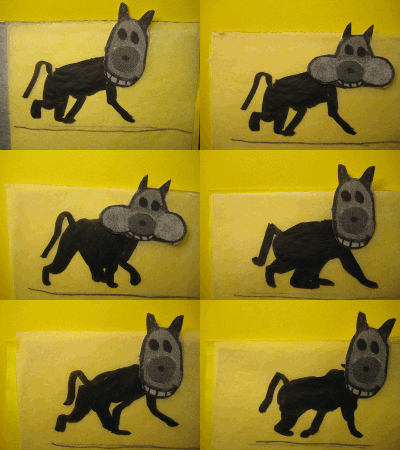
Mark But This Flea

Back in an early writing course at City College the professor, a young, dynamic guy with the torso of a stocky man and the lower body of a powerful goat, read John Donne’s famous poem The Flea.  His eyes glittered during his excellent reading of the flirtatious poem, as he no doubt took a survey of the new young women in his class.  He explained to his impressed students that he was originally an actor, had become a novelist and then a college professor.  He was an inspirational teacher and a great reader, and he brought the wooing words to memorable life as he began:

“Mark but this flea, and mark in this, how little that which thou deniest me is”

The line rings in my head today as I ponder how little the smallest things we deny each other actually are.  Invisible to the naked eye, these tiny, crucial things.

Letter to Walter (draft 2.2)

Dear Walter:

I’ve been reading your books since my mother recommended Devil in A Blue Dress to me a few decades back.  I admire the story-telling as much as the running themes of the power of imagination to change the world and the gentleness that is at the core of even your most hardened protagonists.  

Reading Twelve Steps to Political Revelation not long ago I was struck by the section calling for changes in how education needs to work to ensure a more creative, critically thinking, multi-lingual populace.  I agree that the generations coming up now are the last, best agents for the change needed to avert the looming disasters we face as a planet.  You gave a great example at the Moth recently, those two young gay strangers on Christopher Street retooling the ugly word “nigger” into a shorthand for their brotherhood.

Cheekums baboon

In the wake of Cheney and Bush I thought up my best bet for helping to bring about the kind of change we need to see.  I’ve started a not-for-profit student-run animation workshop, called wehearyou.net, to listen to young children’s concerns and help them show the creativity that is so often ignored in our testing-obsessed prison-prep factory schools.  

My hope is to have young kids produce works that will shame the more liberal of the Job Creator types (currently chafing at a theoretical 0.03% stock transaction tax) enough to fund what I envision as a grassroots movement to change the landscape of urban education, starting in the worst public schools I can find in NYC.  I worked in one in Harlem for several years, so I’m intimately familiar with the challenges kids in those schools are up against.

Cheekums1

I invite to you have a look at some of the kids’ work at wehearyou.net, along with my descriptions of the program   I hope the potential of this program, directed and produced by young kids working as teams of creative problem-solvers, lights up your imagination.   I would love to speak to you about the program.   You can send me an email or call me at (… ellipsis added…).   On my dream team of people of vision and action to work and brainstorm with, you’re very high on the list.  

Yours sincerely,
[name withheld at request of ‘author’]

The Darkness

Went to bed early, for me, after a day of exhaustion

This darkness, I thought at one point,

either the black

that proverbially comes just before dawn

or a tasteless prelude to the darkness that goes on

as dark now as 1,000 years from now.  

A fucker with a kennel of power tools

started barking under my window

a few hours later,  

put an end to that right away

Packet of Poems

A packet of poems arrives in the box

I read them throughout a wasted day

during which, at one point in my paralysis,

I wonder about medication  

medication I know to be a crock

based on false tests,

creating as much misery as it purports to cure

enriching powerful

multi-billion dollar snake oil operations.

In the poems a worldview  

Amazing, really, since the poet is a kid  

I find myself writing in the guy’s cadence  

what next, that MacArthur I’ve been banking on?

The Darkness Reaches for You

Last night an old friend described his waking horror, a stream of sinister associations in the blackness of early morning that woke him and continued on their own, torturing him in a way he could hardly explain, and really didn’t need to.  Started his day off with an unpleasant bang at 4:30 a.m.

Describing it to another friend earlier in the day had left him with the great pantomime, his friend’s miming of the terror, coming up to grab you with both claws, with that intent look on its face.   His friend reported it had been a long time since, but the thing had come up on him that way recently as he was trying to get some rest.

Call it what you like, the hideous hands reaching up to pull you down into its deadly embrace, lucky is the person who has not felt it.

Do What You Love, the Money Will Follow

Years ago I had a single blind date with a sighted woman who worked in publishing.  I’m pretty sure it was she who gave me an advance copy of a book called “Do What You Love– the Money Will Follow”.  I remember it had a white cover.   I told someone about it recently and commented that I still have it on my shelf, unread more than 20 years later.  I don’t see it anywhere as I scan the shelves now, but it’s possibly fallen into a crevice and been covered with fur along with my missing pocket book of jazz standards and innumerable other items.

I read a few pages and put it aside in disgust back then, like many things.  Like a middle class life, for example.  How that happened is worth a word:  I found I wasn’t cut out to compete for the love of wealthy people in the art world.  Displaying drawings and paintings in libraries, as my father suggested I try, was not the same as being a fantastically paid meteor in the art world firmament– I retreated into a kind of autism for a few months as I came to realize neither of these options was viable.

To my surprise, I found that I really enjoyed working with third graders.  I was hired as a teacher in a series of horrible situations.  Being a NYC public school teacher in poor neighborhoods was a bit like being a death camp guard in World War Two who loved Jewish and Gypsy humor.   I was as helpless as the children against the meat grinder that was at work on them, that was paying my salary and health insurance and giving me ten paid weeks off every summer. 

I worked full-time at four or five different NYC public schools.  Choosing which was the worst would be hard, and I’ve already used “meat grinder” and “death camp” and those pretty much cover the gamut.  I assume at least one of the principals I worked for was motivated by something other than lust for the virtually unlimited exercise of arbitrary will.  Assuming that, I can explain at least some of their distaste for their popular young male teacher as animated by a concern for the children.  

That was not the case with the last one, the principal whose clumsily sexualized tango proved deadly for any belated daydream I might have had for a middle class life.  Minnie Frego was probably insane, but was I any better?   In response to a series of escalating, mad provocations, as the new, mad principal zeroed in on me as the leader of the school I worked at for almost three years, I finally snapped.

“You’re not paying attention,” she told me tartly, as I tried to ignore the sickening demonstration of meat grinding she was conducting with my class for my benefit.  She had just crossed out the work of a bored child who was working on workbook problem number five when she was still working her methodical way through number three with the rest of the class.  She’d firmly told that child to fold his hands over his book and follow instructions.  I was trying to do the same at my desk, but it was burning me.  I was glancing at my required lesson plans when she called across the room to me.

“I’m doing this for your benefit,” she told me, as the eyes of every eight and nine year old Harlemite in the room turned to me.   It was like looking into the eyes of twenty-five smart young animals in the slaughterhouse chute.   I could not let them down, did not stop to think.  By way of response my arm swept everything off my desk on to the floor.  Then I folded my hands on my empty desk.

The rest, as they say, is history.

My Mother Reads

Driving back to New York from the outskirts of DC, where my once difficult aunt and still problematic uncle live in a well-kept, depressing home for unwanted old people, my dead mother is reading a story by Grace Paley.   The sun is fading behind the car like a world disappearing into the past as my mother reads the story like she’s one of the little girls, later women, arguing on that Bronx stoop.

“But Edie!” my mother pleads as Ruth, the perfect Bronx six year-old.   I used to buy my mother journals, try to get her to write, but she always complained that she couldn’t.  To hear her read a story, you’d never believe she couldn’t write one, she reads the stories exactly the way she would have told them.  Plus, toward the end she often spoke happily about how much she loved to lie.  She was pretty creative with some of those lies, too, and sneaky fast.

Eventually tears came to my eyes, driving as the daylight died, my dead mother’s voice coming through the car speaker, reading with such feeling, such understanding.   I used to urge her to write, she’d get defensive, then mad, but it wasn’t like I was writing.   I mean, I was writing, but I wasn’t out wrestling with other writers, proving my prose could kick their prose’s ass.  I wasn’t promoting myself, fighting the brutal fight to get recognized and paid, though my mother would once in a while read some pages I’d give her and smile and sometimes say “this is wonderful”.

“So your dead mother was a fan of your writing, how nice that must be for you,” says the guy standing on my head to get where I thought I was going.

The emotions I felt listening to my mother read, I’ll spare you.   How did I get the cassette?  It was found, by chance, in a box of tapes by my first cousin, my only cousin, really, as he was preparing to put the torch to his childhood home.  His older sister died young and I’ve tried to be more or less the brother he never had, he’s been the brother I grew up lacking.  We come from a very small family, most of the rest murdered en masse or dead of cancer.  Our two mutual grandparents, cancer.  His sister, cancer.  My mother and father and both of my mother’s parents, cancer.

“That’s impressive,” says the writer, eating my sandwich, drinking my single malt Scotch, dainty feet up on my hand tooled Corinthian leather divan.  He has all my stuff neatly arrayed in his condo.

But it’s not the cancer I’m thinking about, though on the same trip we visited a brilliant, patient, gentle man with a wise, slightly reptilian smile always at the ready, with stage four lung cancer, it turns out.  Explains a lot about how he looks.  He looked bad right after the radiation, but, even with his hair grown back, he looks bad now.  But he’s cheerful, taking every moment as a gift and planning on hanging around.  The new chemo is holding the tumors at bay, and he’s thankful for that, even with all the terrible side effects.

As I drove north, musing, I was unaware that a large library had fallen out of my pants pocket, onto the ground somewhere, probably at a Maryland gas station, with a tiny plink I didn’t notice.   My mother would not believe it, all the things that were on three tiny drives on a loop of black cord that together were no larger than a finger.  Maybe 2,000 pages, probably 1,000 tunes I’d recorded over the last few years, 200 short animations, maybe 500 drawings.   I have no idea what was on those flash drives, how to reconstruct them, back them up again.

Sekhnet was all solicitude, too much, really.  Her cousin reassured me that I could recreate the flash drives from my computer, probably.

It was almost like the gift of the found tape, recorded in 1986 when my mother was Sekhnet’s age, was cancelled out by the lost back up copies of my life’s work.   Why I was carrying my life’s work around in my pants pocket is a bitter little puzzle, at the moment.  As for the tape my mother recorded and sent to my aunt, another mystery.  

My mother once offered me $2,000, then quickly $3,000, to reschedule my court appearances and come to Florida for the week my aunt and uncle would be there visiting her, not long after my father died.

“You can’t leave me alone with them,” she pleaded, “I’ll jump out of my skin, just the thought of it.  If you love me, you’ll take the money and come down here when they come.  Please, Elie, there’ll be bloodshed.   Six days!   I’ll pay you!”  There was nothing phony about her desperation.  

The funny thing is, twenty years earlier she’d sent the tape of her reading Grace Paley stories (probably from the book of them I’d given her) to her only sister-in-law, the same woman she probably would have paid 5 Gs to be protected from.   By the way, I earned every penny of that $2,000.

“Your parents both look good,” I told my cousin at breakfast that last morning.   

“Way to kick me in the nuts!” he said, alarmed, echoing my mother’s tone as she bribed me to protect her from them.  “Why don’t you just take this fork and stab me in my right testicle?” he said, offering me the fork.

My uncle is 86, and except for the fact that he’s in a wheelchair after a stroke a year and a half ago, he looks like he could live another ten or fifteen years.  My aunt, a few years younger, also looks good.  Whatever serious health worries she’s had seem well in the past.  She’s steady on her feet, eats with a good appetite, the mild dementia agrees with her.

“I’d trade both of them for your parents, in a heartbeat,” my cousin said.  I nodded and chewed my breakfast, and thought of that ledger on which all our deeds are tallied.

Creativity

Warning: this is a mild bummer, forced up like a synthetic hairball; it contains little of the spontaneity it seeks to evoke

The pursuit of creativity (he begins pedantically) might sound like a frivolous add-on for somebody who already has enough and might want to enrich some downtime.  I could be drinking my own Kool-aid, but to me creativity is essential to just about everything.  Creativity is the life force, what makes our lives here possible in the first place, and as rich as they can be, no matter how otherwise poor, after that.

Why bother to invent a new way to say things when the old ones are tried and true, fine and dandy?  Because we need to, cleverness is a net gain, like a laugh, the difference between a grim march and a healthy hike.  Why do we laugh?  If I have to ‘splain it, Lucy, it won’t be funny.  We laugh because we hear something comically unexpected, or see something that surprises us and makes us lose it.  If the moment hadn’t been spun that way, by someone creating it just right, we’d still be yawning.

Creativity is a moment of grace that refreshes and restores the creator and the beneficiary of the creation, the aerialist spinning amazingly from one trapeze to another rather than plummeting to splat like a pumpkin as the crowd shudders.

Creativity is a moment of faith, taking a chance to do something new with belief in success.  It’s done with a freedom we might not otherwise see in our day.  

Lack of creativity makes us wince, someone trying to be original by imitating something many others have already done trying to be original.  Or when the attempt misfires like, for example, a mildly embarrassing moment from yesterday’s nice chat with an old friend.  This guy is very funny, and it struck me, toward the end of a serious talk, that we hadn’t had a single laugh, which is rare for a conversation with him.  The subjects we talked about had been serious, we were both concentrating hard.  My mind was sluggish trying to shift gears as I was reminded by something he said of a certain joke.  I asked him if he’d heard the one about…. and I dick-fingeredly handled the joke by the punchline to jog his memory.

“No,” he said with a smile.  I could hear over the phone that the same smile was there a few moments later, along with a slightly surreal laugh, as he acted like the punchline I’d already told him had been a surprise.  He created a little reaction to distract us both from the embarrassment of my moment of anti-creativity.

But how about the person somewhere down south who first described someone’s clumsy attempt to do something as being “dick-fingered”?

Supremely creative.  If you think about it, even for a hot little moment, you will realize I am right to extoll its importance.  Now go forth, be fruitful and multiply yourself, and have a nice day.

Better This Than That

I know people who meditate daily.  They recommend it even as they acknowledge it doesn’t seem to help much with the thousand tiny horrors that gnaw at them on the average day.  Others, to my surprise, use religious rituals the same way.  Same results.  There are no two ways about it– this world is a challenge.

I sit here tapping out a few words, the fewer the better.  The effect is about the same as meditation or a religious ritual, I would think.  I focus on writing clearly.  The world is work enough without writers flexing, flourishing their pens and making the point a little harder to grasp.

So, to be clear– these few moments of clarity are often the better part of my day, like meditation for others.  I sit and the keys clatter.  I watch the words on the screen, change a few, go back, read it from the beginning, make a change here to make it more clear, there to make it less clunky.

Unfortunately, I can’t do this all day.  It’s time to get back to the biting tics.