I’ve Waited Long

I am typing in the room where my mother’s ashes sit in a box in a beautiful paper bag.   The elegant bag is in the corner, out of my view, and I haven’t looked at it in a long time, but it is a distinctive bag.   The bag is brown paper on the outside, a pure slate gray on the inside.   My mother would like the bag.   She has no worries now, nor any wishes, either.  I decided years ago that I’d scatter her ashes in the Long Island Sound at the public beach at Wading River, but we haven’t done it so far, in eight and a half years.   I haven’t been to that beach in more than fifty years, who knows if you can even get on the beach now without a resident pass?   When I was there last there were swings, seesaws and a sliding pond on the sand, and a small parking lot with maybe eight spots painted on the once black shore road.

The idea of scattering my mother’s ashes in the water at Wading River was a sentimental one.  I  think of those months in that rented green and white bungalow a hundred yards from the lapping water as the happiest summers of her life, but who knows?   She always said she wanted to live near the water, and for a couple of summers we did.   I don’t know if she was happy there or not, hearing the waves breaking at night.  What I do know is that at the moment she truly doesn’t care.   Her concern at the end was about not being eaten by worms and bugs, the thought terrified her.  I assured her it would never happen and it will never happen.  

The scattering of her ashes is more a poetic matter, really.   Every so often it gives me a pang, that I haven’t managed to scatter her ashes into the gently lapping Long Island Sound,  that her ashes are sitting there in that elegant paper bag.  On the other hand, I am positive she doesn’t mind, even if she would chide me about my long failure to do it, if she were somehow able to.

That I can sit here, a few feet from her ashes, writing thoughtfully about it in words almost nobody will ever see, is a blessing and my form of daily meditation.   Thinking these thoughts, molding them into sections that I then comb carefully for readability, focuses my spirit, clarifies my beliefs, sharpens my sense of purpose.   That I have little clue about the only thing the world understands — attaining financial success — does not distract me while I work.  The hard work of vainly striving is not a remote consideration while I concentrate on making my words express my thoughts, my heart, as clearly as I can.

                                                                           ii 

I had a call just now from a one-time good friend of my mother’s, a woman a year older than my mother.   My mother would have been ninety last May, this woman was ninety-one last month, and still going strong.  God bless her, as we say.  Her mind is sharp, her language is crisp, she is upright and walking and driving great distances– still a force at ninety-one.   In the course of narrating a lot of horrors she asked me to keep to myself, while assuring me that she is up to the challenges, taking them one day at a time, she mentioned something that gave her a glimmer of hope in these dark times.

She attended an interfaith vigil the other day, the great throng of several faiths who had gathered was inspiring to her.   The hall was very crowded, with a big crowd outside also.   Somebody came through the mass of people outside and ushered her inside to a seat she didn’t want.  “I can stand, I’m perfectly fine,” she insisted, “give the seat to someone who needs it.”   In the end, she took the seat, though she felt bad about it.   Her ninety-two year-old friend, who had declined the seat in another part of the crowded hall, regretted it afterwards as her lower back tightened up painfully after standing on the concrete floor for a couple of hours.   Better to be seated than aching, I say more and more often now.

Small mercies take on a bigger and bigger significance as life goes on.   We see few enough of them in the world now, as so many nations stand on the brink of merciless horrors many of us believed were a barbaric relic of a bygone, insane age.  I’m talking about a small mercy like finding a vacant bench at the point of a walk when your arthritic knees are barking.   The relief you feel, taking the weight off your troubled bones, a gift you give yourself, provided by a merciful side of the universe and gratefully accepted.

There was a lot on this woman’s mind, and much of it I agreed not to share with anyone, so there’s that.   At one point, God bless her, she couldn’t resist giving me just a little shit about not calling her lately, after I’d spent hours on the phone last month advising her about some very vexing things– and sent her several more pages about my father’s life that she was too vexed to really take in.   

                                                                  iii

After the Saudis murdered a journalist in their consulate in Turkey last month there was a period of several weeks during which the vicious, smiling thirty-four year-old Crown Prince had his advisors and marketing folks make up and spin multiple lies about what happened to the disappeared critic of the regime.  Our president, also born to great wealth that made him feel truly exceptional since childhood, stalled along with the Crown fucking Prince of Saudi Arabia, a fundamentalist Islamic monarchy.   “We have to wait until  the Saudis finish investigating whether they murdered this vicious, lying journalist, which they strongly deny, look, they strongly deny it, like Justice Kavanaugh denied all those lies against him  — whatever happened to the presumption of innocence that liberals used to talk about?  Here they go, rushing to call MBS a murderer, which we don’t know, we may never know, certainly not until he’s done investigating whether he is or not, look, this kid is a gem, a great, great future king– no presumption of innocence for him?   Typical of the lying haters and hypocrites, funders and defenders of the raping, leprosy and smallpox infected terrorist hoards advancing on us …”

All we have, any of us, is the impression we leave behind on those who knew us. We are whispers, after our death, not even ghosts.   The example of how we lived is the only thing we leave to the world of people who knew us.   The power we may have wielded over others is nothing, it is how we used that power that is remembered, that lessons for the living can be drawn from.

I had an old friend who lives the frenetic, embattled life of a successful suburban citizen.   His many stresses and frustrations have few, if any, safe outlets.  It appears that I became his best option for relief.   More and more, particularly since I’ve devoted myself, from before my mother’s death, to restraining my angry reactions as much as I can, he took to provoking me.    I pointed this out to him each time he did it, but he always argued that he was not provoking me, that I just get mad unfairly, that maybe I was the one with the provocation problem, not him.    I had more than one opportunity to throw him on the ground and kick him, but I breathed and fought my way to remaining as peaceful as I could.   This restraint apparently goaded him to ever greater provocations.

In the end, he provoked me into detailing the many things I don’t respect about him.  I don’t know if I mentioned his lack of basic courage, which I think is probably encompassed in the unfortunate phrase I do recall using “moral retard”.   In the wake of this his wife called me, basically offering me an ultimatum.   You have to forgive him, she told me, because he loves you, we all love you.  

I explained why it’s impossible to forgive someone who takes no responsibility for hurtful things they repeatedly do.   Futile, really, since those hurtful things continue on and on into the future if they are not acknowledged and corrected.   The only option, to pretend everything is fine because people tell you that they love you, is not one I’m willing to take, even for the high moral cause of professed love.

Besides, I told her, love is the way you treat people, what you reflexively do when you see a loved one in pain.   Love is action, not a word.  I told her to let her husband know that I’ll be happy to hear from him once he gets some insight in the therapy he assures me he is working hard at.  “That’s not going to happen,” his wife told me, and it had the ring of truth.   He would rather lose his oldest friend than admit that the annoyingly superior fuck might have been even partially right.  Zero sum, baby, he can’t help himself.  If you don’t win, you lose.  What could be worse than that?  Ask the president.

It began to bug me more and more that because I’d taken a principled stance in regard to an old friendship I’d lost the longtime friendship of his wife and his two sons, as well as the friendship of a close mutual friend, apparently enraged at how badly I’ve hurt his troubled old friend.   I called the guy on Halloween (spooky, I know), to ask him three questions that had formed in my head.   I left a voicemail.   I heard nothing back from him, though I’d spontaneously left him the option of doing nothing, saying I’d email him the questions if I didn’t hear back.

A few hours later I rethought my offer.  What was the point of sending questions to someone who could not even reply to a voicemail?  It would only increase my aggravation if I never heard back, give him an easy, an effortless, final provocation.  I called again, left a second message, asking him to text, email or call me if he was willing to help me by answering three questions.  

Two days later, having heard nothing, I texted him, asking if he was out of town or too weak and unJewish to respond.   “Weak and unJewish”, an admittedly provocative formulation (especially to a Jew who fervently prays every morning), but, in context, restrained, I thought, particularly after two days of silence by way of reply.

I soon got the texts one would expect, explaining how he’d heard the first message and thought he’d be getting an email, and then no email came, and then, belatedly, he saw the other voicemail from me but didn’t actually hear it until after my recent text a few hours earlier and so on and so forth and so, you see, there was a rationale to all the delay, a hazard of digital communication (which is what I’d called to avoid in the first place) and, yes, please send him the three questions.

I sent this:

It depresses me that people I was friendly with and had no quarrel with, your wife, your sons, R___, have all vanished from my life as a result of our falling out.  Not to mention you.   I understand your wife and kids have to take your side, whatever it is, but still.   And you can’t even pick up the phone and return a missed call? (rhetorical question)

What was my final, unforgivable act against you?

What did you tell R____ that made him cut off communication with me?   When he left the US we were seemingly the best of friends, he was apologizing that we’d only managed to squeeze in one quick visit when he first arrived.  Then, as a prelude to complete radio silence,  I got a reference to “other developments over the last year or so” that presumably magnified the differences between us beyond the point of possible friendship.

Did you talk to your rabbi in the days before Yom Kippur and, if so, what did he tell you?    I don’t think it’s possible that a rabbi would advise someone to make no further attempt at reconciliation with his oldest friend during the Ten Days of Repentance.   I conclude you didn’t discuss it with your spiritual adviser.   I think you should consider this seven minute discussion on apology, forgiveness and atonement: 

https://www.wnycstudios.org/story/metoo-men-repent

I heard back quickly by email.  He’d received my questions, but I’d have to give him a few days to answer them.

I took a breath and typed back: OK.
Provoking vs. Disrespecting: anatomy of a fatal falling out

I will use a personal story to flesh out a mechanism that commonly leads to violence and sometimes death.  It is a mechanism that is particularly ubiquitous in this black and white zero-sum society we are living in at the moment.  It is the reduction of a complicated story to a simple, primary concept, like betrayal, or loyalty.   One party wins all, the other loses all, or it’s mutual destruction — fine, everybody loses and everybody wins, sort of.

In this particular personal anecdote no punches, kicks or bullets were exchanged, though both sides wound up feeling hurt and completely justified in their final anger at the other.  Every person who knows my once good friend, including two who claimed recently to love me, has cut me dead, which is as bad as the underlying impasse with a guy I’ve known since fourth grade.   In some ways it’s worse, more painful, this tribal closing of ranks after an ultimatum to forgive without condition or forever be seen as the vicious loveless party persecuting a weaker man. 

This is an aggravating story Sekhnet, who tries her best to take care of me, urges me to somehow put out of my mind every time I mention anything connected to it.   I don’t know how that’s done, until I am done working through it to my satisfaction.   A gnawing, vexing story untold is just a fucking tumor in waiting, as far as I can see. There is nothing I can do about a lying sociopath president or a lockstep political party who seems to have, with alarming speed, acquired a taste for the inside of their new leader’s ass, but this situation with an old friend I can wrestle with directly.  I believe it also sheds light on our larger problem as a culture, which comes largely from partisan oversimplification and a mass failure of empathy.

The common response to a fight is to take sides, be loyal to your people.  They call this tribalism now, reminding all of us homo sapiens that when it comes to war, we jump with those closest to us.  Loyalty has been elevated to the highest value, they used to call this kind of reflexive patriotism “my country– right or wrong” — you defend whatever America does because you’re American.   Somewhere far down the list of civic virtues, after loyalty, are being analytical, and fair-minded, and trying to find the causes of friction and the best solutions for difficult problems, including interpersonal troubles like I had with an old friend recently.

My mother always expressed frustration, even anger, at her daughters’ children’s seeming ingratitude.   My sister (my mother’s daughter) always expressed frustration, even anger, that her mother could not just give with grandmotherly generosity without demanding a “thank you”.    I always thought that a skilled mediator could convince my sister to teach her kids to say “thank you, grandma” when grandma gave them something.   This simple act would have gone a long way toward reducing tensions, but they were both too angry, and too stubbornly committed to being right, to ever go to a mediator.   Each one dismissed the idea of mediation as something the other would never agree to do.

Sekhnet reminds me of all the other things I should be worrying about, instead of this intransigent former friend who is too hurt and angry to make peace.   I have worry enough to cover these other things, and have made appointments, or at least calls, about all but one of them. [1]   Seems funny, in light of these other immediate worries, that I’m returning over and over to the sad and now sickening falling out with a friend of more than fifty years, but here we go.   On the other hand, this is the only vexation I have any chance of getting closer to solving today.

Much violence among armed teenagers is over the issue of perceived disrespect.  “He dissed me,” more than one violent young man will say in complete justification of why the person he shot needed to get shot.   Disrespect is a fundamental blow that we are taught not to tolerate.   For purposes of my friend’s case against me, I explicitly told him I don’t respect him and I gave several specific reasons why I don’t.   It would seem to be case closed for our friendship.  

I disrespected my friend, first by my actions and then by explicit words, and that’s all she wrote.  If you don’t respect someone it’s impossible to be friends with them.   End of story.   There is no coming back from this.   It’s as bad as lack of trust, lack of mutuality, lack of empathy, lack of affection.   There is nothing else to tell, many would say, closing the case, though I will tell the rest, as is my way.  The details may be useful in seeing how this sort of irrefutable tribal conclusion is often reached.   

What I was seeking from my friend, by the way, was that when he saw me getting aggravated as he pressed ahead in some conversation — the reddening of my face, the clenching of my arms and hands, the gritted teeth, the labored breathing, the other universal signs of approaching anger, plus my words to that effect — that he could take his foot off the accelerator, apply the brakes a little and change direction.   He was increasingly unable to do this in recent years, as his own life got more and more stressful.

During our last discussion my friend told me, three separate times in the course of about twenty minutes, that he felt disrespected by me.  He felt this because I had been ninety minutes late to meet him for an important discussion to try to save our failing friendship.  He told me at once, and slightly sheepishly, that he knew the feeling was irrational, since we’d been loose about the time, and he’d declined to accompany me on the errands that took longer than planned so that we could meet at the original time.  This talk was important to him and he’d saved the entire day for it, from two pm on.  

He told me we could meet at any point, true, but still, I didn’t show up until almost 3:30 and ninety minutes is past the border line for disrespect.  It was even worse when you start the clock at 1 pm, which was my initial suggestion, making me a full one hundred and fifty minutes late.   It was true, he said, that I’d called as soon as I knew I was going to be late, spoke to him from the middle of a traffic jam on the Grand Central, and that each time I called he’d reassured me that he wasn’t, for once, under any particular time pressure. He’d told me not to worry, in fact.   All this was true, he said, and so it might seem irrational to me that he felt disrespected, but there it was.  Ninety minutes.  It’s hard to ignore ninety minutes.

The second time he told me how disrespectful I’d been to him, about ten minutes later, he was in the middle of denying that he had provoked me again recently, intentionally or unintentionally.  He told me that he’d only apologized to me in the most egregious previous instance because I seemed so peeved.   He had actually been in the right, he told me, to insist in the face of my rising aggravation, on the annoying thing he’d been insisting on me hearing, for a second time in a week, as it turned out.   In fact, he added, he’d do the same thing again, if it came to it.  

I was just wrong, he said, to see what he’d done as provocation.  He is not provocative, he is actually a lifelong peacemaker by nature, and besides, I was the one who’d behaved disrespectfully toward him and was now not accepting his most recent apology.  Ninety minutes, he reminded me, more than enough time for my disrespect, intended or not, to sink deep inside of him.

This line of counter-attack is familiar from my childhood.  My father liked to reframe everything away from whatever I was concerned about to a discussion of my terrible temper, how angry I always was.  When I was young, this used to piss me off pretty quickly, the abrupt pivot from what I needed to talk about with my father to the general subject of my crazy anger.  Once I got mad, I lost any chance to talk about anything.  “You see,” he’d say with a smug smile, “this is exactly what I’m talking about.  The People rest, you’re irrationally angry again.  You really have a fucking problem with your violent fucking temper.”    

My father did me a favor, in a roundabout way, since by the time I was a middle aged man this kryptonite became a weaker and weaker weapon against me.   It took years of work, but years well-spent, in my opinion.

My disrespected friend, on the other hand, had been actively taught never to show anger.   Anger is a threatening emotion, particularly to someone raised never to express it by word or conscious deed.  “I was taught to swallow it,” his mother told me recently, “avoiding conflict at all costs is how I was raised.   My mother used to tell me to use any means necessary, including creatively altering any details of what happened that could possibly make anyone mad.  The only supremely important thing, according to my mother, was avoiding confrontation.”  

I experienced a few untruths from this now very old woman over the more than fifty years I’ve known her, but I never held that personality quirk against her.  She’s a lovely woman, outside of that.   I spent hours on the phone with her last month advising her about a very aggravating and frightening situation I must keep secret.   That’s the other piece about her approach to anger, fear, shame — really emotionally explosive things must always be kept secret.

The son is like her in some fundamental ways.   His occasional bending of the truth was something I just accepted as a regrettable feature.   I always felt I could trust him about the big things, in spite of his tendency to be less than truthful at times about small things.   Funny that this equivocation was never a terrible issue in my friendship with him, I guess because our affection went back to childhood and since I always felt I could trust him in the larger sense, I never worried when he did that dance he sometimes does to try to make sure everybody is happy.   I suppose I never questioned his motivations when he was being less than honest, it was for the sake of avoiding what he saw as an inevitable confrontation, I could always see that.  

Now here we were in a real confrontation, and his dance was not at all endearing nor did it give me any reason for optimism.   He simply could not admit, beyond saying the words “I’m sorry”, that he’d been wrong to blame me, based on a casual remark made to his wife in passing, for willfully, or recklessly trying to destroy his long-troubled marriage.   I was his oldest friend, and I tried my best to help him get the full context to that particular, unfortunately weaponized remark.  

I was not at all angry at the pointed accusation, odd to say.  I was on the spot, I was concerned, there was a slight tightness in my gut, I felt under pressure, but I wasn’t angry.  Seeing him in such distress I did what I could to try to help him.  It took an hour or more to get things to a reasonable place that he could offer to his wife and their therapist in explanation of his oldest, closest friend’s alleged treachery.

When I was finally done with that he asked me if I harbored anger at him, conscious or unconscious, and told me I’d never once in our long relationship ever admitted I was wrong, had never apologized to him about anything.   These are faults I work on not having, when I become aware I’ve hurt a friend I do my best to make amends as soon as I can.  He brought up a thoughtless thing I’d apparently done to him years ago and I told him I was wrong and apologized, for what it was worth.

As soon as I was done telling him how sorry I was he accused me, based on something “someone in his family” had disclosed to him, of insultingly treating him like a helpless child.   The vexing information he complained of being spilled by a family member (there are only three possible candidates) was something I later realized that I myself had told him months earlier.   It was quite an emotional trifecta in his car that afternoon.  It took a few days before it began to strike me as an unfriendly, and unfair, assault on my character and my friendship.   My friend kept telling me how impossible his life was, worse than ever, the pressure on him was unbearable.  I told him we needed to talk face to face, that things between us were very bad.

Now I was in a suddenly aggravating conversation, doing what I could to try to save a friendship that was hanging by a thin, fraying thread.   The conversation was hard work, because he’s very smart and quite capable of putting up a strenuous emotional and intellectual fight.   His position was that he’d apologized to me already, about everything, including that “thing in the car”, and that it appeared to him that I was unforgiving, unreasonably demanding more than an apology.   “I apologized to you already, but my apology apparently wasn’t enough for you,” was his opening line to this conversation we needed to have to better respect each other’s feelings if our friendship was going to survive.  

In his defense, I’m pretty sure he honestly does not see himself as capable of expressing vehement hostility.   That, he likely believes, is my area of expertise.  I am the one who expresses anger, after all.    All of his efforts in interpersonal relations are intended to keep the peace, make peace, be a mediator between angry people.  In the short term, his efforts sometimes work, two angry people kiss and make up.   Long term, his record is not as good — as nobody’s can be when “peace” is based on persuading everyone to let bygones be bygones and a polite agreement that everybody loves each other.  That’s not how love, or anger, actually works.  In any event, the impasse between him and me is a special case and he really couldn’t be expected to make peace with someone as angry and unforgiving as I apparently am.   Plus, of course, the disrespect, how do you get past that?

In the end, the third time he brought up the disrespect, about five minutes after the second time, I finally lost it.  Outside of provoking me, I have no other theory for why he kept mentioning this perceived feeling of being disrespected.  I snapped.  I told him he was right to feel disrespected, that I don’t respect him, not the way he treats people, not many of the choices he’s made in his life, not his inability to empathize, to be honest about his feelings, to have any insight into his anger, to make a meaningful apology.   If you apologize for hurting somebody, I said, and you continue to do the same hurtful thing over and over, your apology is a shit apology.   A lie.   A meaningless fucking lie, dude.    

It may be worth mentioning here that we spoke for another four or five hours after that.   We talked quietly, but in circles, each trying our best to somehow rescue our deeply wounded friendship.   Oddly enough, he seemed to calm down and fight much less after making me explode at him.

 My childhood friend now spends a lot of time studying the ancient wisdom of Judaism with an orthodox rabbi, though he chose not to contact me during the Ten Days of Repentance, a time when Jews are supposed to make amends with people they know they’ve hurt.   Feeling the aggrieved party (victimhood is one of the most frequently and potently weaponized feelings in Trump’s America) I am sure he contented himself praying for his soul and the souls of his loved ones.   I thought about this falling out, blamed entirely on me for my inability not to be provoked by what I falsely claim is provocation, extensively during those ten days and beyond.  

I heard a rabbi talking about apology, atonement and forgiveness.   A fascinating seven minute segment on On The Media (click here for the excellent conversation) .  The rabbis apparently require someone seeking forgiveness to apologize at least three times before they can give up with the human and atone before God.   Element number one of an apology is empathy– I know you’re hurt, if someone had done to me what I did to you I’d be hurt too, just like you are, I’m sorry I hurt you, I’ll try my best not to ever do it again.   Remove empathy and you have only the empty form of an apology:  I see you’re hurt and waiting for an apology, so I’m sorry, can we just move on now?

Can we just move on, you merciless fucking irrationally hurt self-righteously enraged prick?

Think about any member of his family who might want to keep in touch with me– impossible.   There is a huge cost to taking sides against your own family, going against the current of your tribe’s strong feelings, even in a small way.  This conflict in the soul when a person opposes the will of the tribe has been the stuff of drama forever.  First, it is seen by those who trust you as disloyal.   Second, if you are critical of the accepted tribal story your head can be next on the chopping block, you see how upset everyone is.   Best to say nothing.  

I have a friend fond of quoting his grandfather’s aphorisms, gleaned from the teachings of the rabbis.  One of our favorites is “yaffa shteeka leh cha-chameem”   beautiful is silence to the wise.   Dig it.

 That said, the only hope we humans have, if we truly seek to change things for the better, is looking as deeply and dispassionately as we can into things that are sometimes, frankly, terrifying.  It is easy to resolve conflict in your own mind by reducing something to a simple scenario.   Few scenarios are actually as simple as we easily convince ourselves they are.


[1]  I have a CAT scan of my kidneys, bladder and ureters early next week, then a camera on a long stick up the penis into the urethra to look for the source of a large blood clot, gross hematuria, some emergency dental work I need to set up and a bit of fancy footwork to do playing the insurance odds, by the December 15 deadline to buy health insurance for 2019, trying to learn before then if I’ll need another $88,000 infusion of chemotherapy for my eventually life ending kidney disease.  

Storytelling 101 — part six

Stories, we humans need them for many reasons.   They make us feel better about contradictions that are otherwise impossible to reconcile.   They bolster our ideals, confirm our worst doubts, or clinch the deal on the things we already know.  They cause us to walk forward, united with brothers and sisters, millions of them, not alone in a terrifyingly cold universe.   We do not live random, meaningless lives that end in inevitable death, we are part of a larger story, connected to our ancestors, our living loved ones, our lives nurturing the lives of those who come after us.  There is great comfort in a good story.

It was a bit of a shock to hear the story today, three weeks after the murder of Saudi journalist Jamal Khashoggi, told by the dictatorial leader of Turkey, speaking to his parliament and the world beyond.   Erdogan announced unequivocally that the journalist had been the victim of premeditated murder in the Saudi consulate in Istanbul.   He asked pointedly where the body of the murdered man is.    

Our president has been very coy about this whole affair involving our cherished Saudi allies, telling Americans that we have to wait for the Saudi investigation into the alleged murder to be complete, so that we have all the facts.    Meanwhile, he dispatched the U.S. Secretary of State, and more recently the Secretary of the Treasury, to Riyadh and CIA Director Gina Haspel to Istanbul.    

It may be an odd thing, to some of us, that the president was waiting for the alleged murderer to finish investigating whether they had committed a murder, but in the rush of ongoing chaotic events, there hasn’t been much time for most people to even consider this troubling story.   Besides, POTUS reminded us, the sacred democratic presumption of innocence was once again being discarded by people rushing to find someone they don’t like guilty until proven innocent.   Very unfair!   It’s not like the Saudi royal family is in any way comparable to the hoards of Mexican rapists surging toward our own borders.  

The president compared this lynch mob mentality of those who feel the Saudis should be accountable for their crimes (including, of course, massive war crimes against the poorest nation in the Middle East) to the people who insisted there should be a full investigation into the multiple terrible allegations against innocent choir boy Brett Kavanaugh, or at least into the most credibly detailed of them.  A mob, a violent angry mob, motivated by tribal bloodlust, satisfied with nothing but the fatal lynching of a good man, a good tribal monarchy, presumed guilty until proven innocent, in the president’s telling.

The president was not wrong to make the connection between the aftermaths of the murder of Khashoggi and the allegations against Kavanaugh.   There were credible stories in both cases to check out and investigations to be concluded.  In Kavanaugh’s case a quick investigation proved he was innocent, at least to the satisfaction of these who mattered in the 51-49 vote.   In the murder of Khashoggi, after a few weeks of thorough investigation, the Saudi story was that the chubby sixty year-old journalist and critic of the thirty-three year old Crown Prince got pugnacious and decided to take on the fifteen armed men who were tasked with merely ‘interrogating’ him.   He resisted, starting a fist fight, and was, unfortunately, well, he died during the altercation.  

Subtle, but valuable, that passive voice.   In law school we were actually instructed about the only proper situation for a lawyer to use the passive voice.   If your client’s knife, in your client’s hand, was plunged into the heart of the now dead man, you can’t deny it, exactly, but you can soften it with the passive voice.   The knife, admittedly belonging to my client, was plunged into the heart of the victim.   Sounds so much better than the active voice since it highlights not the act itself, but facts that are not in dispute, facts that appear to damn your client.   So in the belated Saudi spin on Khashoggi’s last moments alive, it’s not that he was killed, so much, as that he, unfortunately, died.  Why wait more than two weeks to admit that the journalist was dead?   We had to investigate everything very, very thoroughly.  Where is the body?   No fucking idea.

Stories rule, in every situation we can think of.  Whose story do we believe?  Which story makes more sense?   Which story moves us more?   I was practicing my writing with a new nib last night and decided to copy Lincoln’s famous 272 word Gettysburg Address.    The poor Irish immigrants who were drafted into the slaughter to reluctantly fight for the Union — and die gruesome deaths, by the thousands–  were transformed in Lincoln’s immortal rhetoric into ‘honored dead’ devoted to that cause ‘to which they gave the last full measure of their devotion’. That their sacrifice not be in vain, Lincoln said in his marvelous short speech, should be our work going forward as we pursue Liberty in the nation dedicated to the proposition that all men are created equal.  

He gave that moving speech, appealing to the better angels of our nature [1], almost 155 years ago (it’ll be 155 years exactly on November 19th).   We have come very far since then in becoming a land honestly and tirelessly devoted to true liberty and equality for all.   Or we have come a few halting steps, and taken many more steps backwards.   Which is the more inspiring story?   Not much of a contest, I’d say.

It is, of course, like this in personal life too.  A man who has a long history of lying, stealing and committing fraud, a man who made death threats against his own wife and children in a moment of rage– well, your view of him will depend on which story you believe, based on your relationship to him.   He has a warm, loving side too, is a supremely sensitive reader of the moods and needs of everyone around him, he has a good heart.   He is a loving father, the death threats were a one time thing, he was very desperate!   The story becomes tricky only if you try to reconcile the two indisputable yet jarringly contradictory sides of this fellow.   For his part, the man will never admit he did anything wrong.   Either you have love in your heart or you’re a vicious asshole, is his position.    

The facts, we often think, matter.  This turns out to be a quaint belief.  The story is the only thing that matters.   Was Lincoln lying about the heroic dead who so nobly gave their lives that we might have a more just nation?   He was telling the story that needed to be told so that we did not conclude the massive number of American dead and dismembered had been merely a sickening instance of the intransigent, inhuman greed of a powerful few unleashing a river of American blood to protect their right to have complete control of their way of making a living, a way that makes most of us shudder today.

Likewise, if you put your friend in an unfair, untenable, even vicious situation, forcing him to convince you that he did not deliberately, or thoughtlessly, jeopardize your most sacred relationship, there is a way to put it that sounds infinitely better than that.  “That thing in the car” you can call it, if you confronted him in a car.  Now then, it was referred to directly.  It was a thing, like many other things.   Then you fucking overreacted and blew it up into this huge justification of why you can never fucking forgive me, you judgmental fucking piece of shit!   You’re dead!   You’re fucking dead!!!

As always, it’s all in how the story is told, my friends.


[1]  “We are not enemies, but friends. We must not be enemies. Though passion may have strained, it must not break our bonds of affection. The mystic chords of memory will swell when again touched, as surely they will be, by the better angels of our nature.”    source

Worth knowing by heart

20181018_033359.jpg

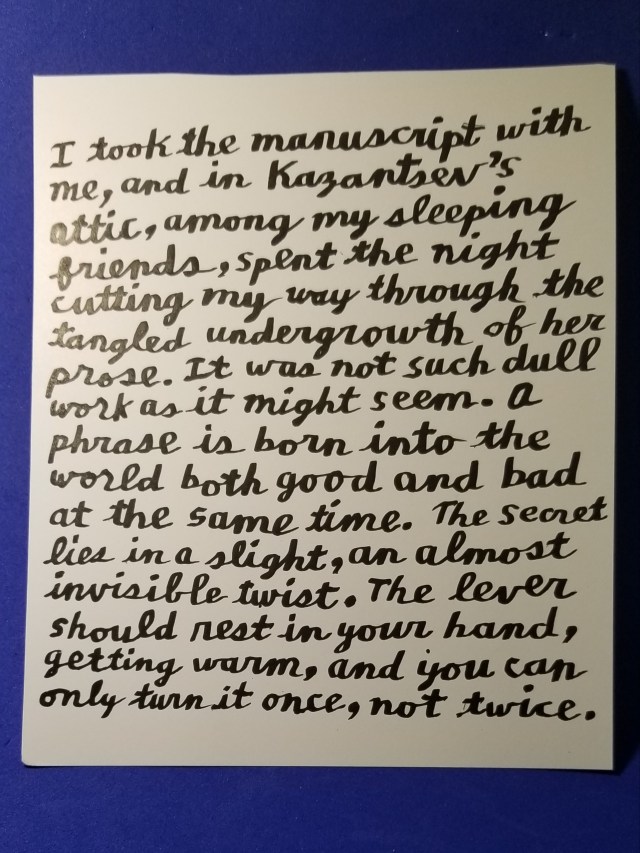
This is from Isaac Babel’s  immortal short story Guy de Mauppassant, perhaps the greatest story ever written about the love of reading and writing.  

These line below were set forth by a less skilled craftsman, but they are good enough.  They worked.  They’ve been rattling through my head a lot since I heard them recently.  I need to set them down to study them a bit.

20181017_171200 (1).jpg

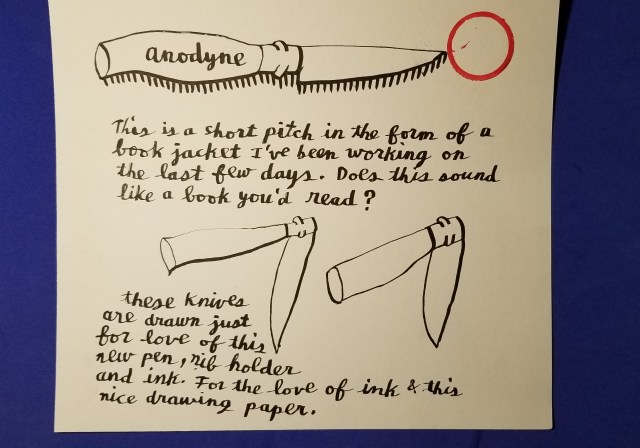
I know, I know.   A dead horse, a dead horse, stop whipping!   I jotted these lines down the other day.  I will explain.   I am using a pen and ink a lot lately, because I suffer from graphomania, an idiopathic, little understood and apparently incurable condition.  [1]   I need to make marks on paper sometimes, it can become urgent.   It’s good to have a few words handy to practice, otherwise the words are completely random and the pages look a little batty.  

So these words were handy, since I noted them the other day, and I used them to practice my handwriting and try to master the new pen I need to dip into ink in order satisfy my graphomania.  My graphomania has gotten worse over the years.  I become quite desperate if I ever find myself without a good writing implement   and some nice paper [2].   So, anyway, because I like to have a passage handy to write, unfortunately, I seem to have chosen this one.  

While we’re here, let’s examine the banal and unconvincing nature of each element of this half-assed non-defense.   These lines were passionately delivered in opening remarks by someone defending himself against charges that he is an angry partisan, an evasive lawyerly crafter of arguably non-perjurious but deliberately misleading answers given under oath [3], and also, of course, to drive home a strong, full-throated, sometimes tearful blanket denial of every detail of every allegation mercilessly made by those tools of the Clintons and George Soros — never drunk, never disrespectful, never out of control, never  did anything bad, ever!

Let us take them line by line:

20181017_184915.jpg

This is standard for any political conspiracy theory — an elite of smart, powerful people making devious calculations to advance their goals and then skillfully orchestrating the actions of a group of disparate conspirators in what amounts to a mob style rub-out, an assassination.    I give him points for the two words used like that, calculated and orchestrated, they underscore how much thought and planning go into this kind of partisan torture and execution of an innocent opponent.

20181017_184958.jpg

The first of these assertions blames the pitiful losers for being so doggoned enraged and desperate they’re prepared to believe ANYTHING that could discredit a good private school boy who has led a storybook life and is a wonderful dad and husband.  Their pent-up rage, you understand, makes them irrational, hysterical, capable of insanely justifying any viciousness you could imagine.   They are mad, nuts, blinded by anger, in a blind rage, a blindly raging mob, because they’re losers.  

This kind of in-your-face violent talk about pent-up anger plays great to the Trump base– anything that makes a libtard cuck look like a loser is gold for this fist pumping MAGA demographic.

The fear that has been stoked about his twelve year federal judicial record is real. It is based on his actual record.   So he takes pains to insert “unfairly”, to show that he is the victim of a coordinated effort to make him look bad.   Here they go again, the haters, unfairly stoking unreasonable fear.   He asserts the fear has been unfairly stoked, though he says this in passing without pause, on his way to his next serial accusation.  

But if we pause to have a look at his judicial record on the federal bench we would see a straight line of decisions and dissents that are the proof of the staunchness of his political bona fides.   He grew up a Federalist Society member, he resigned briefly, for the optics when he was up for appointment to the federal bench by G. W. Bush, and then rejoined the Federalists as soon as he was informed it was no breach of any kind of judicial ethics to be a member in good standing of an ideologically pure libertarian legal society.  

His judicial record reflects his belief in a particular notion of American liberty– business should not be fettered, nor any citizen, corporate or human, coerced, nor is business often unduly accountable to people it may harm, in the service of the common good,  corporations are persons with rights and feelings as important, and often more important, than individual human plaintiffs or groups advocating on behalf of the environment, worker safety, non-discrimination, voting rights and so forth.

20181017_185041.jpg

This is the bit that reveals, more than any other part of his long angry opening, what an insanely partisan fuck this man is.  After clerking for Supreme Court Justice Anthony Kennedy, upon the recommendation of disgraced former federal judge Alex Kozinsky [4], he assisted Ken Starr in the far-ranging investigation that led to Bill Clinton’s famous perjury charges for lying about oral sex in the White House, perjury that was used as the grounds for his impeachment.   Kavanuagh was one of the most extreme and zealous of Starr’s advisors.  He urged Starr to aggressively press Clinton under oath, without a break, as the best way to get him to slip up and say something that could be used for a perjury charge. Talk about hypocrites… He references the second Clinton too, Hillary, one of the most divisive and hated personalities in American politics.   She has reason to hate him too, according to his tribe, because Trump beat her, because she sucks and because she’s an angry, vindictive loser bitch.

The rest of Brett Kavanaugh’s independent, impartial legal career was no less partisan.   After his work with the Independent Counsel Ken Starr he worked for the Bush/Cheney campaign and was one of the lawyers who successfully prosecuted Bush v. Gore which stopped the Florida recount and led to George W. Bush being declared president by a 5-4 majority on the Supreme Court in a special one-off decision that instructed posterity that it could not be cited as a precedent.  He then worked loyally for the Bush White House and Bush appointed him to the federal bench a few years later.   Virtually every piece of controversial legal advice he ever gave President Bush was classified and off-limits during his confirmation hearings.  Deemed top secret by his friend who got to make the final call on every document.

There has never been a time in his ambitious, well-connected life when he has been impartial or independent, especially when it comes to his strong activist political ideology, his deepest convictions.

But we really should take him at his word, when he speaks to Fox News during the hearings, on the eve of his accuser’s testimony, or when he writes an editorial in the Wall Street Journal about his impartiality and independence on the eve of the Senate Judiciary Committee vote to send his name to the full Senate, and tells us again that he is not only an impartial judge, but independent.   He amply demonstrated both of those things in this articulate denial of the fake charges against him.   The People rest.


[1] See Confessions of an Aged Graphomaniac, E. Widaen (coming soon to a university press near you),   This book combines writing with a generous portion of visual art and graphics.

[2] In the days before we finally had to put the beloved Baron down I finally broke down and paid $160 for a fountain pen.   It was a beautiful pen with a unique, soft, flexible nib, and I began immediately working on writing in a more elegant hand.   It was a pure pleasure to write and draw with that soft, flexible nib.  Sadly but predictably, my graphomania worsened with this beautiful flexible nib fountain pen always in my shirt pocket.  After six months, the nib — the part that actually makes the marks on paper —  was irreparably ruined and replacing the delicate nib would cost at least $140.   I was too bitter to even consider this, but later found readily available Speedball C-4 nibs that, if dipped in ink, could make a line very similar to the beautiful flexible line of the defunct $160 pen.  The Speedball rig costs about $5.

[3]  One seemingly petty example to stand in for many:  asked by Senator Whitehouse for a definition of the term “Devil’s Triangle” on his printed yearbook page, he invented a drinking game of that name.  Any search of the internet would show a definition for the term that was a sexual act, two males one female.   Kavanaugh made up a drinking game by that name that was nowhere referenced on the internet, the repository of the world’s accumulated knowledge, fact and opinion.

Almost as soon as he was done falsely testifying, a new Wikipedia page was suddenly on-line, describing a drinking game similar to the one Kavanaugh had just made up.   The authors of LikeWars, a recent investigation into the weaponization of social media, were interviewed recently on Fresh Air.  Here is a link to the interview.  

According to them, Wikipedia was updated to include the fanciful new drinking game by someone connected to the House of Representatives.   Apparently, because every computer and location have a particular IP address and some other location data indicators, it could be determined that the new Wikipedia information had been uploaded by somebody sitting in the offices of the House of Representatives.

One data point, lost among billions in lightning paced cyber space, but fuck.   Talk about your calculated and orchestrated political hit squad work!   Nice going, Team Brett!!! 

[4]   Wikipedia:   Alex Kozinski (born July 23, 1950)[1] is a former United States Circuit Judge of the United States Court of Appeals for the Ninth Circuit, where he served from 1985 until announcing his retirement on December 18, 2017, after a growing number of allegations of improper sexual conduct and abusive practices toward law clerks.[2] Kozinski was chief judge of that court from November 2007 to December 1, 2014.

During his tenure as a court of appeals judge, he has become a prominent feeder judge. Between 2009–13, he placed nine of his clerks on the United States Supreme Court, the fifth most of any judge during that time period.[13] He has been particularly successful placing his clerks with Justice Anthony Kennedy, for whom he had himself clerked.   

Thoughts on Common Madness

I have been writing daily now for a long time.   I look forward to it every day, taking some thought, some idea, and writing it out, refining it, making it as clear as I can, to myself and to the reader.    It feels like a valuable exercise, particularly in the perplexing world we live in.  

“All he seems to do is write, he doesn’t actually DO anything, except walk, draw and play the guitar.   It’s funny that he sometimes talks about writing for ‘the reader’, since the reader he had doesn’t even read his stuff anymore.  He had an aspiring writer friend who used to read his stuff everyday– well, the guy was actually a failed writer, he’d tried to write one ambitious great American novel decades ago and then kind of quit — but outside of that, he writes for an audience of one, himself.   It’s kind of crazy.   His stuff is sometimes pretty good.  He could make some money from it, probably, if he focused and learned a bit of marketing.”    

I surprise myself, sometimes, with the things I learn as I am mulling something over.  For example, in writing a massive first draft of a life of my father, I eventually came to see things from his point of view.  This amazed me, since the guy had always been a bitter adversary.   The process of seeing the world from his vantage point snuck up on me, but one day I suddenly had a clear view from his eyes.  It explained a lot to me about his life, about my life, my sister’s and my mother’s lives.

“He spent two years working steadily on a massive memoir of his father, it will be three years pretty soon.  He will mention the 1,200 page manuscript he has on his computer like it’s a normal thing for someone to have written.   He’s written more than a thousand pages about a complicated, difficult, unknown man nobody’s ever heard of.   Think about that.   A guy who’s published only two short pieces, ever, and suddenly he’s undertaking a massive, landmark biography of an unknown man.  

“He gets worked up about celebrity culture, the shallowness of our materialistic, advertising-driven world, the hideous spectacle of one famous idiot after another publishing and publicizing books they are well-paid for, about losing a famous trial, working for and being fired by an internationally famous bully, having a talk show where irrational hatred is preached like a religious calling.     Fame sells books, it has always been thus.  He dreams, somehow, that this massive book about his father’s life will be magically published and then he’ll get that MacCarthur Genius Grant that’s been eluding him, the one that will keep him from having to eat cat food in his dotage.”

It’s easy to see me as wasting my time.  Time is money, and where is the money for me?   I see the world I live in as clearly as anyone.   I understand that without success you are a failure, but it’s more complicated than that to me.  

“Look, he’s a smart guy, nobody will dispute that, but something is amiss with him.   He always admired Hillel, the Jewish sage remembered for his kindness, a man who was an illiterate shepherd until he was forty.   Like Hillel, who became a leading scholar only after learning to read late in life, he got a law degree at around the same age Hillel hit his stride.  Passed the New York and New Jersey bar exams on the first try and went on to earn a meager living as a lawyer that enabled him to just about pay his modest bills every month.  He is kind of self-righteous about his inability to make a living, really, it’s like he judges everyone around him for their success and feels morally superior, somehow.”     

Success is problematic.  

“When he has no answer, he speaks in riddles.  Zen koans.”  

I am driven to try to understand things that perplex me.   Three of my four grandparents lost everyone they ever loved back in places in Europe that had never been hospitable to their kind, places that suddenly became deadly for them.  The fourth grandparent probably lost almost everyone too, but he himself, it is said, was lost.    Fifteen lost brothers and sisters of my three grandparents that I can count, back in the Ukraine and Belarus.   No graves, no details, names for only three of them: Chaski, Volbear, Yuddle.

“He goes into these irrelevant, morbid reveries about people he never knew.  We have all lost things, some of us have experienced terrible, unbearable losses.  But we get up every day, brush our teeth, take a shower, get dressed and go out into the world.   We go to work, we socialize, we try to help others, we go to the gym, we participate in things. He thinks about things.   He does this while being very critical of successful people who think for a living.  Lately he’s on a kick about David Brooks, of all people.”

The murder of everyone on both sides of my family is no historical anomaly, really.   Millions and millions worldwide have experienced similar things in the past century, and down through history, in every epoch.   What is the larger meaning of this?   To me it is to oppose organized violence wherever you encounter it.    

“In the privacy of his rented hovel he fancies himself a kind of contemporary Gandhi.   His kick the last few years is ‘ahimsa’, the philosophy of ‘non-harm’ that Gandhi made famous in the West.  He certainly has a funny version of it, with his foul mouth, his opinionated remarks that he often delivers with no filter, no concern for how his views might chafe the person he’s talking to.   His neighbors on the air shaft are regularly treated to his alarmingly vile curses, words I will not even hint at here, grunted loudly out of nowhere, exploding violently whenever his internet service winks out for a minute, or an hour, often long after midnight.”  

There was a guy, years ago, who lived in an apartment with windows on that air shaft.   I concluded he must have had Tourette Syndrome since he would bark periodically, out of nowhere, streams of staccato curses.   I thought he must have had Tourette’s but maybe he had Spectrum internet service, I think now.   No, this was years ago, before anyone spent hours a day staring at a computer screen, clicking on links for distraction,  information and disinformation.   I remember reading in one of the local tabloids that a man had been screaming incoherently in a nearby bodega and was beaten, later dying of the beating.  I immediately thought the guy must have been him.  I never heard any screams from the air shaft after that, seemingly confirming my theory.   The only screams now come from me, I guess. 

“I don’t know if he thinks it’s funny, or clever, or what, some of the things he writes.  I mean, hours upon hours, millions of words by now.  On papers in folders and dozens of notebooks prior to the computer age, on various computer drives since then.   He even, somewhere, has the rolled up degree he got in Creative Writing.  ‘Creative Writing’– seriously, they give a masters degree for that.  He had to translate a long passage of very obscure literary French to get that degree, along with writing a ‘thesis’.   That was many years ago, before law school, before his subsistence legal career.   I mean, if you look at his life, it makes no goddamned sense.”

If you look at a human life, it rarely makes much sense.   The irrationality of so much of history is readily apparent reading it, watching it unfold.   We are not primarily rational actors here, we humans.   Powerless people are often whipped into frenzies, sold vicious ideas like racism, carry out unspeakable acts against people who, in every fundamental way but one, are exactly like them.   Powerless and supremely vulnerable.   Frustration, terror and rage are much bigger forces in history than contemplation, logic, desire for fairness.

 “Fairness.  There we go.  He likes to write as though we all have a vast array of choices, among all the daily pressures most of us face.   He feels superior to the rest of us working stiffs in a life of ‘contemplation’ only possible because he had the fantastic luck, eight years ago, to inherit enough money to live without having to work for a living, provided he lived like a monk.   The financial advisor his girlfriend took him to informed him that nobody could live more than five years on the amount his parents left him.   That was seven years ago.   He considers himself a secular monk, I suppose.  It’s clear he fancies the life he lives a life of contemplation, though what he actually contemplates is hard to imagine.   He speaks in generalities about the irrationality of human affairs, like he’s above it.   His life is arguably the most irrational of anyone he knows.”    

Any idiot can make arguments.  Some of the most argumentative people in the world are the most idiotic.   Something is wrong, they are stirred up, they react, they make arguments.   There are not two sides to every argument, sometimes there are four or five sides.   We look for logic, but most of it depends on the biases we start from.   A mentor in law school told me to read Dred Scott, the 1854 Supreme Court case that infamously, but accurately, declared “the negro has no rights a white man is bound to respect.”   Read that decision, he said, and find me one weak legal link in the argument– outside of the premise that blacks are inferior to whites.   As he said, once you get past the premise, a flawless legal argument.  I couldn’t find a single weak link of legal reasoning in that irrefutable chain of arguments and sophisticated syllogisms that led directly to the Civil War.

“He works by distraction, by the relentless, endless divergence of his written attack.  Finally he just wears you down with irrelevant bits of remembered trivia, there is nothing you can do against a scripture citing devil like that.   Nothing but turn away.”  

Nicely played, for whatever difference it might make to anyone.


Fighting with the Only Weapon They Have

It’s a fairly safe assumption that someone who regularly suffers from a physical condition he reasonably believes is caused by rage is frequently angry.   He may not often know exactly why he is angry, or even that he is so angry, but then a car cuts him off on the road, his skin cracks open, his spine painfully seizes up, and he literally can’t move without agony.   So angry, he can’t even scream.

There are releases from the choking grip of anger.   Vigorous physical exercise, for example, is frequently thought of as a great outlet for stress, including rage.   You work up a sweat, breathe hard, drink in oxygen for your hard-working muscles, endorphins are released,  you experience a sense of well-being.   In movies we often see a persecuted protagonist sweatily taking out her frustrations on a punching bag,    It is better to pound a heavy bag than your own head against a wall, for sure.   Probably also better than the fake catharsis we so often see in American movies, vengeful violence as the final and best answer to unbearable pain.  I’ve found that writing clearly while thinking through something thoroughly can sometimes make a difference, help me contextualize, understand  and digest my anger.

Many people don’t see anger as a chance to work through an aggravating issue that has long plagued them, but something to repress at all costs.   If a friend you admire is secretly screwing the girl you love, a young woman who then inexplicably scorns you, well… that’s something for a novel you might dream of writing some day.   Bros before hos, yo– no reason to get angry about even a double betrayal.    A person given to repressing anger, no matter how reasonable that anger might be,  will not be tolerant of someone who sees anger as part of a process to be worked through, with important insights to be gained.  

For example,  if you feel yourself getting angry there are steps you can take to control how you express that anger.   That modicum of self-awareness and self-control is sometimes the only thing that can prevent violence.  The first essential thing is learning to recognize the initial rising of anger, that is the moment when you must become super clear in your mind and body about what you need to do differently than what the chemicals coursing through you are now urging you to do.   It is not an easy process to get better at controlling an angry reaction, but I have two friends who’ve made great progress controlling their tempers and I take courage from their examples. 

“Yeah, but he still makes that face,” a mutual friend will observe with a wry smile.   OK, but making that face is much different than following it up with a provocative insult, violently smashing things or bashing your face, isn’t it?  A much better reaction, the face, with no violence in word or deed beyond that.   I’d say that is tremendous progress, and I find it inspiring.   Plus, you can’t help the look on your face, beyond a certain point.

To someone at the mercy of  the constantly percolating violent impulses of repressed anger, there are only the tools at hand to crudely express it.   This is where the passive-aggressive playbook comes into play.   Anger is threatening and must not be expressed, but I am enraged.  I am also terrified, because if I express anger there’s no telling how cataclysmically destructive the violence will be.  The best course of action, for someone with a mortal fear of anger, is passive aggression.  In fact, it’s often the only course of action available to people afraid of conflict.

“You are a judgmental motherfucker,” the individual I have in mind here snarls, departing from his usual high civility.

We are all judges here, friend.  We judge what we can accept and what we can’t, what is proper and what is out of bounds, what is fair and what is unfair.  We judge crime and punishment.   We all do this every day, in many choices we make.   We judge this better than that, this one a friend, this one an acquaintance, this one an enemy.  

“Only vicious people like you have enemies,” says the person too angry to be angry.  

I rest my case.

“Yeah, easy for you to set up a straw man and knock it down, with nobody here to contradict your pontification,” says the nonjudgmental one.  

Nothing could be easier, buddy.  

So here’s what you do, the only power left to you.  You withhold.   I know all about the power of this, having been raised by a father with many weapons, but none more effective than this one.   You listen to the heartfelt expressions of someone close to you who is in pain, you read them laid out at length in writing, if necessary, and then reply, simply:

You’ve expressed your view of things here very clearly and I truly appreciate the mildness of your formulations.  

Period.  

Many people would find this reply to a long, thoughtful letter inadequate, annoying, perhaps even provocative, but no matter.   As all decent writers learn at some point, no iron can stab the heart like a period placed just right. [1]  


[1] this truth was expressed by the great Isaac Babel in his wonderful story about writing and editing “Guy De Maupassant”.


The battle to dominate the narrative

We can call this battle to frame the story the war for history, it is also the war for the present and future.   Those victors who get to frame the story win the most important battle in human affairs — the battle for hearts and minds — legitimacy and power.   These storytellers win the most coveted political and personal prize: convincing people to go along with what they say so that their story prevails.   The correct astutely told narrative will either completely justify or absolutely condemn a course of action.   Masses of people are whipped into action or lulled to sleep by a compelling story told just right.  

There is the undeniable reality that we are all soaking in, the facts on the ground, the war is for which story will be accepted as the credible explanation for what we can all see looking around, reading, watching, discussing.    This was driven home to me yesterday during a talk with a friend.

He has largely tuned out the political news these days.   He doesn’t follow developing stories as they are happening.   It is too aggravating, too harrowing, too depressing, too consistently unfair, too troubling.   I understand all that and I share all those feelings.   It is a reasonable response, to not focus on the predictable parade of horrors that are constantly being thrust into our faces under the seal of the President of the United States.  

I’ve taken a different approach recently, having the time and inclination, I watch certain events closely as they unfold.   The drama is endlessly gripping, if also often horrifying.

In the end, watching or not, my friend and I arrive, along with hundreds of millions of our countrymen, billions more worldwide, at the same seemingly inevitable bad place (or glorious place, if you think catastrophic climate change is fake, poor people and immigrants are criminal parasites, pre-existing medical conditions should condemn a middle class person to death, and so forth).   My friend at least spares himself the agony of constantly thwarted hope while watching the driverless car careen towards its inevitable destination.

I understood again,  watching recent events unfold in the Senate Judiciary Committee hearings, how history can sometimes turn on a single unexpected moment, a small detail can change an outcome — things that the best strategists seize on to turn into political narratives that change outcomes.   Here is where storytelling comes in, who is the hero, who is the victim, who is the vicious participant in a vast, well-funded conspiracy?  

The funny thing is that in each opposing story the victim is actually the persecutor and vice versa — since the only information we really have is her claim and his strenuous denial. Anybody else who was there has no memory of that inconsequential summer hang out at somebody’d house, it apparently only meant something to the younger girl who was traumatized there, if you believe her.   The truth is often not zero-sum, one side is 100% right the other side 100% wrong, but a good partisan story makes it seem so. 

If she’s lying, he’s the victim.  If he’s lying, she’s the victim.  Oh, dear, who do you believe?   Who gets the presumption of innocence?   Several others who knew the nominee well in high school and college stepped forward to give further detail about the nominee during the time he was accused by two different women of drunken sexual assault, seeming to corroborate— but, wait, corroboration is bad…. oh, dear!  A secret, limited investigation should put everything to rest.  

In our current tribal cannibal culture only one of the two gets the presumption of innocence, the other one has to disprove a presumption of guilt.  Depending on which zero-sum story you embrace, your view of the facts will be completely different.    Which story makes more sense to you?   Use Judge Martha Kavanaugh’s famous test:  use your common sense, what rings true, what rings false?

There are facts, things that actually happened.  Without witnesses, of course, it’s a matter of faith that people who vow to tell the truth under the penalties of perjury are in fact telling the whole truth and nothing but the truth.   A liar will always try to take advantage of this presumption that people do not lie under oath.   They always do if they know there is no definitive proof that they are lying.

Our current president galvanized a lot of rage and discontent during a carnival-like campaign, spinning a shifting narrative that was dismissed by his many detractors as the inane blathering of an idiot con-man.  His crowds, fond of raising their arms in unison and lustily chanting things like “Lock Her Up! Lock her Up!” are easy to make fun of (from afar, anyway).    In the end this shameless huckster became president by less than 100,000 votes nationwide.  Broken into the individual precincts necessary for his Electoral College margin, his national victory came down to deciding handfuls of votes in a few hundred, or maybe even only a few dozen, shrewdly targeted polling places.  

That fact, that his victory depended on genius analytics, skillful marketing and aggressive voter mobilization in selected counties of selected ‘battleground’ states, contrasts with the wider narrative that he was swept into power by a populist movement, millions and millions of average Americans sick of corrupt American politics, tired of America no longer being great.  The candidate himself frankly described how at first he had dismissed “Drain the Swamp,” considering it a fairly lackluster slogan.   He only changed his mind when he saw how quickly crowds seemed to take to it, how they loved chanting it.   He made it a central part of every rally after that.  What good showman refuses to play one of his greatest hits when the crowd screams for an encore?   

It is sickening to repeat, particularly in a political environment that makes an excellent case against the proposition (and repeatedly, about the existence of truth itself), but facts really do matter.  The largest lesson of his victory in 2016 is not that a plain-spoken outsider with a long history of using the media to promote himself and get massive amounts of free publicity can reach millions of disaffected people, with the help of a few supportive billionaires, and get enough votes to win.  

The more important story is how the powerful people who wanted to consolidate their power in perpetuity, willing to ride even this particular crude, cruel, unsportsmanlike donkey to their larger, long-term goals, got that crucial margin of a few thousand votes exactly where they needed them to put an unqualified fake into the White House and a long-term majority of justices they trained and selected on to the Supreme Court.

Whether Russian hackers hired by Vladimir Putin helped the effort or it was a 100% American initiative, or some combination of both, the outcome is not in question: Mr. Trump got the tiny slice of votes required, exactly where he needed them, for a majority in the Electoral College.  He is legally the president, end of story.

I was thinking of this to watch/not to watch decision in the context of the recent Kavanaugh nomination hearings.   The conclusion was foregone, as my friend wearily pointed out, as we all knew going in.   A partisan Senate with a 51-49 majority, there was no way the majority party’s partisan nominee was not getting confirmed.   Which, of course, is exactly what happened, so all that anxiety about the outcome while the depressing circus ground on was a waste of energy.   But as always, the real drama, and any possible lessons, of the story live in the devilish details that can only be seen by watching closely.

Everyone who saw Christine Blasey Ford’s testimony found it to some degree credible.   She came forward reluctantly, with nothing to gain, in well-founded fear, facing death threats.   She spoke meekly but also with certainty about the details she remembered, including the identity of the drunk teenager who for a few unforgettably scarring moments (for her) made an involuntary sex toy of her.   She even explained how trauma is indelibly stamped on the hippocampus, making a victim’s visual recall of certain specific details highly accurate.   She did not make an irrefutable criminal case against the man who had sexually assaulted her decades earlier, nor was she required to, but she made a very credible case about the events of that day and the identity of the boy who held his hand over her mouth after locking her in a bedroom.  Another woman came forward seeking to testify about another drunken assault at Yale.   A third woman came forward.   The desperate liberal conspiracy in full bloom!

In light of the nominee’s confirmation a few days later, my friend considered Blasey Ford and her compelling testimony ‘collateral damage’, the whole kangaroo hearing so much dirty water down the drain.   Accurate description, of course, in terms of how little effect her testimony wound up having, how her life was destroyed in passing by forces who 100% didn’t give a rat’s cuisse about the truth or falseness of what she said.  

The issue had been reframed: she had not made a credible criminal case that would have stood up to get a conviction in court– plus he denied it 100%, the exact degree of certainty she had about him being the attacker.  A nothingburger!   No need to even look for corroboration, let’s vote!

The issue as she testified was not about making a criminal case, of course, but about shining a light on the nominee’s character, including his willingness to make many misleading and untruthful statements, and the long-time Republican operative’s possibly unjudicial temperament.   Once the nominee denied it all, and the issue was reframed that her testimony didn’t rise to the level needed for a criminal conviction, all that was left to the nominee was to demonstrate his innocence and his judicial temperament.   That he did neither, outside of indignant conspiracy-bashing 100% denials, did nothing to contradict even the reframed story. And, of course, because it was 51-49, no story was actually even required.   Yet we are left with a potent right wing talking point now, good enough for their base, about the Democrats’ self-serving “abandonment of the presumption of innocence.” Their guy was, as always, the only victim here.

Christine Blasey Ford is, absolutely, in the minds of millions, ‘collateral damage’.   You can see right wing women on youTube picking apart her facial expressions as she awaited her public ordeal, about to relive the trauma on live TV– “she involuntarily opened and shut her mouth twice, clear indication that she’s preparing to lie”.   Right wing women jumped on this with both feet, apparently.

My thought was that we should make her name part of a rallying cry to mobilize voters in the upcoming elections.   Make her sacrifice mean something politically, was my thought.   It was this absurd idea I was toying with, in trying to think up ways to support the opposition in the crucial upcoming elections, that caused my friend to try to straighten me out.

I’d described to him how, immediately after she testified, Republicans, including the crew at Fox, were worriedly questioning whether Kavanaugh could survive this totally believable and very damaging testimony.   There was a short period when it appeared that a brave citizen might have been able to stop a political gang bang in progress.  In spite of everything, in spite of 51-49, when they broke for lunch, it appeared the nominee was in big trouble.   Fox was worried and so, reportedly, was the president.

After a long lunch break and presumably a hurried war council, the nomination was saved by angry counter-accusations during which Blasey Ford’s credible allegations, although barely even referred to, were strongly shouted down by one Republican man after another, denounced as part of an orchestrated political hit funded, according to these angry partisans, by millions of dollars from rich liberals. A series of loudly sounding charred pots and kettles, talking about how black the motives of their unprincipled opponents were.  A draw, decided 51-49 (50-48 in the end).

My friend, by not watching the drama as it unfolded and before it came to its preordained conclusion, had no trouble dismissing Blasey Ford as anything but the latest example of another innocent, decent person burned up by the ruthless application of opportunistic partisan politics.    Having seen the proceedings, I believe her name, properly invoked, could be a powerful political rallying cry, get many otherwise apathetic, resigned people to the polls for midterm elections that are typically voted in by only the tiniest slice of our electorate, decided by handfuls of votes. 

I don’t have the phrase yet, and even if I did, I have no way to reach anyone with my ideas.  A few friends might think it a good phrase, if could I coin it pithily, present it winningly, and that would be that. On the other hand, we need to use every persuasive technique at our disposal to change the outcome of enough state elections to return subpoena power to the opposition party.   A 51-49 Senate majority is hardly the expression of democracy that full investigations into widespread government wrong-doing is.   

How is it that a woman can face death threats (ongoing we hear) to testify credibly about a traumatic attack that has tortured her anew since her long ago prep school sexual assaulter was put on the short list to be one of the nine most powerful people in the country, and be effectively shouted down by enraged partisan men ignoring the allegations entirely, and that is the end of it?   I know, I know, 51-49.

But does that inevitable ‘collateral damage’ apply to any woman who comes forward and testifies against a powerful man as credibly as Blasey Ford did?   Collateral damage, sister, if the guy is as connected and powerful as this good, God-fearing Jesuit prep school graduate.    The Jesuits disowned him in their national weekly, but who the hell are they, anyway?  A bunch of self-righteous partisan traitors, if the prevailing story, in all of its many contradictory wrinkles, is to be believed.

We tell the stories we need to tell, privately and publicly.  It is up to fair-minded people of good will to decide which stories are more believable than others.  My own story, for example, is a long tale of seemingly willful refusal to succeed.   I tell it differently, of course, bringing integrity and other fantastic notions into it, but there is a powerful case to be made that I am a deluded, judgmental, viciously opinionated loser who can’t even write half as well as I believe I can.   Luckily for me, it’s not up to me to convince anyone about anything.  


The value of good feedback

Every book you have ever read was written by an author and then edited, and improved,  by a professional editor.   It is this team that produces a book worth reading, writing combed thoroughly to make it as readable and coherent as possible.  No writer can anticipate every problem a reader might encounter with her work.   Tics the writer can’t see may make an otherwise excellent piece impossible for many people to read.    I understand now how important good editorial input is for good writing.   For the best results, writer and editor must have similar sensibilities and goals.   In the scantest of published careers, I’ve experienced the horror of having whole paragraphs rendered barely coherent by an overzealous and untalented editor who swapped specific. carefully worded opening sentences for generic ones that meant something completely different.  The wrong opening sentence curses the rest of the paragraph.

We try to impose editorial oversight on ourselves as we write by imagining our reader’s reactions, with mixed results.  It is easy enough to learn to distrust and murder the overly cute darlings we may come up with from time to time.   Writing under strong emotion we might write, in an otherwise persuasive analysis of a vexing subject, that the man we are describing is the closest any of us will ever encounter to a talking piece of shit.   This is not an observation that will clinch the moral correctness of an argument.  Many readers will be repelled by a writer who stoops to scatology to portray an arguably despicable zealot; turn away and never turn back.  

An editor will immediately flag the line, something the writer may have a harder time even noticing.   The editor will demand more of the writer than a summary dismissal of a man who is, arguably, the very thing the writer has described.  Good writing requires more and a good editor asks the writer for it.

I offer this example of a paragraph I rewrote after considering my sister’s comments on the original paragraph.    After hearing her concerns, I was unable to defend the specificity of the original paragraph and I understood more clearly what I needed to write in its place, in terms of advancing the story.   Here is the rewritten paragraph about my thankless career as a lawyer:

The fees I should have earned on those two cases would have allowed me to pay off my student loans and choose a life more suitable to my personality.  I didn’t have the stomach to persevere on either case, finding both clients despicable.  I persisted unhappily in a distasteful career I’d undertaken mostly to try to please a father who nothing could have pleased.

The original paragraph, which my sister told me had an off-putting whiff of anger notably absent from the rest of the piece, read:

In one case the attorney who took over the case after I’d spent months securing a rare win at the EEOC got one-third of the half-million or more we won for the discriminated against asshole client; for reasons too sad to detail, I got $6,000.   In the other case, a frivolous but not illegal attempt at a lucrative eviction, I took in about a quarter of what I should have, put off by the client’s offhand anti-Semitic slurs. The opposing counsel was, indeed, a vile piece of shit, though “dirty Eastern European kike” proved impossible for me to swallow.  

I had already rewritten the paragraph above in response to another reader’s discomfort with the original, even more detailed paragraph.   The rewritten (now discarded) paragraph above was about half as detailed as the one before it, and, as it turns out, still many times more detailed than it needed to be.    What point was the paragraph trying to make? That I’d been unable to hold my nose as a lawyer, even on the rare occasions when there was a strong monetary incentive to do so.   No details really needed to make that point except that I turned away from a bad smell, and two excellent paydays.

You can read the original piece and see the rewritten paragraph in context.   If you are fortunate enough to get thoughtful feedback from someone whose intelligence as a reader you respect, consider it carefully.   The value of good editorial input is nothing to sneeze at.  Comments by perceptive readers help us write better.   Dismiss the considered opinions of others you respect at peril to your writing. 

Letter to Jeremy Scahill

Because I sat, utterly voiceless, like almost 300,000,000 other Americans, while the brutal farce of the preordained 51-49 Kavanaugh confirmation was grinding on like a sloppily drunk schoolboy against a girl two years younger, writing this long contemplated proposal to Jeremy Scahill is more urgent than ever.  I had to listen to the likes of David Brooks and Alan Dershowitz insisting that the credible testimony of Blasey Ford and the frustrated, emotional pouting of Kavanaugh was essentially a wash.   A handful of people read my thousands of spewed words on the subject and silently yawned.  

A person is not a writer because he or she writes for hours every day. Being able to occasionally move people with your words is touching, but ultimately, that doesn’t make you a writer.  A person is a writer only if he or she gets paid for writing and the writing is publicly disseminated.   Those are the rules and I understand that more and more clearly as the years go by.

Jeremy Scahill is a co-founding editor and the senior investigative reporter at The Intercept, a publication that describes itself this way:  

The Intercept gives its journalists the editorial freedom and legal support they need to pursue investigations that expose corruption and injustice wherever they find it and hold the powerful accountable.  source

A theme Scahill returns to again and again is historical context.  I salute him for this, and will propose writing a piece from time to time providing historical context, legal context.  Jeremy recently gave an excellent contextual introduction to a discussion of Trump’s repudiation of the Obama-era deal with Iran.   Iran’s distrust for America has direct and hideous historical roots dating back to the CIA directed coup, during the Eisenhower administration, that removed the democratically elected president of Iran and helped install a militarily backed monarchy.   The monarch, the Shah, ruled as Persian monarchs of old did, but with an infamous modern secret police force to ensure obedience to his will.  The Shah was very reasonable about sharing his oil wealth with American oil corporations, in a way that his predecessor, who planned to nationalize Iran’s oil reserves, was not.

Scahill laid this out recently and I was grateful for the primer.  The background is important, it is the only way we can ever see things in perspective, from another point of view, and we so rarely get any background on anything.   The reasons for this are fairly obvious, nuance only complicates things for most people.    The reasons for the long war in Iraq, for example, complicated, complicated!  All you need to know is that freedom is on the march and a modern day Hitler is finally being taken out. 

I’ve been intending to contact Jeremy for a long time to confirm what I recall from his book Dirty Wars— namely, that not only were no charges ever brought against American citizen Anwar al-Awlaki before his execution by drone (this I have independently confirmed), but no evidence of any connection to Al Qu’eada or any other terrorist organization was ever produced, let alone evidence that he was involved in planning terrorist attacks, as alleged by President Obama after Al-Awlaki was executed.  

This story contrasts sharply with the unanimous public knowledge and information available about Al-Awlaki.  Every reference to Al-Awlaki to be found anywhere in print or on the internet (outside of Scahill’s excellent book), including recently at the Intercept (to my surprise and shock), identifies him as connected to Islamic terrorism, a highly placed, influential Al Qu’aeda propagandist, most sources also stating that he was directly involved in planning terrorist attacks.

Truth and context matter, particularly when the execution, without trial or even charges, of an American citizen is authorized by a Democratic president.   The current president, using the identical rationale, and citing bi-partisan precedent, can, entirely at his discretion, place any person, American or otherwise, on the enemy combatants list, the kill list, authorize the secret extrajudicial execution– charges optional.  It would be as easy for him, and, one presumes, as politically inconsequential, as shooting somebody on Fifth Avenue with the added bonus of being completely legal to do, based entirely on his say so under the bipartisan rules for our borderless, timeless War on Terrorism.   The only question is why he hasn’t used this extraordinary power against Amy Goodman and Jeremy Scahill yet (or Stephen Colbert, for that matter, though Colbert’s vast popularity might be a restraining factor).  He’s probably just too busy mocking women who’ve been sexually assaulted and attacking black athletes who protest the ongoing killing of unarmed blacks by police at the moment.  There will presumably be time to take care of his more able enemies during his second term, when all squishiness has been pressed out of American democracy.

Instead of the whole truth we are subjected to a cascade of justifications and bullshit everywhere we turn.   Lying attacks from the president are now too common to and too frequent to take note of, the partisan mendacity of the party Trump leads is the new normal.  The best hope for our survival as a democracy is fearless journalism that exposes the details of the widespread corruption in our government.  It may not be a robust hope, in a nation that rarely reads anything but the screen of their phones, while being taught to chant “lying media” at Nuremberg style rallies, but it’s our best hope.  It may be a quaint and naive notion, in our day of ‘alternative fact’, but the truth of what actually happened matters, even as the untruthful version often prevails.  It would be better, of course, if integrity was a real issue in public life, but, of course, that is hoping for a lot in a superficial, celebrity culture like ours.  So we have fearless journalism.

 Scahill’s investigative journalism has taken him to places like Afghanistan, Somalia and Yemen where he did the hard, dangerous work of talking to a variety of sources, in the government and on the ground, in his search for the truth about American foreign policy.  It turns out “freedom is on the march” is only a tiny sliver of the real story.   I want to ask him if he got additional information after Dirty Wars was published that supports the contention that Al-Awlaki was a terrorist.    

His reporting on Al-Awlaki’s long ordeal at the hands of the FBI was thorough.   The FBI’s repeated interviews found nothing about terrorism, but they turned up personally compromising material they threatened to blackmail him with if he didn’t become an FBI asset.   The FBI blackmail threat was the final straw that made him decide to leave the US.  After his arrival in Yemen he was arrested and spent a long stretch in solitary in a Yemeni prison (extended at America’s behest).   In the end his transformation from moderate American Muslim imam, the go-to Muslim for American TV interviews,  to America’s deadliest enemy who required immediate extrajudicial killing was complete.   Scahill makes the case that Al-Awlaki was strenuously exercising his First Amendment rights as an outraged American citizen and was no planner of terrorist attacks, nor did he have any known connection to that or any other terrorist group.  Still, history remembers his execution as entirely right and proper, up there with the killing of Osama Bin Laden among the triumphs of Barack Obama.

History remembers, curious phrase, particularly in an increasingly distracted nation with a rapidly shrinking attention span, driven more and more by strictly partisan rage.  We are living now in the age when the preservation of human “liberty” trumps everything else.  You are free to be very, very rich and you are free to die of malnutrition based on your poor food choices, your choice.  It’s all about liberty, so choose wisely what to do with your vast inherited fortune.

And with that, I’m pretty sure I’ve exhausted your attention span, dear reader, and so, onwards and upwards!  I’ve just noticed a link at the Intercept for submissions and proposals, I’m going to read up on what I need to do to have something considered for publication there.  (Alas, it is merely an email address– on the other hand, it gives me free rein, like the FBI recently had investigating the charges against Kavanaugh, to make my pitch!)


Nurture the Creative Spark Inside

20180913_172332.jpg

Preserving the joy of creativity is essential to a happy life, in my experience.  I don’t know how you nurture the creative spark inside you, though I hope you handle that spark with great tenderness.  I wish you the blessing of doing something you love that transports you, involves you completely, makes you feel grateful to be doing it. The surest way to nurture this feeling is by truly loving the things you create and everything about the process of invention and refinement that leads to their creation.  

Speaking for myself, the reverb on a note sustained on the guitar is reason enough to love that note, continue to exercise vibrato upon it, to love the notes that preceded it, the ones to follow, to enjoy their interaction with the beat.   A good cook gets to eat well, feed others well with the best ingredients perfectly combined and prepared.  The sung note, melding with the harmony of a chord, with other voices, the sound of it all, a kind of miracle.  Pick whatever you love most, and love it from time to time.  Your love may light a love in others who cannot help but be a tiny bit inspired.   The world is better for that love.

For me, late last night, finding this great, discarded Speedball C-4 nib, stuck in an old cork handled nib holder I’ve had for years, dipping it in ink and bringing it down toward a nice piece of drawing paper, with a low-medium tooth, made me excited to drag the ink across the page.   That thrill on contact, to see what a succulent line it was, was enough to make me wonder, did I actually have anything to write in my best flowing hand?  

It was no matter, just as much fun to draw the knife, pen the word ‘anodyne’ on its handle.  I thought how nice it would be to hand write the short note for the short Book Jacket copy I’m going to send to one of my oldest friends tonight.  


20180913_172332.jpg 

She would immediately wonder why the hell I’ve drawn folding knives, Opinels by the looks of ’em, all over my note explaining what the enclosed page was.   I answered that question as best I could, alongside the knives, and while I dipped the pen and wrote that answer I had no wonder about what to write to keep the pleasure of using this lovely nib going.  A pleasure on top of a pleasure.   Pretty good, in the scheme of things.