The obligation to do right

I heard national treasure Bill Moyers interview a brilliant and courageous woman named Vandana Shiva.   You can hear their discussion here.   At one point Moyers asks her how she can continue to fight huge, immensely wealthy and aggressive agricultural multinationals with such little hope of success.  She tells him of a passage from the Bhagavad Gita that explains it is not whether you can succeed or not that determines whether you should do a thing, but whether you have an obligation to do it.   It resonated deeply for me.

The following week Bill Moyers interviewed Chris Hedges, former seminary student, who came to his calling– speaking truth to power– from a Christian perspective.  After discussing Hedges’s work witnessing slaughter, systemic poverty and oppression the world over, and writing and speaking about it in eloquent detail, Moyers asks him the same question.  How can you, a good person driven to despair, continue to resist in the face of such odds?  Hedges gives the same answer Vandana Shiva gave the week before.  We are obliged to do what is right, no matter if we can succeed in changing things or not.  

This rang that bell of mindfulness inside me again.  Death waits for each of us, more patiently or less patiently.  What would you do now if you knew for certain that you had six weeks to live?   What would you do if you had six years?  Or twenty-six? The question seems to call for the same answer.  Do what you are called to do, what makes you feel most useful, what makes the richest demands of your talents without diminishing you.  

One thing not to do is spend a second more than is necessary with people who prove toxic to your unique and infinitely precious self.

I Don’t Know the Rules

I don’t know the rules of the blogosphere, or of business, or of how not to be upset by the occasional sociopathic reaction.  I’m certain there are rules for all these things, as well as exceptions, but I’m taking a time out to say — I do not understand the rules here.  Or at least, I have not internalized them very well.

I’ll tell you the rules for working with impoverished kids, as they were taught to me when I was a teacher in Harlem.   Do not set high expectations for your students.  Keep the lesson plan simple, the goal clear, the step-by-step execution predictable and the outcome easy to quantify.  Always provide a worksheet with blanks for the kids to fill in.   The lesson plans were reviewed by people who had done their best to get out of the classroom and into supervisory positions where they could tell teachers how to teach, instead of working with children.  

It was unthinkable, in the difficult schools where I worked, that the students could actually generate ideas that could enhance their own educations.   I am currently attempting to prove that this model of motivating learning by letting creatively engaged students direct it works at least as well as the other.

The rule for success with attracting more readers to your blahg is, apparently, to immediately visit and like back anyone who sends you an email saying they like your blahg.  It seems like fair play, good form, a decent thing to do and all that.  Writing a few words praising another blog  in your blahg, or linking to it, apparently does not have the same meaning in the blogosphere.  OK, live and learn, what difference does it make anyway whether I set a personal record for most views on a given day or week or for least views?   It would appear to be mainly vanity that has most of us rattling here, to be thought thoughtful, clever, modest, deadly in the clutch, poetic.

Some turn their blahgs into lucrative businesses.  I saw one the other day, a woman who liked a couple of my posts, who appears to have done that, with 25,000 devoted followers and a host of corporations and other businesses who have signed on to be part of it.  An inspirational American success story, by the looks of it, and I wish the woman who writes and lives it every success.  She certainly deserves it, she’s an inspiration.

The more difficult thing for me is reacting well to the occasional sucker punch from a sociopath.  Anyone flipping the channels of the TV might laugh to hear me say this.   Not an hour goes by where we do not see a dramatization of this, hear a news report of it, or listen to a pious, boastful or motivational speech by one kind of highly successful sociopath or another.  These folks are often highly motivated, driven, hard-working, smart, cunning and, when necessary, ruthless.  These qualities are seen in almost every boardroom and in governments of every level.  They are leadership qualities.  Not all leaders are sociopaths, not all sociopaths are leaders, but there are enough sociopaths who are highly successful business leaders and public servants to prove the rule.

“Call me a sociopath, then,” the old sociopath might say, affecting a mocking yet convincingly hurt-looking expression, “I’ll go cry in my villa, then in my Lear Jet, I’ll sob all the way over to my pied a terre in Paris, and cry there, then I’ll sniffle through dinner, the opera and try my best to be consoled by my twenty-five year old mistress, the current silver medalist in Kama Sutra who is also Ms. Tahiti.   It sure sucks being a sociopath, though I wouldn’t be you, loser.”

I get it.  It doesn’t suck being a sociopath.  It sucks being victimized by a sociopath.  The sociopath doesn’t feel your pain, doesn’t feel his own very much, except as a goad to keep him focused.  Like a shark that needs to keep moving and eating, this type plunges endlessly forward.

It wearies me greatly to think about it anymore at the moment, except to exclaim “darn it!  Sociopaths, sheesh!”

In the moment

One thing is easy to forget, when we are not in the moment.   We forget that we are always fully alive in the moment, rather than thinking abstractly about it.

As the car skids on the wet road you snap into the moment.  

A second ago you may have been distracted, or tired, had no idea how slippery the sudden downpour had made the hot turnpike.  In the skid, you have the wheel in your hands and the pedals at your feet.  You are in the moment now and you will do what you know how to do, everything you are able to do.

Likewise, if you can sing, and weren’t made self-conscious about singing, you jump right in when the band strikes up the beat, the intro ends and others begin singing along.  

That is the moment, you can be in it or out of it.  The creative, effective place to be is in the moment.  Whatever that moment may be.  It is a challenge to stay in the moment all the time. 

The moment is like the beat of a drum, announced in your blood.   Bring your voice in right on the beat, or wait, a split second too quick to describe, come in perfectly off the beat.

Playing against the primary rhythm, the 2 and 4 of the beat, gives music its swing.  Django Reinhardt’s mischievous, dancing notes come to mind.  Playing off the beat is impossible until you can play perfectly on the beat.  Playing directly on the beat is also a great and incomparable virtue.  

So remember to play on the beat sometimes too, it’s good form, helps the rhythm section keep pumping steady and is always beautiful in its own right.  But, most of all, be in the moment whenever you can.

Political Research 3 Fiscal Year & Deficit

One of the most important fiscal years for the economy is the Federal Fiscal Year, which defines the U.S. government’s budget. It runs from October 1 of the prior year through September 30 of the year being described. For example:

  • FY 2012 is from October 1 2011 through September 30 2012.
  • FY 2013 is from October 1 2012 through September 30 2013.
  • FY 2014 is from October 1 2013 through September 30 2014.

(source)

Now let’s take a look at Obama’s whopping world-record deficit in fiscal 2009, 

2009 $1416 Billion Deficit

and see how he ran up that much debt so soon after taking office.

Fiscal year 2009 began on October 1, 2008 and ran through September 30, 2009.   Barack Obama was sworn in on January 20, 2009.  

Ah, screw it, read this

Let Dubya Speak!

Oh, you fickle, hard-hearted Republicans!  How quickly you cast aside the charismatic wartime commander and two-term president who, one sunny September day in 2001, after an unprecedented catastrophe on our Homeland, set the US and world record for American presidential popularity.

Sure, his popularity may have declined slightly after that day in September 2001, when it soared from 51% to 90%, and you can track the graph here, but what happened to your famous loyalty?   Republicans are known for sticking together through thick and thin.  Look at your 100% opposition to the Democratic president during these last four years.

I say, Let Dubya Speak.  Or, if not Dubya, at least let Dick Cheney have his say, I say.  OK, maybe not Cheney, who left office at a 13% approval rating, after mixed approval for his  visionary patriotic stance during his two terms.  Come to think of it, Bush left at 22%.  But it still doesn’t excuse you for excluding him from your convention, in my book.  Many of the people who opposed him were Independents, Democrats, Undecideds and worse.

Let Dubya Speak!

A Story About Politics

Humans are hungry for a story.  I’m not saying anything you don’t know.  A speaker who does not incorporate a few stories is a very dry speaker indeed.  When we hear even a lying politician say “let me tell you a story…” we are momentarily attentive.  Every ad we see tells a little story.  Stories are how we learn about life.

No less an expert than Adolf Hitler (no matter how we may hate the success he had, none can doubt the magnitude of that success) emphasized the importance of story in creating a community of believers.  He was constantly creating the myth, constantly reinforcing the worldview founded on that myth, a worldview that was the foundation for his actions.   That’s why he loved the work the unscrupulous fellows in the British, French and American War Departments did during the World War.  Give the folks at home, and the soldiers in the trenches, a vivid and horrible story they can sink their teeth into, digest, take to heart!  That the story is a lie makes no difference.  In fact, Hitler noted, a lie is often more powerful than the truth.

During a brief stint in a doctoral program in history I was determined to write the definitive study of how propaganda and marketing have shaped our world more than any other single force.  The professor I pitched the idea to, that the Nazis were the innovative pioneers of the modern marketing-driven use of a party controlled mass media to influence the citizenry, shook his head skeptically, scaled my project way back.  The hubris of my intended task seems obvious to me now too, as I think of it, but I believe as firmly now as I did back then that the Nazis showed how it was done, developed many of the techniques now standard for influencing public perceptions.   Events are increasingly supporting my thesis.  

The Big Lie, endlessly repeating useful untruths in the mass media, is now a familiar idea that doesn’t raise too many eyebrows.  It’s old hat.  “Yeah, yeah, Saddam bought aluminum tubes in Africa for his nuclear centrifuge.  Yeah, he had WMD.  Yeah, we don’t want ‘the smoking gun to be a mushroom cloud’.  Yeah, Saddam was a big supporter of Bin Laden, even though Bin Laden wanted him dead.  Yeah, Muhammad Atta met with agents of Saddam in Prague before the September 11 attacks.  Yeah, Saddam was behind 9/11.  Yeah, we’ll fight them over there so we don’t have to fight ’em here.  Yeah, freedom’s on the march, combat operations are over, we have prevailed over Evil.  Yeah, so what’s your point?”

At the risk of seeming partisan I will make an observation others before me have made.  The Republican party is much more successful in telling (and selling) a coherent and moving story than the Democrats are.  The Republican story goes like this:

 Once upon a time this great, innovative country was greater still.   We had values that were a light unto the world, not least of them democracy, fairness, freedom.  We are now in a crisis, caused by Americans who take freedom for granted (0r outright hate our freedom), do not want to work, want to blame others, especially successful people, for their troubles.  And Big Government, and we all know how corrupt that is, is right in the middle of the problem.

The problem is all those illegal aliens getting free medical care and free college educations, old people expecting the rest of us to subsidize their rent and heating bills, pay for their fantastically expensive health care, young lazy people who feel entitled to take our money so they don’t have to work.  (We’ll leave aside the politically explosive, nagging, unspoken question of what those people we used to call niggers actually want.  Let’s stay on the high road and focus on getting America back to greatness.)  

We need to give complete freedom to the free market.  The free market is great because it’s free.  The leaders of the free market must be free to innovate, to take great risks for potentially enormous, unregulated rewards.  To regulate these rewards would hamper job-creating entrepreneurs in their enthusiasm to take the risks that have made this country the world’s leading innovator for more than two centuries.  Besides, Big Government, who would decide on and enforce regulation, is bad, part of the problem, not part of any solution.

Democrats have no counter-narrative, none.  At best they will quibblingly point out that big government is bad, except when it enforces the rights of former slaves not to be lynched, except when it gives women the right to vote, rescues flood victims, frees hostages, builds highways, bridges, tunnels, schools, firehouses, police stations, avoids foreign wars through diplomacy, guarantees that old people who’ve worked their whole lives don’t have to eat dog food too many times a week, that people who’ve lost their jobs in a trashed economy do not also automatically have to lose their homes.  It’s no story, it’s a yawn, however true it all might be.

Democrats, if they’re feeling brave, will point out that the terms used, like “free market”, are problematic, misleading.  If the free market is free to employ the cheapest laborers to be found in a global marketplace, to pollute air, water and earth as much as needed to make maximum profit, to pay the lowest possible taxes and exercise the greatest possible political influence by buying unlimited political advertising, maybe the price for that “free” market is a bit more than the rest of us can afford.

Or the “Death Tax.”  Shoot, everyone is against death and tax.  The Republicans control that debate right there, having coined the phrase that frames and decides the debate.  I don’t recall the amount of millions that trigger the “Death Tax”, I think it’s up to eight million, but it’s many more millions than 98% of Americans will see in their lifetimes, let alone have the chance to leave tax-free to their daughter, Paris Hilton.

Paris, there’s a story.  We can all picture her face, feel the emotions this rich girl inspires, be they the envy of those who call her a “celebutard” or the love of those, like me, who observed the true tenderness she displayed giving pleasure to her lover in that short video.  But, anyway, you see how much more interesting a story is than talking about “politics”?  A story speaks for itself, politics is an unbearable swirl of depressingly complicated detail that can best be understood by oversimplifying its complexities into a good story.

I love you, Paris.

Propaganda — short tour

soapbox, please.

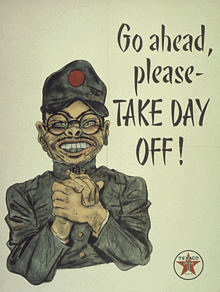
Personally, I thought this recent Texaco-sponsored Romney ad was a bit over the line.  Whether President Obama was born here or not, whatever his religion, or his extreme European Socialist views, what possible good can this sort of offensive negative ad do for our great nation?

(Full disclosure: the Texaco-sponsored bit of propaganda above was part of the war effort against Imperial Japan during World War Two and not an ad for Mitt Romney’s presidential campaign.  I am not linked with the Romney campaign, nor with any related or unrelated super-PAC or other charitable group supporting Mr. Romney, nor was the crude example of propagandistic rebranding strictly called for.  But, see paragraph below beginning “The Allies, Hitler pointed out…”)

But let us backtrack a bit and try to be a little more analytic.  What makes something propaganda?  A shameless and manipulative appeal to our emotions, brought to us via mass media.  What makes something good propaganda?  A well-paid ad agency, or government, or both, employing the most skilled people it can recruit.

1622, Pope of the Catholic Church, under attack by the so-called Reformation, creates an office to propagate the faith, sow it, let it flower.   Three hundred years later Hitler dictates the first volume of Mein Kampf, pauses to wipe the foam off his mouth and delivers a short, cogent lecture extolling the effectiveness of Allied propaganda in the recent World War.  That lecture concluded he resumes foaming at the mouth for the remainder of volume one and, presumably, in the secret, unpublished volume two.

Note: the editor of Mein Kampf was killed in “The Night of Long Knives”.

The psychopathic future dictator made several astute points in his discourse on propaganda.  One is that a lie, wielded without mercy or weakness, is almost always more useful in inspiring obedience and violent action than any sort of truth.  The Allies did not hesitate to lie about alleged atrocities committed by the Hun.  Hitler applauded this, it creates hatred of the enemy and also fear, which combined, engenders a determination to exterminate the enemy.   In contrast, the German authorities made a snobbish appeal to the superiority of their culture and troops, sneering at the contemptible unsophistication of the enemy.  

The Allies, Hitler pointed out, didn’t hesitate to make  up inflammatory captions to hideous photos– a gruesome pile of bodies waiting to be taken to morgue had not died of typhus (truth) but had been tortured to death, in a specific place and on a given date, by the Hun.  Not only that, they ran the incendiary picture in every paper for days running, with articles scrupulously documenting the invented crimes against humanity.

You starting  to get the picture?

Why did the USA get into the World War in the first place?  That is a question nobody to this day can give a very good answer to.  There’s no question American bankers had loaned many millions to the French and English war efforts, stood to lose a shitload of money if Germany won, but that alone can’t explain it.  There was a scramble for colonial possessions and a frenzy of competitive nationalism, but that wouldn’t be enough to have American farm boys, city boys and young collegians lining up to enlist.

It was the genius of George Creel and his Committee for Public Information that got them on their feet, cheering, patriotic and bursting to “make the world safe for democracy” to fight the “War to End War” and cover themselves with glory.  You can look it up.   Woodrow Wilson enlisted Creel and the Creel Committee, ingenious, tireless, unhindered by scruples of any kind, whipped up a great patriotic frenzy for war.   Lines of guys singing “Over There!” went over there to run to glory out of muddy trenches into barbed wire and machine gun fire, through mustard gas and aerial bombardment.

It begs the question of why America entered the World War. But it explains how.

Anyway, Google “propaganda”.  Look at the Wikipedia article.  I guarantee that the images you will imagine as you read will be based strictly on your political outlook, shaped by the famous confirmation bias.  Some will read the descriptions of the various techniques and see images of Cheney, Bush, Condoleeza Rice and so on.  Others will immediately see Obama, lying eloquently through wolfish teeth.

The one thing we can be sure of, effective propaganda costs a lot of money.  You have to saturate everybody, constantly, for it to work.

The Supreme Court told us recently that money is speech, the same way it once told us in the Civil Rights Cases* that biogtry against blacks had nothing to do with their status as former slaves, that nobody should get constitutionally huffy about it, and that the Fourteenth Amendment had nothing to say about it.  Go tell the Supreme Court they’re wrong.

“So, call me ‘pisher’,” the Supreme Court will shrug, “we’ll talk about this again in 90 years or so.”

As for me, I’m speechless.

*  see italic section near bottom of  post below for a full-bodied quote from that fascinating decision, it begins When a man has emerged from slavery

https://gratuitousblahg.wordpress.com/2012/08/07/my-fellow-americans-ignore-me-25-2/

My Fellow Americans Ignore Me

The statistics don’t lie, there is only one reader in Poland who continues to click on this blahg occasionally.  I’m not grousing, mind you, we Americans pretty much ignore each other as a matter of national pride.  USA!  USA!

If I have learned one thing from this program I’m trying to launch, the one in which I put all the eggs I will ever have in one basket and balance it at the end of a long, brittle stick held by an extended, shaky arm, it is not to be so damned sensitive.  Sure it’s nice to have feedback, to feel  some appreciation from time to time, but here’s what I’ve realized:  the work is the same, whether it is commented on or not.  Also this: I am the final judge of whether I have succeeded in a given work or not.  I am the expert on my progress or lack of same.

“Oh, you are talking to yourself, trying to be brave,” you will say.  Absolutely right, but there’s more.   I am not dashing face-first into a wall, I am not collecting cobras like the little girl in India who gets bitten by one of her “best friends” 

http://www.youtube.com/watch?v=ZMz7DOcwUpg&feature=player_popout

I am no longer pissed off all the time about friends who can’t bother to lend a few seconds of moral support, even as a tic seems to force me to check the stats on this new blahg several times a day and mutter to myself “some American bastards messed up my perfect downstepping ziggurat on August 5.”  I know it was Americans because of the map.  And I know, pretty much, which Americans those probably are, since only five or six have been sent the secret link to this blahg.

But, who am I fooling?  I know why Americans ignore me, and I would ignore myself too, if it was within my power.  I don’t dream the American dream, for one thing.  A friend and I were discussing that dream the other day.  On its face a dream of “freedom” (like what was on the march in Iraq a few years ago when so many lost their lives) but it is, more precisely, the dream of being rich, of having enough money to buy whatever you want and also, with that money, the ability to tell everyone to go fuck themselves.  As dreams go it may seem a tad materialistic, maybe a little shallow, but who am I to judge a dream as big as the American Dream?

Sure, it’s easy to take potshots at a nation that used the phrase “Manifest Destiny” to commit a deliberate genocide against the people who occupied the territories it was God’s Will Americans could own and exploit.  Easy too to condemn practices carried on for more than a century, under the “inalienable truth” that “all men are created equal” (and for 150 years before that banner was raised).  

The practices of our Peculiar Institution left the once fertile soil of the American south stripped of nutrients and the soul of America stained with the kidnap, murder, subjugation and rape of millions kept in chattel slavery.  You could say that the Divine retribution Jefferson feared, even as financial considerations made it impossible for him to manumit the hundreds of chattel slaves he owned (his sole wealth, after all), is still being visited on America for the way it built its collective wealth on the exploitation of slaves.

Generations later you can see the descendants of these slaves, hardly grateful at all, most of them, for the freedom they have enjoyed since being freed in 1865, and more particularly, since the Civil Rights Acts of 1964 and 1968 guaranteed these freedoms once again.  Including the freedom to once again seek redress in a federal court, after a ninety year hiatus, if you or your family is lynched by a non-governmental outfit like the Ku Klux Klan.

I know I go on about this all the time, and I’m aware how tedious it is.  I really should take the hundreds of hours of research I did in Law School and write a concise version of that paper “The Day of Blacks as the Special Favorites of the Law is at an End”.   That was the conclusion of the Supreme Court when it decided the unintentionally aptly-named Slaughterhouse cases in 1873.  The reasoning was quintessentially American.

The slaveholding states of the former Confederacy, who, until their secession, held their slaves under inalienable Constitutional right, were devastated by the Civil War.  There was nothing civil about the Civil War, as we all know.  The infrastructure of the South was destroyed, roads, bridges, levees, crops, cities, everything.  In order to qualify for Federal funds to rebuild, the defeated rebel states were forced to ratify the 13th, 14th and 15th Amendments.

I don’t know much about the other amendments, except that the First allows me to write the word “fuck” here if I fucking feel like it, and the Second guarantees the right of private American citizens to have as many guns as they like, including assault weapons designed for spraying up to 100 bullets a minute, and as much ammo as they can afford.

But I know a lot about the 13th, 14th and 15th.  The 13th ends slavery and involuntary servitude.  Under the 13th amendment the only way the state can put you on a chain gang is if you’ve been convicted of a crime.  Private actors may or may not be subject to this restriction, but that would be fought in the courts for more than a century and is still in dispute, hinging as it does on the precise meanings of “involuntary” and “servitude”.

The 14th Amendment is a big one, it guarantees that the rights of U.S. citizenship shall not be denied or abridged by the states.  Since the angry radical Republicans in Congress who drafted and forced these Amendments down the throat of the defeated South knew lawyers and judges down there would look for loopholes, they created an enabling act as part of the Amendment.  Congress can, and did, pass any law necessary to enforce these federally guaranteed rights. 

The 15th Amendment is really not worth talking about.  It guaranteed to Negro men, whatever their previous condition of servitude, the right to vote.  Treated as a bit of dark humor from the beginning, it would wait a century for any sort of enforcement.

But the 14th Amendment was a big one, it created the Department of Justice, for one thing, and the never repealed laws passed under its enabling act virtually shut down the Ku Klux Klan for a short time.  It allowed, for a time, the election of numerous black representatives, seemed to guarantee that the former Confederacy could not continue to exploit its former slaves or, for instance, pass Black Codes that made it a crime, punishable by a lifetime of indentured servitude, to be unemployed.

The 14th Amendment protected freedom until the Slaughterhouse decision and a few others, (like the little known Cruikshank case holding that States had exclusive jurisdiction over adjudicating murder cases, even cases of organized, racially motivated mass murder), made the scope of the 14th Amendment and the law of the land crystal clear.

The Slaughterhouse cases were brought by white businessmen, slaughterers and butchers,  protesting the monopoly the State of Louisiana had granted to other white businessmen.  Their lawyers styled Louisiana’s restraint of free trade as imposing a kind of “involuntary servitude” and sought the protection of the 13th and 14th Amendments.  I don’t remember the dull procedural details, you will forgive me.

But I remember well the holdings and influential dicta of the case.  The Court said, first of all, everybody knows the 14th Amendment was passed to help Negroes, not white businessmen who were never slaves, so you slaughterers are a cynical bunch trying to invoke it.   And, second of all, the rights of Federal citizenship protected by the 14th Amendment are three:  the right to freely migrate from state to state, the right to use navigable interstate waterways and another, equally essential right, that slips my mind now.  Everything else, said the Court, is the province of the individual states as far as granting or taking away rights, inalienable or otherwise.  Law of the land for almost a hundred years after that.  In layman’s terms the Court said: “I’ve got your 14th amendment right here, bitch”.

The Court also took pains to make it clear, less than a decade after the bloody Civil War ended, that the day of former slaves “as the special favorites of the law” was at an end.  “And how!” as my idealistic grandma Yetta would have said.

Oh dear, my fact checker, Google, informs me that I am incorrect.  That last bit was not uttered by the Court until the so-called Civil Rights Cases decided ten years later, by which time former slaves had, arguably, enjoyed their freedom for almost two full decades.  Here’s what the Court wrote:

When a man has emerged from slavery, and, by the aid of beneficent legislation, has shaken off the inseparable concomitants of that state, there must be some stage in the progress of his elevation when he takes the rank of a mere citizen and ceases to be the special favorite of the laws, and when his rights as a citizen or a man are to be protected in the ordinary modes by which other men’s rights are protected. There were thousands of free colored people in this country before the abolition of slavery, enjoying all the essential rights of life, liberty and property the same as white citizens, yet no one at that time thought that it was any invasion of his personal status as a freeman because he was not admitted to all the privileges enjoyed by white citizens, or because he was subjected to discriminations in the enjoyment of accommodations in inns, public conveyances and places of amusement. Mere discriminations on account of race or color were not regarded as badges of slavery. If, since that time, the enjoyment of equal rights in all these respects has become established by constitutional enactment, it is not by force of the Thirteenth Amendment (which merely abolishes slavery), but by force of the Thirteenth and Fifteenth Amendments. blah blah blah.

I confess, I have no idea why it doesn’t come under the 14th Amendment (Slaughterhouse notwithstanding), as it would come to be almost a century later.  Oh, of course, Slaughterhouse ruled that the 14th Amendment covered virtually no rights a white man was bound to respect.

Anyway, I leave you, Polish guy, with the last part of a review of Manning Marable’s biography of my brother Malcolm X, clipped and sent to my attention by a friend  I sent the link to.  It has some bearing on the earlier part of this exercise in tedium, where I was on about the American Dream.

The real tension exists in one simple fact: Malcolm’s story is one of the great human stories, but it is not one of the great American stories. This is not Horatio Alger, Benjamin Franklin, or even John Galt. His success as a human being is not measured in terms of wealth or prestige. It is measured in moral terms. His was not a life to be evaluated within the basic assumptions of mass capitalism. He cannot be reduced to a postage stamp or a children’s book. In his final days, Malcolm recognized that this is a worldwide struggle of the people versus mass capitalism, which was out of control in 1965 and now out-Orwells Orwell. This marked him for death in our society. It also made him one of the great figures of world history.  If we ever figure out why this is true, we might have a chance at social transformation – a reinvention, as Manning Marable puts it.

full review here:  http://www.ctka.net/reviews/Manning_Marable_Malcolm_X_Green.html