I Did It, I Can’t Believe It

I saw a well-done Hollywood biography of the Notorious B.I.G., Biggie Smalls, the talented fat kid from Brooklyn.  I saw this movie on TV not long before my mother finished dying her long, lonely death.  I was often sad in those days but I couldn’t cry, even though my mother was in the last weeks of her life  — this movie made the tears flow.  I sobbed because this kid had seen the light, and was, in the screenwriter’s convincing story, making peace when he was shot in revenge for a killing he tried to stop.

I must have cried for ten minutes after the credits rolled, as Angela Bassett wipes her eyes as half of Brooklyn comes out to line the streets where Biggie lived, larger than life, rapping, rhyming, styling like TJ, the Master and mf.

In the Hollywood version he was played by a charming, charismatic actor, a quick witted mostly jovial young man, also quite fat.  He’s mean to his women, breaks his mother Angela Bassett’s heart, and he is a criminal and a thug.   A friend takes the rap for him and goes to prison telling Biggie “if I do this for you you can’t waste your talent, you’ve got to succeed– for all of us”.   By the time the friend gets out of prison  Biggie is a huge star, has an accident and is recuperating in the hospital.   The friend goes straight to the hospital bed and is disappointed in Biggie.   Biggie realizes he’s gained fame, and success, but he’s still  an unredeemed asshole.

And, in the movie, he’s moved by this realization and  he begins to change.  He wants to make amends, seeks forgiveness.  He doesn’t want to hate anybody anymore, and he doesn’t want anybody to hate him.  He makes peace with his ex-wife, his ex girlfriend, starts spending time with his daughter.  He wants to be a positive model for the people he loves.

When he goes back to the studio he doesn’t want to record another  violent, incendiary album, what his fans are hungry for.  He regrets the bad influence he’s had on millions.  He wants to make a tender album, rapping from the heart instead of his killer persona, but he’s afraid people will think he’s weak.

He’s terrified, as he begins to record, with no street bluster to hide behind.  He’s scared  of how weak he must look and afraid to listen to the playback.  But when he hears it a smile comes across his face as soon as the first vamp comes up in the headphones and he starts to shake his head slowly from side to side.

“I can’t believe it,” he says, shaking his head to the slow beat, “I did it…  I did it!” and he laughs, and keeps the beat with his head, and his friends around him at the console all smile too.  The actor who plays Biggie keeps smiling, closes his eyes and floats away on the music.  

In the movie’s next scene he’s shot dead from a passing car.  Then all of Brooklyn is mourning him on the streets as his body comes back for one last ride through the streets, and Angela Bassett looks on weeping, and I’m sobbing long after I turn off the TV.

And then, tonight, after I mixed this clip of the first two animation workshops  I started to laugh.  I said to myself  “I can’t believe it, I did it.. . I did it!”  I pumped my fist in the air as I jumped out of my chair, then I watched it again and again, with and without the headphones on.  I’m smiling as I type this, and I’m laughing too, to think about it.

(animation clip here)

“How’s your head?”

My friend inquired from her Blackberry.  I wrote back that my head was fine, better than her rear-view mirror, then could not help adding:

On the outside, I mean, the outside of my head is fine.  Demons are hopping around inside of it, playing rugby, by the sounds of it.

 What a nice little vignette we lived in that ten minutes on S____ Avenue during the parking/jumper cables drama.  As I crossed to go into my building, as you drove away, a giant white Humvee, with silver studs on the sides like a shark’s gills, paused to let me walk in front of it.  A voice from inside asked “did you get it started?” and I said “yeah, thanks” without looking up.  Didn’t want to get shot.

Night Time Parking Drama

We took the long way back to my place so she could tell me a few more sad stories.  I could not shake the feeling that all the people I have met, in some fundamental way, are mad.  They pay mortgages, raise children, possess professional expertise, make all kinds of choices, live complex lives, but there is an element of madness to all of it, it seemed to me.  The thought struck me as slightly mad too, made me wonder if it wasn’t me.  The evidence that it wasn’t just me seemed strong, but then again, isn’t that what every delusional person believes?

There was a spot across from my place, and she double parked in front of it, shutting off the engine.  We were exchanging somewhat sorrowful anecdotes as we sat and one led to the next.  At one point she turned the radio down, and I didn’t think about it until later.   After a while a car pulled up next to us and asked about the spot we were blocking.  She turned the key to move the car, cranked, a weak cough, then nothing.

“But I don’t understand,” she said, not understanding.  “The lights go on.”  She flashed the headlights.

The driver in the other car said “put it in neutral” after she told him she had jumper cables in the back.  Her car slid back a few feet once she took the parking brake off.  

“What’s he doing?” she asked, as he did a three point turn so his battery would face her’s.  

The jumper cables sparked as she went “yow” and I pointed out that I shouldn’t let the claws on the other end of the cables touch after I’d connected the jumpers to her battery.  They sparked again, then I attached them to the red and black terminals in the other guy’s car.

A black SUV conducted a neat maneuver and began sliding into the guy’s spot.  There was a quick exchange in Spanish, my friend dashed around to calm things down, the driver of the first car yelling “he doesn’t have to come at me like he’s going to kill me” and my friend pointing out that this is New York City and parking is a rough business.  To my surprise he seemed satisfied with her statement and drove off. 

She turned the key and her engine roared to life.  I disconnected the cables.  Just them a white Humvee looking like a warship came from the wrong direction and wanted the spot.  The passenger came toward us menacingly, looking like the bad cop Denzel Washington won the award for playing in Training Day.  “It’s illegal to hold a spot in NYC,” he informed us.   He reached into the collar of his sweater and pulled on a length of chain.  “I’m a cop,” he said, “and it’s against the law”.  

I explained that we were trying to leave when the battery died, and this guy getting the spot was doing us a favor, we hadn’t been holding the spot, he had been waiting to park.  Denzel sized me up.  “We’re not trying to get over on anybody, this guy is just doing a good deed,” I said, sounding very reasonable.  Nobody would have suspected the mad thoughts that had just been racing around my head.

He got back into the white war machine and drove off.  I shook the other driver’s hand and thanked him, he parked the car in the contested spot. I got into the passenger seat of my friend’s car and leaned across to kiss her goodbye.  There was a loud crack and pain in the center of my forehead, the rear view mirror now hung at a crazy angle against the windshield.  It was impossible to reattach it so it could reveal the rear view it was intended to show.  She assured me it was fine, she was only going a few miles on the West Side Highway, that her guys would fix it tomorrow.

She was philosophical, and her philosophy struck me as a little bit crackpot.  I told her to wait, ran upstairs, got a roll of gaffer’s tape and tacked the rear view back in place.  She patted my now damp brow.  I kissed her goodbye and crossed the street to go back upstairs.  A giant white Humvee, with silver studs on the sides like shark’s gills, paused to let me walk in front of it on my side of the street.  I waved my hand by way of thanking them for pausing.

“Did you get it started?” a deep voiced asked me from the passenger window.

“Yeah, thanks,” I said, without turning my head.  I hopped up the one step to my lobby, went inside, up the two flights and sat at the computer, where I am now.

New York City, baby.


Complaint Department

Sekhnet’s father, during his last long hospitalization, at one point shared a room with a noisy insane man.   The insane man was well-known at the hospital and always fretfully and annoyingly attended by his troublesome, equally insane wife.   Sammy soon had his share of stories, which he told with a wry world-weariness that was very becoming.

“He came over in the middle of the night to try to take my glasses,” Sammy reported one morning.

“He tried to climb into my bed last night,” Sammy said matter of factly the next day.

Once, when the madman turned to me in fear and fury and accused me of being his landlord, and told me I couldn’t harass him in his hospital bed, that he was a veteran and an American hero and so forth, Sammy raised his eyebrows to the ceiling in a gesture more eloquent than any rejoinder I can invent now, years later.  

The crazy man complained about the poisonous food, the criminally negligent treatment, threatened legal action.  He barked a series of accusations at Sammy who said “the Complaint Department’s on the fifth floor.”  For some reason that quieted the agitated man.  Perhaps he was wondering how to get there from the hospital’s top floor, which was the fourth.

Skunkie

Walking back from the all night grocery store with a small bag (which says “be the change” on it)  I turned up Cumming, a quiet one block street that leads to the famous corner where it joins Seaman.  It was 2 a.m. and garbage was set out in black plastic bags for early morning pick up.  Looking ahead and to my left I saw an odd looking cat moving among the garbage bags.

Strange looking cat, I thought as I got closer, with that wide beige back, and the dark fur everywhere else, the pointy face is not a cat’s face, nor that stripe on his head, nor cat ears, and what an odd splayed tail.

“Skunkie,” I said casually as the wild animal eyed me momentarily.  I noticed the skunk’s back was toward me, in position, and thought for a second “please, don’t spray me, man.”   I was like that kid getting tasered because he’d worn a t-shirt insulting to a powerful politician.  Don’t tase me, bro.

The skunk, satisfied that I was not going to try to pet him or otherwise molest him, that I was staying to my side of the narrow sidewalk, walking away at a steady but not alarming clip, looked after me to make sure I was serious about avoiding a show-down, and then went back to looking for dinner in the loose collection of plastic garbage bags, very businesslike.

I thought of another gentleman skunk I’d seen in the neighborhood a few years ago.  This one stepped out between two parked cars to cross Seaman Avenue, not far in front of my bike, also long after midnight.  I slowed, and the skunk, very self-assured, paused to look at me.   His look seemed to say “you know who I am, you know what I can do.  I say you move nice and slow and I walk across the avenue to my buffet.”   I agreed at once, waited straddling my bike as he unhurriedly crossed the wide avenue and disappeared among the black plastic bags.

To this day I’m convinced that skunk was the spirit of Sekhnet’s father, Sammy.  It was just after the good-looking, dapper 92 year-old died and my first thought, seeing the good-looking intelligent face of that skunk, calculating and shrewd, was that Sammy’s  spirit was visiting me in the person of this handsome little forest creature out for some human food on a Wednesday night.  When I told the story to Sekhnet she had no doubt her father had contacted me in the person of the skunk.

I’d almost forgotten this annoying slice of NYC life

Luckily I had my notes from 9/7:

I took the C local uptown because there were plenty of seats, the A was crowded, and I could take the C, a slightly slower boat, to 168th where I could switch to the A for the short last leg of the ride to Dyckman Street.

As these things often happen, the C train inexplicably stopped in the tunnel a few hundred feet from the last stop, 168th Street, the stop where I’d catch the A for the five minute ride home.   The train sat in darkness for three or four minutes, the engines silent.  Suddenly the engines rumbled to life, the train lurched forward two or three feet, then stopped again, and went silent.  Another few minutes passed.  Though I had nowhere to be, this was annoying, since it would likely mean missing the connecting A train and waiting another ten or fifteen minutes for the next one.  For nothing.

The speaker started crackling, the conductor about to begin a belated apology for the delay.  Before he could even thank us for our patience the train rolled slowly into 168th Street.  Very slowly, but not slowly enough that I didn’t see the A train across the platform, its doors closed, poised, either just having pulled in or just about to pull out.  

It happened in slow motion.  We sat on our side of the platform, with our doors closed, looking at the immobile A train, with its doors closed.  If we were pirates we could have swung easily from one train to the other, daggers in our teeth.  

In the way of such things the doors of the C took a minute to open at that last stop and the A train, after waiting with doors closed for just long enough to give hope, pulled slowly out, towards my stop five minutes up the line.

The conductor of the C, its run now at an end, was looking out his window and I took the opportunity to vent to him a bit.  “Did you see that A train leave right as we pulled in?” I asked.

“Nah,” he said pleasantly, “I didn’t notice it.  It was odd that they had us waiting in the tunnel, you know, because we were already late.”  Clearly he worked for a messed up transit authority and didn’t get too bent out of shape when stupid things happened. 

I smiled at the conductor, who seemed like a pleasant enough fellow.  “It’s frustrating that the A didn’t wait another fifteen seconds and now I’ll wait 15 minutes for the next one,” I opined.  He nodded, thoughtfully.  Then I had another annoying thought, “and we can’t even assault you guys any more.”

I was referring to the new law of the last few years making it a felony, punishable by up to seven years in prison, to slap or punch a conductor or bus driver who closes a door in your face or otherwise dares you to be indignant or unruly.

The conductor gave me a big smile and in the same NY second retracted his head and slid his window shut.  I smirked and settled in for my wait on the broiling, airless platform.

On the A train

heading uptown

with new brushes

black ink

the entire universe

anything that cannot be said

by pausing

string bent

to lay a bit of

succulent silence

against the beat


on cue

tres payasos

in cowboy hats

clubbing a Mexican beat

to death

with upright bass

buzzing twelve string

and a squeeze box


Mama

don’t let your baby

grow up to be a payaso

with a squeeze box.

You play the game, you takes your chances

I’d like to be an omniscient observer sometimes, omnisciently observing, instead of grunting and bleeding in the game itself.  Become a deadpan, detached narrator, paid to craft a story that makes sense and satisfies on some level.  Anything, sometimes, rather than this.

I have had an umbilical hernia probably for years.  It is one among several medical things lurking, probably one of the more benign.  The surgeon himself made no pitch for me to have surgery, pointing out that probably half of Americans have umbilical hernias.  The treatment poses problems about as often as leaving the hernia untreated does.  It seemed to be a crap shoot.  I was convinced by the noncommittal surgeon himself not to have my belly button slit open.

Two guys I know spoke highly of the surgery.  One said since the surgery he is able to walk like a man again, with his stomach sucked in.  I’ve never been able to walk that way, even when I was skinny.  The other is a man with many fears, and his fear of an incarcerated hernia, the excruciating and sudden event (and apparently very rare) when part of the intestine is forced through the torn wall of abdominal muscle, necessitating an agonized rush to the emergency room and emergency surgery, caused him to swallow his fear of doctors and have the surgery.  “It was nothing,” he said, patting his ample belly, “and I am, truly, a complete coward.”

I fancied the hernia bothering me as I sat typing recently, felt it sometimes as I strained pumping the bike up a hill, or carrying the bike up two flights of steps after a ride.  I remembered the surgeon saying “if it starts to bother you, come back and we’ll fix it.”  I became fixated on this reasonable-sounding advice, reasonably or unreasonably, and went back for the surgery.  “Well, if it’s bothering you…” said the surgeon.

Now nine days after the surgery it’s bothering me again.  But bothering me more are the words of my old friend, a long-time pediatrician.  “Why are you having a hernia operation?” she asked me the night before the surgery, the first time she heard of it. “We see kids with hernias all the time,” she said, “we almost never operate on them, unless they’re having pain from it.”

The surgeon had a glib answer for that the next day.  In children, he pointed out, hernias often heal by themselves.  Anyway, I’d already paid my $75 co-pay, was in a gown about to go into the room for surgery, my blood pressure was 140/72, it was a little late to call off the dogs.

“Most hernias in children don’t heal by themselves,” my friend told me tonight. “that’s not why we don’t operate on them.  We don’t operate because there’s usually no reason to operate on a hernia.” 

Tonight my hernia is bothering me as I sit here typing.  It could be related to the three trips I made up the flights to my apartment last night, carrying heavy bags.  It could have to do with walking around today with a briefcase that was also a little heavy.  The surgeon did tell me to take it easy after the surgery, maybe I just overdid it a little too soon.

Or maybe there was no reason to have the operation at all, and this pain I’m feeling now, although dull enough and almost mild, is a harbinger of a problem I never had.  As pleasant as my lunch and meeting with a very intelligent woman who indicated a strong desire to help with my nonprofit was today, an opaque cloud passes in front of my memory of it.  Besides, it’s been five hours and she hasn’t replied to my thank you email.  Isn’t it as likely as not that she was just humoring me?

Oh, to be an omniscient narrator.  I’d do it for a modestly discounted fee.  I’m clearly not in any of this for the money. But if you will excuse me, I have to lie down with a hand over my stomach.

Slice of NYC

The rain was pounding down this morning as I turned in bed for a few last winks at Sekhnet’s.  I was off the leash today, a friend from far away coming by to play some music as we do now for a few hours every two or three years.  He came in, bent, and whispered Polish to the cat.  The cat regarded him intelligently.  I had no idea the cat understands Polish.

The rain that had pounded down indicated the kind of barometric upheaval that sometimes left the inside of my face swollen, achy and the rest of me slightly nauseated.  I didn’t notice, while playing the host, the exact location of my general sense of unease.

As my friend made the best of my plastic piano, the guitar went in and out of tune.  I had to keep hopping up to stir the sauce I was making, make sure the pasta didn’t boil over.  Soon it was time for lunch, and a toast.  The scotch went down easily, even into my empty stomach.  Didn’t notice how much I was sweating when we went back to play.

The feeling of time slipping away.  Trying to think of songs we’d meant to play together.  A few nice moments, amid the grasping, then it was time to say goodbye.  After he left I realized how much my sinuses were bothering me.  At least then I knew why I’d felt so crappy all day.

Here’s your slice of NYC life:  

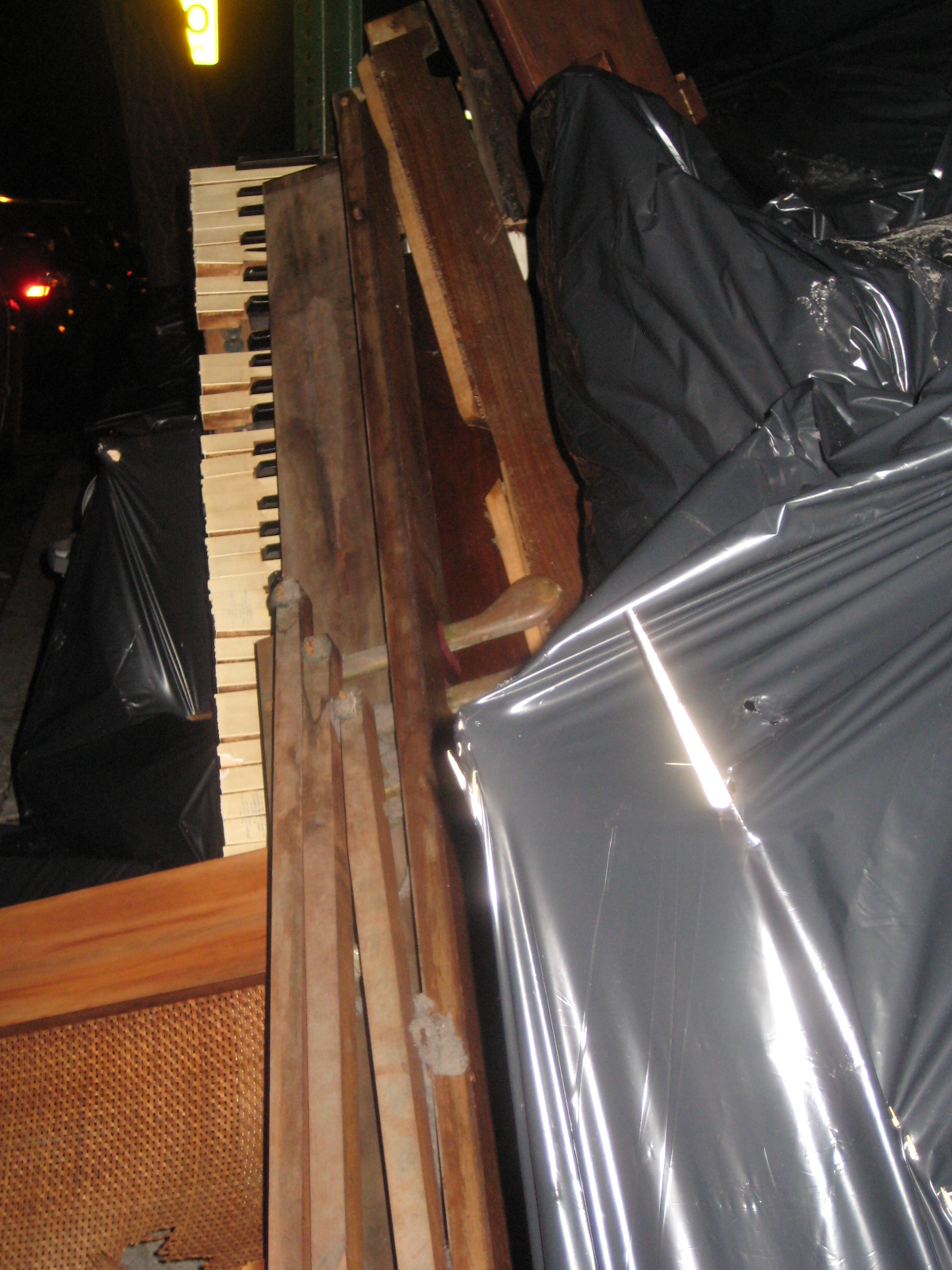
Coming back to my third floor walk-up there was a pile of black plastic contractor bags on the curb, wood sticking out of some of them.  Something about this odd collection of misshapen bags caused me to linger, look them over.  Sticking out of the bag furthest from me was a piano keyboard, mostly intact, but looking like it could use some dental work.  The several other bags held the rest of the piano, an actual piano of wood, strings, hammers.


“Damn,” I thought, and trudged up the two flights to my airless apartment.

Stinking Garbage Truck

I take my bike rides at night during the hottest time of the year.  The hilly streets around here are quiet, lights flash on the front and back of my bike, I wear white, and a helmet.   I can get a good aerobic, mind-clearing ride while listening to Bill Moyers, the timer in my pocket counting down an arbitrary 37 minutes.

One thing I’ve noticed this summer is a stinking garbage truck that races down the Avenue between 1 and 2 a.m., the same time I’m usually pumping up and down the hills.  Since the streets are empty, the truck rumbles along at top speed, trailing a wake of wet stink that hangs in the humid air for two blocks behind it.

I keep an eye out for the stinking truck, and smile when I manage to turn up another street to avoid breathing in its humid reek.   Last night, though, they were doing road repairs on both ends of Seaman Avenue.   The broad avenue was blocked off by trucks running their engines to keep the overtime crews inside cool.   I found alternate uphills on a much shortened route and was coming up Indian Road, a fairly steep incline, when the stinking garbage truck roared around the blind turn and came at me on the narrow street.   That I was riding a bicycle uphill and they were speeding the wrong way on a one-way street did not come into the equation for anyone but me.

“Motherfucking stink merchants,” I muttered as I managed to leap a mercifully low curb and continue up the sidewalk next to the narrow one way street.  Then I turned right, breathing hard, and headed into two blocks of the truck’s foul backwash.