Open the book

I’m talking to myself.  The book is the notebook I made a list in on Thursday, on the way home from session 16 and a long dinner with my two assistants.  It was a very pleasant dinner, I thought.   The heavy bags I’d struggled with rushing to the session in a downpour (my pancho and ziplocks were indispensable)  were much lighter walking from the restaurant.  When I put on my backpack with the laptop, cameras and stands and picked up my duffle bagI thought I must have forgotten to pack something when I left the classroom.   My bags were much heavier when I set out, they were lighter when I hefted them to leave after the session and a nice dinner with these two intelligent women I hope to expand the workshop with.

On the train Thursday evening I made notes of calls I need to make, emails I must not forget to write, follow-ups, most of them, things to push the program forward when the school year ends in three weeks at our current site.  I was leaving for a long weekend, everyone was and I’d take care of all business on Tuesday when the business week resumed.    Only Tuesday found me staring at the cracked walls, the buckling ceiling and the missing tiles on the unwashed floor.  I remember thinking “what the fuck?”   I thought it many times, but I did not open the book to look over the checklist of my tasks.   At 1 a.m. I took a bike ride.

Today was Wednesday for me.  Some will call it Thursday, since it is 2 a.m. and technically they are correct.  It is 2:11 a.m. Thursday.  But for me it is still Wednesday, the day I woke up to 14 or 15 hours ago.  I could not open the book.  Did not open it.   Poetry may have spilled out of it like a delicious drink on the sandpaper tongue of a parched man, face and facade about to crack, but nothing could tempt me to open it.  I would not, did not.   I wrote a pleasant email to a lovely polymath, the inventor of many things scientific who has in recent decades turned his great mind to the problem of educating primary school children.   You may have heard of Sugata Mitra, I hope you have.  If you’ve been paying attention you have heard me go on about him.  Wonderful man, I wrote him a pleasant email today.  It took a very short time.  My small committee, two excellent writers who read these kind of letters for me and fire back their comments, both wrote back quickly to say it was just about ready to go.  I made one quick pass, trimmed a few sentences, sent it off to Mitra in Newcastle, found his personal email address, shot a copy across the pond to him over there too.

But I did not open the book with my list of important reminders in it.  It was as though I didn’t want to be reminded of the steep uphill climb.   I walked to Target in the Bronx, bought t-shirts and a pot to cook in (I have one to piss in).   I found cauliflower for $2.50 and bought a head, took it home, reduced it to a bowl of florets, chopped garlic, ginger, jalapeno peppers, made suki gobi out of it in the suddenly humid NYC summer.  Listened to the Yankees get stomped by the hapless Mets and then took another bike ride, working the heart and lungs.

But I did not open the book.  No force in the world could get me to reach on to the chair, extract it from the open blue bag and pull back that heavy cover.   The cover of that book weighs I do not know how many metric tons. 
Spring Cleaning

I paid $92 a couple of months ago for the privilege of riding my bicycle 38 miles through the five boroughs of New York City.   Thousands do this ride every May, I’ve done it several times.  Sections of highways are closed as motorists seethe, and it is very cool to be biking on the FDR, the Belt Parkway, across the 59th Street and Verrazano bridges.  The trouble is, I hadn’t been on a bike in months.   Last night I took my 7th ride in 11 days, getting my legs and lungs ready for that long ride.

But that’s not the point, nor should anybody be particularly interested.  In fact, there is little reason for anybody to be interested in what comes next– and I can say that with confidence, even as what comes next, at the moment, is an expanse of white below the words I’m typing now.    

I like to draw and I have become addicted to certain drawing implements lately.  If I don’t have a black ink filled brush (calli free-flowing waterproof black) , a yellow ink (Winsor Newtown’s beautiful Winsor Yellow) filled brush, black and red calligraphy pens in two widths, a .9 mm mechanical pencil and a few other odd devices, I am desperate.  I look over at the metal mug filled with them and I feel happy.  Leave one of them at home, I am bereft.  I have extras, empty and ready, in a drawer against the possibility I might lose one of these marvelous drawing implements.  I say again, I love to draw.  I cannot help it.

But I am not organized about it, do not sell the drawings, or send them anywhere to be published.  I rarely even think to give them as gifts.  I’m sure the ones I do give most often get lost, or tossed.   So I draw something and put it to the side.  Another drawing goes on top, but not in a neat pile, there are other things under the drawings.  A bunch of cables for electronic devices, a coil of wire, some one-hand folding knives, a bank statement, metal rulers, a roll of gaffer’s tape, phone charger, digital recorder, wire bound and other notebooks, music– I can see the corner of the lead sheet for Body and Soul winking out at me as I tap here.  The desk, as large as a door, is basically two precariously piled haystacks of drawings and other items, with a little space in the middle, under the computer screen.

The leak in my ancient bathroom sink (it has two spigots, one for hot, the other for cold) had become a waterfall in recent weeks.  I ran into the super and he told me he could come by any time to fix it, I just had to call him.  Weeks went by as I glanced at the floor, which had become an extension of the desk, the kitchen table, papers spilled in an avalanche, papers I daintily stepped over.   I could not expect the super to do this dainty dance.  I realized, to my horror, I’d have to make a wide, clear path from the front door to the bathroom.

This may sound like common sense, something every five year-old learns “pick your damned stuff off the floor!”.   Well, common sense, as Sekhnet’s mother used to say, is not so common.  But marshaling my will, at last, I made a clear path to the bathroom, the super came up, and after a titanic struggle that involved taking the immense, heavy top off the antique pedestal sink, he was able to install two shiny new faucets.  For the first time in months the sound of running water is not coming from the bathroom.  It’s almost eerie how quiet it is here, with just the computer and refrigerator purring at me.  

“Was there some point to this?” a poor soul, tried beyond silence, will ask.

Uh, only that I spent over an hour yesterday making some small progress in tidying this place.  And that if I could put in another hour today, and one more on Wednesday, and so forth, I might again have an apartment where people could feel comfortable sitting, where Sekhnet could spend time without leaping out of her skin, hopping on to the back of her skeleton and skittering out the door screaming.

Letter to Walter (draft 2.2)

Dear Walter:

I’ve been reading your books since my mother recommended Devil in A Blue Dress to me a few decades back.  I admire the story-telling as much as the running themes of the power of imagination to change the world and the gentleness that is at the core of even your most hardened protagonists.  

Reading Twelve Steps to Political Revelation not long ago I was struck by the section calling for changes in how education needs to work to ensure a more creative, critically thinking, multi-lingual populace.  I agree that the generations coming up now are the last, best agents for the change needed to avert the looming disasters we face as a planet.  You gave a great example at the Moth recently, those two young gay strangers on Christopher Street retooling the ugly word “nigger” into a shorthand for their brotherhood.

Cheekums baboon

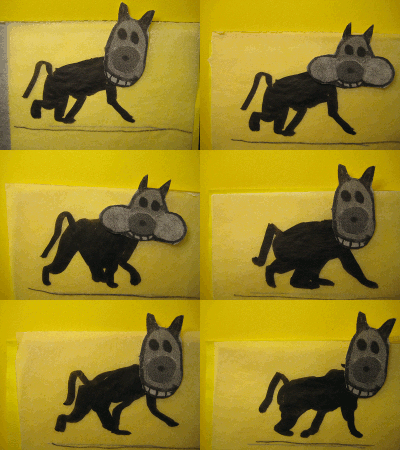
In the wake of Cheney and Bush I thought up my best bet for helping to bring about the kind of change we need to see.  I’ve started a not-for-profit student-run animation workshop, called wehearyou.net, to listen to young children’s concerns and help them show the creativity that is so often ignored in our testing-obsessed prison-prep factory schools.  

My hope is to have young kids produce works that will shame the more liberal of the Job Creator types (currently chafing at a theoretical 0.03% stock transaction tax) enough to fund what I envision as a grassroots movement to change the landscape of urban education, starting in the worst public schools I can find in NYC.  I worked in one in Harlem for several years, so I’m intimately familiar with the challenges kids in those schools are up against.

Cheekums1

I invite to you have a look at some of the kids’ work at wehearyou.net, along with my descriptions of the program   I hope the potential of this program, directed and produced by young kids working as teams of creative problem-solvers, lights up your imagination.   I would love to speak to you about the program.   You can send me an email or call me at (… ellipsis added…).   On my dream team of people of vision and action to work and brainstorm with, you’re very high on the list.  

Yours sincerely,
[name withheld at request of ‘author’]

Memory

Standing with my portable animation studio in bags on my shoulder and at my feet, on the uptown platform at Spring Street, a woman drops something plastic that clatters on the concrete.

I watch in my memory as the dental retainer, plastic and wire, flips off the wet sink and high dives into the swirling toilet water, down and gone, forty odd years ago, up early in the still dark morning for an exam up in the Bronx, in the bathroom of the house my dead parents sold long ago.   Reflexes too slow to grab the dexterous little translucent plastic mouthpiece. My father cursed when I told him, as he often did, and no arrangement was made to pay the orthodontist, Valens, now probably wearing red or kelly green pants in Florida, or Arizona, if not a shroud, to make another retainer.  Thousands already down the drain to fix his children’s teeth, to hell with the ungrateful little fucks.  “Goddamn it!,” he said, and cursed some more.

Thus was lost the last chance to finish the work of having my crooked teeth uncrossed.  So, on the platform at Spring Street I’m feeling my teeth with my tongue, thinking that my father’s immature, yet understandable, reaction deprived me of the chance for a more even smile.  I remember very clearly the pain of trying to bite a hamburger at a rest stop on the New Jersey Turnpike the day after the braces were tightened.  For nothing.

The lost retainer explains the uncorrected upper teeth, but what of my Frank Zappa-like lower teeth, a jumble of beige choppers?  Or my sister, also a patient of this Dr. Valens, who to this day speaks of him mockingly, sticking out her still prominent slightly bucked teeth.  Both of us still remember the smell of the orthodontist’s breath and his hairy hands.

The Dumbest Lawyer in New York

My mother was once wrangling with some guy at a desk in Florida.  She asked for my advice, which I gave her for free.

The next time we talked she said the guy said “your son must be the dumbest lawyer in New York!”.   It turns out she’d grasped the principle I’d explained, just had the action to take reversed.

“Ah,” she laughed when I told her.  I was only mildly indignant, the guy had a point if you considered only the benefit of the bargain I got for the law degree, licensing fees and dry cleaning bills.

Do What You Love, the Money Will Follow

Years ago I had a single blind date with a sighted woman who worked in publishing.  I’m pretty sure it was she who gave me an advance copy of a book called “Do What You Love– the Money Will Follow”.  I remember it had a white cover.   I told someone about it recently and commented that I still have it on my shelf, unread more than 20 years later.  I don’t see it anywhere as I scan the shelves now, but it’s possibly fallen into a crevice and been covered with fur along with my missing pocket book of jazz standards and innumerable other items.

I read a few pages and put it aside in disgust back then, like many things.  Like a middle class life, for example.  How that happened is worth a word:  I found I wasn’t cut out to compete for the love of wealthy people in the art world.  Displaying drawings and paintings in libraries, as my father suggested I try, was not the same as being a fantastically paid meteor in the art world firmament– I retreated into a kind of autism for a few months as I came to realize neither of these options was viable.

To my surprise, I found that I really enjoyed working with third graders.  I was hired as a teacher in a series of horrible situations.  Being a NYC public school teacher in poor neighborhoods was a bit like being a death camp guard in World War Two who loved Jewish and Gypsy humor.   I was as helpless as the children against the meat grinder that was at work on them, that was paying my salary and health insurance and giving me ten paid weeks off every summer. 

I worked full-time at four or five different NYC public schools.  Choosing which was the worst would be hard, and I’ve already used “meat grinder” and “death camp” and those pretty much cover the gamut.  I assume at least one of the principals I worked for was motivated by something other than lust for the virtually unlimited exercise of arbitrary will.  Assuming that, I can explain at least some of their distaste for their popular young male teacher as animated by a concern for the children.  

That was not the case with the last one, the principal whose clumsily sexualized tango proved deadly for any belated daydream I might have had for a middle class life.  Minnie Frego was probably insane, but was I any better?   In response to a series of escalating, mad provocations, as the new, mad principal zeroed in on me as the leader of the school I worked at for almost three years, I finally snapped.

“You’re not paying attention,” she told me tartly, as I tried to ignore the sickening demonstration of meat grinding she was conducting with my class for my benefit.  She had just crossed out the work of a bored child who was working on workbook problem number five when she was still working her methodical way through number three with the rest of the class.  She’d firmly told that child to fold his hands over his book and follow instructions.  I was trying to do the same at my desk, but it was burning me.  I was glancing at my required lesson plans when she called across the room to me.

“I’m doing this for your benefit,” she told me, as the eyes of every eight and nine year old Harlemite in the room turned to me.   It was like looking into the eyes of twenty-five smart young animals in the slaughterhouse chute.   I could not let them down, did not stop to think.  By way of response my arm swept everything off my desk on to the floor.  Then I folded my hands on my empty desk.

The rest, as they say, is history.

Delcog III

Here on Delcog III we don’t mess around with pie in the sky, or touchy feeliness either.  Life here is as frightening as it wants to be, and nobody on the planet has any quaint illusions that it could be any different. 

“Oh, yeah, Delcog III, isn’t that a bit lame, sir?” a blunt reader might ask.

“A bit lame, earthling, sure, as lame as you like.  It could not be otherwise, no matter what color glasses you put on, no matter what olfactory filter you dial in.  The air here, for example, you cannot breathe it.  When your tank runs out you will die in four or five agonizing minutes,”  the Delcog looked off indifferently, then went back about its business.

And you wonder, who is the narrator here?  Who is Delcog?  Why am I suddenly part of this story?   Is it true about the atmosphere on “Delcog III”?  Am I living in a fool’s paradise of bottled air, will it run out and will I asphyxiate?

“You may scoff at Deleterious Cognition,” said the Delcog, “you may think it is the same as plain pessimism, or depression, mere expectation of the worst.  But it is more than a passive expectation of the worst, I assure you, my soon to be oxygen deprived friend,” the Delcog gave its version of a smile.  It was as bad as the confident prediction of an agonizing death.  

“Cognition,” continued the Delcog mercilessly, “is a thought process that involves perception, gathering information, digesting it and using it to make informed predictions while assessing various risk factors.  You label it Deleterious and we embrace that label, yes, cognition can be deleterious– to wishful illusion, for one thing.  Your dreams, my friend, they depend very much on your oxygen supply.  I note that you are wearing a four hour tank and that the gauge reads 5%.  Let us do the math together– 50% would be 2 hours of breathing time, or 120 minutes.  5% of four hours, therefore, is a tenth of 2 hours or 12 minutes.  I suppose we can round it down to eleven now.”

You know, I’m thinking I don’t have to take this kind of crap from some pedantic literary invention, yet I stand here, under the winking blackness.  I’m interested to hear what this sick bastard has to say.

“Of course you are,” said the Delcog agreeably, moving seamlessly into the past tense, “instead of making your way back to the ship to replenish your air supply you are listening to me rattle on with breath so bad that, I dare say, if you were not wearing the mask and breathing apparatus you would be unable to stand so close to me.  The ship, by the way, is at least seven minutes from us, so in three or four minutes the point will be as moot, as mute, as the song you imagine you are hearing.”  

The music I hadn’t been aware of swelled thrillingly, and along with it a sense of hope, soaring.  That is one amazing aspect of music I sometimes forget, it can fill you with feeling, sometimes impossible to express except through music.  

“Yes, that’s fantastic,” said the Delcog with a slight smirk, “talk about music, since it is more precious, apparently, than life itself.  It’s kind of funny: choosing music over life, since in the afterlife everybody is deaf.”

Now the Delcog had gone too far.  I was thinking about zapping him with my bop gun, raising some funk and a little sand too.  But what if he was right about the atmosphere being poison for me to breathe?  

“By way of example,” the Delcog said, “and forgetting about your insoluble breathing emergency a few minutes from now, you are writing this instead of working on a business plan, instead of figuring out how to recruit the crucial people that will allow your plan to move forward, instead of working on strategies to network and sell your idea.  Whatever you think about capitalism, baby, you’ve got to raise capital if you want your own business.  The widgets your business will make are no different than any other widgets, they’ve got to be branded, marketed, dressed in short skirts and marched out into the marketplace.  You think you are doing something special since you are ‘nonprofit’.   That’s very funny, if you think about it for a minute.  Oh, I forgot, you don’t really have a minute… that’s a little Delcog III joke… you actually have maybe nine minutes, or, actually, two– to decide to hightail it back to the ship and see if they can get the hatch open in time.” 

It was wearying talking to this guy, but I was already weary.  I got to thinking it was a long shot to make it back to the ship in time to save myself.  The music had stopped, I felt sick, sweaty and claustrophobic in my space suit.  I had to get out of it.  I pulled off the face mask, and, outside of the fartlike smell of the Delcog, who hadn’t been wrong about his breath, the air was very much like the air in a dank basement.  It didn’t smell very fresh, but it was fine to breathe.  I winked at the Delcog and went on my miserable way, shrugging into a long sideways leap in the low gravity of Delcog III.