Seriously,
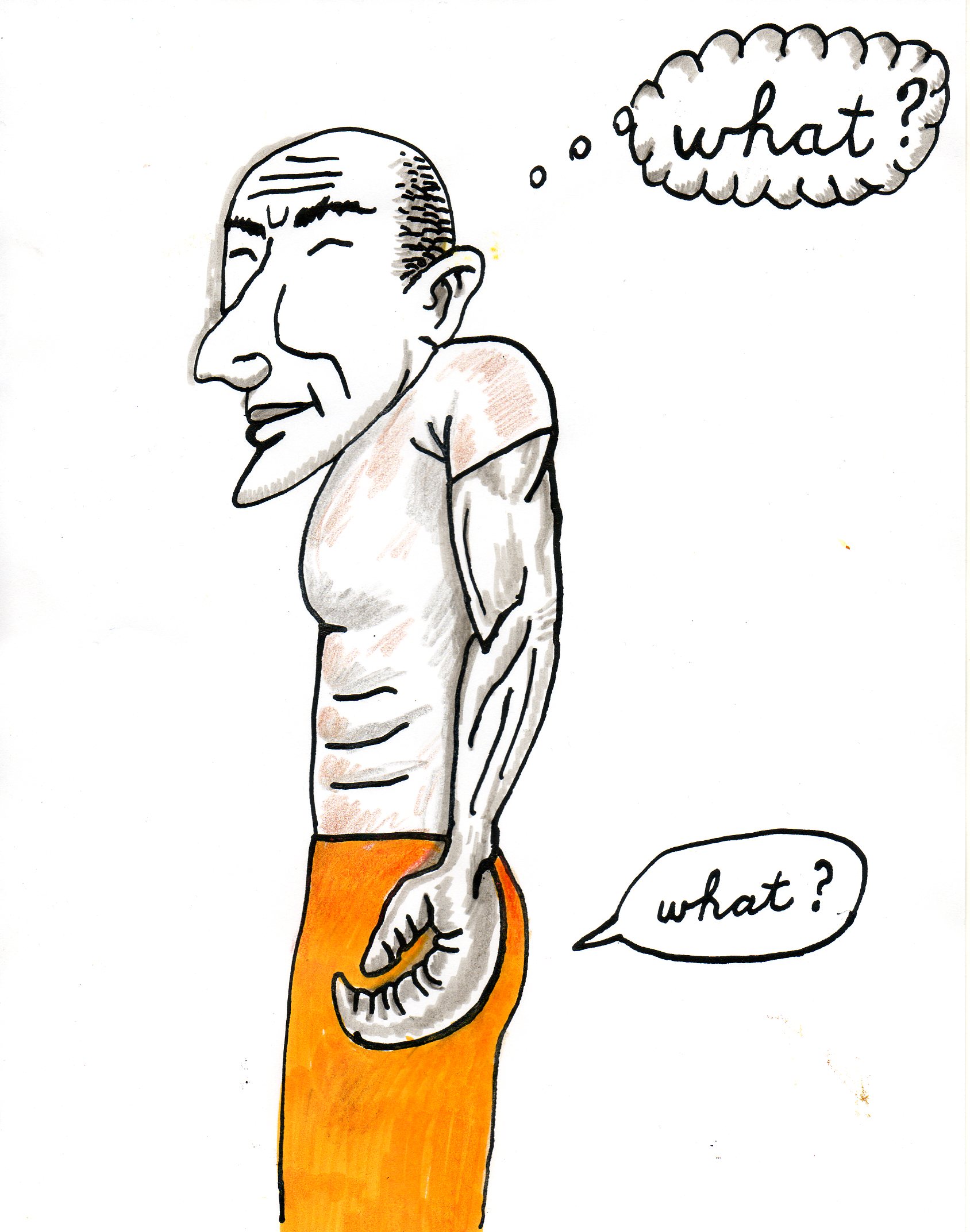
Seriously,

At a luncheon recently I mentioned, intending to share my skepticism about the evolving DSM and its 5,000 new categories eligible for lucrative psycho-pharmaceutical medications, Angry Baby Syndrome. I smirked as I brought up the newly minted diagnosis: Temper Dysregulation Disorder with Dysphoria, a proposed addition to the fifth edition of the Diagnostic and Statistical Manual of Mental Disorders (DSM), among other things the guide for what insurance will pay for by way of pharmaceuticals.
One of the strangers at the table, a woman with some professional familiarity with these matters, immediately nodded knowingly. “Yes, it’s a real condition, there are some babies who just start off angry,” she informed us and the conversation drifted quickly from where I was trying to steer it. In truth, though I am opinionated, I had no real interest in steering this particular conversation, I was merely stroking one of my pet peeves– the madness and brutality of runaway capitalism. I worked on my vegan lunch plate, smiling neutrally as I chewed, and let my mind drift in and out of the talk around me.
I’d read a great article, given to me by my friend the now retired judge, about the meteoric rise of mental illness diagnoses. The article was a review of several books on the boom in psychopharmacology, I’ll find it for you. A long review, but fascinating, well-written and worth a read. Marcia Angell begins:
It seems that Americans are in the midst of a raging epidemic of mental illness, at least as judged by the increase in the numbers treated for it. The tally of those who are so disabled by mental disorders that they qualify for Supplemental Security Income (SSI) or Social Security Disability Insurance (SSDI) increased nearly two and a half times between 1987 and 2007—from one in 184 Americans to one in seventy-six. For children, the rise is even more startling—a thirty-five-fold increase in the same two decades. Mental illness is now the leading cause of disability in children, well ahead of physical disabilities like cerebral palsy or Down syndrome, for which the federal programs were created.
(click here to read the article)
I can’t help thinking of TDD, Angry Baby Syndrome, in the context of a story my parents told, and believed, until the end of their lives, a myth I always took pains to demythologize. At ten weeks old I became red and rigid, my little fists clenched, with a look of rage on my face that no amount of concerned staring or direct questioning from my frightened parents could wipe away. With great anxiety, they rushed me to the pediatrician. The good doctor took one look at me, began to laugh and said: “this child is having a temper tantrum! I’ve never seen it in a baby so young, but this is definitely one angry baby!” I recall thinking “fuck you, doc. I’ll live to laugh at your fucking anger some day, you articulate, quack prick. Just wait until I can talk, assbite.” By ten months old, according to my proud mother, I was talking, though neither at ten months nor at any time after that did I bother to track the cavalier pediatrician down.
The point of this story to me was always that rather than figure out why their child was so unhappy as to be having a temper tantrum, the two young parents took comfort from the quack’s diagnosis that the kid was just irrationally enraged. The expert confirmed my parents’ fear that their baby was just one of those born pricks– adversarial, angry, vindictive, challenging, defiant, hating all authority. Who knew a ten week old could have the worldview to make all these judgments? I have to believe it helped set the course of my adversarial childhood, this expert’s glib diagnosis that did not extend past a relieved chuckle. He concluded, essentially, that this baby suffered from nothing more than being an enraged little asshole. Kind of funny, in a way, no?
I always thought a good doctor might have felt the kid’s little fists– said to the parents, “I’ll be damned, even though it’s August, feel how cold this little guy’s hands are… maybe he’s pissed off because nobody has made sure he’s warm enough.” Indeed, my mother reported that I always immediately calmed down whenever she gave me a warm bath, but of course, it was impossible to carry around the baby bathtub full of warm water to bathe me whenever I started becoming irrationally enraged.
But my point in writing this is not to wonder whether TDD with Dysphoria is not a perfectly good diagnosis (why not give a pill to a young child who is just an irrationally angry bastard all the time?) or to muse about whether or not that pediatrician 57 years ago did anyone any favors, or to belatedly defend my, admittedly, infantile behavior.
I replaced a roll of toilet paper backwards just now. I noticed it and calmly removed the roll, reversed it, snapped it back into place. This struck me as a great moment. The calm fixing of a minor problem was unaccompanied by any sort of snarl, curse word, smirk, clucking of the tongue. I still fly into a Tourretic rage when I’m leaving the house in a hurry and my ear buds are violently yanked out of my ears as the cord whips around a doorknob, or the long horn bicycle handlebars. Part of my rage is at the randomness, seeming cruelty and absolute regularity with which these little delaying things always seem to happen, as though the universe is giving me the finger when I most need its silent cooperation. But with today’s toilet paper tragedy, I was happy to notice myself fixing a minor problem as calmly as the Buddha.
I took a breath and thought about the progress I’ve made from that vicious little ten week old I once was, the raging TDD poster baby. It made me think of my father’s terrible temper, and his insistence, until right before the end, when he smartly reversed himself, that people are what they are programmed to be, by genetics and upbringing. He always dismissed as delusional the idea that one can consciously change this programming. My dad’s reflex, when a mistake was made by himself or anyone else, was to become instantly enraged. I spent decades being mad at myself when I did something careless, or stupid, things that earthlings do all the time.
Follow if you can: you are snipping the ends off string beans, nipping the stem off and a bit of the tip on the other end. In one bowl the prepped beans that will be steamed or sauteed, in another the ends you will be discarding. One after another, bing, bing, bing, the stems into the little metal bowl, string beans into the strainer. Then, bip! stem into the string beans, whole string bean into the bowl of ends. One would expect, at most, a little smile and head shake, a plucking out of the stem, an extraction of the string bean, and quickly restoring them to their desired places. It would be hard for many people to understand the reflex to a paroxysm of rage when the stem gets flipped into the wrong bowl, but it is there for some.
Did my father have his face whipped all through his early childhood, and the angry course of his life irremediably stamped on his little soul, because he had undiagnosed TDD? Did his mother, an insane little bitch, as far as I can make out, suffer from untreated TDD? Is the reflex to be enraged carried in the DNA? If this reflex is then reinforced by infallible repetition, can the programming to react this way be undone by mere mindfulness and a desire to not react with rage to every frustration, no matter how minor?
Let us not underestimate the practice of mindfulness, working in tandem with a strong enough desire to change a painful reflex. I’ve been trying to apply this principle to my dealings with others, with some success. I have remained fairly mild in situations that would have provoked me to major unmildness before. Imagine my delight to find myself the recipient of this forgiving gentleness in the moment of realizing how maddeningly idiotic my placement of that roll of toilet paper had been. Noticing these small, valuable steps is a great gift we can give ourselves.
Or, an old reflex suggests, the wishful thinking of a fucking idiot. Though I think not, whatever my father or a respected doctor might have once said to the contrary.
It’s one thing to nonchalantly pay your 3.85% mortgage on something that you live in, a comfortable home that appreciates in value, is an asset you can eventually sell to recoup your investment, if not also a profit.
It’s another thing entirely to pay mortgage interest four times what the banks are paying, on a house you will never live in, a house full of vermin and every kind of expensive vexation, a house of plague you avoid. And the repayment amount exceeds your combined income for a decade.
But I’m not here to whine about interest rates on unwisely taken student loans. There is more important business, like getting you to reading this again, with focus and attention. To imbibe its truth, and to taste the truth of it, and to think on it a moment.
WENDELL BERRY: But that’s the problem we’re in to start with, we’ve tried to impose the answers.
The answers will come not from walking up to your farm and saying this is what I want and this is what I expect from you.
You walk up and you say what do you need. And you commit yourself to say all right, I’m not going to do any extensive damage here until I know what it is that you are asking of me.
And this can’t be hurried. This is the dreadful situation that young people are in.
I think of them and I say well, the situation you’re in now is a situation that’s going to call for a lot of patience.
And to be patient in an emergency is a terrible trial.
source: http://billmoyers.com/episode/full-show-wendell-berry-poet-prophet/
Had lunch yesterday with an old friend from High School I haven’t seen in decades. He was going to our fortieth HS reunion, I wasn’t, so he stopped in for lunch on his way to the reunion. His life has gone in a logical line, the next in several generations of engineers, he’s been studying or working, mostly happily, in the field for several decades since graduating high school. For the last twenty years or so he’s been at the same company, working on inventions that will do many things, including make smart bombs smarter and more precise in their targeting. There is good money in those government contracts, the company he works for values his work, and many of his co-workers there feel like extended family to him. He can narrate the events of his resume over appetizers, as he demonstrated nimbly over the vegetarian lamb satay.
When it’s my turn, I am at something of a loss. Neither my life nor my description of it goes in a straight line, it jumps from my years as a bike messenger, too angry to consider any way to participate in a society that seems sick beyond redemption, to the 1981 meeting I had with a dean at CCNY who told me it was no problem to waive some requirements so I could get the remaining seven credits on my BA (magna cum laude, it should be noted). He could not waive gym, he explained, so I took volleyball and led my team to the championship.
The dean, a physics professor, if I remember correctly, a kind looking man with a resemblance to Kurt Vonnegut Jr., took care of the paperwork quickly and then gave a concerned look. “That part’s easy,” he said, leaning forward and looking mildly concerned “but, I have to ask you, on a more personal level– what is someone as obviously intelligent and thoughtful as you are planning to do with your life?”
My companion at lunch nodded, his eyes wide open. A scientist and human being, approving of the humanity of his fellow scientist, going beyond his role and asking a good, compassionate and very logical question. I proceeded to try to answer, weaving the story of my father’s life and death among the different periods of my life and times. There was no line to follow, except for the evolution of my resolve to avoid argument and conflict, to be direct, and remain as mild as possible. There was no pay-off to any of this, certainly nothing monetary, outside of a life with somewhat less anger and violence.
Odd to say, while we walked after lunch and chatted, never once did the image of, not three generations of engineers, but three generations of angry, depressed people, seventy years ago virtually all of them murdered in ditches, burned, gassed, one of the lonely survivors whipping and sobbing over her first born, clinging in fear to a God who had clearly turned his back, come into my head.
Just a single brief description of this enraged little redhead I know so little about, other than how she violently sowed the seeds for her baby’s tormented life, the baby who grew up to be my father.
I had a pleasant few hours with my HS friend and was left with the feeling I haven’t figured out how to make sense of much of it. My HS friend looked at my current program through logical eyes and didn’t see why I wasn’t working as a middle school art teacher. Better pay, benefits, same basic work.
The finer distinctions I tried to draw about the uniqueness of my program, the integration of teamwork, children taking complete ownership of the collaborative process, peer-teaching, creative problem-solving, seemed pretty much lost on him, reminding me again how important it is to find a few people who grasp essential things about the program that cannot be quantified in a lab.
Having said that, and not to suggest an inherent contradiction, I also need to quantify the claims I am making in a lab, in order to demonstrate to people who have money that this idea is worth funding.
That said, the only logical conclusion might well turn out to be that it makes no sense, this flickering idea of mine. In time I will either discover this for myself, to what end I know not, or be pleasantly surprised to see a program I’ve long dreamed of alive and walking among the living, and inspiring them.
There are things we say, thinking they are everything we need to say. A year or more later, sometimes, we realize there was something important we should have added, but left out.
I’m thinking about this, oddly, as I begin to keep a Gratitude Journal. I’ve written down about, well, let’s see, 28 things I feel gratefulness about so far, collected last night during a long train ride home. I hope to form the habit of noting my good fortune, and increasing my ability to see the small miracles that are quite common, but easy to miss if you’re not looking for them. The love between that child and his mother on the train the other day, for example. Or the fleeting smile on the face of the tough guy on the other side of the subway car when he saw the same thing I was smiling about, a second before he put his mask back on.
Out of the blue recently I thought of a missed chance to add a sentence or two when I should have, and it haunts me slightly that I didn’t add the important sentiment I realize now was missing from my answer. Sometimes, in the effort to come to the point smartly, the larger point is missed.
An old friend was in town, a very talented musician and wonderful improviser, someone I love to play music with. He was moving to the other side of the world, I don’t know if he was truly happy about it, but he was gamely moving to the other side of the world. It would be a long time, if ever, until I saw him again.
He and I had a mutual friend, a very good friend for many years, famously demanding and difficult. This friend was increasingly unhappy as the years went by, and critical, and humorless. His demand for attention, inflexibility and inability to listen made him more and more difficult to be around. He called at the worst times and always needed to have a long conversation, he always had a long, usually aggravating, story he needed to tell. He was angry when he was not depressed, and expressed his disgust at a series of betrayals that began to look eerily identical. He fought about being angry, claimed he was not at all angry. Although he was extremely intelligent, quite talented and had other good qualities, those things became harder and harder to see. The relationship became toxic to me and it finally came to a head in the weeks after my father died.
I’d tried valiantly to have a better friendship with him, over literally several years, long letters, long conversations, but in the end I could not save the relationship. We brought out the worst in each other and it was time to stop being constantly reminded of what he considered my failures, hearing over and over about his endlessly repeating betrayals at the hands of virtually everyone he met. His mother was very understanding of my position in the end and asked helplessly what, if anything, she could do to help him.
My friend the musician was in NY visiting an old friend who has always been an older brother to him. He and his wife stayed with this old friend on the eve of their move to the other side of the world and while they were in town I was invited to join them for a quick lunch and then, a day or two later, to spend an afternoon walking over the Brooklyn Bridge with them.
At the end of that nice walk, as we drove up the West Side Highway, my friend mentioned he was probably going to visit this former friend of mine. They’d been out of touch a long time, he said, but he was planning to drop in. I told him and his wife that the guy would be delighted to see them, lived in a beautiful place they should not miss while touring America, would surely show them a good time.
The driver, my friend’s older brother, smiled at me from the rear view mirror and asked me pleasantly why it was I’d stopped being friends with him. I smiled back and said “Truthfully, I came to realize we brought out the worst in each other.” And that was that. I never heard from any of them again.
I might have added that it pained me greatly to have things come to that sad end after decades of friendship, and that I’d tried mightily, and made every effort to improve things. I might have spent five seconds to impress on them how seriously I take friendship, that I am not the categorical, black and white hanging judge who cuts off an old friend the way saying “we brought out the worst in each other” might have made me seem. Probably would have changed nothing, but I regret not adding that bit of my humanity as my character was being weighed.
Truthfully, it was long in dawning on me that I was on a kind of trial in that moment.
I don’t know if it’s just me, or if the level of rage around us has increased dramatically. I know why my father was in a rage much of the time, his mother whipped him in the face with a heavy cord from the time he could stand. Anyone would be subject to rage with that kind of upsetting start. I had some insight into my mother’s anger, though she’d get angry when I’d try to be sympathetic about it and I learned to change the subject, on a dime, when she got that look on her face. My sister’s anger is not hard to figure out. But the most perplexing thing is the amount of anger simmering, some behind smiles and the best of intentions, in people around me, in the world at large.
A few weeks ago a friend set a misunderstanding into motion for seemingly inexplicable reasons. He later had an insight — he was provoking a fight between his two older brothers by his actions. His brothers were each over a thousand miles away, so others were cast as gladiators. He cast me in the role of the tougher of his two brothers, I imagine. I had a friend years ago who bizarrely mistook me for his father, unbeknownst to me, and was enraged, for years, apparently, that I never praised his teaching. Many of us seem to spend a good deal of our lives playing out scenarios with surrogates standing in for dead abusive parents, absent abusive siblings.
I blame nobody for being enraged in a world like the one we live in. People are livid all over the place. Look at the highways in Florida, general incivility, the unsportsmanlike behavior of trash talking millionaires on TV, the wars raging on several continents, the indifference to the death and torture of innocents done in our name, the bitter zero-sum impasse in our government, the continued war against the weak while the richest grow much, much richer as the world becomes more and more crowded, warm, polluted. You may have a nice group of friends, a supportive community, a sanctuary from the violence and hatred afoot everywhere these days, but the murderous rancor in the papers every day is hard to ignore. A wit, Harry Shearer, tweeted today: On FTN, Colin Powell calls Assad a “pathological liar”. I clearly remember when Assad assured the UN that Iraq had mobile bioweapons vans.
Of course, there were no mobile biological weapons vans in Iraq, nor any other signs of a nuclear weapons program, no ties to the 18 or so Saudis who were the suicide pilots on 9/11, but, for some reason, a lot of death was rained down on Iraq, in my name and yours — countless Iraqis and thousands of dead, maimed and permanently disabled American veterans of a war as senseless, and brutally patriotic, as World War One. The wartime president who ordered the pre-emptive attack on Iraq recently told a group of Shock and Awe veterans with prosthetic limbs that he deeply appreciated their sacrifices and that he’d tried diplomacy to avoid going to war with Saddam Hussein.
Maybe it’s true we can do little to change the big things. Change starts with ourselves. I have to be thankful that I’m able to remain mostly mild, instead of flying into rages. Hard work, and good work, and I’m glad and grateful to be doing it. Maybe it’s true the only thing we should focus on is taking care of the people in our lives, being kind, and helping, and always giving the benefit of the doubt to our friends, until they prove us wrong.
It isn’t easy to be consistently kind and empathetic when things are difficult. It’s hard to be patient when events press in on us, or to be mild when people treat us badly. Kindness and mildness are more important than most people know. Like hope, they are the things that remind us that life is good, they make an unbearable situation worth enduring.
A friend wrote recently of a yoga tale in which the snake, badly beaten, complains to his friend the guru, who finds him bloody in the road, that the guru told him not to strike back. “Christ,” says the guru, “I said don’t bite. I didn’t tell you not to hiss!”
Sometimes it is necessary to hiss, I suppose. But when confronted with things we can recognize as expressions of generalized hostility, my approach nowadays is to walk away, remain silent, there is no last word to be had worth the letters it takes to spell it. There is usually little to be gained by talking to people who will argue to the death that you are nuts to be hurt by things that were not intended to cause harm.
My elbow that accidentally broke your nose? What is mysterious about “accidentally”, asshole?
We get variations on that from angry people sometimes and experience teaches that the best response is to seek medical attention and stay out of harm’s way in future. You will not win any arguments with people like that.
Nor is there any point in trying to.
I began writing this musing over whether people who were the victims of angry people when young are attracted to each other. The little brother who was sucker punched by his older brothers, the middle sister who never got a dollar, nor any credit, from her parents, the older brother who bore the brunt of his mother’s rage and her random slaps across his face, the little sister terrorized by her insane bully brother. There may be a magnetic force at work, drawing a certain type together. I hate to think that is so, but it’s hard to imagine that everyone out there is the victim of some kind of crime against them when they were a child.
On the other hand, take a look at the world we live in. Sadly, you will not have to look very far.
We have a political culture, for lack of a more accurate term, in which the nuance/complexity of a given issue is generally crushed under the dualistic false equivalency favored by corporate sponsors and those millions who crave certainty and don’t like a lot of confusing detail. Raise the issue of massive American poverty, the shrinking middle class and the increasing income chasm between the super-wealthy and everybody else? Class warfare, unless you’re on the winning side, in which case, taste dictates not bringing up the ugly subject.
This automatic black and white analysis with its bogus equivalencies is not done by chance. It is supported by research– people want their answers simple. If 99.5% of climate scientists have documented the rise of CO2 in the atmosphere, rising ocean temperatures, the melting of polar ice, the cluster of alarming evidence that we are heading toward a man-made tipping point on the way to massive earth-wide disaster, there is another side to the story.
For one thing 99.5% is not 100%, let us not forget that. And then there’s the machine that influences public opinion, and it runs on millions of dollars. It provides comforting certainty in an uncertain world by confirming what we’d all like to believe.
The fossil fuel industry and others profiting handsomely from the status quo have the dough and the motivation to dispute burning carbon’s role in Climate Change. The rest, as they say, acrimonious, corporately sponsored public debate between Climate Change Skeptics and Global Warming Alarmists.
Al Gore, with his depressing Power Point presentation? Alarmist. Guy with an on-line doctorate from Holy Trinity University reassuring his audience that man’s activities have nothing to do with global warming? Skeptic. Now, be logical: who do you believe, an alarmist or a skeptic?
The alarmist is emotional, the skeptic rational. So who’s more credible on such an important and potentially frightening issue? Of course, victims of crime tend to be alarmed and emotional, but why bring that up? The tens of millions spent by the main polluting industries have influenced a large segment of the American populace to believe that the “liberals” and their godless scientists are alarmists perpetrating a hoax. Manipulating the true facts because they hate our freedom. Case closed, next.
Theory of evolution vs. Intelligent Design– an unproven “theory” vs. God’s infinite wisdom as the ultimate genius designer. Death Tax vs. Paris Hilton Tax– a ruthless tax levied on your death by a relentlessly invasive government vs. a tax effecting only the heirs of the very wealthy, an affirmation of a dead billionaire’s right to pass along every hard-earned cent without inheritance tax. Collateral Damage vs. War Crimes– bad things happen during war vs. the quaint notion that killing innocent non-combatants is often a war crime.
My father died full of regret that he’d seen the world as black and white, rather than the full-color, vibrant, finely gradated world it truly is. There are plenty of desperate idiots here, no doubt, and violent people, and even the most evil convince themselves they are doing the right thing. But the world itself, as God made it, is an endlessly fascinating kaleidoscope of color, a cornucopia of subtle and sometimes wonderful textures, tastes, smells, things to touch.
To proportionality, then. If someone hurts you, a friend of many years you rarely see, and you are committed to mildness, what to do? If you never get a chance to talk about it, and are feeling overwhelmed, you might write about it, try to comb through what happened. I have a blahg with two or three regular readers. I posted something about inexplicably insensitive behavior I experienced at the hands of two friends recently. The post may have stung the anonymous persons described unsympathetically.
The stung party writes something in return, an email from a conspicuously fake address. Knowing that I am having a devilishly hard time rolling the massive rock of my idealistic program up a hill alone, and how impossible it’s been so far to find true allies, he sends the kind of note I’ve been longing to receive, someone who gets the program’s potential, loves it, offers some of the very expertise I’m seeking.
And in the body of the email, while he is dancing out, in the manner of the dancing sadist in Reservoir Dogs, on his toes and grooving as he cuts off the ears of his bound, gasoline soaked victim, this “don’t you wish somebody actually cared like this?”, he turns his stiletto heel once, twice, comparing his fictional self to Mother Theresa, and mocking the program I have been working on, unpaid, for three years, the program I am staking my life on.
A proportional response? Only if you believe a ten year war in Iraq was a proportional response to the 9/11 attack justified by WMD, Saddam’s connections to Bin Laden, Freedom on the March, Oil to pay for the War, strategic geo-political considerations, Supporting our troops, war on those who hate our freedom, war on terror, war to end war, shock and awe, whatever. “Whatever”, by the way, is the most convincing rationale of those listed above and one of the few that is not either an outright, intentional lie or a tissue of smelly ruminant feces.
If my friend was hurt by my confusion as to why he’d lie to me, stated so bluntly and inappropriately in this “public” space, there were many less bitchy ways he could have brought my insensitivity to my attention. But that surely couldn’t have been as much fun as dancing like that. Hurt real good, must have been very satisfying, even if a bit cowardly. Rage is rarely pretty, even when it feels justified.
From time to time, I’m told, it’s good to write a manifesto– a plan of action laying out the beliefs that animate it. I’m going to do that, if you watch this space you will see it soon. I hope you may even be inspired by it. But today I have only a few minutes. Somewhere I jotted a note the other day, I remember writing it down, and that it was a hook to a big part of the manifesto and my motivation. Let me dig it up.
“I don’t want to see stubborn, opinionated, pandering televised idiots having false debates about reality and the most pressing questions of the future– help create smart citizens.”
I’m doing it, B. I’ll get more into the details of this next time. There is one other matter and then I have to jump into the shower, get ready to go.
People, when they’re young, love to play. Without play, what does a young person have? Grim preparation for a life of unsatisfying drudgery. Seems pretty clear, when put that way, that children should be encouraged to make discoveries during play time. Got that one covered too. And older people, we need to keep playing too. You know what’s left if we don’t? You know what’s left.
Last point. You hear often from funny, successful people that feedback and support were key elements in their growth. I hear it loud and clear, even as I am put to the test, over and over, to prove that even without much feedback or support — if you have enough belief in what you are doing and in your creative power to do it — amazing things can still be done.
Now go forth and play, my friends.
 gratuitousblahg