My Proudest Sports Moment

Sports is a metaphor for a lot of things, many of them fairly mundane if not moronic.  But one very beautiful and meaningful thing is sportsmanship.  Playing fair, and cleanly, and being a good teammate, is no small metaphor for how a person should always try to live, even as it is largely a neglected art on the professional level where trash talk and loudly stinking millionaire egotism has become the norm in our sickened unto the death society.

Top personal contender for my proudest sports moment was a long, grueling contest I had on a paddle ball court in Queens with an Israeli who kept assuring his friend, waiting to play the winner on the only court available, that he’d beaten me many times, that I was shit, that he’d kick my ass easily, that I was lucky as a bitch every time I made a good shot.   In his defense, he said all this in Hebrew and had no idea I understood everything he was saying.  

He soon had me down 9-2 in a 15 point game, then 12-3.   Then I just got sick of hearing his bullshit and wound up beating him in triple or quadruple overtime.  You have to win by two when the game is tied at 14, 15, 16, etc. and in the end I did.   He was like a wet, wrung-out rag as his friend started on to the court to play me.

I graciously gave them the court, but not before turning to my opponent, putting a hand on his shoulder, and telling him in flowing colloquial Hebrew “this happened to you, sweetheart, because it wasn’t enough for you to play the game and win– you wanted to annihilate me….”.  The look on his face was indescribable and his friend had a very hard time not pissing himself as he fell over in hysterics.  I waved goodbye and walked off, feeling like a true champion.  I remember feeling like Bruce Lee.

But that was an ego-gratifying event in a sport I had decent skill in.   The true number one moment in my life playing sports was this one, years later, with much less personal glory in it for me, but much more illustrative of the way I have always tried to live.

I taught a semester of French (a language I mangle badly) at the Frederick Douglass Academy, a public middle school in East Harlem, directly across the East River from Yankee Stadium.   I was hired because the dynamic principal, Lorraine Monroe, hated her French teacher and wanted to get rid of him.  I’d been working in every kind of weather (there were many blizzards that winter) as a sub at the attached elementary school, been screwed by the moron principal of the other place, who reneged on her offer of a full time job, and I went to the other side of the building to say goodbye to Ms. Monroe.

“Widaen, do you speak French by any chance?” she asked me.  I told her I was taking a French translation test at CCNY in a few weeks to complete my Masters requirements.  That was good enough for her.

I rehearsed the line I delivered with a Gallic shrug when the French department chair asked me how my French was.    “Le Francais n’est pas exactement mon metier, you know,” here I gave the nonchalant little shrug and added what I didn’t know how to say in French “but I can get by”.  He nodded, good enough for him.  I was hired for an extended joke term as French teacher for several classes of 8th and 9th graders.

At the school there were several Teach for America teachers, America’s brightest and most idealistic young graduates, who taught for a year or two in inner city schools before going on to their graduate studies and lucrative and fabulous medical, legal, financial careers.  

Toward the end of the year there was a school sports day and Lorraine Monroe walked her entire school and staff a couple of miles across Harlem to the State Park built on top of the sewage treatment plant on the Hudson River in West Harlem.   The Park was impressive, a giant running track, many basketball courts, both indoor and outdoor, a weight room, tennis courts, an indoor pool.   This particular day the air flow was moving the right way and it did not smell like the million tons of human waste being processed directly under us.  In fairness to the many Harlemites who had protested its construction, on many days the whole neighborhood now does smell like shit.

When we got to the track, one of the young Teach for America guys, a tennis pro, I’d heard, challenged me to a foot race. He was ten years younger than me, and wiry, but the kids seemed to want to see the race, so I said ‘sure’.  I was amazed by the number of kids who were noisily rooting for me as we ran.   He claimed he won, but if he did, it was by less than a step.  A surprisingly slow motherfucker for a young tennis pro, I remember thinking.  I probably said as much to him at the time.

But that was not the great sports moment.  It came an hour or two later, when I walked into a gym where a full court basketball game was going on.  For some reason the tennis pro and an even more athletic Teach for America guy were on one team, the other team was all kids.  The team with the two adults was beating them something like 45-6 when I stepped on to the court for the side that was having its ass kicked.  

I don’t recall taking a single shot, or pulling down a single board, and I never was a very good basketball player.    I just fell into the point guard role.  I kept calmly talking sense, distributing the ball, pointing out a guy who wasn’t covered, getting everyone back on defense.  

In a very short time the game was tied.  I remember the way my teammates changed their demeanor, from whipped dogs to the clearly better team.  I remember the shock on the two young superstar teacher’s faces as the seesaw pivoted, the cautious way they started to play, the shots they were suddenly bricking.  

I don’t remember the final outcome.  I think I probably left before the end of the game, rotated back out and left the gym, never found out who won or lost, I truly didn’t give a shit. 

It remains my proudest sports moment.
Dog Days

The dog days of summer, dear diary, are heavily upon us here in New York City.   The radio warns of a fourth straight day of heat alert, real-feel temperatures again well above 100 with humidity to melt you.  Keep your pets inside, air-conditioner on high, the expert on the radio advises.   Check on the old people next door, make sure they have not parboiled.   The city opens “cooling centers” where sweat-soaked, stinking citizens can come and recover in super-cooled public rooms scattered around the more working class neighborhoods.

I am a complainer by nature, so it will surprise no-one to hear me bitch about lifting my head from a wet pillow, unpeeling myself from the wet sheets and picking up the thermometer I’d dragged up to the bedroom late last night.  I smirked as I read “95”.    I nodded grimly, this all figures, I said to myself, possibly out loud, as I began to mutter and staggered downstairs to get something to drink to restore some of the lost hydration I’d left soaking the bed.

A pair of bare feet at the bottom of the stairs startled me, I caught the next mumbled syllable in my throat.  It was Sekhnet, waiting for a call-back from work, stretched out near the cat, both of them vaguely in the warm wind of a tower fan, the only thing standing between any of us and certain death from heat stroke.   There is a tower fan next to me now as I write, bringing semi-cool air to my left armpit and side, wicking away the freely flowing sweat. I dare not write much longer, for fear of burning out this laptop in the 95 degree heat up here.  

Sekhnet was somber there on the living room floor.  We’d trapped three feral kittens the last few days, had them neutered by a vet a friend recommended, with certificates from a nonprofit making each wild animal’s care come in at not much more than a hundred and thirty dollars.  The two I picked up at the vet’s yesterday, after their hysterectomies, cried all the way home.  It was pitiful.  I was glad Sekhnet wasn’t there, her sobs would have drowned out the wails of the miserable little cats.

These feral cats have brutal, short lives in Sekhnet’s garden, though she cares for them like they were her own pets.  An old one lives to be two or three.  We have seen many generations now, and each generation has ended badly, dead kittens found here and there virtually every season, the older ones simply disappearing.  A dead kitten was found today, one of the almost full-grown males from Mama Kitten’s previous litter.  The grey, tiger striped corpse was found under the Chan’s apricot tree.  Sekhnet had Joe open the contractor bag so she could identify the dead cat.

“Scratchy,” she told me, and urged me not to mention it to the younger brother of the neighbor next door if I see him across the garden fence, to let his older brother tell him when he gets home from work.   The younger brother is a sad, limited man.  He has some kind of mental problems that erupt in screams sometimes, once in a while the cops are called in.   Not much danger of me running into the brother, or anyone else, as I won’t be spending more than a moment out there today, and certainly not a second at the garden fence.

“Mama Kitten had her litter, as I told you she was,” said Sekhnet, “she came by today and she’s not pregnant any more.”  Mama Kitten had her first litter at the age of six or seven months.  Three kittens, two of whom survived, one of whom survives today (the third is the corpse in Joe Chan’s contractor bag).  The runt of that litter, cute, spunky Dobbie (named for his long ears which made him look like J.K. Rowling’s house elf) made a nice meal for a red-tailed hawk, as far as we can tell.

We watched the two surviving kittens of that first litter eventually drive Mama Kitten out of the garden and take the turf for themselves.  Talk about ungrateful fucking offspring.  Talk about the cruelty of nature.  (Talk about a metal laptop heating almost to frying pan temperature…).  She’d come around to visit, always affectionate– rare in a feral cat.  She’d come to trust Sekhnet and me, would rub her face on our legs, let us pet her one stroke as she’d walk the length of her body under our hand.  

One day, as all the feral mother cats around here have always done, she came to the garden to introduce her new kittens to their benefactor, Sekhnet.  She marched four of them past, three with white faces like Dobbie’s, one who looked like her tiny twin.  Of those four, three survived (one disappeared a week or two ago, probably lunch for a red-tail).  All three have now been neutered (though it seems the runt may not be up for the challenge of survival– not having taken a bite since returning from the vet’s yesterday, staying out of sight) and…

“Mama Cat came by, skinny again,” reported Sekhnet somberly.  In a nest somewhere nearby she has her next litter, four or more adorable little doomed kittens born on a very muggy day in hell.   Mama Kitten was the one we were trying to trap, to have her spayed and the embryonic kittens aborted, but she was too wary, too close to giving birth by the time we arranged with our friends to come by with the traps and expertise in how to catch the ferals so they could be released back into the wild in a way that would not increase their already too large numbers.  

“She loved the turkey, which is what we should bait the trap with, once she reappears with her new batch of kids, once they’re weaned,” said Sekhnet.  “She hated the sardines though, she gave me a very dirty look and jumped back when I offered them.   Mini-Me ate the sardines, though Mama Kitten hissed at me for offering them to her.”  

The mother kitten began hissing at her kids when she became pregnant again, making sure they were on their own before she brought the next batch into the world.  So far this beautiful little cat, now little more than a year old, maybe a year and a half at most, has given birth to seven kittens that we’ve seen and several more newborns, tiny and suckling somewhere behind a garage, waiting to become Sekhnet’s adorable little charges.

Meanwhile, it is about a hundred degrees and only two of her last batch of four kittens is accounted for, the one who looks like her and the one still at the vet’s.  Hearty, brave and recently spayed, the little alpha kitten who looks like her has been up and around, eating with her usual gusto.   Her sister, skinny and withdrawn, traumatized by her trip to the vet, did not eat yesterday and has not been seen today.  The blue-eyed Dobbie-looking sibling, who turns out to be a boy, I will pick up at the vet’s tomorrow.  He will probably cry the whole way home, like his sisters cried yesterday.  Luckily, Sekhnet will be at work and not in the car, crying along with the cat.

Well, diary dear, I’d better shut this machine down, before it fries itself.  I ought to hop into the shower and drink another liter of seltzer, if I know what’s good for me.  Stay cool!


Putting a bow on the story

The art of persuasion, selling,  winning over, converting, is the art of great storytelling.  We love good stories, live by ’em, we need stories to make sense of a largely incomprehensible universe.   I heard a master storytelling salesman at work the other night at the Democratic Convention, weaving a long, compelling story about his wife.   Former president William Jefferson “Bill” Clinton, considered by many our first black president until one with 50% African blood was elected.

“Also considered the finest Republican president of the twentieth century,” said the skeleton.  

“To hear him tell the story, he and his brilliant wife have always been humble servants of the People, selflessly doing everything they could to make sure the tide kept rising and that the rising tide lifted all boats.  He has that down home Elvis charm, calls people ‘man’ and has a deft touch with humor and pathos.  Blacks loved him when he was their president, he spoke their language to them, played the saxophone.  Shucks, he was a charming southern white boy who was completely comfortable with blacks, clearly liked and even admired ’em.

“Meantime, in the name of compromise (and in the worst sense of the word) he did the bidding of some rabidly bad people, over and over again.   Welfare ‘reform’, his 1994 crime bill*, with three strikes and mandatory sentencing, and NAFTA did more to make things harder for blacks than anything Reagan, a president who clucked at racism, had done.  Not to mention the farcical and emblematic “Don’t Ask; Don’t Tell”.

“I recall we had a chat about then governor Bill Clinton’s return to Arkansas, during his first presidential campaign, to oversee the execution of some brain damaged killer on death row, a shooter who’d turned his gun on himself and blown most of his brains out without actually dying,” said the skeleton.  “Show them the Times article to refresh their recollection, to tell it to those too young to remember.”

Well, we’ve talked about the psychopath test for president.  You don’t qualify to run for the office unless you demonstrate that, among other things, like lying convincingly, you can kill when needed, for the good of the country, of course. Plus, you have many Americans who believe in an eye for an eye, literally, death for those who kill, and they need to be satisfied that their president will unflinchingly see justice done. 

“Kill whoever you like, if you’re the president, as long as you tell the story properly, or keep the killing properly secret like your current president’s kill list.  Admittedly, sometimes the president has to be willing to kill, but much of the time it hurts more than it helps.  Framing the story of the killing is the most important part, if you do that, kill away, man.  

“You remember on TV we used to see those numbers like insanely lopsided basketball scores, the kill numbers they’d show every night during dinner?   US: 19  Viet Cong: 345.   Low score meant you won.  So piles of dead Vietnamese would be added up, and if any of the dead were males between the ages of 15 and 50, you had dead Viet Cong for the tally.  William Westmoreland and Robert MacNamara’s people came up with that body count system.  Great for morale, it told the story, every night, of our irresistibly mounting victory.  What did you guys yell when unfair teams were chosen: slaughter sides!!!

“How about Agent Orange?  You remember that amazing stuff, defoliant, highly concentrated herbicide, I think it was also called Dioxin.  They called the destruction of jungle and crops ‘Operation Ranch Hand’ — how cool is that?  Spray it from a bunch of airplanes and it dissolves all plant life underneath.  Neat.  Except that it may have killed almost half a million civilians and caused birth defects in probably many more than that, plus what it did to many American boys.   Luckily for us, about half of those Vietnamese killed were males between the age of 15 and 50, like the many terrorists we’re secretly killing today in the president’s brilliant and legally complex drone war.  

“These are the hard calls a president has to make, Elie.  Would Clinton have won that election if he couldn’t go back to Arkansas and sign the death warrant for a severely brain-damaged person’s lethal injection?  He probably would have lost his own state, like Gore would eight years later.”  The skeleton looked around, weary.  

“But, look, you started off talking about telling a story and now we’re talking about psychopath presidents.  You know what telling a good story involves?  Seeing the whole story before you start to tell it and not getting lost in digressions that detract from the story you want to tell.  

“You need to have a good beginning, to hook your listener, an interesting story-line that’s easy to follow and a satisfying pay-off at the end.   The story has to hang together as an organic whole.   People have to know why you told the story and everything you need for people to grasp and digest the story should be explained as you go.  

“You should never have to go back and add something you belatedly realize you’ll need for the punchline.   You need to see the whole picture you want to paint before you lift your brush to start painting.

“Which places you in an unenviable position here, telling my story.  What is my story even about?  I was born in poverty, had certain ideals, worked my ass off, had a certain amount of luck, accumulated enough money that when I died my son could take a year off to write my biography.  What kind of story is that?  

“Hey, I got it, here’s your story: the loser’s son, at the end of the final withered branch of a family tree rather crudely pruned by hate-filled Ukrainians, anti-Semitic Poles, Nazis and Belarusians, in his mad hubris, thinking anyone in the world actually gives a shit about another anonymous loser.  The story could actually be about you, you know, the meta-story, with the story of me kind of floating by in the background, like a hallucination.  

“We see the author sitting in an unbelievably depressing rented one-bedroom apartment, with decaying walls, etc. cracked ceiling, bathroom floor disintegrated.  All around are papers, some beautiful, most not, but a colorful jumble that defies description.  Why is he in his underwear in front of a fan at 2 pm? Is this a mental patient, tapping away as he stares at the computer screen with no expression?”

Point taken, I should put on some pants, although it’s 88.3 degrees in here at the moment.   Here’s the story in a nutshell for you, then.

The cards dealt to you were a daunting hand.  You were born poor, Jewish, at the dawn of the Great Depression, less than twenty years before the organized mass-murder of poor Jews.   The human helplessness that is the birthright of every human being who does not get help was laid heavily on you, over and over.  The small town you grew up in was anti-Semitic.  You wore a jacket with a Jewish star on it because your mother insisted, as only a few years later Hitler would insist all Jews do.  Drafted into the army’s air force in 1942…

“Blah, blah, blah, I don’t see a story here.  No hook.  Next!” said the skeleton in the manner of a distracted record company executive forced to listen to his mother’s friend’s son’s demo.

 “Ha! You remember that, don’t you, you rascal, Robbie’s big break, when Caroline got the A & R guy son of her friend to listen to his cassette.  It was like your letter from that nice girl at Farrar, Strauss and Giroux way back when:  I don’t see the hook.  Robbie learned, eventually, to put the hook way up front.  He told you about the ‘elevator pitch’, right, you’ve got to be able to put the hook into them within a short elevator ride, you have maybe fifteen seconds.”

Yep, yep.  And in fairness to the gatekeepers, everyone thinks they have a book in them, that their life should be a book.  Most books, like most lives, and particularly the imagined but unwritten books of most lives, are dull, stupid, vain, too predictably depressing to be bought and sold.   I have to package you and sell you, simple as that.

“What’s your fucking story?  Give me the angle.  What’s your fucking elevator pitch, bitch?”

I was raised by a brilliant, funny father who was full of self-hatred.   He fought me from the time I was a baby and the fight continued up until the last night of his life.  On that night he told me, for the first time, that he was sorry he’d been….

“Time’s up, bitch, we’re at my floor.  Nice meeting you.  If you want to blow me some time, set it up with my secretary.  Otherwise, have a nice day and most excellent life,” said the skeleton, his face as vacant, inscrutable and mad-looking as Andy’s.


NOTES

Again, we’re dealing in a story element, a passing example of how Clinton was the best Republican president in recent history.  For those purposes the 1994 Crime Bill works nicely, it contains some heinous provisions that played a part in increasing American’s off-the-hook, disproportionately poor and black prison population.  But fairness dictates telling the rest of the story, a snippet of which follows, more of which can be read here:

The trend toward increased incarceration began in the early 1970s, and quadrupled in the ensuing four decades. A two-year study by the National Research Council concluded that the increase was historically unprecedented, that the U.S. far outpaced the incarceration rates elsewhere in the world, and that high incarceration rates have disproportionately affected Hispanic and black communities. The report cited policies enacted by officials at all levels that expanded the use of incarceration, largely in response to decades of rising crime.

“In the 1970s, the numbers of arrests and court caseloads increased, and prosecutors and judges became harsher in their charging and sentencing,” the report states. “In the 1980s, convicted defendants became more likely to serve prison time.”

Indeed, this trend continued with tough-on-crime policies through the 1990s as well, but to lay the blame for the incarceration trend entirely, or even mostly, at the feet of the 1994 crime bill ignores the historical trend…

…So while it may go too far to blame the 1994 crime bill for mass incarceration, it did create incentives for states to build prisons and increase sentences, and thereby contributed to increased incarceration.


Four for Nothing

There was a middle aged black musician who came to the school where I worked in Morningside Depths years ago. He was there to teach the kids the fundamentals of music.  He spent most of the time teaching them to count and to read music.  I don’t recall much music being made by the group, but I do remember him bringing the group to attention for each exercise by smartly announcing “four for nothing”.  This meant four bars of some kind of intro before the actual piece would start.  You can hear examples of this all the time, I could sing you five of them now, these “four for nothing” bits.

Four for nothing.

1)

At seventeen I saw “Enter the Dragon”, the only Hollywood film starring the immortal Bruce Lee.  I saw it with a group of friends in a Jerusalem movie theatre.  It was intoxicating.  My friends and I left the cinema flooded with youthful strength and with the amazing possibilities contained in the human body and spirit.  We walked the streets imitating Bruce Lee, doing his graceful, stealthy walk from the scene where he spies on Han’s evil operations.  We did Lee’s catlike war cry, stopping to take heroic poses from various scenes in the movie.  I remember feeling like I could lift up or overturn cars.  We were all devastated to find out later that Bruce Lee had died, just before his greatest movie was released, just as he was about to become an international superstar.  He was already a superstar all over Asia, we learned.  I have seen Enter the Dragon perhaps six or seven times since, and I am never disappointed.

A few years later, at City College, I enrolled in a gymnastics class, hoping to learn to do the amazing handspring Bruce Lee had done, bounding into the air off his powerful arms and doing two or three flips in the air before landing with catlike nonchalance to bow to the judges.  There was a sign in the City College gym I remember.  It said: practice good hand stands every where.  This was excellent advice if you wanted to develop the strength and balance to do a handspring.  I was never able to do a good hand stand anywhere, the version I did required a wall nearby to brace my feet.  

I was too naive to realize that one does not enroll in a course that meets once or twice a week and expect to master something that people who do it have been doing every day since early childhood.  It is not enough to be young and fit to learn to do a backflip or handspring.  One thing needed for doing flips in the air is fearlessness.  Another is complete confidence.

I have the image of Simba Perkins, a Harlem nine year-old, balanced on a metal hand rail above a cement courtyard.  Simba was in my third grade class.  When he saw me getting to my car outside the school he called out my name and told me to watch.  Before I could get the words “Simba, don’t!” out of my mouth, the kid launched himself into the air, flipped upside down in the air high above the bar and landed lightly on the cement, smiling like Bruce Lee.  

You could have taken a photo of the fearless boy, with a very fast shutter, and caught him upside down, his back straight, his head pointing directly to the deadly cement six or eight feet below his head.  The still image would be of a boy about to spend his life in a wheelchair with a spinal injury, if he survived the shattering trauma to his skull.  Simba, of course, had done countless back flips.  He never had any fear or hesitation.

I had both and could not overcome the instinct to tuck my head when I went into any position where I might land on my spine.  This is exactly the opposite of what one needs to do to perform a handspring.  It was only by an act of mercy that the teacher passed me after I did my version of a floor routine, in the middle of a gym full of leaping, hand standing, back flipping gymnasts who were good enough sports not to laugh or otherwise show their pity for my game but sad attempts.

2) 

My uncle, a meticulous man, bought a blood pressure monitor.  It was a good one, top of the line, automatic, with a computer interface to keep track of your blood pressure and pulse readings.   He placed a post-it on the monitor where he wrote the date of the purchase.  All this soon became very ironic, and poignant, when, two or three days later, he had a massive stroke.  He spent the remaining time he had on this planet in a wheel chair.  Every time he had to urinate someone needed to hold a jar for him to pee in, the other hand guiding his penis.  The only time this wasn’t done was during his several trips to the hospital for intensive care, when, presumably, they inserted a catheter into the slowly dying man’s urinary tract.

I acquired the brand new blood pressure monitor, which he had no further use for, and took readings of my own borderline high blood pressure for a year or two.  Eventually a doctor friend convinced me to take the drug she and another friend of ours take to control elevated blood pressure.  She informed me that, after a certain age, when the blood pressure is elevated on a regular basis, diet and exercise will no longer have much effect.  I told her I wasn’t worried about having a stroke and she told me to worry about the permanent damage to my heart and liver the high blood pressure was already causing.  I got a prescription soon after and, although on half the dose she takes, my blood pressure has been in a healthy range ever since. 

“116 over 74,” said my former doctor, impressed.  

“White coat syndrome,” I told him.


3)

One summer afternoon about thirty years ago, in the early days of a romance with a pretty young woman ten years younger than me, we went shopping in Jackson Heights for every kind of ripe fruit we could find.  We borrowed my parents’ house in Queens where we made an enormous fruit salad in the kitchen, with mangos, melons, cherries, pineapple, oranges, strawberries, peaches, plums.  My parents were away for a few days, I don’t recall where, but there was no chance of their returning home.   It was a warm day, but not hot, and we stripped off our t-shirts and shorts as we made the fruit salad.  Then, as the sun began to set we took the huge bowl of fruit salad out into the backyard and sat naked in the grass to eat it.  

As we started to eat the fruit salad darkness fell.  Next door the flood light in my neighbor’s driveway cast enough light to see us clearly by, especially once it got dark.  Long stripes of shadow from the picket fence fell across the grass, halfway to where we were.  Beyond the shadows, just light.  I remember being slightly paranoid that my long-time neighbors, a young widow and her two beautiful daughters, could come outside or drive up at any moment, and there would be no way to hide, but the memory of that delicious fruit salad in the grass stirs me to this day.

4) 

Schoolyard, Bronx, 1972 or 1973.  I’d been playing guitar a year or two by then, and there was a genius at the school I went to, a school for science nerds.  Neither me nor this genius were science nerds, in fact, he had almost no interest in any of his classes, even the English and History classes that sometimes engaged me.  He was only interested in playing the guitar.  So disinterested was he in his scholastic studies that he had failed sophomore English.  I passed him once as his young English teacher was detaining him at the classroom door to implore him to give her some way to pass him,  a Junior, failing sophomore English for the second time.  He motioned for me to wait for him, so I heard her plea.

“Frank, you’re obviously very bright, and verbal, and you can write very well, but you have turned in absolutely no work this term and I cannot pass you.  I also don’t want to fail you….” she was clearly at a loss.  My friend shrugged and indicated that he and I were about to have an important conversation and that he needed to be excused.

 “What do you do all the time?” she finally asked him, “clearly you don’t spend any time doing my assignments.  What do you do?”

“I play guitar,” he said.  

“You must be good,” she said.  

“I am,” he said, with great understatement.  

She thought for a moment and came up with an idea only a young English teacher at that moment in history could have thought of.  “OK, bring in your guitar and play for the class and I’ll write it up and maybe I can pass you for that.”  He agreed quickly and we walked off to have lunch.  

Let’s say it was during lunch that same day, in the school yard.  I showed him my version of the intro to Stairway to Heaven, a delicate bit long passed into cliche, now banned in all music stores. He took the guitar, strummed the heroic variations on the D chord that presage the heavy electric guitar solo, and launched into Jimmy Page’s unforgettable solo.  He played it again when I asked, and I soon mastered that cool little intro and the opening of Page’s solo.  It was a great thrill.

A few days later I cut my fourth period class to be on hand during his guitar recital for the idealistic young English teacher.  To her credit, the teacher did not even ask who I was or what I was doing there.  I could have been the guy’s agent, for all she knew.  The desks were all pulled to the sides of the room and the chairs were arranged in a circle.  Frank sat in the middle, with a guy named Allen Saul on backing guitar.  I’d never seen Frank play with Allen, but Allen turned out to be a fine accompanist.   Frank began to play.  The English teacher looked on as though falling in love.  With tears in her eyes, and not looking away from Frank, she scrawled a note and sent a kid out into the hall with it.    

A few minutes later the chairman of the music department and both music teachers were standing by the door of the room, listening to Frank, clearly moved by his playing.  When he was done the chairman announced they’d had no idea they had a student of his caliber at the school and gave Frank basically the keys to the city.  “Come by when you get a chance and we’ll give you the key to a practice room.  Our resources are at your disposal, whatever we can do for you, whatever you need, we will be happy to do our best to provide it for you.”  

Then it was the English teacher’s turn, and words were clearly failing her as she attempted to tell Frank how moved she was by his playing, how, she too, would do anything Frank needed her to do.  Frank was clearly embarrassed by all this adulation and so, when a friend of his gave him, literally, a Bronx cheer, Frank leaped over the chairs and got his friend by the neck and they tumbled to the ground in a clatter of desks, playfully fake fighting.  

“Frank!!!” called the English teacher, like Dave Saville calling “Alvin!!!” when the cartoon chipmunk got out of control.  Perfect bit of real-life imitating art, Hollywood style.

A few days later, having absented myself from a trigonometry or physics class, I ran into Frank in the hall.  He asked if I had a minute.  I did.  He took me up a narrow stairway I’d never seen into a bank of rooms I’d never seen.  Using a key he opened a door and we went into a room just a little bigger than an upright piano.  

We sat on the piano bench and he played a line on the guitar.  It was a lightning fast bit of a solo from John McLaughlin’s wonderful acoustic album My Goal’s Beyond.   It was an extremely complicated bit of improvisation that Frank had easily copped from the record.  He played it on guitar, then took his right hand and played it perfectly on the piano.

My eyes popped wide open.  “How long have you been playing the piano?” I asked him.

He told me it had been a few days, and counted off the days since they’d given him the key to a practice room.  “About a week,” he said.

“How the hell can you do that?” I asked the sixteen year-old genius.  

“I have no idea,” he said, “and I can’t explain it, but, it’s exactly like playing the guitar, if that makes any sense.”

First attempted opening to the Book of Irv

My father was like Zelig, a peripheral character uncannily at the center of some of the most important events of the tumultuous twentieth century.  His life is a great illustration of many difficult things and the light it can shed on other lives is considerable.  I can’t overestimate the light it sheds on mine, even as it’s been a life’s work, so far, to fully view everything it reveals.  He imparted enduring moral values and a humanistic worldview to my sister and me, even as he placed enormous obstacles in both of our paths.  

The dramatic arc of Irv’s life story, this likable underdog’s tremendous potential, notable achievements and terminal bitterness, is a tragedy that compels me to put things into a perspective I can use as I trudge toward old age, which does not tarry in its inexorable creep.   I remember the world of my childhood and the changes in the decades since.  The changes of our lifetime are like an echo of the titantic changes that took place during my father’s eighty years.

Born in New York City in 1924, young Irv walked into a small town kindergarten unable to speak English and was promptly mocked by his tiny classmates and punched in the face by the Great Depression.  His family, already poor, became unspeakably more poor, the poorest family in that wretched little town.  He was drafted and served in World War Two, while virtually his entire family was being wiped out by Nazis.  Against all odds he went on to get a graduate degree in History from prestigious Columbia University and remained committed to helping bend the moral arc of history toward justice while he worked hard to build a respectable middle-class life.  He then raised two kids while watching his idealism turn largely to dust over the next four or five decades.  Seeing his life’s hard work slipping down the drain did nothing to enhance his serenity during his golden years.

My father was supremely sensitive, a lover of animals, of the underdog, friend of the oppressed and an eloquent fighter for the weak.  As a young public school teacher in New York City he spoke to parent-teacher groups in support of school integration after the Supreme Court, in Brown v. Board of Ed, finally admitted the obvious, that “Separate but Equal” was a pernicious fiction that needed to die.  My young father was greeted as a “nigger-loving fucking Jew Commie” and attacked by parents and teachers alike in the cafeteria of the first NYC public school where he spoke in support of school integration in the late 1950s.  After that first scare he was accompanied by two NYC cops at the other schools where he spoke.  He later worked in a special unit at the NYC Board of Education that intervened in riot-torn high schools, and solved problems in school after school, even though the peace did not endure anywhere.

My father was scarred beyond healing by a childhood of grinding poverty, emotional and physical abuse, finished with a tart note of small town anti-Semitism.  His wounds and his great intelligence combined to make him a fierce and formidable fighter.  His most enduringly destructive battles were conducted across the dinner table in the little house he owned.  A man with a great, dark wit, a deep reservoir of compassion, able to grasp subtle nuance, he also saw the world as an eternal struggle between right and wrong and was unable to refrain from total war, especially with his children, though he’d regret this greatly, and explicitly, the last night of his life.

As my father’s most dependable adversary I was groomed from before my first memories to fight the way a pit bull puppy is trained to do battle.  The pit bull is a cute dog, trusting, loyal and friendly by nature.  It takes a great deal of calculated cruelty to transform this animal into a vicious prize-fighter.  Young pit bulls raised to fight are tortured until they become enraged enough to rip another dog’s throat out.  My father, a good man who loved the souls of animals, was horrified by such things, though he did things to his wife and children that were equally terrible.

F. Scott Fitzgerald rightly defined first-rate intelligence as the ability to hold two contradictory thoughts in mind at the same time.  My father was a good man, in some ways a great man, who frequently did terrible things to those he loved.  My father was a flawed and deeply wounded man who could not help but destroy, even as he did the best he could to protect those he loved.  He was brilliant, he was an idiot.  He was a kind and thoughtful man, he was a fucking sadist.  He was the best of husbands and fathers, he was the worst of them.  

He was an unshakably honest man, even as he denied the reality of the mass-murder of most of the family to his nine year-old son.  My father led the nation’s largest Zionist youth movement after his retirement from teaching, was a proud Jew, even as he told his young son to stop whining when the boy learned about the murder of his mother’s twelve aunts and uncles, in addition to most of his father’s family, executed and buried in mass graves only thirteen years before the kid was born.   There is no contradiction in any of this, even as it has taken me the better part of six decades to grasp this eerily simple fact.

Only a gullible school child, or a person raised to be an uncritical consumer of any toxic product that is winningly advertised,  could believe only the good about any hero.  There is no such thing, except in our longings, as a purely good hero.   Andrew Jackson, remembered as a beloved man of the people, a champion of participatory democracy, friend of the common man, was also a cunning land speculator who seized millions of acres from people he killed and used his government position to become fantastically rich while trading slaves, a vicious racist betraying allies while slaughtering Native Americans, indulging a psychotic rage whenever the mood was on him.   Gandhi, Thomas Jefferson, Martin Luther King, Mother Theresa, choose your hero, every one of them three dimensionally human.  We all have different sides to us.  The good within a person is always in a struggle to overcome the shabbier impulses.  Those we admire the most do the best job in that struggle.   Or anyway, the ones I admire the most do that.  

The biographers I admire the most, like Jane Leavy in her great book on Mickey Mantle, give us all the reasons to love and admire the protagonist while also unflinchingly providing the terrible specifics of their human flaws.  On the same page we have all the evidence that the beloved Mantle was a loyal, generous, heroic man with a great sense of humor and that he was a haunted, irredeemable asshole well-justified in his self-hatred.  A man capable of great kindness and touching gentility, he was equally adept at literally farting in the face of a young Yankee fan clutching a score card in her little hand.   “Oh, Jesus, I did that?” he said sheepishly to the little girl, now a grown-up sports writer and a supremely talented biographer.

I devoured that book greedily, thinking “fuck…” over and over as I read about one of my childhood heroes, liking him no less, understanding him much more.  I aspire to do something similar telling the story of my father’s forgotten life.  It is a life that deserves not to be forgotten.

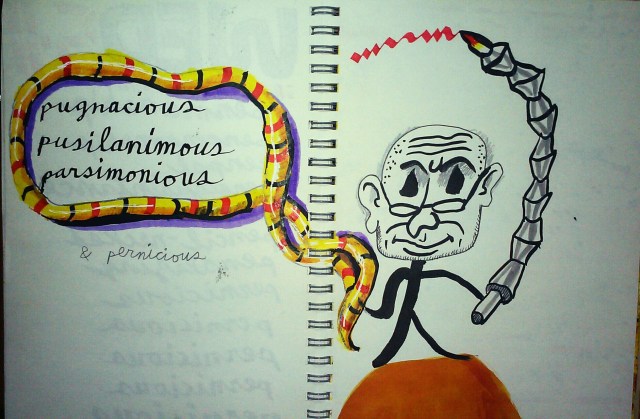
penmanship 101

20160512_035750-1~2

note to kids:  because there is no smell-checker for drawings, and visual artists frequently are not the world’s best spellers, the word “pusillanimous”, meaning ‘marked by contemptible timidity, cowardice’, has been misspelled above.  Sorry about zat.  Always spell that shit with two ‘els’, kids

A Note on Writing

I am a mostly unpublished writer so please feel free to ignore my opinions on the matter of writing.  I have acquaintances who’ve written for a living, and are much more qualified to opine about the profession of writing, even though I predictably dismiss their mercantile views.   They tend to be skittish about going near the deeper truth that is at the heart of the writing I love most. Their primary interest is in being good craftsmen and getting paid to write what the market demands.  

We have different ambitions when we write, different approaches to the truth, where it is, how we feel it, express it.  

That’s probably just the bitterness talking, of course.  Here’s the point.  Pat Conroy, days after he died, told me in a sound bite the reason that I write:  to explain my life to myself.  

If one is lucky enough to do this in a way others are interested in enough to read, buy, publish and sell, you are truly blessed.  If all you get is some peace and understanding for yourself from digging and writing this way, that’s better than being poked in the eye with a sharp stick too, as my father used to say.

From Conroy’s marvelous A Reading Life.  He describes a brilliant, demanding lover of books, a man who made his life about good writing and great books.   Conroy was a young writer when he first came into contact with publisher’s sales rep Norman Berg, a hard man who would become a lifelong friend, and he listened carefully to this older genius:

“You claim to be writing your first novel,” Norm said it in a voice that let me know he didn’t believe me.  

“I have,” I said, having written the first pages to the book that would become The Great Santini.  

“Does it tell me everything I need to know about leading a good life?” he asked.  “and I mean everything?”  

“No.”  

“Then throw it away.  It’s not worth writing.”  

“I’m twenty-six years old, Norman.  I don’t know everything in the world yet.”  

“That is good,” he said, softening.  “At least you know that much.  Keep writing.  If you’re lucky you’ll have one or two important things to say before you die.”  

“Here is one of them,” I said.   “Fuck you, Norman.”

(then, after describing the uncompromising older man’s eternal certainty, and fondness for Conroy’s spirited resistance to his implacable pronouncements, he comes to the beating heart of the matter)

“Always know which phase the moon is in,” he would say.  “Keep up with the transit of planets.  Know everything.  Feel everything. That’s your job as a writer.”  

“What’s your job, Norman?”  

“To suffer.  To feel everything in the world.  But it dies inside me.  I have no gift.  I can’t write.  That’s why I’m driving you crazy.”

Which makes such sense, it stopped me in my tracks, literally, there on Sixth Avenue where I paused in my listening to Conroy’s incantatory reading of his book on writing and reading.  I went to the library, to have the written words in front of me, to ponder and copy out for others to read.  This moment explained so much about the ungenerous side of the life of a supremely critical thinker, it almost made me laugh.

It happens that even gifted writers can also sometimes have this ungenerous gift for other writers, surprising as that may also sound.

Hats Off To Larry

Sometimes it’s good just to do something for the joy of it.  I pick up the guitar in that spirit sometimes, just for the happiness of making pleasing sounds come out of it.  I write this one today in that spirit, to remind myself of the only partly sardonic good luck I have to find myself me, given the alternatives.  

Last winter I went to court, dressed shabbily, I realize now, to represent a nattily dressed fellow who walked with a cane.  A very well-spoken man a lawyer friend of mine represented.  My friend had filed and served all the appropriate papers and made a motion for a judgment on default, since the defendant never answered any of his papers.  The judge needed to hear the damages to make an award and this would be done at a one-sided trial called an inquest.  My friend was not comfortable speaking in court, and since I was used to it, I examined the plaintiff at the inquest.  With me walking him through the story, and nobody to object that I was leading him, he told his story about an insensitive Bronx dentist who had treated him badly.

“And what did the defendant do when you told him you were in pain from the temporary cap that was cutting into your gums and cheek and making your mouth raw and bloody?”  I asked the plaintiff, in the manner of Fred Astaire leading Ginger Rogers.

“He told me ‘get the fuck out of my office’, excuse me, your Honor,” he turned quickly to the judge who nodded nonchalantly for him to continue.  “Then he called me cabron,” he repeated the entire Spanish phrase which he began to translate for the judge.

“I know what cabron means,” said the judge, “in English it’s cuckcold.”  

I nodded at the judge and the plaintiff and there was no reason to emphasize that what the hot-headed dentist had actually said was “get out of here man whose wife I fuck like every other man with a dick fucks, you dickless fucking fairy.”   No point, Judge, I confirmed with a glance.

“And after the police left and you told the dentist you would get a lawyer and sue him, what did he do?”  I asked with fake innocence, since anyone could tell I knew full well the answer to this twenty thousand dollar question.

“He picked up a stack of his business cards, threw them in my face and said ‘give these to your fucking lawyer, cabron, and get the fuck out of my office’,” I nodded with obvious sympathy.  The judge was impressed by the defaulting dentist’s cold-bloodedness.  I didn’t need to add what he would have said about the court, the judge, the law itself, if given the chance.

“Here, cabron, take these for that fucking homo judge who’s going to hear this case after I wipe my ass with your lawyer’s fucking legal papers, in fact, I have a box of a thousand business cards here, wait, here they are, and you can tell the judge to have a nice time and watch the paper cuts when he shoves all of them up his syphlitic asshole.  Now, go, and please, have a very nice day, cabron.”

 This would have been overkill, I thought.  In any case, it was unnecessary.  The judge, suitably inflamed, awarded a judgment against the dentist that was, with the 9% statutory interest, about $20,000.   When informed of the judgment against him the ill-tempered  dentist remained unconcerned.

I learned today that, pursuant to some papers we filed with banks and a marshal, $12,000 of Medicaid payments, on automatic deposit to one of the good doctor’s bank accounts, was seized by the marshal.   My friend and I will split a third of that sum.  “Ha hey!” I said, “better than being summoned for jury duty.”

I called a friend who is actively concerned about me.  I don’t blame him for being concerned and wanted to give him a little upbeat news.  When I told him the story he was very happy.  When I told him I’d write it up and send it to Larry, maybe get another $250 for it, he laughed.   Then I told him, quite seriously, that I’d return to my regularly scheduled pissing and moaning now and he wisely rang off.

The good news cheered me up briefly, I have to admit.  But I’m over it now, and looking for new thrills today.


De gustibus

The young musician often played for her father and was always dismayed at his lack of reaction.  He showed no pleasure, no appreciation, nothing.   He sat, politely, and never said anything afterwards.

Many years later, as he was dying, he said to his daughter “I’m sorry, I just never liked music.  Any music.”  

She blinked at him, and he added “it wasn’t you, it was me.”  

A light went on in the room, a glow of important insight illuminated the death chamber for a moment.  In another wink, the old man was gone.

Snapshots

These tiny images of frozen moments, the way we remember life.  I am often reminded how great my memory is, which makes me feel like a fraud.  In my mind, I remember almost nothing.  Less than a millionth, I’d suspect, of what I have lived, remains in my memory.  There are odd bits, sometimes, that I remember in great detail.  They are like snapshots.

I have a few new ones now.  An old friend, wrapped in his prayer shawl, praying in the remote Jordanian desert at dawn.  The radiant face of a young beauty in the ancient tourist shrine Petra, posing irresistibly near a desert weed I was photographing.  The Seven Pillars of Wisdom, a magical mountain.  The fisherman’s expressive face as he held court in his little open fronted restaurant, a hundred meters from the sea.  There are other photos in there, those baby ibexes, no bigger than small dogs, looking for food from smiling humans under the “Do Not Feed The Ibexes” sign.  A small fox leaping across the road near the national park called Appolonia over the beach at Herzliya.  The skinny dog in Petra who accompanied us for miles, seemingly just for the companionship as he went about his rounds, looking for good garbage to eat.  

Some cannot be unseen.  The little Jordanians firing rocks at our dog escort, cursing him, as he yowled piteously and took off.  Thankfully Sekhnet missed that one.  She cried when I told her about it.  I did not need to tell her of the one we all saw the next day, the large pale ass of the man, squatting directly in front of his car (instead of on the side where he would have been out of sight) poised to take a shit on the shoulder of the road up from the Arava desert to Mitzpeh Ramon.  I was praying as we passed that I would not see the turd dropping from the grotesque vertical smile.  My prayer in that case was answered.

There was that great moment with the woman we were visiting, her head thrown back in a great laugh, I don’t remember over what, though I recall laughing too.  That one was caught by the ever ready Sekhnet, whose phone is a better camera than most cameras. 

These snapshots remain, along with some beautiful views.  I think they will be in there for a long time now, along with some of the actual photos we snapped.