First attempted opening to the Book of Irv

My father was like Zelig, a peripheral character uncannily at the center of some of the most important events of the tumultuous twentieth century.  His life is a great illustration of many difficult things and the light it can shed on other lives is considerable.  I can’t overestimate the light it sheds on mine, even as it’s been a life’s work, so far, to fully view everything it reveals.  He imparted enduring moral values and a humanistic worldview to my sister and me, even as he placed enormous obstacles in both of our paths.  

The dramatic arc of Irv’s life story, this likable underdog’s tremendous potential, notable achievements and terminal bitterness, is a tragedy that compels me to put things into a perspective I can use as I trudge toward old age, which does not tarry in its inexorable creep.   I remember the world of my childhood and the changes in the decades since.  The changes of our lifetime are like an echo of the titantic changes that took place during my father’s eighty years.

Born in New York City in 1924, young Irv walked into a small town kindergarten unable to speak English and was promptly mocked by his tiny classmates and punched in the face by the Great Depression.  His family, already poor, became unspeakably more poor, the poorest family in that wretched little town.  He was drafted and served in World War Two, while virtually his entire family was being wiped out by Nazis.  Against all odds he went on to get a graduate degree in History from prestigious Columbia University and remained committed to helping bend the moral arc of history toward justice while he worked hard to build a respectable middle-class life.  He then raised two kids while watching his idealism turn largely to dust over the next four or five decades.  Seeing his life’s hard work slipping down the drain did nothing to enhance his serenity during his golden years.

My father was supremely sensitive, a lover of animals, of the underdog, friend of the oppressed and an eloquent fighter for the weak.  As a young public school teacher in New York City he spoke to parent-teacher groups in support of school integration after the Supreme Court, in Brown v. Board of Ed, finally admitted the obvious, that “Separate but Equal” was a pernicious fiction that needed to die.  My young father was greeted as a “nigger-loving fucking Jew Commie” and attacked by parents and teachers alike in the cafeteria of the first NYC public school where he spoke in support of school integration in the late 1950s.  After that first scare he was accompanied by two NYC cops at the other schools where he spoke.  He later worked in a special unit at the NYC Board of Education that intervened in riot-torn high schools, and solved problems in school after school, even though the peace did not endure anywhere.

My father was scarred beyond healing by a childhood of grinding poverty, emotional and physical abuse, finished with a tart note of small town anti-Semitism.  His wounds and his great intelligence combined to make him a fierce and formidable fighter.  His most enduringly destructive battles were conducted across the dinner table in the little house he owned.  A man with a great, dark wit, a deep reservoir of compassion, able to grasp subtle nuance, he also saw the world as an eternal struggle between right and wrong and was unable to refrain from total war, especially with his children, though he’d regret this greatly, and explicitly, the last night of his life.

As my father’s most dependable adversary I was groomed from before my first memories to fight the way a pit bull puppy is trained to do battle.  The pit bull is a cute dog, trusting, loyal and friendly by nature.  It takes a great deal of calculated cruelty to transform this animal into a vicious prize-fighter.  Young pit bulls raised to fight are tortured until they become enraged enough to rip another dog’s throat out.  My father, a good man who loved the souls of animals, was horrified by such things, though he did things to his wife and children that were equally terrible.

F. Scott Fitzgerald rightly defined first-rate intelligence as the ability to hold two contradictory thoughts in mind at the same time.  My father was a good man, in some ways a great man, who frequently did terrible things to those he loved.  My father was a flawed and deeply wounded man who could not help but destroy, even as he did the best he could to protect those he loved.  He was brilliant, he was an idiot.  He was a kind and thoughtful man, he was a fucking sadist.  He was the best of husbands and fathers, he was the worst of them.  

He was an unshakably honest man, even as he denied the reality of the mass-murder of most of the family to his nine year-old son.  My father led the nation’s largest Zionist youth movement after his retirement from teaching, was a proud Jew, even as he told his young son to stop whining when the boy learned about the murder of his mother’s twelve aunts and uncles, in addition to most of his father’s family, executed and buried in mass graves only thirteen years before the kid was born.   There is no contradiction in any of this, even as it has taken me the better part of six decades to grasp this eerily simple fact.

Only a gullible school child, or a person raised to be an uncritical consumer of any toxic product that is winningly advertised,  could believe only the good about any hero.  There is no such thing, except in our longings, as a purely good hero.   Andrew Jackson, remembered as a beloved man of the people, a champion of participatory democracy, friend of the common man, was also a cunning land speculator who seized millions of acres from people he killed and used his government position to become fantastically rich while trading slaves, a vicious racist betraying allies while slaughtering Native Americans, indulging a psychotic rage whenever the mood was on him.   Gandhi, Thomas Jefferson, Martin Luther King, Mother Theresa, choose your hero, every one of them three dimensionally human.  We all have different sides to us.  The good within a person is always in a struggle to overcome the shabbier impulses.  Those we admire the most do the best job in that struggle.   Or anyway, the ones I admire the most do that.  

The biographers I admire the most, like Jane Leavy in her great book on Mickey Mantle, give us all the reasons to love and admire the protagonist while also unflinchingly providing the terrible specifics of their human flaws.  On the same page we have all the evidence that the beloved Mantle was a loyal, generous, heroic man with a great sense of humor and that he was a haunted, irredeemable asshole well-justified in his self-hatred.  A man capable of great kindness and touching gentility, he was equally adept at literally farting in the face of a young Yankee fan clutching a score card in her little hand.   “Oh, Jesus, I did that?” he said sheepishly to the little girl, now a grown-up sports writer and a supremely talented biographer.

I devoured that book greedily, thinking “fuck…” over and over as I read about one of my childhood heroes, liking him no less, understanding him much more.  I aspire to do something similar telling the story of my father’s forgotten life.  It is a life that deserves not to be forgotten.
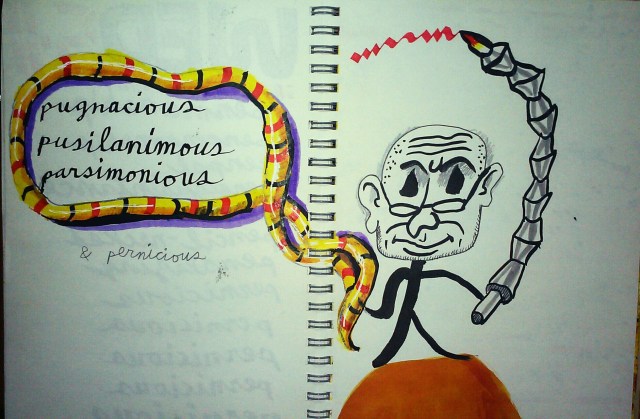
penmanship 101

20160512_035750-1~2

note to kids:  because there is no smell-checker for drawings, and visual artists frequently are not the world’s best spellers, the word “pusillanimous”, meaning ‘marked by contemptible timidity, cowardice’, has been misspelled above.  Sorry about zat.  Always spell that shit with two ‘els’, kids

A Note on Writing

I am a mostly unpublished writer so please feel free to ignore my opinions on the matter of writing.  I have acquaintances who’ve written for a living, and are much more qualified to opine about the profession of writing, even though I predictably dismiss their mercantile views.   They tend to be skittish about going near the deeper truth that is at the heart of the writing I love most. Their primary interest is in being good craftsmen and getting paid to write what the market demands.  

We have different ambitions when we write, different approaches to the truth, where it is, how we feel it, express it.  

That’s probably just the bitterness talking, of course.  Here’s the point.  Pat Conroy, days after he died, told me in a sound bite the reason that I write:  to explain my life to myself.  

If one is lucky enough to do this in a way others are interested in enough to read, buy, publish and sell, you are truly blessed.  If all you get is some peace and understanding for yourself from digging and writing this way, that’s better than being poked in the eye with a sharp stick too, as my father used to say.

From Conroy’s marvelous A Reading Life.  He describes a brilliant, demanding lover of books, a man who made his life about good writing and great books.   Conroy was a young writer when he first came into contact with publisher’s sales rep Norman Berg, a hard man who would become a lifelong friend, and he listened carefully to this older genius:

“You claim to be writing your first novel,” Norm said it in a voice that let me know he didn’t believe me.  

“I have,” I said, having written the first pages to the book that would become The Great Santini.  

“Does it tell me everything I need to know about leading a good life?” he asked.  “and I mean everything?”  

“No.”  

“Then throw it away.  It’s not worth writing.”  

“I’m twenty-six years old, Norman.  I don’t know everything in the world yet.”  

“That is good,” he said, softening.  “At least you know that much.  Keep writing.  If you’re lucky you’ll have one or two important things to say before you die.”  

“Here is one of them,” I said.   “Fuck you, Norman.”

(then, after describing the uncompromising older man’s eternal certainty, and fondness for Conroy’s spirited resistance to his implacable pronouncements, he comes to the beating heart of the matter)

“Always know which phase the moon is in,” he would say.  “Keep up with the transit of planets.  Know everything.  Feel everything. That’s your job as a writer.”  

“What’s your job, Norman?”  

“To suffer.  To feel everything in the world.  But it dies inside me.  I have no gift.  I can’t write.  That’s why I’m driving you crazy.”

Which makes such sense, it stopped me in my tracks, literally, there on Sixth Avenue where I paused in my listening to Conroy’s incantatory reading of his book on writing and reading.  I went to the library, to have the written words in front of me, to ponder and copy out for others to read.  This moment explained so much about the ungenerous side of the life of a supremely critical thinker, it almost made me laugh.

It happens that even gifted writers can also sometimes have this ungenerous gift for other writers, surprising as that may also sound.

Hats Off To Larry

Sometimes it’s good just to do something for the joy of it.  I pick up the guitar in that spirit sometimes, just for the happiness of making pleasing sounds come out of it.  I write this one today in that spirit, to remind myself of the only partly sardonic good luck I have to find myself me, given the alternatives.  

Last winter I went to court, dressed shabbily, I realize now, to represent a nattily dressed fellow who walked with a cane.  A very well-spoken man a lawyer friend of mine represented.  My friend had filed and served all the appropriate papers and made a motion for a judgment on default, since the defendant never answered any of his papers.  The judge needed to hear the damages to make an award and this would be done at a one-sided trial called an inquest.  My friend was not comfortable speaking in court, and since I was used to it, I examined the plaintiff at the inquest.  With me walking him through the story, and nobody to object that I was leading him, he told his story about an insensitive Bronx dentist who had treated him badly.

“And what did the defendant do when you told him you were in pain from the temporary cap that was cutting into your gums and cheek and making your mouth raw and bloody?”  I asked the plaintiff, in the manner of Fred Astaire leading Ginger Rogers.

“He told me ‘get the fuck out of my office’, excuse me, your Honor,” he turned quickly to the judge who nodded nonchalantly for him to continue.  “Then he called me cabron,” he repeated the entire Spanish phrase which he began to translate for the judge.

“I know what cabron means,” said the judge, “in English it’s cuckcold.”  

I nodded at the judge and the plaintiff and there was no reason to emphasize that what the hot-headed dentist had actually said was “get out of here man whose wife I fuck like every other man with a dick fucks, you dickless fucking fairy.”   No point, Judge, I confirmed with a glance.

“And after the police left and you told the dentist you would get a lawyer and sue him, what did he do?”  I asked with fake innocence, since anyone could tell I knew full well the answer to this twenty thousand dollar question.

“He picked up a stack of his business cards, threw them in my face and said ‘give these to your fucking lawyer, cabron, and get the fuck out of my office’,” I nodded with obvious sympathy.  The judge was impressed by the defaulting dentist’s cold-bloodedness.  I didn’t need to add what he would have said about the court, the judge, the law itself, if given the chance.

“Here, cabron, take these for that fucking homo judge who’s going to hear this case after I wipe my ass with your lawyer’s fucking legal papers, in fact, I have a box of a thousand business cards here, wait, here they are, and you can tell the judge to have a nice time and watch the paper cuts when he shoves all of them up his syphlitic asshole.  Now, go, and please, have a very nice day, cabron.”

 This would have been overkill, I thought.  In any case, it was unnecessary.  The judge, suitably inflamed, awarded a judgment against the dentist that was, with the 9% statutory interest, about $20,000.   When informed of the judgment against him the ill-tempered  dentist remained unconcerned.

I learned today that, pursuant to some papers we filed with banks and a marshal, $12,000 of Medicaid payments, on automatic deposit to one of the good doctor’s bank accounts, was seized by the marshal.   My friend and I will split a third of that sum.  “Ha hey!” I said, “better than being summoned for jury duty.”

I called a friend who is actively concerned about me.  I don’t blame him for being concerned and wanted to give him a little upbeat news.  When I told him the story he was very happy.  When I told him I’d write it up and send it to Larry, maybe get another $250 for it, he laughed.   Then I told him, quite seriously, that I’d return to my regularly scheduled pissing and moaning now and he wisely rang off.

The good news cheered me up briefly, I have to admit.  But I’m over it now, and looking for new thrills today.


De gustibus

The young musician often played for her father and was always dismayed at his lack of reaction.  He showed no pleasure, no appreciation, nothing.   He sat, politely, and never said anything afterwards.

Many years later, as he was dying, he said to his daughter “I’m sorry, I just never liked music.  Any music.”  

She blinked at him, and he added “it wasn’t you, it was me.”  

A light went on in the room, a glow of important insight illuminated the death chamber for a moment.  In another wink, the old man was gone.

Snapshots

These tiny images of frozen moments, the way we remember life.  I am often reminded how great my memory is, which makes me feel like a fraud.  In my mind, I remember almost nothing.  Less than a millionth, I’d suspect, of what I have lived, remains in my memory.  There are odd bits, sometimes, that I remember in great detail.  They are like snapshots.

I have a few new ones now.  An old friend, wrapped in his prayer shawl, praying in the remote Jordanian desert at dawn.  The radiant face of a young beauty in the ancient tourist shrine Petra, posing irresistibly near a desert weed I was photographing.  The Seven Pillars of Wisdom, a magical mountain.  The fisherman’s expressive face as he held court in his little open fronted restaurant, a hundred meters from the sea.  There are other photos in there, those baby ibexes, no bigger than small dogs, looking for food from smiling humans under the “Do Not Feed The Ibexes” sign.  A small fox leaping across the road near the national park called Appolonia over the beach at Herzliya.  The skinny dog in Petra who accompanied us for miles, seemingly just for the companionship as he went about his rounds, looking for good garbage to eat.  

Some cannot be unseen.  The little Jordanians firing rocks at our dog escort, cursing him, as he yowled piteously and took off.  Thankfully Sekhnet missed that one.  She cried when I told her about it.  I did not need to tell her of the one we all saw the next day, the large pale ass of the man, squatting directly in front of his car (instead of on the side where he would have been out of sight) poised to take a shit on the shoulder of the road up from the Arava desert to Mitzpeh Ramon.  I was praying as we passed that I would not see the turd dropping from the grotesque vertical smile.  My prayer in that case was answered.

There was that great moment with the woman we were visiting, her head thrown back in a great laugh, I don’t remember over what, though I recall laughing too.  That one was caught by the ever ready Sekhnet, whose phone is a better camera than most cameras. 

These snapshots remain, along with some beautiful views.  I think they will be in there for a long time now, along with some of the actual photos we snapped.

Childhood Memory (flashback to 1963 or 1964)

My mother, seeking to protect her sensitive, fearful oldest child, urged me not to see the movie scheduled for the hotel ballroom that evening, “Let My People Go”.   I knew nothing about the film, except that all the teenagers at the convention would be seeing it.  I was seven or eight, and curious, and I wanted to see the movie, which was the only thing to do that evening anyway.

“You’re too young to see these things,” my mother told me tensely, “when you had nightmares about Tarzan I could show you pictures of the actors, assure you it wasn’t real.”   Which was true, she’d gone to the library and found books that proved her case.  After her photographic proof that the actors who played the savage cannibals wore regular clothes, drove cars, laughed, played with their own kids, spoke English, the nightmares in which my mother, like Jane, was struck down by a cannibal’s hurled spear, stopped.  

That strategy had also worked a few years earlier when terror of another flood like in the time of Noah, vividly depicted by a children’s book illustrator with an Italian name my mother always recited in connection with this story — ah!  Tony Palazzo!– kept me awake at night.   She drove me past rows of houses on the beach and my fear succumbed to Reason.  

“But these things in the movie really happened, and not that long ago, and they were horrible, and I don’t think you’re ready to see them.”   And she was right, but having been told many times by my childish, blustering father that I was not too young to start acting like a man, goddamn it, I was determined to see the move come hell, high-water or spear throwing cannibals.

The movie started innocuously enough, woodcuts and old paintings, mosaics, pictures of ruins, a narrator detailing the ‘lachrymose history’, as I’d later come to know it, of the tireless persecution of the Jews.  There were the pyramids, built by Hebrew slaves, a familiar story to me, nothing shocking there.  The destruction of the Temple in Jerusalem by the Babylonians, not a trauma to me, I thought smugly to myself.  The subsequent exile, I was young to grasp how traumatic this might have been.  The Romans destroyed the rebuilt temple, OK, that’s a shame, but I didn’t like going to temple anyway.  

The movie was clearly building to something, I was not too young to miss the terrible foreshadowing as the persecution and exile of ancient times became a steadily heavier drumbeat.  Now some crude depictions of Jews put to the sword during the rise of warlike Islam, pretty bad, but just drawings.  In Christian Europe, meanwhile, the Dark Ages had descended, harsh, brutal lives lived under the pall of monkish ignorance and superstition, and the Jews to blame.  By the Middle Ages the Jews were entrenched in collective Christian consciousness as the crucifiers of Jesus Christ, the son of God and the Christian Messiah.   That we were blamed for killing the Messiah came as a shock to me, I’d always thought the Messiah hadn’t come to earth yet, that once the Messiah arrived the hearts of children would be returned to their parents, forgiveness would be universal and there would be no further violence or cruelty, no death.

The torturers and hooded Klansmen of the Spanish Inquisition stood out to me, the auto de fe, trial by being burned to death, was truly horrible.  Things quickly escalated from there, pogroms, the music got more tense, and soon there were some black and white photographs.  In Russia, blood libels against Jews, claims that Jewish monsters killed Christian children to make matzoh on Passover.  This made no sense to me, even an idiot knew that matzoh was basically flour and water, where did the dead Christian child come into it?  A photograph of a grim French military man, falsely accused of treason against France and executed, though everyone in France, and everywhere else, knew he’d been set up because he was Jewish.  Theodore Herzl’s photograph, with that beard practically begging to be carved in marble, the dream of a Jewish State and now the filmmakers kicked into high gear.  This is what they’d been building up to.

Centuries of persecution of a small, decent people, driven from their homeland, vilified and hated everywhere they settled, expelled from Spain and every place else, murdered with impunity– there was only one solution: a return to our homeland.  This would not be without struggle, in part because those on the land that would be our homeland considered it their homeland, not ours.  Deals were made, land bought, proposals made, unmade, snags hit, navigated, more snags.  Nobody, it was clear by now, was in any hurry to help the Jews.  

Meanwhile, more killing of Jews in Europe, persecutions in the Arab lands.   Suddenly, oh boy, there’s a familiar Jew hater– Adolf Hitler.  I had a feeling he’d show up in this shit show.  There he is, dancing a mad jig after the fall of Poland.  Turns out this ‘jig’ was the creation of Allied propagandists using a technique I myself would use decades later, repeating a sequence of frames over and over and speeding them up to achieve a desired effect.  These propagandists took a one second sequence of Hitler laughing and stamping his jackbooted foot and repeated it enough times to create a convincingly mad, cackling dance.  I knew nothing about this trickery, an insignificant detail in context, as I watched in rising horror.  

The violins on the soundtrack began weeping more emphatically.  Then, as I looked around me at crying teen-aged faces in heavy cigarette smoke, there was the footage, shot by the Nazis themselves, of exactly what my mother had cried to try to stop me from seeing.  A terrified boy my age with his hands up, savage beatings, Jewish corpses lying on the sidewalk.  This was terrifying imagery.  Then there was the guy with the wheelbarrow, on grainy black and white film, moving resolutely forward.  The giant wheelbarrow was filled with jiggly, rubber looking skeletons.  He was wearing a cap and smoking a cigarette.  He came to the edge of a huge pit, upended the wheel barrow and dropped the corpses down a chute.  They wriggled down the ramp, landed on top of hundreds more naked dead skeletons.  

I ran up the aisle through the crying audience, got to the elevator, to the room, saw my little sister’s shocked face as I burst into the room and, a second later, projectile vomited.  My mother hugged me, crying, and said “I told you….”

Get Away from the Screen

Excellent advice, read after my timer went off, 48 minutes of cleaning picked at, when I popped back on to the screen.  

Do you see any significant clearing in the tangled undergrowth of your desk, your kitchen table, your chair?   That tangle on the floor next to and behind the chair?  The precarious pile of boxes, paper, musical instruments and effects balanced next to the chair?    

Another 48 minutes for the timer, your back into it this time, instead of looking hopefully at the screen for something that will distract the mind.  There is a rich universe of things here for distracting the mind, although rich is probably the wrong word for the kaleidoscope up here on the screen.

Very well, 48 more, let’s go.

Tenterhooks

I don’t know what they are, exactly, but goddamn them.  Time running out, whipsawed between waiting for a promised immediate definitive call back from a well-meaning woman at the credit card company with slightly insufficient attention to detail and a long trip by subway, bus and foot to allay, to the extent I can, the stress of someone I’ve stressed out by my own slightly insufficient attention to detail lately.

Seeking to reduce her stress, I am on tenterhooks, real or imagined, since I need to leave and was just promised that if I stay I’ll get an immediate call back with a definitive answer I don’t absolutely need until around 9 Central Time (it’s 4:14 Central Time now).  

Time to use my imagination to cast the tie-breaker against reality, whatever that may be.  Here we go:  I can imagine myself on the subway, standing now, since it’s rush hour, listening to a podcast, not minding a bit.  I can imagine finding a vexingly lost item where I hope it is when I get back to the farm, having time to make a surprise dinner for my stressed out, exhausted partner who will be particularly happy to see me if my vexing stories turn out to have happy endings.  

And if not, misery, as they say, loves company.   Y’allah, let’s get the show on the road! 

We complement each other

Sekhnet’s one-time friend, a likable quack she came to refer to as a ‘caboose’ because of the drag he exerted on the rest of the train, once did astrological charts for her.  He did not live by the stars, but had a lifelong interest in them and a fond belief that they held deep secrets for the mortals rushing about below.  He did two charts for her; one for her and one for me, her, then, new love.

Each chart was arranged in a circle, like a clock face, or a pie.   Sekhnet’s  pie was almost completely eaten on one side, solid pie on the other.  My chart was the mirror image, wherever she had pie, my tin was empty, where mine was empty, her’s was full.  

“These charts show two complementary souls,”  he reported happily, “look at how you complete each other!  This is the strongest bond you can have with another person.”  She was happy to believe this and I smiled to see her so happy.  Our bond is, indeed, very strong.

We are, in some fundamental way, like complementary angles, you dig, or properly aligned magnets, or any number of analogues from the world of science.   Adding our strengths and weaknesses together forms one very strong, complete composite person, though that person may be a slightly mad one.   I have noticed many things that seem to prove this complementary thesis.

Deadlines, for example, which famously trouble people, in part because of their sweaty similarity to death.  Sekhnet and I are on opposite ends of the spectrum on these.   Though we both complete absolute necessities by the deadline, our approaches are completely different.  

I give myself an arbitrary deadline, say 3:00, which, as I  glance at the clock now, I see is rapidly coming up.  OK, I have thirty minutes and then I must make those calls I’ve been putting off for two, or three, or six weeks.  At 2:55 I realize it will be impossible to make those calls by 3:00 and I will generously extend the deadline to a more comfortable 3:30.  I feel merciful having done this, and continue whatever else I was doing until… oh, crap, 3:29.  

Would 4:00 work better for you?  I ask myself.  Oh, yes, I answer, relieved, and then we both smile and: 4:00 it is!  In the end I put it on the list for tomorrow, with only the smallest pang of regret.   This is not the recipe for ambition, I understand, but it is how I tend to do it– unless there is some pressing external reason I must have the thing ready by a certain date and time.

Sekhnet is exactly the opposite.  She is tormented every day to know she will meet only a tiny fraction of the hundred deadlines she sets herself every day.  She may accomplish several big tasks in a given day, things that have been bothering her, but that is almost never a reason for self-congratulation or relief.  When I try to pat her on the back she is not having it.  She is quick to point out that she did not accomplish many more tasks, which must now be added to the long list for the following day.  When I try to comfort her she will not take comfort, not from someone who hasn’t made any of those two minute calls he wanted to make two months ago.

Reminds me of other stressful situations where I try to reassure her when she becomes anxious.  I’ve taken to adding a semi-humorous caveat to my reassurances, it sometimes works very slightly.  “Don’t worry,” I urge her, “… said Nearly Headless Nick….”  And I put my arm around her, my head lolling slightly to one side, where the neck has been hacked.

Oh, crap!  It’s 2:53.  I’m late!