She corrected my sloppy writing (take two)

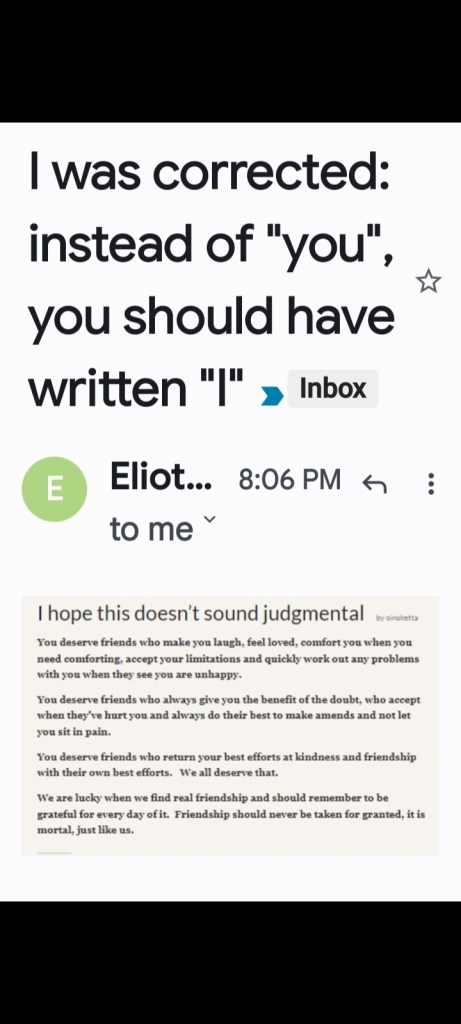
“instead of ‘you,’ you should have written ‘I,’ ” she said, confidently.

It goes without saying, she said with that terse, global editorial improvement, that only a weak, needy person like me would require this type of hyper-empathetic friend. It takes one to know one, if you know what I’m saying, darling.

And as for why it’s so hard to get over this kind of thing, which happened almost a year ago — the intolerable shock comes back again and again because it’s so hard to internalize that someone you loved, someone who loved you, could decide, for all the world, that you are fucking dead.

Dead men tell no tales.

Narcissism

A constellation of consistent emotional incapacities leading to zero-sum relationships which are only conflict free as long as you remain conciliatory. Any conflict, should it arise, will be fought to the death, the carnage blamed entirely on you.

Word to the wise: get out.

A specific use of the word “beautiful”

I am about fifty pages into trying to put this real-life horror movie into book form, this story of cooties in the kindergarten playground, dictated to me, with an air of inevitability I can now almost taste, by a group of old friends, every detail exactly perfect as it happened. If by perfect we mean “beautiful” in the sense certain Ukrainian Jews used to use the word beautiful.

One example of this special use of “beautiful” was the explanation given to a Ukrainian Jew, in 1942, about why a Ukrainian policeman had to shoot a young Jew who had stolen bread. The Jew, who saw the policeman leading the boy away at gunpoint, had sought to save the kid’s life. He tried to convince the policeman, a man he knew, to punish him in a less extreme way, perhaps a beating and a fine. The Jew described how the policeman explained himself, “in a beautiful way.”

Let’s say I fine him,” said the policeman, “and he can’t pay the fine. And we both know he can’t pay the fine, that’s why he stole bread. So if I let him go with a fine that he can’t pay, am I really doing him any kind of favor? Things will go very badly for him in a very short time, with the SS, and I’ll also be in trouble. So by shooting him, I’m actually performing a kind of mercy, it’s better all around, for everybody.”

When I describe the story that a group of my lifelong friends have dictated to me as beautiful, this is the sense in which I mean beautiful.

Message from the Holy Land

Dearest Elliot [sic],

I got your letter yesterday and after trying to read the whole thing a few times, I stopped and just slept on it.

I tried to think about why you were writing it and why to me.

I can’t say I was able to make sense of it, but my heart clearly understood. 

I felt how much pain you are in and how deep your suffering goes. It obviously didn’t begin with the event that triggered your divorce from your bosom buddy and the community that came with him. It began way back within your own family and all the unfinished business you carry like an albatross throughout all your relationships and life.

The letter was more like a purge than an invitation to a conversation. 

I also don’t believe there’s anything I can say to you that will assuage your suffering. If you’re willing to unpack it all, you have to see a professional.  I can tell you that Ilan found his peace many many years ago through meditation. I can attest to the change the man internalized over the years and the impact it has had on our life together. 

If you’re comfortable with just being ‘right’ you’ll spend your life brewing and it will take it to the grave. If you want to find your peace, you know what you have to do. If you want to face your demons you have to find a neutral setting and do all the hard painful work that it takes. You can’t change all the people in your world, but you can change yourself and heal.

Think about it Elliot [sic]. Do you want to throw away the remainder of your years by being angry, by being ‘right’ or do you want to find your peace.

Only you have the answer. 

With much love,

Redacted

I replied with more explanation of why I’d been so hurt and so forth. That night I had a call from the Flying Monkey, Redacted’s best friend and confidant. After that loving chat, I had no choice but to amend my reply:

Oh, one last thing.  You asked why I sent you the pages you could make no sense of.   A reason I forgot to mention in my previous email is that I consider you perhaps the sharpest and most perceptive person in the circle.  I was hoping for understanding, which, clearly, you could not provide.

In replying to you a few days ago I made the same stupid mistake I’ve been making all along, since that hideous year bookended by two angry Yom Kippurs.  I tried to use reason to persuade someone who had clearly made up her mind, based on the other party to my ugly “divorce” from X/Y having already persuaded everyone we know in common that they behaved perfectly and Eliot is, alone in the history of divorce and every other conflict, entirely to blame for everything that happened.  When he’s frustrated he says the fucking f-word!  And worse!

It was very clear from your moralistic response that you follow that interpretation, only one party has behaved aggressively and immaturely (from my point of view, I am not that party, of course – and I have the receipts, if anyone who has judged me unworthy of friendship were interested in being fair, or empathetic). 

Consider for a second: if I was the enraged person you portrayed in your pitying judgment, would I have reacted as mildly as I did to what can fairly be seen as the judgment of someone who feels infinitely superior to me?  Based on a false account imparted during a successful attempt to assassinate my good name among people I have long loved, listened to, made laugh?   No feelings I might have about being unfairly judged and banished by an entire group of old friends, most of whom I never had a hint of a quarrel with, are appropriate — except as manifestations of a need for intensive psychiatric work?  

When someone you care about is upset, you ask them what happened, you listen to them.  You offer to help, if you can. 

When someone is upset and you tell them they have no right to be upset, that they are wrong, and immature, and irrationally clinging to childhood pain, and unable to get past their previous abuse, are aggressively angry, unforgiving, hellbent on being right at all costs and trying to change everyone in the world but themselves, and are unwilling to do the hard work everyone else in pain has presumably done to become more fully human — well, you really shouldn’t sign that kind of message “much love,” darling.

I’ll leave our dear friend the final word on this ugliness (well, me, actually, but you know how I am).

The only way to flush these hard feelings, dear Seedj, is by having the last word in a quiet battle with self-righteous, toxically clannish pinheads.

[Part two is here]

Dream from the book

I was sitting in the front row of a good sized theater, like a large university lecture hall, a movie of some kind was playing on the screen. The lights in the room were also on and nobody in the room seemed to be paying much attention to what was on the screen. There was general conversation going on throughout the hall.

In the row behind me sat the adult son of old friends of mine, a good looking young man with a bison-sized head, even more so in the dream. We were chatting amiably when he leaned forward, inclining his impressive head until his chin rested heavily, but affectionately, on my shoulder.

He told me quietly, into my ear, that I’d gotten him into hot water with his parents, by telling them about some homemade cannabis edibles I’d sent him recently. His parents, long time enjoyers of good cannabis, were apparently militantly anti-cannabis these days and I’d compromised him by outing him with my loose lips.

I apologized, assured him that the last time we’d seen each other, his father and I’d smoked a joint together. I told him I was sorry to have put him in hot water by my unintended indiscretion. Then I imparted my own news, his father and mother had withdrawn all meaningful signs of their friendship from me, after fifty years.

Suddenly, cinematically, he was seated in the last row of the amphitheater, covered by the same blue blanket the rest of his college classmates in the seats around him were draped in.

“Are you writing the book?” he asked, his voice as clear and close as when he was seated next to me. I told him I sure was.

We spoke back and forth for a moment until I told him I was uncomfortable having this kind of private conversation by calling across a large, crowded room.

It was good seeing him.

Trauma is visceral

If you have experienced trauma, and I hope you never have, you will know that you feel it in your body.

You will feel it, sharply, in your lungs, or your heart, your spine, your skin, in various internal organs. Trauma is experienced viscerally. If you have the misfortune to know trauma, you know that it is awful, disorienting, terrifying shit that feels like drowning or being electrocuted.

To convey the experience of trauma, I think it’s necessary to make the reader feel some measure of how extreme and unbearable the feeling is.

The description of trauma needs to be a bit visceral too. To say that it is blindly terrifying fucking shit is a little more accurate than describing it as extremely discomfiting and acutely painful.

I wrote a post recently that was intended to convey the traumatic feeling of being of being betrayed and vilified by people you love, people who claim to love you, people you trust, who insist they love you while brutally blaming you for their own incapacities. If you have experienced this particular trauma you will know how truly fucking soul destroying the experience is.

So while I can say it hurt terribly when these people unfairly judged me, shouted me down, threatened me, vilified me and did their best to destroy my reputation among our mutual friends, I can convey the experience more accurately by describing it as my lifelong friends exerting all their powers to convince people who are fond of me that I am Adolf Hitler incarnate.

That is the best way I know to conjure the to-the-death zero sum game one is up against with people who will pay any price not to feel they have ever been wrong. There is always a certain percentage of these merciless people in the population, sad to say, and their particular genius is manipulating you to make you question things that are actually beyond question. A sudden transition into Hitler underscores the absurdity of a childish insistence on being right, no matter how ridiculous you must make your claim to righteousness.

It feels essential to me, in describing a complex emotion so terrible, to include an element of discomfort to convey the specific deadly truth of that inescapable trap. If the description is not somehow a bit unsettling, I don’t think the reader can fully understand the particular pain that I’m trying to convey.

The pain of blaming yourself, somehow, for failing to fix a problem you didn’t create and that nobody alive can fix, except maybe the person blaming you.

It is two different things to say my friends betrayed and vilified me or my friends insist that if I deny I am Hitler that proves I am Hitler.

The second description captures much more closely the mindfucking experience I am trying to convey to the young woman I was addressing in the post about our respective traumatic mistreatment at the hands of the same couple. For her this couple was her mother and father, for me this couple was my two closest friends for 50 years, or so I believed.

Let me put it this way, if you find yourself in a disagreement or conflict with people who love you there is always a way to resolve things peacefully, unless one of the parties is incapable of admitting fault for anything, because to admit wrongdoing is humiliating to some. If you absolutely cannot admit fault you must deny the hurt of the other person, and since it is impossible that you caused it, the pain must therefor actually be the fault of the person who is suffering and making you feel bad about yourself.

So it is not that the hurt person who is seeking to resolve things with you is simply wrong, a jerk, or some kind of generic doody head. The other person must be irredeemably evil, a compulsive liar, adamantly stubborn, viciously determined to win at any cost, capable of any insane atrocity, for example recruiting an army of fanatics to build huge industrial camps to murder as many people as possible in the shortest amount of time. In short we are talking about Hitler here.

It’s some sick shit, I understand, but it also is what a zero sum worldview is, sad and horrible as it is to say or write. So referring to myself as Uncle Hitler, even while giving what seems to be compassionate counsel to someone I know to be suffering from something I myself experienced from the same couple, aside from the dark, Jewish irony of it, compresses all that in the best way I know, distasteful as it also, undoubtedly, is.

If someone is not a monster like that, there is always hope of resolving whatever the problem is. If someone is Hitler, you are absolutely right to declare them dead to you and nobody will ever fault you for it. Lest you think that I am projecting, and casually doing the very thing that I hate, I have always proved myself willing to endure a great deal of frustration to try to make peace, until it is clear to me that I am being treated as an implacable enemy. Once you see that, in my experience, the only road is away from that person, no matter how much you may have shared and loved.

Belated Happy Birthday, Mom

My mother, Evelyn, who died thirteen years ago today, would have turned 95 years old yesterday. I had intended to write something touching about her, and started on this yesterday, but … shoot, sorry, mom.

I found myself sitting at the piano yesterday working out a song she used to sing, a popular ditty from the 1940s called Mairzy Doats. My father would be driving the car, we’d be on a longish trip somewhere, and suddenly my mother would burst into song, with only slight self-consciousness, imposed by her husband. He was also a good singer who’d soulfully croon a handful of notes, the hook of a beautiful ballad, and cut himself off after five or six syllables. My father was well-known for singing just enough to let you know that he could actually sing, but not a note more, and he was equally famous for inhibiting my mother’s singing.

Evelyn loved to sing and my father’s side-eye as he drove was not always enough to make her stop, though it did make her a little self conscious. Nonetheless, as we drove across some bridge she’d suddenly sing “Mairzy doats and dozy doats and little lamzy divey, a kiddleedivey too, wouldn’t you?”

Now all these years later, being a proficient guitar player finally, and surprised to find a certain facility on the keyboard lately, which helps me work out songs I’m trying to learn, I find Mairsy Doats is a pretty hip little tune to play, in a nostalgic, artfully written pop tune kind of way. The singer explains in the B part, “and though the words may sound queer to your ear, a little bit jumbled and jivey, say ‘mares eat oats and does eat oats and little lambs eat ivy.” And this B part, if I may say, I could play the hell out of this B part on the guitar, and it works out just fine on the keyboard, thank you.

And as I played and sang the song on the piano yesterday, with the sheet music from an actual paper song book, Songs of World War Two, which also, of course, had the lyrics, I called out “Happy Birthday, Mom!”

I thought to myself what a goddamn shame I couldn’t have played this simple, jumping accompaniment thirty or forty years ago and let my mom just sing it. Same with “Do Nothing till you Hear From Me” another genius tune from the genius Duke Ellington, my father would sing just that riff, with the opening line, the riff that Ellington placed over three different sets of chord changes to such brilliant effect. I could have backed both of them on a tenor ukulele, if things had been different.

But again, as in my mother’s actual life, my love and birthday greetings for her get mixed up in a lot of bullshit that has little or nothing to do with her.

It was my mother’s love, and, as I realize now, that she never gave me reason to doubt her love, that literally saved my life in the brutal war zone my sister and I were forced to grow up in. As I emailed the day before yesterday to a genius from high school (truly, one of only two I’ve ever met in this long life of mine):

Tomorrow I’ve got to write something sensitive about my mother, who’d be 95 tomorrow.  I’ve realized only very recently that in spite of [redacted] [redacted] [redacted] [redacted] she never let me doubt her love for me in that war zone I grew up in and in the end she always listened to me.  Even if I couldn’t change her mind, which I sometimes did, she always eventually heard me out — which is no small thing.  Probably saved my life, actually.

Thanks again, mom, for giving me life, and saving it time and again, by simply listening with an open mind and a loving heart.

❤️

When being conciliatory becomes a problem

A friendly readiness to compromise, be agreeable and conciliatory becomes a handicap only when you find yourself in a conflict with someone who has to win, no matter what.

This type quickly makes a deadly weapon of the benefit of the doubt that you keep extending to them. In this moment, it is very important to listen to what that unsettled feeling in your stomach, in your lungs, your muscles is telling you.

You learn agreeable behavior as a baby, as a matter of survival. You must be easy to get along with, easy to love. It is good to be easy to get along with, until you find yourself locked in a struggle with someone who sees the world only as domination or submission.

These motherfuckers play a game where only one person walks away alive at the end. Learn to see the deadly game as early as you can, learn to get away from them as soon as you can. If necessary, learn not to feel bad if you have to kick them hard or punch them in the face to get away from them. They will do much worse to you if you stick around and keep trying to reason with them.

Clarity v Clarity

Life is complicated, confusing, sometimes maddening in its perplexing complexity. It is natural for a person to search for clarity and simplicity when everything is overwhelming. The feeling of seeing things clearly is a great help for mental health. Clarity is a much better guide than confusion for knowing what to do, how to act, what is right and what is misguided. Clarity is undeniably a good thing.

The most common form of clarity is based on general consensus, shared views on right and wrong. Everyone around you agrees about the basic issues, you agree on the proper authorities and experts to consult for confirmation, and you don’t have to constantly fight your way through painful conflict over every detail of every single aspect of everything in a sometimes aggravating life. This kind of clarity is normal, commendable, and at its heart based on love, trust and faith, the highest reasons to believe anything.

There is another kind of clarity that some insist is more substantial and more useful than the clarity of general consensus, faith, love and absolute loyalty. This kind of clarity requires a little more work, and a little less faith. It is slightly more difficult to get, since it seeks evidence and some kind of reasonable confirmation rather than just general agreement.

This kind of clarity is also often seen as more supremely annoying, abnormal, superiority-based and frankly provocative as fuck, this “so-called” clarity based on doing the work to think things through clearly, reconcile conflicting points of view and reach conclusions that can be explained clearly to others.

Practitioners of faith and love-based clarity find this “reasonableness based” clarity profoundly lacking in the three most important aspects of human life — love, trust and faith. We love each other, trust each other and we have faith in each other. Nothing could be simpler, or more commendable, better or more praiseworthy.

The practitioner of so-called “reasonableness-based clarity” already admits that love and trust are not enough for him, nor faith, absent the so-called reasons he claims allow him to see things more clearly than “normal” people, those he feels pugnaciously superior to.

You see where we’re at here. It is elementally human to want to feel you are right, that you are not wrong, that you are not talking out of your ass, out of a blind need to feel right, not wrong, not talking out of your ass. Love covers all those things, of course, since your motivations and intentions are of necessity spotless, if they come from love.

The cold-hearted person who keeps demanding so-called Reason (and for some reason this type likes to capitalize the word Reason in the context of a principle of thoughtful life derived from fact, evidence, experience, trial and error and so forth) will always be lacking in that most important single thing in life — love (and its close cousin loyalty). They also, those who keep delving, and thinking, and digging in emotionally difficult terrain, lack trust and faith, clearly, as shown by their very actions.

They cannot accept that a deity arranged this miraculous universe in a way humans can never fully understand, and that all human attempts to understand the will of one so omnipotent, omniscient, ubiquitous and all-loving are merely the vanity of the flawed creations of this perfect being, creations made in his perfect image… so how can you expect them to understand?

It is easy to understand that people who strongly feel they already have perfect clarity would be offended, even angry, at the assertion that they have taken the easy way out of a difficult problem by accepting something less than ideal, for the sake of peace of mind. I’d be offended, as I am, when people attack my notion of clearheaded analysis, often certain of my position before I can even express it. Homo sapiens, the “wise ape”, is also a reflexively self-justifying, warlike ape.

Those who may happen on these opinionated posts of mine, please don’t mistake me for someone who accepts that an all-powerful, all-merciful creator has dreamed up a world perfect beyond my comprehension and overflowing with a divine love I have locked my heart against. As Neil DeGrasse Tyson points out, it is not possible, in the face of acts of God like earthquakes, tsunamis, plagues, killer floods, events that kill thousands of innocents, including children, that the same God whose acts these are is all-powerful and all-loving. If he was all-loving, you know, and if he was all-powerful, you know.

Leaving God out of it, those who get clarity through ideology, accepting a belief system without questioning what it is made of, what motivates it, what the likely results of its goals are, God bless. Not for me, though. Getting clarity is the only way through the dim night. It’s often more strenuous than serene acceptance of an explanation that gives maximum comfort, though the serene acceptance method often has unintended consequences.

Believe what you like, I say. I don’t proselytize, it’s against my religion. I say what I have to. You take in what you’d like to and disregard the rest, it’s still a free country. God, it is said, created freewill, the basis of human life and all human misery. Human freewill, of course, is God’s get out of jail card against the blasphemous charge that He is not all-powerful and all-merciful, for any evil that humans encounter is the fault of human freewill, God’s gift to mankind, and no fault of an all-powerful, all-loving Creator. I’ll leave it to more pure minds than my own to fight that one out. I have to go now.