Attachments for the letter to the A.G.

Attachments to this letter.

#1  The NYS Health insurance Consumer helpline cul du sac

In an attempt to resolve problems with my health insurance I contacted a circuit of government agencies in vain last December.  Here is a summary of that healthcare consumer help cul du sac:

The NYS Department of Financial Services helpline (from dfs.ny.gov) referred me initially to the US Department of Health and Human Services (877-696-6775) which, supposedly, connected me to NYS Health and Human Services, although to an incorrect branch of that agency, the pertinent branch apparently having been merged into the NYS Department of Financial Services which took over all functions of the former NYS Insurance Department as well as oversight of banking and several other discrete and seemingly unrelated areas.  (When I called this number today, it gave me an option, unavailable last time, to press 6 for “consumer problems with the ACA”, and offered a call back in five business days from a representative.)

The New York State Insurance Department, along with other agencies related to healthcare in New York State, was merged into the Department of Financial Services when New York adopted the Patient Protection and Affordable Care Act (“PPACA”).  The New York State Department of Financial Services, it turns out, does not hear consumer fraud complaints against health insurance companies.

I entered this administrative cul du sac in December 2016 after Empire Blue Cross “Health Plus” sent me to two in-network providers for needed medical services, a cardiologist (for follow-up care after a hospitalization for cardiac issues) and a physical therapy facility.  Neither provided me with any service. 

The fraud investigator I eventually spoke to at the NYS Department of Financial Services, at the end of a long chain of calls, could not find a word other than ‘fraud’ to describe the facts I set forth, but urged me to call the NY State Department of Financial Services Consumer Services Hotline.  He assured me that they were the specialists in the area of health insurance.  The recorded menu at the hotline, which I recognized from my first call hours earlier, offers no option for resolving issues with insurance companies of any kind.  

On my original call to the Department of Financial Services, a long wait to speak to a representative yielded the number of the proper federal agency to contact.   Calls to the U.S Department of Health and Human Services are robotically routed to a NY State number that is, sadly, the office of Temporary and Disability Assistance, where a helpful party connects you to a fraud hotline, which turns out to be at the office of the Medicaid Inspector General, where the office of legal affairs is also sympathetic, but unable to help, and so forth.

#2 Permissible grounds for routine denials of purchased healthcare benefits in NYS and limited “appeal” of denials available to New Yorkers

More ominous than the many billing irregularities consumers are left to resolve with the billing parties, a patient can be denied needed medical service without explanation.  Permissible corporate reasons for denying service are things like incorrect site-specific provider NPI number and improper CPT pre-authorization codes.  These valid grounds for denial are unrelated to an individual consumer’s MOOP, which comes into play more for billing.  There is nobody in New York State a patient can appeal these denials of service to, except to the insurance company itself.  

Immediately before I was diagnosed with a serious kidney disease, in January 2017, I attempted to resolve some issues I’d been having with my then insurance provider, Empire Blue Cross. This was before I switched to Healthfirst, which has a series of nephrologists I’d been referred to, listed as ‘in network” who, it turned out, were not.   Here is the slightly overwrought grievance I wrote when I was a customer of Anthem/Empire.  It reflects the frustration of someone caught in this ‘regulatory’ vacuum:

Grievances – Anthem/Empire Blue Cross Blue Shield “Health Plus”

Grievance 1:  lack of internal complaint procedure for aggrieved customers

After being chided by an Empire representative for never filing a written complaint about any of the grievances detailed below, I attempted to do so on-line.  Logged in automatically under my former bronze plan ID there was an on-line complaint form, easily located.  I was unable to update my member ID info.  A web support representative at Empire walked me through changing the new log-in.  On the website for the “Essential” plan there is no complaint form.

I was also told by web-support/claims representative Laurisha that there is no internal mailing address for submitting a written complaint to Empire and that company policy was not to divulge the name or contact information of company executives.   The rep told me she could take my complaint orally over the phone.   I decided to try my luck with the original claims person I’d just spoken to for an hour.  Nobody was able to connect me to her.

Someone at claims found this answer for me, while looking for the physical mailing address to send a complaint directly to Anthem/Empire.  He told me it was printed in red, as I will reproduce it here:

Essential Plan members do not have a right to file complaint appeal (sic).  If they need assistance filing a grievance or appeal, they may also contact the state independent consumer assistance program at:  Community Health Advocates, 105 E. 22nd Street, NY NY 10010 or 888-614-5400 or email at cha@cssny.org

source:  Anthem’s National Contact Center Document under NY market tab for “Essential” plan updated as of 12-14-16 at 7:56 a.m.

Grievance 2:   unresolvable bill

8/17/16 I went to Madison Avenue Radiology for an x-ray and two sonograms.  I had referrals for all of them.  I got a bill from Madison Avenue for $1,324 for one of the sonograms.   

On 10/19/16 I spoke to a representative at Empire who spoke to the provider, to a person she told me was named Daniel.   I then spoke to Daniel who agreed the $1,342 had been billed in error and told me I’d receive a corrected invoice for the $25 co-pay.  

The next invoice I had, in December, was a third notice from Madison Avenue Radiology that I owed $1,342.  This time Ty at Empire told me she called the provider, who denied ever speaking with me, and that I owed the entire amount, for reasons I could find in the Essential Plan handbook she offered to send me.  She herself did not know the reason a kidney sonogram was covered and a pelvic sonogram was not.  She told me I was responsible to pay the $1,342.  When I asked to speak to a supervisor she told me no supervisor was available.  

(Months later this bill was eventually reduced to a $25 copay)

Grievance 3:   fraudulent referral to cardiologist

I was referred, by Empire, to a cardiologist named David Sahar.  I was given his site-specific NPI number to see him at his 3050 Corlear Avenue office, I sent front and back of my insurance card to his receptionist who confirmed that we were good to go for a December 15 follow-up to my November 18 Emergency Room visit/hospitalization.   Ten minutes into the consultation the nurse who was interviewing me was called away and when she returned she told me Empire had refused to cover the visit. The doctor explained he could not risk not being paid by Empire.

Grievance 4:   fraudulent referral to physical therapy

I was referred by Empire to a facility to continue the Physical Therapy I had begun on 11/1/16 at a facility that treated me once and then informed me that they do not accept the Empire Essential Plan.  I made several calls to Empire to find out how to get them in network, as Empire told me they could enroll by calling 800-454-3730.  After a few weeks calling the PT facility and Empire I gave up.   I requested an in-network PT provider and Empire sent me to an address that turned out to be a nursing home.  It did not offer PT to outpatients.

Grievance 5:   incorrect information; false promises of help from customer service

I called on 12/30/16 in an attempt to resolve these issues, the bill and the two denials of coverage from providers I’d been referred to by Empire. I was told by Joan that the “service not covered” code came up at the cardiologist’s because, likely, an incorrect CPT number had been called in, or possibly the doctor’s office had failed to obtain a prior authorization from Empire’s medical management office, both the fault of the doctor’s office. Empire, I was told, had done nothing wrong.   Joan had no explanation for why I was sent to a nursing home for PT or why the kidney sonogram had been covered and the other one not covered.   She offered to send me the handbook so that I could read it and find out for myself why one body part is covered and another is exempt from coverage for the same diagnostic procedure.  

Joan transferred me to someone who said she was a supervisor.  She identified herself as Julie, at the New York Call Center, assured me she was the only Julie there and that I’d have no trouble finding her.  She noted that I’d never filed a formal complaint about any of these issues and promised to research and get back to me with the answers on Tuesday, 1/3/17 when the office reopened.   Regarding the PT, she gave me a number for a third party vendor called Orthonet.  She incorrectly informed me that they could answer any and all PT-related questions.  When I called Orthonet the receptionist there told me Orthonet’s only role is to authorize services for PT once a provider makes a request to treat a patient.  

When I got no call from Julie at the NY Call Center I attempted to reach her.  Ashanti D, user ID AF09740, was very helpful, even giving me the conversation reference number I52146704.   She told me that without a last initial or employee ID number it would be impossible to look Julie up.  The NY Call Center could not be reached directly by Empire customers, it was an internal number and Ashanti looked it up and transferred me to it.  After a long hold the phone rang three times, then the line went dead.

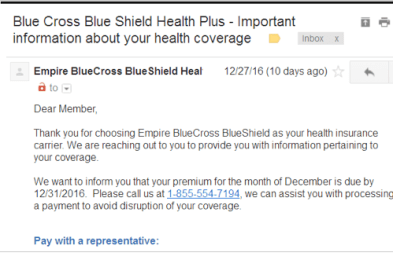
Grievance 6:  improper billing practices

I received confirmation of my payment for December and January two weeks before this arrived:
Screen Shot 2017-10-11 at 5.07.10 PM.png

Grievance 7:  instead of promised return call, customer service survey

Attempted Customer Happiness surveys asking about each of these “customer service” experiences, by telephone and email.

To show that the corporation is not without a certain sardonic sense of humor, I had a solicitation call from an Empire representative, on 1/4/17, thanking me for my business and offering her assistance in renewing me with Empire so there would be no interruption of insurance for my health care.     

#3 The New York State of Health Marketplace

Errors are not easy to resolve at the New York State of Health (”NYSOH”). Answers to routine questions vary from representative to representative. There is a wait of several months to have even the most simple mathematical mistake by the NYSOH corrected, and one must go through a quasi-legal appeal process before NYSOH will correct its error.  Attached is a recent decision by a hearing officer that ordered NYSOH to correct an easily detectable mathematical error they had committed months earlier.   

Note that any employee of NYSOH could have used the online calculator on their website to instantly verify their error, generated automatically by their website (it is easy to instantly lose insurance coverage at NYSOH, hard to regain it), a mistake that took months to have corrected and resulted in the customer being forced to overpay by almost 100% until they did.

Compounding the aggravation of resolving problems with NYSOH is the policy of its director, Donna Frescatore. Representatives are specifically instructed not to divulge the director’s identity or any way of reaching her office. I have confirmed this policy many times, with many different NYSOH representatives.

#4 Common healthcare billing irregularities in New York State

The PPACA, whose primary drafter, Liz Fowler, went back to work in the health industry after her legislative work was done, apparently contains no provision that the cost of a medical service must be divulged to the patient before the medical service is performed.  

The doctor’s office or hospital cannot tell you the fee until the insurance company sends them a statement.  The insurance company cannot predict the fee until they get the provider’s bill.  The insurance company then eventually sends the patient an Explanation of Benefits, (“EOB”), detailing all charges, payments made and the patient’s responsibility for whatever part of the negotiated rate insurance has not paid.   It is like eating at a restaurant with no prices on the menu, and being sent a bill for the meal weeks later.  Except, of course, that it is not a meal at a restaurant, it is often a matter of life or death, or, at least, of health-related stress.

My kidney biopsy, for example, may cost the patient anywhere between zero and many thousands of dollars.  Simply no way to determine the cost prior to delivery of the service, under current law.  I had the procedure on May 26, I got the most recent EOB related to the procedure on September 28.  In the intervening four months, I got many bills from the hospital.

Though there is probably nothing your office can do about this particular practice, I offer it as an illustration of the scope of the challenges facing New York healthcare consumers.  I provide the following letter to the CEO of Healthfirst as a snapshot of the general billing madness under our current ‘regulatory’ scheme.   

Pat Wang
CEO  
Healthfirst
100 Church Street
New York, NY 10007

pwang@healthfirst.org

September 26, 2017

Dr. Ms. Wang:

I appreciate that you allow your reps to give out your contact information to customers who can’t otherwise resolve issues with your staff.   This encourages me to think that you might be helpful in resolving an aggravating billing situation that has been ongoing for months.    I applaud your willingness to be contacted, it shows integrity and is in stark contrast to the policy of Donna Frescatore, director of the “New York State of Health” (NYSOH) ordering her reps not to divulge her name to callers.

I request a corrected bill and an accounting showing my remaining credit toward premium payments.  The credit situation is described below.

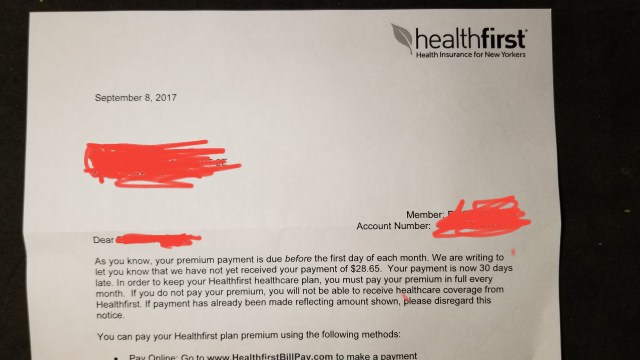
During an August 25th call to Healthfirst to try to resolve the issue of incorrect bills being sent to me, my “case” was assigned an “escalation number” (347-79-923).  I was promised an accounting, showing payment history and current credit toward future premiums.   I received instead a notice, dated September 8 and signed by Christopher A. DiMarco, threatening me with cancellation of my health insurance for a claimed past due balance of $28.   

On September 19 I called Healthfirst and was assured that credit had been applied and my September premium paid in full.  I was also informed during that call that “finance” had included no notes on my account.   I could not be sent a simple receipt for payment or anything indicating my remaining credit.  I was assured by an extremely sympathetic rep that my account was paid through October, with credit remaining toward November’s premium.

Attached is the invoice I received on September 25.   It seeks payment of $482 for October (plus a past due amount), nonpayment of which will result in losing my health insurance (as I begin treatments for kidney disease and skin cancer).   It has been mailed to me in error.   I have a credit of several hundred dollars due to overpayments made as a result of NYSOH’s error.   NYSOH incorrectly denied my subsidy for 2017.   It took months, and a ruling by a hearing officer, before NYSOH was ordered to retroactively restore the subsidy, about fifty percent of the premium.  

As a result of NYSOH’s error, I was required to pay Healthfirst the full premium from February through June.  When I got a bill for July, I called Healthfirst and learned that a credit had been applied for my overpayment.  After payment of July’s premium the rep calculated my remaining credit at $876.

Since then it has been a health insurance headache every month.  In another context, it would be tempting to characterize the attached invoice demanding payment for a premium I have already paid as an attempt at fraud.  I am sure it was sent to me in error.    Please have somebody update my account and send me an accurate statement of my payments and remaining credit.

(invoice attached here)

Thanks,


A short time later, after a call from one of Ms. Wang’s assistants, I got a corrected bill that demanded payment of -$183 on or before October 1.
Edited letter to the A.G.

Dear Mr. Attorney General:

I am appealing to you for assistance, on behalf of many thousands of New Yorkers caught in a sometimes life-threatening situation regarding their healthcare.  As described more fully below, citizens of our state have no government agency that intervenes in cases where patients are mistreated by the corporations we buy health insurance from.   This is true even in cases of apparent fraud.  

I urge you to propose legislation to correct this grave oversight.  The need for state regulation of health insurance grows ever more acute in light of the current federal administration’s determination to gut all regulation.

I’ve followed your career and admire the principled and proactive steps your office has taken against the powerful perpetrators of various frauds.  Leaving politics aside, as one must in a letter like this, it is gratifying to see someone in office holding powerful entities responsible for their bad acts.  Your office is well-suited to fix what I believe is a healthcare emergency affecting the lives of countless New Yorkers who purchase private health insurance, particularly older citizens and those living just above the “poverty line.”

As frustrating as my healthcare-related ordeals have been, a 61 year-old currently trying to get treatment for kidney disease and skin cancer, I have the benefits of fluency in English, computer literacy, legal skills.  It is hard to imagine the life-shortening stress that is inflicted on the elderly and other vulnerable New Yorkers unable to get so much as a hearing for often unappealable denials of health care.

It has been a challenge to put the many healthcare-related issues I’ve been forced to navigate into a streamlined letter.  I’ve attempted to keep this letter short and dispassionate.  To that end I provide some of the devilish details in a series of attachments.  I have confirmed many times that my experience as a consumer who buys health insurance on the New York State of Health Marketplace (“NYSOH”) is representative of the experiences of countless others.  

Attachment # 1 is a detailed description of the “consumer help” cul du sac that desperate NYS residents can spend a few hours in, looking in vain for help with health insurance-related troubles.  Anyone in your office can retrace the useless steps.  Creating a healthcare ombudsman position would be a good first step here.    

Corporate “persons” are without conscience and motivated only by a zeal for profit.  When left unregulated, it is no surprise such “persons” act as they see fit.  In the case of health insurance companies, they are free, for example, to repeatedly refer patients to “in-network” doctors who are not actually in-network.  They are also relatively unrestrained when refusing to provide services, under a variety of corporate rationales, in spite of what the Patient Protection and Affordable Care Act (“PPACA”) may have to say about it.   There is no penalty for these common business practices and they are well aware of it.  Regulations to address these things, with an enforcement arm, would be a good start.  (see #2)

Those mandated by the PPACA to purchase health insurance from the New York State of Health Marketplace may find themselves with a host of new problems during the short holiday season window for purchasing insurance. A consumer advocate or ombudsperson on site at NYSOH would greatly aid in resolving problems, including simple mathematical errors, that presently can only be addressed by a lengthy appeals process.  (See  #3)

Billing irregularities, including improper bills, which are to be expected in a law as complicated as the PPACA, are probably the most common form of immediate stress most of us are regularly subjected to.   The rep at your office’s consumer help desk offered help with billing problems, problems I suspect are legion.   I offer a short overview of the larger problem and one recent snapshot as #4.

Thank you for your time.  I am available to amplify anything written here and to testify anywhere you may require.

Yours sincerely,


From attachment 4:  

The PPACA, whose primary drafter, Liz Fowler, went back to work in the health industry after her legislative work was done, apparently contains no provision that the cost of a medical service must be divulged to the patient before the medical service is performed.  

The doctor’s office or hospital cannot tell you the fee until the insurance company sends them a statement.  The insurance company cannot predict the fee until they get the provider’s bill.  The insurance company then eventually sends the patient an Explanation of Benefits, (“EOB”), detailing all charges, payments made and the patient’s responsibility for whatever part of the negotiated rate insurance has not paid.

My kidney biopsy, for example, may cost the patient anywhere between zero and many thousands of dollars.  Simply no way to determine the cost prior to delivery of the service, under current law.  I had the procedure on May 26, I got the most recent EOB related to the procedure on September 28.  In the intervening four months, I got many bills from the hospital.

Though there is probably nothing your office can do about this particular practice, I offer it as an illustration of the scope of the challenges facing New York healthcare consumers.  I provide the following (obviously minus preamble, dear reader)  as a snapshot of the general billing madness under our current regulatory scheme.   I compare it to eating at a restaurant with no prices on the menu, and being sent a bill for the meal weeks later.  Except, of course, that it is not a meal at a restaurant, it is often a matter of life or death.


Burying the lede

The eagle eyed (or more accurately eagle eared) Sekhnet had a good comment on the letter to the A.G.   I need a more dramatic, attention grabbing opening sentence.   One must not bury the lede.   Can’t make a sale without a good pitch, and a good windup is essential to ze nasty break on zat strikeout pitch.

The present draft begins with this bland statement (note passive voice use, it’s not like it was written by me, he said):

I am writing to give you an on-the-ground view of the stressful health care situation for hundreds of thousands of us in New York State.

Admittedly, not much there to grab you.

My more fiery, overwrought first draft, months back, opened:

I am writing to alert you to a massive consumer protection failure in New York State, regarding denials of purchased health care, and to urge your office to investigate this unchecked fraud.

There might be something there… but not enough.

I am writing to alert you to the scope of the healthcare crisis for tens of thousands of New Yorkers…  

Sekhnet dictates (with some on the fly revisions):

I am appealing to you for assistance on behalf of many thousands of New Yorkers placed in an untenable position regarding their healthcare.   

This also needs to get worked in early on, I suppose:

As frustrating as my medical insurance ordeals have been, I have the benefits of fluency in English, computer literacy, legal skills.  I cannot imagine the life-shortening stress that is inflicted on the elderly and other vulnerable New Yorkers unable to get so much as a hearing for often unappealable denials of health care.

On the other hand, since this is the holiest day of my great-grandfather’s religion, and a fasting day, at that,  I’d better wrap this up and get ready to bring these fruits I’ve been slicing and the other things we’ve been preparing up to our gathering to break the fast.   Once it gets dark.  That first drink of orange juice never tastes better.


Dear Mistuh A.G.

For reasons too tedious to detail here, I will use this platform to compose the beginning of a draft to New York State’s activist attorney general urging him to take action.   This AG is the guy who successfully sued President Winner over his fraudulent university.   In NYS the AG also proposes and advocates for legislation, as it turns out.   I have a plan.  Relatively short, streamlined cover letter with several attachments laying out the infernal particulars.   Blah blah (see #1)  blah blah blah (#2) etc.

Dear Mr. Attorney General,

I am writing to give you an on-the-ground view of the stressful health care situation for hundreds of thousands of us in New York State.  As described more fully below, citizens of our state have no government agency that intervenes in cases where patients are mistreated by the corporations we buy health insurance from.   This is true even in cases of apparent fraud.  

I urge you to propose legislation to correct this grave oversight. The need for state regulation of health insurance is even more acute in light of the current federal administration’s determination to gut all regulation.

I’ve followed your career and admire the principled and proactive steps your office has taken against the powerful perpetrators of various frauds.  Leaving politics aside, as one must in a letter like this, it is gratifying to see someone in office holding powerful entities responsible for their bad acts.  Your office is well-suited to fix what I believe is a health care emergency affecting the lives of countless New Yorkers, particularly older citizens and those living just above the “poverty line.”

It has been difficult to put the many healthcare-related issues I’ve been forced to navigate into a streamlined letter.  I am certain that my experience as a consumer who buys health insurance on the New York State of Health Marketplace is representative of the experiences of countless others.  I have confirmed this many times over the last few years.  

As frustrating as my ordeals have been, I have the benefits of fluency in English, computer literacy, legal skills.  I cannot imagine the life-shortening stress that is inflicted on the elderly and other vulnerable New Yorkers unable to get so much as a hearing for often unappealable denials of their health care.  I’ve attempted to keep this letter short and to include the devilish details in a series of attachments.

I am therefore attaching a detailed description of the “consumer help” cul du sac that desperate NYS residents can spend a few hours in, looking in vain for help with health insurance-related troubles.  Anyone in your office can retrace the useless steps.  Creating a healthcare ombudsman position would be a good first step here.  (see # 1).  

Corporate “persons” are without conscience and motivated only by a zeal for profit.  When left unregulated, it is no surprise these “persons” act as they see fit.  In the case of health insurance companies, they are free, for example, to repeatedly refer patients to “in network” doctors who are not in network. They are also relatively unrestrained when refusing to provide services, in spite of what the Patient Protection and Affordable Care Act (“PPACA”) may have to say about it.   There is no penalty for these common business practices and they are well aware of it.  Regulations to address these things, with an enforcement arm, would be a good start.  (see #2)

Those mandated by the PPACA to purchase health insurance from the New York State of Health Marketplace may find themselves with a host of new problems during the short holiday season window for purchasing insurance.  A consumer advocate or ombudsperson would greatly aid in resolving problems and errors that presently can only be addressed by a lengthy appeals process.  See  #3

Billing irregularities, including improper bills, which are to be expected in a law as complicated as the PPACA, are probably the most common form of immediate stress most of us are regularly placed under.   The rep at your office’s consumer help desk offered help with billing problems, which I suspect are legion.   I offer a short overview of the larger problem and one recent snapshot as #4.

Thank you for your time.  I am available to amplify anything written here and to testify anywhere you may require.

Yours sincerely,


Death by American Healthcare (part 4 of 22,000,000)

Let us stipulate that the wealthiest citizens of this nation, as a polity, are not greatly concerned with the illness or death of masses of Americans who did not have the good sense to be born into the right social circumstances.   We have a privatized health care system here that would be a cause of great national shame, in a nation where shame for such things was still possible.   We are, as a nation, shameless fucks.   A glance at any of President Fuckface’s recent tweets will confirm this, whatever mix of disgust and shame we may also personally feel as a result.  

Here is a letter I was compelled to write today:

Pat Wang
CEO  Healthfirst
100 Church Street
New York, NY 10007

pwang@healthfirst.org

Dr. Ms. Wang:

I appreciate that you allow your reps to give out your contact information to customers who can’t otherwise resolve issues with your staff.   This encourages me to think that you might be helpful in resolving an aggravating billing situation that has been ongoing for months.    I applaud your willingness to be contacted, it shows integrity and is in stark contrast to the policy of Donna Frescatore, director of the “New York State of Health” (NYSOH) ordering her reps not to divulge her name to callers.

I request a corrected bill and an accounting showing my remaining credit toward premium payments.  The credit situation is described below.

During an August 25th call to Healthfirst to try to resolve the issue of incorrect bills being sent to me, my “case” was assigned an “escalation number” (347-79-923).  I was promised an accounting, showing payment history and current credit toward future premiums.   I received instead a notice, dated September 8 and signed by Christopher A. DiMarco, threatening me with cancellation of my insurance for a claimed past due balance of $28. On September 19 I called Healthfirst and was assured that credit had paid my September premium.  

I was also informed during that call that “finance” had included no notes on my account.   I could not be sent a simple receipt for payment or anything indicating my remaining credit.  I was assured by an extremely sympathetic rep that my account was paid through October, with credit remaining toward November’s premium.

Attached is the invoice I received on September 25.   It states that I must pay $482, on pain of losing my health insurance (as I begin treatments for kidney disease and skin cancer).   It has been mailed to me in error.   I have a credit of several hundred dollars due to overpayments made as a result of NYSOH’s error.   NYSOH incorrectly denied my subsidy for 2017.   It took months, and a ruling by a hearing officer, before NYSOH was ordered to restore the subsidy, about fifty percent of the premium.  

As a result of NYSOH’s error, I was required to pay Healthfirst the full premium from February through June.  When I got a bill for July I called Healthfirst and learned that a credit had been applied for my overpayment.  After payment of July’s premium the rep calculated my remaining credit at $876.

Since then it has been a health insurance headache every month.  In another context, it would be tempting to characterize the attached invoice demanding a large payment for a premium I have already paid as an attempt at fraud.  I am sure it was sent to me in error.    Please have somebody update my account and send me an accurate statement of my payments and remaining credit.

Thanks,

Death By American Health Care (part 3 of 22,000,000)

The New York State of Health “Marketplace” is where uninsured New Yorkers are mandated, by the PPACA, to buy health insurance.   The place is staffed by undertrained, underpaid reps who will give you several completely different answers to the same question.   The regulations of the PPACA are complicated, mistakes are common and there is no quick mechanism to fix the many mistakes made by the NYSOH Marketplace.   The director of the NYSOH has ordered her reps not to give out her name, she does not want a flood of calls and mail about the many mistakes her agency routinely makes.   If you were Donna Frescatore, appointed director of the NYSOH Marketplace, you might feel the same way.

The onus, as always, is on the customer.   If you don’t buy health insurance within the mandated arbitrary several week period from just before Christmas to just after New Years you will be uninsured for the following year, or at least for the first few months of that year.  All this is to be expected when you leave the foxes, for-profit health industry corporations, in charge of the hen house.  Only in America, folks.

As a result of a mistake at the NYSOH Marketplace I was preemptively denied, in December 2016, the subsidy I was entitled to in 2017.  The subsidy reduced my monthly premium by almost 50%.  I was required to pay the full premium until I could have an appeal. Three weeks after the telephone appeal (in June) I got a well-written legally complex ruling from the adjudicator.  The ruling stated that I was entitled to the subsidy the on-line calculator showed me I was entitled to, retroactive to February 1, when the current insurance year started.

When I got my invoice from Healthfirst for July it claimed I owed the full premium.  It suggested if I did not pay two months (the current month and one month in advance) I was in danger of losing my health care.  When I called I was told that Healthfirst had received the subsidy money, that credit from my overpayment had been applied and that I had a balance of $876 going forward.   The rep worked through the calculations with me and I was satisfied that the amount of remaining credit was about right.

In August I got a bill for $28.  The letter stated that if I didn’t pay this amount immediately my health insurance would be cut off.   When I called Healthfirst the rep could not tell me why I’d received this bill, but confirmed that I had a good deal of credit from past overpayments.  He applied the credit to my August payment.  He couldn’t tell me exactly how much credit I had left, but he offered to do the math with me again.   I told him snippily that I’d already spent 36 minutes on the phone, had done this same calculation in July and was unwilling to do this every month.  He apparently took offense, putting me on hold until I eventually hung up.    

A few weeks later I got another demand for this phantom $28, accompanied by the same threat.  I have a fairly serious kidney disease and new cancer cells on my nose, I can’t afford to be without health care at the moment.  I called to straighten this out.  It was a naive thing to do.  

The rep saw on her screen that I owed $38, and was confused by this discrepancy.  She also saw that I had overpaid by more than a thousand dollars and still had credit.  I asked her how much credit remained.  She was unable to say.  She placed me on hold.  She was nice.  She tried to be helpful.   I told her I wanted a written accounting of what I’d paid, what subsidy had been paid on my behalf and how much credit I currently had left.  She gave me an “escalation number” meaning she was sending my request up the corporate chain.  She also promised to follow my “case” and update me as soon as she had information.  I told her the main thing was to get me a written accounting, she promised she would.

Almost a month has passed, I got no accounting, nor any update from the nice rep, but I did get this the other day:

20170917_104230.jpg

Somebody else would bite the bullet and spend the twenty or thirty minutes on the phone to try to straighten this out.  It is the least a customer can do every month, is it not?  I don’t know why I am such a stubbornly bitter bastid.

In a system where there is no regulation, no law, no procedure for adjudicating corporate chicanery, no impartial office investigating health care-related fraud and no consequence for even blatantly fraudulent billing practices, scoundrels nonchalantly generate arbitrary bills and threaten consumers if the bills are not paid.  It’s their nature, who could expect them to resist?

USA!  USA!!!!


Obamacare 101

You know it’s a well-designed, consumer-friendly health care program when the second item on the phone menu at your state’s private insurance health exchange is:  

“Press two if you are an in-person assister which includes navigators, brokers, certified application counselors and health plan facilitated enrollers.”

Death by American Healthcare (part 3 of 22,000,000)

I was lucky enough, after more than two months in the wilderness, to get an appointment with a nephrologist who seemed to be very well-liked by his patients.   Sekhnet located this doctor for me, by persistence and almost pure chance.  He was not listed as a participating provider in my health plan, but Sekhnet’s call to his office confirmed that he accepted my insurance.  The only bad news was that his next available appointment was September 19th, almost four months after the biopsy confirming my progressing kidney disease.   I had a call back from his office Tuesday, could I come in Thursday? On Wednesday, the next time my primary care doctor was available, I neglected to get a new nephrology referral, something that is the patient’s sole responsibility.    

Thursday I found myself at the nephrologist’s office without a referral.  My fault, though somewhat understandable, due to the last minute nature of the changed appointment.   I called my doctor’s office and spoke to his service, who informed me he was off on Thursdays.   She promised me a call back, but as I ‘d never had a call back from him, I had my doubts.  Ten minutes later I had a call back from someone in his office, offering to try to get the referral faxed over.  Problem solved, or possibly not.

The problem was, my insurance company requires an Emdeon electronic referral, according to the new doctor’s receptionist.   A faxed paper referral won’t be accepted, she told me, though it had been accepted by the prior nephrologist’s office.  There was a discussion of back-dating the referral, something I’ve been told is insurance fraud.

“Just to be safe,” the receptionist told me, “let’s have you sign this, to avoid a surprise bill.”  The form she gave me stated that the nephrologist did not participate in my plan, was out-of-network, and that therefore I was responsible for paying the full cost of the visit.  

I asked what the cost of the visit was and the receptionist told me she had no idea.  They cannot tell you the price of any medical service, under Obamacare, until after the service is rendered.   It’s a menu with no prices next to anything, the waiter just keeps smiling and tells you not to worry, that you will be billed in thirty days.  It’s fucking insane.  “Just to be safe,” I thought, and then told her I couldn’t sign a paper saying the doctor wasn’t in-network when he was.  I pointed out to Sekhnet, who assured me that she would pay for the visit, if it came down to it, that by signing this, agreeing to pay “whatever”, I was waiving any defense under the recent Surprise Bill amendment to Obamacare.  Even though the bill would, indeed, be a surprise.

The receptionist had another idea.   Call my insurance company and make the doctor my primary care doctor, he was an internist as well as a nephrologist.  This way I wouldn’t need a referral.  The call to my insurance company lasted for 29 minutes.  There were a series of hurdles and I was placed on hold several times, listening to muzak, the last patient of the day, waiting in the doctor’s empty waiting room, earphones in my ears.  Toward the end of this endless call the doctor passed by and I asked if he had any IV valium.  He smiled and told me not to worry, he was in no rush.  

There followed a discussion of his office location.  I told Karen, at the insurance company, that I was at 161 Madison Avenue.  She told me I could only see the doctor at his East 88th Street office.  I repeated this out loud and the receptionist, who by this point had already hugged Sekhnet twice, nodded emphatically that it was no problem.   “Tell her you’re at 88th Street,” she said.   I have a hard time with an outright lie, so I said “88th Street, fine.”

I was now at the last hurdle: a three question questionnaire about my reason for switching primary care doctors.   The last question was about convenience.

“Is the location of this doctor’s office more convenient for you?” Karen asked me kindly.   Not really, I told her.  I explained that the doctor I’d been seeing was half a block from my house and that this doctor was located about an hour from my home, but that I wanted to switch anyway.

“Is the location of this doctor’s office more convenient for you?” Karen asked me again, prompting me.  I repeated Karen’s question out loud for the receptionist and Sekhnet, both now actively coaching me, nodding like two mad women.  

“Yes,” I told Karen, “much, much, much more convenient.  Thank you.”  She thanked me, the transfer was done, I was able to see the nephrologist.    

When the nurse began taking my vitals I heard Sekhnet’s agitated entreaty from the waiting room.  “Don’t take his blood pressure yet, he just got off the phone with the insurance company!”  I told them both it was OK.  My pulse was 57, blood pressure 122/82.   I told them I’d become so used to being screwed around by the insurance company that it rolled off me like water off a duck’s back.

The young doctor smiled again when I apologized for being late (it was now an hour after my original appointment time).  We discussed my idiopathic membranous nephropathy and he told me candidly that the reason there is not more recent research on the disease, which is not as rare as the lack of research might suggest, is that there is no pharmaceutical in development.  The drugs used to treat the disease have been around for a long time.   When a new pharmaceutical is in development that drives research.  “Death by American Healthcare,” I thought, but nodded thoughtfully instead.

He was indeed a very likable doctor.  The upshot was roughly the same as at the previous nephrologist, my best bet was medicine’s only bet: immunosuppressive therapy.   He would refer me to the doctor he trained under, who specializes in glomerular (a word I still can’t pronounce– definition below*) diseases like mine.   There was no immediate rush to begin treatment, he said, as the disease progresses slowly, but his senior colleague was the expert and would fully inform me of everything I needed to know.  We shook hands and bid each other goodbye.   Sekhnet was beaming from ear to ear.  

“You should keep this doctor,” she told me, “even though it’s inconvenient to get to his office.”  I told her I’d think about it.  This morning at 9 a.m. he called to discuss the results of yesterday’s blood test.  We’ve been playing phone tag since, but it was impressive to hear back from him so soon.


*      glomerulus:  a cluster of capillaries around the end of a kidney tubule, where waste products are filtered from the blood.

Informed Consent

We live in an imperfect world, a point that needs no belaboring.  We like to believe that Reason governs human affairs, but most often we can trace the behavior of societies, groups and individuals, to fear, hatred, hopelessness, greed and other mostly non-rational impulses.  The great democracy we live in, for example, is currently presided over by a person who is not a clown as much as a menace.  He was put into office by the galvanized forces of fear, hatred, hopelessness and greed.  He cannot seem to control his impulse to lie.  Here’s Amy on a recent presidential lie the White House just admitted was a lie.  

You can go mad watching the news, dominated by this stubborn attention seeker, unless you believe, as up to 33% of our voting populace seems to, that we live in a time when minorities and poor people are completely out of control, rich job creators are being tortured by our government, the media lies constantly and that only good old fashioned law and order can “Make America Great Again.”  

Going mad is not the best option, at least not as far as I can see.  I’ve made it my daily practice to try not to go mad, no matter how tempting it may be to go there.   One form of this daily practice is writing, in detail, to make whatever I am dealing with as clear as possible, to myself and to anyone reading.  

Transparency, and its deliberate denial, has long been a big issue with me.  It comes from a childhood where blame was shifted on to the children for the problems of adults.  Perhaps my father was incapable of answering my anguished question about what happened to grandma and pop’s twelve siblings (shot in the neck in a ravine, as it turned out) but it was wrong of him to blame me for being anxious about it.   If Reason is to guide us in trying to live reasonable lives, we have to have the information we need to consider things fully and make reasoned choices.  

We have that great phrase from the Author of Liberty, about ideal government: “deriving their just powers from the consent of the governed.” That has been changed slightly in practice, if not rhetorically.  A more accurate statement in 2017 would be “deriving their indisputable powers from the acquiescence of the systematically manipulated.”   Our elections are decided by a plurality of voters casting votes after watching fantastically expensive advertising campaigns.  The winning product is the one with the most effective attack ads on the rival product.  The government that results from this process hardly amounts to one ‘deriving its just powers from the consent of the governed’.  

It is a mark of patriarchy to rest on its right to simply be right.  No discussion is required, if one party has all the power and the other party has none, when the powerful party declares “because I said so.”  You cannot give informed consent if you are not informed.  There is nothing mysterious about this formula.  

As in the larger society, so it goes in individual interactions. If patriarchy is the final word, from top to bottom, and you have a problem with that, you are the one with the problem.   The impulse to be right is a powerful one, and we are all conditioned to argue that we are right whenever we feel challenged.   There is a more merciful orientation, true, and the world would be better if more people operated under it, but that is not the problem of patriarchs.

I called the National Kidney Foundation’s helpline.  Marjorie was great, though, in her own words, not very knowledgable about anything but the basics.  She’d never heard of my idiopathic kidney disease, for example.  She was pleasantly surprised to learn that up to 40% experience a spontaneous remission from this disease of unknown cause.   She told me that most nephrologists, going by what she hears every day, are arrogant jerks.  She said the profession apparently attracts these types.  I told her my experience did not contradict this.  

Here is my problem with the insecure, defensive, arrogant jerk who was treating me, until two months ago.  She did not feel the need to answer questions, was dismissive, manipulative, untruthful, incapable of sincere apology.   Aside from those things, which tend to increase a patient’s stress level, I’m sure she is an excellent doctor.  My biggest problem, now that I have learned much more about this disease and proposed treatments, is her refusal to give me the information I needed to make an informed choice about a side effect-rich course of IV steroids and toxic agents designed to shut down my immune system.  This therapy is recommended only for high risk patients, all others are treated with supportive therapy and counseled about diet and exercise and watched for signs the disease has progressed or begun to wane.

I wrote this, earlier, to send to this gender-neutral asshole nephrologist, for my physician friend’s feedback:

You seem to have concluded that I am a high risk idiopathic membranous nephropathy patient and that therefore immediate immunosuppressive therapy is necessary.   I’d appreciate if you could set out the factors you considered to determine that I am in this high risk category, as these were not explained to me in any detail.

Thank you

Full transparency, which would have called for a “Fuck you” instead of “Thank you” at the end, must sometimes be sacrificed for the greater good.  In this case, I need to know what tests and other factors she considered, in the absence of the standard 24-hour urine test, to determine that I need to begin a chemotherapy regime immediately. 

We all tend to phrase things in terms of our own concerns.  I don’t mean to keep harping about my kidney disease, although it is on my mind.  It serves as a perfect metaphor for many killing situations that are just part of the status quo in our competitive, materialistic USA! USA!!!   If you are not afflicted by a serious disease, the many problems of Obamacare, the calls for its repeal, are abstractions, troubling though they may also be.  If you are unable to get treatment from any of the highly recommended nephrologists you’ve been referred to, doctors allegedly in your insurance network, you are, as they say: fucked.