What Would Gandhi Do?

Let’s say someone made multiple derogatory comments about your religious group, asked you to do favors under a tight deadline that you delivered and that they then ignored, made a promise to you they then violated and informed you of in a cc in an unrelated email?  Let’s say the success of your fledgling nonprofit organization was in some way dependent on this person and that the broken promise related to the very existence of that outfit.

Few would probably blame you for being upset, hurt, angry or all of the above.  The question is, what would Gandhi do?  The other question is: what would Bruce Lee do?

I wrestled with these questions for almost a week.  It was not an easy wrestling match.  In the end I decided that Gandhi and Bruce Lee would do the same thing.  Take a minimalist approach that deflects action back on the other party.  Responding to the cc’d email that informed me he had no intention of keeping his promise to the organization I wrote: don’t worry about it.

It didn’t take long for him to put on his clown costume and begin capering.  But I’m not worried about it.

I Did It, I Can’t Believe It

I saw a well-done Hollywood biography of the Notorious B.I.G., Biggie Smalls, the talented fat kid from Brooklyn.  I saw this movie on TV not long before my mother finished dying her long, lonely death.  I was often sad in those days but I couldn’t cry, even though my mother was in the last weeks of her life  — this movie made the tears flow.  I sobbed because this kid had seen the light, and was, in the screenwriter’s convincing story, making peace when he was shot in revenge for a killing he tried to stop.

I must have cried for ten minutes after the credits rolled, as Angela Bassett wipes her eyes as half of Brooklyn comes out to line the streets where Biggie lived, larger than life, rapping, rhyming, styling like TJ, the Master and mf.

In the Hollywood version he was played by a charming, charismatic actor, a quick witted mostly jovial young man, also quite fat.  He’s mean to his women, breaks his mother Angela Bassett’s heart, and he is a criminal and a thug.   A friend takes the rap for him and goes to prison telling Biggie “if I do this for you you can’t waste your talent, you’ve got to succeed– for all of us”.   By the time the friend gets out of prison  Biggie is a huge star, has an accident and is recuperating in the hospital.   The friend goes straight to the hospital bed and is disappointed in Biggie.   Biggie realizes he’s gained fame, and success, but he’s still  an unredeemed asshole.

And, in the movie, he’s moved by this realization and  he begins to change.  He wants to make amends, seeks forgiveness.  He doesn’t want to hate anybody anymore, and he doesn’t want anybody to hate him.  He makes peace with his ex-wife, his ex girlfriend, starts spending time with his daughter.  He wants to be a positive model for the people he loves.

When he goes back to the studio he doesn’t want to record another  violent, incendiary album, what his fans are hungry for.  He regrets the bad influence he’s had on millions.  He wants to make a tender album, rapping from the heart instead of his killer persona, but he’s afraid people will think he’s weak.

He’s terrified, as he begins to record, with no street bluster to hide behind.  He’s scared  of how weak he must look and afraid to listen to the playback.  But when he hears it a smile comes across his face as soon as the first vamp comes up in the headphones and he starts to shake his head slowly from side to side.

“I can’t believe it,” he says, shaking his head to the slow beat, “I did it…  I did it!” and he laughs, and keeps the beat with his head, and his friends around him at the console all smile too.  The actor who plays Biggie keeps smiling, closes his eyes and floats away on the music.  

In the movie’s next scene he’s shot dead from a passing car.  Then all of Brooklyn is mourning him on the streets as his body comes back for one last ride through the streets, and Angela Bassett looks on weeping, and I’m sobbing long after I turn off the TV.

And then, tonight, after I mixed this clip of the first two animation workshops  I started to laugh.  I said to myself  “I can’t believe it, I did it.. . I did it!”  I pumped my fist in the air as I jumped out of my chair, then I watched it again and again, with and without the headphones on.  I’m smiling as I type this, and I’m laughing too, to think about it.

(animation clip here)

Note to the Directors

I thank you for agreeing to be on the initial board of directors and signing the papers so that we could become a bona fide charitable institution.   I could not have done it without you and will be forever grateful that you were on board for the first leg of what I hope will be a long and fruitful journey.

Now, as the organization moves forward, we need to recruit people to carry out the important jobs that must be done to make any business successful.  If you can help in recruitment, fundraising, business planning, marketing, with your creativity and smarts, now is the time to act.

While I greatly appreciate the help you’ve already rendered, going forward a commitment of some kind is needed:  a commitment to the principles of the organization– listening and responding when asked; a commitment to bringing something of practical value to the business of the organization; a financial commitment.

Absent at least one of those forms of commitment, the time to part as friends is approaching an end.  I am staking my life on this program, and, of course, I don’t expect that from anyone else.   I expect much less from the rest of the board, but much more than nothing.  Any of you would expect the same.

Hopped Up, Exhausted, Immobile

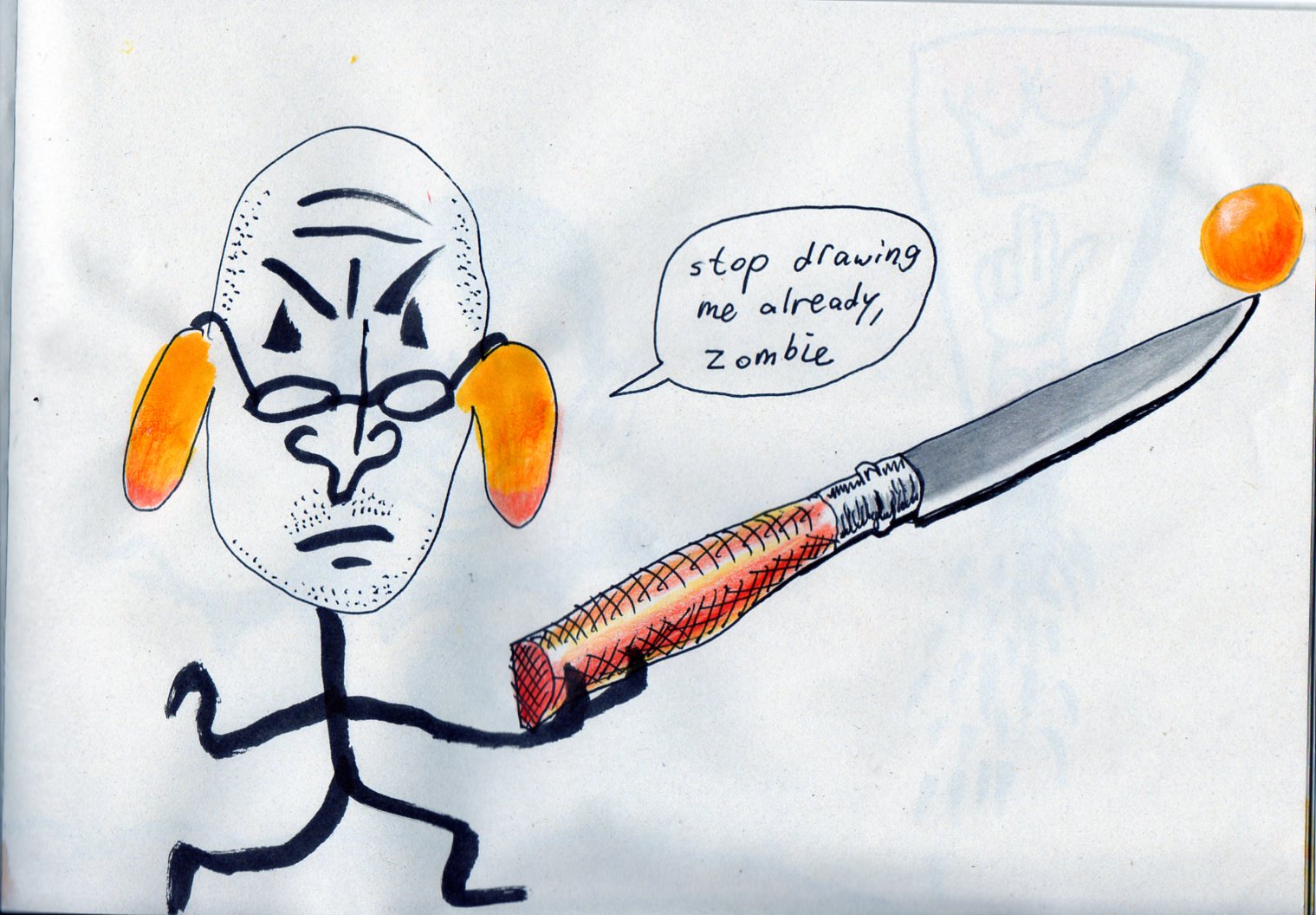
Yes, I’ve been hopped up lately.  Thinking of my mother’s life and death a lot as the apartment where I spent time with her the last twenty years was sold yesterday.  Excited about the workshop with the nine kids grades 2-5 that will begin a week from yesterday.  Hopped up about the state of this apartment, which has been this way for a long time and needs to be fixed up.   Hopped up that I am drawing the same picture over and over, reading, emailing, reading, listlessly surfing the internet, drawing the same picture.  All around, the chaos I would tame, looking on mockingly.

Exhausted, truly.  Eyes tired all the time, reading a novel in too fine print, staring at this screen for hours at a time.   I can’t look away, even to make a long overdue appointment with the eye doctor.  Too many details to take care of lately, too many things on my mind.  Tired, yet unable to sleep for ten hours or however long it would take to not be so tired.  The picture I keep drawing finally tells me to stop it.

Image

Immobile, drawing the same picture over and over, staring at the computer screen.  Thinking.  “Stop thinking so much,” says Sekhnet, echoing the voice from Ecclesiastes “For in much wisdom, there is much vexation, and those who increase knowledge increase sorrow” Ecclesiastes 1:18.  But I can’t help it, Ecclesiastes, old boy, not to say there is much wisdom in my vexation, nor agreeing that increasing knowledge necessarily increaseth sorrow, you know, I’m just sayin’.

Saw a Ted Talk by a man named Sugata Mitra, whose research shows the power of groups of poorly educated children to learn and teach each other what they are motivated to learn (watch it here, I recommend it). He concludes that “values are acquired, doctrine and dogma are imposed.”  This is a very deep conclusion, if you ask me, comes close to the core of what’s wrong with the world we live in.  

He also concludes, as I do, that “learning is a self-organising system” (he spells ‘organizing’ like a former subject of the British Empire).  In other words, individuals and non-hierarchical groups can learn what they need to learn in an organic kind of way that reveals itself as it goes.  I’m in the process of trying to prove these very things, even as I can’t clear off my kitchen table or desk.

So the mind doesn’t stop thinking and the body doesn’t start doing, except to dance here on the keyboard, eight fingered, with the right thumb playing bass on the space bar.  I’d be better off sitting at a piano keyboard, or playing a guitar with eight fingers.  But even that wearieth me, man.

Why am I not going to sleep?  Most people in my time zone are having some serious REM sleep about now, dreaming.

The obligation to do right

I heard national treasure Bill Moyers interview a brilliant and courageous woman named Vandana Shiva.   You can hear their discussion here.   At one point Moyers asks her how she can continue to fight huge, immensely wealthy and aggressive agricultural multinationals with such little hope of success.  She tells him of a passage from the Bhagavad Gita that explains it is not whether you can succeed or not that determines whether you should do a thing, but whether you have an obligation to do it.   It resonated deeply for me.

The following week Bill Moyers interviewed Chris Hedges, former seminary student, who came to his calling– speaking truth to power– from a Christian perspective.  After discussing Hedges’s work witnessing slaughter, systemic poverty and oppression the world over, and writing and speaking about it in eloquent detail, Moyers asks him the same question.  How can you, a good person driven to despair, continue to resist in the face of such odds?  Hedges gives the same answer Vandana Shiva gave the week before.  We are obliged to do what is right, no matter if we can succeed in changing things or not.  

This rang that bell of mindfulness inside me again.  Death waits for each of us, more patiently or less patiently.  What would you do now if you knew for certain that you had six weeks to live?   What would you do if you had six years?  Or twenty-six? The question seems to call for the same answer.  Do what you are called to do, what makes you feel most useful, what makes the richest demands of your talents without diminishing you.  

One thing not to do is spend a second more than is necessary with people who prove toxic to your unique and infinitely precious self.

Be The Change You Want to See in The World

Gandhi is thought to have created that idea, although maybe it comes from one of his beloved texts.  (A writer skillfully straightens out the whole feel-good coffee mug aphorism industry here)

Whatever the source, or whoever coined the pithy bumper sticker, it is on a recycled nylon bag I have used dozens of times and also on the banner of my youtube channel (here) where you will find the opinion “nice work, if you can get it.”  “Be the change you want to see in the world” is a short phrase that encapsulates a lot about the work I need to be doing.

As the writer cited above wrote:   

The closest verifiable remark we have from Gandhi is this: “If we could change ourselves, the tendencies in the world would also change. As a man changes his own nature, so does the attitude of the world change towards him. … We need not wait to see what others do.”

If we would like to see less violence in the world, and are constantly in fist fights because we react to insults with fists, teaching ourselves how not to throw the first punch is a big step in the right direction.  The world isn’t going to magically change from violent to more peaceful if we stop the preemptive face-bashing, but the change in ourselves is a necessary precondition for being able to convince anyone else to stop fighting.  Plus, the violence in our own life is likely to decrease as we change our behavior.

The default settings of life are what enable complex human societies to function in a more or less automatic way in a complicated and demanding system set to default.  But if you have a dream of doing something to influence and change the status quo, the default settings will not help you accomplish it.  If that dream involves doing your part to change the world in the direction you dream of, you are going to have to transform yourself into an effective role model for what you’re talking about.

As the eminent philosopher Moms Mabley postulated “if you do what you always did, you’ll get what you always got.”  

I need to think no further than my father on his deathbed to reinforce for me the importance of being the change– becoming the kind of force you’d like to see in the world.   He died full of regrets, largely related to his fiercely held belief that people can’t change in any significant way.  “The world’s not black and white, Elie,” he told me with the great sorrow of a decades-too-late revelation, hours before he died.  “I think now how much richer my life would have been if I hadn’t seen it as a battle—good versus evil.”

Good versus Evil thinking simplifies the world in a reductive, and frankly, often stupid way.  Of course we can see the difference between good (helping someone in trouble) and evil (torturing someone in trouble) but that’s not the point I’m slogging toward.  Human motivation and behavior is famously complicated –suppose the person in trouble you’re helping or torturing is not a victim but a vicious person, a terrorist not a freedom fighter?– which is the greater good and the greater evil is a topic for endless debate.  

But, for example, if we are hurt every time we feel rejected, and never miss a chance to express that hurt, whether the rejection was actually intended or inadvertent (as much perceived rejection turns out to be), we are trapped in a syndrome caused, largely, by our own reaction.   If our goal is to create a classroom where kids learn to deal gracefully with failure and rejection, we have a good deal of work to do first on our own reactions to what feels like failure and rejection.

Otherwise, we will find ourselves building a lousy model, in a room with kids slugging away with bullies, fighting perceived rejecters on their behalf but teaching the children nothing about the proper way to respect yourself and your work and not be unduly put out by the negativity or silence of others.  The project will fail unless the teacher has first figured out how to keep negativity and fighting out of the space.   That work is on the teacher, if the teacher has a goal larger than imparting knowledge of a particular skill or subject.

That 99% of teachers, 99% of people, will not submit themselves to this difficult work, or have the kind of larger goal I give in the example, has nothing to do with it.  Most people work in default mode, protected by their rationales, encouraged by their successes and taking pleasure and pain where they find it.  This is the way of the world.  

I am talking specifically about those who wish to change the world.  It’s a job that demands upheaval.  The person who would attempt it has some hard work to do before they can even think about being the change they want to see in the world.

That’s all I’m saying.

One for the kids

recent demo of a second session animation project with kids 8-11.   Make some faces, please, then a quick music track, and then we’ll shoot the video on to youTube.

wehearyou.net is now a 501(c)(3) charitable organization.  

Got any old macbooks, iPads, loopers or digital cameras you’d like to donate?  

Email us at wehearyou.net@gmail.com

Howie Gravy’s Dream

Howie told me to make sure to check out the beautiful tile work in the WPA public bathroom built on the beach a block from his new house by the Pacific Ocean.  The bathroom building stood just across The Great Highway, which you could take out of town and through the eucalyptus trees and the fog, over an orange bridge to beautiful Marin County.  I don’t recall if I ever saw that tile work, but I clearly remember Howie’s enthusiasm, which was characteristic.  The man loved life.

When my mother was dying her long, slow death I had a lot of time to think about what would happen to her children after she was gone.  Her children, my sister and I, were in their fifties, but it would still be a first for them, living in the world without mother or father.  There was some terrible drama a month before my mother died, a Florida hospice trying to cover its ass hospitalized her against her will, sent her home eventually on a gurney, with her ass hanging out of her backless gown and soon covered in her own feces.   So much for death with dignity.  

It was on the first day of this unfolding treachery by Vitas Hospice in Florida, during a series of increasingly aggravating phone calls to Florida, that I had a call, not from the director of Vitas, but from an old friend I hadn’t heard from in a while.

Howie, who seemed to be in great shape and excellent spirits, and loving his new house in the Sunset, had stopped for a red light in Berkeley, driving one of his employees home after a convention.   The light changed, the passenger said “Howie, it’s green,” but Howie was gone.  Like a candle blown out by a whisper.

A month later my mother died, as peacefully as possible at Hospice by the Sea, attended by angels, with both of her children by her bed.   After her memorial service my plans began coming into focus.  I would do what I’d long dreamed of doing, find a way to get back to working with doomed– “at-risk”– kids, helping bring out their creativity and ingenuity.  

On a friend’s recommendation I saw a movie called “Saint Misbehavin'” about a hipster named Wavy Gravy, a Flower Geezer, who prays each day, to every deity and noble soul he knows of, to help him be the best Wavy Gravy he can be.  And this former Hugh Romney has done a lot of good for a lot of people.  I left the theatre inspired to be the best Eliot Widaen I can be, to become the change I want to see in the world.  There was a lot of work to be done and nobody but me to do it.

Seven or eight months later I had the workings of my plan fleshed out.  A simplified system for improvising and animating short films for the web that children would be able to do themselves.  The children would learn, problem-solve, teach each other, with a few adults on hand to listen and lend support.  The program, set in a world where people don’t, as a rule, listen, particularly to children (unless they are the doting parents, and even then, it’s no sure bet) would create a place where children would be encouraged to speak, be heard and replied to.  Feedback is crucial to any kind of human growth.

It’s like having a catch.  You throw the ball, the other person catches it, throws it back.  Few things, it seems, could be simpler, but it’s not simple enough to happen regularly.  I think that’s one of the reasons there is this mania for e-mail, instant messaging, tweeting, blogging, texting, pinging– to get the feeling of this connectedness, a primary thing missing from so many lives.  

I know an agoraphobic, bulimic with ten thousand on-line Facebook friends.  He apparently has regular contact with many of them, but when I run into him, on the rare occasions he ventures out, he clings to my company in a way that tells me his ten thousand virtual friends may not be enough.

If you go to wehearyou.net, now a 501(c)(3) charitable organization ready to do business in the world, you will see a brief sketch of the intended program.  A link from there will take you to the youTube channel, wehearyoudotnet, where you can see examples of what the kids will do, and you will notice the name Howie Gravy as the proprietor of that site.

Howie, because he listened, never spoke badly of anyone, had a madcap curiosity about everything, because he was my friend and ready for adventure, and because he died years before his time.  Gravy because of another good-hearted soul, a man who, among other things, helps bring medical services to save the eyesight of thousands in impoverished parts of Asia and other places.  Howie Gravy, as good a name as any I could think of that night, my eyes tearing up, to think that, in spite of it all, I might actually succeed in setting up and running this program that would make my mother proud.

Howie’s wife, understandably inconsolable, felt largely abandoned by their large circle of friends in the weeks and months after Howie’s death.  First life had cruelly snatched Howie away just as they were beginning to enjoy their lovely new home by the ocean, then their many friends seemed to recede, make excuses instead of visiting, listening, helping with her loss.   It was no doubt painful for the friends, as it was for all of us, most especially Howie’s wife and kids, but still.

I listened with concern on long, late-night cross-country calls to the latest details of the group of friends taking her for granted, putting her off with platitudes.  Her hurt was palpable and all I could offer was my concern, my agreement that her friends were a pretty sad bunch.  And to observe how differently Howie would have acted in any of their places.  That her friends also had a difficult and painful job, trying to console this inconsolable woman, did not make them any less sad a bunch to my mind.  Friends do what is difficult, cry with us as well as laugh, that’s why they’re friends, why real friends are so rare.

My thoughts flitter and alight on my current board of directors.  Four old friends of mine who agreed to help out, one of whom is doing all the legal work to get the organization up and running.  He emailed me the other day with the great news that the IRS had given us expedited tax exempt status.  This means we can now begin applying for grants and tax deductible contributions, it is a big step forward.  I shared the good news with the Board in an email 48 hours ago.  

What I heard from the Board reminded me of why the change I have already undergone has been so important to me, why wehearyou.net may have such a crucial role to play in troubled young lives.  I heard nothing from any of them.  

Howie teaches not to judge these busy, preoccupied people, that there’s no reason to condemn them in any way in my disappointment.  Better to move on, following the dream Howie is no longer around to help me dream, except when I dream.