Mass Hunger Strikes at Gitmo, have you heard?

All the rules that our former Vice President Dick Cheney and President G. W. Bush put into place about how to get around international and U.S. law seem to have been vigorously embraced by President “Change You Can Believe In”.    There was talk when Cheney’s lawyers were force feeding this new regime to our democracy– that you can hold people indefinitely without charges and even torture them, (as long as your lawyers redefined the practices to be lawful and interrogators were properly immunized against prosecution), and also kill people without trial and spy on them without a judicial rubber stamp.  Oh, and also invade countries because you honestly believe they might attack you some day, whether they have the means to do so at the moment or not.

I recall the mouse-like debates at the time– “but, if we give these powers to this Unitary Executive, supremely wise and prudent though he is, what about the next one?  Would we want Hillary Clinton (the presumptive next president at the time) to be able to decide who is an enemy combatant, who to kill by drone, which civil liberties to suspend and which countries we can invade without an actual causus belli?”   The answer, five years after an Executive Order closed down the Guantanamo Bay prison facility, is still “NO!”

There were once more than 800 detainees, held in this legal limbo on a corner of Cuba.  These prisoners, many turned in for generous American reward money, were famously called “the worst of the worst”.  Quietly more than 600 of these merciless terrorists have been released, not charged with anything, or after a careful investigation of the facts reveals one as, say, an Afghan pediatrician, turned in for the reward money.  “Go back to your clinic, doctor, and continue treating children.  And sorry about the two or three years of what some critical people might cavil and call ‘torture’.  Have a nice day, doctor.  And by the way, have your lawyer read our new laws carefully before you spend any money trying to sue us.  He’ll tell you we’re bulletproof, and he’ll be 100% correct.  Have a very nice day, and again, sorry we never changed your towels or bedding, during those times when you had a bed.”

At last count there are 166 men left in Guantanamo, 86 of whom have already been cleared by our intelligence service for release.  You may recall that President Obama, in one of his first official acts, closed that shameful “detention center” in January 2008.   Not that it had any real world effect on the actual detention center.  Many of those prisoners, long denied habeus corpus (the ancient right to know what you’re accused of and what jeopardy you face before they lock you up) are now on a mass hunger strike– 100 of them, in fact.  You won’t see much of this on the news.  Face it, it’s embarrassing, and horrible.  Why publicize something so tawdry?   It will certainly not help anyone sell anything.   We don’t talk about 250,000 Indian farmer suicides in the last decade because Monsanto took their farms, why mention 166 people, some of whom may actually have connections to terrorism?

Because America is the land of the free and the home of the brave, and has long been famous for its spirit of fair play, the more than twenty  hunger strikers in danger of death will not be allowed to starve themselves to death.  They are taken out of their cells by force, if necessary (and one suspects it often is necessary, unfortunately, as people desperate enough to go on a hunger strike will often not be the most cooperative or sensible people) strapped into a chair and have a feeding tube forced down their nostril into their alimentary canal (or further down, I’m not a doctor, what do I know about forced feeding?) so that nutrients can be forced into their bodies.  

You see, we value human life, we do.  Some life we value a lot more, and a monetary value can be, and is, assigned to each life, but we find all life precious.  Even the lives of those who may, quite possibly, hate our freedoms, even after more than a decade of forced detention, humiliation, rough-stuff, and, in maybe three cases we know of, enhanced interrogation that may have arguably crossed the line and been near the border of torture as traditionally defined, even those lives are precious.  And we will not let them die no matter how passionately they might beg for that right.

The Law is A Blunt Instrument (10 minute drill)

That’s the nicest way I can put it, by quoting Oliver Wendell Holmes, I think it was.  Again, two seconds on Google is too long for me, as I’ve set the timer for ten minutes and am determined to get on with it.

We’ll go with the Q & A format today:

Do you regret the three years in law school, forty plus thousand in debt and the ten years practicing that miserable (for the subsistence lawyer) profession?

I don’t regret it.  School has always come easily to me, I like books, at least 30% of what I studied was interesting.   The discipline and structure of law, so foreign to my way of thinking and so much the lingua franca of our world, was worth subjecting myself to, I think.   Standing in front of certain judges was a sickening exercise, and I saw up close the corruption of the system.   Shoot, I saw that already in the NYC school system.  Regrettable as the whole adventure was, I don’t really regret it, no.

Are you a hopeless romantic, then?

Hopeless, probably.  Romantic, well, you’d get an argument there from some people.  One person’s romance is the other person’s self-indulgent narcissistic daydream, I suppose.  But we were talking about the law, were we not?

Who are you asking?

Funny!  I didn’t realize you had a sense of humor.  Right, then.  Yes, the law.   What is it about the law that is so disgusting?

Are you asking the questions now, as well as answering zem?

It so would appear, yes, and with less than five minutes left on the clock, it would behoove us to keep things moving.  What is so disgusting about a blunt instrument is to see it used on things it cannot possibly help.  Some wit said if the only tool you have is a hammer the answer to every question will be a hammer.

A hammer?

Yes.  Now, as I was saying, the blunt instrument of Western Law, and probably every kind of law that industrial societies are based on, was designed to protect the property of the wealthy.   If you take a fine-toothed comb over the US Constitution, famed around the world as the blueprint for democratic government, and the first such charter, you will eventually discover three discreet phrases, inserted by lawyers who owned slaves, that make it perfectly legal to import and own ‘such persons as the states shall see fit to admit’ and that, if you own enough of them, your representation in Congress would be enhanced by 60% of the voting power of such creatures, if God had seen fit to give them the vote instead of chains and an angry, poor, sunburned white man to whip them. 

“Pish tosh!”, you say, “ancient history!” as I see 39 seconds left on the clock.  Let me just say this then:  read the Constitution, read The Slaugtherhouse Cases and Cruikshank, observe the almost century-long-sleep of the 13th, 14th and 15th Amendments and have a very nice day, there’s the beeper.

Challenge

It was Mussolini, I believe, who said “what doesn’t kill me makes me stronger.”   I could check this in two seconds on Google, but the point is, they hung the guy and his girlfriend upside down from meathooks in a public thoroughfare, this strong man.   Benito Mussolini, in his arrogance, did some bad things, I understand, in addition to making the trains run on time.  I don’t say he didn’t deserve the meathook, probably he did.  Other people deserve it too, probably.  I can think of several off hand, but none of the ones I’m thinking of will get it.  I can say that with the oracular assurance of a modern day Nostradamus.

What I am driving at is the challenge of making something good out of all this talking to myself.  If someone writes you a check at the end of the week, no matter how lousy the pay, you still get a check, money you can spend to sustain yourself, a bit of validation, no matter how unsatisfactory the amount of money or the actual work may feel to you.  If nobody writes you a check for your work, you may ask yourself questions, things like “what the fuck?” and “who in their right mind would work this hard for no pay?”  or  you might find yourself writing over and over “all work and no pay makes Jack a very exploited and bitter little bastard”.    

“No, no,” you will tell yourself, the very Voice of Reason.  “Nobody will pay unless you make them pay.  It’s the American way, baby.  You just make them pay.  Rugged individual, man.  Nobody wants to pay, they want everything for free.  You just say ‘pay me’ and you look at them very tough, without blinking, stone-faced, and then they swallow, and there’s a stare down, and then, if you’re really good, they pay you.  That’s all, man.  No need to get all philosophical about it.”

“Or,” another voice of reason will chime in, (though not mine), “you can do what most people do– figure out a good or service you can sell for money and sell it.  Use your credentials and work experience, your network of business contacts, for godsakes.  You can make a living most easily by working for an outfit that worries about raising the money to pay you.  Then it’s only a matter of abiding the politics of that particular workplace and you will get paid.”

“It’s called maturity.  You do something you might not necessarily love and you get paid.  That’s why they call it work. It’s what 99% of the world does.”  

I cannot tell you how many times this reasonable Alice Kramden-like lecture has been presented to me patiently by people close to me who have had it up to here with my dreaming and my judgmental complaining.   Look, we torture people and kill children with drones and in other ways, and, yes, we also maintain an apartheid school system virtually unchanged (except for the addition of guns) since Brown v. Board of Education almost sixty years ago, nobody said we were perfect, shut up about it already, we’re trying to enjoy our meal in this nice restaurant.  Go find a leper to kiss and let us eat and drink in peace.

Better, perhaps, if they just spit on me and spare me the lecture.  Then we could duke it out, they’d be surprised, I think, at how tough Ahimsa Man really is.  It hasn’t killed me, after all, it must have made me strong as a meathook.  I tell you what, I wouldn’t want to try me.

But let’s not, as they say, go there.  I was feeling overwhelmed last night and said to myself the exact words my father said to me right before he died.  “I don’t know how to do this…” I said to myself, echoing precisely what my dying father said to me as he tried to figure out how to stop breathing.  Then he did it like a champ, like Rembrandt painting one of those transcendent final self-portraits, like Martin Luther King Jr. giving that speech the last night of his life.  Just goes to show you.  

It’s sad, and it’s funny, that when I woke up seven hours after posting the piece about my father’s death I had a number of emails from WordPress.  When somebody “likes” a blog post an automated email is generated to the blogger telling her or him that somebody “thought your post was awesome”.  The email then suggests you might like to visit the blog of the person who thought your’s was awesome.  And these blogs I visit, every one of them is usually pretty awesome.  

But the funny thing I noticed today was the amazing coincidence that four of the people who thought my piece about the death of my father was awesome have the same great idea for me– become an affiliate marketer in your spare time to generate enough cash to be a globe trotting bon vivant living off your laptop and the constant stream of commissions that will come your way.  It’s awesome, man, seriously.  

I can still write whatever I want, dream whatever I want, be as judgmental and complaining as always, I just have to set up squeeze pages and so forth and drive imaginary traffic to affiliate sites where the affiliates will sell things and send me my commissions.  So easy, I hear, that virtually anyone can do it, and with even a 2% conversion rate you can do this from the beach in Bali or from a sweaty hovel anywhere you choose.    

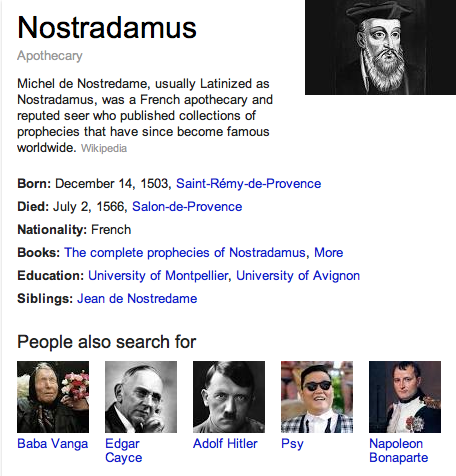
Although, who am I kidding?  More to the point, who the hell am I writing this to?  And would you get a load of this rogue’s gallery under the Google search for Nostradamus (and who knew he had a brother named Jean?)– what the hell is Psy doing between Hitler and Bonaparte?  “People also search for”?  What?   Really?  People also search for their ass with both hands and wind up scratching  a hole in the ground.

Image

Throwing out baby und bathwater

It is easier to hold one thought firmly in mind than to have contradictory thoughts active in the brain.  The nature of reality is complex, the nature of human opinion: simple.  The human mind has been programmed to respond to slogans.  It’s easier to rally under a banner with a few bold words on it than under one with a complex of equally true facts. 

Joey Reiman (see Purpose)  has a private jet he bought, presumably, because he is excellent at what he does and well-paid for it.   He advises the richest businesses in the world about how to become richer, while having a work force that believes it is doing something to make the world a better place.   He advises big business how to convince the public it is doing work to make the world a better place.  This makes the world a better place and it also increases the profits of the company that does this well.

I struggle with bitterness sometimes, even with the several things I love to do and the good health I generally enjoy to do them in.  Even in the face of slow, but great, forward progress of my dream from idea to reality, a certain malaise hovers.   I have neither private jet nor any pay for what I do, however well I may be doing it.  I have built no organization.   I live on diminishing savings, unable to shift my focus from this dream long enough to figure out how to bring in more income.  My thoughts tend to darken at times as I dream of things most people consider too abstract to shoehorn into their busy schedules.   The darkness remains even as I realize how little I care about the details of what other people do for a living, and that this unpaid work I’m doing is also my livelihood and why should I expect others to be engaged by that?   Time is money, after all, so if it’s not fun, or at least exciting, it better pay me something for my time.  

Reading Reiman’s book I allow my distaste for Win-Win Kissinger and McDonald’s (though their products are, in my formerly carnivorous opinion, and in the opinion of billions served, tasty)  to color something more complicated and important– how does one carry out a dream and where does one get help learning that difficult thing?

And Reiman has concrete recommendations– make a short, emotional one-minute purpose film that inspires people with your vision.   Bring in outside experts to energize your organization.   He points out the folly of expecting someone from inside an unworkable workplace to be able to fix the problems of that workplace.  This is also basic common sense.  If the people you have don’t care, find people who care.  It may be easier to do when you can pay the expert consultant her enormous fee, but it needs to be done nonetheless.  My program is designed for poor people and is all about workarounds, I have solved a dozen problems already, a dozen more await.  There is a workaround for each one.

I ran a meeting recently, thinking it was very snappy and productive as I went from one agenda item to the next, succinctly, leaving space for discussion, nodding sagely at every criticism, no matter how slapdash, wrapping up precisely when I promised I would.   I presented a lot of information, laid out immediate goals and challenges and succeeded in everything but recruiting anybody to help me in any facet of the work.  Or even getting anyone to respond to a series of subsequent emails about it.  When I got home, still energized by what I thought of as a productive meeting, I had an email from one of the directors.

“When you’re feeling overwhelmed”  was the subject line.  Under it was a long forwarded email about the many exertions the successful, well-to-do business woman turned energetic social entrepreneur had ahead of her in coming days; proofing the new product, expanding the line to Canada, exploring cheaper production of the product line in Canada, hiring a new North American liaison and raising the money for her salary, breaking in a new secretary, meeting with the powerful partner social entrepreneur from India, accepting another award from the Prime Minister.  The email, intended to give me the inspiring idea that I wasn’t the only one with a lot of work ahead of me, was forwarded to me, I noted, (not without a bitter aftertaste), at the exact epicenter of the meeting, when this tired director was reading her friend’s email and forwarding it to me from her Blackberry.

You can see dynamic speakers at TED talks speaking eloquently of the need for a program exactly like the one I am running on a small scale, in one school, with ten kids.   They talk about the need to allow children to experiment, follow their imaginations, create, problem-solve and collaborate.  The model of schools in our grim, divided, fearful, murderous society is a holdover from factory days when industrialists needed millions of literate High School graduates who could follow instructions, repeat those instructions in unison, if prompted.  

No Child Left Behind, a program with a stirring slogan/name with unintended irony as great as the old Arbeit Macht Frei sign worked in metal atop the gates of an infamous death factory, is a remnant of this factory school mentality.  (OK, this comparison might be unfair, there is no evidence the Nazis didn’t intend the irony of their slogan, they were famous, after all, for practical jokes with a big punchline.  I should also give the designers of No Child Left Behind the same presumption of irony.)  

Like all visionary programs to deal with longstanding problems, the basics of No Child Left Behind (since rebranded as Race to the Top) were clear and simple.   You give standardized tests that measure how every student compares to every other student, you do this often, focusing the children’s attention on the importance of these tests and how to do as well as possible on the tests.  If a kid fails, force them to learn the stuff the second time around, the third time.  If the teacher fails, fire that teacher.  If the school fails, close the school and let a private outfit run it better.  Clean and easy to monitor, just hand out boxes of number two pencils and fire up a bunch of computers to do the scoring and tabulating.

If you watch the TED talks of Ken Robinson, Seth Godin, Sugata Mitra and others you will wonder how, in actual practice, we carry out the ideal of having public education where children, motivated by their imaginations, reach for things considered impossible in a society that values things only in terms of its market sale value.  Externalities like the world’s largest prison population, no decent jobs for most graduates, a dispirited electorate who don’t even bother voting for the corrupt politicians that represent our democracy, well, these are just things to get over, eh?

Here’s another thought to keep in your head at the same time:

Every positive vision of the future began as a dream in somebody’s head, spread because it was a good idea that flowered in other people’s imaginations.   Every organization promoting such ideas began with one or two people.  What luck it must be to have a second person!  But the fact remains, we are set here briefly between two dates, one that we celebrate every accelerating year and one we do not know, unless we are sitting on Death Row, our last appeal denied, date set.  Better, I am thinking to myself alone, and for a clear reason, to be a small light someone might some day read by than another hissing passerby, rushing headlong in the darkness.

All to say, I’m making my way through the rest of Reiman’s book.  He’s a smart guy, no matter how stupid some of his examples and quotes are (e.g., Henry Kissinger as the ultimate win-win guy), and I need all the help and inspiration I can get at the moment.

It’s your problem, pal

“I’m sorry you’re upset about what you think happened to you.  I really am, but now, for the sake of all of us, and I’m asking you nicely, please shut the hell up, you don’t have to go on and on trying to make me understand what you’re upset about, like you always do.  I understand– you’re upset.  I told you I’m sorry you’re upset because you think I did something that I didn’t actually do.”

The look on your face might not convince the other person you accept the apology, so they might feel compelled to add:  “and don’t tell anyone we had this conversation, it is nobody else’s business what we talk about.”

“Look, I’m sorry I don’t have your money I promised to repay today, I know it puts you in a tight spot.  And I’m sorry I won’t be able to pay you back any time soon, because I owe a lot of other people money too, and I’ve owed it to them longer so I have to pay them first.  Once I finish paying the boss back we can start talking about when I’ll be able to start paying you.  Don’t mention this to the boss, or to anybody else.”

If you agree to stay silent, or if you go right in and complain to the boss, the outcome is likely to be similar.  There are people who will urinate on your leg and tell you it’s raining.  This is, sad to say, part of the Human Condition we sometimes hear about.

“Be mild,” you tell yourself, “anger helps no-one, but be direct”.

“Don’t be direct,” a nervous person will tell you.  “Look, I admit I lied, and I know you feel it put you in a bad spot, but there was a good reason, a reason I can’t tell you because you always judge me.  I am not a liar, by the way, though I know you think I am because of that one untruth, but it was an emergency and I had to say something fast.  Who knew it would be a lie?  I didn’t plan to lie, and it was the only time in my entire life I ever did, and I wish we could be done talking about this, I don’t know why you insist on talking about it.  I already told you: I admit I lied, now I’ll tell you I’m sorry it friggin’ bothers you so much, even though it’s none of your business and had nothing to do with you.  And now, for the love of God, get over it and stop frikking bringing it up.”

The problem will be yours to deal with as best you can, don’t expect help from the people who put you in the middle of it.  After all, you’re the one with the problem, not them.

“Look, I know you think it put you in a difficult position, but all you have to do is keep your mouth shut.  The lie doesn’t even involve you, and, really, it wasn’t even a lie.  I don’t even know why we’re still talking about it, why you’re so hellbent on discussing it.  You are so judgmental, you always have been, that’s why I can’t talk to you.  I don’t judge you, even though you do plenty of bad things and constantly judge everyone else.  You’re the only person in the world who would keep bringing something like this up.  You have some kind of agenda and no freakin’ shame.”

“So you had to go talk to the boss, I see.  You couldn’t work this out like a man, you had to go talk to the boss, like a little boy with a poopy diaper.  Nice.  Very freakin’ nice.  Imagine how much of a hurry I’ll be in now to pay you your stinkin’ money back.  People like you, all you care about is money, and crying about it.”

The rain continues to pound down your leg, soak into your sock, your shoe.  It doesn’t smell like water.  What they hell?

“You want people to share in the blame for your problem, but it’s your problem, you’re the one with the problem, deal with it.  Don’t tell anyone about this, or, so help me God, I will dig up your father’s skeleton and do shameful things to it.”

Now, wait a second, what kind of sick idea….

“No, you wait a second.  The sick idea comes from you, pal.   That’s right, if you could have kept your stinking mouth shut I’d never have had to come up with methods to make you keep your mouth shut.  You know, you’ve got a lot of problems, my friend.”

A host of problems, yes indeed.  Unreasonable expectations.  They started young.

“Quit staring at me from that crib with those big accusing eyes!” said the man in the bed.  I couldn’t answer, not because I didn’t have anything to say, but I was too young to speak.  I had no idea what my father was talking about, truly.

“Oh, sure,” my mother called out, “make it sound like it was his fault, like he was the one staring at you with that challenging, angry expression.  The pediatrician said you were having a temper tantrum at ten weeks old.  Ten weeks old!  You think we are making this up?”

“I think a good pediatrician might have tried to determine what was making a ten week old infant so upset, rather than concluding that the kid was just an irrationally angry baby.  Doesn’t that make sense to you?”

They never told me if the pediatrician was a human or a jackass.  He laughed like a jackass when he saw the baby rigid, red, fists clenched and screaming.  “Wow, I’ve never seen it so young, this infant is having a temper tantrum!” and his long ears went back and he honked out a good jackass laugh.

“Oh, sure,” the ghosts of my parents as young parents would have said, “You’re the only one who’s not a jackass.”

Though I wouldn’t have phrased it quite that way, they did make a reasonable point, at least between me and the pediatrician.

My only advice when people try to make something into your problem that is not your problem– shrug that mess off of yourself and go somewhere where people don’t urinate on your leg and insist you tell them it’s raining.  

Many times every day people urinate, and  it often rains, but when it’s on your leg, and it’s body temperature, and it stinks and is some shade of yellow or brown, it’s not really that hard to know the difference, though it can take many years to learn the most productive reaction.
Purpose

I dive in today with a sense of purpose, to describe an odd coincidence and a book I will probably never read much more of, in spite of it being one of the best books ever written on the subject.

Sekhnet occasionally brings home books she thinks I might be interested in, or that might be useful to me.  Most she finds at work, where publishers send them in hopes of getting the author on TV for some invaluable free major network publicity.  

The ones that reach Sekhnet no longer have such hopes, having found their way into the crew room, where they are largely ignored by technicians who come in to check email or fall asleep, open-mouthed, in front of the constantly droning TV mounted on the wall.  One such book was The Story Of Purpose: The Path to Creating A Brighter Brand, A Greater Company and A Lasting Legacy.   Since I am trying to get a purpose-driven business off the ground, she thought I might find it interesting.

I read three paragraphs into the introduction before I made my first bracket in the margin:

Purpose is both a financial and a humanitarian force.  Purpose-driven organizations create more good in the world, which begets greater profit, which allows them to then create even more good.  It’s a virtuous, never-ending circle. 

Leading this virtuous, never-ending circle of more and more good in the world, it turns out a few pages later, his close friends the executives at McDonald’s (improving the world one Happy Meal at a time), Procter & Gamble, a major bank or two and several other hugely successful highly profitable organizations dedicated to greater good and greater profit. 

I turned to the back flap for the author bio, after reading this description of Henry Kissinger, who one of the author’s CEO friends calls “the ultimate win-win guy” before describing the “epic meeting between Kissinger and Zhou-Enlai in which the statesman Kissinger tells the premier, ‘let’s not shake the world, let’s build it.'”   Kissinger might be the ultimate win-win guy to the no-nonsense CEO of a Fortune 500 company that is deforesting the Amazon rainforest to make delicious burgers for happy kids, but to many of us, Kissinger’s the ultimate scumbag war-criminal winner of the Nobel Peace Prize.

“Could they not have exhumed the stinking carcass of Hermann Goring and given his rotting cadar the prize this year instead?” thought the ghosts of hundreds of Cambodian children murdered under Win-Win Kissinger’s policies during an illegal, secret bombing campaign on non-combatants in a country the US was not at war with.

But as is often noted, one man’s Nobel Peace Prize winner is another man’s Hall of Fame War Criminal.  It all depends on your perspective, really.  Morality is a fluid thing in our world of Purpose-Inspired Leadership.  One man’s genius pioneer of branding and marketing (Josef Goebbels) is another man’s Nazi bastard.  You know, you just have to pick the right heroes, choose the purpose that best drives your particular vision of a world-improving business.

Reading the back flap I learn that the author, Joey Reiman, is:

Founder and CEO of the global consultancy, BrightHouse, a company whose mission is to  bring purpose to the world of business.   Reiman has emerged as the leading expert in the area of purpose-inspired leadership, marketing, and innovation.  His breakthrough purpose methodology and frameworks have been adopted by top firms, including Procter & Gamble, The Coca-Cola Company, McDonald’s, Nestle, MetLife, SunTrust, Michelin and many more Fortune 500 Companies… 

I shake my head, close the book, put it back on the tank behind me and flush.  I decide that writing a few words about it some day is probably in order.

A few months pass, I am standing on a hill, next to the headstone I had chiseled with my parents’ epitaphs.  My uncle is being laid to rest on a cold day in Peekskill.  After the small funeral, Sekhnet and I go to a diner with two cousins I see only at such occasions.  Sadly, I’ve lost track of them, both lovely women I always enjoyed spending time with over the years.  I have only dim, distant memories of their several children, their grandchildren.  The family has moved around the country, I have a hard time recalling all the names in my head.

Over lunch one cousin is recounting a recent birthday party, a milestone of some kind, where the kids flew in from all over to celebrate her.  One of her children, her son Justin, a very successful copywriter, with a great job in marketing in Atlanta, had trouble getting a flight.   Joey Reiman had him flown up to the party in the private jet.  Justin had an important purpose in getting to his mother’s party, it was only fair that the guru of purpose-driven things would make sure he got there to read the clever lines he’d composed in mid-air.

“Joey’s a great guy,” said Sheila.

I’m sure he is, I thought, smiling broadly for what probably appeared to be no good reason.

A Funny Thing

Outside the roofs nearby are white, a flutter of snow has been swirling around ineffectually for the last few hours, dancing over the St. Patrick’s Day parade wending its way down Fifth Avenue, I suppose.  They say it will turn to rain after a while, I can hear cars splashing in it as they pass outside.  But the roofs look nice and there’s a dusting of white over parts of the garden.

Somewhere a lion yawns.

A clever woman in law school wrote a student note for one of the scholarly journals, discussing the then frontiers of the internet, dubbing cyber space Cyberia.  I don’t know if that was her coinage or not, but it seemed clever to me at the time.  One reaches for things like cleverness as a law student; I recall one project we had that first year was called “Treasure Hunt.”  The treasure in question was a bunch of tricky to find statutes, case citations and even some dicta.   Fond of drawing as I am, it was hard to resist, during Torts or Contracts, drawing a scandalized guy pointing at a steaming pile of shit, flies buzzing around it, saying “Hey! That’s not treasure!”  The girl next to me, who was beautiful, smiled and wrote an approving note on the bottom of it when I slid it over to her.

A wildebeest passes gas.  “What’s gnu?” the punster asks blandly.

On a day like this, and outside the flakes are now fat and fluffy, falling in a great 3-D display, alone in Cyberia, it seems pointless to dream that my plans will ever be more than the distant daydream they are now.   More than pointless, really.  Without money you might as well (insert your favorite substitute for the vulgar phrase about taking a lustful leap after a rolling donut).

“Your best words, my friend, not worth the air it takes to expel them, even though that air is CO2 and useless to anything but a vegetable,” says the tired voice of experience.

And, sad to say, it’s true.  A word to the wise will suffice, but the best words in the world, addressed to inanimate objects, or immovable ones, or ones prone to silence, or to multitasking or….

“Pipe down, man,” says the voice of experience.  Right again.

You Don’t Need Feedback

It’s the craziest thing, in a world where we buy entertainment and consume sponsored culture in paper cups, that anyone could expect to move forward in a creative business without a good focus group, marketing and branding experts, plenty of street smarts, energy, drive and ambition.  If you have enough money, none of this matters, I suppose.  But for everybody else, selling and funding is the life or death of the creative project.

You send the babies out into the world, but don’t expect too many smiles at those babies, unless you’ve been skillful enough to find the audience that really cares.  The world is a very noisy place, and smiling at babies is low in the pecking order.  The reasons are many.  Some are Zen masters, of course, and float above the world of desire and pain.   Some are being chased by too many things to look back, to pause and smell a flower.  Some truly, and to the bottom of their hearts, don’t give a rat’s tutu.

Myself, I don’t like babies very much.  Yet when somebody holds up their baby, with that proud, expectant look on their face, I have to say something.  “Cute!” I’ll say, trying my darnedest to make it sound genuine.  But that’s just me, too much time on my hands, so I wind up being like that, I guess.


Peekskill USA

My father and my uncle grew up in Peekskill, NY, a once-prosperous river town on the Hudson River.   As times changed, and transport by riverboat faded from memory, the town lost its most lucrative business and its luster.  It took on the haunted quality it possesses to this day.   By the time my father and his then infant brother arrived from the slums of New York City, just in time for the Great Depression, the town was probably a pretty hopeless place.   The father and sons who ran the hardware store were, according to a cousin who punched one of them in the face on his first day in town, proud members of the Ku Klux Klan.

In August of 1949 there was a Paul Robeson concert scheduled for a picnic area just outside Peekskill.  Robeson’s likeness is on a U.S. postage stamp now, but at the time this scholar, college football star and opera singer was considered by many to be a dangerous Communist sympathizer.   Eventually he would be forced to leave the country.  A powerful, outspoken Negro at a time when black people were supposed to be content with their second-class lot and play semi-comical servant roles in movies, Robeson spoke out against wars of aggression, against Jim Crow, against racism, against police violence, against the exploitation of workers and the unbridled materialistic greed of our money worshipping culture, against so many things that patriotic men like J. Edgar Hoover stood for.  It’s small wonder there was a riot in Peekskill in August of 1949 when he came to do a show there with Pete Seeger and other idealists who, at the time, were regarded as a fifth column, fighting for Stalin under the false banner of “brotherhood”.  

It’s easy to get stressed out people to support the fight against an enemy once that enemy is properly demonized, Hitlerized, Stalinized.  Particularly if the people supporting the war don’t have to endanger themselves in any way, they will support the war effort fervently.  And if they get a chance, as they did on a summer evening in Peekskill in 1949,  to kick some mixed race Commie ass in an ambush where they outnumber the race traitor Commies twenty to one, so much the sweeter.

My father was a World War Two veteran attending Syracuse University on the GI Bill in 1949, if I have my chronology straight.  He had grown up in grinding poverty (a phrase he uttered through gritted teeth when tersely summarizing his own childhood) on Howard Street in Peekskill.   A lifelong student of history and current events, in his early years he aligned himself politically with men like Robeson and Seeger.  He was an idealist who’d been in the army fighting fascism and he was passionate about righting injustice.  He wanted to see the world become less fascistic, rather than more so.  He believed in brotherhood,  civil rights and civil liberties then and for decades after.  He also acted on these beliefs, enduring catcalls and rotten vegetables as a spokesman for the integration of NYC schools after Brown v. Board of Education and its “all deliberate speed”, among other things.  I believe he returned to Peekskill for the concert that turned into a riot when angry white mobs overran it.

My father is gone now, as is my uncle, so, unfortunately, there is no way to verify whether he was there or not.  But visiting my aunt the other day for her 85th birthday I spotted a book on her shelves called “Peekskill USA” by Howard Fast.   I recall that my mother admired Howard Fast (although she acknowledged he was probably not a great writer), and hearing from her that he’d been blacklisted by the House UnAmerican Activities Committee and also thrown in jail during the anti-Communist witch hunts of that time.

“Peekskill USA” is Fast’s eye-witness account of events in Peekskill on August 27th and September 4th, 1949.  The first one a riot, the second one an actual concert, as far as I can tell so far.  Published by the Civil Rights Congress Press in 1951, and printed in the United States of America (as it states on the copyright page) the book is a collector’s item.  My aunt was reluctant to let it go, though she certainly has not opened it in decades, if ever.  I understood her reluctance and promised to read it quickly, take good care of it and send it back to her soon.

I started reading it this morning.  The forward states that the events in Peekskill 1949 are destined to live forever in the memory of all who oppose fascism.  It was a hope, like many back then, that was swallowed whole during the so-called Cold War.   I often look around at the assumptions that underlie our singlemindedly materialistic society, like the one that says extremely wealthy criminals must be treated under a different, more forgiving, set of laws than petty criminals, and wonder about the actual winners of the Cold War.  

It seems they are the same winners as ever, the wealthiest citizens, casually united by common interests to preserve their sometimes hard-won prerogatives.  So much of the business of the 1% is amoral that it seems churlish to judge it as harshly as I do.  It’s not as though the richest among us want 45,000 Americans to die of treatable diseases every year for lack of health insurance, or want our wealthy nation to have the infant mortality rate of a third world country, or millions of hungry, malnourished, abused American children, or a permanent underclass and the largest prison population in human history.   These are surely forgivable externalities.  In order for some to have 100,000 times the wealth of others, certain sacrifices must be made.  It is only common sense, after all.

I have often thought, with that characteristic uncharitableness of mine, that Fascism prevailed at the close of the Cold War, disguised as Democracy, which, from the beginning, used phrases like “all men are created equal” with a certain puckishness.   The forces of reaction, inherently anti-humanist, amplified through the largest public megaphones, are always behind the status quo.  Why would it be otherwise?

So, if high ranking Nazi spooks were recruited after World War Two and hired by the American OSS, and their extensive anti-Communist knowledge and techniques incorporated into the CIA and used to undermine and eventually defeat the evil totalitarian system of Communism, why should I even mention this, at best, footnote coincidence, here?  If the same baldly manipulative techniques pioneered by Woodrow Wilson’s Committee for Public Information to drum up American support for unexplainable (except in terms of how it enriched certain already rich people) World War One were refined by Josef Goebbels and his Ministry of Public Enlightenment a generation later to drum up support for the war to cleanse the world of the Jewish virus and its Communist spawn, and if those techniques are still largely in use today by those who promote wars of every kind, why should I draw any negative conclusions?  Why bring Fascism into it?  After all, “collateral damage” is so much better than “murder of innocent civilians” and “Freedom is on the March” is so much better than “what are you going to do about it, asshole?”

I’ll report back on Howard Fast’s account of the Peekskill riots in Part Two.

Vhy Wampires Don’t Bronounce W

I have no idea.

But as my mentor in the writing program at City College observed, I have never been a good reader of my own written words.  I render them as lifelessly as the prose itself is lively.  OK, fine, maybe not lively, but not as dead as they sound when I read them aloud.

As an experiment yesterday I read two paragraphs in a wavering caricature of a Transylvanian accent, based on a mixture of Bela Lugosi and Peter Lorre, born Lazlo Lowenstein, and not a Transylvanian at all.  To my surprise, and perhaps too much delight, I found that the reading was much, eh, livelier.   Wasting no time, I set it to music and added a few light sound effects on another track.  Then, upon hearing it back, I made like the mad narrator of Edgar Allan Poe’s great Telltale Heart, and I laughed.

For those who might fancy me a bit eccentric for telling this, let me reassure you.  The disease has only sharpened my senses.  You will laugh too, I tell you, when you hear how wisely, indeed how sanely, I then proceeded…