One from the shut the fuck up department

Felt good to solve a vexing problem in short order.   Got two numbers for actual dermatologists from the bright, efficient receptionist at my primary care doctor’s office, both in my plan.  Within minutes I was making an appointment with one for next Thursday.  The very reasonable, thorough, old-school receptionist told me I’d pay $150 by check for the visit, will be reimbursed if insured rate is lower.  She told me exactly what referral form she needs faxed to her office.  Got directions to the office, done.  

Too easy, I realized.  Obamacare is famous for not allowing things to happen this easily.  After only ten or fifteen more minutes on hold with Empire Blue Cross, after paying my premium, I was speaking with an agent to verify that this doctor is in network.   She only handles California and Nevada, it turns out, had no idea why my call was routed to her, since I live in NY and called the proper number on the back of my card.  

She was good enough to go on-line, and after only a brief hold, inform me that this old school doctor is out of network.  I will therefore be responsible for paying all undiscounted fees including any possible lab fees with no intervention from the private insurance company I pay my monthly premium to.  

I run the other doctor’s name by her.  Also, unfortunately, out of network.  She directs me to the on-line list for dermatologists in my network.  There are over a hundred other dermatologists I’ve never heard of, within five miles of me.

If you can, please, direct me to the shut the fuck up department, I was told it was on this floor.

Feeling Powerless?

Don’t worry, there are hard-working, brilliant idealists at work standing up for you.

A few years ago the commonly cited number was 45,000 Americans a year dying deaths that could have been prevented had their illnesses been detected before the fatal stage that brought them to an Emergency Room.   My father, though he retired with excellent medical insurance and was on Medicare, though he saw an endocrinologist, hematologist and cardiologist regularly the last two years of his life, as his energy and life force deteriorated, was first diagnosed with liver cancer by an ER doctor, six days before he died.  

My father’s case was, hopefully, unusual in a nation with the most advanced medical technology in the world.  Most of the 45,000 annual American deaths that could have been prevented by earlier intervention (a few seconds of diligent google research shows this recalled number is a fraction of annual preventable American deaths) were died by poor people, people without health insurance, people too frightened, by disease and the specters of unaffordable expense, bankruptcy and pre-existing conditions, to see doctors.  Many who died needlessly probably had serious warning signs they should have heeded.    

In part to address this intolerable death toll in our extremely wealthy nation, in part to rein in the runaway cost increases of the most expensive medical care in the world, President Obama passed the landmark compromise medical insurance bill that bears his name.   I haven’t seen the statistics since Obamacare went into effect, but I’ll guess that the number of annual preventable American deaths has come way down, maybe by as much as a third.  

Progress on an institutional level is at best incremental and the perfect must not become the enemy of the good the president, a man with millions of determined enemies, reminds us.   Malcolm X, in his posthumous autobiography, remarked that sticking a knife ten inches into someone and pulling it out six inches is also considered progress.  But tell that to the guy with the knife stuck into his body.    

The unregulated inflation of the world’s most lucrative medical insurance and pharmaceutical industries, and obscene loopholes like ineligibility for insurance coverage at any price for people with “pre-existing” medical conditions, screamed for regulation.  Obama’s team, headed by medical industry insider Liz Fowler, working for industry financed former Senator Max Baucus (now Ambassador to China), struck a compromise — price increases for medical insurance would be regulated, American health care would become more outcome and prevention-based, there would be no more exclusions for ‘pre-existing conditions’, industry-wide cost saving measures would be introduced over time.  

The private insurance industry got something in return for giving up all this power and potentially some of its profit.  Americans of sufficient means would be mandated to buy private insurance or pay penalties for not buying it.  

Medicaid eligibility would be extended under Obamacare.  Although millions of Americans would remain uninsured, millions who’d been previously unable to afford health insurance could now purchase and even, in most cases, afford it, under the Patient Protection and Affordable Care Act.  

Somehow, along with the industry consenting to be regulated, forced to justify regular, generous increases in insurance premiums, paying out for sick people whose conditions pre-existed their purchase of medical insurance, the law provides that patients have no right to be informed of actual costs prior to any medical visits or treatments.  I kid you not.  

You make an appointment to see a physician’s assistant about a stomach ailment.  Nobody anywhere, not at the company you pay your premium to, not at the doctor’s office, can tell you in advance what that twenty minute visit will cost.  

“We have to wait until the doctor’s office bills us, there’s no way to tell you in advance,” the insurance company will say.  

“We have to be told by the insurance company what the price will be,” the doctor’s office will tell you, “the insurance company sets the price, then we are allowed to bill you.”  

Then, since all plans in your income range might be high deductible plans, you will have to pay the entire cost, whatever it might be, “out of pocket”.   That’s the law.  There is what’s fair and there is law, and the two are, regrettably, not always the same.  

If you went to a store where there were no prices on the items, where no sales person could tell you a price until after you signed a blank credit card statement to buy something, with no chance for return or refund, you would not shop in that store.   Picture a restaurant with no prices on the menu, smiling waiters assuring you that everything was delicious and not to worry, the prices were as low as possible for such amazing food.  

Assume the dinner was fine, or even if it wasn’t, here comes the friendly waiter with your check.  Dinner for two without wine: $507, coincidentally the same as my bill for seeing that physician’s assistant who was so clueless and unhelpful.  The manager is not able to hear an appeal or make any changes to the price.  The owner will not speak to customers under any circumstances, and he’s not in, anyway.  If you try not to pay there is a policeman at the door to inform you lawyers will be called to garnish your wages, and make the collection.   Don’t believe it?  Wait a few weeks, the lawyer’s letter will be in your mailbox informing you of your obligation to pay a legal debt.  

In fairness, and it’s always important to be fair, the $507 total for my visit with the physician’s assistant turned out to have been billed in error.  My next set of bills, which I confirmed the accuracy of with my insurance company, informed me I should have only been charged $457.   And much of that was my own fault.  I’d agreed with the nurse that it was reasonable to do a blood test, to rule out something serious our internet research hadn’t suggested.   The price of the blood test I had to pay was $327, discounted by my insurance company from the sticker price of $642.  Instead of being grateful for the almost 50% discount, here I am bitching and moaning.   Just goes to show, some people are never fucking happy. 

But, if you will excuse me, I have to figure out who else to call to find out how to avoid a similar expense to have a dermatological body scan done by a physician’s assistant I was misinformed yesterday is a doctor.  My concern is not only the cost of the visit and exam, but if anything has to be sent to the lab, that can add from $179 ( to sky’s the limit)  to my out-of-pocket expense, in a addition to $131 for the required pre-procedure office visit, as in the case of my 100% covered preventive care colonoscopy a year back.
Ten Minute Drill – Supervisor

It’s like going to the dentist, really, a ten minute drill (and more for the reader than for me, perhaps).

Thinking of some recent folly, which I’d like to comb out of mind.  With high hopes I began a course of CBT (Cognitive Behavioral Therapy) with a student therapist, at a steeply discounted rate that added up, over many weeks, to the price of a decent guitar, or a very good acoustic amp.  I’m not crying over the money (though I’m resentful) as much as over the long stretch of unthinkingly wasted time.

CBT is a technique that allows the successful practitioner to run negative feelings through the filter of Reason, to consider these feelings from a more productive perspective.  Identify their source and move beyond them to do what negative feelings often stop one from doing.   I’d gone into the program with three distinct but inter-related goals, made no progress at all on the first two and only minimal progress on the third.

Trouble was, the therapist was a student.  Trouble is, I speak well, fluently, concisely.  This student, young enough to be my daughter, revealed, after many, many weeks of spinning my wheels, that she deferred to me, because of our age difference, because I speak so well, am so analytical, seem so capable and confident and blah blah blah.

“Have you no supervisor?” I finally ask, aghast.   I had begun suggesting exactly what the therapy should have been doing, the simple, practical steps that should have been reasonably taken, but many weeks too late, the sessions are almost done.  Another exercise in uselessness.  If I could have designed and implemented the course of treatment myself, motivated myself to move forward toward the three unrealized goals I came here with six months ago, why would I need to be coming here?  “What has your supervisor advised you?”

She was cagey about the supervisor, yes she had one… but… it’s good that we’re talking about how disappointed you feel.   I realize now, since each session is video taped, since her supervisor is clearly not helping her to be a more effective therapist, that she’s aware that this person who is evaluating her will watch with twitchy, beady eagle eye for the moment in any session when she might admit, in the interests of that candor so important to effective therapy, that her supervisor is a bit hands off, distracted, stuffy, paranoid, pompous, kind of the caricature of that useless, tic afflicted maniac we think of as becoming a supervisor and evaluator of other shrinks.

“Do you feel better now?” asks Siri.

Well, Siri, a tiny, tiny bit better, yes, thank you.  I’d better get back to designing my own therapy program now.

A Small Piece of What Hobbles Me

Among the things that have me by the toe, the waning of democracy and the ever steeper upward tilt of the so-called level playing field.

“Are you fucking crazy?  You are held by the toe by a myth that was, at best, an exercise for keeping order and property, designed by the wealthy and maintained, whenever necessary, by their goon squads?”

Democracy was more than that.

“If you say so, my idealistic friend.”

Take the example of public education, a once truly democratic institution.  Not that long ago the children of immigrants, educated in New York City Public Schools, could attend the City College, for affordable tuition they could earn by working as they studied, get an excellent education, graduate debt-free with a degree that was worth as much as degrees now costing $160,000, and find work in their chosen field that allowed them to move out of the tenements where they grew up. 

“OK, nice example of democracy in action, and meritocracy, but times change.  Systems evolve.”

Ya, mon.  This is what has me by the toe, in the New Gilded Age, working with an outmoded belief in something good that is now under constant, coordinated attack by a well-funded army of profiteers.   I designed a program for public elementary school students, to work as a group, guided by their own ideas, supported by adult facilitators.  My idea was to show public school kids, in poor neighborhoods, at their best– give them a showcase to demonstrate what they could do if they weren’t being actively trained to be factory workers in factories that no longer operate in the US, or, failing that, failing, dropping out and becoming prisoners in a privatized for-profit prison system.

“You are pissing into the wind and ignoring the fact that, sad as it may seem to you, you are one of the few people you know who is even passingly following this sickening debate about public education.   Only people with bleeding hearts give more than a passing thought to the fate of the kids you want to work with.  The children of the disenfranchised are an abstraction.   ‘Disenfranchised’ — without the right to meaningfully participate in decisions about their own governance.    But let’s not get lost in emotionality.”

“Look at the numbers, it makes everything easier to understand when you view it with a calculator in hand.   Simply multiply the number of students entitled to a free public education in the U.S. by the sum each state and school district allocates per student.  That number is hundreds of billions of dollars a year, left on the table for substandard education.”

Hundreds of billions of dollars a year. No need to pull a number out of our asses, when we can pluck one from the internets:  $621 billion a year, as of a couple of years ago.

“No small sum, my friend.   Private entrepreneurs who have already shown they know how to make billions are the best stewards of that kind of dough, not people with interesting theories about how children learn, or a quaint belief that cooperation yields more social benefit than competition.   You can’t expect public school administrators, teachers, educational theorists and the like to know as well as Bill Gates, Michael Milken, Michael Bloomberg, giants in making mountains of profit, some of the richest and most enterprising men in the world, how to maximize the profit of that enormous investment in such an important human resource.”  

You make my case for me, friend.   Milken served his time in prison, ten year sentence generously discounted by 80%, seemingly got to keep most of his ill-gotten money and is now called a philanthropist on his Wikipedia page.  We learn at a glance:  

Michael Robert Milken (born July 4, 1946) is an American former financier and philanthropist. He is noted for his role in the development of the market for high-yield bonds (“junk bonds”),[1] for his conviction following a guilty plea on felony charges for violating U.S. securities laws, and for his charitable giving.  

Forbes currently lists his net worth at $2.5 billion.   

Read on and learn how you do it.  This is how you do it:

Milken and his brother Lowell founded Knowledge Universe in 1996, as well as Knowledge Learning Corporation (KLC), the parent company of KinderCare Learning Centers, the largest for-profit child care provider in the country. He is currently chairman of the company.[18] Milken also established K12 Inc., a publicly traded education management organization (EMO) that provides online schooling, including to charter school students for whom services are paid by tax dollars,[19] which is the largest EMO in terms of enrollment.[20]

“This is really the best use of your time right now?  Showing how a convicted billionaire felon/philanthropist is profiting by redirecting public school dollars to his own for-profit enterprises?   This is really the best use of the time that is slipping like sands through the hourglass?”

Not at all, friend, not at all.  Just a small piece of what hobbles me.

Get Away from the Screen

Excellent advice, read after my timer went off, 48 minutes of cleaning picked at, when I popped back on to the screen.  

Do you see any significant clearing in the tangled undergrowth of your desk, your kitchen table, your chair?   That tangle on the floor next to and behind the chair?  The precarious pile of boxes, paper, musical instruments and effects balanced next to the chair?    

Another 48 minutes for the timer, your back into it this time, instead of looking hopefully at the screen for something that will distract the mind.  There is a rich universe of things here for distracting the mind, although rich is probably the wrong word for the kaleidoscope up here on the screen.

Very well, 48 more, let’s go.

Tenterhooks

I don’t know what they are, exactly, but goddamn them.  Time running out, whipsawed between waiting for a promised immediate definitive call back from a well-meaning woman at the credit card company with slightly insufficient attention to detail and a long trip by subway, bus and foot to allay, to the extent I can, the stress of someone I’ve stressed out by my own slightly insufficient attention to detail lately.

Seeking to reduce her stress, I am on tenterhooks, real or imagined, since I need to leave and was just promised that if I stay I’ll get an immediate call back with a definitive answer I don’t absolutely need until around 9 Central Time (it’s 4:14 Central Time now).  

Time to use my imagination to cast the tie-breaker against reality, whatever that may be.  Here we go:  I can imagine myself on the subway, standing now, since it’s rush hour, listening to a podcast, not minding a bit.  I can imagine finding a vexingly lost item where I hope it is when I get back to the farm, having time to make a surprise dinner for my stressed out, exhausted partner who will be particularly happy to see me if my vexing stories turn out to have happy endings.  

And if not, misery, as they say, loves company.   Y’allah, let’s get the show on the road! 

Stats Corner

One thing I love about baseball is the stats.  You can look at a sheet of numbers next to a bunch of names, arranged as a box score, and quickly learn virtually everything about the game these people played.  Few stats are as straightforward as the numbers in a box score, though, of course, a blooper that falls in and rolls is indistinguishable from a shot that caroms off the wall at 120 mph.  “That will look like a line drive in the boxscore,” says the announcer of the dribbler that stops halfway to the hot corner as the runner reaches first and gets a perfectly valid base hit.  Most stats can be manipulated any number of ways, like words, moods, standardized test scores, economic numbers, people who want to please, fearful souls, etc.

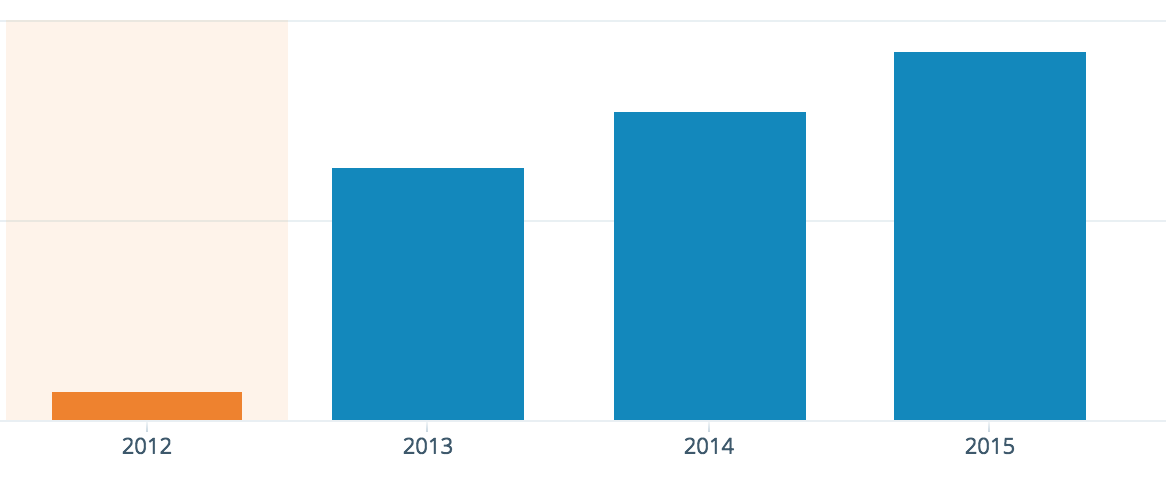
WordPress offers stats, along with your free blahg.  Stats let you know how much traffic your site is getting, how well your little on-line journal is doing as far as readership.  You can see, for example, how many visitors you have on any given day, week, month, year.   You can see the numbers of likes, comments, views.  I look at these from time to time and nod, observing what an obscure little corner of cyberspace the gratuitousblahg occupies.   Rearranging the stats like the entrails a sooth sayer in the time of Caesar studied for omens of the future, I see this smiling augury.

Screen Shot 2015-10-04 at 3.41.27 AM

Not a bad trend, I think, coyly trimming off the tell-tale column to the right that shows the actual numbers.  But look at the trend, if you will; it is the trend I am getting at here with this chart.  I have reason to feel slightly encouraged by the steady uptick in annual visitors, do I not?  In ten years time, at the present rate of increase, I will have as many visitors in a year as the average porn site gets in a few hours.  Progress, by any measure, I’m sure we all agree.

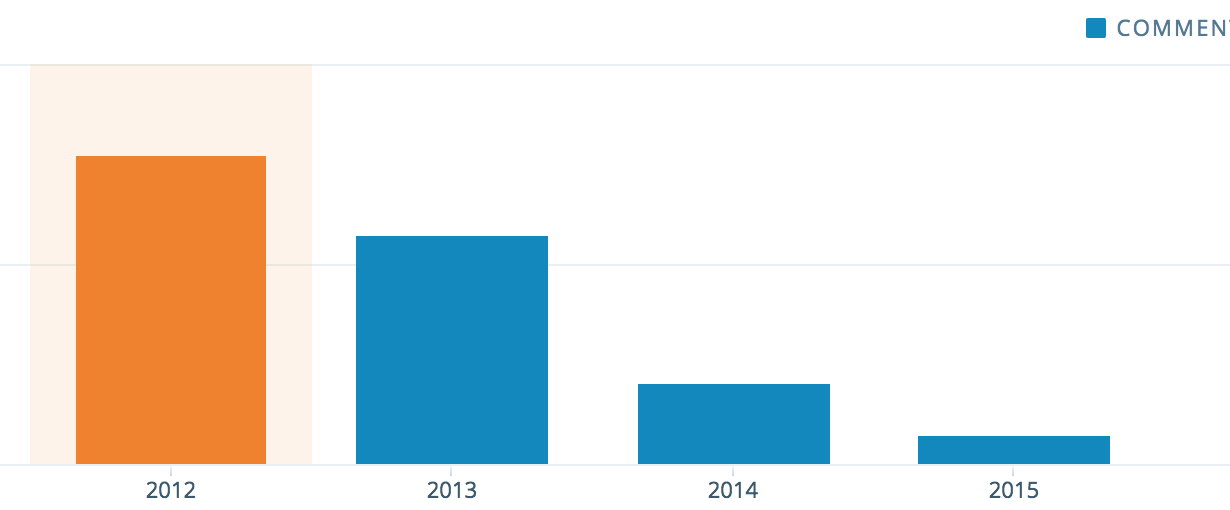
Stirring the entrails with my stick to divine further trends I notice an odd contradiction in the stats.  Although I’ve stopped complaining about it, as much as I am able to, long time readers of these posts will know I’ve often sung sad songs about the difficulty of getting any feedback on anything.  The echoes from my adversarial childhood make me more susceptible than some to the sting of silence by way of response, though I think anyone  who expresses herself does so with some hope of a response.   (Note the sensitivity of my gender choice there, gentle reader.  I was encouraged to do this in law school, of all places.  Funny, I know.)

The most dependable form of response in real-time, something that, sadly, cannot be heard in cyberspace, is a laugh.  A laugh is also gratifying because it’s usually honest, spontaneous and an instant of blessed relief for everyone involved.   Not so with a response to other kinds of expression– they require both thought and action, even if each might take only a few seconds.    

Much non-response is simply the result of most people being too busy to read, hear or watch something they thought was pretty good and then take even more time to type “nice”.  “Nice” seems insufficient, so after a moment of searching in vain for a better four letter word they sensibly move on to the next thing.  

On top of the fast pace of modern life, it also doesn’t even occur to most people that a person who spends time creating something would be gratified by the encouragement, even as they applaud even a mediocre live performance (writing isn’t a performance, read it publicly, then we’ll clap) and most people remember to compliment the chef at dinner when a new dish is served (hey, nobody asked you to serve me this crap, bub).   Social behaviors change when people are anonymous, which is whey they created the “like” button, although the chart for gratuitousblahg likes is too ambiguous a little mountain range to be of any use to us here.

There is pleasure and satisfaction to be had from doing a thing as well as you can.  These excellent things are not to be sneezed at.   Recognition that the thing is well-done, interesting, has provoked a thought or feeling, welcome as the validation might be, well… no one can hear you shake your head in cyberspace   Anyway,  have a look and quick ponder at the next telltale graph, comments on the blahg since its ‘launch’ in August of 2012.   And, please, no comments, this one’s on me.

Screen Shot 2015-10-04 at 3.40.52 AM

The Unfairness of justice-biasing profit vectors

Corporations are people, you know, our highest court has affirmed this truth, as self-evident as the proposition that all men are created equal.   Corporations are just like you and me, endowed by their creators with certain unalienable rights, although skeptical Bill Moyers says he’ll believe corporations are people when the state of Texas puts one to death.  

I heard an excellent talk by a man named Yuval Noah Harari describing the ascent of one hominid species, homo sapiens, to dominate the planet.  Homo sapiens were not the top predators, far from it.  There were many animals who could easily kill and eat homo sapiens, there still are a few.  Homo sapiens were bound together by common terrors, and driven by fear and a large brain, came to dominate all the other species on earth, and wipe out many of them on our way to planetary domination.  

He compared us to sheep with a nuclear bomb.  A truly terrifying and profound comparison.  He pointed out that you don’t fear a lion with a nuclear bomb, not that he would ever try to create one, because a lion is not afraid, knows its power, can defend itself without a bomb, but a sheep with a bomb?   The top animal in a group of sheep will press the button in a heartbeat when a lion comes too close, the second he runs out of weaker sheep to shove into that lion’s jaws.   

Harari also pointed out how homo sapiens are driven by our abstract world view, march forward as societies united by belief in a common myth.   He underscored the fluidity of the self-created myths that humans live by.  We can turn on a dime, when it comes to the beliefs that drive us. Torture, for example, (although I don’t think he mentioned it), a practice universally reviled as barbaric, quickly becomes acceptable to many once it’s rebranded as something that moral freedom-lovers necessarily use against evil fredom-hating monsters.   Harari gave the humorous and horrible example of members of a divinely inspired religion based on peace and brotherhood who obey God by setting on fire those who deny the divinity of the awesome god who has commanded them to be merciful, to love their enemies.   We eventually get to an idea like the “Free Market”, another good one.

An empathetic person can see things from another person’s point of view.  So let me not be so judgmental about a freedom loving and prosperous people who consider the inadvertent downstream poisoning of impoverished babies in some faraway hellhole, or the wholesale destruction of life-sustaining jungles, “externalities”, the unfortunate but acceptable price of doing business in a “Free Market”. That millions were displaced by a war we started, hundreds of thousands maimed, killed and orphaned on orders from our leaders, who may have honestly believed they were doing the right thing?   Regrettable, of course.  

Jesus was very judgmental about the injustices of the status quo of his time, and the status quo wasn’t having it,  nailed him to a cross, made an example out of him.  Few are willing to be made such examples of.  I am certainly not hoping to be made such an example of, as I preach quietly to my distracted flock of three or four.  Let me, therefore, try to be more empathetic toward the powerful.

Seeing things from a corporate point of view, as our lawmakers are obliged to, things are not so black and white, Mr. Moyers.  Really the only thing corporations want is unlimited immunity from the justice-biasing of their profit vectors.  If fairness were the only yardstick by which we measured our actions in the world, few great things would ever be done.  How many great fortunes were made by people who passionately believed in across the board fairness?   Grow up, would you.  Life is unfair, get used to it, stop bellyaching about it, move on.

Allowing a justice-bias into the conversation about the Free Market just gums up the works, kills job creation, makes us all less wealthy.  Think about it.  You can’t spend time (which we all know is money, and therefore, also, free speech) considering every abstraction, after all.  And bias of any kind is wrong, as we are reminded constantly.  If a very profitable process for extracting a valuable commodity from the earth causes earthquakes, well, a lot of bad shit happens every day.  You cannot blame people for wanting a good life.   It’s certainly not smart to blame those people too shrilly if they have their finger on the trigger of a nuclear bomb.  

Corporations, like people, can be oversensitive too.   We all have a limit to what we can take.  For the sake of us all, and our prosperity and our freedom, and for the love of God, take a stand against the unfairness of those who would call for the justice-biasing of our profit vectors.  The Free Market cannot tolerate such meddling!