Letter to Whom It May Go Fuck Yourself

Office of the Attorney General
The Capitol
Albany, NY 12224-0341

Honorable Attorney General Schneiderman:

I am writing to enlist your efforts to remedy the lack of state oversight of health insurance companies under the Patient Protection and Affordable Care Act (“PPACA”).

I have admired the courageous and proactive steps your office has taken against the perpetrators of various frauds and urge you to consider this letter in the context of systemic healthcare-related fraud against a large class of vulnerable citizens of New York State.

Defrauded health insurance consumers in New York State have no forum where complaints can be resolved, outside of the NYS Department of Financial Services, which, it turns out, does not hear such complaints.

 The fraud department investigator there could not find a word other than fraud to describe what I detailed, but urged me to call the NY State Department of Financial Services Consumer Services Hotline. He assured me that they were the specialists in this area. The answering machine at the hotline, which I recognized from my first call, offers no option for resolving issues with health insurance companies regulated by the ACA, or otherwise.

 On my original call, a long wait to speak to a representative yielded the number of the proper federal agency to contact.   Calls to the U.S Department of Health and Human Services are robotically routed to a NY State number that is, sadly, the office of Temporary and Disability Assistance, where some helpful party connects you to a fraud hotline, which turns out to be at the office of the Medicaid Inspector General, where the office of legal affairs is also sympathetic, but unable to help, and so forth.

 I understand that the PPACA was drafted by Liz Fowler, a career health industry insider who went on to an executive position with Johnson & Johnson immediately after her work on the PPACA was done. I have witnessed the many attempts to repeal the law, rather than fix any of its original flaws, as most other complicated laws are tweaked and improved over time. Even so, the lack of any provision for oversight of ACA programs by New York State is grotesque. As a cardiac patient unable to see a cardiologist now for many months, the lack of oversight may also be deadly.

Although the situation I’m complaining of is personal and extremely aggravating, it is typical.  I’ve commiserated with others who suffer under similar insurance coverage. Erroneous bills are a common, if relatively innocuous, theme.

I receive bills that there is no way to resolve, most recently an invoice for $1,324 for a fully covered sonogram I had in August. It was resolved with the insurance company (Empire) and the provider to a zero balance in October. Two months later, the full bill for $1,342 was sent to me again in a Third Notice.   Nobody at Empire could give me the reason the provider had sent that bill, although the representative, who checked my account and called the provider again, informed me that, this time, it was my responsibility to pay it in full.  

Empire recently sent me an email warning of termination of my insurance for non-payment of December’s premium two weeks after their email confirmation of my payment for December and January.

More ominously, you can be denied medical service without explanation (provider NPI numbers and CPT codes notwithstanding), and there is nobody in New York State you can appeal to, except to the company itself.  Empire Blue Cross “Health Plus” recently sent me to two providers for needed medical services, a cardiologist and a physical therapy facility. Neither provided me with any service. 

I received the site-specific NPI number for the cardiologist, scanned and emailed the back and front of my insurance card, got pre-approval from his office. The consultation was halted ten minutes in and I was informed that my insurance would not cover the visit.   When I arrived at the nearby ‘physical therapy facility’ Empire had referred me to, it was a nursing home. They offer PT, but only to residents.

The circuit of government agencies I have contacted in vain came full circle with the “consumer help line” the NYS Department of Financial Services Fraud Unit investigator had me call, which I immediately recognized as the very first number I’d called.   Here is a summary of that cul du sac:

NYS Department of Financial Services referred me initially to the US Dept of Health and Human Services which connected me to NYS Health and Human Services, although an incorrect branch of that agency, the pertinent branch apparently having been merged into the NYS Department of Financial Services which took over all functions of the former NYS Insurance Department, as well as the NYS Banking Department.

The NYS Department of Financial services, it appears, conducts all oversight of health insurance, as well as all fraud investigations related to consumer fraud against insurance companies, and complaints about the practices of banks and brokers. Everything but, according to John Marconi, a fraud investigator there, apparent fraud committed by insurance companies against mandated health-care “consumers” in New York State.

My political and legal conclusions are beside the point. Whatever the reasons, the fact remains that in New York State in 2017, even under the PPACA, citizens whose health is menaced by private insurance company denials have no redress.  

Outside of a possible Article 78 (which government agency would you sue for relief?  The Department of Financial Services?) or a class action under a private attorney general or qui tam statute, what is a patient trying to get an appointment to see a cardiologist since August to do under the Patient Protection Act in New York State?   At minimum an ombudsperson, or a few hundred of them, would be a good start.

As I stated above, I’ve followed your career from the start and have admired your principled engagement in the fight against injustice.   To have a legal right that cannot be enforced is to have no legal right.   While certain injustice is accounted “the price of freedom”, the lack of legal recourse for denial of health care must not be allowed to stand in New York State.

I look forward to hearing from your office and stand ready to give any other details needed.

 Yours sincerely,

A. Schicklegruber
Don’t Torture Yourself

President Obama, a man who can be counted on to deliver an inspirational speech, made an unambiguous admission about the systematic brutality visited on Muslims who fell into American hands after the invasions of Afghanistan and Iraq.   He left no ambiguity about the “enhanced interrogation techniques”.  In one of the most regrettable phrases the great speechmaker ever uttered he made it clear that “we tortured some folks.”  

That was in the summer of 2014, and the remark was prefaced by “after 9/11 we did a lot of good things, but…”  His legal training was on display in the way he buried that terrible admission in the second half of a sentence that began reminding us of all the correct things we did after 9/11.

Great rhetorical speaking often calls for a stirring generality that can unite listeners and make the bitter medicine go down easier.  Obama did not disappoint, making the larger, more abstract and more palatable point that “one of the strengths that makes America exceptional is our willingness to openly confront our past, face our imperfections, make changes and do better.”  Keep that remark in mind, we’ll get back to it in the punchline.

His high-minded (to give him the benefit of the doubt) decision not to prosecute anyone for these war crimes, American crimes, flagrant violations of international treaties, etc. fails to account for one dependable human tendency.  If you admit what your country did was abhorrent and then vow to look forward, without any accountability for those who ordered the savage, illegal acts committed, it’s not hard to imagine what will happen the next time you and other good people feel pushed into a desperate corner, surrounded by implacable, murderous enemies who hate your freedom.  

This guy we have coming into office loves tough talk and loves the idea of inflicting maximum pain on our enemies.  Waterboarding is not enough for him, he boasted, he’d do really bad shit, much worse than just controlled drowning over and over as you’re strapped to a board upside down, between punches in the face as you vomit and gag for air, at the very edge of cardiac arrest (which is why they always had a doctor by the waterboard– how about that for a post 9-11 turn on the Hippocratic Oath?)

I have whined about all this torture done in our names since I heard the U.S. had secretly “legalized” torture during the Cheney-Addington-Bush years.   I was glad to hear, even as I winced at the grotesque nonchalance of the expression, an American president admit “we tortured some folks”.  It was like hearing Bill Clinton say what no other American president had ever said: slavery was an atrocity and America should apologize for it.  Another great moment of national healing that should have made folks feel much better.

Why am I whinging about this today of all days? Last week there was some debate, way in the background, about the fate of the 6,700 page Senate Torture Report.   Although the Obama Administration has kept the report top secret since its release, it appears that the full scope of the torture program is laid out in its pages, specific atrocities are described in detail, it contains the testimony of the torturers themselves about gaining no useful intel from the torture, details the eventual insistence of the torturers and their bosses that the program be stopped because it did far more harm than good, and so on.  

The full report is apparently a ringing slap in the face to tough talking guys like Dick Cheney, who continue to insist that torture works, that we got plenty of good intel from it, that those we tortured fucking deserved it, and worse, and that countless American lives were saved by torture, even if many of those tortured were wrongfully imprisoned detainees who had no connection to terrorist activities and were eventually released from indefinite detention.

When Republicans regained control of the Senate in 2015, Republican Senator Richard Burr, the new chairman of the Senate Select Committee on Intelligence, the committee responsible for the Senate Torture Report, apparently sought to collect all copies of the report that had been distributed so that the report could be classified and/or destroyed once and for all.  

It seems mad to destroy the report, erase its still classified findings, but, that’s partisan politics, I suppose.   Objection to torture is seen as largely a liberal tic in current American politics. Why that would be the case is hard for me to understand, I am certain that many conservative people also abhor torture, which has long been considered antithetical to American values, but there it is:  torture  is now another snarling partisan issue in our Divided States of America, like abortion, global warming, full rights of citizenship for homosexuals.

Obama took decisive action the other day to preserve the Senate Torture Report.  He’s including a copy in his presidential library.  He has been praised for this action.   He has also classified the report for the maximum twelve years under the Presidential Records Act.   Nobody, including, presumably, the incoming president and his administration, who are unlikely to consult it in any case, will be able to have access to the report until 2029, at the earliest.  

The cliche about the unlearned lessons of history comes to mind.  Along with this stirring epitaph about American Exceptionalism: “one of the strengths that makes America exceptional is our willingness to openly confront our past, face our imperfections, make changes and do better.”  We can start to do that on the subject of torture in a mere twelve years, maybe.

Opacity is all that is needed for evil to flourish

One of the stated reasons wealthy American colonists revolted against King George was that they were being subjected to ‘confiscatory’ taxation without representation.  Nor were they offered any meaningful process for redress of their grievances, no way to have their concerns heard and their honest grievances dealt with.  Government secrecy and lack of voice in governance are vexations members of a democracy are not supposed to endure.

A transparent democracy is the best cure for citizen misery, knowing who to contact to solve a problem.  Mr. Obama constantly and correctly reminds us of the importance of transparency in a healthy democracy (even as he does things like classifying the Senate Report on Torture for twelve additional years under the Presidential Records Act — see, and, and). * A transparent democracy is what the Founding Fathers set up, for members of their social class.   The rest of  you bitches?  Go talk to King George.

No requirement in the Patient Protection and Affordable Care Act for a grievance procedure?  Not a problem, bitch.  Just keep quiet, you’ll be dead soon enough, shhhh, shhhhh…. no reason to get excited.  If you had any power, we couldn’t treat you this way.  Be reasonable, little n-word.  

If you’re skillful enough, and manage to choke down your rage and describe the situation coolly enough, maybe you can write something the New York Times will run in the back of their paper of record.  There, there.

Here, here:

Obamacare subsidy income limits

Premium tax credits and cost-sharing reductions have different income limits based on the federal poverty level (i.e., poverty guidelines). They are as follows:

  • Premium tax credits: 100 – 400 percent of the federal poverty level
  • Cost-sharing reductions: 100 – 200 percent of the federal poverty level

Your health insurance subsidy for the current year is based on the previous year’s federal poverty guidelines. That means 2017 subsidies are based on the 2016 federal poverty guidelines, which are available through the Department of Health & Human Services.

The 2016 poverty guidelines show that $12,071 is the poverty threshold for a one-person household. Based on these numbers alone, 100 to 400 percent of the federal poverty level for a single person would be $12,071 to $48,284. However, this person may or may not be eligible for a premium tax credit.

Please be aware that your subsidy eligibility may be impacted by the state you live in due to Medicaid expansion decisions and other savings programs available there.[1] Furthermore, state benchmark plans (i.e., the second lowest cost silver plan) can also impact subsidy amounts and eligibility.[2] You can estimate your premium tax credit using online calculator tools such as the one available through healthedeals.com.

* The New York Times editorial board weighs in  on declassifying the now secret 6,700 Senate Torture Report and Senators Levin and Rockefeller ask Obama, who they quote as saying:  “one of the strengths that makes America exceptional is our willingness to openly confront our past, face our imperfections, make changes and do better” to do the right thing.


Obamacare, a last word

I got a phone call just now from John Marconi, an investigator at the NYS Department of Financial Services Fraud Office.   His number came up as 212-555-5555, which can’t be called back, as it happens– it’s not a working number.   I spoke to John for fifteen minutes.  

He listened carefully to my description of being denied services by doctors I was referred to by Empire Blue Baboon’s Asshole, the private insurance company I chose after being assigned my income-based level of PPACA “health care” by the New York State of Health Marketplace.

I read John the 800 number for the New York State Insurance Department I’d been given yesterday, ninety minutes into my investigative work, by the kind woman at the office of the Medicaid Inspector General, who got it from her supervisors.   John explained to me that the NYS Insurance Department had been abolished in 2012, but that the 800 number I’d been given was currently the Department of Financial Services consumer help hotline.  

The governor, while abolishing the Insurance Department in 2012 also abolished the Banking Department.   These abolished agencies were merged into the more streamlined and user friendly NYS Department of Financial Services.   John thought it was a good move, though he admitted it might be more confusing for the public.    He urged me to call that hotline, since his office usually investigates consumer fraud against insurance companies, and fraud by brokers, and things like that. 

I asked him to use a word other than fraud to describe an insurance company sending you to, so far, two doctors and then denying coverage when you arrived for needed medical services, or informing you that an ultrasound of your kidney was covered but that an ultrasound of your pelvis was not.  

He conceded he didn’t have a word that described this behavior better than ‘fraud’, but urged me again to speak to the consumer hotline, they were the experts.  If need be they would refer the matter back to his office.  He modestly told me he was not an expert on fraud under the PPACA (apparently impossible to commit, unless you are a health insurance consumer), though he was the fraud investigator on duty today (they rotate, apparently, today was his day on the phones).  

John said he could connect me to the consumer services hotline.  I told him I’d expect to have a long wait to speak to anyone at the consumer hotline.  He assured me that wasn’t the case, that they picked up right away.  He then connected me to the number I was planning to call today, foolishly thinking it was the NYS Insurance Department, 800-342-3736.

It will not surprise you, dear reader,  to learn that I found myself instantly back in a nightmare cul-de-sac.  This was the 800 version of the very first number I’d called yesterday, 212-480-6400.  I recognized the voice prompt tree: abandoned “zombie” properties — press one, mortgages– press 2, something else was three and “all others”, like those defrauded by a private medical insurance company they are forced to buy services from, press 4.

I pressed four and learned that the expected waiting time to speak to the same office I’d talked to the day before, on my first of six calls, was fifteen minutes. I called John Marconi back, but he’d called from a blocked number and the call could not be completed.

In the interest of completeness I dialed the final number I’d been given, for The New York State Department of Health, Division of Health Insurance, 800-343-9000.  A female robot greeted me:

“Thank you for calling E-Med Meade provider services.  This call may be monitored or recorded for quality purposes.   Please have your NPI number available.  

“For claims, billing, remittance form orders and prior approval questions, press option one.  For new enrollment into the NYS Medicaid program, revalidation… blah blah… and provider maintenance, press option two.  For explanation of eligibility response, press option three.  For MOAZ and threshold override applications press option four.   For Peatzar support, press option 5.”

It had taken less than three hours of my life to come full circle in the cycle of futility that is our current United States of voracious, psychopathic corporations and their human personifications.  

Our current president-elect is making good on all the business stimulating promises of the recent past: complete opacity, secret presidential kill lists, elimination of all health and safety regulations, denial of decades of science on the destructiveness of carbon released from burning fossil fuel, destruction of collective bargaining for workers, dismantling of the social safety net, nominating the CEO of the most lucrative private corporation in history, one devoted to extracting and exploiting every last bit of the fossil-based product that is doing the most to destroy life on the planet,  to negotiate on our behalf, etc.  

Let’s be honest, though.   He got a good start in all this from his celebrity all-star predecessor, that brilliant, caring, charismatic soon to be self-made billionaire, who is taking his subdued victory lap now prior to his sensational, highly engaging, funny, record-shattering “Raking in the Tubmans Tour.”  

God bless us all.


In praise of a dead dictator

A Castro supporter on the radio just now spoke of free medical care and higher education for all Cubans.  Typical.

Any free market American Exceptionalist will plainly see these things for what they are: shameless Communist apologist propaganda.   In a free market things like health insurance and  higher education are best left to free enterprise.  

Literacy, another of the dead dictator’s alleged legacies to the people of Cuba, also, highly overrated in the age of smart phones.

Worst from an American Exceptionalist perspective: in Castro’s Cuba, nobody born entitled to makes a dime on health care or education.   SAD.

One reason Trump is President-elect, why most Americans hate their government, and why they hate others, as well

I voted for Barack Obama twice, holding my nose the second time. “All presidents disappoint”, Bill Moyers reminded his viewers during the euphoria (for many) when Obama was elected the first time.  Moyers’ reminder was one of the most sobering, and prophetic, I can recall.  Obama, smooth, thoughtful, droll, sensitive, has disappointed more than any other president in my lifetime.  

For but one example of my disappointment, let’s have a peek at his signature achievement, The Patient Protection and Affordable Care Act, popularly known as Obamacare, the program the president-elect has vowed to repeal as soon as he’s inaugurated.  

I am the only person I know who is directly affected by the outgoing president’s masterful compromise with the massive health care corporations who need to remain as lucrative as ever.    I speak of the workings of the PPACA with bitter personal familiarity unmixed with statistical satisfaction of any kind about things like the possible long-term altering of medical care cost vectors.  

The law was a hasty compromise with what was sorely needed to prevent tens of thousands of preventable American deaths every year.  It was written, by industry insiders, to ensure, above all else, that the private insurance and drug industries would remain as healthily profitable as possible.  

Written by wealthy health industry lifer Elizabeth Fowler (check out the great five minute Bill Moyers clip at the bottom of the link) who worked, during a brief sabbatical in ‘public service’, for the most handsomely paid (by the Health Insurance and Pharmaceutical industries) man in government, Montana Senator Max Fucking Baucus.  

Baucus apparently admitted never having read the bill, stating that it would have been a “waste of time” to do so, because only an expert could understand its 2,700 pages (NOTE: the author of the linked Washington Post article, no friend of Mr. Obama’s, is a professor at the ‘Antonin Scalia Law School’ whatever the devil that infernal place is).   A somewhat less biased account of Baucus, with a passing note on his ambivalent role in the crafting and passage of the PPACA, is here.

One learns from the Grey Lady article that Baucus is the scion of a “prominent and mostly Republican” Montana ranching dynasty who always “marched to his own drummer” as he did, one assumes, when accepting Obama’s appointment as ambassador to China rather than face sure defeat in a re-election bid as Montana Senator after three and half decades on the job.  

Baucus took over the lead role shepherding through the PPACA when Ted Kennedy died.  Baucus is known (albeit not well) for these right-wing, business-pleasing votes, as well as for taking millions in campaign contributions from concerned health industry lobbyists:

In 2001 Mr. Baucus defied Tom Daschle, then the Senate Democratic leader, by co-writing President George W. Bush’s tax cuts, setting off screaming matches between the two Democrats. In 2003, Mr. Baucus broke ranks to support a Medicare prescription drug benefit that Democrats viewed as a giveaway to drug companies.  (source)

You can google either of these characters, Baucus or Fowler, to read their sordid bios.  One can admire the way Ms. Fowler danced through the revolving doors, and made millions while serving her fellow health industry executives, without applauding, or even cracking a smile about, the sickening health care law she lovingly crafted for Mr. Obama’s signature.

Anyway, I’m just worked up because I got “an important notice” from the New York State of Health in the wee hours of the morning. It arrived at 3 a.m., certainly the most effective hour to send such crucial health insurance-related news that likely impacts a patient’s immediate health insurance coverage.  It read: 

A notice has been sent to your inbox in your account. This notice tells you important information you need to know about your health coverage for you and/or your family.

You must log into your account on the NY State of Health website to read the notice.

The careless motherfuckers at New York’s Obamacare “marketplace”, The New York State of Health, contacted me last year, with an almost Josef Goebbels-like sense of mischief, on Christmas Eve and Christmas Day to inform me I would be ineligible for health insurance until March 1, 2016, at the earliest, and gave me seven (7) days to provide all tax forms and a full, written explanation of why I should be given health insurance at all.


Almost lost in my inbox, I took a moment just now to log into the accursed site and read this:

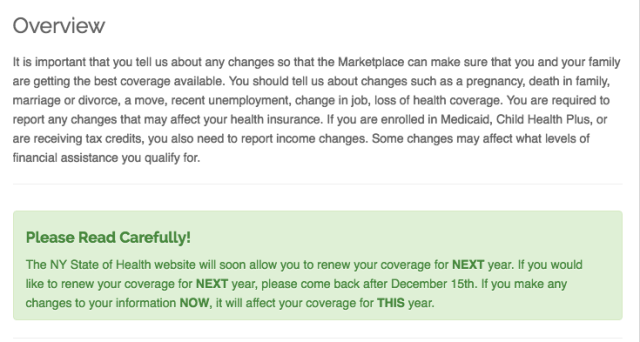
Screen shot 2016-12-04 at 3.04.34 PM.png

IMPORTANT NOTICE:   Today is December 4th, please come back AFTER December 15th to keep your insurance up-to-date and in place for 2017.  On, or just after, December 15th you will then have up to 24 hours — provided our servers, often overloaded just before our short, arbitrary registration deadlines, do not crash– to provide all required updates within that short window in those leisurely days before Christmas, or lose your insurance coverage until, the earliest, March 1, 2017.  

Or maybe not.  Nobody you speak to at New York State of Health, after a wait of no more than 25 minutes, will have the definitive word on what’s what.  The only thing you can rely on regarding the New York State of Health is not getting reliable information.  Take heed, though, and take that to the bank, bitch.

I’ll be eagerly following Barack Obama’s career as a private sector public speaker.  I am confident that my man will break all existing earning records for corporate speaking.  He’s that good.

Death of A Thousand Cuts

“Well, that’s the nature of the beast, isn’t it, Elie?  It’s rarely one thing that kills you, it’s that gang of relentless demons that finally takes you down, one pulling sneakily from the direction you least expect, as another one gleefully kicks you in the throat, two others clog dancing on your lungs, a tiny one knifing you in the kidneys,” said the skeleton of my father cheerfully.  

You remember I went to see our cousin Eli toward the end, a week or so before he died, actually.  On the phone he’d told me not to bother coming up, that he wouldn’t be very good company.   I told him I was on my way anyway and when I arrived he scowled and handed me the insert from the fentanyl patch he was wearing.  The insert was a long scroll of tightly printed mouse type, a learned collaboration between medical and legal professionals, in a life-saving effort to shield the manufacturer of the drug from liability.

He had some damned, very intense pain nothing could touch (turned out to be from inoperable cancer his children decided he didn’t need to know about) and they’d given him these damn pain patches, which did a little bit to ease the pain, which had been getting worse and worse while nobody could tell him what the hell it was caused by… but he had every damned side effect on the list.  

“Black, tarry stools?” I read from the scroll.  Yop.  The answer was the same curt “yop” to literally every symptom on the list.  Blurred vision, yop, chest pain, yop, difficulty breathing, yop.  Dry mouth, yop, increased thirst, loss of appetite, yop, yop. Muscle pain, numbness and tingling, difficulty urinating.  Yop, yop, yop.   Back pain, diarrhea, yop, yop, loss of strength, yop.  Irritability.  

“What the fuck do you think?” he roared irritably.  

“Yop,” I said and we went down the rest of the list.  We fell into a cadence of symptom, yop, symptom, yop.  

When I left Eli hours later we hugged and I told him I was sorry for not giving him a good fight.   It was very rare to have a visit with him for any amount of time when he wasn’t purple faced with rage at some point.  Fighting was the favorite sport of Eli and my mother, and they never missed a chance for a good brawl.  

“That’s OK,” said Eli patting me as we let each other go.  “We’ll fight next time.”

The next time I saw him, just a few days later, he was in a  hospital bed.   He didn’t know I was there, though the nurse told me to speak to him, that he might be able to hear me.   His wrists and ankles were bound to the bed frame and he was fighting with all his might.

A day or two later he was gone and my father and I were speaking at his funeral, me reading my careful, heartfelt notes, my father improvising like John Coltrane playing over changes for a tune he loved.

                                                               ii 

I was thinking of Eli’s fentanyl side-effects because I’d wound up in the Emergency Room last week with troubling symptoms, which seemed to be getting worse, even though it had been a few days since I’d stopped taking the statin I’d been prescribed a couple of weeks earlier.  My doctor told me to go to the E.R., just to rule out a heart attack.  

I had weakness, numbness, fatigue, muscle spasms in both arms and legs, tingling in both hands, tightness in the chest, pain over the heart, pain radiating down the left arm, odd urinary symptoms and, finally, unreasoning fear at 4 a.m. as all the most ominous symptoms continued to worsen.

As I wait for my $20,000 hospital bill for the sleepless overnight stay I decided to look up the side effects for Crestor.  They include:  weakness, numbness, fatigue, muscle spasms in arms and legs, tingling in hands, tightness in the chest, pain over the heart, pain radiating down the left arm, odd urinary symptoms and unreasoning fear.  

Reading the list I recalled my surprise, in the bathroom of what was, for about eight hours, my hospital room, while urinating into a plastic jug they never collected the urine from to study, to suddenly see blood and cloudiness– two other uncommon but known side effects I hadn’t seen before.    

The thought quickly went through my mind:  Jesus Christ, doc, you might have saved me a lot of worry and thousands of dollars I don’t have if you’d told me to go upstairs, do a quick google search and check how many of these symptoms were known side effects I was advised to contact my doctor if I was experiencing.

The Patient Protection and Affordable Care Act

The New York Health Exchange, which determines the metallically designated (platinum, gold, silver, bronze)  level of PPACA insurance coverage your income qualifies you to have, has no ombudsperson.   It has no meaningful appeals process to correct things like an error that deprives a patient of health coverage for a few months.   The name of the director of the New York State of Health, if you ask, figuring you will contact that office directly, is none of the public’s business, although the enterprise is a wholly public one.  

It employs practices that fit the definition of “arbitrary and capricious” but would probably not be so deemed in a court of law.   You can hire a lawyer to bring an Article 78 proceeding, under NY State law, if you have a few thousand dollars lying around, but, there is zero chance of recovering any kind of monetary damages, so why go there?    

The Patient Protection and Affordable Care Act could, as accurately, have been called the Health Insurance and Pharmaceutical Industry Profits Preservation Act, but while the name would have been more truthful, it would have been a harder, and more embarrassing sell for the president.

But, let’s leave all that aside for now.    

Now you have health insurance assigned to you and you pay your premium. You liked the doctors you’ve been seeing for years, and were promised you could keep them, but that was not a truthful promise by the president.  No problem, and don’t get all pissy about it.  You find new doctors and you can have medical records sent to them for free by your old doctors, provided you send the proper authorizations to each previous doctor’s office.  Not really much of a problem, as anyone would agree.  

Except when you try to find out who will pay the new doctors for their services.  Then it becomes the patient’s sole responsibility– and you’d better be smart and patient as hell, preferably a trained lawyer, too — to figure out what you have to do so that you won’t be left holding the often shockingly unaffordable bill.

Although there is no requirement in the law that the patient be informed of the price of any medical service until after it is rendered (and therefore, purchased) it turns out to be possible, if not simple or straightforward, to research which services and providers are covered by insurance under the Patient Protection and Affordable Care Act.  

All you need, in the end, is the provider’s NPI number.   You call the provider (in health insurance jargon doctors and hospitals are called ‘providers’) request and write down the ten digit NPI number for that provider. Then you call your insurance company where you can usually speak to a representative within less than twenty minutes, since they are generally busy assisting other “customers”.   You give the person who answers the NPI number and then go back on hold while they connect you to someone who knows what an NPI number is.  

Do not get overwrought when the ads you are listening to while on hold are suddenly in Spanish, or in Mandarin.  You can never be sure, from a marketing point of view, which language ad will be the most ‘impactful’ even if the customer did not oprime el numero dos when given the choice of languages.  It is best to remain free of judgment while on hold.  

One must not be unduly disturbed by the thought that every health-related transaction is driven by the imperative to maximize corporate profit.  It is also important to keep in mind that any aggravation you may experience while on a long hold has nothing to do with any active desire to make things harder for patients trying to get medical treatment.  The health insurance company keeping you on hold to speak to customer service is only trying to keep costs down, for your ultimate benefit.  

“You didn’t get the provider’s NPI number?” the representative may say, throwing up her hands.  If you had the foresight, and got the NPI number, it is only a minute’s work for the insurance company representative to look up the doctor, determine if the provider is “in network”.  If you have not made a prior call to the provider to learn the provider’s NPI number you create additional work for a representative who does not get paid very much to do the patients’ work for them.  

You may learn, to your great surprise, and only 51 minutes into your customer service experience, that one provider may have multiple NPI numbers, each corresponding to a specific office location and associated telephone number.   Call the wrong office, or even the right one picked up at the wrong location, and the NPI number and provider are no longer “in network”– even though it’s the same provider, it’s a totally different NPI number, which should be obvious enough.  

From the insurer’s point of view, why would you expect to have insurance pay for a provider who you think is in network, even if the insurer itself told you so, if you do not have the correct NPI number for the specific service delivery situs you are making an appointment to see that provider at?

I understand that the bottom line in our global economy is corporate profit.  I get that, I really do.  I don’t like it, particularly when applied to health care, but I understand we live in a materialistic world and that corporations are legally constructed psychopaths the Supreme Court has us pretend are living human beings for purposes of their right to have a say in the government that makes and enforces the laws they must “live” by.  I get all that, I do.  

I get that all presidential candidates lie, that all presidents disappoint, that Mr. Obama was no worse than most in either of those areas.  He was better than some recent ones, certainly.  If you’re going to be fleeced by a predatory corporation, or killed by a drone without charges or trial, or have your phone and email records secretly collected, or be denied a Freedom of Information request, or threatened with the death penalty for being a diligent journalist, or anything else Mr. Obama or any other American president might do, you might as well get that treatment from someone who is thoughtful, funny, smooth, cool, calm, who knows how to sound like his heart is always in the right place.

I don’t begrudge B.O. the hundred million in speaking fees he will get in the next couple of years.  He’s brilliant and very talented and deserves the handsome fees much more than most of the famous and infamous speakers who get paid obscene sums to inspire corporate audiences.  God bless America and God bless his freedom to make those hundred million in the next few years.  Couldn’t happen to a nicer guy, as far as I can tell.

That said, I have limited patience for statistics-spouting, blindly partisan defenders of a deeply flawed,  perhaps fatally compromised, solution to a long-standing problem that afflicts millions of our most vulnerable, especially if that partisan defender has had no personal experience with the day to day niceties of the Patient Protection and Affordable Care Act.  

The outgoing president, taking his bows now in a last well-measured victory lap, has to get some of the blame for the many flaws of the monstrously complex, profit-driven health industry-favoring law that bears his name.  

You want to point out that he’s been surrounded from day one by detractors, many of them racists, snarling, unreasonable, petulant obstructionists who have done nothing to fix the flaws in the complicated, problematic law, outside of trying to repeal it countless times?  Fair enough. But the solution the president put on the table at the start of negotiations was designed, before anything else, to ensure that health insurance and pharmaceutical company profits were kept as healthy as possible.    It was drafted, after all, by experts who went back to work for those industries after the bill became law. 

And, as in any zero sum game, the weaker party, regrettably, wound up, inadvertently and completely unintentionally — and we’ll stipulate, out of respect, that it was done with only the best of intentions — burdened, scammed, coerced, unaffordably billed and, in many cases, simply fucked.  

But, hey, would you rather have a preexisting condition?   Or die in an E.R. with the 45,000 other Americans who died every year for lack of health insurance?   Thanks to Obamacare the number of Americans who die in Emergency Rooms for lack of decent preventive health care is certainly much lower now.   Though statistics are hard to find, I’d wager that terrible number has been cut in half.

As the president said when signing the flawed law “don’t let the perfect be the enemy of the good.”  Or, as a patient protected by the PPACA might say, “don’t let the good be the enemy of the fairly crappy.” 

Two notes on the “C”, “N” and “G” words

Few words in English retain their potency as expressions of rage, and their violent power to offend, as much as the words “nigger” and “cunt”.  

“Nigger”, unless pronounced by a black person using it in a colloquial sense, is as offensive to at least 40% of Americans as “motherfucker” a word with its roots in American slavery, the same hateful and largely undrained swamp the “n-word” derives from.  In polite society everyone is expected to defer to the new convention not to utter the hateful word “nigger.”  I get it, though the fucking “n-word” is just plain wrong.  

Pretending to be publicly polite about this word that is in constant private circulation in our great, still largely racist nation, gets nobody one millimeter closer to discussing the underlying poison of our racist past, present and future.   The young are our hope on this issue, they seem, as a group, to be less concerned about race– but they deserve our help addressing this troubling issue with its deep, ugly historic roots.  Swapping in the fucking “n-word”, and pretending it’s progress of any kind, is, if you will excuse my Yiddish, bullshit.

Same deal for “cunt”, or the “c-word”, if you’re not nasty.   A stand in for hundreds of years of brutal, senseless male domination of the, arguably, superior half of the species, “cunt” is the word a man might utter right before a modern woman kicks him in the “cunt.”   I understand how hateful and hurtful a word “cunt” is these days.  

That said, the female opera singer and the male supporter of the arts across the air-shaft who defends her right to caterwaul loudly and at length in the name of her art?  A pair of cunts I could, with equal conviction, say are a pair of dicks. 

ii

While I’m on the subject of cunts, I should mention the late, great American genius Steve Jobs, who not only redefined our notions about technological elegance and its seamless integration into our aesthetic lifestyle, but clarified the modern American meaning of “genius” (the g-word) itself.

Dig– a genius is only a genius if he exerts his vision on the world.  It’s a simple definition, as elegant as an iPod.   The genius prevails, gets to modestly opine before vast crowds, and die with billions earned and trillions to come in his wake.  A grateful world, beneficiaries of his visionary gifts, remembers him with love and respect.

I should be thankful to Steve Jobs and his ilk, for finally clarifying this always difficult issue of who is and who is not a visionary genius.  

That said, this American icon was always, as the genius culture and company he founded continues to be, as the Brits say, a right cunt.  Also, it is said, a dick.


Anatomy of an If-pology

For those sickened, as I was, by the recent extended recitation of my personal hurt over perceived mistreatment by a long-time writer friend, as I slowly processed the complicated toxins, please be forewarned.   This is the final bit.   Unless you’re interested in a dissection of an if-pology, please click away to something more diverting.

Here is a cool one I recommend, by a talented and philosophical cartoonist.  This one is also neat. 

For the fully annotated if-pology, which I offer in the hope it might be useful if you ever find yourself discomfited by an oddly unsatisfying apology, please read on.

Below is a writer friend’s apology, followed by my notes. You will find my take clarifying or proof that I am indeed the thin-skinned, vicious prig I was recently taken for.  

The writer had been hurt by something I posted here, felt personally and deliberately attacked and betrayed.   He assumed the worst of me after his outraged ex-wife forwarded the link to a poem I’d sent her.   You can be the judge of how entitled to his rage he was, the offending post is here too.  His tart email ended “I think you will agree we’re done here”.  

My relatively mild reply apparently surprised him, he thereafter wrote this apology, after reminding me again that I’d done something terrible to him that was kind of hard to forgive. Sadly, I find it irresistible as an example of a  textbook if-pology:

so let’s go back to april.(1)

i recall after our getting together you sending me some material and, as i remember, i read and responded to at least some  of it.(2)

it’s possible that i didn’t read it all, or perhaps i did and simply failed to respond.(3)

i simply don’t remember.(4)

but either way, it’s on me, and i am truly sorry because to you this was much more than a casual oversight. (5)

but, shit, man, all you had to do was call or drop me a folo-up note in may or june. (6)

i did not know you were hurt until i read that screed yesterday. (7)

i had some idea you might be pissed at me when you didn’t respond to my invite to the giants game in sept, (but, again, it appears now that i mis-sent that email).(8)

seems we currently have three choices:

1) we could cease and desist from all further communication as of this afternoon;

2) we could keep on emailing each other, which would likely create even more misunderstanding;

3) or the two of us could get together and see if we can work this out and maybe remain friends going forward.

 #2 doesn’t work for me. i’m okay with #1 if that’s what you like, but i’d be amenable to #3 if you are.   let me know your preference.(9)

NOTES

1) in April we’d had a lovely four hour chat over dinner, the final hour or so about the manuscript I’m working on, which was then 300 pages, about my tragic, aggravating father’s life.   I’d mentioned I’d just posted some sections on a brand new website I was working on and he expressed great interest in reading it. 

2) I never heard a word back about any of it.  Our email string on the subject contains no reference by my friend to any of the pages I’d sent or any comment about the brand new Book of Irv website which I was regularly updating with new photos and pieces. The email string includes two or three subsequent links to other pieces I’d sent him.

 “as i remember, i read and responded to at least some of it” implies I that I could well be mistaken in my belief that he never replied.

The only other email I had from him in the days after was the mysterious:

from the late, great New Yorker cartoonist William Hamilton, speaking of his novels and screenplays: “Although I have not exactly been published or produced, I have had some things professionally typed.”

3) This note, and notes 4-8, are from his P.O.V.

I acknowledge the possibility that you might be right and I might be mistaken.  I’ll allow it’s possible I might have never given you any response.

4) it goes without saying, in light of this remark, that whatever you wrote clearly didn’t make that much of an impression on me one way or the other.   Nor did your website contain anything that notable or memorable.

5) “Either way” whether you hyper-sensitively, nay hysterically, blocked out that I actually had replied, which I believe I probably did, or whether, as you say, I never replied, it’s on me.  

To you” is the key qualifier to this otherwise 100% sincere if-pology since, to you, being ignored, as you imagine you were, was hurtful.  

Granted, of course, that not everyone would have reacted this way, but since you did, I am truly, truly sorry.  

The oversight was casual in any event, you oversensitive fucking irrationally angry twat.

6) This “but” points out how easily you could have prevented this hurt and hostility on your part. Shit, man, if I didn’t reply to three or four requests for my feedback, you should have just sent me five, six or seven like anyone else would have done.  Clearly, jerk-off, I didn’t do it on purpose, if I even did it at all, which I reserve the right to argue I never even did.  

7)  This highly offensive post, as I already told you now three or four times, was a screed (a lengthy rant) an aggressive and unprovoked attack, a clear and unambiguous personal public betrayal.   Open to debate how vicious or unfair the screed was, perhaps, but you cannot deny that I was very hurt by it, hurt enough to write you off as the intentionally vicious fuck you clearly are.  

8) It may be fair to ask, if a simple folo-up would have solved any misunderstanding after you didn’t hear back from me, why I assumed you were mad at me for not replying to my email you, I regrettably admit, probably never received, why I didn’t just call or resend the invite instead of assuming you’d  silently rejected the invitation I mis-sent and never followed up on.  

But surely, someone as sensitive as you apparently are to a casual and unintentional slight, can see why I felt you were acting pissily when I never heard back from you to the email invite I sent but I guess you never got.  

It may also be fair to concede that you never failed to reply to anything I ever sent you, at the address where we exchanged numerous emails over the years.  

But that is not the point here anyway, you are the vicious asshole here, not me.

9) Me speaking now:   I wrote back proposing choice 4– I would call him whenever he liked and we could talk.  A phone call was not fully acceptable to him, presumably it would be hard for me to adequately grovel unless we met in person.  

And then, sub silentio, as the old Latins used to say, he added:

and for the record, I will never tell you what I think of that book you are optimistically working on, needy butt cheek.

After chewing things over, and in consideration of his clearly offended manhood, I opted for option 5, which was basically an elegant, silent restatement of his option 1.