An unreasonable belief in Reason?

“Droll thing life is — that mysterious arrangement of merciless logic for a futile purpose. The most you can hope from it is some knowledge of yourself — that comes too late — a crop of inextinguishable regrets.”
― Joseph ConradHeart of Darkness

At least one reader finds these musings I post here a window into a tortured soul.   For me, there is no torture involved.   When I write I experience a kind of peace as I sort things out, comb through things that may be hard for me to understand or digest.   Taking enjoyment or some kind of sustenance from this kind of contemplation is, no doubt, an acquired taste.   A friend recently told somebody he’d rather die than be forced to grapple with his innermost thoughts on a page.  Me, I’d rather grapple with my innermost thoughts on a page than die.  Just me, though.

My friend’s comment got me wondering.   What am I actually trying to accomplish by writing things here?   I don’t promote myself; I put my late beloved cat’s name as the author of these pieces.  I don’t compile them and send them for publication somewhere that might pay me for this work.  I am not connecting myself to a network of like-minded souls.  What the hell am I doing here?

I realized the other day what might be at work, at least in part.   An arguably unreasonable belief in the power of Reason to shine a light on an often irrational world.   Seeing intolerable things, like a political party willing to de-fund the government and hold a nation hostage to an ideological demand while spending billions on a secret torture program, trillions invading countries that pose no threat to the U.S., murdering on a vast scale in the name of old saws like “freedom” and “democracy”, I feel I need to somehow put things in perspective, articulate my position.   The powerlessness one feels can be overwhelming.   So I put my best arguments for that puckish abstraction Reason here.  

That the world is not run by the wise, or even the reasonable, is clear.  In the realm of our personal choices, and in the face of the irrationality of human society, we strive to be smart, to learn from mistakes, to not repeat the unpondered lessons of our personal history.   The most painful feeling is finding oneself in the same situation over and over, what a brilliant maniac friend tagged as the Repetition Compulsion.   It is easier to see in others than in ourselves– doing the same thing over and over: trusting, helping, attacking, saying too much, too little — and finding oneself in the same regrettable place.

In my case, I was raised by fearful adversaries.  Before I had any say in the matter, I was cast as a dangerous opponent.   Puts one on ticklish footing, being cast this way as a child.  After more than 40 years of battles to the death a dying father says “I deeply regret having been so impaired all my life and taking it out on you and your sister.  You were right to try to reach out to me, as you valiantly did for many years; I was wrong to keep myself out of reach.  I was afraid my whole life, seeing the world as black and white, and I see now how impoverished my life was by not fighting that fear.”  You can’ t make this kind of shit up.  The echoes of these painful disconnections reverberate through one’s life, influence our behavior, set our course in life.

So I use the time here to muse, to ponder, to make myself clear, to myself as much as to any reader.   There is probably a line between “therapy” and “art”, I don’t know where it is.   The tools I have are my willingness to muse and my practiced desire to express myself as clearly as possible.  What these things are worth, I cannot say.  They have always been with me and no doubt developed as I struggled to make sense of the senselessness I came up in, to become the capable parent I never had.

It has been shrewdly pointed out that work is the curse of the drinking class.  If we do not work, and we do not drink, what is left, how do we spend our time here?  If we work but receive no payment, what is our work worth?  These are questions one does not often think to even ask, unless one neither works for pay, nor drinks.  Work is the greatest and most universally embraced form of therapy there is– it takes up most of one’s time, sets a schedule, provides clear reasons for action and regular, tangible rewards. including a paycheck.  Work allows one to prioritize things in an easily understandable way that makes perfect sense. Work first, play later. Work hard, play hard.  If you work hard it is important to play hard, and one earns the right to do so.  

Hard work gives meaning to life, a sense of accomplishment, a certain status. On a societal level, lack of meaningful, remunerative work is a main reason countries with massive unemployment, like L. Paul Bremmer’s Iraq, become  powder kegs– men with guns and no jobs, no prospects for accomplishment except for raging against those who keep them from the dignity of a life of productive work.  

Is it unreasonable to believe it’s possible to think one’s way out of a painful cul de sac?   I don’t know.  I only know it is worse to be in a bad situation without hope of an exit.  We dream of a way out, we conceive of it, design it, take our best steps toward creating it — all better things than staring at a wall and seeing only our confinement.
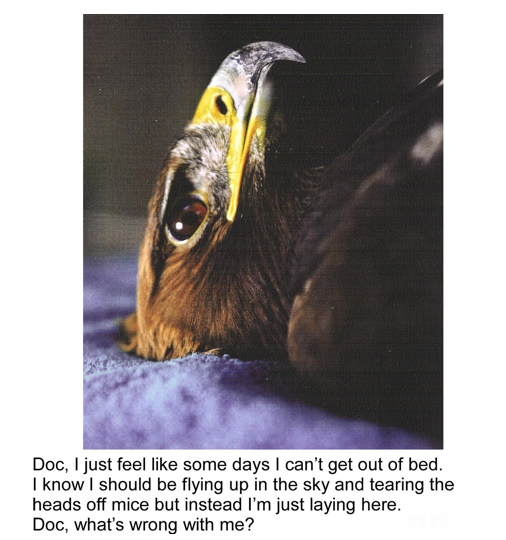
 

Depressed Eagle

An old friend from High School I’ve seen only a couple of times in the decades since emailed to apologize for being out of touch.  He referred to this blahg as a window into my tortured soul and then supposed he could unsubscribe.  Fortunately for me, he was inspired by the endless scroll of arguably depressing musings here to create and send this, which cracked me up.   May it have the same effect on y’all:


Picture 2

The Bitterest Use of Silence

In my experience, having been sensitized to it young, strategically deployed silence is one of the most effective and damaging expressions of rage out there.  It has the great virtues of ease and simplicity– plus the razor sharp double edged bonus of deniability.   Not all silence falls into this category, of course.  Much of it does not.  But those angry people who feel entitled to their rage can make excellent use of the simple device of saying nothing in return.  The real beauty part, it can be used again as a clever bludgeon if the party put to silence ever whines about it.  “Oh, Boo HOO!  Silence…. oh, dear….”

Here’s how it operates:  take an unbearable pain in your own life.  Maybe it was a mother who, from your earliest memories, regarded you with hatred and whipped you across the face.   Hard to recover from that one.  One will do one’s best not to repeat that in one’s own life, but the cards are stacked against you.  You will have to deal with some version of the following:

My son is brilliant, but he’s got a grievance against me, has been my accuser from the time he was born.   Now he wants my approval.  Let me do the math: not giving him the approval he wants versus being humiliated over and over by an insane and violent mother?   He has a lot to complain about, this pampered, angry boy.   I will say nothing, let him deal with a world as cruel as you like, but one ten times more merciful than the one I managed to survive.

One vice of heavy duty victims is comparing the pain of others to their own and always finding other people’s pain a pale and pathetic wannabe pain.  I was the victim of incest by a beloved family member, you want my sympathy because your boss called you a cunt?   Silence, I say, waiting with a slight smile for that delicious moment when you feebly accuse me of not caring just because I said nothing.

I never got a dime from my parents, nor even the respect of a thank you for the many services I did for both of them when they were dying.   You didn’t inherit enough from yours to make you independently wealthy?  Boo fucking hoo.  Get a job, loser, instead of dreaming you’re special enough to be the change you want to see in the world.

I am the most talented person I know, yet you don’t hear me whining about my lack of recognition.   I go to work, live in the world, do not whine about my creative efforts being unappreciated, myself being unlionized.  And, dude, I am much, much more talented than you.  So, yeah, sue me if I don’t have any comment on your wonderful hobby “art”.  Oh, boo hoo hoo.  Silence…. oh, my… pobrecito!

Etc.

It may seem a small thing to someone lost in a world of anger now, but I have seen my father’s regrets as he was dying.   It was a terrible thing to see a man with all the tools to have been a great friend, a loving father, bereft because he had been unable to separate himself from his pain enough to do either of those things.  Terrible for its own sake and in its timing, because all that was left for him was death, and he had become wise, and grasped the simplest and most beautiful of human truths, too late.  

He may have been putting on a play for me, trying to do me a final favor after decades of putting walls and heavy stones in my way, but I prefer to think his regrets were real.   He had defended himself against his pain as well as anyone could have, heroically, if tragically, since it came at the cost of true friendship and the warm, direct love of those closest to him.  He had deprived himself of the most important things in life, in order to cower behind a brittle sense of invulnerability.

I don’t judge the man.  It’s hard to imagine how anyone recovers from what he was subjected to in a childhood of unimaginable pain and humiliation.  I’m not comparing the pain of being whipped in the face daily with the pain of a father turning his face away at important moments.   I merely note that if you set out to hurt somebody who asks for your point of view, while maintaining that all important sense of superiority, silence is a beauty way to go.

A Few Thoughts on Madness

My only visit to a locked mental ward was to see a friend incarcerated in Elmhurst Hospital in Queens.   When I left I waited for the elevator in a dingy space between the ward for men and the ward for women.  A woman was screaming, part of her face visible behind the medieval looking screen over the tiny window in the metal door.   From the sounds of it she was being tortured while the guards read magazines, ostentatiously pretending not to notice.  It took a long time for the elevator to arrive and the woman begged for my help the whole time.

I’d been visiting a friend who had been committed to this ward for refusing to be admitted voluntarily after a few weeks of increasingly bizarre behavior.  This meant that police with guns came to the suburban house where he was holding court, arrested him as a possible danger to himself and others (it’s unlikely he actually was, though he was clearly crazy) and took him to a room where they held him for several hours as they processed his paperwork and decided what to do with him.   We watched him for a rueful moment through the one-way mirror.   I remember he just sat there, still, and we saw him in profile.

The locked ward in Elmhurst, where the State in its mechanistic wisdom brought him next, was a scary place.  It was more a prison than a hospital, I thought during a short visit before he was transferred to a less restrictive section of the hospital a few days later.  Our friend seemed to hold his own there, pacing, glowering, vibrating with an energy that was disconcerting to watch.  It was an energy that most of the ambulatory men in that large, dingy day room seemed to have.

Before witnessing this breakdown I had a romantic notion about the fluid line between madness and sanity, seeing it more as a social construct involving conformity than a hard line.  I learned that it is, at times, a hard line; there is little subtlety involved when someone is having a full-blown episode of being batshit crazy.  There are plenty of eccentric, pain-filled, maladjusted, tormented, impractical, melancholic, aggressive, self-destructive, absurdly demanding people in the world who nobody would claim are completely mad.   It may be said that most lives, examined for more than a moment, are tinged with irrationality, ruled by destructive beliefs, misperceptions, shifting angers, ill-shaped grievances, avoidance, bottomless sorrows.  Or maybe this only describes the people I have met.  There is always that possibility.  

Anyway, this friend emerged OK, went back to work, continued courting his new girlfriend, soon to become his difficult wife.  Things were fine until a few years later, when I had a series of shrill, early morning calls from the difficult wife demanding that I drive to Greenpoint and take care of my friend, who was barking mad again.

When I arrived at their door she pushed him out, without his keys or wallet, and locked the door behind us.  This woman is vicious, full of self-important opinions, demeaning, demanding, narcissistic, reserving the right to rage.   A thoroughly unlikable person.  Though we got along for fleeting periods of time over the years, I think of her, for shorthand’s sake, as Hitler.  She is certainly as implacable as the famous psychopath.   Although, on that day, after a few minutes with my friend, I realized that she had been pushed to this desperate, if harsh, maneuver.  

My friend was clearly manic; he was cheerful as hell, spoke quickly, his great intelligence swerving the conversation from one difficult to grasp idea to the next. His eyes glittered with a combination of merriness and malice.  He had partially shaved his head, giving him an excellent look for his new attitude.  He was very thin, clearly had not been feeling the need to eat for some time.  I tried to get him to eat something at the nearby McDonald’s, but he wisely declined.

Fifteen or twenty hours later, at my wits’ end by now and realizing that the only help for my friend would come from skilled professionals, I made him a plate of pasta in my apartment.  He agreed that he should eat something.  Then as he sat down he turned to me and said something so provocative, so vicious and uncalled for, so perfectly aimed at my greatest vulnerability, that I grabbed him by the scruff of the neck, lifted him from the chair and slung him toward the door of the apartment, intending to shove him into the hall.  I am not proud of this moment, though neither am I unduly tormented by it.  Every human has his or her limit, and that now forgotten cruel comment as I was trying to get my insane friend to eat something was mine.

He grabbed me by the throat.  I grabbed him by the throat.  It was a moment when raging insanity was about to prevail.  In a moment of inspiration I lurched forward and kissed him, on the lips.   He laughed.  I relaxed my grip on his neck, he let my neck go.  I patted him on the back, told him to go eat, and went into the shower to blow water out of my face and try to regain myself.

A few hours later, somehow, I had him at the mental hospital, this time without police.  No locked ward this time.  He was restrained on the gurney, however, and I recall seeing him in profile spit a Haldol pill into the doctor’s face.  They wheeled him away.  The next time I saw him he was in the hands of a psychiatrist who became convinced my friend had been misdiagnosed as a schizophrenic.   Treated as bipolar, on a long-time regimen of Lithium, he has had no recurrence of mania in the twenty or so years since.

Knowing that Lithium is eventually fatal, he weaned himself off the drug.   He’s been maintaining himself with Zen meditation, achieving a certain clarity that included the realization that one can not live a happy life sharing a home with Hitler.   He finds comfort in cult-like settings, he tells me, and has found a nice group of people he meditates with.  He found a woman there he is very fond of and has a lot of sex with.   His wife broke the window of his rented room in a jealous rage over this and he obtained a restraining order against her.  She somehow got one against him.  The divorce is not going to be smooth sailing, but then, how could it be?

We check in from time to time.   The dispirited period I am going through makes it harder than usual for me to reach out, but we talk every month or so.  He reports that he is mostly content.  I nod, since regular and good sex with its steady flow of life-restoring endorphins will have that effect on a person’s outlook.  

The last time we spoke he was keen to taste the single malt I keep on a high shclf and have been refraining from drinking, being depressed enough without imbibing depressants.  He began singing its praises.  He does not keep it at home, fearing to fall into the bottle himself, but loves to drink good stuff from time to time at the home of a friend. I told him I’d prefer not to drink, and explained why, but later gave him a snort, against my better judgment, which led to having a few myself.  I felt like shit the next day and haven’t touched it since.

Had a call from him the other day, for the first time since.  “B is such a good friend to you,” he said, “he helps you with your business, and brainstorming, and trying to get your apartment shaped up, he hauls boxes of things to Good Will, puts his back into it, really cares about your well-being.  He seems like such a good guy and I feel bad that I’ve made such a bad impression on him.  He probably sees me as a guy who is always sucking around looking for something from you.   Dragging you back into well-worn bad habits you’d just as soon pick up.  To him I must look like Lampwick from Pinocchio, my ears slightly donkeyish as I persuade you to uncork the bottle, pour us just a drop.”

I agreed that this was likely the case, refraining from saying there was a certain accuracy to the image.

“I’d appreciate it if you could let him know that I’m not really that way.  If I ever meet him again, and I hope I do, I’d hate to think he has such a poor opinion of me.  Would you set him straight?”

We talked for a while more, he described the likely end of his period of unlimited sex, how the younger woman was very practically looking for a mate her own age, to have a child with, and how he could probably not hold on to her much longer.  He told me she was compassionately trying to set him up with another woman in the group, and that he had certain hopes for this new one.   He observed in passing that I am depressive.   I described some semi-comical recordings I’d made recently, and an aggravating piece by the often aggravating David Brooks that I had annotated.

“Send them to me!” he said emphatically.  I had stopped sending creative things to him because of his penchant for remaining silent.  We have been over this time and again in the past, my sensitivity to the easy slight of silence, when even “nice” or “ah hah” suffices to break the bitterness.   My father had been severely abused as a child and his cruelty translated often into the strategic, viciously ungenerous withholding of attention or comment.  This regular practice had sensitized me to the chillingly brutal power of complete silence in response to a query or creative effort.  I have stopped sending things to people I rarely hear back from, particularly those who attempt no creative work themselves.   His silence had become conspicuously dependable. “Send them to me,” he said again.  I told him I would and later that day did.

“By the way,” he said, by way of providing an excellent punchline, “I was thinking… if it’s OK with you…. you know, heh…. that I could come by for a drop of that excellent single malt today.  I have a few hours before I have to go see my girl.”

Neither of us laughed then, though it is very droll, if you think about it.  As droll as the silence into which the things he asked me to send him dropped.

Freakshow

If you had a camera in here, recording my steps around this crowded apartment, you would see the steps circling endlessly back to this chair with the excellent view of this computer screen.  To either side of the screen, and in front of the keyboard, drifting piles of beautifully colored ink drawings, like sand dunes seen through a prism.

“Why don’t you shut the computer off and just clear off the kitchen table?” a reasonable voice asks.

The camera would show me nodding, powering the machine down, stepping away from the computer, into the kitchen, looking at the table.  An hour’s work, one would estimate.  Put the blood pressure monitor somewhere, take away the power cord from the macBook, put away the cable for the iPod.   Remove the two wire book stands, collapsed and interlocking, lying interspersed with various small items, most of which, although they’ve been there for years, should be discarded.   Move away the cutting board, unplug the disconnected phone, put the unit in the electronics recycling bag.  

Then just go through that raft of papers, most of which can be thrown away or shredded after a glance. There is even a prize at the bottom of that Crackerjacks box, in addition to a clear work space to prepare food, eat a meal not propped on your lap.  Under those hillocks of papers, hopefully, is the card with the new return address of your old friend’s widow.  You’d like to write back to her, wouldn’t you?

But first, the steps lead back to the computer, power it on again, just a little sit here, see what’s doing, just a moment.  That snow storm, winter storm warning still in effect, what time is it now supposed to hit Queens and when do I need to leave here in order to shovel out from under it without being caught in it?  Etc.

This is all undeniably a bit freakish, and worrisome.  Just a moment’s pondering and I see it is just a fragment of a larger freak show all around.   We leave aside things like $81,000,000 paid to two psychologists to reverse engineer a torture program nobody seems very upset about.  Here there is a car going 75 mph on the interstate, accelerating onto a lane of hidden ice with the thought to go 80 in the HOV lane.  Here is a man issuing periodic and alarming reports from hell, describing a relentless monster wife and an unbearable life, now suffered for over twenty years.   There a man tells his longtime wife that their marriage has been over for a decade and shakes his head at her angry display of shock.   Here a man calls an old friend and complains that he is often seen as using the man, dragging him back into the weeds of bad old habits. He urges his recovering alcoholic friend to intervene, for the sake of his reputation, tell them it isn’t so, that he is a good friend, and then… by the way, if you don’t mind…. if I could prevail on you … do you still have that bottle of excellent single malt?   The examples are too numerous, the exceptions too few… it is all a gorgeous, swirling landscape of barely concealed madness.

There must be some kind of way out of here, said the joker to the thief.  I will just tap here a few seconds more and now …. if you will excuse me… I must be…. on my way.

A Few Thoughts on Friendship

I foolishly tackle a huge subject, attempting to extract a kernel of something here, before plunging into my list of many times put off tasks.

People who share our most deeply held beliefs, or passion for something we love, unless otherwise repellent, are easy to become friends with.  There are drinking friends, and sports friends, and so forth, people we become friends with because of shared interests and good times spent together.  

I have heard there are also business friends, people we meet who can help us advance our fortunes, and these are also cultivated as friends by most intelligent people.  There are other intelligent people who lack even the basics of practical knowledge of advancing oneself in the world, they may be idealistic, but are ultimately a sad and perplexing lot.  

The true friend, whose faults we can always overlook because of the great comfort we derive from their company, is extremely rare.  Humans are fucked up, take a look at history, an unending scroll of rage and violence stained with blood and shit and scattered with torture devices.  It is a miracle that we can find true friends, given the terrain, but it is also our greatest blessing to find a kindred soul.

Some Greek, possibly Socrates, maybe Aristotle Onassis (it was Plato, actually), divided people according to the preponderant part of their natures:  Appetitive, Glory Seeking, Truth Seeking.  All three parts comprise each soul, but individuals are driven by the dominant part of their nature.   Just societies, this opinionated Greek opined, are ruled by that minority who seek truth, fairness and goodness above all else.  

Our society is dominated by the ravenous appetite, and a love of out-sized glory, and the easiest thing to do with the meek ones who seek slippery abstractions like the common good is to mock and piss on them.   You know what I’m saying.  Bring Jesus back and pious billionaire Christians would instantly crucify him again, secretly, and destroy all traces of his visit.  

And here we have the beginning of the rub that has been rubbing me for some time.  How difficult it is to strive towards our higher nature without judging those who hold themselves to a more general standard.   Nothing is more insufferable than a person who takes their virtue seriously.

I think back to a few I’ve considered friends, who revealed themselves, over time, to be driven to dispute, wrestling with their demons, given to outbursts of anger followed by lack of remorse or apology, incapable of refraining from hurtful behavior, while feeling virtuous.  Like everyone else who has ever acted, feeling completely justified in their actions.

The retired judge who speaks convincingly of an abiding plague of our times: honor anemia.  People’s contributions are slighted by lack of recognition, which is demoralizing, he points out.  The few who are honored are often the least deserving.  The man speaks the name of his own syndrome, an abiding and deep seated lack of respect, like Rodney Dangerfield but without the laughs.  And behind that honor anemia lurks the virtue he believes in himself to be unassailable, no matter what else the facts of his life may have to say about the exact nature of those virtues, and a rage to defend these self-perceived virtues to the death.  One may continue to be friends, as long as one accepts the playing field– certain buttons will set off explosions and woe unto the person who presses these buttons.

The former leftist, now a politically independent defender of Sarah Palin, who cannot restrain herself from sending political diatribes blaming liberals for terrorism, murder of police and every other plague of our divided, bleeding society.  A woman of otherwise considerable insight, she has promised time and again to refrain from provocations on politics.   Blacks (and many others) are upset because young black men, unarmed, are regularly killed by the police, in numbers disproportionate to their numbers in society?  Her reply is quick: what about all the black on black violence? How come, she asks, guilty white liberals show so little concern over that?

You are insane, friends tell me, to have a correspondence with this woman.  How many times has she promised not to send you political emails?   How many times has she failed to honor that promise?   What do you call someone who promises one thing and does the opposite?  Let’s not call names here.  It is true, though, I am insane to believe this person is a friend, no matter what other good things I may share with her.

“I can’t help it.  I know it’s wrong.  You are so gentle, trying so hard not to get angry.  You are admirably walking on the high road.  I applaud what you are doing, the great progress you have made.  But I can’t help it, once in a while, I just… I know it’s not right, but I have to give you a bloody nose.  It’s not you, it’s me, I know, and I pray you will forgive me.   I have tried to get insight into my rage, my isolation, my fear, my hatred.  The best I can make out is that I value a meek friend like you I can bloody and dependably be forgiven by. You restore my faith in mankind, a pretty unredeemed bunch.  You understand, don’t you?  Please….”


Apathetic Paralysis

“Don’t say ‘can’t’,” she said again.  “It’s not that you can’t do things, you can.  It’s that you don’t make yourself do them.”  

“A distinction without a difference,” he said.  

“No,” she said, “saying ‘I can’t’ means you’re incapable of doing them and it is far different from not making yourself do things you are clearly capable of.”  

“Is it really?” he said. “If I don’t do something I am clearly capable of, something I want to do, something it frustrates me not to be doing, doesn’t it mean, for all practical purposes, that I can’t do it?”  

“It means you won’t do it,” she said.  “It doesn’t mean you can’t”.

“The beggar says to the woman in the mink coat ‘please help me, I haven’ t eaten in three days’….” he said.

“And the woman says ‘force yourself”.   Yes, you are very witty, Shlomo, but better to use your energy for seriousness at the moment,” she said.  

“Energy?” he said.

The conversation was a circle, it moved like the hands on a clock that had long ago given up trying to keep time.  It would move in a circle and stop, sit in the dark, and when the light went on again, it would continue to pointlessly circle.


Protagonism Redux

In a society that extols the rugged individual who, by sheer force of character and relentlessness of will, prevails to reach the top of a chosen pyramid, it’s not surprising that so many of us are afflicted with protagonism.

Protagonism is a syndrome where I see and present the world from a heroic point of view, with myself as the fascinating individual at the center of the universe, my own actions and feelings featured in sharp relief and those of others serving as mere background color.  That everyone else may feel like the protagonist of their own lives, well, what do you expect?

In cultures that view the good of every one in the community as more important than the prosperity of any single individual, protagonism is an anomaly.  People in those cultures work together for the common good.   In our culture we commonly think of such people as fucking losers.

The rugged individual is a pretty shitty model for our ideal citizen, though.   That person is self-centered, ruthless, devoted to self above all else.   He tames the Wild West, sure, and amasses fabulous fortunes that will eventually fund philanthropies, sure, but he’s, most often, basically a prick you wouldn’t piss on if he was on fire.

Think of Samuel Colt*, inventor of the Colt .45, the Equalizer.  What did this innovative gun allow one to do for the first time?   Shoot dependably several times in a row, instead of one shot at a time.   How was this an equalizer?  It made the man holding the Colt the equal of several men who were about to rush him.  Say these men about to rush you were slaves, bitter about their hard lives and not afraid to die to take you with them, and you were the overseer with the whip and pistol.  Well, if you could only get off one shot, chances are these disgruntled slaves would kill you.  But with the Equalizer in hand, well, “how many of you boys are willing to visit Kingdom Come on the off chance you’ll be the lucky one to watch me die? Hmmmm?  Ah’m waitin’….”

Celebrity culture has a pernicious effect on us winners and losers down here in the cheap seats.  Do you have something to say that reaches beyond your own personality and desire for fame and fortune and into my life?  Lay it on me, something I can think about later, use in wrestling with my own mind.

Are you in it strictly for my applause and admiration?  Well, then it’s on you to deliver something pretty amazing every time.  A lot of pressure to be amazing, seems to me.


*  During the American Civil War, his factory in Hartford supplied firearms both to the North and the South. Later, his firearms were prominent during the settling of the western frontier. Colt died in 1862 as one of the wealthiest men in America.

According to Colt historian Robert Lawrence Wilson, the “lectures launched Colt’s celebrated career as a pioneer Madison Avenue-style pitchman”.[7] His public speaking skills were so prized that he was thought to be a doctor and was pressed into service to cure an apparent cholera epidemic on board a riverboat by giving his patients a dose of nitrous oxide.

source

What We Are Doing Here

As a young man, tortured by much of what went on around me, I spent a lot of time alone, mulling things over.   I learned to play guitar, found my way around a piano keyboard, drew, wrote– all solitary, expressive things I did in any quiet spot I could find.  Outside of those hours, my life seemed to be, as Albert King sings in Born Under A Bad Sign, one big fight.  

I fought with my parents whose limitations as parents left them prone to frustration and anger rather than able to guide or advise me or my sister in any meaningful way.   I spent decades fighting with many of the inevitable assholes one encounters almost everywhere.  

There is no shortage of angry assholes to fight with, if that’s what you are trained to do.  In fact, you’ll never even need to seek them out.  Bullies and jackasses will be irresistibly drawn to you in a crowd, seeming to know you are set up to struggle against them.  Each one will passionately make the case that you are the asshole.  It would take me decades to get enough insight into the idiocy of fighting with raging fools to start becoming a consistently gentle person.

I recall that when I used to sit down to write in my younger years I was bursting to write everything down, impatient to tell it all each time, get to the bottom of our existence here all at once.  Not only is this an impossible wish, it is self-defeating.  

The ideal writing session results in setting out one thing as clearly as possible, providing exactly enough detail and nuance to make the reader feel and understand that thing. In deference to the reader one also prunes away digressions, no matter how interesting the particular darling might be, if they might distract or confuse the reader.  Setting out one thing clearly, to me, is a good day’s work.

I’m reminded of this after reading something a very talented young writer posted recently.   It takes four or five very compelling story lines, summarizing each one in abbreviated fashion, and jams them together into one piece to tell an ambitiously global tale.  Reminded me of my own long ago impulse to try to tell everything at once, get to the bottom of what our lives and the things we learn here mean, if anything.  

Reminded me a tiny bit of Clint Eastwood’s latest, American Sniper, which reduces the most compelling mysteries of the story to a short vignette and a single line title at the end, while spending the rest of the time showing the simple heroism of a likable, honorable, driven man valiantly fighting to save his brothers in an unquestioned, horrific, war.  We see him suddenly cured of PTSD, smiling and hugging wife and children goodbye, heading to his car.  In the next frame, on black, a title summarily informs us that he was killed by one of the vets he was helping.  What?  Now we’re at his funeral and the credits are rolling.  What? Really, Clint?

I was around when this brilliant girl began to show her prodigious talents.  If I was feeling a bit more outgoing at the moment I’d reach out and invite her for a plate of dumplings.  I’d offer to tell her the rest of the story, for whatever use she might make of my view.  I was there on the scene from before she was born, a more or less objective adult observer, over the years her remarkable life began telling itself as a story.  

I’d also advise her to wait and consider, before publishing the piece, if it wouldn’t be better written as four separate pieces, each one including all the information the reader needs to see each complex story as three dimensionally as possible.  And to discard interesting side stories that distract, even alarm, the reader, and remove focus from the larger story being told.

And I’d remind her to be sure to tell each story with the satisfying amount of shading and detail she always has in her best work.  I’d stress the importance of mercy to oneself when telling a story.  Being unfair to oneself does not always seem unfair, but it is.  Unfairness is as hard to see in writing as it is to experience in life.   I really ought to call her.

As The Walls Close In

Our happiness, or unhappiness, we are often reminded, flows directly from how we view the world.  That glass– half full or half empty?  Life, full of cool, even miraculous, possibilities or a grim waiting room for inevitable depressing decline and death?

Of course, this kind of either-or thinking, so prevalent in our culture, can be as unproductive as it is simplistic.   It’s true we are better served taking pleasure from small things than being tormented by what Professor Bukowski astutely called “that swarm of trivialities that can kill quicker than cancer, and which are always there”.  But our lives here are complex and, at least for some of us, defy the kind of easy logic that tells us it’s better to look on the bright side than the dark side.   Better to be active and productive, solving problems as they arise, than paralyzed by shifting, hazily understood affective disorders.  These mood disorders, a quick check of the internet informs us, can not be detected by medical tests.

When I was a kid Batman was on TV, a colorful, campy live action version of the comic book.  Many episodes ended in a cliff-hanger, the Dynamic Duo trapped in a room with the water rising, the floor and ceiling slowly moving toward each other to crush them, the walls, spiked with swords, closing in.  Viewers were exhorted to tune in next time at the same bat time, same bat channel.

The walls closing in would begin the next episode, and just as things were a second from fatal, Batman’s ingenuity, gadgets, fearlessness and physical prowess would save the day.  They’d get out of the trap and go kick the bad guy’s ass. 

I struggled out into this frigid day with the image of the walls closing in.   The walls are not closing in.   Metaphors are one thing, the walls actually closing in are another.   I did a little research to see if the Cognitive Behavioral Therapy study was still going on at a local psychiatric institute.  I’d been given a doctor’s name and number yesterday, more than a month after I’d made several inquiries.  I called and haven’t heard back yet, so I did a bit more research about the study on-line.

Cognitive Behavioral Therapy (CBT) is, and I couldn’t say it better myself:  a “structured, short-term, present-oriented psychotherapy for depression, directed toward solving current problems and modifying dysfunctional (inaccurate and/or unhelpful) thinking and behavior.”[1]

I’d prefer this action oriented, insight based approach to the usual psycho-pharmaceutical one so often endorsed by well-paid, highly respected snake oil salesmen.   You can read a thorough review of the effectiveness and testing of these pills here.   Placebos, it has been demonstrated, are more than 80% as effective as the patent drugs for treating things like depression, dysthymia, anxiety disorder.   (Which reminds me, I have to stop putting off reordering my organic placebo– it always gives me a tiny jolt of hope when I take it every morning).

I read about the study and was suddenly stopped in my tracks.   The first step, after a psychological evaluation to determine your level of affective disorder, is to pop you head first into a long, claustrophobic metal tube, where amid frightful banging, your brain will be scanned to get an image of the “before” brain.

“Fuck that,” I found myself saying, shrugging out of my skin and preparing to hop on to my skeleton, waiting alertly on all fours, to gallop off screaming into the night.