When a goat calls, be glad. It is cool that animals can talk and wonderful when they pick up the phone.
An error does not become a mistake until you refuse to correct it, somebody said, correctly.
When a goat calls, be glad. It is cool that animals can talk and wonderful when they pick up the phone.
An error does not become a mistake until you refuse to correct it, somebody said, correctly.
Went back to buy the guitar today. As I passed through the main room there was a quiet vibe in the electric guitar section. A young woman played quietly with a phone propped on her thigh, maybe jotting down a song idea. A guy, who looked, with tattoos and serious Scottie Pippen profile, like a possibly dangerous gang member, was playing some meditative lines that brought Jerry to mind. A few other people played, thoughtfully, none of them too loudly. I reproached myself mildly, perhaps I’d been too harsh the day before about those exhibitionist wankers I pictured driving themselves into dividers.
Into the acoustic guitar room where a guy was checking out a booming electric acoustic bass. I took the guitar into the other room, with the acoustic amps, and slid the glass door closed. An introverted kid with dark hair dyed blonde on top sat facing the wall, a big acoustic/electric guitar plugged in. The kid played some interesting open chords, paused as I got in tune. I played for a moment and the kid started again, an open chord the young guitarist could not have spelled. The raga bass note was D and it was not hard to find things to play that complimented the kid’s strange chord changes.
The notes you finger on the strings form harmonies, chords. Some are basic ones every beginner learns, G, A, D, Dm, E, Am. You can spell these chords by naming the notes you finger: G-B-D-G-B-G forms a simple G major chord, spelled 1-3-5-1-3-5, the places of these notes on the G major scale. You can make the harmonies fancier, and weirder, by changing a note or two of a familiar harmony. You can also change the voicing, the order of the notes. A G chord can be played with a B, its third (a strong harmonic partner) on the low string. Lower that B one fret to a Bb and you have a cool fingering of a G minor chord, with the minor third in the bass. You can add notes to harmonies, subtract notes, play open strings that give unusual sounds — there are many possibilities. Jazz guitarists can tell you that you have fingered an inversion of a C6-9 chord, called that because the notes added are the sixth and ninth degrees of the C major scale, but many guitarists, particularly young ones, just find cool sounding chords and mess around with them up and down the neck.
These odd chords and eccentric invented voicings are among the first amazing things creative young guitarists discover, and this young player was working with these ideas as I was checking out the guitar I was going to buy. The young guitarist was not insistent, in fact was somewhat reticent, but from time to time some of those odd chords would flower into the air from the amp, a rhythm would be tapped out. I’d catch a chord and bend a bass note along to it, let it shimmer, then play a little run ending with the flavorful riff from Norwegian Wood. It sounded good to me, this interplay, and it felt good, too. There could not have been a greater contrast between this interactive guitar player and the showy jacked up masturbator of a few days earlier.
I lingered, checking out the guitar, listening to this kid’s ideas, adding notes and ideas of my own. The guitarist was making musical sense, there was logic to the choices and a sensibility, a poetry, that made it easy to follow. Most importantly, he left generous patches of silence among what he was playing, inviting oxygen-rich spaces where music can breathe and grow.
It put me back in time to when I was first learning the guitar, the magic feeling when something accidentally turned musical. I thought of my friend Paul, a young man who couldn’t spell even a simple chord to save his life (and once, when his life literally might have depended on it, he couldn’t be bothered to learn to spell) but who is probably the most intuitively brilliant and inventive guitarist I’ve ever met. He’d stumble on a chord shape he loved the sound of and would soon fashion a song out of it, then another, then five variations on that. I remember his beautiful solo arrangement of By The Time I Get To Phoenix, a song that caught his fancy, though he couldn’t have told you the key or the names of any of the chords he was playing.
This kid in the acoustic guitar room was no virtuoso, but he played with great taste. The way he lovingly took a sound and played with it reminded me of Paul, of my own early experiments with guitars. I could have played there until the store closed, the guitar was nice to play, the room was air-conditioned, the amp had a great reverb, our levels were perfectly adjusted so we could hear the nuances of what each of us was playing. I suppose we played for about an hour.
I got up, unplugged my new guitar and bought it. As this was going on the kid left, head down, eyes avoiding everyone else’s. I wanted to say “hey, you sounded good. It was a pleasure playing with you.” It would have meant a lot to the kid, I think. My reflexes were too slow. I said nothing to the kid, but I note here; things may be horrible sometimes, but without warning, the opposite may also be true. Be alert for the small miracles that make the rest of this worthwhile.
The pursuit of excellence for its own sake is regarded as idiocy in a society that values only the creation of value– that is, the creation of the dough re mi — money you can buy things with. Things are given value according to how much they’re worth — in dollars and cents. Nothing could be more basic and immutable than this first law of the marketplace, no? Why bother to write clearly, if not to hone your craft for money? Why be meticulous about playing in tune, and in time, if nobody is paying — if, in fact, nobody is listening? I am listening.
I was checking out a guitar yesterday, a 3/4 size Martin that felt good in my hands, sounded good. I’d been thinking about it, realizing I’d probably have to buy it, even though it’s not really made of wood. “How does it sound amplified?” I asked the kid with very long hair. He handed me a cable and led me to a room with padded stools and amps.
“It sounds good,” he said. He was right. Damn, it sounded very good. I began to play, now with a pick, now using fingertips to pluck the chords of One Note Samba; I strummed with my thumb, with the pick. A nice rich, round tone. The pleasure of playing this little guitar was considerable, my hands relaxed, playing things they’d played enough to play smoothly, improvising, checking out the harmonics.
Somebody came into the room after a few minutes and began to play another guitar. At first I was annoyed at the intrusion, but when I realized the guy was playing a straightforward thing in E, I played in E, some fills, a couple of chords. It was OK, I could continue to check out the guitar. My back was to the guy, he’d sat behind me. He soon got very ornate, playing a fast, elaborate finger-picking piece that was tricky to follow. He turned up his amp.
It was quickly obvious that this was the common exhibitionist wanker in a guitar store, there are dozens of them, wailing away, fancying themselves gunslingers, striving for supremacy, the spotlight, the admiration of their flailing peers. If you walk through the main room of any guitar store there are many of them, bashing away at guitars, in every key, in no key, with varying degrees of skill, playing over each other, all of them way too loud. The cacophony is unbearable. They get into cars, if they have them, tailgate, ride the horn, pass on the shoulder cursing as they go, spin out of control, ultimately wind up totaling their cars into a divider. On a good day.
I never turned to look at him, unplugged the guitar and brought it back to the salesman. I’ll buy it tomorrow, I decided, when I’ll be in the neighborhood next.
In the subway on the way home I am fleshing out an idea that struck me while walking across 18th Street. I’d paused to write: reading is magic, think about it. Marks on paper tell you what I’m thinking.
Picture that animated. That’s what I was doing on the subway. I drew a pen, took a brush and painted a shadow under it. The train swayed, jerked, but I have always written and drawn on trains, am an experienced surfer that way. It is a very rare stroke that goes wrong for me on a train. I soon had a 3-D looking calligraphy pen drawn on the page. I made a note to animate the drawing and then cut the pen out. I’d take the cut out pen, dip it in a drawing of an ink bottle, the cruder the better, and write the words, in stop-motion, as though they were flowing from the moving pen:
Reading is magic, think about it. Marks on paper tell me what you’re thinking.
True. A simple but powerful illustration of the amazing human invention of writing and reading — communicating anything you can think of to express using combinations of 26 symbols. Also a powerful evocation of the potential of animation to get kids interested in literacy. I drew in my book for about ten stops, was pleased and shut my eyes. It felt wonderful to shut my eyes on that air-conditioned train.

Inevitably I had the second thought, which caused my eyes to open and which I began to note on another page — in black and white.
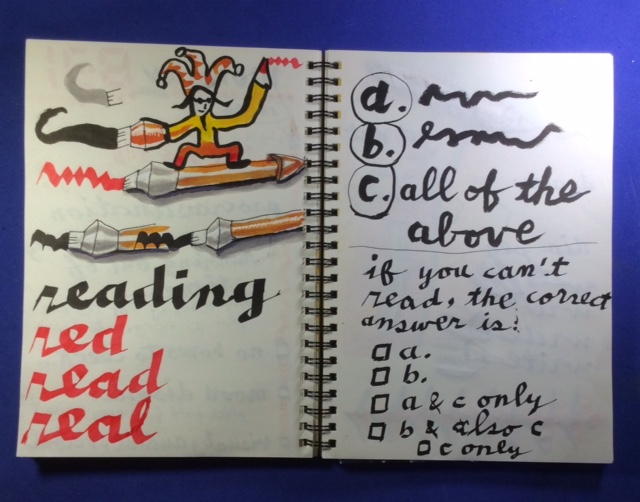
We do not, as a society, give a fuck if you can read, have a rich mental life, consider ideas and solutions to problems you might not have imagined. We do not, as a society, give a rat’s ass if you can write, beyond clicking a box assuming liability for any and all debts incurred in the course of your dealings with our corporation.
Our society does not have work, or any productive use, for a good chunk of its people, tens of millions of them. The young versions of these unneeded people are sent to schools to prepare them for a life where they are not needed. The lesson many of them learn clearly is: fuck you, asshole, bend over and spread your cheeks. Lift up the nutsack. Cough.
Life’s work: knowing this, all of it, and living calmly and productively, doing everything your talents allow to inspire, give hope, make a small ripple of change. Death is waiting for you anyway, why be aggravated by the many aggravations this life dispenses so generously for free?
It’s wrong to abuse people gratuitously, or even trying to be funny. There, I said it, fuck you. Seriously, there is most often no humor in abuse, no matter how otherwise witty. Abuse masquerades as humor to apply the talent for malice, seizing a jocular tone to wield the lash with the deniability of “only kidding… Jesus, stop being such a pussy.” A “roast” on TV can be occasionally funny, it’s all in good fun, blah, blah, but a roast in real life is rarely fun for the roastee. It is uncomfortable for most people to be put on the spot.
If I put you on a spit and turned you slowly and lovingly over the flames, basting you with your own juices to keep your skin from burning, no matter how otherwise hilarious my patter was while doing this, I know for a fact you wouldn’t find it all that adorable. We do this to each other from time to time, and it’s no joke, it’s a sign something sick is going on.
Not to be all judgmental about it, but when someone who has just been kicked in a delicate place is crying, the most humane first reaction is sympathy, not a smirking admonition not to be a pussy. “Everybody gets kicked there, whiner. Stop fucking crying and finish listening to my problems, asshole. I have problems too, you know. I kneed you by accident, ACCIDENT– pussy.”
I am thinking about this because when being polite is the only reason for doing something, against many good reasons for not doing that thing, experience teaches that it is a mistake to do the thing out of politeness. Being polite is a good thing, especially with strangers and potential assholes, and politeness has an important place in civility. Being polite as the only reason to do a thing? A weak ass reason indeed, and almost weightless against any reason not to do the thing at all.
Years ago, after an unhappy, brilliant, talented, witty and often abusive friend turned her abuse on me at a particularly bad time for me, I replied to her hurtful email with a long explanation of why I’d been so hurt by it. She declined to respond to my wimpish complaint. I never heard from her again. It was the quiet whimper at the end of a long, troubled friendship between two damaged people.
A year or two later, her husband’s mother died at 99 or 100. The old woman had been severely demented for the last decade or two, and when she finally died, the husband’s sisters began screaming for him to do something. He jumped up and applied mouth to mouth resuscitation to the dead woman, until, presumably, nurses intervened.
Sekhnet and I spoke to him shortly after learning, by email, that his mother had died. He was very grateful to us for a long call that gave him some comfort. I had nothing against him. In fact, it had been a source of stress and pain to watch him severely verbally pummeled by his unhappy wife every time the four of us got together. I always took his side, tried to pour some humor on the ugly situation, distract the wife from her assaults. Sekhnet was also very troubled watching this brutality at every meeting. When the woman turned that same whip on me one time too many, I was not having it. That was the end of our long, troubled friendship. Against my better instincts, I yielded to Sekhnet’s persuasion that I attend the wake in Chinatown. It would mean so much to our lapsed friend’s husband who had just lost his mother, she convinced me. Sentimentality and a misguided sense of duty and kindness triumphed over Reason and self-interest.
I have never had a reason not to regret going to that wake. I rushed from something I needed to concentrate on to be there, and needing to rush off had distracted me from the important thing I’d needed to focus on. I stood in line to have a meaningless hug from my former friend who made a smiling, breezy comment, only gently barbed, and it was the only exchange we had. Her husband thanked me several times for coming, and even took a moment, at a family dinner after the wake that I should also have not been persuaded to take part in, to find out if I was still trying to do that ridiculous animation business with kids.
I have never had a reason to think I did the right thing going to that wake. I did the wrong thing, for myself, thinking it was the right thing. Lesson learned, and now I move on slightly wiser.
Politeness for its own sake? Complete fucking lying bullshit.
Although I ate chicken, steak and hamburgers often during my childhood, and particularly loved fried chicken, flank steak, deliciously marinated, and burgers char-grilled over coals, I have been a vegetarian now for seven or eight years. As they say, just because you’re a vegetarian doesn’t mean bacon stops smelling delicious. The smell of burgers on a charcoal grill still gets to me, though I haven’t eaten one in years. Same for pastrami (a childhood delicacy) and barbecued brisket (which I discovered very late in my meat eating life), damn that stuff smells delicious. As for my vegetarianism, a friend corrects me, I am a pescatarian, since I eat fish a couple of times a week.
I zestfully ate the lean muscle of many animals over the years, what we call meat, but was always squeamish about eating internal organs, feet and necks. My mother loved to gnaw on a neck, or chicken feet, working her way around the tiny bones and sucking out the marrow with a smile of pleasure; I’d watch in horror. Squeamish is defined as a “prudish readiness to be nauseated” and no Victorian lady was ever more ready to recoil prudishly than I was from the smell of a calf’s liver frying with onions. The odor would literally sicken me and drive me from the house.
Why did I stop eating meat? I heard Michael Pollan on the radio, a long interview on WNYC, I think he was speaking to the gourmand Leonard Lopate, a man who will seemingly try any food. Pollan described something I’d witnessed as a teenager and was able to ignore at the time: animals we eat are raised in death camps not much different in spirit than places like Auschwitz.
Yes, this was an uncomfortable fact, and I’d seen the brutal treatment of tiny chickens and turkeys on kibbutz in Israel, but then Pollan described the intelligence and suffering of these meat animals and I looked over at my cat, a handsome carnivore, and he seemed to nod. Pigs become very depressed, they are much smarter than dogs, smarter than cats. They have to be restrained and drugged to stop them from freaking out in the weeks and months before their painful slaughter.
Delicious, yes, but also way smarter than this cat I like very much. The cat has a personality, preferences, moods, a certain brutal sense of humor. I will cry when he dies, hopefully many years from now. Sekhnet will be inconsolable, she cries at the thought of how inconsolable she’ll be. I suddenly could not eat pork, delicious as it is. Or cows for that matter, large gentle animals who, raised by the millions for meat, are big players in global warming with their ruminant farting. Human love of burgers has incented (as the capitalists now say) the destruction of the Amazon jungle, the earth’s lungs, for grazing land for cows. They say a vegetarian who drives a Humvee has a smaller carbon footprint than a bicyclist who regularly eats cow. That is another matter, also important, but it was the idea of the terrible lives these sentient animals raised in industrial death camps lead that instantly made me unable to eat meat.
I recalled the way we chased down baby turkeys, sometimes they were kicked, take four or five in each hand, upside down by the feet, pass them to someone with a pair of clippers who’d snip off their beaks. A spurt of blood and they’d be passed to someone with a syringe who’d shoot them full of antibiotics, hormones and who knows what else. Then they were thrown into another section of the enclosure with their squawking, blood spattered colleagues. I have a vivid memory of these birds, all with blue eyes, suddenly turning into a friend of mine, a beautiful girl with blues eyes. I excused myself and went into the bathroom to write this up in my journal. I was eventually rudely called back to work in the turkey coop. There were thousands more turkeys to get ready for meat and I was a needed volunteer. Eventually, decades later, after hearing Pollan’s description, I had to stop eating birds too.
This does not make me highly moral, of course. Hitler was a vegetarian for the last fourteen years of his hideous life. He gave up meat in penance for his part in the death of the young niece he was obsessed with. The only woman he ever truly loved, he said later in his life. At twenty-three Geli Raubal finally shot herself in the lung in 1931, with Hitler’s gun, during the last leg of Hitler’s marathon to power. Who could blame her? Hitler was obsessed with her, jealously kept her virtual prisoner in his apartment, and though we may like to think of him looking at her through a bathroom keyhole and jerking off, her nauseated face as he rubbed against her sometimes, it is probably just because Uncle Hitler was fucking Hitler that she chose death over life in the end. In any case, when he snapped out of his depression and got back to his life’s work, he gave up meat.
So, although I can’t eat meat these days (fish, a hypocritical compromise) I’m not on a moral high horse about it. I’m on a moral high horse about many other things, of course. I also wish people would stop eating so much increasingly poisonous and earth-damaging meat, but enough on that.
Toward the end of my mother’s long death from endometrial cancer she lost a lot of weight. She had always been very heavy, but after my father’s death, nibbled at by cancer, she lost most of her excess weight. “The widow’s diet,” she called it, a lost interest in cooking and eating, for the most part. She was almost gaunt by the end.
A few years before she died we were driving in her Cadillac in sunny south Florida and she suddenly said “I feel like Golden Corral all of a sudden. Do you want to go?” I was hungry, and she expressed so little interest in food, that I immediately I swung the car toward Golden Corral and we got our trays and giant plastic cups.
Golden Corral is a large scale buffet with many stations. It’s possible to eat semi-healthily there, if one sticks to three or four foods, but that’s not why people go there. My mother was thinking of fried chicken, macaroni and cheese, a bunch of other things I wouldn’t necessarily put on my plate. I had not yet heard Michael Pollan’s description of the suffering of animals raised and slaughtered in Auschwitz and I took some fried chicken along with some side dishes.
I’d had a tasty steak there a few weeks earlier, and I took a thin well-done steak as well. I did not notice the tell-tale onions. My mother ate the chicken happily for a moment, and then pretty much lost her appetite, the cancer was all over her and probably had something to do with it. She watched me eat and asked me how I liked this, wasn’t the macaroni and cheese good, and so forth.
I sliced into the thin steak, took a morsel on my fork, put it in my mouth and chewed it. It tasted funny, it tasted bad. This was not the tasty steak they’d served for dinner a few weeks earlier, this was some kind of horrible lunch time meat.
“It’s liver,” I said right after swallowing it, with a nauseated face that made my mother laugh.
“It’s not liver,” she said dismissively. For some reason I’d swallowed the foul tasting dark meat and I was feeling sicker by the moment. A waitress passed by. I asked her if it was liver.
“Yes,” she said with a big smile, “isn’t it delicious?” I gave her the expression of Woody Allen about to go into the MRI. My mother laughed again and told me to grow up, that it wouldn’t kill me. I wasn’t so sure.
Not long afterwards I heard Pollan describe the torment of literally tens of millions of animals raised in factories to be killed so we might cook and eat them and I could finally stop worrying about eating liver.
“So are you working hard? Busy?” asks one of my few living cousins, now in her ninth decade. She means, I suppose, ‘are you still delusional?’ I tell her cheerfully that I’m working hard and busy, I describe the marketing and this week’s well-received unveiling of the new pitch I’ve been working on all summer. I explain breezily that I’m currently focused on marketing, a necessity my team would have been working on all along, if I had a team. The program itself runs very smoothly, done over 100 times now all over, without a glitch. She likes this, a retired teacher, does not sneeze at it. Tactfully avoids asking if I’ve made a dime in 2015, usually her husband’s second or third question.
“Still working alone?” she asks, and I cheerfully tell her that, except at the sessions themselves where I have assistants, yes, still delusional.
“And how is Sekhnet?” she asks cheerfully, and we’ve successfully negotiated the minefield of my difficult mission. Now we are in the lush backyard farm that farmer Sekhnet lovingly tends for hours every day, before and after her long hours at work. I can see that colorful oasis spread out under the window. A paradise of color and deliciousness, brought forth from the dirt.
Then, after talking about the organic fruits of this magical garden, and the health it brings, we’re on to raccoons, possums, feral kittens. They have them too, in New Jersey and the Berkshires, plus a litter of baby skunks and their mother. Luckily for everybody the mother skunk took her babies and left the garden after a while, there would be no need for any violence against them, just as the exterminator had predicted.
Downstairs almost all the components for garden fresh sauce are prepped, waiting in their metal bowls for the first pop of garlic in the olive oil and then the sauce making begins. Sekhnet is out buying onions, we’ve used up the ones she grew this season. I have to go down and pick some fresh oregano (delicious), chop it, get it ready for the sauce. Two large bowls of perfectly ripe tomatoes, red, yellow and green, all zipped out of their skins, wait patiently for the Saucier to begin.
Life moves at its own pace, if you can walk calmly and excitedly with it, you’re blessed. Ideas take time to germinate, must ripen into action. At least this is what I have been philosophically brushing into my drawing book lately. If you are in something for the long haul you must develop a philosophy that helps and doesn’t hurt your chances.
That said, I need to get a few hours in punching the heavy bag of revising the pitch, starting on the next one, much shorter and sweeter, showing the fun and the therapeutic value of working in a creative team helping each other animate ideas, still objects miraculously taking life on a colorful screen while cancer waits impatiently outside, ready to continue its assault, pissed off to be outside waiting to return to the center of the merciless universe.
A good thing, I believe, keeping that killer waiting in the hall for a while as kids and their families get a break, play, have some goddamn fun. Now I just have to sell the excellent means I’ve invented to do that.
Thoughts are more susceptible than most things to being, at the same time, reasonable and helpful and bizarre and unhelpful, according to the angle they’re viewed from, how the light hits them.
In discussing whether I might actually be mad, trying to do the quite possibly impossible thing I’m trying to do, the teenage therapist and I seem to agree that the jury is still out. Clearly, the most sensible thing to do is find something to do that brings in money. If it’s something that also brings personal satisfaction, helps others, is enjoyable and challenging — that’s great. But given the choice between earning a living or being in a constant state of turmoil over a ridiculously challenging thing requiring a good deal of self-reinvention while not bringing in a groosh or a kopeck… most people, on every shade of the elusive sanity spectrum, would choose the former.
I am ambiguously blessed, at the moment, not to have to occupy myself with the vexing question of how to pay my bills. Five years ago I inherited enough money to support the average person three to five years. Not lavish years, mind you, but average years for the average person living a modestly middle class life. I have always tried to keep my expenses low, my options open for working the fewest hours in a conventional job. Five frugal years later I still have money, riding on the “free market” roulette wheel like the trillions scooped off the slanted table the last time the richest and cleverest gamed the system prior to the “collapse” (or wholesale fraud, if we want to be more accurate) in 2008. For the moment I am not worrying about that, though, of course, I probably should be. My not worrying is another tick on the side of the ledger the jury may lean toward when deliberating over my relative sanity.
But here was the slightly odd thought that snuck up on me the other day. I’m working strictly on marketing now, as much as I can, focused on presenting the workshop in a light that will make it hard for public school innovators in the de Blasio administration to resist. This marketing work is also necessary for interesting and recruiting the best possible people to work with me on the program. I’ve spent many hours removing all self-deprecation, self-doubt and frustration when I describe the program. I’ve eliminated all references to the likely impossibility of my task. I focus, when I can, on how well the program I designed works for its intended purposes.
I am making my language terse, yet natural. In the first minute I now summarily answer the most obvious questions: who I am, what brings me to the room and why this program is so important and valuable. I am isolating the talking points, keeping them simple and rotating them, repeating each one enough times for the message to hopefully sink in. You want to involve children in their education, make them eager partners in their own learning? Give them a stake, let them learn what fascinates them and let them teach each other. You really want children to become creative problem solvers? Put them in a room full of art supplies and technology, with an exciting end-product they can enjoy, and adults who set things up then take a back seat, and watch what they do. Etc.
The odd thought, yes, I’m coming to it presently. I’d been stuck for a while trying to complete the pitch. I need to be able to present a snappy and memorable show during the structured yet natural twenty minutes I will get to pitch it some day. Improvisation in a sales pitch is foolishly risky business, as I’ve learned in a gently brutal manner. Wrestling with the technology to make the AV (I reveal my age with this anachronistic reference to “Audio Visual”) side of the presentation has been an added frustration. Every added frustration makes the mountain I have to climb steeper. The fucker is already almost vertical, any steeper and I’ll have to find or design special shoes to allow me to walk upside down. Another of five dozen, sometimes ridiculous, workarounds so far.
But this week I was finally able to negotiate the last technical hurdles with the program I’m using to create the pitch (a total of five hours winning over ever more supportive and expert tech support) and it gave me the ability, at last, to record version after version and watch them back. Recording myself was a useful bit of advice I received a few weeks ago when the very idea of watching my sluggish progress set my teeth on edge. Being able to finally see my work played back eliminated the rehearsal-to-myself motivation problem, and the equally vexing one of finding someone to do me the favor of watching each version and helping me assess my snail-like progress.
“Wait,” you will say, “you supposedly have an organization, a non-profit founded in the Spring of 2012. Why do you still need to find people to do you a favor? Call a meeting and….” Shut the fuck up, would you, fuckface?
Ladies and gentlemen of the jury, ignore this well-meaning yet provocative clown and my client’s outburst as well. My client suffers from acute Founder’s Syndrome, a well-known condition that eventually afflicts the CEO of virtually every one-person organization.
Anyway, now that I can work on the pitch and watch it in progress it’s much easier to see transitions that are bad, points that are not made clearly, glitches, clumsily worded talking points and so forth. Clearly this is the work of a committee, a team, but since I have neither, it’s taken way, way longer to complete. Now that it’s finally not so difficult to see and fix weak points I’ve made good progress the last week and it’s now virtually done. I’ll be presenting it to a successful non-profit entrepreneur on Tuesday and once more have the benefit of his experienced feedback. He has mastered a pitch that is successfully selling a once one-man program related to mine. My pitch is ready now, 48 hours before the meeting, though I plan to polish it a bit more, if I can.
Now the slightly odd thought, after one last bit of set up. I ran the short new segment by Sekhnet the other day. It contained my freshly written “who am I, why am I here, why should you care?” rap. She was distracted from my short personal and professional message by the flash of oddly unrelated animation on the screen. She was right to be distracted, I could see at once. I set to work making the proverbial enormous changes at the last minute. Had I presented that first version to the social entrepreneur I’d have lost him in twenty to sixty seconds and he’d be bracing for a wasted 20 minutes with a clearly mad person with a single good idea and a hundred bad ones.
Several hours of concentrated work later I had a 49 second animated clip that I can actually link to this post (later) explaining who I am, why I am here and setting up why my program is something you should check out. These simple questions had been impossibly ticklish ones for me to answer. I knew the new version was pretty good. Ran the less than minute by Sekhnet. “I like it,” she said, after a little laugh at 0:20 where I’d inserted a little bark of levity, “it really shows how much work you did developing the program”. Went back to work, tweaking a couple of things I noticed while showing it to her. I fixed several other small weak links in the pitch.
At the end of a very productive day I stood at the mirror shaving. As I watched myself I noticed a small twinkle in my eye. In that small moment of satisfaction I glimpsed an entire universe of truth and I had this odd thought: it’s easy to have ideas and it’s morally satisfying to have ideals; living them is the hard part. I don’t personally know many people working as hard to live their ideals directly, to see their unique ideas mischievously afoot in the world. It is hard, maybe impossible, work, but it’s the best work I could hope for, it occurred to me in that moment. I am also blessed, by pure luck of circumstance, to be free and able to pursue it for as long as I have been.
I pushed aside the thought of all of my more successful friends, figuring out how to live well doing things that are also important, or sometimes not; pushed aside the often odious comparisons that come so naturally to all of us here in the Free Market.
I am free, the twinkle in my eye reminded me, and lucky to be doing important work for which I am uniquely suited. I’ve learned to savor the small but crucial moments of reward that are invisible to most people. This could be a sign of madness, of course, seeing these tiny, isolated moments as a blessing, but I prefer (in the custom of all madmen) to think not. It’s crucial to drink fully of every life-sustaining moment of reward we feel in order to persevere in any difficult undertaking. I’ve learned to suck every drop of juice from these rare and subtle moments of reward one must be vigilant to enjoy.
If my life is harder, harder to explain and less materially sustainable than the lives of many people I know — these are all part of the price the world extracts from those who dream of a more merciful society and struggle to make these dreams real in the world. There is a price to be paid for being different, clearly, and it’s not just a theoretical price. Part of that price involves the occasional questioning of your sanity.
It was an excellent moment in front of the shaving mirror, even if, at the same time, a slightly odd thought.
Mood is a mysterious subject. We have already seen that humans at times have little insight into why they act the way they do, although virtually all of us are pretty good with the rationales. We do things for reasons, almost never without one we can swing like a cudgel or use as a shield, if it comes to it. Sometimes the reason we do or don’t do things is strictly our mood. We are all capable of amazing things when in a buoyant mood, it’s difficult to do even basic things when a hopeless mood descends. Those with an abundance of what scientists call “the happiness gene”, which I always think of as the fucking happiness gene, may more often do things in a practical, rational, positive way. There are no demons dragging them away from right actions, the things anyone would do if not hobbled by one mood or another. For the rest of us, moods exert an influence as strong and invisible as the moon on the tides, the stars on the fortunes of the least lucky of Shakespeare’s characters.
I have been good friends over many years with people I now see as remarkably negative characters. We had in common traumatic childhoods that did terrible damage. They were raised by monsters, abused, molested, neglected, had to parent themselves as best they could. That kind of upbringing leaves scars that are not always easy to overcome. Being your own parent is a hard job, I can tell you from experience. The first thing a parent must do for the child is not blame others for the situation the parent and child are in. The parent must model resilience, and care, and healthy choices, must model problem-solving and transmit a love of the things in life worth loving.
I remember my poor father on his death bed, trying to apologize for what a poor father he’d been, telling me poignantly he’d had no model for showing affection, he’d never seen it done in his childhood, by anyone. “I had no idea how it was done,” he sighed. He was being too hard on himself, he managed to instill a love of animals, soul music, social responsibility and other things in my sister and me.
The mood will be on the adult, like PTSD, when the child is challenging them– a flash of the coarse cord whipped across the face, the sting, the betrayal, the look of hatred in the mother’s eyes. In the adult, like a cliche, the unjustly persecuted child cries out, and the parent may struggle not to react in rage. I have seen it, felt it, been on the other side of it many times. It leaves fingerprints on the young soul, without a doubt. As Dr. Nadine Burke Harris pointed out in her wonderful TED talk (see block quote at the bottom of this post), repeated fear and trauma lead to the production of adrenaline and cortisol in amounts that do damage to the body, actually change the DNA.
You may live in a beautiful mansion, be well-loved and respected at work, laugh a lot in your personal life, have an otherwise fabulous life, and, as in that wonderful Yiddish curse, the devil may also be chasing you from room to room in your mansion of a hundred rooms. You may have the very best of intentions, and do little good for anyone, or yourself. There are endless variations on this horrible theme and millions struggle the very struggle I am struggling to describe. Rage, disguised as hopelessness, or terror, or Terror, disguised as pride, or anger, or other sneaky, powerful forces that sometimes bring a person to do stupid things, or cruel things, or senseless things. Then there are also the extremes of this, full-blown mental illnesses and difficult to control mood disorders.
I think of a witty man I know who always smiles, always, always, ALWAYS has the very best of intentions. He is a great humanist, a sensitive man, a great and humble soul, a soulful singer, a lover of children, a protector of the weak. This creative fellow with a thousand professional contacts always wants to know what he can do to help, will be in touch to apologize for not helping, ask again what he can do, be told again, not do it.
“He’s insane,” my sister says after, months of his broken promises have passed, “you have to forget about him. He’s not going to help you. Next!” Good advice, truly. Believe people’s actions, not their rationales, not their intentions, not what they say they want to do. What stops us from taking right action? Mood.
Some people find the support they need to help them over moments of doubt in difficult undertakings. Having a positive person to bounce ideas off, to get a bit of courage from, is a great help in any endeavor. Not everyone has these people in their lives. Lacking these lucky contacts, with only those who may wish well but watch with fear, one must persist alone and take much longer to do difficult things.
The thing I am trying to do, the program elements now largely worked out, extensively field tested, an almost perfect machine for the job it sets out to do, is enormously difficult, maybe impossible for one person to do alone. I may have almost all of the skills needed to do it, the question is will and the ability to conquer the mood when hopelessness descends. Call a friend? My friends are all concerned, none have any real idea how to help, if they were inclined to spend the time. It is a subject better avoided. It seems to them, as far as I can tell, that I have already failed to build this ambitious cathedral to my ideals, it’s three years already and instead of funding and real results I am gamely showing pictures of my dead baby as though the kid is doing wonderfully in pre-school, already headed to an elite private elementary school and on the way to Harvard. It is mood, only mood, that stays me in my tracks most days. The opinions of those who have no way to understand what I am trying to do, what I have already done, should not have any effect on me.
On the days the benefits of what I’m working on emerge to me unclouded, benefits for myself and the children whose talents I am hoping to showcase simple to see, I move resolutely and joyfully forward. That I am often discouraged by the incremental nature of my forward progress, only a mood. It behooves one not to be a moody bastard, particularly when engaged in a long-haul project that, no matter how helpful and close to completion it is, may well be impossible to carry out. Then again, how not to be a moody bastard is a ticklish question I have not learned a very good answer to so far.
A year or two ago I saw a plainspoken philosopher speaking to Bill Moyers about our culture of cruelty. I forget the insightful man’ s name, but I will never forget his comment after playing a clip of a campus cop nonchalantly walking along a row of seated peaceful college protesters and spraying them in their faces with orange mace from a huge, seemingly inexhaustible, canister. The campus cop did this with the body language of somebody watering a garden with a hose.
“He’s doing this like it’s a normal thing to do,” said the philosopher calmly, but with appropriate horror. He then showed a campus police force with a tank, surplus from our many recent and ongoing wars. He detailed the widespread militarization of police forces all over the country, essentially an army of occupation in the many slum areas of our great nation. Heavily armed SWAT teams in flak jackets and combat helmets, wielding automatic weapons, breaking down doors and storming in to break up illegal card games, apprehend dangerous people who are bagging marijuana.
Normal. A frightening word in many ways, when you think of what is normal today. It is normal for very wealthy people to want and be able to own everything, there is no shame attached to this normal desire, no matter the consequences. It is normal for an angry or frightened person to defend himself with a gun — he now has a right to “stand his ground” in many states, even if he went looking for trouble and the ground he is standing on is far from his home and castle, the traditional boundaries of where he has long been free to defend himself with deadly force, if he could not flee to safety. It is normal, depending on where you’re from, to kill your unmarried daughter or sister if she exchanges flirtatious glances with a man. Honor killing, it’s normally called.
It was normal, in 1776 when Thomas Jefferson, with his gift for a felicitous phrase, was putting together The Declaration of Independence, the charter of American democracy that lit the torch of human freedom, for people of means to own other people as property. We hold these truths, being wise men capable of holding more than one truth at a time, to be self-evident, that all men are created equal, endowed by their Creator with certain unalienable rights, and so forth, and that, at the same time, we may hold great, easily liquidated, wealth in the form of human chattel. I myself, he might have added, presently own a few hundred of them and I love ’em.
Of course, when I write this way it is easy to nitpick: nobody likes Honor Killing, or the grotesque inequalities between the 1% and the rest of society (except, perhaps, most of the 1%), or the American plague of carnage by gun masquerading as Constitutionally protected freedom (except for millions of American gun owners, the NRA and the politicians they purchase or rent), or slavery, for that matter. But there is another side to these things, normal though they may also be, that makes discussing them a bit more complicated. To denounce terrible things on the internet is about the easiest exercise there is. Why not challenge myself, you ask?
OK. Thomas Jefferson, it is safe to presume by his writings, had much better intentions than he was able to live out, though his life was, in most outward respects, normal and respectable for a wealthy Virginian of his time. He probably truly loved the beautiful, light-skinned mother of his four children born over the course of their long affair. Although each of these children was born nine months after a Jefferson stay on Monticello, each looked white and at least one had a striking resemblance to Thomas Jefferson, even though Sally was his chambermaid, even though each of the children was given preferred work in the manor house, and all were eventually freed (virtually the only of Jefferson’s slaves to have been released from bondage) the master’s patrimony of Beverly, Madison, Eston and Harriet Hemings was indignantly denied for 150 years after Jefferson’s death — and to this day, by some, almost 200 years later, in spite of the DNA match and other strong evidence.
In a better world he would have married his devoted servant, a delicate and cultured woman fluent in French, as Jefferson was, loved her openly, embraced and educated his children and grandchildren by her. In this world he quietly freed the slave children by letting the first couple escape when they came of age to do so — they looked white and were easily able to “pass” and assimilate into the racist society of the time– and freed the others in his will. He had promised the slave mother, Sally, in exchange for the pregnant teenager’s agreement to leave freedom in Paris and return to Monticello as his slave, that he would free their children at 21 and he kept his word. Sally too was discreetly freed not long after Jefferson’s death. I have always held these deplorable things (excluding, of course, the promises he kept) against the Author of Liberty.
Here are a few little known but devilish details that help explain Jefferson’s dilemma. Under Virginia law at the time, had Jefferson freed Sally she could not have remained in Virginia beyond a year and a day. It would have meant parting with his long-time lover or seeking a court-order allowing her to stay, and giving good reasons in the court filing for this dispensation from the law. The publicity would have destroyed Jefferson’s career.
Here’s an even more devilish detail: Jefferson’s mentor and lifelong friend George Wythe had, after his wife’s death, a love affair with a one-time slave of his, Lydia Broadnax. Wythe freed her, got the legal paperwork in order so that she could stay in Virginia, and may have had a son by her (this is Fawn Brodie’s conclusion, disputed by others based on Broadnax’s age when the child was born). What is undisputed is that the free-born mulatto Michael Brown was tutored by Wythe, that the teenager was very devoted to Wythe and that the aged Wythe provided well for him and Lydia Broadnax in his will.
Learning of this, Wythe’s grandnephew, who had stolen valuable books from Wythe’s library and forged Wythe’s name on checks, outraged on being written out of the will, his inheritance going to people then normally known as niggers, promptly poisoned Brown, Wythe and Lydia Broadnax, killing both men. They died agonizing deaths over the course of almost two weeks. The woman survived, but was prevented by Virginia law from testifying in court to seeing what she understood too late: the young man putting arsenic in the coffee. Other blacks had seen the grandnephew dispose of arsenic before his arrest and from his prison cell (he apparently had a lot of it) but they also were prevented by Virginia law from testifying in court.
The murder trial in Virginia was attended by great publicity, and Wythe’s grandnephew, skillfully defended by zealous attorneys, glad for the exclusion of black eyewitness accounts and using inside knowledge of the perfunctory autopsies to create reasonable doubt, was acquitted of all charges. You can imagine the outrage in Virginia had a white man been sentenced to death for killing the sort of people Wythe’s grandnephew had killed. George Wythe, although a famous and respected legal mind, one of the greatest Virginians of his day, signer of the Declaration of Independence, beloved of Thomas Jefferson, recipient of the largest funeral in Virginia up to that time, was also someone who taught Greek and law to a free black boy, and treated the kid like a son, after all.
If Jefferson had a sudden, crazy, fleeting thought about marrying Sally and legitimizing their children, the last chapter in George Wythe’s distinguished life story would have put an end to that.
And so it goes with each of these “normal” things. There are reasons, always. Even if the reasons are later seen to be immoral, insane, vicious– they are the underpinnings of law at the time, they form the moral norms of the era.
Fifteen or twenty years ago, when Israel used a drone to blow up a car and execute some people Israel claimed were terrorist masterminds, there was a lot of controversy over this extrajudicial killing. For one thing, it was illegal under international law at the time. It is one thing for a team of daring secret agents to get up close to cunning, uncapturable terrorist masterminds (or, depending on your view, freedom fighters), through skill, guts and determination, and quietly inject them with something to induce a heart attack. Or slit their throats. Or sabotage the brakes on their car before engaging them in a high speed car chase over dangerous terrain. It is a different thing altogether to have a robotic plane flying by remote control to distant places to kill people who are blips on a computer screen.
Again, when Israel first practiced these extrajudicial executions by drone, it was extremely controversial. Today it is perfectly normal, as plain and unobjectionable as a glass of cool, pasteurized milk. The president of the United States today looks at a list of names of people to be killed extrajudicially and says “go ahead.” One day one of the names on the kill list is of an American citizen whose father has brought a lawsuit in US federal court to stop the expected killing by drone. The president, in this case, consults with legal experts, decides there is a perfectly valid exception under American law, the killing is legally justifiable, and, anyway, no court will ever hear the case. Done— kill him. A week or two later the guy’s teenage son, also an American citizen, shows up on the list — or maybe not. “What the fuck?” reasons the president, if he hesitates at all, and on his order the strike is carried out and the American kid is also killed. We’ll never know how it went, since everything to do with the kill lists is highly classified.
“He should have been more careful when choosing his fucking father, the little bitch!” was the administration’s entire public response to the question of how do you kill an American boy with absolutely no ties to terrorism? The president’s press secretary said it smirkingly when asked about the execution of the boy and three friends who were eating at an outdoor cafe in some remote region of Yemen. A total of eight were killed by that missile, we’ll never know who the others were, except that, apparently none were the target, an Egyptian al-Queda member.
In a perfect world, I walk up to the press secretary, clench my right hand and break his nose. “You can give a better answer than that,” I would tell him encouragingly, helping him up off the floor like the nonviolent devotee of Ahimsa that I am. Then the White House press corps and the international TV audience would get the real answer.
“We killed him by mistake, we had no good reason for killing him… his name was never on the kill list, he was collateral dam…. uh, he was another innocent civilian killed in our endless, borderless war against Terror, I mean… one of perhaps thousands of nameless, faceless people killed for the crime of living somewhere our intelligence determines is also home to those who hate our freedom enough to plot to murder us. It just happens we later learned his name, and that he was a 16 year-old American, that he’d done nothing wrong, and that he was killed with other boys who probably had nothing to do with terrorism, along with four others who it is not worth talking about. Look, mistakes are made… the passive voice used…. oh, goddamn it, leave me alone!!!”
That would have been a perfectly normal reaction. Much more normal, at any rate, than what I have been doing so far today.
What is the harm in believing your adoring maternal grandmother and seeing yourself as a talented person uniquely qualified to leave something worthwhile for society when you go?
I can see a few pitfalls in that sentence: the blinded grandmother with her six dead siblings, dozens of nieces and nephews never seen, described in Yiddish letters that stopped coming in 1942 or ’43, buried with everyone else in that ravine to the north of town, has many reasons to be unreliable.
My grandmother (my mother’s mother, not the one who whipped my infant father in the face, I never met that one, she died before I was born) was a talented woman, a dressmaker who could see a garment, remember it, buy the material (as she always called fabric) and put one like it together in a few hours, cutting with large scissors, working at her sewing machine and mannequin. After she retired, between copious draughts of straight vodka, she could go with a wealthy neighbor to a fancy Miami Beach store and look at dresses. They could pick out the general cut of one, the neckline of another, the detailing on a third, the material of a fourth. She never made a sketch, kept it all in her head. Her customers always loved the dresses she made, but does that make her an authority on talents that uniquely equip one to tackle and carry out the impossible? Hardly.
I believe that everyone possesses talents, many of which they are unaware of. This loss to the world is largely the work of our capitalistic society — only major league talent that can beat the competition is talent worth paying for. Everyone else with your unmonetized talents — you got a hobby you like, good for you. I had a grandmother who wanted badly to believe that her only grandson was a genius destined for fame and wealth. She needed to believe it more than most grandmothers, with only her daughter, her granddaughter and me the last shot at keeping alive the genetic line. I have not kept alive the genetic line, except in myself so far, though my sister has a daughter and a son.
Back to my belief that many people have great talents they are unaware of, an example:
I was riding in the back seat of a car, behind the driver. There was music on the sound system, it sounded good, a woman singer or two harmonizing beautifully. I knew this music, but was not aware of the version with the harmony singer on it. I discovered it was the driver, singing live with wonderful pitch and a great voice, a woman who does not consider that she has any musical talent, a woman who’d be embarrassed if I told her how impressed I was. Her husband, unaccountably and nonchalantly, also has a great voice, a remarkable memory for a tune he’s heard once — yet, also, no musician. It mystifies me with these two: all of their children play instruments and are excellent singers. Yet they…. well, I wouldn’t understand, as they tell me, since I’m a musician.
I consider talent a near universal thing, every individual possessing some particular gift, and it is sad to me that here in Free Market World so many of these talents are hidden, wasted, not contributing wonderful things in every area of life. There are untapped and valuable talents beyond the easy artistic ones that come to mind. Some have an innate talent for organizing information, a talent for talking soothingly to groups of people, a talent for seeing the larger structure and fixing problems others would take a long time to put their finger on, a talent for making people feel comfortable, for bringing out the best in them, a talent for peace, a talent for happiness, a talent for enjoying the best things in life. These are all talents that, if cultivated and freely expressed, would make the world a much better, happier, more contented and peaceful place.
“Ah, there you go, typical… fucking dreaming again, as if utopian socialism ever had a chance in reality,” a reasonable voice will say. “The world is the world, Darwin was essentially right, it is survival of the most cunning and ready to murder their rivals. One look around shows the counterfactual nature of your absurd, idealistic, wish. Evolution itself argues against it.”
Unless survival through increased insight and interconnectedness is true evolution– learning from mistakes instead of compounding them by revenge.
“Oh, they will shoot you many times if you say that loudly enough, my friend, if you ever get enough attention for your wishful views, which, thankfully for you, is unlikely in any case,” says the voice of reason.
“I’ve always held that seventeen bullets to the torso for speaking a powerful enough truth clearly is worth the price paid by those who smolder, volatile and ready to blow, living lives of desperate and unreasonable compromise under intolerable conditions.”
“Mmmmm…. a talent for the felicitous phrase, a talent for justification, a talent for recasting clear failure as something actually laudable…”
A talent for talking to myself. A talent for ignoring certain hard realities as long as I can and then recoiling from them. A talent for finding myself in a loop, shaking my head and going, “damn…..”
Back to my original question: is it mad, if you are uniquely situated to help, to carry on in spite of the seeming impossibility of success? If you have an idea that can help people in need, develop it into a program that can contribute something constructive to the noisy and often misguided conversation being hollered all around, can give some joy, fun and sense of accomplishment to kids who are presently doomed to lives of tragedy that will seem longer than their twenty years…. do you not have a moral duty, if you have the means to carry out the program, to soldier on?
“You expect an awful lot of yourself,” says a device, weakly.
I have the tools. I have the program, done successfully now one hundred times. I have the written materials describing it, a curriculum, a website… I…. I….
I remember meeting my grandmother’s first cousin, George Segal. George, creator of life-sized plaster casted people posed in evocative dioramas, is remembered today as a giant in American sculpture. I met him twice as an adult, once in passing at a gallery on 57th Street, we walked west together toward Columbus Circle, and shortly thereafter as his guest at his farm in New Jersey. He took me into the converted chicken coops, huge sprawling studios, rustic but comfortable even in winter.
“Your grandmother was very good for you, and very bad for you,” he observed sagely when we were sitting alone in one of his studios.
Somewhere in my many haystacks of papers I have the furious letter he wrote me after that visit. You can practically feel the clench of his teeth at the monstrousness of someone who wanted to be an important artist but felt himself superior to the guardians of taste, the wealthy art collectors and the unctuous subculture that curates their collections. They certainly did not deserve the bitter anger of someone who hated them but felt entitled to their money and respect. These taste-makers were some of the greatest and most generous people in the world, he pointed out through clenched teeth, and worthy of respect and honor, not scorn.
It had certainly worked out well for him.
 gratuitousblahg