Extractive vs. Regenerative Economic Models

Few of us question the status quo on essential matters that seem beyond question in a free society, like the necessity for constant war, eternal poverty, other plagues of human misery like desperate addiction and mass incarceration.   One reason is that we don’t have the language to ask these questions intelligently, even if we know something is sickeningly wrong with the way business as usual is conducted.  If you come across the right term, as I did recently from an activist — “extractive economic model,” and consider it against her alternative, “regenerative economic model,” you have the beginning of your question.  Spoiler alert, the irrefutable answer to this well-framed question, if you are not very, very wealthy and have some means to influence people, is “oh shut the fuck up, you fucking loser fuck.”  Nonetheless…

The great fortunes of some of our greatest families are founded on wealth they had workers extract from the ground.   This model for ‘creating wealth’ continues unabated to this day, with the tireless extractors of wildly lucrative fossil fuels still raking in vast fortunes every year.  In fact, with the new corporate tax break, Exxon and their ilk will keep many additional billions in the coming years for their essential contribution to the bustling world economy.  Same for the Koch boys and the industrious geniuses who invented the invasive, highly toxic hydrofracking procedure to extract safe, clean, lucrative, natural gas from deep within the earth. 

Back in the days when America was great, and people of means could own other human beings, the economy of the South was based on non-food cash crops, cotton and tobacco, that required massive manpower to harvest and which also depleted the soil.  Plant any single crop long enough in the same place and you end up destroying the soil.   That’s why crop rotation has been around for thousands of years.  That was one reason the Planters (that’s what the slave-driving motherfuckers were called) were so keen to add new slave territories to our great nation, they had destroyed the soil of the south growing the same two highly profitable monocultures every year.  

It’s just the way we do business here.   There are externalities attached to most enterprises that create vast wealth.  The death of the Amazon jungle, the lungs of the planet, is considered (by winners) a small price to pay if it allows McDonald’s to continue selling healthy three dollar meals to poor people, and reaping massive worldwide profits.  We live in an extractive economy, extract what you need, as cheaply as possible, to ensure maximum profit, and sorry about any lifeless ecosystems we leave behind.  Read the fine print, also, you can’t sue us in court but we can hire an arbitrator together to tell you you have no rights a wealthy corporation is bound to respect.  In the worse case scenario, like in the battle between big oil and local activists in Nigeria, you can just hang a few of the local leaders and the rest of the protesters will go away.

But this is all just bellyaching.  Until, perhaps, you have the alternative model to present: the regenerative economic model.   Regenerative grows back, extractive removes with no thought or hope of replacing anything. Regenerative is the essence of sustainability, Extractive depletes unto extinction.  Regeneration supports living creatures, extraction eventually kills them all.  

“OK, fine, Mr. Idealist, a sustainable economy is better than an earth-raping one, but where is the money in your precious regeneration?   Extraction has a long proven history of profit going back to the Conquistadors who forced natives to mine and give up their gold.   In fact, it goes back way further, to when great conquerers just extracted what they wanted from loser cultures who went whimpering under the sword.”  

No argument there.

“So, sir, with all due respect– why don’t you fucking shut the fuck up you fucking loser fuck?”  

I couldn’t say, sir.  I suppose it is not in my nature. 
Waking from Unsettling Dreams

In the first dream I was in and out of a bar that was headquarters for a violent motor cycle gang reminiscent of the Sons of Anarchy.   The tough men and women in there tolerated me, nobody seeming to even notice me.   I didn’t interact with anyone, I was just there, passing through.   I don’t know why I was there, I wasn’t drinking and rarely enter bars of any kind in real life.   I returned to the bar several times in the course of the dream.   

Around me fights got out of control, people were killed.  Some of the dead bodies were displayed outside the bar in grotesque positions, reminiscent of the crucified left as grim examples to others considering defiance of Rome.   At one point in our history crucified bodies were displayed in long lines, to the horizon.   It was a terrible dream, although I felt myself to be in no danger.   

In hindsight, the violence seemed virtually random, I could have been next, except that nobody paid any attention to my comings and goings.   The bar, I realize now, was set on curving, residential Marengo Street in Jamaica Estates, a place I visited often as a child.  

The second dream shook me up in a different way.   I’d invited a former good friend over, among a group of people I’d invited to my apartment that evening.  The former friend in question, I’ll call him Andy, had demonstrated to me in real life how little our friendship meant to him, how superior he felt to me and how illegitimate and pathetic he thought my feelings of hurt were.  During our last conversation he was unrepentant and even bullying, over the phone.  He may have been equally unrepentant in person, but I doubt he would have tried to bully me face to face.

This dream was unsettling to me for reasons unlike the couple of other bad dreams I’ve had where this guy shows up.   In those dreams I am shaken up afterwards by the palpable feeling of violence I experience.  He does something provocative and I react with anger, shove him, slap his face hard, kick him after knocking him down.   This shakes me up because I am dedicated to being as nonviolent as possible in word and deed (not that I’d meekly let someone attack me, don’t get any ideas).  In the most recent dream it was much different.

He’d set fire to some things in my kitchen and several of us struggled to put the flames out.   I knew at the time that this pyromania was a manifestation of his mental illness and not anything malicious directed at me.  Like with my often vicious father, I realized he could not help himself.   Others at the gathering reacted with anger, I didn’t.  When they began verbally attacking him I told them that I’d invited him and that he was my guest just like they were.   

As I was defending him he lit another fire and I took a cooking pot and banged it loudly on the wall next to his head.  I yelled at him.  I scared the shit out of him.  He disappeared.  We managed to put out the new fire.  Then I heard sirens, which grew closer and closer.  Somebody called out that someone had called the fire department. 

I opened the door and Andy was standing in the hallway, a shattered expression on his face.  He told me sheepishly that he’d called the fire department.  I took this as the best apology somebody as damaged as he is can offer.  I patted the side of his face and a fireman stepped through my front door.     I assured the fireman that the small kitchen fire was under control, he made a quick round of the apartment, signaled his colleague and they took off. 

This dream was fucked up in more ways than I can count.  

I was fairly wide awake, after very short sleep, and I succinctly recounted the dreams to Sekhnet, who was getting ready to go to work.   I mentioned to her that I had to find a new nephrologist, most likely, to follow up with the treatment of my kidney disease.   The need to find yet another new nephrologist is likely because my fucking health insurance changed in 2018.  She asked when I was going to make an appointment to see the Integrative Medicine doctor I’d spoken to months back, a man trained to view the body/mind/emotions as a holistic ecosystem [1]. 

My kidney disease, while eventually deadly, is not serious enough to inspire big pharmaceutical research dollars to be invested in it.  Its cause is unknown to science.  The specialists I’ve visited are blind men clutching the elephant’s tail, ear, leg, penis, promising the darts they throw in a dark room have a decent chance, as high as 30%, of curing what will eventually kill me, if not cured.

Maybe that’s all the unsettling dreams were supposed to do, wake me up and remind me to find a new nephrologist, take perhaps a thousand dollars and go visit this holistic doctor.   We are all heading toward death.  In my case, this kidney disease may not even be the thing that eventually kills me.   

Having this disease is enough to wake me up, though, and not want to waste time.   Writing something thoughtful every day, until I can figure out how to get some of this organized and read, and get some money for it, seems to be the most productive use of however many days or years I have remaining to me. 

Isn’t that the challenge of every human life?  Finding a meaning that gives beauty to the colors around us, music to the sounds we hear and excellent taste to the food we eat?   Satisfaction in our work, pleasure in our play.   A sense of connection to others that makes us cherish them as beings as precious as we ourselves are.


[1]  ho·lis·tic  (adjective)

PHILOSOPHY:  characterized by comprehension of the parts of something as intimately interconnected and explicable only by reference to the whole.

MEDICINE:  characterized by the treatment of the whole person, taking into account mental and social factors, rather than just the physical symptoms of a disease.


Losers Walk

In touch football back in Cunningham Park, a game in which I was once knocked briefly unconscious on the opening kick-off, the team that had just scored a touchdown would say to the other team “losers walk.”    The team that had just been scored on would walk the length of the plotted out field and wait for the kick.   It’s as good a metaphor as any for our competitive society, except that losers do not wait for the next chance to score, they are are simply expected to keep walking.  

I wonder, as I did when I heard an interview with a remarkable man named Mohamedou Ould Slahi, author of the bestselling Guantanamo Diary, how people viciously fucked by our society manage to retain their full humanity.  Mohamedou, mistakenly detained on suspicion of terrorist connections, spent fourteen years in an American hell, underwent every kind of torture, and in 2016 was released to go about his business.   “Have a nice day,” said the guards as he was released.

Is brutality simply human nature, as defenders of our most inhuman practices say, or is disregard for basic human needs the perversion of a ruggedly competitive zero sum economic system that reduces everything to its monetary value?    I wonder about this in connection to many of the things that plague us.  Remove the profit motive and is there any debate about anything on this list?

  • The climate on the earth is rapidly and drastically changing, as easily seen by the wildly escalating natural disasters.  Human activity plays a major role and we need to reduce the pollution that is fueling it before vast swaths of the earth are uninhabitable.  The U.S. Defense Department has expressed concerns over the social upheavals these changes will cause. 

  • All humans need medical care from time to time.  Preventing disease is better than curing it.   Tens of millions of Americans should not suffer from preventable diseases of poverty and despair, like diabetes and other obesity-related fast food diseases.   No human being should die because they can’t afford health care.

  • Every human needs food, clothing and shelter.  Nobody should be forced to live on the street because they’ve lost their job and their life savings.   No child should starve to death.

  • There are millions in our own country without meaningful work.  Many are in despair.  Programs to train them to provide excellent care for the aged, work with troubled youth, provide physical therapy, repair the infrastructure, work in a dozen other fields for the general good, could put all of them to work in meaningful jobs that would allow them to feel productive and positive.

  • Prisons are for locking up people who pose dangers to the rest of us.  Nonviolent people convicted of possessing or selling arbitrarily banned substances do not belong in prison.   If anything, they need treatment.

There is one argument against all of these.  “Who is going to fucking pay for all of this pie in the sky you fucking Commie son of a fucking bitch?”   

A friend recently told me he didn’t think I was actually a Commie.  In the strict sense of believing that any of the Communist countries in history have been much better than our freedom loving capitalist countries, true, I am not a Commie.   But in the sense of believing that every human being has the same intrinsic value, and that the Winner/Loser dichotomy we live under is the creation of greedy, entitled psychopaths and those who aspire to be like them, color me red, comrade.

I hold this shit to be self-evident:  being born wealthy does not make that kid’s life worth more than a child who goes to bed hungry every night.   This is true even if our society places a wealth-calibrated monetary value on every human life.   A human life is of infinite value, as Immanuel Kant noted.   Why is any of this debatable? 

The right of somebody to acquire $75,000,000,000 with no reciprocal obligation to anybody is unquestioned in our society.  If fucking Mark Zuckerberg, creator of fucking Facebook, had announced, once he made his first $50,000,000,000, that he was giving the rest of any money he made to fund a program assembling the best minds he could find to solve social problems, to provide pathways to meaningful lives to millions, he’d be considered a saint.  And a fool.  On the other hand, that $25,000,000,000 could already have funded programs that could help solve a lot of despair.

On the other hand, as we say here in America:  that’s true freedom, baby, never having to give a shit about anybody but yourself.  The American dream, having “fuck you money”.   Buy the entire beach on a Hawaiian island, bring lawsuits to make sure no natives trespass.  That’s fuck you money.   

Some people struggle to understand why there is a vicious, incompetent person with no apparent moral values in the White House.  Look around.   We live in a society that has two sets of laws, one for the rich, one for everybody else.  “One for winners, one for losers, fair is fair,” as our CEO-in-Chief might put it.    We operate, I learned without surprise in law school, under the American Rule: in American courts, with very few exceptions, everybody pays their own way.   

In many other countries victims of borderline frivolous lawsuits, brought only to harass and harm to the other party, are repaid for the cost of hiring expensive lawyers to defend themselves if the person who sued them loses on the merits.   Under the American Rule everybody pays their own legal fees, and, win or lose, losers walk.  That’s why somebody like the president can sue whoever he likes, on virtually any grounds his lawyers can pull out of their collective, extremely well-paid asses.  The only ones who lose those expensive cases are the losers, even if they “win”.

A loser, for example, like that innocent Canadian we sent off to Syria for a year of extreme interrogation shortly after 9/11 changed the moral universe.   When the Canadian government awarded Maher Arar $10,000,000 for their part in his unspeakable ordeal they added $1,000,000 for his legal fees.  The money he would have spent if the lawyers who got him the settlement had actually charged him for their hundreds of hours spent getting him legal relief.  In the US this loser’s lawsuit was thrown out.   It was thrown out for many reasons, take your pick.   The American Rule, yo.    Losers walk.

All I Want

I think I can put this simply and accurately: a dialogue.   What do I want that dialogue to be about?  That’s secondary.   

The main thing is that everything said is heard and digested and what is said back relates to that thing, expands the subject we’re talking about, leads to further understanding, even insight.   Too often the subject and the discussion are circumscribed by many factors. 

If a family member is in a cult, for example, a full discussion of that cult is impossible.  The family member may insist that it is not a cult at all, “cult” being an ignorant and pejorative label imposed by outsiders, but reality in its purest form.  A detailed and open dialogue on the subject is not in the cards, no matter how much mutual goodwill is present.   Often people join cults as a response to a need to be accepted that is not fulfillable anywhere else.   It is not productive to point something like this out to someone who follows a true path laid out by a superior being.

I can think of many situations where an honest conversation is not ever going to happen.  My best hope for that is often here, setting my thoughts and feelings out with as much clarity as I can muster.  Sad, in a way, this ongoing conversation with myself and an imaginary reader, and a great blessing in another way.  I will take the blessing any day. 

Sadness is part of every sentient being’s lot here, and so be it.   A blessing, my friend, is a blessing, and I will take a blessing every day of the week, including today, a day when I am late to get about my rounds.

So if you’ll please excuse me…

Cutting Contest

Sekhnet took me to see the incomparable Tommy Emmanuel at Town Hall last night.   He put on his usual great show, playing with virtuosity and joy throughout.   It’s a unique experience being moved by some beautiful and complicated playing and at virtually the same instant laughing at some offhand shtick the guy does at the same time.   The man is that good.   If you ever get a chance to see Tommy live, just go see him.

It’s clear watching him play how much he loves what he is doing.  He got that good because, in addition to the talent that God gave him, he loved what he was doing enough to do it for a million hours over the decades.  His joy and sense of how much fun he’s having is infectious.   After his opening number I turned to the guy next to me, another guitarist, and said “damn, he just keeps getting better!”  My neighbor agreed.  “Like a fine wine,” he said with a satisfied smile.

It was something the guy next to me said before the show that inspires what I’m thinking about now.   We were discussing guitarists we admire and at one point I mentioned some younger blues players I’d heard for the first time in recent years, including a passionate player named Jonny Lang.   He nodded and told me I should check out the youtube of Lang and Eric Gales trading riffs.  He’d started the conversation telling me about Gales.   

“At one point the crowd is urging Gales to cut Lang, and you can see the results, I mean Lang didn’t have a chance ….”

I stopped him to say I never got the point of cutting contests.  We didn’t get a chance to pursue the subject further, because Tommy Emmanuel took the stage and that was that.

You can read about cutting contests going all the way back.  A great trumpet player came to town, there was a jam session after the show.  The local trumpet king would bring his horn and proceed to try to out-blow the star trumpet player.  It was like gunslingers, making a name for themselves by outdrawing the fastest gun in the west.   It always struck me as an idiotic misuse of talent, an ego-driven exercise in being an asshole.  Or a killer.

As a guitar player I’ve found myself in these situations a few times over the years at jam sessions.   The session is, to some guitarists, not about playing the best music we can invent, it’s about proving who is the best guitar player.  To me the best guitar player is the one who always plays exactly what you want to hear in the music.  Nice inversions of chords set perfectly against what the singer is singing.  A little bass riff that sets up what another instrument is doing.   One note, vibrating plaintively against a series of harmonies.  Sometimes it’s playing your ass off in tandem with another instrument, riffing off what the other player is doing.  I never see it as a contest and if I’m in a room where others do, it can sometimes be a long session.

A cutting contest has nothing to do with tasteful collaboration.   It’s about showing off.  It is a no holds barred competition for who is top dog.  I never understood that shit.  I know that professional musicians are often egotistical and competitive, that’s how they get to the the top of their game.  I suppose the cutting contest has some place in that world, though I’m pretty sure not everyone in that world engages in cutting contests.

But in a group of pissants renting a practice room to make some joyful noise? I mean, seriously, what the fuck?   Who is the best pissant guitarist?  Really, this is a question you think should be answered now?  Determining matters of dominance and submission instead of pursuing the highest quality musical interaction we can come up with?   

Ranking professional guitarists is dumb in any event, it’s largely a matter of taste.   Vying for supremacy with other amateur guitarists is useless at best.  You can play with virtually anyone unless they play out of tune, off time, too loud.    If you don’t like the way they play you don’t play with them anymore.  But a cutting contest among pissant guitarists?  This really how you want to waste our precious time?  Figuring out who will get to solo and who will hold down the rhythm part?

Tommy Emmanuel told a story that illuminated the issue beautifully.   His mother loved to sing and strummed a guitar and later took up lap steel guitar.   She needed an accompanist for her lap steel playing and, around the time Tommy began kindergarten, she taught him a few chords on guitar and he became her rhythm guitar player.   He couldn’t wait for school to be over so he could run home and play rhythm guitar for his mother.    His older brother Phil soon thereafter took up guitar, and he too wanted Tommy to play rhythm behind him.   He did it happily, for years.

The guitarists I love best, and I think mainly of Jimi Hendrix and Django Reinhardt in this regard, were brilliant rhythm players.  Jimi said all guitar playing is rhythm guitar playing, and it made a big impression on me.  Django could play an accompaniment like nobody’s business, hard to imagine anyone doing it better.  If you can’t play the rhythm part to one of Django’s tunes, you have no hope of playing any other part of it.

When I was learning to play two guitarists would take turns playing rhythm guitar and lead guitar.  Think of the Beatles in their early rock ‘n roll days, John banged out the rhythm part that moved the band, along with the bass and drums, and George played the cool fills and riffs and took the solos.  We’d take turns.  I became a pretty good rhythm player, and I took pride in playing a solid rhythm part.  Sometimes another player would be so inspired by the solid rhythm part I was laying down he’d solo forever, which soured the whole thing for me.

I don’t know how much of the cutting contest mentality is a result of a capitalist mindset that endlessly compares endlessly competing entities and how much is just homo sapiens nature.   We are, after all, largely powerless, and often pissed off, and trying to unsee the terror we know awaits each one of us at the end of our mortal days.  Maybe that fleeting feeling of supremacy when we step on somebody who’s a little weaker is the best we’re going to get that day.   Count me out of that shit.  I’m busy trying to complete a reasonable written accounting of myself while I’m here.

By the way, I enjoyed the clip of Jonny Lang and Eric Gales.  Gales is great.  I don’t think anybody is cutting anybody here.  They are making a joyful noise.  If you like rock and blues guitar, check ’em out (no idea what’s up with Lang’s hairdo, or Gales’ for that matter).  Here you go.

The Smartest Man in the Room

My old friend Andy was a very clever fellow.   Only he, Antonin Scalia and James Woods, for example, ever scored perfect 1600s on their Scholastic Aptitude Test.   He clearly had a facility for math and abstraction, demonstrated by his perfect 800 in Math, but his verbal skills were, clearly, equally well-developed.  He spoke well, wrote well, was a highly critical reader.  This was partly because much of what he read he could probably have written better. 

We used to joke about his red ginsu, the razor sharp one he used to parse, slice and vivisect paragraphs.  I don’t know that all of his corrections were for the best, although I know he felt unshakably certain about every one of them.  His occasional howls at the way a line was written were a giveaway, I always thought.   From time to time they’d lock him up in a ward somewhere until he calmed down, so there is also that.

The smartest man in the room, someone who takes the sketchy title seriously, is rarely impressed by other people’s cleverness, it seems to me.   If he is impressed, he keeps it to himself.   It’s as if he’s sure the clever remark is something he could have easily delivered better, he was simply thinking of more important things at the time.  I find myself mulling this over this on a frigid day, this cold trait of some very smart people I have known.    

I once knew a very bright professional writer, a former journalist.  He was a good storyteller and a true literary craftsman,  He also turned out to be loathe to compliment, or even comment on, writing that was not currently for sale.  He had a pragmatic orientation, for one thing.  Writing for oneself was just that, and no further commentary was necessary.  Writing for pay was a job, a craft, work, every sentence open to debate and revision by the buyer.  It was two different worlds to him, I surmise, presenting an idea for publication versus masturbating at length (or even succinctly) in the privacy of one’s own notebook. 

To increase the odds of having a piece published the writer must proceed pragmatically.   What subject will the publication want written about?  What kind of prose does the publication usually publish, what is their editorial point of view, what style do they prefer?  How much of the personal is acceptable in a personal piece and how much of the private is expected to be suggested with discretion?  What tone do they buy?   How many words? 

You take these factors into consideration, and the taste of the person who buys the pieces, if you are able to find out, and craft your piece accordingly.  All of this is sensible to keep in mind while writing for pay.   Follow these steps while writing as well as you can and you increase your chances of selling the piece.

Here’s a harder part.   Suppose someone sends you chapters of an ambitious manuscript of a book he’s trying to write, a personal biographical project you have discussed with him at length.   It is unlike most straightforward memoirs you’ve read.   It would be hard to put it into a marketing slot, or imagine what shelf to put it on in a bookstore, if it did become a book.   It’s a kind of creative nonfiction, a reimagining of a difficult life, a sometimes poignant wrestling match between anger and acceptance, set against huge historical backdrops.  Some of it is, admittedly, moving, and it takes an occasional nice leap from apparent reality to pure conjecture, but in the end, what the fuck is it?   Best to say nothing.

The writer’s ex-wife will later angrily defend the writer’s continued silence on the several chapters of the ms. he was sent.   According to her, he was unable, or unwilling, to write that way, with the creative leaps and the wildly reimagined confrontations, the deeply personal stuff.  He simply wasn’t built that way, not in his writing, not in his personal life.   It was unfair, she said, to judge him harshly because he was not able to write that way.  Unfair to bring up that he’d expressed interest and offered feedback on the pages and then never sent any feedback.   “What do you fucking expect him to fucking say about something he himself couldn’t do, you fucking self-absorbed fuck?” she added, a bit gratuitously, I thought.   

Eventually, when the subject was gingerly raised and discussed between the writer and the would-be writer, the published author told the unpublished one that he had been raised, by a supremely successful grandfather, to always compete.   This was as close to a plausible explanation as the unpublished writer would ever get from the pro.   

I get to wondering about this, a man who no longer keeps a journal, outside of the words that find themselves here.  Maybe I delude myself, judgmental bastard that I also am, that I always try to nurture the creative efforts of people I encounter.   Somebody sends me a beautiful photo, I send back “beautiful”.   It takes a few seconds and it feels right.   Perhaps it means nothing to the other person, is like a single “like” on fucking Facebook. 

Maybe I’m largely the same way as these paragons I describe above, oblivious about the many times I don’t even send “well-done” when a virtual tear runs down my virtual cheek after reading something that moves me.  I mean, unless the writer is a needy, vain, weak person, why do they need me to tell them that what they wrote made an impression on me, right?

When I write now I scrutinize every sentence and the whole before I hit “publish”.   I’ve polished my style by this exercise of preparing these pages to be read by a stranger in Malaysia, or Saudi Arabia or, today, Slovakia.  I picture anyone in the world reading my words, and picturing this reader, I strive to make what I am saying as clear as possible.   

I read this top to bottom, numerous times, as I write, flashing my own ginsu over any word that casts a shadow over the clarity of its neighbors.   Writing clearly is a kind favor to the reader, and to ourselves.   We write to be understood, to express thoughts coherently, to make our feelings felt by others, to connect.   We strive to write without a thought for who is the smartest baboon in the room.  At least I think we do, though, it also must be noted, I am clearly not the smartest baboon in the room.

The Torture Debate

Disclaimer from Sekhnet about this piece:

“I hated it.  ‘I hated it’ was an understatement.  I urge you to take this down, people will not realize it’s fiction.   They will think this is something that really happened, you acting like a complete asshole.  It’s horrifying, and very realistic, it’s plausible to people who never met you.  It seems to have been written from life.  They will think this is an actual story from your life, and it’s a sick story.   And the connection between the narrator’s torture debate with his colleague is not made to what the asshole narrator does to his guest. It’s just plain stupid.”

Enjoy.

Rest assured, this is a harmless work of complete fiction:

The Torture Debate

A classmate of mine from law school I hadn’t heard from in decades, a striving type who’d gone to work for “the man”, and “done very well”, called to check in with me, the great idealist.   Our career trajectories could not have gone much differently.   He was very wealthy, loved the new tax cuts, I was still idealistic, and paying off my student loans on the drip, drip, drip plan.   I got a couple of laughs out of him before he turned serious, began talking politics.

It wasn’t long before we found ourselves coming from our respective corners, the then-contentious subject of torture reared its ugly head, specifically the issue of Americans and foreign partners collaborating in the torture of terrorism suspects.   His points were predictable: the human right of one particular individual, or hundreds, not to be handled inhumanely did not equal the human rights of a little blonde girl not to get blown up by a fanatic on her way to school.

We eventually “agreed to disagree,” with appropriately fake phone smiles, about things like whether a stress position, forced enemas, a freezing cold cell or prolonged sleep deprivation were actually torture or merely forms of tough, but perfectly legal, ‘coercion’ to get vital information to save the lives of those innocents whose deaths from a terrorist’s bomb were imminent.   After we reached this lawyerly agreement I thanked him for calling and told him I had to get going.  He said he’d be in town the following week and asked if I’d be free to meet him at some point.  He cheerfully accepted my invitation to come by for a drink.

He liked the drink I served him very much, the last of a bottle of 12 year-old MacCallan’s.   We drank a toast with that lovely single malt, followed by a round of Johnny Walker Black, also good.  We chased the whisky with small glasses of cold seltzer and, being both suddenly thirsty, found ourselves musing over the peculiarly unambiguous American use of the word “drink.”

“I haven’t had a drink in ten years,” I said, setting up the old gag.

“Boy, you must be thirsty!” he said, smiling like he’d spiked the winning shot at the Canker, Boyle and Whitehead annual volleyball tournament.

“If you are, in fact, thirsty,” I said, “I can get you a delicious drink I just re-discovered.  I think you’ll find it quite refreshing.”  I brought him a tall, frosty glass of fresh squeezed pink grapefruit juice, very sweet, spiked with a splash of ice cold seltzer.  I had one too.  The delicious combination of the sweet liquid fruit and the cold bubbles really hit the spot.  He liked it very much, too.  I offered him a refill and he smiled, thanked me and drank that also.

When I came back from the bathroom I asked if he’d like one more.  Best to avoid dehydration while drinking whisky, I reminded him.  With a slightly sheepish smile he said he wouldn’t mind one more, if I had enough.   I assured him I did and brought him another tall, frosty drink.  We had another shot of whisky, too.

When he got up to go to the bathroom I stood, put a firm hand on his shoulder and restrained him.  

“No,” I said.

Unable to dislodge my hand he quickly became indignant.  He started using his words.  Being stronger than him, and determined, I was not obliged to pay the slightest attention to his arguments.   I would remain, for purposes of this particular dispute, the proponent of argumentum ad baculum, which the internet informs us is the fallacy committed when one appeals to force or the threat of force to bring about the acceptance of a conclusion

We were locked this way for over an hour, maybe two hours.   Every time he tried to get up, I’d press down with force.   The futility of this exercise of trying to stand, once it became clear that I was determined to argue like a “Might Makes Right” asshole,  finally overwhelmed him.   

After the ignored legal and moral arguments came the cursing and the attempts at intimidation.  When the cursing was done, the appeals to my common decency, the ethical standards of our shared profession, to our long ago friendship, began.  The consciences of my dead parents, who he’d met at graduation, were eventually dragged into his shameless appeal.  The appeal got so personal I had to stop looking at him.   Eventually, he was quiet.  

It took a moment before I realized my work was done.  His chair was in the middle of a dark lake.   His ride home would be embarrassing, his tailored leisure pants would need a dry cleaning and his expensive shoes appeared to have been ruined.  

Then the tears began, which was horrible to see, really.   Hosing down the tile floor afterwards, I knew that my old classmate now had every right not to call me next time he comes to New York.  Worse, I’ll never get to find out who won that long-running debate between us about the exact nature of torture.


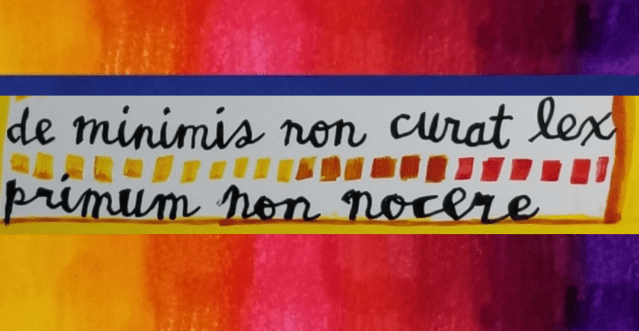
two self-evident truths

Crude calligraphy aside, we hold these two to be self-evident.  

The first means “the law does not concern itself with trifles”, a self-evident yet supremely aggravating truth to everyone fucked without a remedy at law.

The second means “first do no harm” and it is one we should all try to live by, is it not?

20180128_182125.png

Five Minutes

(Start the clock)   Five minutes is very little time, the cosmic wink of an eye.  Five minutes is a terribly long time to hold your breath.  Five minutes of an awkward pause at an emotionally fraught impasse seems an eternity too.    In reality, five minutes is enough time to express a lot.  

The missile has been launched, is landing in now 3:44 minutes.  Now 3:33.  If I gather my thoughts for thirty seconds I can stop counting down and use my remaining time for whatever may be most important to say to whoever I am with as the universe is about to end for both of us.  Saying “2:17!” adds little to the conversation, though it’s also true.

Now I have one minute and a half left, less.  It seems a good time to point out that a loving attitude is better than a hating one, almost every time.  To remember things we love is a better way to spend these last moments than terrified of that approaching warhead.   There will be a flash in a few seconds, and the end of this beautiful world.

time.

Context

Context matters greatly in human affairs.  If you have the proper context you can understand cause and effect, see what could have been done better, what could have been worse, where the argument falls short.  Without context, everything has to be taken out of context — on faith.   You are left with an unreasoning “hooray for our side!”, a collective huzzah or curse, depending on the context-free thing you’re responding to.  

Context provides nuance, detail, background, and while we may dispute the significance of certain details, without context we are looking through a pinhole.  We have a very limited ability to analyze anything presented out of context, as many things are presented, particularly in politics.  I heard a great illustration of context, I don’t recall where [1], but I’ll share it now.  

A guy is on the subway when a man and several children enter the subway car he’s in.  The man sits down and the children proceed to go wild, screaming, swinging from the hand rails, jumping on the seats, snarling, chasing each other.   The guy endures this wilding for a moment, goes over to the guy and tells him he ought to control his fucking children.  

“You’re right, and I’m very sorry,” the man says, his head down, “I’m at a loss for what to say to them right now, we just came back from their mother’s funeral.”  

Bingo, from asshole to wholly sympathetic character, in a few seconds, purely as a result of seeing his situation in context.  

I recently offered a friend an anecdote about how we often buy ridiculously oversimplified explanations as the plausible final story about something. Racist historians attacked the brilliant W.E.B. DuBois when he pointed out that their rewritten history of Reconstruction, and defense of southern apartheid as good for the blacks, was standard anti-black bullshit.   “He’s a fucking communist!” was their response, since DuBois was busy analyzing the systematic economic inequality that led poor whites to hate poor blacks instead of finding common cause with them.   Can we have some context?

The anecdote I told this friend was about our mutual friend’s view of his father’s sudden outburst of anger.   I spent many days in their house when I was growing up and this particular father took a tremendous amount of shit daily.   He took it with style and some grace, a drink usually in his hand.  His ancient widow and their son told me about a period when he was suddenly, unaccountably, berserk with rage on a daily basis.   Turns out it was a reaction to the steroids he was taking.  Nobody had told him that a common side-effect of steroids was rage.   In their telling he was sent to a psychiatrist who taught him to meditate.     Problem solved.  Suddenly the old, placid, droll, lovable man was back with his family, no more rage.

My friend wrote back that this seemed to make sense.  Mediation is a good skill to have when you’re trying to calm agitation between people.  I’d omitted the second T of meditate, leaving “mediate”.  I wrote back that he’d been taught to MEDITATE, and that meditation, in this history I’d been given, taught him to look within, calm himself and not get angry anymore.   A world of context erased in the time it took the son and his mother to tell me the authoritative anecdote and nod in agreement at the end.

Do we really not need the rest of the story to understand the incompleteness of their history?  The man took steroids for relief of a nervous condition that had long plagued him.   Medicine did not have an answer for his particular condition, though it was observably driven by stress, probably exacerbated by swallowed anger.   He was prescribed the wonder drug of the day, a steroid.   My father was given steroid shots once in a while for his psoriasis, for the same reason.   No more context needed than that the person had a mysterious emotion-driven disease, had a bad reaction to the treatment and learned to look within?  

To tell the rest of the story, give the context I’d observed many times, the widow would have had to make the difficult acknowledgement that while she took good care of her husband, she also could not resist riding him with sharp spurs whenever the mood was on her.  The son would have had to realize that the treatment his father was often subjected to in front of guests would have made anyone angry.  Based on what I observed as a boy, the guy had every right to scream “enough!”    Not acknowledging that right?   I don’t know how you can understand the man’s life and ongoing dilemma without that piece of the puzzle.  And the story the family had agreed on reduced the problem to a matter of a simple bad reaction to a drug and a wise psychiatrist teaching him how to overcome that side effect.  Easier to swallow, for them, harder for me.

Context, context.  Without it we lose the ability to analyze and depend on experts to give us insight into how we should react.   The New York Times published a critical review of Dave Chapelle’s recent stand-up special on Netflix where the comedian discussed the wave of sexual harassment that is suddenly coming into public light.   I’d watched the show with Sekhnet and we both thought it was thoughtful, sensitive, sometimes very funny, sometimes just thought-provoking.  Chapelle said at one point that women were going to have to realize that some of the men who would be helpful to them going forward in solving this shit would be “very flawed allies”.  He made many good points.  The New York Times found him insensitive, thought he was making light of a very serious problem.  

I found the Grey Skank typically tone deaf, predictably sanctimonious.  My friend who’d read the review in the Times was hesitant to watch the special, after reading the cautionary piece in the paper of record.  He thought he might read the transcript of Chappelle’s show, he told me.

I thought of Dustin Hoffman (recently accused of fondling beautiful young starlets on the set, or something like that) as Lenny Bruce in “Lenny”.  At the end of the movie, beaten down by the long obscenity prosecution he was fighting, he jumps up in court to interrupt the police witness who is reading from his notes.  The police witness is reciting his transcript of Lenny’s act, emphasizing each “fuck” and “pussy” and “motherfucker” and “asshole” as he puts the final nails in the dirty mouthed comic’s coffin.  Lenny pleads to the judge to let him just do his act.  

“This witness is mutilating my act, your Honor.  Let me do it for you, and if you don’t think it’s funny you can find me guilty right now and sentence me, I can’t afford to keep fighting this case anyway, I’m broke.  It’s comedy, your Honor, let me just…”   He is drowned out by the pounding of the judge’s gavel, threatened with being found in contempt of court, and the witness continues hacking Lenny’s routine to death.  The next shot is Lenny on his bathroom floor, finally broken, dead of a heroin overdose.  

“That’s comedy from a transcript,” I tell my friend.  No context.


[1] most likely source is a talk on forgiveness by Zen teacher Jack Kornfield