The Seven Deadly Sins

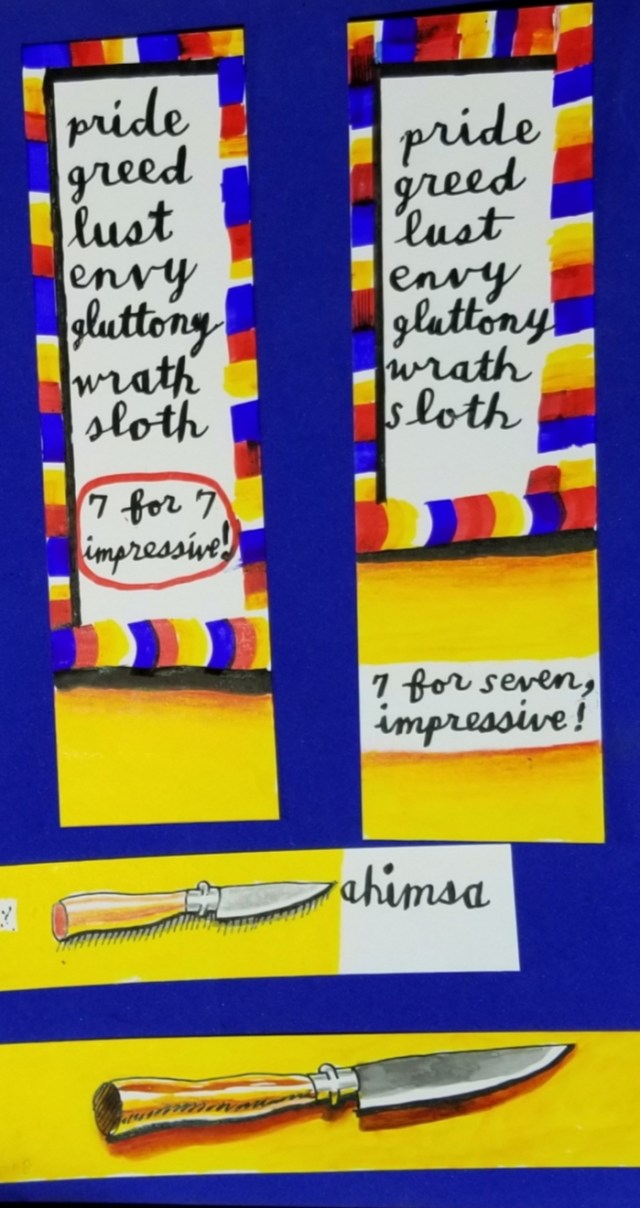
Last night I was making a bookmark for a friend I promised months ago I’d send some bookmarks to.  I’d made them months back.  A few were nice, but I’ve mislaid them here in the quivering paper quicksand in this house of constantly shifting stacks of paper.   Most had gibberish writing on them, among the colors and drawings.  I decided to use my fancy Namiki Falcon to inscribe more meaningful words on the new bookmarks.  I made one with the Seven Deadly Sins on it, for handy reference. [1]    

Pride
Greed (avarice)
Lust
Envy (jealousy, covetousness)
Gluttony
Wrath (anger)
Sloth (laziness)

Reading the list I had a minor revelation.  Below the sins I wrote “7 for 7, impressive!”

I don’t have to say any more than that, I think.  Except perhaps to state the obvious, what is lacking in someone who exhibits all seven of these bad traits.

Pride keeps a person thinking they are more important than everybody else, removes empathy.

Lust turns other people into mere vessels for gratification, removes mutuality, makes the objects of lust disposable.

Greed speaks for itself, it places the desires of the self about all else.

Envy, as corrosive an emotion as there is, is an enemy of peace and driver of malice, it keeps bitterness and ill-will simmering.

Gluttony means you will covet and steal someone else’s portion to overfeed yourself.

Wrath is the same as just being mad, fucking nuts — it is the opposite of prudence, if you think about it, since an angry person literally cannot think straight.

Sloth may be the slipperiest sin.   It means you are perpetually too lazy to do the hard work that needs to be done.

Seven for seven! You’ve got to hand it to the motherfucker.   Every cardinal sin on the list and the pious Christian right loves him.  Now that is a unique species of fucking genius!

20180518_005809 (1).jpg


[1]   The seven deadly sins, also known as the capital vices or cardinal sins, is a grouping and classification of vices within Christian teachings. … These sins are often thought to be abuses or excessive versions of one’s natural faculties or passions (for example, gluttony abuses one’s desire to eat).   source

Loneliness (for fun and profit)

The loneliest woman in the world married the most gregarious man in the world.  She told me, during the last conversation we had face to face, that at the time they met and got married he was very lonely and isolated too.   The man was a good friend of mine, and over the years I got to be good friends with his wife as well.   He was a kind, generous person, full of good cheer, an excellent host who really enjoyed company.  The time we spent together over the years was always full of laughter and meaningful conversation.    Sekhnet only got to spend a few fleeting times with him, but she immediately felt like she’d known him always.

In a vindictive turn on the phrase my father used only to make my mother tearful, “don’t worry, Evvy, only the good die young”, my friend died young.   Suddenly, stopped at a red light just off the freeway in Berkeley.   When the light turned green his passenger said “Howie…” but Howie was already gone.  His life had winked out like a candle flame in a soft breeze.

There was a lot of crying over Howie’s sudden absence, which came about a month before my long-suffering mother breathed her last breath.  I spent many an hour on the phone with Howie’s widow.  She felt abandoned by their large circle of friends, things were getting worse at work, her old enemy had been steadily climbing the corporate ladder and was now sabotaging her at every turn.   I noted at one point that I’d never heard Howie speak badly about anyone, a remarkable thing, we agreed.   We both marveled for a moment about this saintly habit of the departed and then wondered what we’d talk about, if not for badmouthing people.  

Then her complaints would continue, the treachery of those who’d always pretended to be her friends, how everyone had turned their backs on her, while feigning great love and concern.  The details were endless, the proofs she advanced very damning.  I was as sympathetic as I could manage.    

I remembered well my own mother’s loneliness after my father died.  My mother was bright, interesting, a sociable person with a great sense of humor, but my father, it emerged as soon as he was gone, had been the social glue that bound people to my mother and father.  Funny, in a way, because he always professed to be a curmudgeon who’d rather spend his time reading and my mother was the social director who arranged all the dinners and visits.  Until my father died, and the calls and visits abruptly stopped.   So I was in touch with Howie’s widow regularly, recalling how painful the isolation had been for my mother after her mate was gone.

Howie’s widow could be demanding, as I learned, shopping for and preparing the buffet for Howie’s unveiling, for example.   She didn’t always show gratitude, I began to notice, while doing nice things for her.  Over time our friendship began to feel more and more like a one way street.   Her mother, someone who’d given her a lot of grief, died after a period of dementia.   I loaned her a great book on seeing the larger picture after the death of a parent, even a difficult parent.  I wrote her a letter to go with the book.  She took the book and letter without comment.   On three separate occasions in the years afterwards she told me she’d look for the book, which she hadn’t read, and send it back to me.  I never saw my original, annotated copy of Death Benefits again.

Here is the kicker, and I notice, as it is not the first time, that a missed call is later cited as the fatal proof I didn’t give a fuck about somebody.   The first time that happened was when a former good friend, a mentally ill guy with vexing emotional problems and an unbearable amount of self-hatred, broke a promise at a very trying time for me and then left me a missed call afterwards, instead of an explanation or any kind of apology.  He claimed he’d left me a “missed call”, at any rate, my phone had no record of the call.   I was hurt at the betrayal, and angry, and didn’t return the “missed call” I hadn’t known about for several days, something that was then thrown in my face by this pant-load while shabbily blaming the emotional standoff on me, you dig, for being too petty to return a “missed call”.  That my phone recorded no such missed call was but a trifle for someone determined to defend himself at all costs.    

Howie’s widow used a similar ploy in the end to make me the asshole who’d viciously rejected her.   I had a missed call from her.  She had been calling, I learned a few days later, to tell me she was coming to New York, but she left no message, sent no email or text.  Once in New York, a day or two before she was leaving, she called to chide me for not caring enough to call her back in time.   I arranged to be available the following day, but she never called back.  I left her a message and I assume she flew off to California pissed at my betrayal.

I heard how hurtful my betrayal had been to her months later, when mutual friends were in New York.  They’d been asked to find out why I had so coldly rejected our old friend.  I told them the story and have heard nothing since from, or about, our rejected friend.

Loneliness, my friends, is a curse and often its own reward.  This woman is very active on Facebook.  I am not, in fact, I hate that shit, for too many reasons to list here.    Another mutual friend called to give me shit a few months ago for missing his mother’s funeral.   I told him how sorry I was, that I hadn’t known his mother died.   He told me it had been on Facebook.   He then gave me some grief for not being a good friend to Howie’s widow, now almost ten years after Howie’s death.   I explained, but it was no use, he wasn’t buying it.   Most likely she’d announced on Facebook that she was coming to New York, but I was too much of a self-absorbed asshole to even check her Facebook page from time to time.   He told me he’d call me back the next day, and that was the last I heard of him.

Loneliness has been monetized, friends, if you want to verify how much, just look up Mark Zuckerberg’s net worth.   I was recently at a free dinner Sekhnet had RSVP’d to attend, hosted by some financial company.   One of the speakers flashed a slide and mentioned the FANG stocks, very valuable positions in any respectable portfolio. I glanced over at Sekhnet who gave me a sly smile at the term FANG, which encompassed some of my most hated mega-corporations.    The slide showed the logos of Facebook, Apple, Amazon, Netflix and Google.  

Every FANG stock is part of the increasingly monetized loneliness of our digital world.   Don’t go to a store, or even talk to anyone on the phone, order shit from your computer, have a slave deliver it to your door for free.  Use a device that marks you as a cool person with money to burn — sure, you can buy cheaper versions of the products Apple sells, but you can’t be COOL if you do.  Don’t interact after work, go into a cocoon, chill and binge watch shows without commercials on Netflix.  Down the fucking list of FANGS.

One of the many reminders, this apt acronym, of the vicious power of loneliness to drive commerce and finance a comfortable retirement, if you are properly positioned with FANG to do so.  God bless these United Global States of corporate personhood.  


Who gets to tell the story?

The cliché that history is written by the victors, as a rule, is hard to dispute.  We have to be a little careful about oversimplifying the categories of winner and loser, though.   Take the history of the American Civil War.   A generation or two after it ended the daughters and granddaughters of the great families of the South, the wealthiest families, the “best” families, in the popular parlance, became very concerned with how history would remember their glorious families.    An influential school of historians arose, largely supported by these well-born gals, who told the story the way they preferred it: a glorious history of high principle and protection of an inferior race who became predictably savage when liberated from the protection of their former masters.    

It may also be said that this history, written in the late 19th – early 20th century when most of the Confederate monuments were being erected to the heroes of the violent rebellion against federal tyranny, gave a moral fig leaf to a new generation of American racial terrorists.   The history is only now being written of the long, bloody decades of lynching and intimidation that went along with this sanitized, glorified version of the antebellum south and the Civil War.   It became cool, and often politically smart, for glory-seeking white racists to become “knights” in the Ku Klux Klan, membership soared nationwide after World War One.  Nothing like a good old-fashioned beating, mutilation and death by torture to remind everybody of their places.  The lessons of this brutality, even as it was most often kept a local secret, were not lost on anyone.

Who gets to tell the story?  In American politics mass media pundits (even drug addled ones), with no background in anything but self-promotion, are more influential than our most well-read, well-spoken, deepest thinking scholars.  Put the scholar on one side, a defiant blowhard on the other side, and America gets to watch another egghead get put in his fucking place.   It is a kind of thought crime here, basing your thoughts on too many fucking facts.  Fuck you and the fucking facts you rode in on, asshole!  You think you’re better than me just because you’re smart, and devoted to knowledge, and actively seeking facts and something you claim is truth?  I got your truth right here…

 Who gets to tell the story, even in your family?  Put any spin on it you like, dismiss the version that makes you feel bad.   No need to ever feel bad, just write anything bad out of history.  See how simple it is?     Most people I know, like my highly intelligent, idealistic father, eventually give up after enough time banging their head against the imperatives of our frequently merciless world.

I wrote the book about my father.  Not yet a book, it is a collection of stories and conversations, evoking the times, conflicts and the complicated spirit of a gifted man who did not fully enjoy his gifts, who died full of regrets.  More regretful than angry, even at himself.  How’s that for a deathbed surprise, dad?   The lifetime of rage and denial yields to the reality that death is hours away, your thoughts became more and more focused on how you missed out on the most beautiful parts of the ride your gifts might have otherwise provided you.

 “Oh, give it up, Elie!” says the skeleton of my father.   “Better to go through the hundreds of pages you’ve already written, picking likely lottery winning passages, pasting them together into a scroll.   Your lifetime of rage and denial will end in your own terrible regrets, when death is closing in on you, that you never managed to sell your book, be interviewed by Terry Gross.  I hear your man Leonard Lopate got canned for some likely sexual impropriety or other, so you missed that boat.   Keep paddling, Elie, is all I’m saying.”  

Righty-oh, dad.   I remind myself, while I’m wondering about who gets to write the stories we all come to believe, that there are many ways to see a given thing, a given person.   Not to say that every point of view is equally valid, equally interesting, equally revealing.  Can we separate a devoted Nazi’s beliefs from his watercolors?  I mean, the guy may have been a supremely gifted watercolorist, a regular Winslow Homer, but he was a major fucking Nazi.  A Nazi, dude, those beautiful watercolors were painted by an officer in the SS.    Nazi watercolors, dude.   Ain’t dassum shit?

The best artist I ever knew, a few nights before she died, expressed this very clearly.  She had no truck with Nazis who were otherwise very artistic people.

Selections for Sheila

My second cousin once removed, Sheila, recently asked me to send her what I’ve written about my father.   Sheila was always treated to the best of this likable man, his irreverent wit, his intelligence on every subject of consequence, his charm, his idealism.   I told her I’d send her a link to the 1,200 pages I’ve written in my two and a third year wrestling match with this gigantic subject.    

Then I thought better of it, picturing her struggling helplessly in that dense jungle of unorganized prose, and began going through the unwieldy manuscript, making some selections, almost at random, to give her a picture of the whole project.  I saved a 53 page chunk as “Selections for Sheila”– served with the personal touch, don’t you know?

She wrote back to tell me she liked what she’s read so far, though much of it was painful to her.   She’d had only the most generalized idea of the darkness in his early life and no inkling of the dark side he often retreated to in the company of his wife and children, the overarching tragedy of his life.  

I’ll refer you back to that post a few days ago for my thoughts on writing, why, and how and what for.   Bukowski wrote a great poem about real writing that is hard to argue with.   It is not the praise of another reader that makes a piece of writing worth reading, it is the writing itself.  Writing with passion and care is its own reward, sickening as that also is to say in a world where so many empty, ill-considered words are churned out by people well-paid to churn the vomit out, often with the help of ghosts who do the real work of making popular, bankable idiots sound relatively intelligent.   That said, having a reader or two who gets what you’re trying to do, appreciates the work involved– priceless.  

After I sent it off I looked over the Selections for Sheila and immediately wondered where a few important stories were.   At one point the manuscript had a table of contents and an index, to help me locate things.   That was hundreds of pages ago, I couldn’t keep up with the administrative tasks associated with the writing– the pages piled up too fast.   OK, I am… how to say?… I don’t like certain kinds of hard work.   I can work for two hours or more taking rough edges off a few paragraphs, increasing the clarity of what I am saying, adding an illustration where it will help the reader see something I haven’t been able to make clear enough.   To some people this kind of work is unthinkable.  To me, most other kinds of work are unthinkable.  

I am not anti-social, I like people, for the most part, enjoy interacting with people (animals too, for that matter).  I am open to people, let me say that.  I spend most of my time alone.   No single thing is as important to me, or makes me feel more like myself, than the time I spend by myself, focused, concentrating on making something as clear, or elegant, smooth or rough, as I can make it.   Craft has become one of those quaint notions in our fractured tabloid culture, but hold a beautifully finished wooden spoon in your hand once in a while, run your fingers over it, and you will feel what I am talking about.

I’ve always loved that Chekhov story  “The Bet.”   Chekhov wrote it when he was 28 or 29, a young man already two thirds of the way through what would turn out to be a short life (he died at 44).  Read it yourself, (click here) if you haven’t, it’s quite short.   The bones of the story:  a wealthy banker bets an idealistic guy who claims to love life and the pursuit of knowledge above all else two million dollars that he can’t stay locked in a room for fifteen years without any human contact.  The idealist takes the bet, on the condition that he can have musical instruments, books and writing materials brought to him whenever he asks.   He suffers terribly at first, constantly playing the piano, then learns several classical languages, reads the classics in their original languages, he studies a wide range of subjects, including the collected wisdom of the world’s religions.

I’ll save you the spoiler alert, in case you haven’t read that story, but I have always related to that character Chekhov created.   The banker is just the crass way of the material world, the pondering reader is the soul of the human world.  It doesn’t embarrass me to make this simplistic statement.   I am already too far gone.  

I am now collecting pieces for Selections for Sheila Two.  Hopefully one day a literary agent will be moved by an unsolicited packet of pages culled from those selections.  The agent will skillfully introduce my pages to some corporate person I wouldn’t piss on if they were on fire.  I won’t have to piss on them– they’ll give me money instead.

Now, back to collecting pages for Selections for Sheila part two.

Nuance, Context and other quaint notions

There are knee jerks that are almost impossible to resist.   Those knee jerks, now amplified and encouraged by our own private on-line and mass media cheering sections,  rule our world today, certainly our politics.  Right is right and evil is evil and if you try to defend evil I will swat that shit away and wag my finger like Dikembe Motumbo under the basket, as your shot winds up in the third row.   Don’t try that shit in my house!

When I hear somebody say that  God told them to do something, and that thing is bombing a water filtration plant and hospital in a far away land (because the dictator of that land is a modern-day Hitler), causing children to die along with their elders, my knee jerks.  That kid in Florida, Trayvon Martin, when the vigilante with the gun stopped him, whatever the guy with the gun may have said to him, why didn’t the black kid just say “yes, sir.  I’m up from Miami, visiting my family, sir” and get to live another day?  Knee jerk.   When the president does what he’s on record as saying his predecessor was an idiot for considering…. boing, there goes the knee.

Flash the cards, there is no shortage of them.  Abortion: murder of a human soul or a hard choice in a situation where an unwanted child will otherwise come into the world to live a life nobody would wish on it     If you believe God said abortion is murder, that’s the end of the story, bub.  It’s murder if the fetus was put in a thirteen year old’s womb by a rapist, or by the coercion of a sleazy, criminal relative.  Murder if they held the girl down and took turns punching her and raping her.  Murder because, every soul was created by God and the soul comes into being at the moment of conception, because God loves every soul.  

True believers are hard to have a conversation with.  There are no facts you can put forth that will allow them to see things from another perspective.  I’m not singling out hypocritical Christians, doggedly defending the rights of fetuses while letting the little unwanted newborn fuckers fend for themselves.   I am just using rigid religiosity to illustrate this larger point about belief that is impervious to discussion, nuance or context.  We all believe what we believe and we justify those beliefs according to our ability to rationalize.    

I am floundering today, as I try to make this vague yet obvious point clear.  If we omit nuance and context in a discussion, we are just talking opinionated shit at each other. Nuance is the first casualty of absolute moral certainty, any sense of a larger context is killed at the same time.  Not to say there aren’t principles worth fighting for– personal integrity is one, it seems to me, but even there, choosing your battles is very important.  This black and white, red and blue, us and them world we live in is the divided, divisive hell it is for many reasons.  High on the list is a massive failure to acknowledge nuance and context, particularly on the other side of our own beliefs, when talking about particular issues. 

I was surprised to learn, as I was writing a long manuscript about my father’s life, trying to draw every lesson I could from his tragic example, that it is possible to identify with the feelings of a desperate, trapped woman who viciously takes it out on her baby.   The feelings, I say, not the actions.  It’s impossible to identify with the actions, I think.  The actions are despicable, whipping a baby in the face, there’s no defending that.   The feelings, odd to realize, are quite readily understandable.   That’s some fucking nuance right there, dear reader.  Let me try to make it as clear as I saw it that day.

A relative I never met, who was portrayed to me only as red-haired, tiny, very religious and with a terrible temper (also a great cook), turns out also to have whipped her infant son in the face, regularly.   It was part of her daily routine, breaking this toddler’s spirit.  I always assumed she was a psycho, which she most likely also was.  But one day it dawned on me, how tortured this woman was when she began taking it out on her first-born son.    It doesn’t excuse what she did in any way, but it sheds light.  Light is the only antidote to darkness.   It shows a path out of what she was trapped in, even if one didn’t exist for her in 1926 when she began her lifelong persecution of the boy she called “Sonny”.

The man she fell in love with was driven away by her brother and her sister-in-law.  It was nothing personal for them, nothing against the young man who loved her.  It was strictly practical.  Her marriage would have meant the loss of their indentured servant and they weren’t ready to give up their live in maid.   Years later she was forced into an arranged marriage with a man who seemed to be brain damaged. He’d been knocked in the head many times by his own angry step-mother and nobody will ever know if this deadpan man who died young was brain damaged or not.   He couldn’t make a living.   They lived in a filthy, teeming slum, the Lower East Side of Manhattan, in 1922.   Every day the woman woke up to this horror.   Somehow she got pregnant.  The baby girl died shortly after she was born.  

At some point the heartbroken woman got pregnant again.   This time the tiny woman gave birth to a gigantic son.   We can imagine the pain of this childbirth.   The baby looked exactly like the idiotic husband who had knocked her up.   He looked at her with that same dopey expression.   One day the woman snapped, whipped the baby in the face with the thick, heavy, burlap wrapped cord of her iron.   It apparently felt good.  Maybe the only thing in her life that did.

I’m not being a lawyer for this evil mother.   We’d like to think a mother like this today would be in the hands of an excellent psychiatrist.   That her child would be getting help recovering from his trauma.  But what I’m digging for here is Nuance.   Not that she’s in any way right to act in this vicious way, but in order to understand her pathology, on the way to hopefully making life better for all involved, we have to fully know the context of her actions.

I rattle on about this subject tediously often, I’m aware.   We live in a world where every message we get, every bit of news, is curated, structured to support one polarized point of view or another.   It is extremely rare to get the full story about anything, from anyone.  I am always looking for a way to make the point about nuance and context that is not partisan.  I do this animated by the Anne Frank-like faith that most humans, in their hearts, are not haters.   That we are all basically good.

I believe this even as I hate any U.S. president who rains death on people who have no power to do anything but agonize and die, or if they manage to survive, fear and hate.   Few problems have ever been solved by the application of massive deadly force, whether you call it “Freedom on the March” or by any other high-sounding name.  It is of course business as usual,blowing shit up is a driving force of capitalist profit making.  

I felt a surge of hatred when Bill Clinton sent missiles that blew up civilians, destroyed infrastructure they needed to survive.   That same hatred surged through me when George W. Bush ignored millions of us marching in the frigid streets and launched “Shock and Awe”, later declaring victory and lynching Saddam after shooting his two hideous sons in the street like dogs.   As for the massive civilian deaths?  Killing civilians is now blandly called “collateral damage” nothing to get excited about, certainly no war crime, you have to break a few eggs to make an omelet.   Barack Obama’s extrajudicial murder of the radicalized American cleric Anwar al-Awlaki and his teenaged son Abdulrahim a week later– same deal, along with all the other deaths our recent president inflicted on unknown brown people on his secret kill list.

Can we have some fucking nuance, a little context so we can discuss these things intelligently instead of just using force to kill things like Terror, Evil, Haters of our Freedom?  Our previous president told us we were looking forward, not backwards at the architects of  our recent crimes under international law, you know, because we are, uh, taking the high road.   To be totally honest, we tortured some folks, what are you going to do?   Good folks doing some bad shit, with the best of intentions.  

Make American Great Again.   Hope and Change.  Make America Great Again, again.  The slogans change, a few of the proponents of government violence change with each administration, but the song remains the same.  Fuck nuance, fuck context, it feels good when our leader bombs the shit out of some fuckers who might very well be evil.  If nothing else, they really do appear to hate our freedom.  Even pundits who usually seem to have a reasonable grasp of world affairs go momentarily gaga when the president blows some shit up with a huge show of force.   It doesn’t seem possible to me that we are a nation of such stupid motherfuckers.

The evidence is not strong that we are not, but I am always digging for it.


Shout out to invisible friends

The people we know are the people in our family and people we’ve met by chance, gotten to know, kept in touch with.   For most, this is a fairly small circle. Back in the old days, as in more primitive societies today, kids were raised by an entire village, knew everybody there.   The psychological advantage of this is easy to grasp:  the odds of knowing someone attuned to your particular personality are much higher, I would think, when you know everybody and have known them since you can remember.   

Today, here in the West, we keep in touch digitally, with little electronic messages, birdbrained tweets, posts on Facebook walls.   In law school a classmate used the term Cyberia to describe this void where we often exchange our modern intimacies.  I don’t know if she coined the phrase, but it’s a pretty good image.   A vast stretch of darkness, and coldness, with little blips of this or that, personal messages coming through, dinging our phones nowadays.

Luddites are always among us, and I am not disparaging this latest technology, even as I see some inhuman tendencies in it.   It has always been this way with new technologies for communication.   I’m aware that people were aghast when the printing press came in, convinced that it would ruin interpersonal communication. The telephone must have alarmed people who were initially horrified by a mysteriously disembodied voice in their ear.  I’m sure there were people railing against the radio, the way it turned everyone’s attention to disembodied voices coming through a speaker, mysteriously in the house via wireless waves.  

It must have been scary to some, being in a room full of people who in earlier times would have been talking, reading to each other, playing musical instruments and singing, now passively sitting around, wholly focused on a box.  TV, same shit.  These days we have the internet in our pockets, and on a day when I wake up and the monopoly that provides my internet service is asleep at the switch and I have no internet connection, I truly feel cut off.  Hanging precariously in the world by my cellular phone.

Way back in our hunter/gatherer past, every individual had to know pretty much everything.   This was before the agricultural revolution, when people could do one or two repetitive jobs for the planting, growing and harvesting seasons, and eat every day without knowing everything about the world around.   The early homo sapiens individual had to know which plants were edible, which were deadly.   How to make clothes, tools, weapons, how to stay warm, how to find water, how to make fire using flint and sticks, how to not die from a wound, how to survive a blizzard, a heatwave, a snake bite.

In our increasing specialization as a species we have produced millions and millions of individuals who can survive knowing very little about the world aorund them.   Everything we need to know is on our phones, available in seconds, as long as the power grid is up and running everyone is cool, we are all geniuses.  This diminution in general knowledge of the world is one price we’ve paid in becoming a consumer society.   Our main value is consuming, having the coolest shit, the best brands, the things that make us momentarily forget we are all connected to whatever happens on our planet.  Buy a nice car and for a few days drive around with no thought of death, disease, global climate catastrophe, the enraged Tweeter-in-Chief angrily preparing for the next senseless, endless war.    

An old woman is on her deathbed, waiting for death.   She is in and out of pain thanks to the medicines now available.   Her grandson hears her talking to somebody, goes into the room– there is nobody there but the dying woman.

“Who were you talking to, grandma?” the boy asks. 

“I was talking,” the grandmother begins to explain, but she is too out of it to explain.   She was talking because we humans need to talk, need to connect.  If there is nobody physically available, we will write a letter, or today, a text or email.

“Who the fuck are you talking to?” a demon asks me pointedly.

Same answer, motherfucker, I tell the demon.


The truth, the whole truth and nothing but the truth

I learned, at an otherwise soporific session on legal writing many years ago, that in the old days lawyers had their writs, complaints, answers, surreplies, etc. written by scriveners.  These professional scribes had elegant handwriting and were, one won’t be shocked to learn, paid by the word.  

So much of the seeming double-talk in the law, the endless legalistic quibbling, caviling, carping, signifying, distinguishing, synonym stringing, de-empahsizing, re-emphasizing, privilege-preserving, seemingly redundant, overstated, reiterative language in traditional legalese was the work of these craftsmen.   “Do you promise to tell the truth, the whole truth and nothing but the truth?” is more than twice as many words than “do you swear to tell the truth?”.   Cah-ching, scrivener!

But that’s not the only reason for the development of legalese, of course.  Make something complicated, convoluted, meandering, equivocating, jargonized, specific, obfuscating enough et, voila, half of your problem is solved.  

If half the country hates slavery, do not ever use the word in the founding document that preserves the right for those who love having slaves.  No “slave”, “African” “chattel”, “servant” or any other straight forward reference in the Constitution to the slaves, from Africa, who were regarded by the law as chattels, unpaid servants for life.  

Instead, in three or four discrete, discreet clauses, we read of “other such persons as the states shall see fit to admit” and nonchalant, misdirecting yet precise, legally-binding phrases like that.   You can feel better that the word ‘slave’, or even some of the horrible things these forced laborers were called, is nowhere near our sacred founding text.   Even as, of course, the legality of slavery, and its enforcement under federal law, received irrefutable, iron-clad federal protection in that same discreet document.  

We are, and have always been, a nation of laws and freedom under those laws, notwithstanding the 3/5 of such persons– and it goes without saying we use the term ‘persons’ in its broadest sense — who come into play for apportionment in Congress for grossly underrepresented slave-states (majority slave state, in the case of South Carolina).  The devil, yop, yop, in the damned details.

OK, this has been my typical ‘why I hate our freedom’ rant and you are well within your rights to treat it as such and click over to something more uplifting.  The point I am driving at today is not our national tic for concealing truths that might make millions of our citizens angry enough to rebel, it’s personal.

I recently took down some fiction I’d written and posted here, realizing that if certain parties read this work they would see themselves and feel violated, angry, perhaps even vengeful.   When a person guards a humiliating secret, which each of us has every right to do, any reference to that secret is easily seen as a betrayal.  

I once wrote a line that infuriated a very wealthy man living, closeted, as a salt-of-the-earth working stiff, by writing “it’s not as if he needed the money.”   This was construed as a betrayal of a secret he had kept from me, something I could only have learned from his ex-wife, which was how I’d inadvertently heard it.   She described a $75,000 settlement of their divorce, which I called generous when she told me about it about 30 years back.  She laughed, and agreed it was generous, although, possibly not quite as generous in the context of her ex-husband’s fortune of more than $20,000,000.   The whole thing was humiliating to him, the poisonous reference to him “not needing the money,” and my mention of these facts here, where any member of the public can theoretically see them, was an unforgivable, final betrayal, even if he was never mentioned by name.  I get that.

I am not in the habit of violating confidences.  If somebody tells me something in confidence, I will never break that trust.  I can think of many examples.   All we have is our word and our good name.  Which reminds me of something my old friend the judge told me once, on the Triboro Bridge.

I’d just purchased an iPad, which I was integrating into my student run children’s animation workshop.   We were driving along and I was using the iPad’s video camera for the first time, filming the trip.   We were chatting when suddenly the judge turned to me and asked me if there was sound on that video I was recording.  I told him, now that he mentioned it, that there was.  Our talk was being recorded, although that was not my intention when I started filming.  He told me to shut the video off and erase it, that he didn’t feel comfortable with our conversation, which he hadn’t known was being recorded, being preserved in perpetuity.  He got quite exercised about it, actually.  I assured him I had no intention of playing it for anybody and then he made a good point.

“At the moment you make a promise like that, it is inconceivable to you that you would ever betray my confidence.  That’s why contracts are drawn up when the parties are friends, with protections built in for after their falling out.   Provisions against non-disclosure are not made for when everybody is on the same page and getting along great.   They are for the day when the parties are no longer friends, for the day they are adversaries, in fact, looking for evidence to use against each other.”

I assured him that once I had extracted the video footage, isolated from the sound, I’d delete the original, with our conversation on it.   As it happened, not that long after that ride, we were on shaky ground as friends and soon after that completely estranged.  

Here’s the morally sticky part.  A loved one tells you they were threatened with particularly violent death by a husband with a long history of road rage, speeding tickets and petty crimes, including embezzlement, credit card fraud, shoplifting and who knows what else.  You are not told this in confidence, your loved one is shaken and upset when the details pour out.  You hear the same story from another party involved in the drama, which involved multiple murder threats.   Later you are told you may never speak of this.   There’s your moral quagmire for you.

The children of that couple?   Do you have any obligation to them?  

Clearly, I am wrestling with this constantly.  I think part of the reason it is a bone crosswise in my throat  is the frustrating world we live in now, our general powerlessness in this corporate age.   We live in a world run by the corporate imperative: admit no wrongdoing, cite the plain language of the contract, construct hoops for someone with a complaint to jump through, restrict options available to the aggrieved, condition any settlement on nondisclosure.   In politics it is the same: never admit fault, stick to your theory of why you were justified, state your talking points, pivot, constantly, away from any responsibility on your part, repeat talking points.

When a personal connection resorts to this intolerable bullshit more than once or twice, it may be time to dissolve the apolitical bands which have connected you.  It seems self-evident; you cannot depend on a person who routinely lies.   Depending on someone who will say whatever they feel is necessary under the circumstances is like depending on a person like Donald Trump to take the moral high road.  

“That high-road you moral fucks talk about is for you high-minded assholes to walk on, it’s a road for fucking losers.  I walk on the winner’s road, it is very smooth, and padded to be gentle on the joints, and downhill all the way.  All other things being equal (LOL!!!)  I’ll take my regular road against your moral tight-rope every minute of every day, asshole.”

If you have a problem with any of that, take a fucking chill pill and dummy up.  Word to the wise.
 

Individuals part 2

It is good to remember that individuals, while generally better than members of an enraged mob stomping off to do something atrocious, are still individuals, subject to immense variation.  I was reminded of this two or three times after I wrote yesterday’s feel good piece.  

The sympathetic woman who took my initial call about a brusque postal supervisor who gave me a polite “tough, fucking shit, sir” when I complained my rent check had been inexplicably returned to me, and the equally nice woman, a Ms. Linton, I was later informed, who fielded my follow-up five business days later, were two very decent individuals.   The first, whose name I did not get, was not, as it turned out D. McNeil, the woman who was out to lunch when I spoke to the second kind individual at the Postal Inspector’s.

Ms. McNeil knew nothing of my complaint, her name had simply been on the automatically generated email that had been sent to me confirming that my complaint was being seriously investigated.  She confirmed that it was being investigated at the local level, by the person best suited to evaluate it, the brusque postal supervisor in question, who now had my confidential complaint in his hands, with my name and address.  

Ms. McNeil knew nothing of the case, put me on hold to read the case notes.  Five minutes later she was back, still not sure why I had wanted a return call from her.  The case had been ‘escalated’ to the individual post office level.  I asked her what the sense was to have my complaint in the hands of the man who had created the problem when, instead of being helpful, gave his tour de force of super-cool tough guy customer service.  She sort of agreed there was only a limited point to him investigating himself.

Unlike the others, Ms. McNeil didn’t bother to apologize on behalf of the Post Office for this Clint Eastwood-like customer relations specialist, though she did agree that it would have been better customer service to have told the customer holding the mistakenly, inexplicably returned rent check, “this should not have happened.  I will put it on the truck now and your landlord will have it in two or three days.”   She said it would have been better if he’d said something like that, instead of handing me a fake complaint number to call, instead of crossing out the barcode so the idiotic mistake would not be repeated.  She agreed that had he said that an apology of any kind would have been unnecessary.   She asked me wearily what I expected her to do at this point.

“For starters, I still want the Post Office to deliver the rent check they’ve returned to me twice,” I told her.  She explained again about the bar code, how it had to be crossed out and covered with a label.  Sadly, there was no guarantee it would be delivered this time either.   She then mentioned the original idea I’d had– have the post office put the thing in another envelope, readdress it and send it again.   Ms. McNeil liked this idea.  Eventually she told me she would ‘escalate’ the complaint, sending it to the area supervisor, the person to whom all branch supervisors answer. I asked for the email address to send my photos of the twice returned envelope.  She placed me on hold.   While holding I was treated to an endless stream of upbeat ads about the many unbeatable services offered by the Postal Service.   I listened, for as long as my patience lasted, which was about three minutes.  I hung up and dialed the number I had for D. McNeil.  

A pleasant recorded voice told me the person at this number had not set up their voicemail and then announced I would be transferred to a representative to assist me.  There was a beep, then another recording.  It said “your session cannot be continued at this time.  Goodbye.”

Twenty minutes later Ms. McNeil called me back with a fax number where I could fax all the photos I wanted.  I told Ms. McNeil I’d gotten rid of my fax machine years ago.  I asked again for an email address.  She sighed, having no idea why I was being so difficult about these simple things.  She was sure they probably had an email address, would I like to hold while she searched for it again?

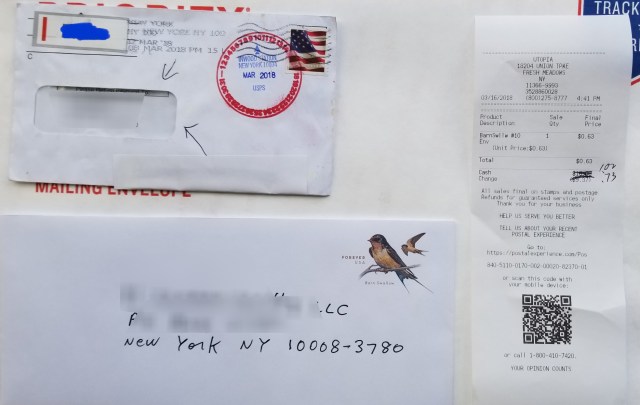
I thanked her and walked over to the local post office.  The two Chinese American clerks there had always been very nice.  But all the one I spoke to told me is that she could cover the bar code, send it out for sorting again and hope for the best.  “But,” she told me in strongly accented English, “some Postal employees do not do what they’re supposed to.  You can never tell.”   As for putting it in another envelope, they had no such envelope, I had to go to the main post office for that service.   She agreed it wasn’t fair to make me pay more postage for another envelope, the only option available.  Then she looked at me with intensity and said “But if I give you envelope I have to pay, nobody pay me for the postage.  You think that’s fair?”    I didn’t.  They had no supervisor available at their little Utopia Branch (heavenly though the place otherwise is.)   The two Asian-American clerks regarded me seriously until I agreed it wasn’t fair that one of them should be forced to pay.

I had a sudden thought that none of this was fair.  Our fucking world is off the fucking rails, every business we encounter here in America, with rare, beautiful exceptions, is managed from the style book for psychopaths.  I bought the envelope, it cost me 63 cents.  I paid in cash.  I  addressed the blank envelope and re-mailed the twice returned rent check to my landlord.  I apologized to the wide eyed clerk, who had begun staring at me, seeming truly hurt by how I seemed to be making such unfair demands of her.  When I handed her back the envelope I said “thank you, ma’am.”   She smiled.  I walked back into the sunshine trying to get over the feeling that I had been successfully pissed on, for more than a week.

20180316_200343.jpg

“Greeked” for posting on this website.  The envelope was addressed as neatly as circumstances yesterday allowed. 

Peace be with you.

How we force you to lose hope

Government, increasingly the mechanism by which wealthy corporations, and individuals, make sure their profits are robust and their schemes unhindered by things like regulation,  accountability or prosecution, has learned tremendous customer relations lessons from their canny corporate cousins.   We have come to expect as little protection from our government as from the makers of very expensive toxically produced shit.  Right wing extremists have exploited, and whenever in power exacerbated, this disaffection with our own democratic government, now seen by so many as the enemy instead of the protector of our liberties.  Such forces find it easy to crush problem consumers/citizens.

Check out this example of the fiendishly simple means by which hope for correction of even the simplest error by an institution is snuffed out, routinely, for people without power who appeal to the institutions available for relief from mistreatment.

I got snotty treatment from a Post Office supervisor.  All he had to say is “whoa, that’s a mistake, that letter should have gone to the office it’s addressed to, not to the return address it was sent from.  We’ll fix it, it will be where you sent it in two or three days.”   Not even a ‘sorry’ needed.  “Sorry” is a word that our winner society has made the exclusive domain of weak losers who have no choice but to apologize.

Instead of a reasonable response to a postal error you get, giving him the benefit of the doubt, dismissal from a tired, testy civil servant who doesn’t like the tone of the disgruntled customer.  It’s not his fault that the customer waited on line to be jerked around for an excruciating five minutes by an extremely dull, monosyllabic postal clerk before being passed on to him.   It’s not his fault the letter was returned to the customer without explanation, instead of going to the clearly printed address on the properly stamped business mailer.   None of this is his fault, yet he is taking the full heat for a postal system that sometimes simply just fucks up.   Doesn’t like the way this dick of a customer is making demands, relentless, unsatisfied with the explanation of machine error and his noncommittal shrugs.    Fine.  “No guarantee it will get there this time either, SIR, (the s-word) we’ll just have to hope for the best.”

The customer goes home angry, and finds a federal agency to complain to.   The person he speaks to there seems to be very concerned with the story of the poor treatment the customer has received.    He should not have been handed a complaint number that does not allow a complaint to be made, particularly after the brusque treatment of a customer who had every right to complain.   Especially since there was no explanation given for the illogical return of the letter, except machine error, “shit happens,” and no guarantee given that it won’t be returned to him again.  Not to mention the sly “fuck you” of the fake complaint number.

She promises the customer an investigation, gives him the case number and tells him a report will be emailed to him in 2-4 business days at which time he’ll be able to follow up, if necessary, including emailing photos of the canceled, improperly returned envelope.

Sure enough, two business days later, this email arrives:

Updated information regarding your recent inquiry (Case ID:137194142) (KMM50585860V79654L0KM)

Dear Elliott Widaen,  [got the tricky last name right, but misspelled the first name, one L, one T]

This message is to let you know that we have received your inquiry at the Post Office. 

After we review and investigate the information you have provided, we will contact you and work with you until the case is resolved. 

Thank you for letting us know about this issue.  We look forward to serving you. 

Sincerely,

Your United States Postal Service

D. McNeil
Consumer Affairs
(212) 330-3667
NYDistrictcao@usps.gov

PS: Please do not reply to this message as this email address is not monitored for responses.  Your privacy is important to us.  If you would like additional information on our privacy policy, please visit www.usps.com.

Ten minutes later, a US Postal Service bot sends this update:

In order to better serve you, your recently submitted inquiry was forwarded to an office that is better suited to address your needs. It is being investigated and you can expect a reply within 2 to 4 business days.

Which office?   Where is this office?   Who?  What?  Why?   Mysteries to be answered within 2 to 4 business days, if all goes well.  

The following day the original envelope with the rent check to the landlord, being sent a twenty minute truck ride from the post office it was returned to, arrives back in the customer’s mail box.  The issue very much not resolved.

You figure, for fifty cents I can put this small business envelope into a standard sized envelope, address it by hand, put a stamp on it and mail it from another part of town. Maybe the postal workers there will not have all been lobotomized, or addled on opioids, or drunk, or willfully assholic, or whatever the problem is when such a simple, routine task is not done properly.  A fifty cent stamp and done.

But for somebody like me, raised by an angry asshole, sensitized to that asshole reflex to testily shift blame to the person mistreated — hard to bite the bullet and do the easy thing.   On to another post office, in another borough (have to go there for something else tomorrow anyway), where everyone has been very nice so far, and humbly make what should be a relatively easy to make case that I have not received the service I paid for.    I’d like them to put it in another envelope, with explicit instructions to deliver it to the address it is addressed to and not, mischievously or imbecilically, to the return address.

This reflex to get some kind of just result is also part of how they break you like a fucking twig.    I don’t know exactly what to do about this reflex, but some part of me believes that once it is neutralized, in enough of us, the Klan will be marching down the main street of every town again, making America great again, like they did when my father was born, in 1924, at the height of their national power, 4.5 million proud members strong.