Cause and Effect — senseless brooding or productive musing?

I have been wrestling with a difficult issue for many years now, my seemingly all but final estrangement from two people I was always close to. Their loss was a kind of ‘collateral damage’ resulting from the demand to hide someone else’s well-founded feelings of shame.

Seen in the worst light, my constant return to this painful subject is what psychologists call perseverating, self-inflicted pain from regretful preoccupation with an ultimately insoluble tragedy, the neurotic need to constantly relive the past suffering that caused deep wounds.

Seen another way, the way I prefer to see it, I’m searching for an elusive solution to an ongoing tragedy. I’ve been turning the evidence of our estrangement over in my hands, looking at it from every direction, shining light on it from every angle, seeking a creative solution to something important to me, an inventive idea that has been evading me.

Last night I thought of two questions, one for each of them, that sum up my long musings, without divulging anything of underlying shameful events to anyone involved.

They are a sister and brother, the girl a history buff, the guy a poet and a fiction writer. Sadly, I lost touch with them over the last few years. My intermittent attempts to maintain the relationships are finally met with mostly silence. Yesterday, while thinking about something else, I stumbled on a final question I could ask each of them. If I had only one last question to ask, I think it might be these (note the lengthy illustrations to the historian’s question).

To the young historian:

Q: Is history the fact-based inquiry into the nuanced reasons events and trends happen in human society, pursued to give us insight into the challenges of the present and the future? Isn’t the alternative to factual history propaganda, a false narrative supporting a pre-determined outcome?

Historical narratives emerge to make sense of the past. From earliest human history people were strategically erased from memory. In the days of the Pharaohs the new dynasty would send slaves to scrape the faces of their predecessors off the tomb walls, fucking them in the afterlife, erasing them from history. This is an ongoing pattern in human affairs.

When Germany lost the first World War certain Germans came up with an infuriating myth, The Stab in the Back — the victorious German army had been betrayed and humiliated by treacherous enemies who would be made to pay with their lives. The endlessly shifting narratives of history often swing wildly between opposite interpretations. A school of history will hold forth its theory — insist and largely prevail for generations (like the Dunning School at Columbia rewrote the history of the Civil War) inverting the previous understanding. In the case of the Civil War, the revisionist early twentieth century history (influential for decades) held that the Confederacy did not secede over slavery, that in a real way they never lost the glorious war to preserve their way of life, that the people they massacred were the real traitors to the Constitution.

We are watching a historic battle for the soul of history at this fascinating, scary moment in history. The recent riot at the Capitol, the ascendant far-right tells us now, in one voice, was done by leftists posing as Trump supporters, to make Trump look bad after they stole the election from him.

Isn’t inquiry into the facts of what actually happened in the past the crucial work of the historian? Isn’t good history the business of making the often irrational human endeavor understandable by placing carefully uncovered ideas and events into context?

Example:

Senator John Tester (D-Montana) told Bill Maher the other night that the original purpose of the filibuster was to promote bipartisanship by requiring a 3/5 majority vote to hold a legislative debate or a confirmation hearing [1]. Maher had no comment on this origin story, a dubious story Tester offered in passing, one he had no obvious motivation to promote.

Tester’s comment leads to a reasonable question: was the filibuster designed and used to promote bipartisanship in the senate?

Would even a cursory reading of history, or Wikipedia [2], show that John C. Calhoun, our nation’s greatest defender of slavery in the Senate, refined the use of the filibuster to allow the proslavery minority to block legislation that could threaten the viability of the Peculiar Institution? Would we learn that virtually every use of this minority tool during the twentieth century was to oppose legislation that would favor the greater rights for the majority? Does this not strongly suggest that bipartisanship was not the original motivation for this parliamentary device that can instantly disable a majority’s ability to pass laws?

Or, does it make no difference, historically, like whether or not the 2020 Election was actually stolen from the rightful winner by an illegitimate president who was sworn in over the strenuous objection of countless patriots?

In the case of the 2020 election there is a great deal of evidence to suggest this claim of a stolen election is a lie, and no evidence of substantial voter fraud has ever been produced, but couldn’t you say, without being judgmental, that it’s really just a hotly disputed matter of opinion that people of good faith could agree to disagree about?

Or, is there even such a thing as historical fact?

For the young writer:

I was more than forty years old, after solid decades of senseless war with my heavily defended, often aggrieved father, before I got a glimpse of understanding into his desperation, what made him so intent on winning an imaginary war against his children. His mother, it turned out, had whipped him in the face from the time he could stand on his little baby legs. Trying recovering from that primal betrayal.

Learning this, from a relative who’d witnessed it many times and sadly related it to me, flooded me with sudden sympathy for my poor battling old man. I understood, in a flash, the humiliation that led to his desperate lifelong battle against his children. It didn’t fix the years of senseless brutality or reverse the damage he’d done, but it gave me an insight that opened a door I’d never seen. A few years later that insight, and months with a good therapist, enabled me to stand by his deathbed and gently listen to his regrets, help him die as peacefully as he could.

If you are writing about a character who is depressed or angry, or conflicted, or up against it, is it important to show the stress, provocation, abuse and other stresses she underwent that led to her dramatic situation? If you tell the story of an unhappy, angry, anxious character compelled to dramatic action without giving the reader these things, what kind of story are you telling?

Or is all shit simply stuff that just happens? A Zen koan unfolding against unhearable music?

And if someone reaches out to you and you don’t acknowledge it, after a while, shouldn’t that idiot eventually get the message that the continued reaching out is folly? Seems straightforward enough, no?

[1]

I just realized, the filibuster– requiring 3/5 of the Senate to vote to hold a hearing on a bill or confirmation, was our nation’s second 3/5 Compromise (the first being in the Constitution, to increase the power of the less populous plantation states by increasing their populations for Congressional representation by counting 3/5 of each slave towards apportionment in the House).

[2]

Reliance on Wikipedia, in this case, would result in a skewed understanding of the filibuster, which in this telling was first used by Alabama Senator (and future vice president) William Rufus Devane King, and was not the favorite obstruction tool proslavery and later anti-Civil Rights minorities in the Senate, liked the good old boys who blocked anti-lynching legislation for decades during the height of anti-black terrorism in the U.S. Although, you will read:

Then Democratic Senator Strom Thurmond of South Carolina broke this record in 1957 by filibustering the Civil Rights Act of 1957 for 24 hours and 18 minutes,[24] although the bill ultimately passed.

source

Hannah Arendt on “ideology”

I just heard a great discussion with Masha Gessen about the autocrat’s (or cult leader’s) imperative to replace thought and inquiry with unthinking, unquestioning belief, based on an overarching worldview (or “ideology”). No totalitarian leader can come to power without convincing multitudes that debate based on so-called facts, truth, outmoded common agreement about empirical reality — what their eyes and ears may tell them — means nothing compared to the belief system their leader instills in them.   This destruction of belief in “fact” and its replacement with narrative-driving “alternative fact” is a precondition for any takeover by an authoritarian regime (or cult leader, though Gessen didn’t speak of cults, cults and autocracy have the same operating system).

The only sure route to the autocrat’s desired end is by instilling an “ideology,” a belief system that eliminates the need for doubt, instantly invalidates all criticism and cuts off the need for thought, replacing these things with loyal obedience to the inevitable historical imperatives dictated by ideology. The expression of ideology is often reducible to an easily remembered phrase.

Why do thousands gather on January 6th to enthusiastically support the outlandish and many times disproven proposition that there was massive voter fraud among Democrats and an illegitimate communist-puppet president is about to be sworn in? Why do 140 Representatives in the House and a dozen Senators stand to voice this baseless objection to certifying an election that was deemed fair by members of both parties and certified in all 50 states? Because tens of millions are angrily repeating these “ideologically-driven” allegations, tens of millions who voted to keep #Stop the Steal proponents in Congress, and therefore, those allegations of a rigged, stolen election might be true, must now be investigated! Before it’s too late!!!!

Here’s Hannah:

GESSEN: The way Arendt saw Hitler’s ideology – and she wrote about ideology a lot, but not in a way that you probably would intuitively imagine she wrote about ideology. She didn’t write about ideology as coherent thinking or as a system – as a worldview. She wrote about ideology as definitely a bad thing, as a kind of unthinking system.

SHULZ: (As Hannah Arendt) The last century has produced an abundance of ideologies that pretend to be keys to history but are actually nothing but desperate efforts to escape responsibility.

GESSEN: And she broke down the word ideology into its component parts, one idea taken to its logical extreme to derive from this ideological thinking the laws of history, right? So if history is inexorably moving in that direction, then we can help history along. And so they see themselves as agents of history. So then they go start – go about exterminating the other masses because the laws of history dictate that that be done. In the case of Germany, the idea that the Aryan race would come to rule the world…

source

Arendt broke down the word ideology into its component parts, one idea taken to its logical extreme to derive from this ideological thinking the laws of history.

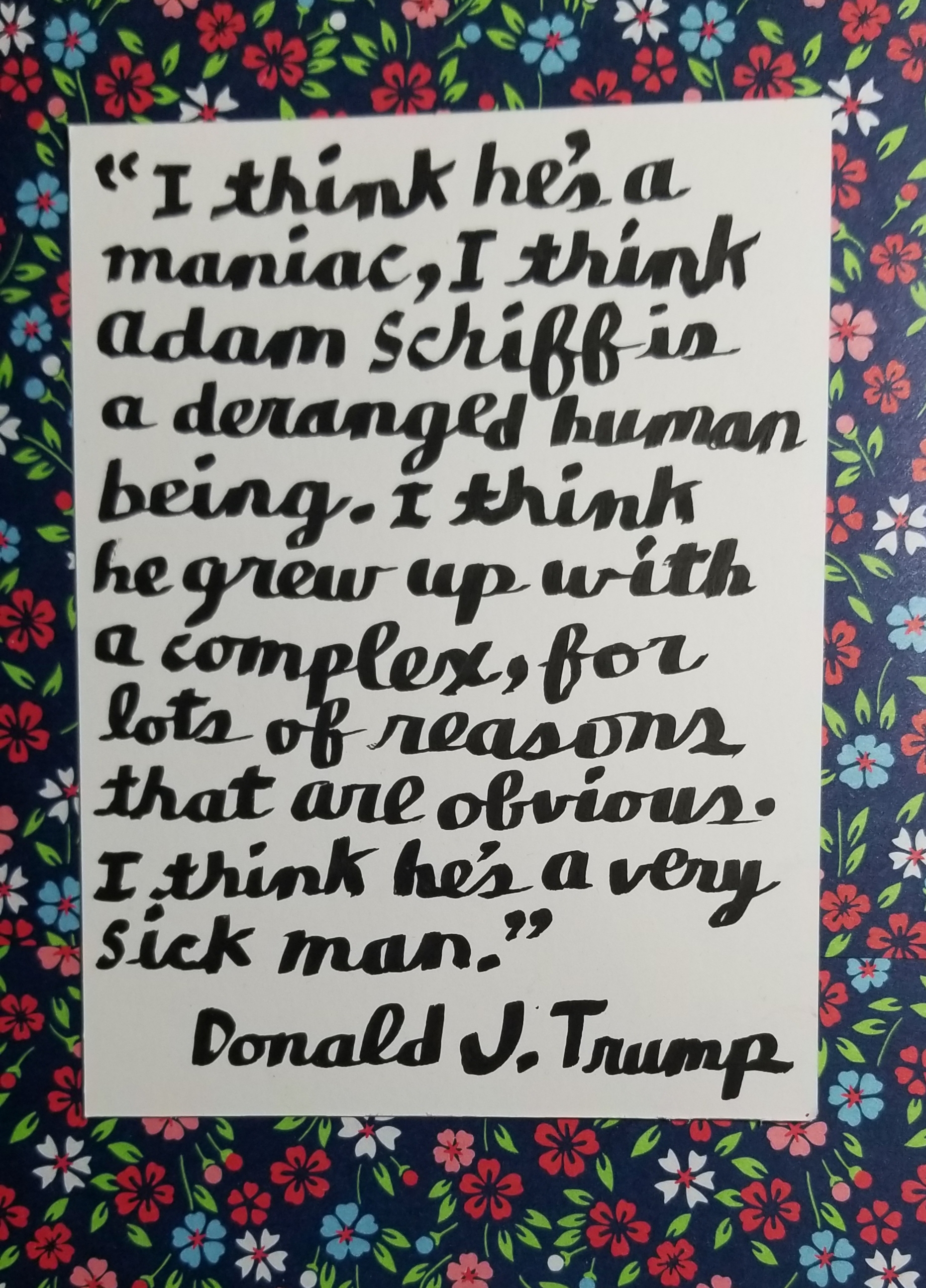
With a client’s ideology on trial, and a sufficient number of jurors working with the defense and committed to acquittal, all a lawyer must do is show one incident where the other side is “lying” to prove his case that every enemy of his client is a fucking liar. As Mr. Trump’s lawyer, the sabbath observing David Schoen did with this arguable lie by Adam Schiff [1], who deliberately pronounced the commonly misspelled word “cavalry” in Kylie Jane Kremer’s tweet as “cavalry” [2].

You see how these filthy, lying socialist Jews do it?” asked last-minute Trump attorney David Schoen, silently, referring to the alleged trickery of his sick and dangerous co-religionist.

Of course, as any Christian knows, and any clever (or even just choleric) Jewish lawyer knows, Calvary was where Jesus Christ was crucified. So, obviously, when talking about the modern day crucifixion of Donald Trump… this Trump supporter clearly meant that the place where Jesus was crucified was on its way. Exclamation point!

You could argue, of course, that in the context of Trump’s December 19 call for a march (no mere protest rally) on January 6, retweeting his “be there, will be wild” promise, the tweet by the person Schiff deliberately and cunningly misquoted could refer to the troops Trump was calling for to march on the Capitol and Stop the Steal (which they, in fact, did).

Of course, “context” is just more lying bullshit, calculated to obstruct and distract, if there is sufficient fervor for your “ideology.” The Trump supporter’s tweet was clearly referring to Our Lord’s crucifixion, which was coming, lying libtards!!!

Meanwhile, in other news, youth around the world are suffering massively from pandemic-induced social isolation. The New York Times reports ‘What’s the point?’ Young People’s Despair Deepens as Covid-19 Crisis Drags On. We philosophical old bastards have years of experience to compare this disorienting, historically unusual situation to, a world before we were all locked down in fear of infection and death. The young have not had as much time to become this philosophical, yet.

[1]

[2]

But this [misspelling] is also a mistake that Trump himself has made. On Jan. 1, promoting the Jan. 6 rally, Trump retweeted a user who also used “calvary” — prompting Merriam-Webster to troll the president by publishing an article on the differences. “Although they begin and end with the same groups of letters, cavalry and calvary are not related in either origin or meaning,” the dictionary company wrote.

source

The seeming slipperiness of the truth, and its value

Our defeated ex-president, seizing on the death of a man of great certainty of opinion and even greater influence, around whose neck he’d hung a presidential medal at his last State of the Union, reemerged into the public spotlight, on FOX, to repeat the familiar refrain that he’d won, in a landslide, the election he lost decisively. In support of his ongoing #Stop the Steal campaign he said that this great, recently departed American anti-Leftist had strongly agreed with him, the presidency was stolen from him, from all real Americans. The professionals and experts all know the truth, he said — that the presidency had been stolen from him and from America by a vast cabal of evil, sick, dangerous enemies of the people — the vast Leftwing, Antifa, BLM, Feminist, Homosexual, Liberal Jew media conspiracy.

The charge that he won the election he lost may be untrue, (reasonable people can argue about it, claims Lyin’ Ted Cruz, reasonably) but you have no right to call it a lie when tens of millions honestly believe it’s true that there was massive voter fraud that stole the election from the rightful winner. How dare you call the sacred dead former talk-show host with talent on loan from God a liar?!! Standing up for possible truth is the whole reason more than a hundred and fifty GOP members of Congress united to contest the “certification” of an election that nobody ever proved wasn’t massively fraudulent, the deliberate and systematic theft of an election, by lying traitors, that the “defeated” candidate actually won in a landslide.

Back for a moment to the personal, to the moment when somebody decides you will be in a fight to the death no matter what you think about it, no matter what actions you may take to try to prevent it. Certainty is a powerful force. I’m thinking about an old friend who called to angrily confront me about being unjustly angry after my health insurance was abruptly cancelled, (illegally as it turned out). He then escalated his indignation and challenges week after week, finally, after pressing me to just fucking move on from whatever my grievance was, snapped, cut me off mid-sentence with a snarl and hung up. Then texted me that he was done being reamed by me.

It seems petty, I know, to keep coming back to this same indigestible example of another old friend suddenly become a devoted, eternal enemy. I’m trying to wring something instructive out of the vexation of it. It seems like the lesson has to be more than that we can all convince ourselves of the righteousness of our own actions, once we construct the right frame. It may be no more than that, though that answer is as unsatisfying as the conclusion that homo sapiens are just a petty, quarrelsome, largely irrational species whose history is always written in the blood of the justifiably murdered.

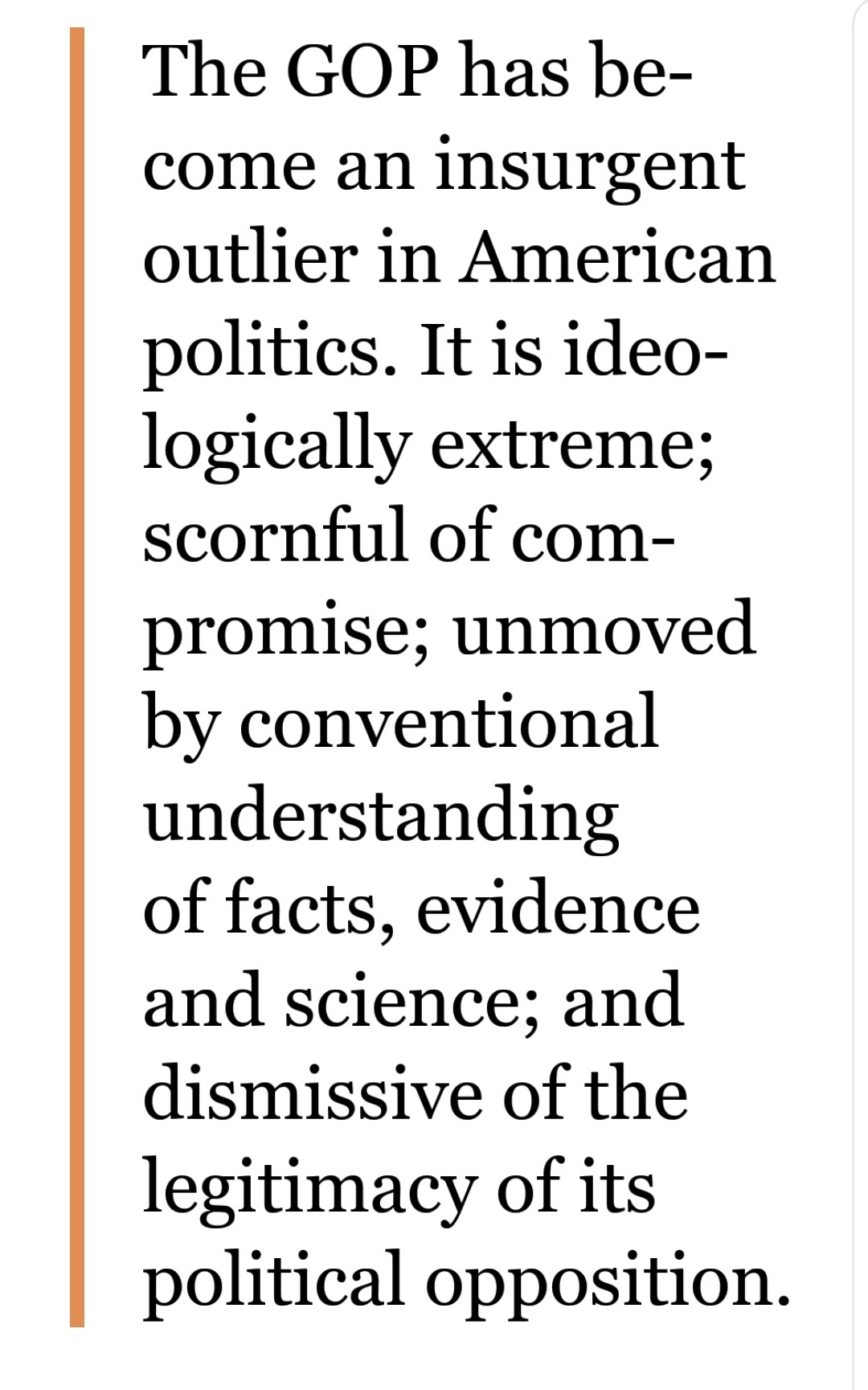
Surely there is something like objective reality. If you have no dog in the fight you are generally able to look at what actually happened, trace cause and effect, and often assess who is basically correct and who seems to have things ass backwards. The answer is rarely that both sides in a heated argument (like the consensus of Climate Scientists versus for-profit Climate Change Skeptics) are equally valid. There is generally more truth, more fact, more data, more thought behind one position than the other. The genius of the long right-wing project to convert the GOP into a radical right-wing party, similar in its essential features to the one-time fringe conspiracy-based John Birch Society cult, described this way, by political scientists Norm Ornstein and Thomas Mann in 2012:

is that today massive, repeated allegations of something, funded by tens of millions of dollars in ad buys to convince people of the allegations, suffice to back and fully justify any political move, including a righteous riot to disrupt the peaceful transition of power in the Capitol. You no longer need a shred of proof, evidence or any discernible facts on your side — the accusation itself is sufficient to fuel the righteous fight to the death.

Proponents of the need to contest the results of an election they claim (without evidence) was massively fraudulent, even after results have been certified fair by bipartisan officials, votes recounted, challenged dozens of times in court, left in place by the courts (for lack of evidence of fraud) need only site the ALLEGATION of fraud, believed by millions, to support their right to contest the election. Regardless, of course, of whether there is or isn’t, or has ever been, actual evidence of significant voter fraud found, even by the Koch-funded Heritage Foundation or Trump’s Presidential Electoral Fraud Commission headed by Hang Mike Pence and defeated voter-suppression expert Kris Kobach.

The project of convincing tens of millions of fraud that didn’t actually happen is vast power at work, and successful propaganda instilling belief in something that is based only on the needs of maintaining that power. It is our job going forward to make a humane case for the 99% as emotionally undeniable as these Koch-funded geniuses have made on behalf of the 1%. It saddens me to see the Democrats resorting to Lincoln Project-style attack ads, which they are now (the Lincoln Project proudly claims credit for Trump turning on his loyal retainer Pence) and I keep thinking there has to be a better way to make the case for fairness, although maybe not at the moment.

Back to the personal. This long-time friend, no matter how clearly I set out my issues, my specific concerns about our long “argument,” insisted that we can’t ever really know what is in anybody else’s head or heart, even someone we’ve known well for half a century.

It seems an untenable and depressing position to me, one that inevitably leads to estrangement, but this man is very smart, an accomplished lawyer, and he rests his case for this unshakeable belief on the fact that in the end, after my many attempts to be analytical and nonviolent in stating my concerns (concerns he repeatedly asked me to clarify, no matter how clearly I’d already made them) I admitted, in a very hurtful way, that I was frustrated, angry and disappointed in his limitations as a friend.

After all, from his point of view, every one of his attempts to make peace was met by my stubborn refusal to simply forgive, even after he made it clear that he truly didn’t understand what he’d ever done to me that was hurtful. Instead, he pointed out, I kept struggling, stubbornly and incoherently, to make him understand what was so “hurtful” about his conduct.

When I hear that Tucker Carlson, for example, said, of the police killing of George Floyd (bracketed by Brook Gladstone’s commentary from her excellent On The Media:

BROOKE GLADSTONE Later that evening, Fox primetime hosts Tucker Carlson and Sean Hannity drew on increasingly deranged conspiracy theories to denature the evidence [in the impeachment trial –ed].

[CLIP]

TUCKER CARLSON They’re just flat out lying. There’s no question about that. The question is, why would they lie about this? For an answer, think back to last spring. Beginning on Memorial Day, BLM and their sponsors and corporate America completely changed this country. They changed this country more in five months that it had changed in the previous 50 years. How’d they do that? They used the sad death of a man called George Floyd to upend our society. Months later, we learned that the story they told us about George Ford’s death was an utter lie. There was no physical evidence that George Floyd was murdered by a cop. The autopsy show that George Floyd almost certainly died of a drug overdose. Fentanyl. [END CLIP]

BROOKE GLADSTONE Right. A full autopsy report by Minneapolis police found that Floyd had fentanyl and other drugs in his blood. He also had Covid-19. None of that killed him. His death was ruled a homicide. Maybe Tucker will move on to flim-flam less foul, but why would he? 

source

my blood instantly boils.

I don’t often listen to FOX, or Cucker Tarlson (or whatever the well-born, entitled prick’s name is) but hearing him smugly intone a transparent and incendiary lie, calling the story of Floyd’s (who he called “Ford” at one point) homicide a lie, made me ready to fight him, as it was intended to. I immediately felt a violent urge to put my knee on Tucker’s neck and kneel on him for as long as it took him to stop kicking and begging, letting him up a second before his death. The whole FOX/Murdoch right-wing exercise is “triggering the libtards” and thar’s gold in them hills (Rush Limbaugh died with a net worth of over $600,000,000). The Minneapolis coroner who ruled that a grown man, armed with a gun, supported by three armed colleagues, kneeling on the handcuffed George Floyd’s neck for almost nine minutes, the last three after Floyd lost consciousness after begging for mercy and calling out for his mother, had caused Floyd’s death? A fucking liar and traitor, a tool of the fucking lying libs.

Hearing Carlson’s inflammatory hate speech I immediately, and involuntarily, flashed on my former friend’s claim that in spite of the thousands of words I’d written him trying to keep the peace (the first few thousand he thanked me for humbly, for I’d taken pains not cast undue blame on his actions) nothing I had written, in the end, gave him the slightest clue why I was so hurtful to him now.

The truth can slippery once strong emotions creep in, and people we trust can twist it convincingly sometimes, but, call me old-fashioned, I still believe there is a world of cause and effect that can be observed, that some narratives are closer to the truth of what happened than others. I can’t be sure what the root cause of my friend’s insistence that we fight to the death was. Not sure I made all the right moves to try to avoid it, obviously I didn’t, based on the irreconcilable enmity at the end.

But if someone asks you why you are angry, and you tell them you are protesting the long history of too many unarmed black people unaccountably murdered by the police in this country every year, and they respond by calling you a terrorist, dispersing protests with the full force of non-deadly state violence (tear gas, horseback charges, rubber bullets, anti-riot squad phalanxes swinging batons, mass arrests) you might be forgiven for feeling unheard.

“What is the real core issue here?” asked my friend, time after time, telling me he clearly didn’t understand what he did that seemed to have upset me so much. I told him that, in a nutshell, having my expressed concerns met by silence is probably the single most hurtful thing to me, that the attempted negation of my feelings by silence is like kryptonite to me. He stood on his right to remain silent, and on the reciprocal truth that I had no right to expect any different, since nobody can ever truly know what is in somebody else’s heart and mind or why they feel as they feel or do what they do.

“I read everything you wrote, searching in vain for a single clue as to what I’d done that made you so irrationally angry and hurtful to me,” he concluded, resting his case.

I can’t do anything about the gigantic phenomenon of unchallenged far-fetched falsehoods being presented as just good as undeniable truth when it comes to a partisan GOP argument. Greg Abbott, the Trumpist governor of Texas, is angrily blaming the Green New Deal for his state’s deadly weather-related emergency — and fuck your fucking facts, cucktards. The political is personal, of course, and there’s little we can do, outside of hard, slow, resolute work on the long-game of bending the long arch of history towards justice. In our personal lives, our choices are more straightforward.

I can’t do anything about a friend who insists that he will do everything in his power to save our friendship, while standing on his right not to revisit any concern that might make him uncomfortable, or even acknowledge I’ve clearly expressed a single goddamned thing worthy of consideration. In the end I can do one thing in the case of a friend like that — let him make his final arguments, accept his right to remain unchanged, and his verdict, and try not to brood about it whenever I hear a similar case indignantly made by a Tucker Carlson.

Though, I also have to acknowledge the deeply disturbing personal resonance of things like hearing the Rochester cop, while hand-cuffing and pepper spraying the emotionally disturbed nine year-old girl (and the fact that the cop was not immediately fired and prosecuted tells you the race of the child) demanding that she stop acting like a child. “I AM a child!” she replied, stating the obvious, to a brutal asshole who didn’t have the slightest concern for what was true and what was instantly verifiable bullshit. I heard the same from my own father, when I was that age and younger. That I should start acting like a man instead of a fucking child. He apologized about that right before he died, for whatever good that might have done anyone.

Truth and reconciliation, y’all, there is a tremendous value to it. It’s the only path to true healing.

Reframing, quick refresher

When stuck with an untenable position in an argument, when the facts, the law and common sense are all against your cause, reframing is probably your best option. Here are three recent examples from the news.

Senator Ron Johnson, the Always-Trumper from Wisconsin, confronted by the fact that his leader unleashed a heavily armed mob, many in body armor, to riot in the Capitol building (immediately after a rally he promoted, promised would be wild and spent at least $3,500,000 in donations organizing) injuring 140 police officers, and killing several other people (including one of their own they trampled to death), focused on the word “armed.”

“Armed” Johnson claimed, reframing the word, means carrying a firearm. Since only one person was killed by a firearm, and a police firearm at that, it followed that the mob was not armed. Take something you can’t deny– the violent mob seriously hurt a lot of people, using a variety of arms (weapons, if you prefer), and reframe the question into a very limited definition of the word “armed.”

Bear spray (a super powerful form of mace to be used against wild 800 pound apex predator assailants), metal poles, baseball bats, stun guns, sticks, brass knuckles, whips, barricades, fire extinguishers and the other implements used in the riot to inflict injuries — not “arms,” not weapons. Guns only are arms, and only a small number were confiscated by police after the riot, and nobody was shot to death by the rioters (and only a few more automatic rifles, high capacity clips, homemade napalm and a few bombs were found– outside, in trucks owned by rioters– which don’t count) so, by simple logic, there’s your proof — the crowd was not armed. And even if there were a few guns, nobody was shot, except one rioter climbing through a window (by police) so, therefore, the CROWD was not ARMED [1].

It is an asinine bit of reframing, sure. Though how foolish the reframing is to a given individual in post-Trump America will depend on what their definition of “is” is and the color of their hat.

Texas is in the grips of winter storms and freezing temperatures rarely seen in that part of the country. The demand on electricity to heat homes caused a massive power outage across the state. Millions of Texans are without power, some have already died and many are in real danger of freezing. The power outage appears to be the result of unregulated energy in the state, arranged that way by the great state of Texas to evade those nasty federal regulators. Areas of western Texas that are part of an interstate power grid that is federally regulated, lost power briefly and then had it restored. A hard set of facts for the anti-regulation/government bad crowd to counter.

The Trumpist governor of Texas announced that since wind powered generators failed in the extreme cold, it was proof of how deadly the New Green Deal would be, with its reliance on renewable sources of energy.

Nicely done. Unless you know that wind powered generators account for only 10% of electric power in Texas.

Perhaps the most sickening recent bit of reframing — earlier this month police were called to help a girl who was in emotional crisis. When they arrived the nine year-old was very upset. The Washington Post reported:

The mother of the 9-year-old Rochester, N.Y., girl who was handcuffed and pepper-sprayed by police said Wednesday that she repeatedly told an officer that her daughter was having a mental health breakdown and she pleaded with them to call a specialist instead of trying to detain her.

source

The police did what they are trained to do — gave chase, ordered her on to the ground, subdued her, hand-cuffed her, pepper sprayed her (to calm her down), hustled her into a police car. She kept resisting. Here is the exchange between the child and one of the police officers, reframing to beat the band. The child has a better argument here, but that “stop acting like a child!” was a nifty bit of on-the-fly reframing by the police officer:

[1]

Others were armed during the riot: A police officer said he noticed a bulge on the hip of Christopher Alberts – who was dressed in body armor and carrying a gas mask – as he filed out of the Capitol grounds, according to court records. When they stopped him, they found a loaded handgun. Alberts’ lawyer did not respond to questions about the case.

source

A visit from el perro negro

At a particularly depressing and anxious time for the human race like the one we find ourselves in now, depression and anxiety are understandable. It is hard to stay optimistic in the face of prolonged social isolation, a still raging incurable disease that can kill you, lies and denial of reality in the service political brutality, cascading climate catastrophe and all the rest. The hanging out with friends, family and likeminded strangers that used to remind us of the other side of life is now dangerous, must be approached with caution, if at all.

Social media, texts and emails are no substitute for personal contact with people you like. People think you are insane (and they are probably justified) if you send them a hand-written letter in the mail. Sekhnet, a self-proclaimed happy hermit, is relatively fine with cheerful random encounters with strangers, by phone or socially distanced and masked. At times I find myself wistful about the ongoing lack of connection with others.

I’ve been aware of not falling into the trap of despair. The world is the world, always full of danger and challenges, and though fear may grab us hard sometimes, and doubt, and all the other dark things of this world, it is best to keep in mind all the rest, the sweetness of life that keeps us grateful for every lifegiving breath we take.

The world is also change, all life is constantly moving, evolving, changing. This shit too will pass, surely, and once the pandemic is over we’ll hang out together to talk about it and laugh in relief to have survived it.

There is hard work to be done fixing a lot of things that are badly broken, I’d like to help. I hope to figure out how to lend a hand, throw my back into it. I feel like I’ve been doing OK emotionally, the usual complaints (the arthritis in my left knee is getting to be a real pain) aside.

Last night I cheerfully dialed an old friend, to check in, to resume my long habit of checking in with distant friends. I’d decided not to talk for long, just hear how he was doing, hopefully have a laugh (he’s a funny bastard) as I exercised my ailing legs outside in what was suddenly a mild evening. I got his voice mailbox, which was full.

I suddenly remembered the weight he carries, responsible for the livelihoods of literally hundreds of people in his badly stressed organization, dozens of whom must call his cellphone daily. It was too late to ring his home phone, his wife goes to bed early and it was already almost 10:00. Figured I’d call the home line tonight, after the dinner hour, see how they’re doing.

Watched an episode of David Attenborough’s brilliantly presented (and beautifully shot) Planet Earth on Netflix, had a moment of despair about what human greed has made of the oceans and deep seas (which contain 95% of the earth’s life, I think I heard), but mostly, we marveled at the weird and wonderful beauty of nature and the gentle, wise presentation of it . Here’s a nice montage from the wonderful limited series.

Sekhnet and I went upstairs, played few rounds of Wordscapes on my phone and I tucked Sekhnet for the night (so she could spend the next hour learning Chinese in Duolingo).

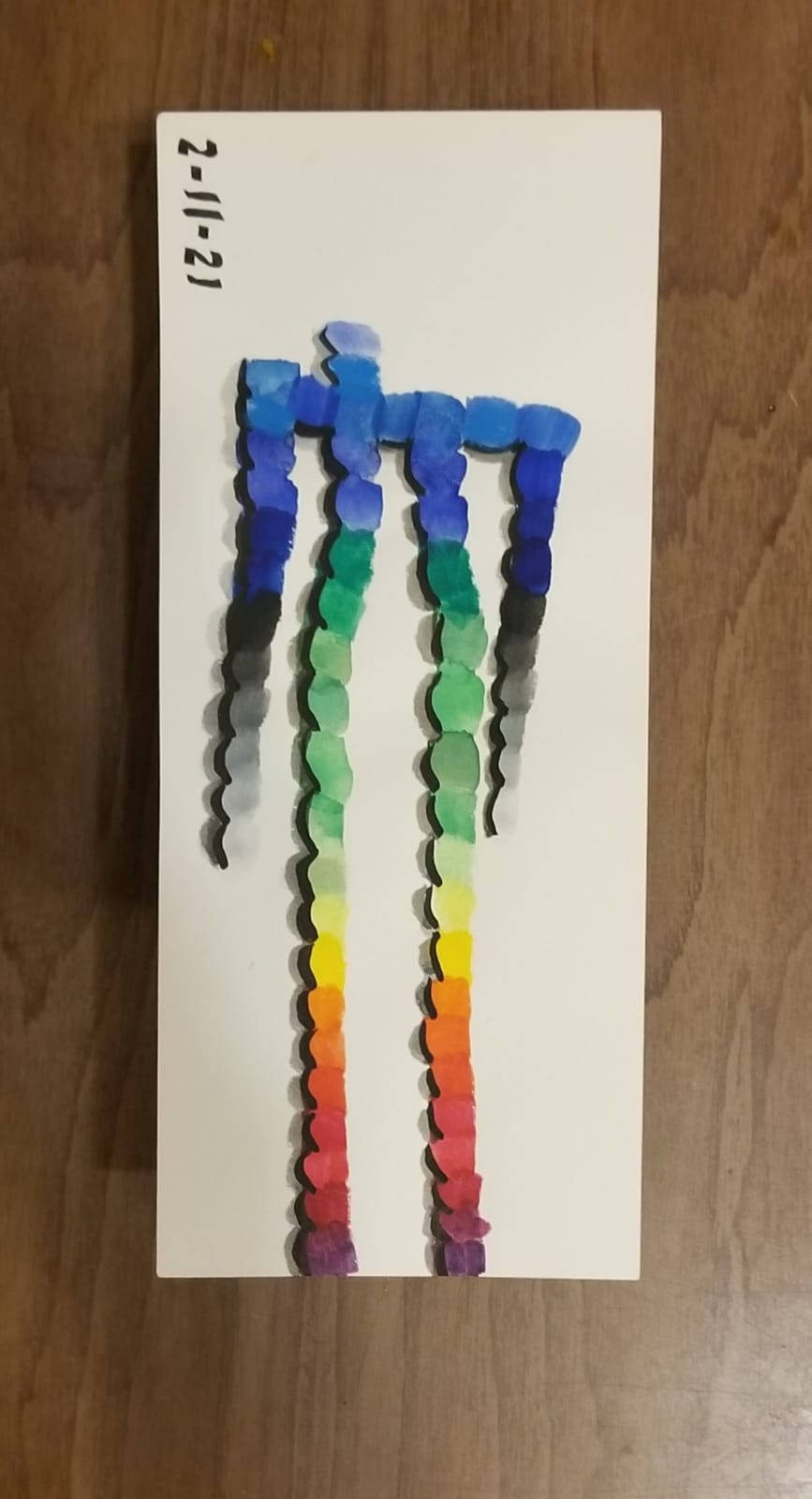
Then sometime after I did a little watercoloring (a variation on the figure below):

washed the dishes, got myself a cold drink and sat down to prop my leg up and watch a dark crime show, I became aware that the Black Dog had crept into the room with me.

I’d truly forgotten all about el perro negro.

“Remember me, motherfucker?” asked the black dog.

I did, indeed. Everything was suddenly hopeless. Why bother calling my friend? I’d destroyed my life, utterly, the whole thing a series of stupid mistakes I’d keep making until the end. Nobody gives a rat’s ass about your precious, polished, meaningless, unmonetized hobbies. The world is only a depressing antechamber to certain, terrible death. Nothing is ever going to work out well, you’ll see. Everyone who ever said they loved you was lying, and they proved it, in spades; everyone you love, dead. Evil triumphs in this world and if you think it doesn’t — fuck you, I’ll slit your ugly face. Look around, asshole.

“Forgot how persuasive I am?” asked el perro negro, stinking faithfully at my feet.

Not for a second.

I took two Tylenol PMs (discovered by Sekhnet’s insomniac cousin recently) and waited for the stabbing in my left knee to subside. Within an hour I was drowsy, went up to bed. Today, no sign of the black dog, though I can still smell his wet, cloyingly pungent fur. I’d forgotten all about the motherfucker, actually.

Third try at Eliot Widaen’s impeachment post-mortem

I wrote two long versions of this the last two days, assessing the painful one-sided travesty that resulted in a jury that included the 45th president’s co-conspirators (Hawley, Cruz, Graham, Lee, Tubaveale among the most vocal) voting, on a disputed, minority-embraced technicality, to acquit a president they helped to organize and incite an insurrection against the government.

Two things the angry pro-Trump mob chanted during the ransacking of the Capitol that I don’t necessarily disagree with — “Treason!” (yes, it was) and “Hang Mike Pence!” (I’m never in favor of political murder, but if some sacrificial lamb has to go, why not the already soul-dead religious bigot Mr. Pence?) [1].

I realize now, fittingly on Presidents’ Day, that it’s time to look forward, to always frame things in the positive, from our perspective, what we concerned citizens need to do to fix a broken democracy, not from the incendiary and intentionally crippling perspective of modern day Nazis. The immediate future includes criminal conspiracy prosecutions of violent criminals (and ethics investigations of those in Congress who continue — they persist, even now — to shill for the soundly disproven Big Lie about a “stolen” election Trump and his party unsuccessfully tried to rig) and changes to the law to allow actual fair trials in future impeachments and similar Congressional investigations.

First, a palette cleanser, from E. J. Dionne (in an op-ed in yesterday’s Bezos, er, Washington Post) for a bit of perspective:

Don’t waste time mourning the Senate’s failure to convict Donald Trump for crimes so dramatically and painstakingly proven by the House impeachment managers. The cowardice of the vast majority of Republican senators was both predicted and predictable.

Instead, ponder how to build on the genuine achievements.   Led with extraordinary grace by Rep. Jamie B. Raskin (D-Md.), a diverse and able group of prosecutors laid out an indelible record not only of what happened on Jan. 6 and why, but also Trump’s irresponsibility throughout his term of office: his courting of the violent far right; his celebration of violence; his habit of privileging himself and his own interests over everything and everyone else, including his unrequitedly loyal vice president.

This record matters. We often like to pretend that we can move on and forget the past. But our judgments about the past inevitably shape our future. Every political era is, in part, a reaction to the failures — perceived and real — of the previous one. The Hoover-Coolidge Republicans loomed large for two generations of Democrats. Ronald Reagan built a thriving movement by calling out what he successfully cast as the sins of liberalism.

By tying themselves to Trump with their votes, most House and Senate Republicans made themselves complicit in his behavior. And Trump will prove to be even more of an albatross than Hoover, who, after all, had a moral core.

Given the chance to cast a vote making clear that what Trump did was reprehensible, only seven Republicans in the Senate and 10 in the House took the opportunity to do so.

You can tell how worried Republicans are that they are now the Trump Party by the contortions of Senate Minority Leader Mitch McConnell of Kentucky, who aided Trump almost to the end. Rarely has a politician been more blatant in attempting the impossible feat of running with the foxes and hunting with the hounds.

Moments after voting to let Trump off — “on a technicality,” as Democratic Rep. Joaquin Castro of Texas shrewdly observed about many GOP “not guilty” votes justified by anything and everything but the question of guilt itself — McConnell blistered the inciter in chief in a speech the impeachment managers could have written.

His words told the world who won the argument. They also underscored how wrenching it will be for Republican politicians to appease the GOP’s Trump-supporting majority while pretending to be another party altogether.

The fact that only seven Senate Republicans bolted should end the absurd talk that there is a burden on President Biden to achieve a bipartisan nirvana in Washington. If most Republicans can’t even admit that what Trump did is worthy of impeachment, how can anyone imagine that they would be willing and trustworthy governing partners?

The case for ending the filibuster is now overwhelming. There are not 10 Republican Senate votes to be had on anything that really matters.

source

Say it again, brother:

The case for ending the filibuster is now overwhelming. There are not 10 Republican Senate votes to be had on anything that really matters.

Free speech is our right as Americans, but, at this point, so is shutting off noise that makes free thought and informed debate impossible. We don’t need to endlessly give oxygen to demented theories endlessly repeated by our agitated mass media. No reason to waste energy further debunking the lies of a party that unites behind Big Lies that are shown to be false over and over and over and that have proven to lead to violence and mayhem. Nobody cares, those who drank Trump’s/GOP’s insane kool-aid have shown they will swallow anything. The Jews did it, fine, we did it, now let’s move forward.

If Democrats do the only sane and practical thing and end the filibuster, which has been used (since its creation by slavery advocate John C. Calhoun three decades before the Civil War) overwhelmingly to support slavery (fake, there was never slavery here! LIAR! Jew!) and racism (only Black people and radical Jews perpetuate that lie!!! Anti-lynching laws blocked by filibuster were attempts at COMMUNISM!!!) they can pass laws favored by the vast majority of Americans. Here’s a short list.

Pass the John Lewis Voting Rights Act, making it easier for people to vote, as a right of citizenship, and much harder for Republican state apparatuses to continue violating the Voting Rights Act in the name of suppressing the majority vote, which they frame as a “privilege” only their side is fully entitled to.

Use actual scientific knowledge to fight the pandemic and give financial relief to millions of Americans who are in desperate situations.

Get busy doing everything possible to slow the hastening destruction of the earth.

Nominate five or more “moderate” Supreme Court justices and confirm them with as much bipartisan support as is available.

Stop aiding foreign despots in genocide (our billionaire Saudi “allies” are mass murdering Yemeni people in the poorest country in their region).

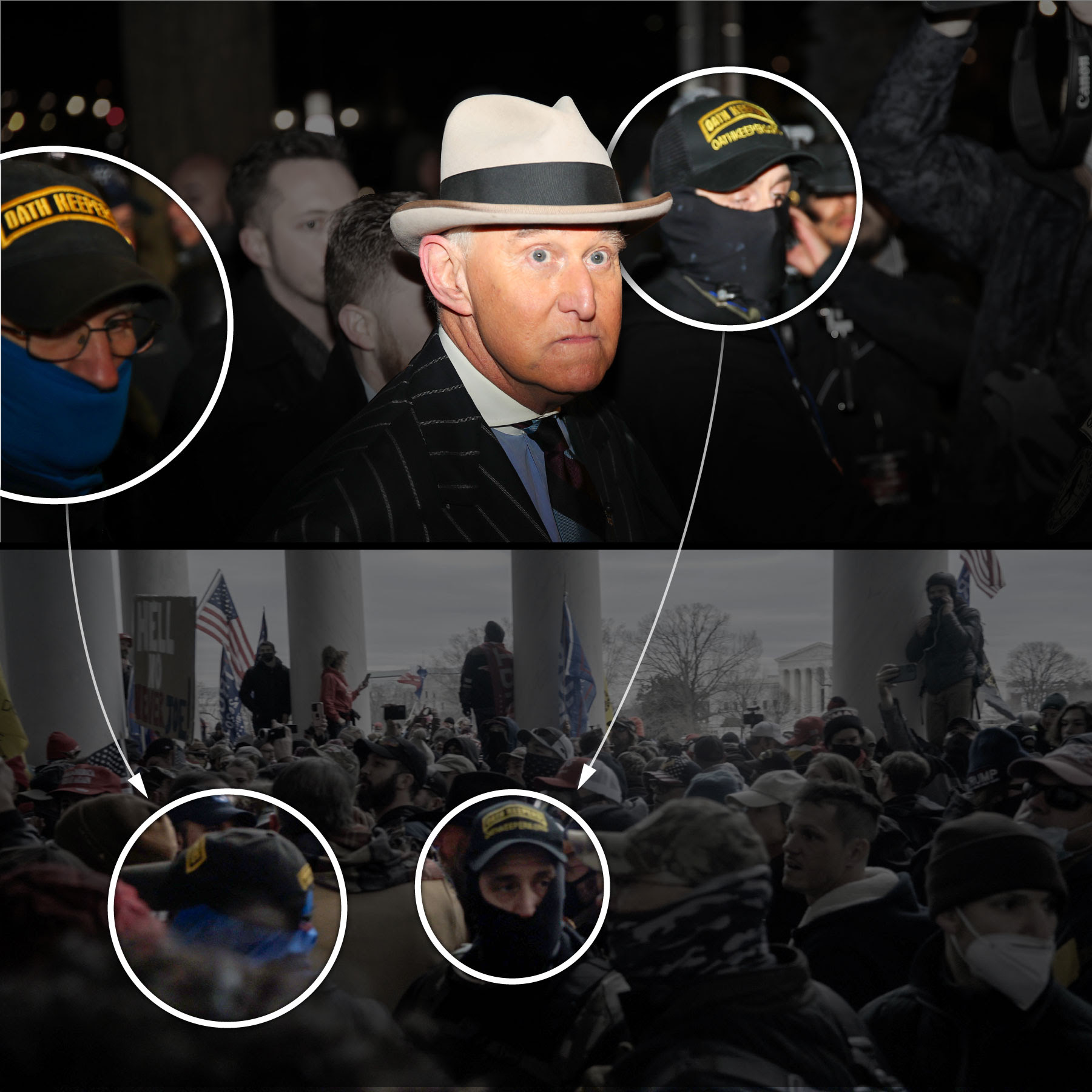
Restore faith in the rule of law by enforcing the law against powerful serial scofflaws like several criminal associates pardoned by our criminal former president (“Mr.” Trump must now be prosecuted for leading the well-financed “collusion” to overthrow an election) guys like Roger Stone and the always innocent Mike Flynn, who called for violence and actively participated in the planning and promotion of the riot and (in the case of self-proclaimed rat-fucker Stone) whose phalanx of Oath Keeper bodyguards all took part in breaking into the Capitol (as the NY Times documented yesterday).

Free OJ and exonerate him (sorry, couldn’t help myself… trying to be bipartisan. How did Trump miss this layup? Why is Bill Cosby still languishing in prison? Oh yeah, Trump is the least racist person in the world.)

and so forth.

And here’s an important concrete suggestion, from former federal prosecutor/justice activist Glenn Kirschner — create an Inter-branch Dispute Court [2]. Here is why this idea is a crucial step toward actual justice and enforcing a true democracy-protecting balance of powers, as intended by the sainted Framers. There was, sadly, a strong argument for the seeming resigned, weak-kneed capitulation of Democrats on the issue of calling fact witnesses to disprove transparent lies told by Trump’s defense team about crucial facts that established Trump’s guilt — the interminable delays caused by the slowness of adjudications by federal courts.

When Robert Mueller interviewed former White House Counsel (and weasel-dicked Conservative operative) Don McGahn, McGahn admitted, under penalty of perjury, that Trump asked him first to fire Mueller, and then, after he refused because it could be seen as part of an ongoing pattern of Trump’s obstruction of justice, to write a memorandum for the record falsely stating that Trump had never asked him to fire Mueller. Erring on the side of staying out of prison, McGahn left the White House (after successfully installing Gorsuch and Kavanaugh on the Supreme Court) and returned to private practice.

McGahn was subpoenaed by the House to testify to this effect, on live TV, in connection to Trump’s first impeachment. Had McGahn (and others who swore to damning facts in Mueller’s Obstruction of Justice volume II) been allowed to testify, the House surely would have drafted an article for Obstruction of Justice, backed by the eye-witness testimony of those asked by Trump to “collude” in making the Mueller thing go away, as he had tried to make the Flynn/Russia thing go away by firing Comey. It would have been hard, with that sworn, live testimony, for even today’s GOP to unanimously (thanks, Mitt, I didn’t forget your historic guilty vote on one count) acquit their leader, even at the no witness, evidence-free first impeachment trial.

McGahn had the politically unpalatable (for him) option to appear before the Congressional committee, and likely the legal obligation to testify, but McGahn chose to fight the subpoena in court, one of several such decisions by prominent present and former Trump officials to defy/contest subpoenas during the Trump term. McGahn v. Congressional Cucktards was filed in federal court in 2019. The matter has still not been decided.

As angry as I was Saturday that Democrats didn’t pause the trial and get testimony from former Trump aides present with him during his absorption in the riot on live TV, testimony that would have made an airtight case that Trump didn’t care how many police officers and other people had to die when his Stop the Steal riot was going on, I grasp one aspect of their hesitation. While in office Trump ordered subordinates to defy 130 lawful subpoenas, under Barr’s inspired suggestion he assert a ridiculous pre-emptive blanket immunity against anything that could tend to incriminate or compromise the Unitary Executive. His remaining loyalists, like Kevin McCarthy, who had already said he would not testify voluntarily, would certainly fight a subpoena, as his team does now by reflex.

Trump was never held accountable for that open violation of the law under color of Barr’s absurd theory of absolute Executive branch authority. One reason the issue was never decided is is that federal courts are overwhelmed, even essential cases of great public consequence move lethargically. Another reason is that if you manage to run out the two year clock on a Congressional subpoena, as McGahn, John Bolton and other “patriots” did, the question of defying the subpoena expires too, when that Congress ends, the subpoena is no longer valid. The “case” becomes moot, as they say.

When there is a dispute between the Executive Branch, insisting on its Article II supremacy, and Congress, enforcing its legitimate Article I powers, that dispute must go to a court that can immediately rule on the question of vital national concern expeditiously. Glenn Kirschner outlines how this dedicated court would work:

McGahn refuses to testify, based on an asserted presidential privilege. McGahn sends the legal arguments for his refusal to obey a lawful Congressional subpoena to the IDC. The Court gives Congress 72 hours to respond, they file an answer. The court then has 72 hours to make a ruling. Instead of a two-year wait for House Minority Leader Kevin McCarthy to appear as a hostile witness, admit that he had a shouting match with Trump during the riot and that Trump said at one point “Well, Kevin, obviously there are people a lot more upset about this stolen election than you are, bitch…” the wait is less than two weeks. Impeachment trial adjourned for the ruling of the IDC and the inevitable Supreme Court challenge (which would be fast tracked, as in the instant overnight vacating of stays that sought to prevent the execution of federal death row inmates Trump was intent on killing). McCarthy then testifies, under penalty of perjury, and we learn the truth about a matter crucial to all of us, as the rule of law should have it.

Instead, because of the practical impossibility of enforcing Congressional subpoena power, impartial jurors Graham, Cruz and Lee are free to openly strategize with Trump’s defense team on the eve of their (angry, incoherent, false) closing arguments and Lyin’ Ted is free to visit Trump’s legal team during breaks in the trial itself, right up to the acquittal.

There are ways for people of good will to fix some of the fatal weaknesses Trump’s lawless reign exposed. Now we have to get busy doing it. La lucha continua! Let’s get busy, and be of good cheer!

[1]

And, talk about unfailing, obsequious loyalty, nobody, NOBODY, showed this more than Mike “I’m NOT a Fag!!!” Pence. You can see him standing behind the president every time Trump made an outrageous claim, his face a solemn mask of moral neutrality, conveying a certain zombie-like fealty to his master at the same time. Pence passionately defended his insane boss at every turn. When others quit, went to the media with accounts of Trump’s insanity, Pence made speeches praising Trump. He defended indefensible statements and actions, over and over, proudly. His reward for this doglike fidelity?

An angry crowd, dispatched by Trump, calling to hang him for betraying them by not breaking the law. Learning how Trump actually felt about him and Karen. When Trump learned they hadn’t yet strung up the traitor Pence, he sent another rage tweet (ten minutes later) that was immediately read aloud through a bullhorn, repeating Trump’s opinion that Mike Pence lacked courage, had not stopped the steal and, arguably, deserved whatever happened to the weak fuck.

Trump made it clear to coach/senator Tommy Fucking Tuberville, in their phone call that ended after Pence was hustled out of the Senate, that Pence’s life meant nothing to him. He also told House Minority Leader and expert bootlicker Kevin McCarthy that he didn’t give a rat’s ass about the riot, or dead and wounded cops, that Pence was as dead to him as Sessions, Barr, Bolton, Bannon, McMaster, Tillerson, Mulvaney, Liz and Dick Cheney, that the important thing was to continue to Stop the Steal.    Poor Mike Pence!

[2]

[00:59:17]
To deal with, for example, interbranch disputes between Congress and the executive branch, so Congress issues a subpoena for testimony in an impeachment hearing, the executive branch says, nope, you can’t have that witness. Well, you know what you do? You go to the interbranch dispute, caught the eye, BDC and you get 72 hours to file your brief. You get another 72 hours to prepare and conduct your oral argument, and then you’re going to have a court opinion in another 72 hours.

[00:59:52]
Was that nine days? If I can count, I don’t have my calculator. You want to appeal that decision? 72, 72, 72. Now, in less than a month, you’ve got an appellate court opinion and it’s been all but definitively resolved because you could still go to the Supreme Court. But what you have done is you’ve taken out the endless Don Meghann year and a half delay to run out the clock. The interbranch dispute caught folks it’s imminently doable.

[01:00:19]
Donald Trump has opened our eyes to all of the problems, all of the deficiencies, all of the areas for abuse, right where they’ve wiggled into the cracks in our system and they’ve engaged in their abuse in those cracks and they’ve just blown them out into chasms, chasms of abuse and corruption and crime. By Donald Trump and his cabinet members and his family, and they’ve exposed they’ve exposed the weaknesses in our government, in our republic, in our democracy and our institutions.

source

Encourager vs. Discourager

How we respond to others is an often subtle art, though it can make a big difference. The word “courage” is embedded in the two effects our responses have on others. We can either encourage or discourage by our reactions. We often react by reflex, but it is something we should be aware of doing better at, it seems to me. Personally, when it comes to people I encounter, I’d usually much rather encourage them than discourage them. I have been discouraging many times over the years, by simply not thinking before I comment, something I’ve become more aware of as times goes on.

I wrote yesterday about Friedman’s devastatingly discouraging remark at a hard time for me. In his defense, he was at his wits’ end when he said it. Walking with his best friend, an affable guy with a gift for gab, who had become a shambling, monosyllabic zombie, he found himself bereft. He was reaching out to his old friend, trying to help, and all his always talkative friend could do was grunt the occasional noncommittal syllable. Of all the people he could imagine this happening to, I was the last of them. He simply said what he felt, what anyone likely would have felt at that moment.

For purposes of that understandable remark, we don’t need to consider that Friedman, by his unhappy, critical nature, was a reflexive discourager. He was a perfectionist and a control freak, very demanding of himself and everyone else. Few things were what they were supposed to be in his world. For one thing, he was extremely sensitive, and talented, and sang his clever, musically ambitious songs, (in a painful voice, granted), from his heart. The world needed to hear his take on things, he believed. The world, it turned out, didn’t give shit one about what was in his heart. If you don’t get what you need from the world, why give it to anyone else?

I have always consciously tried to encourage people, especially in creative endeavors. There is always something good to find in any work of creation. Don’t like the song the songwriter played for you? “Wow, I forgot what a great voice you have,” is not a bad thing to say, it gives the singer a little boost. It is so easy, while being honest, to unintentionally discourage somebody. “Eh, that song didn’t do anything for me, not your best work, it doesn’t swing, the melody is weak, there’s no hook, it’s… eh,” while truthful, is like throwing yer proverbial turd in the old punchbowl. It is an honest but discouraging thing to say that probably doesn’t need to be said, in most cases.

My mother, in her later years, took up acrylic painting for a short time. She went to class with a photo and came back after every session with a finished painting from the photo. She mentioned that she was by far the most prolific painter in her class, many were still working over their paintings from the first week while my mother had already completed many. Her paintings were pretty good. A few evoked her deep loneliness in a very profound way. There is one in particular, of a fat seagull sitting alone under a stormy grey sky, the turbulent ocean reflecting the gloom in cold, grayish green, that is a powerful evocation of her existential aloneness. I actually love that painting, which is now owned by her granddaughter, who was obviously also moved by it.

When I visited my parents in Florida during my mother’s painting frenzy there were several of her paintings, framed and hung on the walls. She showed them to me, her artist son, and asked me what I thought. She never let me forget my unenthusiastic reply, which she always recounted as a damning “eh…” I didn’t take a second to think, apparently, that a kind word from me about her work would have meant a lot to her, possibly encouraged her to continue painting, if she wanted to. I honestly had no feelings about most of the paintings, painted faithfully from fairly pedestrian magazine photos, but I could have walked the entire apartment and stopped before the painting of the fat, lonely seagull under that cruel sky. I could have said “wow, I love this one, it does what a great painting is supposed to do — it makes you feel. I can really feel this poor bird’s loneliness.” Instead, I apparently said, of all her artistic efforts, “eh…”

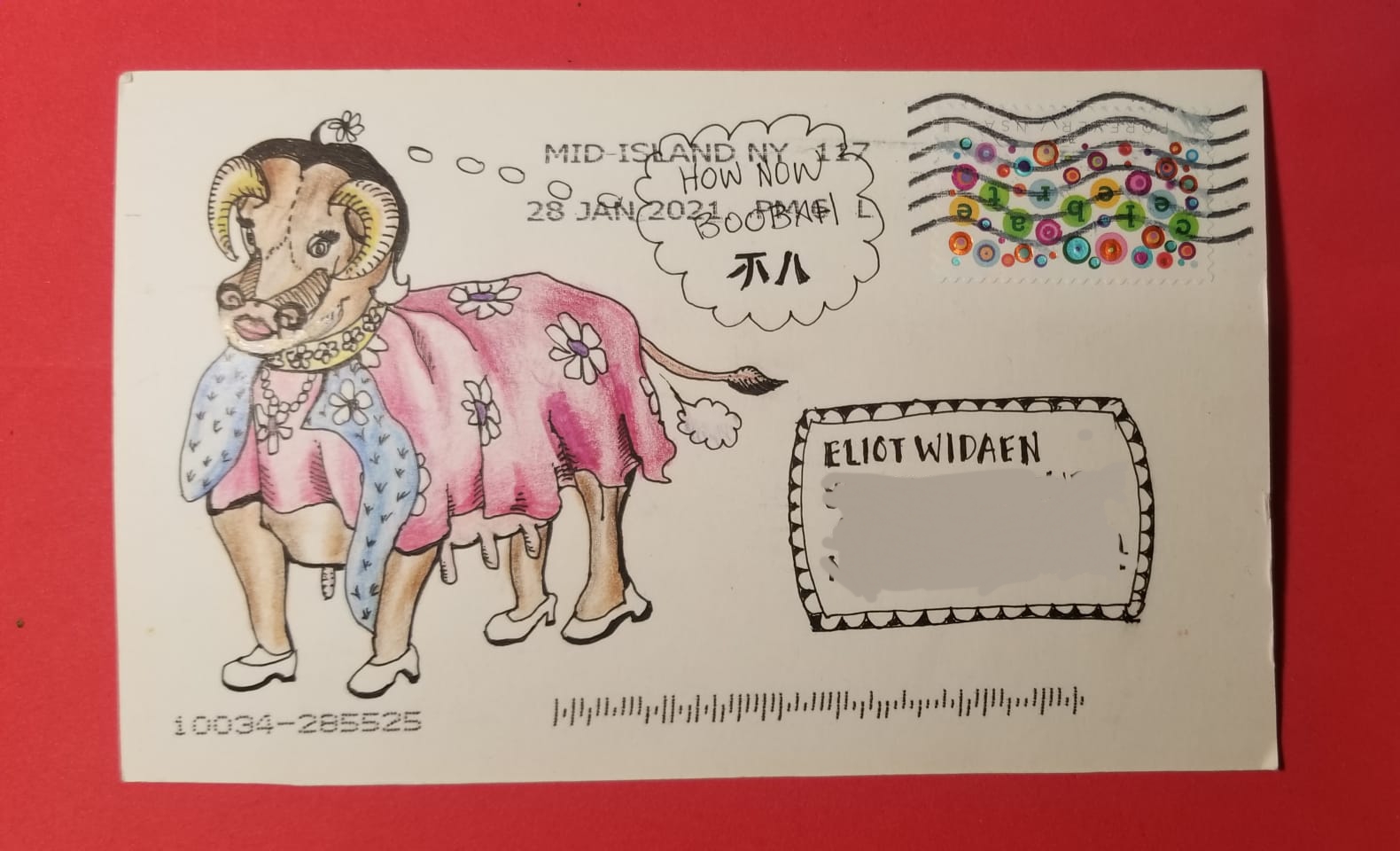
Sekhnet is an amazing artist who rarely finds time to draw or paint these days. Since her retirement she has been super-busy with dozens of things which leave her little time to draw, something she loves to do. I recently took a mat knife to a watercolor block and made us a pile of 4 X 6 postcards, with a sheet of postcard stamps next to it. I painted a couple and sent them to her, which got her thinking about returning the favor. Over the course of a few days she drew, and embellished, a delightful, whimsical beastie of some kind on one side and, on the other, in pale colors, wrote a greeting. When I got it (during a brief layover at my apartment) I snapped a photo and wrote: perfectly timed! I also noted that I loved the beast.

“What about the other side?” she asked. Sekhnet has a thing about too much white on a drawing. We disagree about this sometimes, but it is a constant critique of her’s about drawings I present to her: too much white space! She left too much white space on the message side of her card, and, acknowledging this, wrote, in tiny letters, “too much white space!” There was, in this case, objectively, way too much white space. In addition, the color had been applied very tentatively, so that the space that was not white was washed out. Not only too much white space, too little contrast, too little to otherwise catch the eye. Still, my unenthusiastic response miffed her. She found it discouraging that I would point this out, when she asked me what I thought of the flip side of her postcard. “No more postcards for you!” she immediately threatened. A threat I have no doubt she’ll make good on.

Decades ago, when I was teaching third grade in Harlem, I had a student named Gerald Davenport. We did a unit on poetry and the kids all submitted their original poems, which I typed out and printed up in a little booklet they all got a copy of. Gerald’s disappointment in not having his poem, which made no sense to me at the time, included in the collection haunts me to this day. Several times afterwards he asked me, poignantly, why I didn’t put his poem in the book with the rest. Each time I had no answer, except that I had been an unthinking asshole, which I was not able to really express, except by telling him each time that I was sorry, that it had been a mistake. The mistake was being an unthinking asshole who accidentally discouraged a kid when he could have instead easily encouraged him. Food for thought.

The importance of a word of hope in dark times

I forgot this one important chapter from my short piece about the life and death of a supremely unhappy man, The Book of Friedman. It might be the most significant and illuminating snapshot of the whole sad story. A reminder of forgotten hope at a terrible time is a great gift to give somebody, just as a sincere expression of premature doom may be about the worst thing you can offer somebody in trouble.

As a boy I believed I was destined to become a great artist. I always loved to draw and I was encouraged in this dream of immortality by my grandmother (who dreamed of my worldwide fame, which would surpass her first cousin’s, internationally known sculptor George Segal) my mother, and to some extent by the grudging respect for my talent that my natural born enemy, my father, often showed. My mother foolishly (she was proud, I guess) told me that my IQ was a ridiculously high number and that, therefore, it followed that I had all these limitless interests and talents. I was going to cure cancer, my mother predicted, while never explaining how my drawings would do that.

It was all largely a crock of shit, of course, as I would soon learn, but it pleased me as a young man to believe that being smart, sensitive and talented meant something more than a lifetime of “underachievement” and a number of friends holding sullen, mounting grudges that burst into inexplicable rage from time to time. An oversimplification, obviously, but I don’t want to linger here setting the stage for this illustration of the power of a word from a friend at a crucial time.

My old friend Friedman, as you may recall, lived an endless repetition of the same three act tragedy for the entire time I knew him, more than forty years. Act one was great admiration, excitement, hope, joy, giddiness. When he discovered something he found amazing, he adored it with all his might, placed all of his hopes for happiness in it.

When he found a long-haired kid two years younger than him who truly seemed not to give a shit, who had a quick, dark sense of humor, seemed open to the world and infinitely curious while finding the absurdity in everything, he was hooked. I was the object of his great admiration and I, in turn, basked in the admiration of this quirky, very intelligent two years older guy who could drive a car. The friendship worked well for both of us in the early days. I had one concrete benefit at the start, he taught me to drive and I would tool around Ft. Lee, New Jersey in his parents’ Dodge Dart.

We started playing music at the same time, we were fledgling guitar players together. Our band, Stifled Sweat, recorded its first album a few weeks later. It was a heady adventure, making anything we could imagine become some kind of cockeyed reality, “two minds working as one” (the name of our second album, I think).

Soon, unbeknownst to both of us, we began the longest and most convoluted Act Two in Friedman’s life of a thousand identical three act tragedies.

Act Two, you will recall, is the nagging inkling of disillusionment phase of the play. Cracks begin appearing, warts, enlarged pores, spider veins, hairs in the wrong places, signs that the perfect, beloved object may contain some imperfections. For a man who’d come to be increasingly haunted by signs of aging, of death, seeing these flaws created great tension in him. Imagine his horror to discover that it wasn’t that I didn’t give a shit about anything and quickly found the absurdity in everything because I was naturally cool, it was mostly that I was trying to escape from tremendous pain I could hardly understand and I had no fucking idea how to make hurt less.

Far from being the cool guy he thought he’d found, I was insecure, uncertain, sometimes brutal. The adorable, perfectly self-contained kitten he’d adopted was shedding his fur, and skin, and there was some kind of formidable snake emerging!

As an older man, I can now easily see that this was Friedman’s problem of perception and expectation and had little to do with who I actually was or even how I seemed to be. Nothing in his expectations of me or his perceptions of me had that much to do, really, with who I was or what was in my heart and mind.

At the time, though, Friedman’s constant disappointment in me for not being an actual mythically “cool guy” was a source of great mutual bitterness. The more shit he gave me about not being a cool guy deep down, the cooler I’d be. You want cool, bitch? Here you go. It’s the kind of stupid back and forth certain young people get into, particularly young men, I suppose. He lamented that he lacked the unhesitating certainty and killer instinct of Isaac Babel’s brutal, grimly cool cossacks. I became a cossack.

Anyway, as my thirtieth birthday approached (we covered about 16 years in the previous few paragraphs), I struggled to reconcile my view of what the role of an “artist” was (smart social critic) with the widely accepted view that an artist is someone celebrated for their vision, their inspired works displayed as marvels in the world’s museums, someone famous, popular, sought for conversation by media types, prized for wit and insight into human affairs, whose bravura scrawl on a restaurant table cloth is gratefully accepted as full payment for a lavish meal for ten at the most expensive bistro in Paris.

A crock of “poop” I picked up somewhere that was suddenly much too heavy to carry, especially as my recognition of class conflict and the injustice of wealth inequality became more and more acute. So the wealthy art-collectors/speculators decide who is a great artist and who is just a pretentious, agitated schmuck with unrealizable ambitions? I griped about this to an art teacher once at City College and he shrugged. “When has it been any different? Every artist we remember today had a wealthy patron. You want to get paid? You work for the rich.”

To resolve this tricky conflict I did the only thing possible. I had a kind of nervous breakdown. I’d made an ambitious super 8 mm movie that had been enthusiastically cheered by an audience of a hundred or so people I assembled in an auditorium on the Lower East Side. I was riding a bicycle, making deliveries, to make money while I dreamed of an even more ambitious movie, this one starring me as a misunderstood, highly sensitive antihero based loosely on Bruce Lee.

I was hit by a car while cutting across several lanes of traffic diagonally on Fifty-Seventh Street (ironically in front of one of the city’s most prestigious art galleries). The guy grazed my handlebars, spun the bike, I wound up breaking an arm. Waited at the scene with the driver, as I’d learned from experienced colleagues, until an ambulance picked me up.

Even though it had clearly been my fault, the driver’s insurance company was on the hook. A few months later some shyster got me a few thousand dollars from the driver’s father, or the insurance company or whatever.

This money was going to be my big break. I was going to go to Israel to visit friends and drink fresh carrot juice, then travel East a bit (most of the route east of Turkey was by then already an Islamist hotbed I probably couldn’t have navigated). When I returned to New York I was going to make this movie with the remaining four or five thousand dollars from the bike accident. That movie was going to be my calling card, the artistic statement that would vindicate everybody’s expectations of me as a great artist (and possibly also cure cancer).

I found it harder and harder to make decisions. My arm had healed, I didn’t need to work, yet I hesitated making plans to travel. I needed shoes, went to a shoe store, spent two hours trying on shoes, agonizing, left without a pair of shoes. The same thing happened everywhere. Soon my wit turned against me, as soon as I thought of something funny to say a harsh voice in my head would angrily tell me how stupid the crack was. I had trouble sleeping, I had trouble staying awake.

I’d promised a friend he could sublet my apartment while I was traveling. He’d made plans to move in. Then I told him I wasn’t sure what I was going to do. He was pissed, I told him I’d call him back.

“Look,” said my father, “it’s not fair to jam up your friend Brendan because you can’t make a decision. You’re planning to travel, so get out of your apartment and while you make up your mind, you can stay here.” I agreed, making the worst mistake in my life to that point. Brendan moved into my apartment for six months and, at twenty-nine, I was suddenly back living in my parents house, a place I hadn’t lived since I was seventeen. I soon found myself too paralyzed to do anything.

Dark days followed, the darkest of my life so far. I won’t linger trying to describe the pain of those interminable days as I became more and more comatose. I went into the city twice a week to talk to a shrink of some kind. She knitted her eyebrows with great concern. I’d walk to a friend’s place near her office, sit on his couch and immediately fall into a deep sleep. To me my waking life felt like Jimi’s line about “living at the bottom of a grave.”

The shrink eventually diagnosed my state as some kind of dysthymic disorder [1], not even full blown depression. I was too numb to be scandalized by this weak tea diagnosis. One thing that stayed in my mind at the time, as I read William Styron’s account of his own period debilitated by depression, was that the duration of a depressive episode was the same if you took medication or not. The shrink concurred. I opted out when she offered me pills.

One icy night I found myself walking with Friedman, down by Battery Park. It was freezing cold, thick sheets of ice all over the ground, and we were shuffling around this desolate park on the edge of the abandoned business district, by the river where it was even colder than everywhere else. In the distance the Statue of Liberty’s brass brazier was frozen in the harbor. Walking there was like being in hell. Physically and psychologically acutely uncomfortable, though fortunately for me, I was warmly dressed and mentally numb. What we were doing there I couldn’t tell you. Presumably Friedman had driven us there and parked his van, we got out and started to walk in this frozen hellscape. It was all the same to me. Friedman turned to me at one point and said the words this whole thing has been the frame for:

“Of all the people I’ve ever met, you’re the last person I ever thought would end up like this.”

The words he delivered with such sincere disappointment and conviction hit me hard. The compliment of the first part was totally lost on me. I’d ended up like this. Fuck. I don’t recall anything in those six months that hit me with anywhere near the force of that sad conclusion by a close friend.

A few weeks later a friend, finding out I was back at my parents’ place, invited me to live in his spare bedroom on West 163rd Street. He had a four track tape recorder in that room and a couple of nice guitars. I wrote three or four of the better songs I ever wrote, recorded them. I still couldn’t sleep, and couldn’t stay awake, and couldn’t really carry on a conversation, but this was a much better arrangement while I waited to get my apartment back in June.

In the spring I went to a party, in the former painting studio of my teacher and friend Florence. There was a girl there, cute, dark eyes, dark curly hair, caramel colored skin. She was wearing a white peasant shirt, open at the neck and bare tan shoulders and every time she passed I somehow tried to look down her shirt. When she was leaving she asked me to call her. I looked at her blankly “how.. uh.., can I call you if … I don’t … have your number?”

She seemed to find this charming, gave me a little laugh and a winning smile, bent to write her number and as she did I finally got a look down her shirt. Fuck me. Within a week we were having conjugal visits. Life was worth living again. Not perfect, but, shit, it never is. Still, I was very glad I hadn’t wound up like that. I was the second to last person who ever thought I’d end up like that.

[1]

A mild but long-term form of depression. Dysthymia is defined as a low mood occurring for at least two years, along with at least two other symptoms of depression. Examples of symptoms include lost interest in normal activities, hopelessness, low self-esteem, low appetite, low energy, sleep changes, and poor concentration. Treatments include medications and talk therapy.

Reminder: this too shall pass

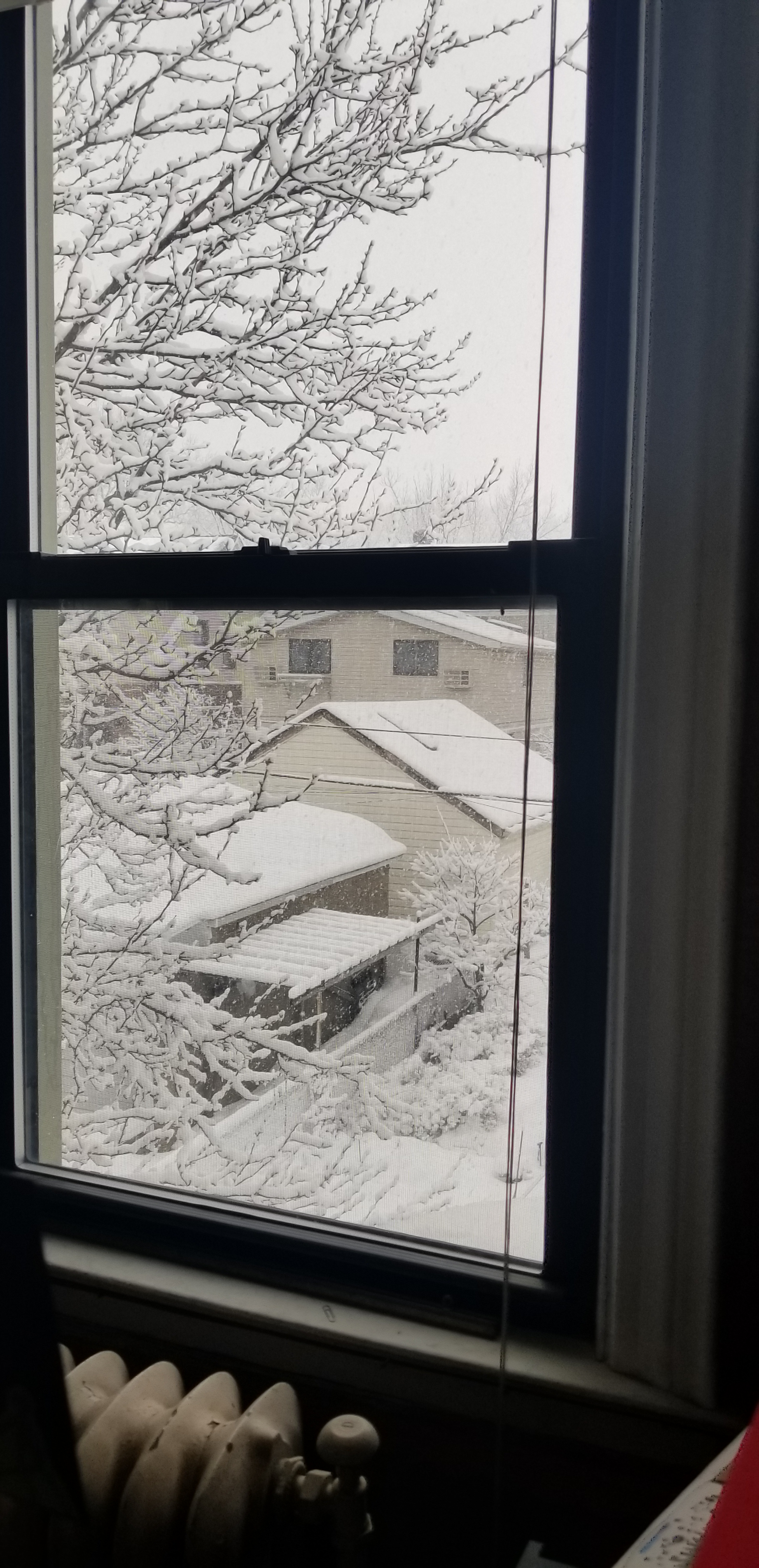
This is the view from my desk, out the window of the room where I am tapping out these words. Our bodies were just about recovered from the last strenuous session of countless lifts of shovels heaped with snow, a few days ago. Woke up a few days later to Groundhog’s Day, the movie. Got to say this for the snow, it’s beautiful this time. The last batch did not sit so perfectly on the branches of the trees.

It’s easy to forget, when you are faced with the forced lifting of something heavy, that this is not your life, or your fate. It’s a few hours, a day, a week, a month, a season. In the case of 2020, a year. In the case of the last four years, a few decades. Everything passes.

It’s easy to forget how odd and disorienting it is living through a deadly, airborne plague. It’s actually hard to remember once common things, like sitting in a room with a bunch of people you like but don’t see often, somebody cracking wise and everybody laughing. It used to happen all the time, the odds say it will happen again before too long.

It is not easy to remain philosophical during catastrophic times, though remaining philosophical is always a good thing to do. Yes, we are living in an age of worldwide insecurity, terror and rage — an age of terrible suffering on a massive scale. Yes, many millions around the world are freaking out, getting unreasonable, desperate, violent, authoritarian. The terror and rage is somewhat understandable, given the circumstances. This is a challenging epoch we are in, a bad patch, historically bad times. Unreasonableness has become the rule in many places. That doesn’t make it right, of course, but the reasons for it are pretty plain to see.

I usually chalk it up to the insatiable desire of a few entitled people, with the means and the power, to have, literally, everything. Pursuing this urge to have everything requires convincing millions that this arrangement — 1,000 for me, 1 for the rest of you suckers to share — is what nature intended. This convincing has never been easier to do than during this age of mass, instant “social media”. It may seem like a simplistic premise, but the unsatisfiable greed of those few in position to do either great good or terrible bad, explains much of the misery in the world.

I think of it like the old story of the fisherman’s wife and the magic fish, a parable about the inevitable misery that comes from an irrational, insatiable desire to have everything. A former girlfriend’s guru compared this unquenchable urge for ever more to a deer chasing a mirage of water as it dies of thirst.

The fisherman, a poor man, catches a remarkable looking fish. The fish speaks to him, telling him that if he shows mercy and throws him back that he will grant the poor fisherman any wish. The fisherman puts him back in the water, telling him this wish is too important to make by himself, that he must consult the wife. The fish tells him to go talk to his wife, promises to wait.

The fisherman talks to the wife, goes back to the fish. Tells the fish they want a beautiful house, with indoor plumbing and heat. The fish says fine and when the fisherman returns to the hovel there is a beautiful house, with indoor plumbing and heat. The fisherman and his wife celebrate.

Of course, it’s not long before the wife becomes dissatisfied with what now seems like a modest wish. “Go back to the fish,” she tells her husband.

When he returns it is drizzling. The fish agrees to turn the beautiful house into a magnificent castle. The fisherman returns to find the beautiful home is now a majestic castle.

It soon dawns on the wife that a castle without servants is not a very good deal. “Go back to the fish,” she says. Now it is raining hard as the fisherman conveys his wife’s request to the fish. The fish seems a little impatient but provides the servants.

You can see where this story is going, and where my analogy is going to go right after. Each request for more — soon it is power the wife wants, she needs to be a duchess, then a queen — is accompanied by worse and worse weather. In the end the fisherman is standing at the end of the dock in a raging hurricane, waves splashing around his legs, telling the fish sheepishly that his wife is no longer happy being the queen, she wants to be God. “Go back to your wife,” thunders the fish.

When the fisherman finally gets back home the wife is furious, dressed in her old rags in the original hovel.

We have people among us who are the fisherman’s insane fucking wife. Their voices are much louder, their breath much worse, than the rest of us. Depending on your prejudices you know who these people are. I am thinking of particular people, or corporate “persons,” owners of vast wealth who literally feel they are entitled to all the wealth in the world. This is a long discussion, perhaps, and this post, about remaining philosophical during challenging times, is not the place to make my case. If $100,000,000 is not enough to allow you to enjoy your life to the fullest, is $100,000,000,000 going to somehow help you in that regard? Just asking.

We have a certain amount of choice about certain things that torment us. We can exercise this choice to reduce the irrational urges we are all subject to sometimes. An undisciplined boy millionaire who craves respect and attention grows up to be a young adult “playboy” who brags in the media, like a comic book hero, about being the greatest winner in Gotham City. Then he needs to be at the top of the Forbes wealthiest list. Being rich and famous is not enough to fill his bottomless emptiness, of course. “Go back to the fucking fish, you fucking fucks,” he tells his lackeys. Being the president, of course, is not quite the same as being the king, or God. “Go back to the fucking fish, you worthless pieces of shit!” he thunders, as he sends a mob to decapitate the government he is about to lose control of.

It’s not just him, of course. There are a few thousand just like him. There’s a genius who makes $70,000,000,000 during a pandemic and tells his workers (and the independent contractors whose tips he steals) to suck it up and get back to work and if they don’t like the conditions — fuck off and die. There’s another guy who makes a similar bundle, stubbornly (and counter-factually) arguing that Americans are smart enough to decide for themselves whether one of the two major political parties is run by a cabal of Satan worshipping child raping cannibals. Just because millions of people hear this arguably extreme claim hundreds of times a day, on his platform, it is not, legally or morally, his concern. While literally billions of people live in desperate poverty, a shitload of the world’s wealth is in the hands of a fairly small group of super-wealthy guys who are unaccountable to anyone but the shareholders. We live in a hyper-competitive society that has only one true value — the bottom line.

People of good faith can argue both sides of this proposition about systemic unfairness, I guess. There is nothing inherently wrong, perhaps, with one person having more wealth than can be spent in a thousand lifetimes while millions of others live precarious lives, bundling ragged, hungry kids into their outdoor beds, while tens of thousands die deaths every year that could have been prevented, if only they could have seen a doctor, in the wealthiest nation in history. It is an abstract question of morality, perhaps, whether we just have to accept injustice as the way it is and has always been, no matter how vicious it sometimes is.

Those are arguments for another day. Discussions, really. If we are arguing about these general principles of fairness and mutual responsibility, the day is already lost. If Reason cannot guide us to be reasonable, it’s set and match. It may be set and match already, only time will tell, though the odds at the moment say that we won’t be meeting in a death camp (worst case scenario) but rather in a room full of people we like where someone will crack wise and we’ll all be laughing again (one of the better case scenarios).

To the extent you can, be of good cheer. Remember, this too shall pass. Here, it’s almost time to gear up and get to shoveling again, if only to dig out a couple of our feral cats trapped out back in this winter wonderland.

An evocative song for our times

Here is a beauty by Frank Burrows, a comrade from high school I have embarrassed over the years by repeatedly, and without provocation, calling a genius. I Wish is unique among his works (as far as I know), both instrumentally and because it’s a waltz. My hat’s off to the guy. I love this tune. Take a few minutes, breathe, and take it in. You won’t regret it.