Incoherence is no problem

The obvious problem with an incoherent position — one that relies on nothing but the right to take any position you want– is that, as long as the incoherence persists, there is no hope of solving any disagreement. We can only persuade each other if we reach a basic agreement about the facts in front of us. An incoherent argument doesn’t depend on facts, agreement or anything else– it’s an illogical position that closes the mind to persuasion.

I’ll give you one example, the argument over the filibuster, to stand in for the rest, as we navigate this “alternative fact” world we are living in post-Trump.

A lie, which can be shown to be a lie, can now be openly cited to prove that the policy you favor is necessary. That it is a demonstrable lie is no longer a problem, for purposes of partisan position-taking. You can call the well-publicized lie a “widely believed allegation”, which makes it sound much more reasonable. The same goes for any glittering generality pulled out of one’s nether sphincter — it’s good enough to support an otherwise incoherent argument.

Most Americans get their news from partisan sources. On the right people say that PBS, MSNBC and CNN are just as distorted, prejudiced and untruthful as FOX, Newsmax and OANN. It’s a flimsy claim, unsupported by actual evidence. Media on the right frequently highlights conspiratorial claims as though they are mainstream beliefs — when pressed on airing false claims they call the promotion of fringe ideas “entertainment” rather than factual “news” which has a much higher standard of “truth”.

Even the wildest ideas quickly become mainstream beliefs, like the widespread belief among conservatives that the 2020 presidential election may well have been stolen by massive fraud. A large percentage of Republicans believe the 2020 election was stolen from Donald J. Trump and that the January 6th riot at the Capitol was understandable, peaceful, non-threatening and perfectly legal [1].

Here’s one example of circular incoherence in public debate about restricting or getting rid of the peculiar institution known as the filibuster.

The problem is that a party with a razor thin Senate majority needs to find ten votes, in a disciplined opposition party that votes as a block, in order to pass almost any law. This is because the burden, in a filibuster, is on the majority party to reach 60 votes to end debate (even if there is no actual debate) and vote on a bill becoming a law.

Why is the burden not on the minority party filibustering to kill a proposed law? Why are 41 filibustering members not required to be present to maintain a filibuster rather than the majority party having to find ten votes among the filibustering party to stop this form of obstruction? There is no coherent explanation offered. It’s just the way it is.

Why is nobody in the minority party now required to stand and talk non-stop to keep a filibuster going? No coherent explanation is offered — outside of the small change in the rules that makes announcing the intent to filibuster good enough to infinitely block debate on any bill.

Those who advocate neither changing filibuster rules nor abolishing the parliamentary practice outright claim this obstruction technique encourages bipartisanship by making people more willing to compromise.

We don’t need to change anything about the filibuster, say conservatives like Joe Manchin and Kyrsten Sinema, what we need is more bipartisanship, more compromise, more trust between political parties that have become armed camps. We need more faith in the integrity of American elections that tens of millions now have lost faith in. We need this faith because our confidence in the fairness of our own democracy has been, rightly or wrongly. so badly undermined — and it’s a bipartisan problem.

That the argument is incoherent, in a nation where one party is committed to a lie about widespread voting fraud (and cast not a single vote to relieve the suffering of millions of Americans during a pandemic), is not a problem. Listen to Manchin being interviewed, read his op-ed in the Washington Post. Nobody will press him on the essential incoherence of his position, which he states as calmly and reasonably as can be, and which amounts to: the answer to racism is for people to stop being so damned racist.

The role of incoherence in human, particularly American, life is hard to overstate. Why do racists hate the people they hate? Ask ’em, they’ll tell you. It’s not all of ’em, you see, there are good ones, even among them. It’s really mostly the bad ones we hate, the angry ones, the ones who are violent, the ones who don’t denounce the violent ones, the quiet ones nobody can tell which side they’re actually on. Am I making sense? If not, maybe you need to think harder. We got this sturdy rope here, and the mob is pretty worked up, so think hard before you answer that you understand what I’m saying, since there’s none of them around to string up right this minute and people’s blood is getting hot, been getting hot, I can tell you for sure.

I keep thinking of a very neurotic guy I was friends with since grade school, his eyelid twitching as he nervously accused me of trying to deliberately destroy his troubled marriage. When he was done explaining his insane claim I was able to straighten things out a bit, but, you know, seriously– what the fuck?

Incoherence is particularly attractive when you’re very, very angry. Takes nothing particularly persuasive to convince oneself of the righteousness of one’s own rage. Anger can always justify itself, as long as you stay mad.

[1]

There is no PROOF that the people chanting “Hang Mike Pence!” were NOT actually skillfully disguised antifa provocateurs, rather than Trump supporters, nor that the policeman killed, or the one who lost an eye, were not attacked by these same BLM activists, disguised as Confederate flag waving insurrectionists. Listen to this:
Helplessness hurts like hell

I’ve been gripped by unease recently, a hopeless feeling that comes from my helplessness in the face of what I can only call evil. It’s painful to sit with helplessness while watching inexorable horrors. It feels like a continual punch in the gut. I think it’s because helplessness serves to underscore the intractable cruelty of the world, and its irrationality — it doesn’t matter if your perceptions, feelings and beliefs are clearly right — you can do nothing about the upsetting unfairness you are witnessing. Particularly if the perpetrators are willing to employ every weapon imaginable to make you shut up, or, if it comes to it, simply die.

It is useless to argue with an enflamed lynch mob, try to convince them that they are mistaken, whipped up by lies that have driven them insane — you can only run like hell from that kind of lust to kill, and hope your trick knee doesn’t give out. It is a nightmare, truly, standing by and watching someone abuse, even murder, somebody else, and being unable to help, being forced to swallow the horror that you are helpless.

Hence the grating Serenity Prayer, about God granting you the wisdom to know when to stop being tormented about terrible things you can do nothing about. There is a time to walk away from a painful situation, but serenity is certainly not the cure for so many bad things we are told we must simply tolerate.

Listening to some of the testimony in the Derek Chauvin trial you hear over and over the pain of witnesses who felt helpless as they tried to intervene, tried to get Chauvin up off the dying man’s neck, tried to get medical attention for the unresponsive George Floyd after he’d gasped out his last pleas for mercy and lost consciousness. Several of the witnesses broke down crying while trying to describe how they’d been unable to get through to the four policeman who worked together to slowly kill the handcuffed, terrified man they had pinned, face down, on the pavement.

It is 2021, this is probably the first internationally televised trial of the perpetrator of a lynching. Hundreds of years of this practice went unaddressed, with shrugs, with filibusters against laws to make lynching a federal crime [1], with practical warnings about how to avoid being lynched — don’t make trouble, keep your eyes on the ground, head down and your mouth shut, except to say “yes, sir.”

When police commit such killings, in the course of doing their job, they are often protected by a legal concept called “qualified immunity” [2] which makes sure they are never even put on trial, and if they are, only long enough for this protection to be invoked and the case against them dismissed. While a concept that only applies in civil suits, a similar logic — holding the police accountable for every split second (or even nine minute plus decision, as in killing George Floyd) would make the job of the police officer impossible to do — works in decisions about whether to prosecute police officers for deaths of unarmed people they may sometimes cause.

It may seem partisan to call the killing of George Floyd a lynching, instead of a tragic mistake, or the result of a split second judgement call, but check out the behavior of the officers, their unchanging demeanor, even after it became clear to every witness that they were killing an unresisting prisoner, over a fake $20 bill.

Picture the impassive face of the former officer Derek Chauvin, one hand in his pocket, as he steadily pressed his weight on the neck of a handcuffed man, avoiding eye contact with the agitated crowd, choking the life out of a man who had long ago ceased struggling. He ignored the crowd that was yelling that he was killing the man who pleaded for his life, kept his knee on Floyd’s neck long after his victim went limp and lost consciousness (which he never regained).

I don’t see any difference between what Chauvin and his colleagues did to George Floyd and what violent strangers did to my family, most dramatically in 1942-3, what violent men did to families of Tutsis, Rohingya, Armenians, lynching victims of every ethnicity throughout the ages. One commonality of all these atrocities is the enforced reality of helplessness in the face of deadly violence. You have moral objections? OK, step right up, you can be next.

My mother, a lifelong practitioner of helplessness (as well as a great reader), used to love Frank Bruni, who has long written for the New York Times. She told me she used to read him when he was the Times restaurant critic, and that his opinion columns were equally good reading. I check him out from time to time, and my hat’s off to him. He wrote a recent op-ed addressing the pain of helplessness and our duty to help destroy certain kinds of helplessness — like the helplessness of a crowd witnessing a police killing of a handcuffed man and unable to stop it. I’ll let Frank Bruni sum it up, this is from the end of his op-ed Listening to Those Who Saw George Floyd Die.

Seeking context for Floyd’s cries to his dead mother just before his own death, one of the prosecutors asked Ross about Floyd’s relation with his mother and how the loss of her affected him.

“He seemed kind of like a shell of himself,” Ross said. “He was broken.”

Her testimony was meant to shed light not on how Chauvin behaved but on how Floyd lived, and that made it essential. She reminded anyone paying attention — and a great many of us are paying close attention — that Floyd, now a symbol, was also a man: loving, loved, strong, weak, with virtues, with vices.

And so very, very vulnerable.

The witnesses who were there at the end of his life came face to face with that. I think they came face to face, too, with their own vulnerability — with the confirmation of how many people are unsafe, and sometimes even helpless, when we let hatred and bigotry fester.

Unable to alter that big picture, a few of the witnesses wondered what, if anything, they might have done differently on that one day.

“If I would’ve just not taken the bill, this could’ve been avoided,” said Christopher Martin, the clerk at Cup Foods, where Floyd used a fake $20, prompting a manager to summon the police.

Martin, 19, seemed to be struggling with a kind of survivor’s guilt. So did other witnesses. They shouldn’t, but I can’t say the same for many of the rest of us. We too seldom turn toward the ills that factored into George Floyd’s fate. We too often look the other way.

[1]

imagine what these titans of the former Confederacy would have argued, in opposing a federal law to criminalize lynching, if they hadn’t been allowed, by parliamentary rules, to simply read the phone book aloud

[2]

In the United States, qualified immunity is a legal principle that grants government officials performing discretionary functions immunity from civil suits unless the plaintiff shows that the official violated “clearly established statutory or constitutional rights of which a reasonable person would have known”. Wikipedia

Party of the Lie

Oppression is always based on a lie. Not all human lives are of equal value. Blacks, Hispanics and Muslims are inferior to Whites (and no true White can be a Muslim). An animal has no rights whatsoever, nor any real feelings, either. Jesus Christ, and His father, in their infinite mercy, intended wealthy white men to autocratically rule over everybody else, for the benefit of all. A “well-regulated militia” means every individual can own as many guns as he likes, with no regulation allowed. A fair and decisive election that even Bill Barr stated was without fraud on a scale that would change any results was “stolen”, we need to fix the laws to allow the GOP state legislatures to make the final calls in every state on which votes to throw out to ensure “election integrity”. The Civil War was not fought to defend slavery, it was purely an issue of states’ rights (to own slaves or not).

The list is endless.

Someone well-born has the God-given right to rule over the rabble, those who chose the conditions of their birth less wisely. A self-evident truth like “all men are created equal” obviously excludes natural inferiors like women, white men without land, slaves, the servant class, indigenous non-citizens, Chinese, other immigrant groups (unless they obtain sufficient wealth to make themselves equal), felons who’ve served their sentences and the rest of them.

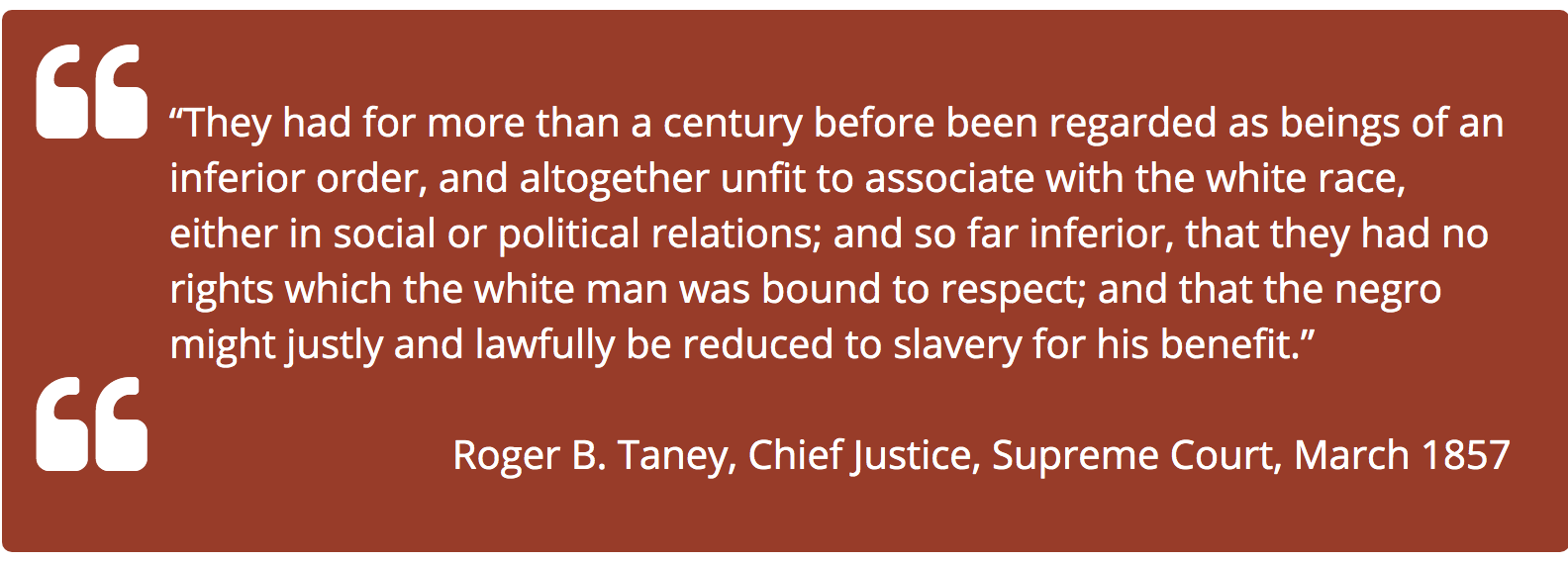
These things are so self-evident, they really go without saying. When the law is forced to say them, they sometimes do so unequivocally, as in the unappealable words of the Supreme Court: the Negro “has no rights which the white man is bound to respect.” [1]

After four fun-house years when repeated presidential lying was just doing what a solid 39% of Americans loved, what they themselves, if they had the power, would do, we have a party finally and irrevocably devoted to defending what is now routinely called The Big Lie — that the 2020 election was stolen. Because of widespread belief in this lie, you see, we need to fix laws that are not broken, to ensure that something that didn’t happen never happens again.

The Big Lie was a technique perfected and named by Hitler’s brilliant Minister of Public Enlightenment and Propaganda Joseph Goebbels. It’s a simple technique. Make an audacious lie (they get more attention and enflame more outrage than small lies) and repeat it over and over and over via the mass media. It works like magic, so seamlessly that after years of doing it, a depraved government can indulge its wildest fantasies. Why not, as millions of credulous Americans would celebrate, put Tom Hanks, Oprah, Hillary and the rest of those sick child blood drinking pedophile fucks in torture camps?

We now have one major political party, representing a solid 40% of our citizens (conservative estimate), marching in lockstep to the Big Lie. Because voting rights advocates have made great strides bringing more people to the polls, and we had a historically large turn out in 2020, during a pandemic, no less, we need new laws that would allow GOP state legislatures the final call on which votes to count in each state.

Such laws, which would ensure “election integrity” would also relieve any future Trump of the need to call individual state election officials, or fly them to Washington, to persuade them not to certify votes or to change certified vote totals. We need these laws, the GOP argues, to stop voting fraud, whether it actually happened or not, because of mass perception of widespread fraud that, tens of millions believe, led to an infernally clever, successful conspiracy to steal the election. This was an argument ambitious Lyin’ Ted Cruz made continually in the days leading up to the January 6 riot at the Capitol, so many Americans believe this baseless lie, we have to have a commission to investigate it before we allow a possibly stolen election to stand.

The 2020 election, with its historically large turn out, was miraculously clean and fair, in spite of widespread fear, and certified as such by members of both parties. This included the president’s own gunsel, one of the most powerful men in government, Bill Barr, who stated unequivocally, after railing nonstop about the danger of unverified massive voter fraud (by mail) leading up to the election, and authorizing federal investigations into suspected fraud right up to election day, that there had been no fraud anywhere on a scale that would have changed the results of the election [2].

Because of this lie, that the 2020 election was stolen, we had a riot in the Capitol to stop the certification of the Electoral College votes that Biden won by the identical “landslide” Trump won by in 2016. A riot there is now great dispute about, Republicans not supporting a full investigation into whether the president and his underlings planned and incited it, spending some $54,500,000 dollars (according to evidence produced in Trump’s second impeachment) to publicize, organize and foment it.

Republicans don’t want an investigation, because, after all, it would be so partisan and unfair, with Democrat [sic] control of the government. Can you really even call it a riot if only five people were killed, and only 140 police officers were seriously injured? The GOP resents all this kerfuffle about the so-called insurrection, this “riot”. Isn’t a riot, by definition, what Black people do? There were no Blacks in this one, among the violent antifa terrorist provocateurs posing as Trumpists, so how can it be a riot?

That is one of the terrible things about a Big Lie, or any lie you insist on, really, it leads to endless lies to support it. You have no choice, once you commit to an audacious and baseless lie, but to continually shore it up with further lies, block any inquiry that could show your lie is a lie.

It’s not even like an investigation into the cause of the January 6 “event” at the Capitol will necessarily lead us to the truth. Recall that when the 9-11 Commission finally met, after many months of stonewalling by Cheney and Bush, it had strict limits put on certain parts of its investigation. For example, when they interviewed Bush and Cheney there could be no notes taken, the two would take no oath to tell the truth, nobody could discuss anything either of them said, and nothing from that “testimony” could be included in the report. In other words, we have nothing to hide, and the power to enforce our right not to have to do so.

Trump, although its most grotesque and tireless exponent, was not the first powerful Republican (or Democratic, for that matter) compulsive liar. Trickle Down Economics, for example, the idea that giving more money to the wealthiest would immediately produce a tiny trickle of money to everybody else, was a big lie. If you give money to poor people, they spend it to buy things they need and want. If you give money to rich people, they hoard it, having no real need for the additional cash. Seems simple enough, but you repeat the idea that those who inherited $100,000,000 or more are “job creators”, that a “Death Tax” on their inherited fortunes unfairly penalizes those same people, and, in time, you can convince enough people to have your way.

As always, Heather Cox Richardson has a great analysis, this time of the current tug of war between voting rights activists, Big Business and the GOP on the final outcome of Trump’s last, greatest, most lucrative [3] Big Lie. Here you go, Heather for the bigger picture.

[1]

source

[2]

Barr, of course, his heroic efforts on behalf of Trump during his historically unjust and partisan stewardship of the Department of Justice aside, is now widely regarded by Trumpists as a disgrace who lacked the courage, like cowardly traitor Mike Pence, to do what was needed to keep their president in office. Finally, something we can all agree on in this brutally divided nation, Bill Barr is a disgrace.

[3]

Trump has raked in something like a half a billion in donations based on this Big Lie, the number was about $207,500,000, as of November 23, as the Rupert Murdoch-owned right-wing Wall Street Journal reported on his Big Lie-based fundraising on December 3, 2020, using the election lie to fleece both his sucker followers (they’d love him even more if he shot somebody in the face on Fifth Avenue and skull-fucked the corpse with his unimaginably gigantic member) and the usual mega-wealthy Betsy DeVos-style true believer cynics who fund right-wing crusades of all kinds.

I came across this article searching, unsuccessfully so far, for how many tens of millions of dollars Trump/RNC spent on their more than 250 lawsuits attempting to limit voter access prior to the 2020 election and the 60 or so claiming fraud and illegality that it lost after the election.

This is from Rupert Murdoch’s WSJ December 3 account:

President Trump’s campaign and the Republican National Committee have raised more than $207.5 million in the weeks since Election Day, his campaign said Thursday, as their claims of voting fraud have generated a financial windfall that could be deployed in future political ventures.

Despite an aggressive legal effort by the president’s attorneys in many states, there has been no evidence of widespread fraud and numerous federal and state officials have disputed the campaign’s fraud claims.

The size of the postelection fundraising haul between Nov. 4 and Nov. 23 is unprecedented for a losing candidate, much less an outgoing president. The fundraising total ensures Mr. Trump will have a considerable war chest at his disposal as a major figure in the Republican Party, especially as he contemplates a second White House bid.

source

Angry Punishment for Anger

This one hits me deep in my childhood — a furious reaction to anger. What do we learn from this lesson? The larger, more powerful party has the right to anger– you fucking don’t.

I’d never seen this maddeningly cruel dynamic set out more forcefully, or with more clarity and restraint, than Robin Givhan did in yesterday’s Washington Post.

Who has the right to be angry?

Anyone who has been hurt by someone they trusted has a right to be angry. The party who hurt them might be able to reassure them afterwards, placate them, apologize, make things right, but that is not the usual course of things — in my experience. An angry reaction seems to cause defensiveness and even more anger in most cases. Then it is a pure, adrenalized struggle for who will prevail in their right to be angry. This struggle is generally “won” by the more violent party, as when peaceful, shouting protesters against police violence are met with the overwhelming force of militarized anti-riot police violently dispersing them. Anger is explosive, your anger can ignite the adrenalized rage of someone who can bludgeon or even kill you to carry out their oath to protect the peace. You got a problem with that?

The defense in the Derek Chauvin murder trial has a very hard job. They need to convince somebody on the jury that Chauvin acted correctly when he kept his knee on the neck and back of a handcuffed man long enough for the prone man to lose consciousness, after the man pleaded for his life for seven agonizing minutes, and who kept the pressure up once the man stopped moving, then didn’t allow the dying man to receive medical attention. On the other hand, the defense only needs to convince one juror.

How do you do show that Chauvin acted correctly, according to his police training, when his actions seemingly killed a subdued misdemeanor suspect? By showing it wasn’t his fault, that things got out of hand, as well as by establishing arguably reasonable expert witness introduced doubt about whether Chauvin’s seemingly depraved actions contributed substantially to his victim’s death.

To show George Floyd’s death was not Chauvin’s fault, the defense needs to pin the blame on somebody else. In this case, a crowd of random bystanders, who were angry and abusive, and threatening, yeah, they were menacing, they refused to disperse when they were told the slow, torture death of yet another unarmed Black man was NOTHING TO SEE. Chauvin’s colleagues, who will be tried separately for their roles in killing a handcuffed civilian, prevented anyone in the crowd from intervening, prevented CPR on the seemingly lifeless man who was probably already dead on the street. The story their lawyers need need to sell is that the police feared for their lives, feared violence from an angry mob that gathered and surrounded them, and because of that reasonable fear, may have made innocent mistakes.

Leave aside the obvious fact that the police had the guns, the police had the ability to arrest people, call in reinforcements, helicopters and every manner of militarized support. But the angry crowd had them so rattled, you understand, that they didn’t realize they were actually killing the big handcuffed guy who had stopped breathing after they kneeled on him long enough. And as for the victim, he died of other causes unrelated to having the air supply to his heart and brain constricted for nine minutes and twenty-nine seconds. All you have to do, if you’re the defense, is establish a little doubt in the mind of a couple of jurors, even one.

If anyone had the right to be angry, the defense could argue, it’s Chauvin and his colleagues who were being disrespected by this irrationally angry, abusive crowd as they merely performed their duties the way they’d been taught to in the academy.

It reminds me of that bagpiping piece of shit Bill Barr’s smugness in continually blaming, and provoking, victims and protesters for their anger over regular “justified” police killings of unarmed citizens. It reminds me of anyone who provokes, out of their own rage, and blames the victim for being so fucking angry.

It reminds me of my own dear mother, shaking me by the shoulders when I was small, snarling “what did anybody ever do to you to make you so fucking angry?!” If I’d had the presence of mind as a kid, I’d have said “I don’t know, mom, maybe it’s my mother angrily shaking the shit out of me and demanding to know what I was so angry about?”

“She never laid a hand on you, you lying prick,” says the skeleton of my father. And as the doors open, I hop off this train, it’s become a bit stuffy in this car.

Does an unintentional lie hurt?

There’s a rhetorical question for you. If a guy lies to you, truly believing he is not lying, is that really a lie? Here’s another way of thinking of it: does an unintentional hard knee to the privates hurt?

The law, a problematic beast at best, has an intent requirement for many crimes. If you don’t have the required malicious intent to cause harm, you are not, under these laws, held responsible for committing a crime or even a tort. Malice has a strict legal definition, which comes in several varieties, express malice, malice aforethought, implied malice, etc. most of which boil down to the deliberate, intentional infliction of illegal or tortious harm. An act done knowingly (or in some cases just recklessly) to harm another, without just cause or excuse, constitutes legal malice.

When I complained of malice in the hard-heartedness of a lawyer friend’s increasingly aggravating responses to my aggravation, he told me that it plainly was not the case — he neither felt nor expressed malice, merely his opinion of the facts on the table as he understood them. Therefore, by the legal definition of malice, the definition he assumed I was referring to, with its requirement of no just cause or excuse, it was impossible that he had acted with malice, since he had, alternatively, no intent to cause me harm, nor (he added, sub silentio), lack of just cause or excuse if he had, unintentionally, caused such harm.

This is what comes of arguing with a lawyer, trained to parry and thrust whenever presented with even a straightforward assertion — to be “malice” it all hinges on the strict definition of intent or lack of just cause or excuse, doesn’t it?

I had to resort to other words to describe his unsympathetic stance: ill will, spite, hostility, for as the law notes:

malice in law
:implied malice in this entry
2: feelings of ill will, spite, or revenge 

NOTE: Such feelings are usually not an important component of malice in legal consideration unless punitive damages or actual malice is an issue.

source

In the ordinary use of the word malice, among non-lawyers, it is interchangeable with “ill will”, its synonyms are spite, malevolence, animosity, hostility, bitterness, rancor, enmity.

“Yes,” says the lawyer calmly, “but don’t all of these things require an intention to cause harm? If I am accidentally bitter, or arguably hostile, or seemingly spiteful, in your subjective estimation, how can you fault me for that? Accident negates will– there can be no ‘ill will’ without an intentional act of will, as you will have to admit, if you’re being honest. Since any harm I may have caused was purely unintentional and inadvertent, what are you complaining about?”

Might as well argue with a tumor.

This “intent” business is where the law gets sticky. An ordinary person assumes that a powerful man who lies over and over about a stolen election, spends $50,000,000 for media advertising of that deliberate lie, organizes a Stop the Steal rally (at a cost of $4,500,000) on the day the election results are being certified, shows an inflammatory two minute video about widespread voter fraud committed by riotous haters of American freedom, before speaking at length about the many detailed lies he’s already told, (the 205,000 corpses voting in Fulton County, to take just one), who repeatedly tells his crowd that they are the victims of a stolen election and that they have one last chance to fight like hell to stop it — I mean, once you’ve done all that, and a violent riot erupts, the most passionate of your crowd storming and ransacking the Capitol to Stop the Steal — it would seem to the ordinary person that you have set out everything needed to prove this fellow is responsible for the insurrection.

The law, however, often imposes a higher bar than common sense about what seems to be clear cause and effect. It often requires proving the subjective intent of the alleged perpetrator, a deliberate course of conduct, knowing that he was lying, and lying to deliberately bring about the foreseeable result his actions caused. Without this kind of legal rigor … well, you just have mob rule (says the law).

Similarly, when the same guy called the Secretary of State of Georgia and tried to convince him and his lawyer to throw out almost 12,000 ballots with arguments like “fellas, I’m talking about 11,780 votes here, give me a break…” to establish that he violated Georgia law about soliciting interference in an election we must prove that he intended to solicit that illegal interference. What if he did it by accident, truly believing that the 11,780 votes he wanted thrown out had really been cast fraudulently?

I went to law school, passed the bar exams of two states, practiced law for years, and I still have a hard time getting my brain around this shit. In the case of the Georgia law, it’s as if Trump ran his finger down the text of the law while he was trying to convince the Georgia Secretary of State to throw out results that had been recounted and certified three times, and made sure to violate every provision of the law. He went down the list: solicit, cajole, threaten, promise, influence, check! making sure to explicitly violate each provision and every iteration of the crime.

It may be, after the grand jury is done hearing the evidence, that he will be indicted, tried and convicted under this law, which has a mandatory two year prison sentence. I would not be unhappy to see this result, though millions might be, literally, up in arms about their leader being unfairly witch hunted this way.

The same goes for repeated lies about the totally non-threatening love fest at the Capitol on January 6. Cops beaten by the mob? That cop who lost an eye? The one killed? The many videos of anti-police violence? All irrelevant and very misleading, the protesters were peacefully expressing their first amendment rights (unfortunately deprived of their second amendment ones) and the far less than 200 seriously injured that day were injured by over-enthusiastic hugging and kissing. Hugging and kissing, you merciless motherfuckers! Now, prove I KNEW I was lying, asshole! [1].

Ignorance of the law is no excuse, as every school child learns. Just because you don’t know it’s illegal to do X doesn’t mean you won’t be held responsible for violating the law. Unless, of course, you retain diligent, skillful counsel who can create a reasonable doubt about whether you had the required mental state to have committed the crime. Slander, libel, defamation? No worries, if we can show you honestly believed the lies you were telling were true (no malice!).

Does this make sense to you, kid?

As I tap at the keyboard they’ve wrapped up the second day of the trial of Derrick Chauvin, the former police officer who, for 9 minutes and 29 seconds, kneeled on the neck and back of the handcuffed George Floyd, who pleaded for his life until he lost consciousness, while Chauvin continued to keep his knee on Floyd’s neck, long after he was motionless and silent.

The defense is making arguments, as defense attorneys are paid to do, which hinge on this violent constriction of Floyd’s blood and air flow not being what actually killed Floyd. The defense claims he died of a heart attack, caused by adrenaline and the illegal drugs he had in his system at the time of his death. Nothing to do with being pressed to the ground by a large man with his knees on his neck and back until he stopped breathing. Nothing whatsoever. Chauvin was afraid, because a large, hostile crowd was intimidating him. And so on.

It could work. It doesn’t take much to convince one or two in the jury of a plausible sounding excuse, based on actual selected facts. Hmmm. Coroner found fentanyl in his system, he’d been resisting arrest for a misdemeanor (allegedly passing a counterfeit twenty) so there’s the adrenaline, had a bad heart, big as he was, he couldn’t take somebody kneeling on him for eight or nine minutes — he freaked out and died of heart failure. Nobody’s fault, the tragedy, except perhaps the dead guy, who put everybody through all this pain…

Notice, no lying whatsoever required, just reframing. It wasn’t the continued knee on his neck that killed him, with the weight of a grown man behind it — it was a bunch of other things. Not murder, just a fucking tragedy. Not manslaughter, just a cop doing his difficult job under terrible circumstances, with a bunch of unfriendly natives angrily hassling him and mercilessly making videos of him in the course of his official duties. Chauvin didn’t kill George Floyd, George Floyd’s bad choices killed George Floyd.

Sometimes a lie is neither intentional nor unintentional, sometimes shit just happens when people are doing their jobs and we have to make sense of it the best we can. Or maybe we are lying to ourselves that we are not lying. Who’s to say?

Who’s to say?

[1]

What’s the harm of a lie?

It depends on the lie, of course. Some lies cover up terrible crimes, cause massacres, justify endless wars — others just make us uncomfortable. At the same time, every lie attacks our sense of fairness and undermines our faith in ever being able to get to the truth of anything. A lie is almost always a motivating factor for outraged violence, like lynchings. That some lies are relatively harmless does nothing to diminish the harm that lying does.

I had a friend who used to lie — almost always about small things. His particular tic of untruthfulness never bothered me very much. It was hard to tell, much of the time, why he’d told a particular lie. I always chalked it up to the very nervous fellow’s neurosis. I knew his mother, she was the same way. Could look you in the eye, and with the greatest apparent sincerity, assure you of something that was manifestly not true. These little lies can take their toll in a relationship, certainly, but, truly, I never held it against either of them.

Then there are bigger lies, about fundamental things. These are the clearly dangerous ones. By changing the truth, and distorting what actually happened, they serve to deny the validity of your rightful reaction, block the way to solving the actual problem and allow the liar to prevail. Big Lies justify all sorts of things. With a big enough lie, you can have a mob go into a neighborhood and feel totally righteous raining holy hell down on random passersby.

Lying is often motivated by an attempt to protect oneself from shame or accountability. I know a man who has lied since I met him, about almost everything. His father told my father “don’t believe a word he says, Irv, he’s a liar.” He lost his job, took his dead father’s credit cards, maxed them out, had the bills sent to a PO box he rented. Came home every week with a fat cash advance and pretended it was his pay from work. What could go wrong? Everything was fine for months, until his wife found a large unpaid credit card bill, sent to his secret PO box, in his pants pocket while she was doing the laundry. Eventually the credit card companies came looking for their money. If you ask the guy about this, he will have a story, if he doesn’t immediately go on the attack.

What is the harm of a lie? You know the answer to that from your own life, from the times a lie really mattered. The real harm comes when the lie is indignantly insisted on, over and over. Liars have a tendency never to back down and the rest of us tend to believe most things we hear over and over, or at least to develop doubts about what actually happened, based on an insistent lie. Undeviating repetition is crucial for convincing people of the lie, undermining our certainty about truth and falsity, or at least wearing us out and making us drop the whole subject in disgust.

An obvious recent example of what many are calling The Big Lie is about the 2020 election. It is the first time in American history that a president who lost an election, an election certified as fair by election officials of both parties, refused to accept the results — even after his successor was sworn in. He lied, over and over, continues to lie every time he speaks publicly, about massive fraud his lawyers could produce no evidence of in court.

He told his followers that they had been robbed, that he had massive, incontrovertible proof of widespread fraud, that the election was stolen, that the courts are corrupt enemies of the people who were in on the Steal. He called state election officials and tried to get them to change vote tallies, he told the Georgia Secretary of State exactly how many votes against him, 11, 780, he needed thrown out. He whipped up the anger of his most violence-prone followers, so much so that they rioted and Twitter eventually stopped its weak attempts to use disclaimers to hold him accountable for lying, banning him outright from the platform he’d used to such great effect.

When his incensed followers rampaged at the Capitol, injuring more than 100 police officers, killing at least one, trampling one of their own to death, and stormed the building to stop the lawful final certification of the votes, pausing to spread feces on busts of Democrats, it… uh, nobody was threatened that day, nobody chanted for the lynching of Mike Pence, or taunted next in line Nancy Pelosi, nobody released tear gas in the building, nobody tried to crush police in doors, or beat them with their own shields. It was a totally non-threatening riot, completely peaceful, the protesters were literally hugging and kissing the police — and nobody was arrested that day, which kind of proves that nobody was threatened or harmed in any way.

None of the Republicans who were locked down during the riot felt threatened — as the few who will talk about that day continue to insist. The Democrats, according to the GOP and its backers, are trying to blow the whole thing out of proportion for political advantage — lying liars using the liberal media to spread hateful propaganda, which is what these freedom-hating communists always do.

The old maxim that all it takes for evil to flourish is for good people to do nothing now comes into play. Even the handful of Republicans who voted to impeach and convict the former president for provoking the insurrectionist mayhem at the Capitol are quiet about it now, taking their political fortunes into account as they maintain a discreet silence. The corporations who loudly pulled campaign funding after Trump’s riot have now quietly resumed funding these candidates. The most ferocious advocates of the Stolen Election myth are raking in huge donations behind their fierce refusal to back down.

Last week Georgia became the first of 43 states (the hell are you waiting for, former Confederacy?) to pass laws that would allow the GOP to bypass the safeguards that protected the integrity of the last election and disqualify any votes they believed to have been cast by fraud. These “suspect” ballots are, of course, the ones cast in cities, in areas where many “non-whites” stand on line for many hours to cast votes that are cast with no wait in rural and suburban, heavily GOP areas. What is the basis for this new law? Repeated false allegations of massive voter fraud, elections that need their integrity protected, because millions of Trump supporters honestly believe fucking “n-words” illegally stole the will of the real people of Georgia by 11, 780 fake votes last time. This new law will allow a gerrymandered state legislature to have the final say on whose votes count and whose get tossed as “suspicious”.

Heather Cox Richardson, historian, is often described as apolitical. She gives the facts, lays out some of the echoes of history. She often sets the details of true events against modern day claims. Sometimes, simply juxtaposing two things is a political act. Of Trump’s Big Lie about massive fraud that never happened, the lie the Heritage Foundation has cited as valid grounds for the model legislation it produced, that 43 states are considering enacting into law, Cox Richardson compares it to the lies that were at the heart of the Ku Klux Klan, the “Redeemers” and the “segregationists”. A political act, by Heather, setting a true account of treachery against a lying story to justify similar chicanery, but there is nothing inaccurate about it. You can read the whole discussion here.

Is a lie not a lie because the liar honestly believes it’s true? We’ll take a look at that sticky business down the road.

(to be continued)

We were slaves

In a couple of hours Sekhnet and I will join a Zoom seder for passover. Passover is the holiday when we remember that we were slaves to Pharaoh in Egypt, about three thousand years ago, and vow to be vigilant in fighting slavery and injustice everywhere. It is called Passover because, the night before Pharaoh finally let his Jewish slaves flee, all-merciful God Himself, and not the Angel of Death who usually does such things, entered every Egyptian home and executed the first born male child, even if it was a baby; He passed over each Jewish (in those days Hebrew) home and spared Jewish babies — hence “Passover”.

God knew which homes were Jewish homes not by His innate, all-knowing genius or the poverty of the slave quarters (apparently Hebrew slaves in Egypt did not live in glaring, barnyard poverty like our chattel slaves here in the US did) but by the mark over the doorway, painted in lamb’s blood, that told the Holy One that this was a house where the babies should not be murdered.

I have more than one problem with this story. Not the part about identifying with the oppressed, it would be a far better world if everyone cared about and worked to protect the powerless, the weak, the despised. It’s the rest of the story, it’s religion, it’s the maddening righteous double-talk and suspension of critical thought often needed to sustain faith in the infinite mercy of powerful forces we cannot understand. It’s the quiet bigotry that is almost impossible to resist when you believe God loves you more than he loves people with different beliefs. And, of course, there’s God “Himself”, the all-merciful Creator who shows his infinite kindness by killing babies to convince a stubborn king to change his mind, when it comes right down to it.

For purposes of discussing religion and ethics I always yield on the point of God, if it is raised. Sure, there’s a God, fine with me. It doesn’t really change the discussion much, from my point of view. The only way to defend a God who allows continual brutal suffering, atrocity and mass-murder is to devise a Rube Goldberg device that blames humans, we who abuse the free will generously bestowed by the infinitely loving God, to do bad things, things that break God’s heart. A pogrom? Lynching? Insistence that a violent riot to overturn democracy that injured hundreds and killed several was a totally “harmless” love-fest? Nothing to do with God. No, God clearly hates that kind of thing. It’s humans, filthy, sinful, stupid, vain, angry, blaming others, trying to blame God!

I may feel the same way about many humans. Surely a group who breaks down the door of a jail and drags a man out to torture him and kill him– fuck them. Pour out thy wrath upon them, O Lord, as we ceremonially ask God to do, at one point during the seder (the telling of the Passover story and the meal). But no wrath is poured out on them, it’s poured out on the guy whose burnt body is swinging from a tree and on the people who loved him.

We were slaves, subject to hard labor for the eternal glory of rulers who fancied themselves gods in human form. In later generations we were dragged out of our hiding places, tortured, burnt, anti-semites loved doing this on Passover, when groups of Jews singing were easy to find. Hard to remember and identify with these painful things, in your soul, when you live in comfort and safety.

I’m not sure that reminding ourselves every Passover of our duty to see ourselves as though we personally were liberated from bondage really does the trick of changing our behavior very much. It is certainly a good practice to always remember that it is only a roll of the cosmic dice that decides whether we sit in comfortable homes celebrating together or run for our lives to a crowded, disease-ridden refugee camp in Cox’s Bazaar, Bangladesh.

I know this — it is much easier to not have to flee for your life, or go to bed hungry every night, without shelter. It is a better life when you do not have to face the harsh realities that billions on the planet are up against. We should be grateful to live in comfort, free from hunger, violence and random acts of viciousness, the things that break all-merciful God’s heart.

These terrible things should also break our hearts, but our hearts are not big enough to be continually broken by these things, we could not live with the despair it would produce. We’d never stop crying, looking around at the way things are for so many here in the richest country in human history, in other places were billions suffer such unimaginably awful fates.

So, understandably, we take comfort in our comfort, our ability to look away from all this human pain we never have to directly encounter. It’s understandable, after all, God Himself is able to look away, always has, always will. It’s not His fault, it’s ours. There is no God but the God in each of us. But it is a lot to expect that God to be more godly than the God we praise, over and over and over, in the face of all this human weakness and misery.

Happy Passover, y’all.

PTSD

Post Traumatic Stress Disorder was not a recognized psychological disorder when the special forces veteran escaped from prison, carjacked a couple’s car, beat the man unconscious and repeatedly raped the woman. I was working for a criminal court judge at the time, the summer of my first year of law school, when several armed guards brought the shackled, manacled prisoner in to argue his case — PTSD made him do it and he should be released from prison on those grounds.

The prisoner was an imposing man, large, muscular and with a savage looking beard. I recall that one of his three or four armed guards walked ten paces behind him with a shotgun. There were also a few NYC policemen in the courtroom, and the armed court guard had his hand near his gun as the prisoner took his place at the defense table. I was glad the guy was in chains, he was right out of central casting for a scary looking, trained to kill dangerous maniac. He had a passing resemblance to a scowling Liam Neeson, playing against type.

The judge had a court-appointed lawyer ready for the hearing, but the prisoner angrily declined the help. He made his argument, pretty forcefully, laying out the traumatic SEAL training he’d undergone, including waterboarding, beatings and sensory deprivation he’d been forced to undergo in his counter-interrogation training, and claimed that since PTSD had not been a recognized condition at the time he was tried and sentenced, that he be allowed to present it now in his defense.

The judge considered this for a moment then said “so your claim is that when you were under stress, after escaping from the prison, it triggered your stressful training and you fell back into your learned behavior, you automatically did what you were trained to do?”

“The stress triggered my PTSD and I acted as I was trained to act,” said the prisoner.

“I’m still trying to figure out what in your training caused you to repeatedly rape the woman,” said the judge. The prisoner glared at him, his motion denied, and the armed guards carefully escorted him back to prison. If looks could kill, I wouldn’t be here to tell the story.

Post Traumatic Stress Disorder is a real thing, of course. It is a serious, sometimes deadly, condition that is probably the cause of most of the 22 veteran suicides in the US every day (thank you for your service). It makes sense, if you think about it, that being in a traumatic situation (your best friend having his head blown off next to you, for example) would cause nightmares, insomnia, depression, anxiety and all the rest. Imagine how much worse your PTSD would be if the trauma was prolonged, extended day after day after day.

We don’t think of it this way, being in the middle of it, all of us determined to believe we are handling everything just fine, but this pandemic, exacerbated by the weaponization of medical precautions (anti-masker meet anti-vaxxer), exacerbated by obvious lies being constantly promulgated as “grounds” to suppress the right to vote, while claiming there can be no limits on our inalienable American right to own any kind of gun we like, as American poverty and food insecurity reaches new depths our top 0.1% now owns as much as our bottom 90%, having gained an additional $1,300,000,000,000 during the pandemic… it’s been a dizzying, traumatic shit storm, with no sign of an ending. Even if we reach herd immunity (assuming 49% of Republican men who claim they won’t be vaccinated are actually lying) and the pandemic stops killing so many of us, eventually goes down to fifteen deaths, then none… this has been a deeply traumatic more than year-long ride.

Last month (on Valentine’s Day, actually) the NY Times published a piece called ‘What’s the Point?’ Young People’s Despair Deepens as Covid-19 Crisis Drags On. The sub-headline is Experts paint a grim picture of the struggle with lockdown isolation — a “mental health pandemic” that should be treated as seriously as containing the coronavirus. Nothing in the report is at all surprising, though it is also shocking.

Old folks like me may feel disoriented during these objectively odd, scary, isolated times, but we have a lifetime of experience, and long time social networks, to help us keep some kind of perspective as we stumble through the genuine bizarreness of this extended pandemic. Younger people are affected much more strongly, as we can see all over the world. I can’t imagine the damage this lockdown is doing to young children, teenagers, young adults. The understandable impulse to immediately return to “normal”, against the best medical advice, is endangering everybody right at the point that we are about to finally control this plague and get back to more normal social life.

What is the public response? There are still millions who insist the virus was caused by China, that it was deliberately inflicted and exploited to fraudulently end the glorious presidency of God’s chosen imperfect vessel, that the vaccine, developed at “Warp Speed” under that very president will somehow kill you, that an army of woke zombies is coming to take the assault rifles Jesus said we can all have. Beyond that, and more ominous still, a war of good (protecting children from pedophiles) against evil (sex traffickers of children who drink their blood) is raging, a wild fantasy promoted by some of our most extreme elected officials. This is all part of a response to trauma that creates additional trauma. We are living in a supremely dangerous time.

You can have the shit beat out of you, even be killed, simply for looking Chinese. The violence is not committed by geniuses, even very stable ones. The rioters in the Capitol trying to make sure Trump stayed in power (how, exactly?) were not deep thinkers, they were bold actors looking for the next in line for the presidency to hang by the neck until dead — since he was a coward and a traitor. They had a strong belief (never mind what it was based on) and they took action. Now, of course, powerful GOP officials like Ron Johnson from Wisconsin, and Lyin’ Ted from Texas, are spinning the story of the riot, not even bothering to explain why 600 peaceful sit-in protesters were arrested at the Capitol in 2018 [1] but hundreds more, involved in a violent insurrection (in which 140 police officers were injured), were allowed to leave the scene of the riot unmolested.

To me, and call me a weakling, this all constitutes trauma, the kind of shit that can wake you at night with a sharp pang of the old PTSD. The trauma is ongoing, serious as cancer, corrosive as acid. Some days are better than others, mood-wise, and it is worth keeping in mind, I think, how traumatic the days we are living in now are, for everybody, Nazi and anti-Nazi, klansman and anti-klansman, moderate centrist and fiery radical alike.

[1]

Nearly 600 protesters, mostly women, were arrested on Thursday after they staged a non-violent action in the heart of a US Senate office building in Washington against Donald Trump’s “zero-tolerance” policy towards immigrants and separation of families at the border.

source

$7,400,000 an hour — Bezos!

The world’s most successful greedy man, Jeff Bezos, made over $65,000,000,000 during the pandemic. That comes out to $7,400,000 an hour [1] for the man who heroically insists on paying his 1.3 million sweatshop workers $15 and hour for their hard work — and manfully advocates for that generous living minimum wage to be forced on all his competitors. We should note that from Jeff’s point of view, he is actually losing money since his wealth was calculated as increasing by almost $9,000,000 an hour just two years ago.

While Bezos is raking in this pandemic-driven windfall he’s fighting Amazon workers’ attempts to organize. He ruthlessly put down one such attempt in NY at the start of the pandemic when workers concerned with contracting a deadly virus spoke up about conditions in his crowded, un-sanitized warehouses, where they worked around the clock without PPE to fulfill the increasing orders of tens of millions of locked-down Americans and increase the vast fortune of world’s second richest man. Amazon warehouse workers apparently have a 100% attrition rate during their first year, because the working conditions are so atrocious. Bezos also clawed back their $2/hour hazard pay bonus in May, at the end of the third month of the pandemic.

Bezos has been spending millions in business costs to fight attempts at unionization of his vast Amazon work force. You can read all about his tactics of threatening and intimidating anyone in his work force who seeks a voice in working conditions, collective bargaining and so forth. A guy like this is generally considered a piece of shit, I certainly see him that way.

And, of course, eventually the political — a powerful greedy piece of shit’s unfettered right to do whatever he sees fit because he has an army of lawyers and will generally face no consequences for any of his actions — becomes personal. Here’s my petty personal anecdote about the genius Jeff Bezos.

I have a small collection of one-hand opening folding knives, assembled over decades. I find it handy to have a knife in my pocket, for picnic use or for opening otherwise impossible to open plastic packaging, for example. I rarely spend more than $40 for a knife, but each time I see a new design innovation that is cool (a new style of lock or improved deployment method), lightweight and not close to something I already have, I pick it up. With the excellence of Chinese engineering and manufacturing in recent years, it’s possible to buy a knife for $40 or less that not long ago would have cost well over a hundred dollars. We are living in a golden age of well-made, inexpensive, one-handed opening folding knives.

In New York State, for whatever convoluted reason, a knife that is opened with a flipper, a little tab on the back or front of the blade used to pop the knife open, is illegal. An axis lock knife (like the Benchmade mini Griptilian) that can be flipped open in a milli-second, with a flick of the wrist, is legal, as are assisted opening knives that have a spring that makes them fly open in a similar quick blink of an eye. A thumb stud is fine, and there are many knives that have bearings in them that allow them to be whipped open instantly with a flick of the thumb stud. For whatever twisted reason, NY and Massachusetts do not allow you to order a knife that opens with a flipper.

I saw a video of a cool looking flipper knife, made by the reputable CRKT, that was very inexpensive. The couple doing the video loved this knife, and lovingly demonstrated its smoothness opening and closing one handed. It indeed looked cool and I didn’t have one like it. Plus, the price was a steal, a knife that could easily sell for $50 was selling for about $12.

Apparently it was made by CRKT for a cut-rate gun company called Ruger and that company was selling this model on its website for about $12. I immediately went to the website, found the knife (LCK) and, seeing it was not available for shipping in NYC (the site did specify New York City), called a friend who lives ten miles out of the city and arranged to send them there. I ordered three or four, and with the shipping, they were about $15 each. Two would be gifts, one would live on the kitchen table, the other I’d carry around in my pocket.

A short time after I placed the order I got an email from the company informing me that my order had been cancelled, since it could not be shipped to an address in New York State.

I began arranging to send the knives to a friend in Tennessee, who would keep one and send the others on to me in a postage paid box I’d send him. But I was too slow. Bezos never sleeps.

These knives are presently only available on Amazon, at $49.95, because a good businessman is a sucker to leave money on the table. The worlds’ greediest piece of shit apparently bought out the inventory on this LCK flipper knife and priced it according to what the market would bear. Why would he not? Even assuming he paid full retail for the knives (he surely did not), that’s still a rather nice 300% profit– so, again, why not?

Fair is fair, y’all– you snooze you fucking lose. The greed of the greediest among us never sleeps.

Hopefully Bezos will have to deal with his first unionized shop, after the final votes come in on March 29th from his predominantly Black work force in Bessemer, Alabama.

[1]

This comes as a new study, out today, from Americans for Tax Fairness and the Institute for Policy Studies has found Amazon CEO Jeff Bezos has seen his personal wealth increase by $65 billion since the pandemic began a year ago. That means Bezos’s wealth increased on average by over $7.4 million every hour for the past year.

Meanwhile, Amazon workers in Bessemer and other locations are being forced to work 10-hour shifts with just two 15-minute bathroom breaks.

source

Elegant schematic

I’ve been wrestling to put the mechanism of abuse into the fewest possible words. Abuse comes in many forms, and every one of them involves (among other things) the violent suppression of someone else’s rightful feelings. There is a common element to all abuse: whatever you think happened to you, whatever you can show me actually did happen to you — fuck you!

It may be helpful to see it set out this way, as I did toward the end the final draft of my letter to my former lifelong friend Paul:

I have to say, though, the schematic of your method is quite elegant. One friend sets out to prove to the other that people are deeply flawed brutes who cannot change in any fundamental way, salutes his friend for his years of efforts to be less brutish, thanks him for his mildness in the face of an angry confrontation, keeps professing ignorance of what his friend’s actual issues are, no matter how clearly stated — eventually provokes an angry response from his ahimsa-deluded old pal. Game and match! Elegant, man, you win. It must feel great.

It doesn’t feel great, obviously, and I am just being a sarcastic dick to say so to this poor, eternally besieged, black and white seeing, zero-sum calculating fucker. However, raising the bar on what constitutes “fundamental change” from becoming much more difficult to rile up (a difficult but attainable goal) to becoming impossible to provoke (a virtually impossible one, given enough time and perverse persistence) is damned clever, it’s what enables the abuser to insist he is right — and to prevail — no matter what the facts of the case show otherwise.

It’s the same as the game run by racists, the segregationists, those afraid and angry at Black Lives Matter for their cruel insistence that our society is ravaged by racism just because cops are continually killing unarmed Blacks with no consequences. Segregationists blame the victims, it’s all they’ve got.

“We don’t have slavery anymore, haven’t for more than 150 years, and these savage thugs are so ungrateful! What did we do? What did our generation do? A few of them get killed when they disobey cops, it happens to everybody, it happens way more to whites than to them [1]. Yet THEY angrily demand a special right to be treated like their lives matter so much more than anybody else’s. That’s why we hate them!”

That evil kid who decided his uncontrollable sexual urges made it necessary to murder seven women and a man? Police spokesman told every potential juror in the country that the poor little mass-murderer had had a “bad day”, and he wasn’t going to go into whether the slimy mass-murderer had expressed remorse, though he pointed out solemnly that the killer was aware of the “gravity” of what he’d done.

In the mind of the abuse/murder justifiers: Asians who are upset about this recent mass killing of Asian women? Here we go again with the “identity politics” and the “politics of victimization.” We don’t even know if this kid was motivated by specific ethnic or racial hatred when he sprayed these Asian women with bullets. Sheesh.

It’s like McConnell, using political power with unprecedented cynicism and a maddening double standard, threatening to release the Kraken and leave only “scorched earth” if Democrats vote to make minority obstruction more difficult for the obstructionist minority. How dare radical Democrats threaten to break the thing I spent a decade smashing with a sledge hammer!!!

Jesus, it must feel good to be that kind of winner, mustn’t it?

Assholes will be assholes, I suppose. The best we can do is the work of trying to making ourselves better, gentler, more attuned.

[1]

This is what the treacherous Bill Barr kept insisting, as they tried to turn the nationwide, predominantly peaceful, protests against the continual murder of unarmed Blacks, by police, into a sinister, violent anarchist conspiracy to riot against Law and Order, one that justified deploying massive military force to put it down, counter-insurgency style. Barr insisted many more whites than Blacks were killed by cops every year (note: Blacks are 13.4% of the population, so just statistically, that better be true) and you don’t hear whites whining about it — only Blacks. He pulled a number out of his ass, a small handful of unarmed Blacks killed by police each year, and claimed irrationally enraged Blacks were using this tiny number of people like Breonna Taylor, tragically killed, as a pretext to start a violent revolution. Like that large crowd of protesters by the White House that had to be cleared with chemical irritants, horseback charge, batons, riot forces, when they balked at their First Amendment right to peacefully protest being threatened with chemical irritants, horseback charge, batons, riot forces.

“Pepper spray is NOT a chemical irritant, (you irritating bitch!)” snarled Trump’s always pompous, often unapologetically irrational, bagpiping, culture warrior Attorney General, William Pelham Barr, on national TV.