Five Good Ideas for Music

Leave space.

This gives the other players the most options for adding their parts.

Listen.  

A most important and undervalued skill in music as in life, hearing what is going on and reacting to it directly.

Keep it simple.  

This works on a similar level to leaving space, a simple part is best foundation for other ideas.  

Be playful.  

Don’t forget why they call it playing, we do it for the same reason all baby animals love to play.

Don’t look for the spotlight.  

The best ensemble playing is done by generous players who listen to each other and add only parts that make the ensemble sound better.

A protest out the window

My rented apartment is in the back, away from the noise of the cars on the avenue that comes into the sunny front apartments.  On the window side there is a narrow alley between this old building and the one next door.  Out the back windows there is a larger expanse, a back alley city-scape where a rumble for a low budget version of West Side Story could be filmed.  The apartment is usually quiet and good for sleeping.

Years ago there was a man with Tourrets living across the alley.  In moments of my own frustration I would pause to listen to his outbursts, unintelligible growlings of rage, and think “the man makes a lot of sense.”  Then one day I didn’t hear him anymore.  I read a piece in a newspaper about a guy screaming vehemently at another guy in a nearby bodega and being beaten to death with a baseball bat.  I think it may well have been him.   Now I am the man with Tourrets, though my outbursts tend to be one or two screamed obscenities when the internet goes out suddenly or my computer has some robotic fun with me.

Recently someone moved into the building, seemingly a theremin player.   The theremin was featured on the soundtracks of many black and white horror movies, its quavering, wailing tone sliding eerily from low to high and back.  Used properly, it makes the hair on the spine tingle.  I was lying in bed one day listening to someone methodically going up and down the fluid scale of a theremin.  

After a good while, when the theremin began singing in regular intervals and more typical scales, I recognized these were a soprano’s voice exercises.  “Oh, God,” I thought to myself wearily, “shut the fuck up….”  I turned my head on the pillow so that my mostly clogged ear was facing outward.   The high pitched vocal exercises continued, but were slightly muffled.

After another few minutes a man with windows on the alley could stand it no longer.  “Will you please shut the fuck up?” he called gruffly and politely out his window.   I smiled as the singing stopped.  My smile turned to a smirk as the startled soprano resumed her exercises.  I realized it was time to get out of bed, and distracted myself in the other room as the singer continued to chase her dreams directly above my bed.

The Opposite May Also Be True

Went back to buy the guitar today.  As I passed through the main room there was a quiet vibe in the electric guitar section.  A young woman played quietly with a phone propped on her thigh, maybe jotting down a song idea.   A guy, who looked, with tattoos and serious Scottie Pippen profile, like a possibly dangerous gang member, was playing some meditative lines that brought Jerry to mind.  A few other people played, thoughtfully, none of them too loudly.  I reproached myself mildly, perhaps I’d been too harsh the day before about those exhibitionist wankers I pictured driving themselves into dividers.

Into the acoustic guitar room where a guy was checking out a booming electric acoustic bass. I took the guitar into the other room, with the acoustic amps, and slid the glass door closed.  An introverted kid with dark hair dyed blonde on top sat facing the wall, a big acoustic/electric guitar plugged in.   The kid played some interesting open chords, paused as I got in tune.  I played for a moment and the kid started again, an open chord the young guitarist could not have spelled.  The raga bass note was D and it was not hard to find things to play that complimented the kid’s strange chord changes.

The notes you finger on the strings form harmonies, chords.  Some are basic ones every beginner learns, G, A, D, Dm, E, Am.   You can spell these chords by naming the notes you finger:  G-B-D-G-B-G forms a simple G major chord, spelled 1-3-5-1-3-5, the places of these notes on the G major scale.  You can make the harmonies fancier, and weirder, by changing a note or two of a familiar harmony.  You can also change the voicing, the order of the notes.  A G chord can be played with a B, its third (a strong harmonic partner) on the low string. Lower that B one fret to a Bb and you have a cool fingering of a G minor chord, with the minor third in the bass.   You can add notes to harmonies, subtract notes, play open strings that give unusual sounds — there are many possibilities.  Jazz guitarists can tell you that you have fingered an inversion of a C6-9 chord, called that because the notes added are the sixth and ninth degrees of the C major scale, but many guitarists, particularly young ones, just find cool sounding chords and mess around with them up and down the neck.

These odd chords and eccentric invented voicings are among the first amazing things creative young guitarists discover, and this young player was working with these ideas as I was checking out the guitar I was going to buy.   The young guitarist was not insistent, in fact was somewhat reticent, but from time to time some of those odd chords would flower into the air from the amp, a rhythm would be tapped out. I’d catch a chord and bend a bass note along to it, let it shimmer, then play a little run ending with the flavorful riff from Norwegian Wood.  It sounded good to me, this interplay, and it felt good, too.  There could not have been a greater contrast between this interactive guitar player and the showy jacked up masturbator of a few days earlier.    

I lingered, checking out the guitar, listening to this kid’s ideas, adding notes and ideas of my own.  The guitarist was making musical sense, there was logic to the choices and a sensibility, a poetry, that made it easy to follow.  Most importantly, he left generous patches of silence among what he was playing, inviting oxygen-rich spaces where music can breathe and grow.

It put me back in time to when I was first learning the guitar, the magic feeling when something accidentally turned musical.  I thought of my friend Paul, a young man who couldn’t spell even a simple chord to save his life (and once, when his life literally might have depended on it, he couldn’t be bothered to learn to spell) but who is probably the most intuitively brilliant and inventive guitarist I’ve ever met.  He’d stumble on a chord shape he loved the sound of and would soon fashion a song out of it, then another, then five variations on that.  I remember his beautiful solo arrangement of By The Time I Get To Phoenix, a song that caught his fancy, though he couldn’t have told you the key or the names of any of the chords he was playing.

This kid in the acoustic guitar room was no virtuoso, but he played with great taste.  The way he lovingly took a sound and played with it reminded me of Paul, of my own early experiments with guitars.   I could have played there until the store closed, the guitar was nice to play, the room was air-conditioned, the amp had a great reverb, our levels were perfectly adjusted so we could hear the nuances of what each of us was playing.  I suppose we played for about an hour.  

I got up, unplugged my new guitar and bought it.  As this was going on the kid left, head down, eyes avoiding everyone else’s.  I wanted to say “hey, you sounded good.  It was a pleasure playing with you.”  It would have meant a lot to the kid, I think.  My reflexes were too slow.  I said nothing to the kid, but I note here; things may be horrible sometimes, but without warning, the opposite may also be true.  Be alert for the small miracles that make the rest of this worthwhile.

Life’s Work

The pursuit of excellence for its own sake is regarded as idiocy in a society that values only the creation of value– that is, the creation of the dough re mi — money you can buy things with.  Things are given value according to how much they’re worth — in dollars and cents. Nothing could be more basic and immutable than this first law of the marketplace, no?   Why bother to write clearly, if not to hone your craft for money?   Why be meticulous about playing in tune, and in time, if nobody is paying — if, in fact, nobody is listening?   I am listening.    

I was checking out a guitar yesterday, a 3/4 size Martin that felt good in my hands, sounded good.   I’d been thinking about it, realizing I’d probably have to buy it, even though it’s not really made of wood. “How does it sound amplified?” I asked the kid with very long hair.   He handed me a cable and led me to a room with padded stools and amps.  

“It sounds good,” he said.  He was right.  Damn, it sounded very good. I began to play, now with a pick, now using fingertips to pluck the chords of One Note Samba; I strummed with my thumb, with the pick.  A nice rich, round tone.  The pleasure of playing this little guitar was considerable, my hands relaxed, playing things they’d played enough to play smoothly, improvising, checking out the harmonics.

Somebody came into the room after a few minutes and began to play another guitar.  At first I was annoyed at the intrusion, but when I realized the guy was playing a straightforward thing in E,  I played in E, some fills, a couple of chords.   It was OK, I could continue to check out the guitar.   My back was to the guy, he’d sat behind me.   He soon got very ornate, playing a fast, elaborate finger-picking piece that was tricky to follow.  He turned up his amp.  

It was quickly obvious that this was the common exhibitionist wanker in a guitar store, there are dozens of them, wailing away, fancying themselves gunslingers, striving for supremacy, the spotlight, the admiration of their flailing peers.   If you walk through the main room of any guitar store there are many of them, bashing away at guitars, in every key, in no key, with varying degrees of skill, playing over each other, all of them way too loud.   The cacophony is unbearable.   They get into cars, if they have them, tailgate, ride the horn, pass on the shoulder cursing as they go, spin out of control, ultimately wind up totaling their cars into a divider.  On a good day.

I never turned to look at him, unplugged the guitar and brought it back to the salesman.  I’ll buy it tomorrow, I decided, when I’ll be in the neighborhood next.

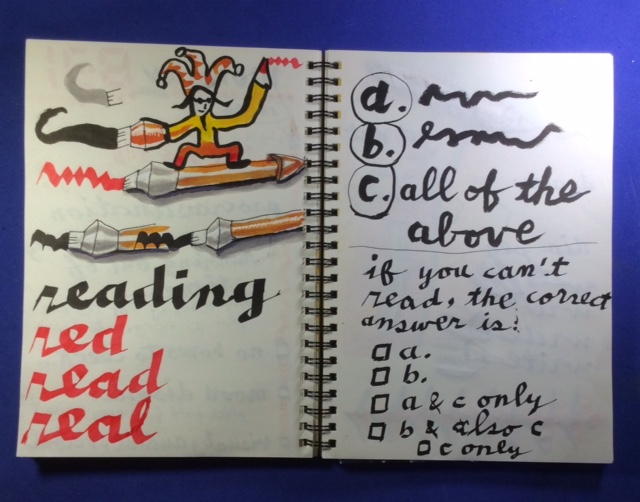
In the subway on the way home I am fleshing out an idea that struck me while walking across 18th Street.  I’d paused to write: reading is magic, think about it.  Marks on paper tell you what I’m thinking.

Picture that animated.   That’s what I was doing on the subway.  I drew a pen, took a brush and painted a shadow under it.  The train swayed, jerked, but I have always written and drawn on trains, am an experienced surfer that way.  It is a very rare stroke that goes wrong for me on a train.   I soon had a 3-D looking calligraphy pen drawn on the page.  I made a note to animate the drawing and then cut the pen out.  I’d take the cut out pen, dip it in a drawing of an ink bottle, the cruder the better, and write the words, in stop-motion, as though they were flowing from the moving pen:

Reading is magic, think about it.  Marks on paper tell me what you’re thinking.  

True.  A simple but powerful illustration of the amazing human invention of writing and reading — communicating anything you can think of to express using combinations of 26 symbols.  Also a powerful evocation of the potential of animation to get kids interested in literacy.   I drew in my book for about ten stops, was pleased and shut my eyes.  It felt wonderful to shut my eyes on that air-conditioned train.  

write ani

Inevitably I had the second thought, which caused my eyes to open and which I began to note on another page — in black and white.  

reading animation

We do not, as a society, give a fuck if you can read, have a rich mental life, consider ideas and solutions to problems you might not have imagined.  We do not, as a society, give a rat’s ass if you can write, beyond clicking a box assuming liability for any and all debts incurred in the course of your dealings with our corporation.  

Our society does not have work, or any productive use, for a good chunk of its people, tens of millions of them.  The young versions of these unneeded people are sent to schools to prepare them for a life where they are not needed.  The lesson many of them learn clearly is: fuck you, asshole, bend over and spread your cheeks.  Lift up the nutsack. Cough.  

Life’s work:  knowing this, all of it, and living calmly and productively, doing everything your talents allow to inspire, give hope, make a small ripple of change.  Death is waiting for you anyway, why be aggravated by the many aggravations this life dispenses so generously for free?

We Wuz Stars, yo

A couple of decades ago, when I still thought I’d make my living by writing a great book or something, I answered an ad in the New York Times and got a job as tutor to the stars.  It didn’t pay much, but it was a cool gig that took me to several nice hotels in different cities and for a while I had hopes of a song of mine being bought for an album by a number one recording group.  The lead singer, my student, dug the song a lot.  I’d daydream about hearing their version of it on the radio, cashing the fat royalty checks.  

It was also fun designing a custom curriculum for my student, as I’d just read Emile by Jean-Jacques Rousseau (ghost writing a paper for my sister’s most oppressive grad school class) and was able to put its excellent principles directly into practice.  It was gratifying to see how well it worked, like water falling on a parched plant that suddenly begins to flower.

The reason the youngest member of the group needed a tutor is a law that apparently requires show biz kids under 17 (maybe 16) to have a tutor hired by the management company who is profiting off them.  It is an offshoot of the Child Labor Laws, I suppose.   My student and I, when in NYC, most often met in the conference room at Get Down Bitch Records, several floors above the lobby where Tupac was shot in the balls one dark night in a gun attack prior to the drive-by that killed him.

“Ordered by (insert name of mogul in charge of Get Down Bitch Records– not its real name) no doubt,” I said to my 16 year-old student one day.   He pointed in panic at the ceiling and mouthed words that led me to understand that the conference room was mic’ed, that the mogul could easily listen from his desk while smoking a blunt and having his knob polished by one of the fine looking women there who had no clear job description.   I caught on quick, “of course, everybody knows Mr (insert name) is a great man, a good friend of Tupac’s and had nothing to do with it, I know he’s looking for the shooters,” I added, quick and cowardly as a young Bob Hope.  My student smirked.  

“That ain’t gonna save you,” he said, laughing.  Then we continued discussing Coffin Ed Johnson and Gravedigger Jones, from the book we were reading together.

“Would I have heard of him?” my sister asked as we walked on a street in a fancy section of Boston.  We were passing a record store and, as I ushered her inside, on cue, my student Jason, all in white, was dancing across a wall full of TV screens.  Twenty or thirty graceful, glossy Jasons exuded charisma as their hit song lip synched its way over the excellent sound system.  “Wow!” said my sister.

For a short time these four talented and obnoxious brothers, my student the youngest, were plucked from obscurity and little Jason was, for a moment in time, young Michael Jackson.  It was like walking down the street with Elvis, when we ventured from Get Down Bitch to nearby Manny’s to play the sequencers there together.  I pretended to be his body guard when fans crushed in, ushering him quickly to some imaginary appointment I reminded him we were late for.

We joked, the road manager and I, that they should have a reality TV show (this was before such shows existed) called “We Wuz Starz, Yo”— never were four bigger assholes given a luckier break they were so comically intent on blowing.   I harbor no bitterness, mind you, heh, but these pricks were Grade A and they fell back to obscurity as quickly as they had risen to fame, and as justly.  The record company likely never recouped its million dollar advance, even with the platinum record, and when their second album tanked the company was glad to get rid of the four prima donnas.

I am thinking about them at the moment for a reason I’ll get to presently.  They came by their brutality and dysfunction the time-honored way.  They were raised by an enraged and upright religious fanatic who whipped the boys with wire hangers he straightened into whips, handles made of masking tape, the better to have a good grip.  The youngest, my student, had been spared at the mother’s insistence, I was assured.  He was the only one to escape the father’s rage in physical form.  The oldest had the whip marks burned into his back, like in an old black and white photo of a slave’s hideously scarred back.  It accounted for their savagery as a group, though one at a time they were nice enough young men.  

My favorite, aside from my bright, wise ass, Special Ed for no reason other than attitude student, was the oldest brother, Chris.  If I remember correctly his nickname was Choc, because he was the darkest of these Trinidadian brothers.  

We flash forward, past the weekend in Beverly Hills, past a second California trip that included a great time in San Francisco, past the great strides the bright, semi-literate Jason was suddenly making when he was engaged with what he was learning, past Chris telling me how much his brother Jason admired me, never stopped talking about me, past the fateful plane trip to Toronto where, after they’d fired the experienced road manager and put the sister in charge (to save money), we were promptly detained for hours at the Canadian airport for lack of the required paperwork the sister and former road manager had argued about.   There was no transportation arranged, and being the only one over 25 with a credit card, I was forced, after a call to the concern I worked for, to rent a van to drive them around in.  It was not part of my job, I was not paid anything for it, but I became these assholes’ chauffeur.  

It’s possible that as things escalated I may have found it necessary to ad lib the arguably anti-Semitic sounding “you assholes ought to make like the Jews and blow the chauffeur,” when I grew sick of their hassling and attempts to bully me.  Their threats heated up, they were going to trash the car, torch it, rip it up– it was on my credit card and I’d have to fucking pay.  Ha ha.  As the abuse became more feverish I told the other brother traveling with us to tell the other hyena motherfuckers to shut up, yelling grew even louder, objects flung at the driver, things got out of control.  I got back to the hotel, packed my bag and booked a flight back to NY.  “You bitches are on your own,” I informed them, driving the rented van back to the airport.

Things certainly could have ended better, I realize in hindsight.  No blood was spilled.  Sticks and stones and shit.  I’d lasted weeks longer than the previous tutor.  Wrote a short story about the experience, centering on the good looking and arrogant sister, and her delightful flirtation on a night flight back from LA, ending with her touchingly sincere, if way too late, voicemail apology for how things had ended.  She’d actually begged me to come back, said she understood if I didn’t.  It was a shit story, in any case.   My tune was never recorded.  C’est la guerre.

Decades ago, piss down the drain.  Funnily enough, a few months later I got a call from someone I’d met at Get Down Bitch, he had a new act, was I still tutoring?  Negotiated a deal for twice my old rate, the girl was smart, cool and very down to earth.  “Be nice to the people you meet on the way up, because you’re going to meet them again on the way down,” she told me one day.  A beautiful, talented girl, a wonderful student and very quick study, mostly a pleasure to work with.  Her mother, on the other hand, almost the complete opposite, destroyed the girl’s promising career before it could take off.  I managed to get paid in full before it all went into the toilet, though the mother did her best to beat me out of those last two paychecks.  Just another sad story in the Naked City.

Anyway, I’m on the A train last night, after midnight, riding uptown.  On the bench diagonally across from me was a guy I am about 75% sure was Chris, the oldest brother, the one with the driest sense of humor, the most intelligent.   Thought of saying “Chris” and seeing if it was him.  Looked at him a long time, couldn’t decide.  Saw him looking over at me, an old white guy who looked a lot different than when he possibly knew me.  It had also been 20 years, after all, years that had been a bit kinder to him than to me.   Besides, one has to be cool on the subway, it’s not a Starbucks in the midwest.   Weighed the pros and cons, couldn’t find enough pros, I suppose.  Closed my eyes and rested for a few moments.

I looked over later and he was lying down on the subway bench, staring up at the ceiling of the A train car.   I heard him singing suddenly– didn’t sound like much, but maybe he wasn’t trying too hard.  He was the best singer of the four, my student always said so.  Got off the train, walked up to my apartment.  Never will know if it was the guy or not.  Does it make a difference?

We wuz stars, yo.

The importance of creativity

Adaptation of something I wrote two summers ago, all bitter references to unhygenic assholes removed, for marketing purposes:

Think of a world without creativity.   No music, comedy, repartee, great food; no movies, books or even articles, no television worth watching, no mischief, nothing worth laughing at, no cause for that good cry that is sometimes so needed.

Creativity, much spoken about by educators today, has always been at the heart of learning and good teaching.  

All creativity involves a certain amount of spontaneity.  It is play. The great John Cleese describes the essential conditions for creativity in a wonderful clip, unfortunately no longer available on youTube.  The five factors he talks about are:  place, start time, ending time, confidence and humor.   

For young children, who are naturally creative when given the slightest chance to be,  we’ve reduced the formula to this:

Have fun and help each other.

You can’t have fun if people are bothering you.  Don’t bother anyone. If you can’t help, don’t hurt.

When it’s time to be quiet for a minute or two, be quiet.

Cleese locates the creativity, you need a space to do it.  How about a room filled with art materials and a camera stand to shoot frames? With a recorder to make soundtracks and a computer to assemble the animations.

Cleese discusses the importance of a time set aside, a time with a beginning and an end, ideally about two hours.   He points out that it takes up to a half hour to leave the pressures of life outside and begin to play.  With luck you will play for 90 minutes or so.  Then play must end, as play always does, because it doesn’t feel like play forever. 

This is exactly what happens in the animation workshop.  For ninety minutes the kids have all the time in the world.

The other aspect of time is patience, taking your time, having a block of time you can use for play and dreaming up ideas.  You cannot be very creative while watching the clock, just like you can’t productively meditate keeping an eye on time.  You have to let things develop in their time, comfortable with not much happening sometimes.  

Asked what she liked best about the workshop, the Idea Girl said “it gives you plenty of time.”    

Confidence is necessary, because if you think you can’t dance, or sing, or draw, or animate, you probably won’t be able to.   What gives a person confidence?  Another one smiling and giving a thumbs up when the idea is presented.   What takes away confidence?  Critical comments, ridicule, skepticism, indifference to your best efforts.

The last part, humor, happens quite naturally in a room where children are playing, relaxed, involved, having fun, trying out the craziest ideas they can think of, not worried about anyone bothering them.