I have a category on my list to the right of this post called “Impossible Letters.” I wrote such letters for many years, each time making a case for kindness, consideration or decency, once all other appeals for these things failed.
I recognized, as I toiled over these pages, trying to get each phrase to ring just right, that the letters were impossible, that the most gently worded, generous, most persuasive, moving case I could present would change nothing. Nonetheless, I continued writing these impossible letters well into the start of old age. I almost never heard a peep in response to any of these letters, but of course, I was complaining, no matter how gently — and now in writing! — about not getting a human response, so the person I was writing to was too defensive to dignify my letter with an acknowledgement.
I’m done writing these letters. If you have to write a letter setting out why you require basic decency, you might as well stick a feather up your ass, dip the end in ink, and write your letter that way. It seems simple beyond needing an explanation, if a doctor, let’s say, treats you carelessly, dismisses your medical questions, claims to have answered them all already (even if you never discussed those concerns with him) NO LETTER IS GOING TO CHANGE THIS. In fact, the letter will make you an enemy to the vain doctor, and a threat, if the letter is written well. Plus, nobody is paying the doctor to read your whining prose.
Amazing that it took me so many years to understand this simple concept: if something is emotionally impossible for someone to give, it is emotionally impossible. That doesn’t mean you’re not raising entirely reasonable concerns, or expressing basic human things that virtually anyone would agree with. It means, if the person you’re writing the letter to has already demonstrated, over and over, that they will not cede any ground to make things better, the best letter anyone could compose will only make matters worse.
Here’s the big discovery. There is a certain personality type that cannot be wrong, must blame others when they are wrong, and will fight to the death if the person they blame refuses to take all responsibility for conflict. This type is immune to persuasion since they are compelled to do these things, by a terror of humiliation based in childhood trauma and shame. Not every traumatized child winds up this way. In some people, being abused actually fosters empathy later in life, but people who cannot be wrong or ever admit hurting others are this way because they were damaged as young children. They can’t help themselves. As long as you are always agreeable, avoid anything that makes them uncomfortable, make them laugh when things get tense, are conciliatory at all times, you need never see the implacable side of these relentless motherfuckers. Once they sense you have some kind of issue or problem with them, the game is on and you must either submit to an irrational narrative (like a conflict is caused solely by one party — you) or it is a fight to the death.
Is there any universe where it makes sense to write letters to someone like this? None that I know of. The only use for a letter to one of them is to make the break complete, if needed. A final word to show you understand the unwinnable game you are now in, increase their defensiveness, fear, anger and make sure their brittle vanity ensures they will never contact you again. I take pleasure in doing this as politely as possible, on the rare occasion that I need to write one last impossible letter.
There is a certain sweetness in crafting a cold ending like this one, to a very old woman, a onetime friend of my mother’s, the mother of a childhood friend I haven’t seen in years, who angrily insists I have to forgive people who claim to love and admire me, no matter what I think they’ve done to me:
When you raised your voice to me a few months back, in response to something you didn’t want to hear about your son, and told me to “be quiet and listen! You’re not going to get the last word!” that should have been the last time I talked to you. Like your son, you mistake my good will and calm manner answering questions about my health for some kind of deep friendship.
Then I took a red crayon and drew a small heart, in the matter of an angry Christian, wishing somebody a facetious “have a blessed day”, under which I wrote my name one last time. Her daily stream of indignant phone messages should finally stop, once the mailman delivers this kiss goodbye.
He was not alone in this category of monster. Some of the most destructive monsters of all time were good looking, funny, smart and engaging. While you were admiring them they were not monstrous at all. They were wonderful, lovely, cool, special, easy to be around, fun.
Once they show you their monstrous side they are obliged to kill you. It is humiliating for them, the possibility they could be revealed as monsters. Better to take no chances, kill all the witnesses, kill them, kill anybody who tries to help a witness!
When somebody who can’t be wrong feels challenged, defied, they fly into a rage. It is embarrassing to lose control like that, humiliating even, and this type will blame the person they raged against, every time. “You did this to me, I just reacted. I did nothing wrong, you did everything wrong. You owe me an apology.” If you are a child, and this person is your parent, you stand up for yourself at your psychological peril.
No allowance. You’re grounded. You’re in my doghouse. You don’t love, or deserve to be loved. You can’t forgive. You cling to your hurt like a baby. You’re crazy. You don’t have the slightest clue how the world works.
This last bit is true. These types literally run the world, because they are deadly determined to always be in control so as not to risk being humiliated. It was their early life humiliation, and that terrifying feeling of powerlessness, that created their zero-sum worldview and tyrannical personality. My way or the highway, asshole. I’ve cut people dead for less than what you did to me, you ungrateful piece of shit. They demonstrate their terrible power by making good on their threats to exact payment for disobedience. If you want to be dead to them, keep insisting they had no right to rage at you.
The adult son is locked in a psych ward after some dramatic display of desperation, two days after arriving back at his childhood home. You, my friend, would be desperate too, if, whenever you needed support, one parent always blamed you for their rage and the other one always quietly agreed with the abusive parent. “We have to present a united face, so as not to confuse the child, it’s just basic good parenting” the abuse enabling parent will explain to others.
To his son he will say “your mother needs to be right, and she is right. She is used to being the boss, she took charge of her devastated family at age twelve and has always been in charge. You need to accept that she can’t be wrong, because it’s true. You are dead wrong if you think either of us is ever going to tell you that she was ever wrong, let alone abusive.”
Not surprising that two days after the adult son moves back into his parents’ home the weight of it all comes crashing down on him. I don’t know how he got to the mental ward, but I know he stayed there until they could stabilize his mood well enough to send him back into the place where his soul was crushed from the time he let out his first unanswered cries for empathy.
It is the biggest part of my current torment, to have the keys to his cell in my pocket and no way of getting them to him.
I’ve got to keep writing the same idea until I get it into a gentle enough form that it might be heard and considered. My credulous former friends are just what they are, there is no reaching those who uncritically embrace hateful lies, angrily close their minds, or what’s left of their minds.
I’m trying to reach a young man who is living in hell, the identical hell I escaped decades ago only by the best of luck. He is living with parents who had no hesitation to fly into a rage at a hurt old friend, arguably their closest, and embark on a deliberate campaign of lies, to destroy my good name among our fellows, when I needed to talk through a conflict with them. This poor guy is their oldest son.
Trauma, observes Bessel van der Kolk, is when we are not seen or known. When a child is upset, and parents look away, wait for the bad mood to pass, will not yield in any way, there is your basic recipe for trauma.
No reason can explain why the kid is acting this way, no explanation or understanding is possible, the crying simply must stop. Parents act this way only if they suffered similar abandonment when they needed to be comforted as infants.
An inconsolably crying child presents a challenge to every kind of parent. Emotionally immature parents, who have been damaged by the same kind emotional distancing when they were crying children in need of comfort, feel embarrassed at their helplessness. It makes them look terrible in public, too, not being able to control their child. The upset child is now assaulting the immature parent’s image as a great parent. The situation instantly becomes about the parent’s feelings, not the child’s.
It can take you decades, if ever, to recognize a basic fact about your childhood. Your strong-willed parent, who can neither be wrong nor apologize, may turn out, when you add up years of evidence, to be a bully. Bullies are created by abuse that damages them to the point they lash out at others whenever they feel threatened.
A bully is, obviously, not a good parent, they are too hurt themselves to help anyone else in trouble. They will do terrible damage they can never acknowledge or take responsibility for.
The best you can hope for, if you do enough hard work and have enough help and luck to untangle complicated emotions, is a deathbed reconciliation with the bully, full of regrets as they are about to leave this world.
I had a deathbed reconciliation with my father, a raging, frightened bully. I felt it was a beautiful mutual gift at the time, a blessing, but his “I wish we could have had this kind of talk fifteen years ago, but I was too fucked up” is about the most poignant line I can imagine a dying father saying to his son. That I can’t cry about it to this day is one of those mysteries of being a male in our toxic society, but the line is no less tragic.
If your parent is still angry at their own mother or father, in adulthood, chances are they will not be able to give you the kind of nurturing they never experienced. They will demand obedience in all circumstances and blame you as defiant and irrationally angry if you show any hesitation or resentment.
Parents who need to be right will not tolerate that kind of behavior for a minute, it will enrage them. The child learns early to avoid this rage any way they can. In the end, expressing true feelings becomes futile.
The damage is done, congratulations, the bullying parent insists they are fully justified, and now your challenge begins. You will be second-guessing your true emotions for the rest of your life, trying to avoid conflict. You may be subject to episodes of mania, rage or depression. Strictly speaking, it’s not your damaged parents’ fault, but that’s cold comfort, I assure you.
To my dismay, I had another email lecture from that friend in Israel. (Part 1 is here) She told me she was my friend, and loved me, no matter what I thought, though she couldn’t force me to be friends with her. She told me if I was looking for a judge, she was not the right person. She accused me of trying to make an enemy of her. She told me again that I need professional help. She assured me that she did not take sides in this “divorce” from my old friends. She wrote “WTF!” followed by an indignant protestation that her characterization of me and what I need to do, and have, according to her, refused to do thus far, was not in the least bit judgmental. She asked, as if I hadn’t explained it in detail a few times already, why I was so angry.
I took a few breaths, and a day and a half, and sent her this. Hopefully the last thing I’ll have to write any of these righteous, loving, dear, judgmental former longtime friends. Their need for attachment to each other, and identity in the group, has short circuited their ability to reason or be in the least bit objective, it would appear. I wrote:
Sure I’d like to remain friends, that’s why I sent you the best explanations I could write about my painful banishment from a group of lifelong friends based on these old friends all accepting the false narrative that I am the irrationally angry, unforgiving aggressor in the falling out with my “bosom buddy” and “the community that came with him”, as you put it. I’m not looking for, or seeking to make, enemies, I’m looking for basic fairness from my friends, the same thing they rightfully expect from me.
You ask why I’m angry. Look up “reactive abuse” online and you’ll get a taste of what I was subjected to for a year, before I finally saw what I was up against and took myself off the wheel of implacable mistreatment. Is it really so mysterious that someone would be hurt that a group of his oldest friends would all assume that he is deluded by anger and that people who have lied about his actions are telling the truth? That this innocent little cherem caused by an unresolvable conflict with two of the members is justified by how upset I seem to remain about it after total war was declared against me and blamed 100% on me?
Shocking, traumatic and difficult as it was to grasp that my two closest friends are unable to take responsibility for their actions or resolve conflicts and resort to making up and spreading an inflammatory story about my ongoing rage to justify their anger, my life is a hundred percent better without them in it. To the extent it’s possible, in the times we are living in, I’m pretty much at peace with most things in my life, outside of a group of my oldest friends believing this kind of slander about my character, seemingly out of tribal loyalty to the prom king and queen from high school. I’m almost over that too, though it’s taken a lot of painful work (such as writing the pages you read, without understanding anything but how much pain I was in).
I don’t need a judge, or a referee. I appreciate that you wrote what you wrote out of a desire to help and will be talking to a dispassionate professional for the first session in a couple of hours. What I needed from my old friends was just to be heard. That was a lot to ask, apparently, and the united, principled voice of the group is like the voice of Switzerland circa 1942 — there is nothing to talk about here, we take no sides, we love and respect everybody, and if only you Gypsies, Jews and Reds would stop making such a racket we could all go on with our lives in peace.
If you read your original reply again you may understand why it struck me as so judgmental. You’ll see that you concluded that I carry my childhood pain around like an albatross that encumbers all of my relationships (every one of them, apparently), leaving me friendless, and that my need to be right poisons my life (how would you know that one way or another? was I vicious as I consoled your gentle brother during the shiva visit? have you ever personally known me to be mean, or to lie, to anyone?) that I refuse to look at my own faults and have never done the hard work to overcome a painful childhood and become a better person, preferring to blame others and take petulant refuge in my “rightness”, as you chided me. Again, how would you know any of that about me, except via a false story told by other hurt, angry one-time friends? And how is any of that not a harsh moral judgment? That it’s all based on lies my former closest friends have spread about me makes it worse still.
So you give me earnest, reasonable advice motivated by your deep concern and love for me, which just happens to accord with the common understanding of the group. The innocent, stressed out X and the noble, persecuted Y have spread their story of my insane, unappeasable anger in our circle, and I’ve been repeatedly moralized to and now excluded from that intimate little group. Everybody has made it clear to me, often indignantly, that they love me and they take no side, though they all clearly have (as your email indicated — pointing out very clearly that the real problem here seems to be my pathological need to cling to unresolved childhood pain, and my readiness to judgmentally hurt people who’ve done nothing to me but, uh, maybe judge me a tiny bit unfairly).
I know a fatal falling out with Y and X would never happen to you, but can you imagine how it would feel if I — and everyone else we knew in common — told you it only happened because you’re immature and clinging to childhood pain?
Your friend (Redacted II) has been quite insistent, the two or three times I’ve spoken to her in the last six months, that I am the only one in the loving group who has a problem “forgiving”, a view echoed in your email. Apparently, I’m insane to think the group has any opinion, has taken anyone’s side or has excluded me — and that I’ve only been excluded because I am so insanely angry that nobody wants to be around my crazy rage. Again, see “reactive abuse”.
I was hurt at being told, gently, firmly, every single time, with perfect moral uprightness, by everyone, the humanistic rabbi, Redacted II, you, silent V, silent W, before that X & Y themselves, to swallow what I feel happened to necessitate the painful end of a cherished, fifty year friendship that nobody but me could fix because the only thing wrong with it, apparently, is my own inability to forgive. If I was upset, I had no right to be, it’s my problem alone, because I’m an angry baby who can’t face his own demons and just wants to inflict his pain on and try to change everybody else. No moral judgment there?
A main feature of friendship is listening to a friend who is in pain, that box is conspicuously unchecked by my righteous old comrades. By “taking no side” and requiring me to be quiet, and urging me to get professional help to look into my own heart for why I alone am so hurt to be harshly judged, the sides you all deny taking are drawn quite clearly. With not one of you seemingly able to put yourself in my position for a moment to imagine how painful it is to be treated this way, or to extend to me the benefit of the doubt friends give each other, like I extended it to X and Y time after time while trying to work things out with them.
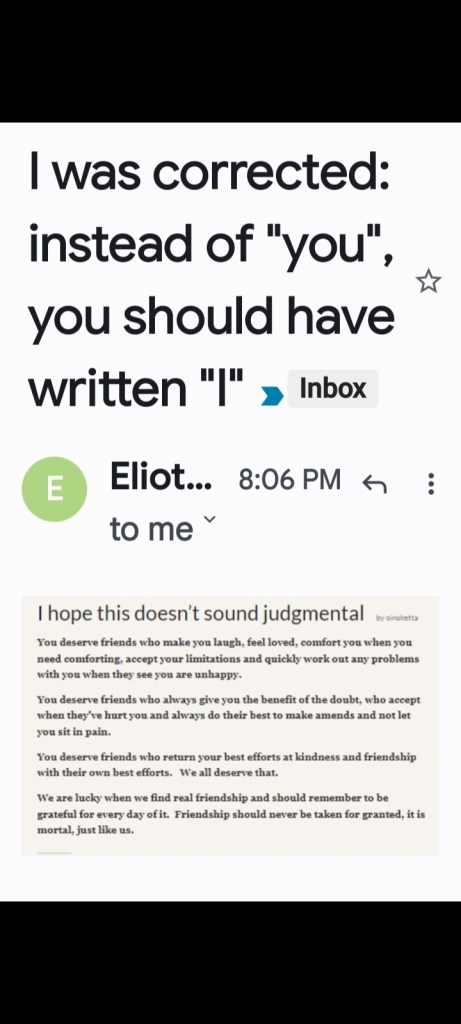
Here is the short description of friendship that X told me I’d used the wrong word in. She said “you should have written ‘I’ instead of ‘you’.” That observation was spontaneously made when I called to make amends with her, after a long WhatsApp negotiation, last August. friendship
Here’s a quick one about how most of us tend to listen to people in pain, even if we don’t know them. the human need to be heard
It’s one zen koan inside another. We can’t forgive somebody who can’t forgive. Your hurt and anger, Eliot, are both completely irrational, though we refuse to hear or consider any points you’re making because you’re so irrationally hurt and angry — from your childhood and completely unrelated to how you claim your two closest friends, people we all love dearly and unconditionally, may have treated you for more than a year during which you claim you consistently, patiently tried to make amends with them. We don’t judge you for being a bitter, childish, angry, unforgiving, defensive, lying, other-blaming asshole, why do you judge us so harshly merely for being imperfect human friends?
We are, every one of us, damaged in some ways by life, Redacted. Some of us strive to be mensches and some just damage others and constantly justify it, while performing virtue and victimhood. Responding to slanders about oneself does not make one the aggressor, unforgiving or obsessed with being ‘right’ at all costs. Calculated lies about your character, and moral lectures based on those lies, from people who claim to love you, are intolerable, no matter how lovingly you’d like to spin it. If you can’t see that after my several long explanations, I don’t know what to tell you. Pass this email on to Zebediah, I guess, he may be able to be more objective.
Outside of that, as you say, zehu.(Hebrew for “that’s all” or “done”)
I got your letter yesterday and after trying to read the whole thing a few times, I stopped and just slept on it.
I tried to think about why you were writing it and why to me.
I can’t say I was able to make sense of it, but my heart clearly understood.
I felt how much pain you are in and how deep your suffering goes. It obviously didn’t begin with the event that triggered your divorce from your bosom buddy and the community that came with him. It began way back within your own family and all the unfinished business you carry like an albatross throughout all your relationships and life.
The letter was more like a purge than an invitation to a conversation.
I also don’t believe there’s anything I can say to you that will assuage yoursuffering. If you’re willing to unpack it all, you have to see a professional. I can tell you that Ilan found his peace many many years ago through meditation. I can attest to the change the man internalized over the years and the impact it has had on our life together.
If you’re comfortable with just being ‘right’ you’ll spend your life brewing and it will take it to the grave. If you want to find your peace, you know what you have to do. If you want to face your demons you have to find a neutral setting and do all the hard painful work that it takes. You can’t change all the people in your world, but you can change yourself and heal.
Think about it Elliot [sic]. Do you want to throw away the remainder of your years by being angry, by being ‘right’ or do you want to find your peace.
Only you have the answer.
With much love,
Redacted
I replied with more explanation of why I’d been so hurt and so forth. That night I had a call from the Flying Monkey, Redacted’s best friend and confidant. After that loving chat, I had no choice but to amend my reply:
Oh, one last thing. You asked why I sent you the pages you could make no sense of. A reason I forgot to mention in my previous email is that I consider you perhaps the sharpest and most perceptive person in the circle. I was hoping for understanding, which, clearly, you could not provide.
In replying to you a few days ago I made the same stupid mistake I’ve been making all along, since that hideous year bookended by two angry Yom Kippurs. I tried to use reason to persuade someone who had clearly made up her mind, based on the other party to my ugly “divorce” from X/Y having already persuaded everyone we know in common that they behaved perfectly and Eliot is, alone in the history of divorce and every other conflict, entirely to blame for everything that happened. When he’s frustrated he says the fucking f-word! And worse!
It was very clear from your moralistic response that you follow that interpretation, only one party has behaved aggressively and immaturely (from my point of view, I am not that party, of course – and I have the receipts, if anyone who has judged me unworthy of friendship were interested in being fair, or empathetic).
Consider for a second: if I was the enraged person you portrayed in your pitying judgment, would I have reacted as mildly as I did to what can fairly be seen as the judgment of someone who feels infinitely superior to me? Based on a false account imparted during a successful attempt to assassinate my good name among people I have long loved, listened to, made laugh? No feelings I might have about being unfairly judged and banished by an entire group of old friends, most of whom I never had a hint of a quarrel with, are appropriate — except as manifestations of a need for intensive psychiatric work?
When someone you care about is upset, you ask them what happened, you listen to them. You offer to help, if you can.
When someone is upset and you tell them they have no right to be upset, that they are wrong, and immature, and irrationally clinging to childhood pain, and unable to get past their previous abuse, are aggressively angry, unforgiving, hellbent on being right at all costs and trying to change everyone in the world but themselves, and are unwilling to do the hard work everyone else in pain has presumably done to become more fully human — well, you really shouldn’t sign that kind of message “much love,” darling.
I’ll leave our dear friend the final word on this ugliness (well, me, actually, but you know how I am).
The only way to flush these hard feelings, dear Seedj, is by having the last word in a quiet battle with self-righteous, toxically clannish pinheads.
Imagine you are on stage at your junior high school, playing the piano. Your parents are in the audience, along with several of their closest friends. As you play, your father turns to his best friend, a guy who was always like your funniest uncle who is also a guitar player. Your father says quietly to this guy “it’s a shame she doesn’t have the discipline to ever become a great concert pianist. We started her too late, that other girl is so much better than her.”
You will of course never hear about this, unless decades later this beloved uncle figure is suddenly rejected by your parents as the reincarnation of Adolf Hitler. The transformation became necessary after he witnessed embarrassingly human behavior and your parents both felt humiliated by his moral stance. Uncle Hitler might write something like this, like this thing you’re reading right now:
You were a musical prodigy, my dear, the independence of hands that you had at the age of 6 was as amazing as your ability to play full classical pieces by ear. Your musical talent was mind blowing, off the charts, phenomenal. But your parents, who, as I only recently learned, are both narcissists and see the world as strict hierarchy, black and white, win or lose, glory or shame, didn’t understand that somebody with your degree of musical talent should be guided by love of music to wherever that talent takes her.
In their ignorance/arrogance your parents decided they could harness your love of music to instill discipline in you by forcing classical piano lessons on you. I always gave them the benefit of the doubt on this, neither one realized that the greatest musicians we know often can’t read music. You know the long list of these Paul Simons, John, Paul and Georges as well as I do. You hated these lessons, and the straightjacket of classical piano training, although you easily mastered everything they required. You fought a succession of these overmatched teachers, who were surrogates for your implacable fucking parents who wound up needing to convince you, decades later, that, among other things, your beloved uncle was actually Uncle Hitler.
I am so sorry to be the bearer of this unbearable, but hopefully helpful news, that your feelings about the unsafeness of the world are based in real experience, and you are not to blame for the hurt you feel. I’m there with you now, in solidarity.
My door is always open to you for any insight a guitar playing mass murderer who has known you since you were born can share.
Have a nice day, and if you will excuse me now, I have to get back to my unslakable, inchoate rage and ongoing mass murder project. I’m on a timetable here, dear, and the clock is ticking.
My friend’s therapist, John House, has a great set of 18 rules of life that make a whole lot of sense. Rule 12 is maybe my favorite, since we see it played out over and over and over and wonder why these nasty, painful cycles continue.
Many people are impervious to the evidence that what they are doing is causing them identical problems over and over. It is always easier to blame others than to search your own life for your own damage’s role in ongoing bad scenes. House’s lessons apply to anyone who is trying to learn to have less pain in their life by changing reflexive habits that cause them pain over and over.
Rule 12: A lesson is repeated until it is learned. A lesson will be presented to you in various forms until you have learned it. When you have learned it, you can then go on to the next lesson.
At my sixtieth birthday Sekhnet threw me a party at the home of old friends. I held forth in front of a room full of loving friends, several of whom I’m no longer in contact with. Most of the people there I’d known since I was a teenager. Most of the people I met back then, and kept as lifelong friends, fulfilled a psychological need for me, to be close friends with people who had many of the traits of my perplexing father. My father had all the tools to be a great friend, he was hampered by a black and white worldview that made it impossible for him to be wrong in any conflict. As long as I avoided conflicts with these old friends who were often similar to the old man, everything was fine, for many years. The pattern of fatal conflict emerged over many years and I could never see it coming or understand it once it arrived.
Tensions would develop, it could be over anything, often over something dear to me, or upsetting to me. I’d be upset because my health insurance had been illegally cancelled (this happened to me three times, including during the first full month of the pandemic). Suddenly a friend would tell me I was overreacting, that my anger was not proportional to merely losing health coverage. According to my friend’s argument, it was an indication of something fundamentally wrong with me, that I was so irrationally upset. Now we had an actual conflict: your feelings are out of line, asshole, and what about my fucking feelings?
This was a mirror of the eternal conflict with my defensive, prosecutorial father — denial of my right to feel the way I did, reframing of my feelings to make them a magnifying glass for my problems and shifting the conversation to his moral superiority in not whining about his, much worse, problems. I’d react to these friends with patience, with a hard-won ability not to explode in anger, extending the constant benefit of the doubt that strikes me as the heart of friendship.
For some reason, I was unable to see, until this shitshow had been repeated several times over the decades, that In a conflict with a narcissist, none of these things will help in any way, except to prolong a maddeningly insoluble impasse. If one person in a conflict is incapable of empathy or compromise, on pain of feeling utterly humiliated, that’s all she wrote, boys and girls.
I was sixty-five when I had my first conflict with my two oldest remaining friends. The conflict itself was supremely easy to resolve, if both parties had been able to remain open, listening, granting the other person their imperfections. I agonized for a solid year, waking every day with the pain of this impasse boiling in my head. It caused tremendous agony to Sekhnet as well, that I was in such pain and couldn’t see my way out of it. I kept thinking of House’s Rule 12, since this conflict had major echoes of several others over the years. What am I not fucking seeing here? I kept wondering.
One day, bingo! When someone shows you they are implacable, will not listen, no matter what, will not grant you the benefit of the doubt that you are extending to them, take notice. When they show you that face it may be a warning of worse to come. The second and third time makes waiting for the tenth or eleventh time an exercise in masochism. How many times can you reassure an angry friend of your good intentions before you realize they don’t have the capacity to care about your good intentions? Three or four unrequited attempts to make peace should suffice.
Lesson 12, in my case, when someone shows you over and over that they must win the conflict, at any cost, including the murder of your friendship, the best roll of the dice is to throw them away. No need to agonize for a year, and extend endless chances for compromise with people who would rather kill you, and murder your good name, than admit they had ever behaved badly.
Lesson 12, when someone shows you that they are a childish asshole, believe them. House’s rule 13 will only be of marginal use at that point:
13. People always do the best they can. If they are doing poorly, it is because they have not learned the lessons that will enable them to do better.
Some people are angrily oblivious to the lessons of their lives. And those who must win at any cost are the world’s greatest fucking losers.
The smartest woman in the room, a Harvard graduate with a successful literary agent practice who has read countless books, loved The Interestings, by Meg Wolitzer. It is the epic fifty year story of friends from summer camp, who met the summer after my closest friends and I met at summer camp, and stayed close thereafter, their lives intertwining over the decades, as, amazingly, ours had. My two closest friends were so excited by the book that they bought me a hardcover copy, in large print, no less, a kindness to my old eyes I always appreciate.
I began reading the book, which starts from the point of view of an insecure, working class teenager Julie, a girl who is flattered to be taken in by a group of the coolest kids at camp, who rename her Jules. This little group, The Interestings, forms the dramatis personae for the rest of the book. I confess, I had a hard time making progress with the book, it struck me, from the start, as profoundly uninteresting, though context may have played a large role, as I will describe. I got the audio version from the library and listened to it, determined to hear the wholething.
Toward the end of the book the depressive husband of Jules tells his wife that her lifelong fixation with these Interestings has always been a mystery to him. Aside from sharing an intense bond as teenagers, what was actually so interesting about any of these interestings? He certainly spoke for me, and I suspect, many readers.
The pretty rich girl who was the queen of this little group wound up rich and successful, and married to a billionaire. Her brother, a charming kid much loved by the females, wound up an expatriate in France, when it became clear he might be indicted for rape. The eccentric, creative kid who couldn’t stop drawing and making little animations, became a billionaire, which is what happens to real geniuses, I suppose. The musician became an engineer, I. forget what became of the rape victim, though I think she remained friends with the others. Jules became a social worker, I think.
We didn’t wind up talking about the book my friends of fifty years had loved so much they bought me a copy of it. Now that I think about it, we’d rarely discussed any books we’d read in common, beyond a thumbs up or a thumbs down. It was not terribly long after I read The Interestings before a fifty year friendship with my two closest friends was over. That’s fairly interesting, I think.
My friend flew into a rage at me over a conflict that, were she not so angry, could have been easily resolved. Her righteous husband forced her to apologize to me the next morning, after I’d had a sleepless night, traumatized that my closest female friend had glared at me with a contempt I’ve only seen from my long dead father. This famously willful woman’s loss of control, the show of rage, and the forced apology, I now understand, were mortifying to both of my old friends.
Although I immediately accepted her crabbed apology, which, while blaming me for the entire incident seemed nonetheless sincere and the best she could do, they couldn’t accept my apology the following day for using the fucking “f-word” in a moment of anger. Her husband rallied to his wife’s side, telling me I had no right to expect him to understand my feelings, because he was too upset by what I’d done (the f-word!) to hear about them. In the space of two days, it was grimly clear these lifelong friends were no longer my friends. It took me over a year to stop agonizing and see the obvious because it all made no sense to me.
My old friend called after the hellish five days in a beautiful rented house that ended our friendship and began “wasn’t that a great vacation?” It went quickly downhill from there. Next stop, a month or so of silent treatment from a friend I alwayscommunicated with a couple of times a week. Then a demand to meet, and at that meeting, his wife beside him, he began “I’ve walked away from friendships for less than what you did to me.” Instead of verbally punching him in the mouth, which, in hindsight would not have been unreasonable, I reassured him of my friendship and he accepted my assurance, handed me a great book they’d bought for me.
Reading this book, some part of me must have understood the superficial aspect of the whole thing, the intimate friendship beyond question, the need to tell the same cover story, stick to the dramatic script, swallow hurt because your hurt is humiliating to someone who claims they love you like family. And, like family, you simply have to unconditionally accept the faults of your parents, your siblings, your flawed uncles and cousins.
The rap goes like this: being family means that nobody ever has to hear or understand why what they’ve done hurt the other family member. Family is a sacred bond that cannot be broken, except by vicious, unforgiving, treacherously angry people falsely claiming to be hurt and who can’t let go of their childish grievances. You understand that if I hurt you, I love you more than you are hurt, so it’s a wash and stop trying to talk about whatever you claim I did to you. It is your problem, not mine, not the family’s, dummy up, be quiet, swallow our version of what you think happened quiescently or you’re going to be fucking sorry. You don’t threaten the family, you fucking filthy mouthed fuck!
Interesting, maybe. On their influencer daughter’s Substack page recently there was a long post with advice about how to endure difficult people, presumably those who intrude with strong opinions and feel they can never be wrong. These people, she suggests, must be placed on an UNSAFE list and only dealt with when you have all of your personal matters for the day taken careof. Funny to find myself on that list, but, yo, that’s family for yuh! You’d have to be a reckless idiot to risk a million dollar inheritance to indulge the need for someone your family deems unsafe to have a word in your ear.


 gratuitousblahg