Disconnect

The young therapist-in-training seemed at a loss when I asked why her supervisor seemingly gave her no advice about a patient who reported no progress week after week on two of the three goals he came into therapy seeking help with.    

“But you speak so well, and seem to know exactly what you need to do, and talk very precisely about it, I…..” and her voice trailed off as I looked on, alert, eyebrows sympathetically raised, listening actively with body language showing her I was not shutting her out.  

“Ah,” I said, philosophical as always, “that’s the devilish subtlety of it.  I can always see another side and even as I feel bad that I cannot, for example, motivate myself to do an amazing thing that perhaps only one in a million people would even dream of doing, I can also reassure myself that it’s cruel to chide myself for not being able to do what perhaps one in a million would attempt to do, on their own.”

I watched the wheels turning in the young therapist’s mind.  She was forced to agree.  

“You’re a tough nut,” a friend concluded with a tiny chuckle when I told him about the unhelpful dance I do with this psychology student for about 40 minutes every week.  His long-ago CBT therapist had eventually found a way to get him to have a good cry.  That cry made him feel pain he was then able to release himself from, in an important way.  I don’t want to feel that kind of pain, of course.  

“Part of what makes you such a tough nut,” said my friend, clapping me on the shoulder and moving our glasses to the sink.

“Makes her the perfect therapist for me, I suppose, she’s not going to make me cry.  Something to be said for that.”  

“Yep,” said my friend, running some foamy water into our glasses.

The Spirit of Rosh Hashanah Past

My father grew up in an orthodox Jewish home, in ‘grinding poverty’, as he always phrased it.  My mother’s cousin, whose family moved many times during the Depression to get a free month’s rent here and there, told me a few years ago “we were poor, but your father’s family was really poor.”  I don’t doubt my father’s childhood was a nightmare.  He was still clawing his way through it on his deathbed in a Florida hospital seven decades later.

His tyrannical, violent mother was the religious one.  I don’t know that his father particularly cared one way or the other, though he swept the synagogue for a dollar or two a week.  My paternal grandfather was described to me as eternally deadpan; his face simply two eyes, a nose and a mouth.   My father’s mother would give generously to the synagogue, even though they had almost nothing themselves.  Nobody there was in any position to question this practice.    

My father became less and less religious over the years.  Bacon started being cooked in the house at some point during my childhood (he didn’t eat it) and eventually, and much to my disappointment, somehow, he tasted pork in a Chinese restaurant.  He liked it, though, to my knowledge he only did this once.  Growing up we’d hear: I’m so hungry I could eat ham!  Something he got from his days in the army when Corporal Israel ate side dishes at meals of ham.  Like many modern American Jews, he took the High Holidays seriously, bought his expensive ticket and sat and stood and sat (“please be seated”) and stood (“please rise”) all day at the services I found so hypocritical and meaningless.  

My mother had no use for religion, although she proudly identified as a cultural Jew, could not have been mistaken for anything else, really, except, maybe, ethnic Italian.   My sister and I stayed out of the synagogue too, for the most part, after experiences there that probably turned off many to the rituals of our ancient religion.  I often said my experience at Hillcrest Jewish Center Hebrew School turned me into an anti-Semite, though that’s an overstatement for effect.  The heart of religion is good.  I’d have to think the heart of every religion is.   The practice is where the trouble generally comes in.  

I have a few friends who take deep comfort from the rituals of religion; I don’t.  I cannot look past the dark side, the crimes and bloodshed so many avowedly religious people take part in, with the monomaniacal self-righteousness that comes from believing God smiles on their horrible acts.  The examples are too well known to require any listing here.   But the experience of wonder, of gratefulness for the many gifts of this world, the impulse to create, to be gentle, to laugh, to share, to care, to repair what is in need of fixing, all these are encompassed by most religious teachings.  

The religious background I had was Judaism and my values were informed by its stories.  There are two Jewish holidays I find very meaningful and that have shaped my life to a great extent.  One is Passover, the holiday that commemorates the eternally incomplete journey from slavery in Egypt to freedom in the world.  A Jew is commanded to retell the story at the seder, an ordered meal that sets out a template for the discussion of values.  This was always a serious discussion in my childhood home, as it is at the seder Sekhnet and I now attend every year.   The value expressed is realizing there is no difference between the children of the rich and the children of the poor and oppressed.  

We are encouraged to take the lesson of our people’s persecution to heart: to identify with the stranger, the other, the underdog, the slave, the oppressed, and reaffirm our commitment to fighting for justice for everyone.   I find this holiday very meaningful and important.  It has probably influenced me more than it should have, I haven’t separated out the symbolism to the extent most practical people do.  

The other holiday I find profound and valuable is the New Year tradition of seeking forgiveness and releasing others from our anger.  We are commanded to make amends with those we’ve injured in the past year during the ten days of repentance, between New Year’s Eve and Yom Kippur, when our fate for the coming year is metaphorically sealed by our imaginary protector with the long beard, the Creator, blessed be He, who created everything miraculous and, because he is all merciful, left humans to figure out what to do about the Hitlers, Stalins, Pol Pots, Cheneys, the raping priests and bloodthirsty preachers.  

The blessings are all from God, the man upstairs; the curses of mankind, as theodicy concludes, are all the result of humans’ misuse of the free will generously bestowed by the Holy Name.  Yeah, yeah.   Fuck all that shit.  The part that interests me is the tradition of righting our psychic accounts at this time of year.  We are supposed to honestly search our lives over the past year for times we have behaved badly, acted wrongly, hurt others.  It is our duty to humbly seek to make things better, to apologize, forgive, offer peace instead of further bad karma.  Prayer and good intentions won’t do it, we have to humbly approach humans and keep our vows to act better.  

It is far easier to see the harms others have done to us than to take an honest inventory of our own hurtful actions and cruel inactions.  I see this more clearly every year as I ponder.  Also, how hard it is to forgive the unrepentant, even as I am challenged to sincerely repent for things I’ve done that I can’t imagine were as hurtful as they may well have been.    

I always think of one Yom Kippur when I went, as usual, to meet my father outside the synagogue after a long day of fasting and services, everybody ashen faced and bad-breathed, trudging off in the gathering darkness with quick, tottering steps to break their day-long fast.  I walked down there as services were getting out, met him and we walked back home, less than a half a mile along Union Turnpike in Queens.   I had a long list of bad things my father had done and would never apologize for, including many terrible failures that had undermined my sister and me over the years, but I’d formulated it as one thing I needed to put on the table.  I’m sure I’ve written out this story before, but I’ll offer the fast version of it here.  

I am reminded of this because my closest friend, a very good man, about the best man you can imagine, has too much pain from his mother’s long betrayals to find it in his heart to truly forgive her for her considerable limitations.   I don’t hammer at it often, though I’ve brought it up over the years, he will be gentle with her as she lays dying, there is no doubt, and it is a shame the healing won’t start until then.  Life is a very painful matter sometimes.  

Anyway, the particular Yom Kippur I’m describing my mother was putting the finishing touches on some no doubt delicious dinner and I sat across from my father in the living room.  I had fasted, as I always do on Yom Kippur, not in fear of God, if there is such a thing, but because it is a good practice, and I always think I should do it more than that one day a year.  If we never feel hungry how do we remember what it is that much of the world experiences every day?

My father was a brilliant, adroit and witty man.  He used these skills brutally much of the time.  His humor had a sting to it, more often than not.  His skills in constructing arguments were used to build impregnable walls around his vulnerable childish heart.  He regretted these things on his death bed.  But walking back from the shul that Yom Kippur he was silent as a sphinx, cautious, waiting to defend himself against anything I might say.  

What I said when we sat in the living room in the little house I grew up in was that I was glad to hear his fatherly advice, provided he stopped using it as a delivery system for his hostility.  I would no longer tolerate being reduced to the sum of my faults while listening to the harsh things “your friends are too spineless to tell you.”   Whether my friends had spines or not, I needed to be treated respectfully by my angry father.  I told him if this did not happen we would no longer have the pretense of a relationship.  I reminded him of my many attempts to make peace with him and he fought as hard as he could not to give a millimeter.  I was determined, and undeterred, and in the end he agreed that he would try to do better.  We broke the fast.

“That’s what you have to do with a bully,” my friend would agree, “be direct, do not back down, do not give in to fear or anger.  Keep pushing the fucker back, it is the only thing a bully understands.  Good for you.”   So, for the next fifteen years or so my father and I had a superficially better relationship.  

At the end of that fifteen years he revealed, during an argument in which he was for the first time overmatched, that he’d only pretended to change his feelings toward me, that if he ever told me what he really felt it would do “irreparable harm” to our relationship.  Checkmate, Dad, have it your way, you win.  And for the last two years, as unbeknownst to both of us he was steadily dying from undiagnosed liver cancer, we kept things cooly superficial.  In the meantime I realized how damaged he was, and that he could not do any better, that it was up to me to make some kind of peace with it.  I made some kind of peace with it, lucky for both of us it was a couple of months before he started actively nosediving toward death.

As he was dying, of course, he lamented his lifelong inability to be truly open to people, to experience real intimacy, to express love.   “I wish we could have had this kind of conversation fifteen years ago,” he said weakly toward the end of the last conversation of his life, “but I was just too fucked up.  It’s my fault, I felt you reaching out to me many times over the years…”.  I recall thinking at the time what a modest and pathetic wish that was– thirty-five years of senseless war and fifteen years of peace.

Of course, I’d take it now, fifteen years, five years, one year, a week, another 24 hours.  There is not time enough to heal certain wounds and it is an uncertain process at best.   We are all left to heal ourselves, as best we can, and to stay open and caring to those who share our best hopes for a good world.  There is no time to struggle with drowning souls determined to take us with them to the nightmare depths as they irrationally defend their right to drag us with them, but the time for healing– very important time.

Life’s Work

The pursuit of excellence for its own sake is regarded as idiocy in a society that values only the creation of value– that is, the creation of the dough re mi — money you can buy things with.  Things are given value according to how much they’re worth — in dollars and cents. Nothing could be more basic and immutable than this first law of the marketplace, no?   Why bother to write clearly, if not to hone your craft for money?   Why be meticulous about playing in tune, and in time, if nobody is paying — if, in fact, nobody is listening?   I am listening.    

I was checking out a guitar yesterday, a 3/4 size Martin that felt good in my hands, sounded good.   I’d been thinking about it, realizing I’d probably have to buy it, even though it’s not really made of wood. “How does it sound amplified?” I asked the kid with very long hair.   He handed me a cable and led me to a room with padded stools and amps.  

“It sounds good,” he said.  He was right.  Damn, it sounded very good. I began to play, now with a pick, now using fingertips to pluck the chords of One Note Samba; I strummed with my thumb, with the pick.  A nice rich, round tone.  The pleasure of playing this little guitar was considerable, my hands relaxed, playing things they’d played enough to play smoothly, improvising, checking out the harmonics.

Somebody came into the room after a few minutes and began to play another guitar.  At first I was annoyed at the intrusion, but when I realized the guy was playing a straightforward thing in E,  I played in E, some fills, a couple of chords.   It was OK, I could continue to check out the guitar.   My back was to the guy, he’d sat behind me.   He soon got very ornate, playing a fast, elaborate finger-picking piece that was tricky to follow.  He turned up his amp.  

It was quickly obvious that this was the common exhibitionist wanker in a guitar store, there are dozens of them, wailing away, fancying themselves gunslingers, striving for supremacy, the spotlight, the admiration of their flailing peers.   If you walk through the main room of any guitar store there are many of them, bashing away at guitars, in every key, in no key, with varying degrees of skill, playing over each other, all of them way too loud.   The cacophony is unbearable.   They get into cars, if they have them, tailgate, ride the horn, pass on the shoulder cursing as they go, spin out of control, ultimately wind up totaling their cars into a divider.  On a good day.

I never turned to look at him, unplugged the guitar and brought it back to the salesman.  I’ll buy it tomorrow, I decided, when I’ll be in the neighborhood next.

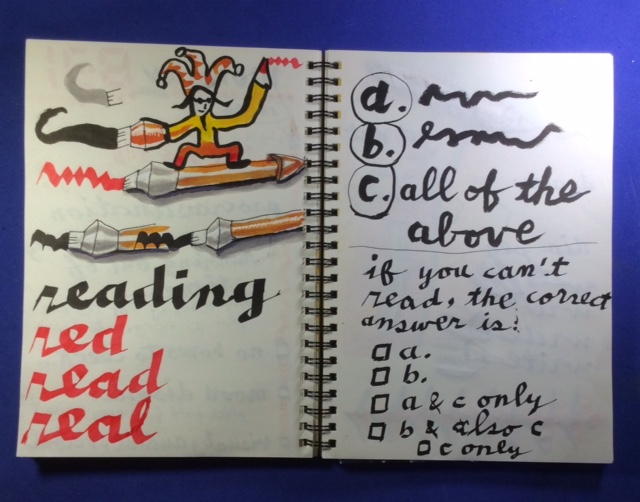
In the subway on the way home I am fleshing out an idea that struck me while walking across 18th Street.  I’d paused to write: reading is magic, think about it.  Marks on paper tell you what I’m thinking.

Picture that animated.   That’s what I was doing on the subway.  I drew a pen, took a brush and painted a shadow under it.  The train swayed, jerked, but I have always written and drawn on trains, am an experienced surfer that way.  It is a very rare stroke that goes wrong for me on a train.   I soon had a 3-D looking calligraphy pen drawn on the page.  I made a note to animate the drawing and then cut the pen out.  I’d take the cut out pen, dip it in a drawing of an ink bottle, the cruder the better, and write the words, in stop-motion, as though they were flowing from the moving pen:

Reading is magic, think about it.  Marks on paper tell me what you’re thinking.  

True.  A simple but powerful illustration of the amazing human invention of writing and reading — communicating anything you can think of to express using combinations of 26 symbols.  Also a powerful evocation of the potential of animation to get kids interested in literacy.   I drew in my book for about ten stops, was pleased and shut my eyes.  It felt wonderful to shut my eyes on that air-conditioned train.  

write ani

Inevitably I had the second thought, which caused my eyes to open and which I began to note on another page — in black and white.  

reading animation

We do not, as a society, give a fuck if you can read, have a rich mental life, consider ideas and solutions to problems you might not have imagined.  We do not, as a society, give a rat’s ass if you can write, beyond clicking a box assuming liability for any and all debts incurred in the course of your dealings with our corporation.  

Our society does not have work, or any productive use, for a good chunk of its people, tens of millions of them.  The young versions of these unneeded people are sent to schools to prepare them for a life where they are not needed.  The lesson many of them learn clearly is: fuck you, asshole, bend over and spread your cheeks.  Lift up the nutsack. Cough.  

Life’s work:  knowing this, all of it, and living calmly and productively, doing everything your talents allow to inspire, give hope, make a small ripple of change.  Death is waiting for you anyway, why be aggravated by the many aggravations this life dispenses so generously for free?

Ten Minute Drill

“So are you working hard?  Busy?” asks one of my few living cousins, now in her ninth decade.  She means, I suppose, ‘are you still delusional?’   I tell her cheerfully that I’m working hard and busy, I describe the marketing and this week’s well-received unveiling of the new pitch I’ve been working on all summer.  I explain breezily that I’m currently focused on marketing, a necessity my team would have been working on all along, if I had a team.  The program itself runs very smoothly, done over 100 times now all over, without a glitch.   She likes this, a retired teacher, does not sneeze at it.  Tactfully avoids asking if I’ve made a dime in 2015, usually her husband’s second or third question.

“Still working alone?” she asks, and I cheerfully tell her that, except at the sessions themselves where I have assistants, yes, still delusional.

“And how is Sekhnet?” she asks cheerfully, and we’ve successfully negotiated the minefield of my difficult mission.  Now we are in the lush backyard farm that farmer Sekhnet lovingly tends for hours every day, before and after her long hours at work.  I can see that colorful oasis spread out under the window.  A paradise of color and deliciousness, brought forth from the dirt.  

Then, after talking about the organic fruits of this magical garden, and the health it brings, we’re on to raccoons, possums, feral kittens.  They have them too, in New Jersey and the Berkshires, plus a litter of baby skunks and their mother.  Luckily for everybody the mother skunk took her babies and left the garden after a while, there would be no need for any violence against them, just as the exterminator had predicted.

Downstairs almost all the components for garden fresh sauce are prepped, waiting in their metal bowls for the first pop of garlic in the olive oil and then the sauce making begins.   Sekhnet is out buying onions, we’ve used up the ones she grew this season.  I have to go down and pick some fresh oregano (delicious), chop it, get it ready for the sauce.  Two large bowls of perfectly ripe tomatoes, red, yellow and green, all zipped out of their skins, wait patiently for the Saucier to begin.

Life moves at its own pace, if you can walk calmly and excitedly with it, you’re blessed.  Ideas take time to germinate, must ripen into action.   At least this is what I have been philosophically brushing into my drawing book lately.  If you are in something for the long haul you must develop a philosophy that helps and doesn’t hurt your chances.  

That said, I need to get a few hours in punching the heavy bag of revising the pitch, starting on the next one, much shorter and sweeter, showing the fun and the therapeutic value of working in a creative team helping each other animate ideas, still objects miraculously taking life on a colorful screen while cancer waits impatiently outside, ready to continue its assault, pissed off to be outside waiting to return to the center of the merciless universe.  

A good thing, I believe, keeping that killer waiting in the hall for a while as kids and their families get a break, play, have some goddamn fun.  Now I just have to sell the excellent means I’ve invented to do that.

A Slightly Odd Thought

Thoughts are more susceptible than most things to being, at the same time, reasonable and helpful and bizarre and unhelpful, according to the angle they’re viewed from, how the light hits them. 

In discussing whether I might actually be mad, trying to do the quite possibly impossible thing I’m trying to do, the teenage therapist and I seem to agree that the jury is still out.   Clearly, the most sensible thing to do is find something to do that brings in money.  If it’s something that also brings personal satisfaction, helps others, is enjoyable and challenging — that’s great.  But given the choice between earning a living or being in a constant state of turmoil over a ridiculously challenging thing requiring a good deal of self-reinvention while not bringing in a groosh or a kopeck… most people, on every shade of the elusive sanity spectrum, would choose the former.

I am ambiguously blessed, at the moment, not to have to occupy myself with the vexing question of how to pay my bills.  Five years ago I inherited enough money to support the average person three to five years.   Not lavish years, mind you, but average years for the average person living a modestly middle class life.  I have always tried to keep my expenses low, my options open for working the fewest hours in a conventional job.  Five frugal years later I still have money, riding on the “free market” roulette wheel like the trillions scooped off the slanted table the last time the richest and cleverest gamed the system prior to the “collapse” (or wholesale fraud, if we want to be more accurate) in 2008.  For the moment I am not worrying about that, though, of course, I probably should be.   My not worrying is another tick on the side of the ledger the jury may lean toward when deliberating over my relative sanity.

But here was the slightly odd thought that snuck up on me the other day.   I’m working strictly on marketing now, as much as I can, focused on presenting the workshop in a light that will make it hard for public school innovators in the de Blasio administration to resist.  This marketing work is also necessary for interesting and recruiting the best possible people to work with me on the program.   I’ve spent many hours removing all self-deprecation, self-doubt and frustration when I describe the program.  I’ve eliminated all references to the likely impossibility of my task.   I focus, when I can, on how well the program I designed works for its intended purposes.  

I am making my language terse, yet natural.  In the first minute I now summarily answer the most obvious questions: who I am, what brings me to the room and why this program is so important and valuable.   I am isolating the talking points, keeping them simple and rotating them, repeating each one enough times for the message to hopefully sink in.  You want to involve children in their education, make them eager partners in their own learning?  Give them a stake, let them learn what fascinates them and let them teach each other.   You really want children to become creative problem solvers?  Put them in a room full of art supplies and technology, with an exciting end-product they can enjoy, and adults who set things up then take a back seat, and watch what they do.   Etc.    

The odd thought, yes, I’m coming to it presently.  I’d been stuck for a while trying to complete the pitch.  I need to be able to present a snappy and memorable show during the structured yet natural twenty minutes I will get to pitch it some day.   Improvisation in a sales pitch is foolishly risky business, as I’ve learned in a gently brutal manner.  Wrestling with the technology to make the AV (I reveal my age with this anachronistic reference to “Audio Visual”)  side of the presentation has been an added frustration.  Every added frustration makes the mountain I have to climb steeper.  The fucker is already almost vertical, any steeper and I’ll have to find or design special shoes to allow me to walk upside down.  Another of five dozen, sometimes ridiculous, workarounds so far.  

But this week I was finally able to negotiate the last technical hurdles with the program I’m using to create the pitch (a total of five hours winning over ever more supportive and expert tech support) and it gave me the ability, at last, to record version after version and watch them back.  Recording myself was a useful bit of advice I received a few weeks ago when the very idea of watching my sluggish progress set my teeth on edge.  Being able to finally see my work played back eliminated the rehearsal-to-myself motivation problem, and the equally vexing one of finding someone to do me the favor of watching each version and helping me assess my snail-like progress.    

“Wait,” you will say, “you supposedly have an organization, a non-profit founded in the Spring of 2012.  Why do you still need to find people to do you a favor?  Call a meeting and….”  Shut the fuck up, would you, fuckface?  

Ladies and gentlemen of the jury, ignore this well-meaning yet provocative clown and my client’s outburst as well.  My client suffers from acute Founder’s Syndrome, a well-known condition that eventually afflicts the CEO of virtually every one-person organization.     

Anyway, now that I can work on the pitch and watch it in progress it’s much easier to see transitions that are bad, points that are not made clearly, glitches, clumsily worded talking points and so forth.  Clearly this is the work of a committee, a team, but since I have neither, it’s taken way, way longer to complete.  Now that it’s finally not so difficult to see and fix weak points I’ve made good progress the last week and it’s now virtually done.  I’ll be presenting it to a successful non-profit entrepreneur on Tuesday and once more have the benefit of his experienced feedback.  He has mastered a pitch that is successfully selling a once one-man program related to mine.   My pitch is ready now, 48 hours before the meeting, though I plan to polish it a bit more, if I can. 

Now the slightly odd thought, after one last bit of set up.   I ran the short new segment by Sekhnet the other day.  It contained my freshly written “who am I, why am I here, why should you care?” rap.  She was distracted from my short personal and professional message by the flash of oddly unrelated animation on the screen.   She was right to be distracted, I could see at once.   I set to work making the proverbial enormous changes at the last minute.  Had I presented that first version to the social entrepreneur I’d have lost him in twenty to sixty seconds and he’d be bracing for a wasted 20 minutes with a clearly mad person with a single good idea and a hundred bad ones. 

Several hours of concentrated work later I had a 49 second animated clip that I can actually link to this post (later) explaining who I am, why I am here and setting up why my program is something you should check out.   These simple questions had been impossibly ticklish ones for me to answer.  I knew the new version was pretty good.  Ran the less than minute by Sekhnet.  “I like it,” she said, after a little laugh at 0:20 where I’d inserted a little bark of levity, “it really shows how much work you did developing the program”.   Went back to work, tweaking a couple of things I noticed while showing it to her.  I fixed several other small weak links in the pitch.  

At the end of a very productive day I stood at the mirror shaving.   As I watched myself I noticed a small twinkle in my eye.  In that small moment of satisfaction I glimpsed an entire universe of truth and I had this odd thought:   it’s easy to have ideas and it’s morally satisfying to have ideals;  living them is the hard part.  I don’t personally know many people working as hard to live their ideals directly, to see their unique ideas mischievously afoot in the world.   It is hard, maybe impossible, work, but it’s the best work I could hope for, it occurred to me in that moment.  I am also blessed, by pure luck of circumstance, to be free and able to pursue it for as long as I have been.  

I pushed aside the thought of all of my more successful friends, figuring out how to live well doing things that are also important, or sometimes not;  pushed aside the often odious comparisons that come so naturally to all of us here in the Free Market.  

I am free, the twinkle in my eye reminded me, and lucky to be doing important work for which I am uniquely suited.   I’ve learned to savor the small but crucial moments of reward that are invisible to most people.  This could be a sign of madness, of course, seeing these tiny, isolated moments as a blessing, but I prefer (in the custom of all madmen) to think not.   It’s crucial to drink fully of every life-sustaining moment of reward we feel in order to persevere in any difficult undertaking.  I’ve learned to suck every drop of  juice from these rare and subtle moments of reward one must be vigilant to enjoy. 

If my life is harder, harder to explain and less materially sustainable than the lives of many people I know — these are all part of the price the world extracts from those who dream of a more merciful society and struggle to make these dreams real in the world.   There is a price to be paid for being different, clearly, and it’s not just a theoretical price.  Part of that price involves the occasional questioning of your sanity.  

It was an excellent moment in front of the shaving mirror, even if, at the same time, a slightly odd thought.

Perfect Moment

Many years ago, on a sunny summer day, I was on a train heading south from San Francisco to Santa Cruz.  It was the only time I was ever on a train in California.  Outside of San Francisco the train went along the Pacific Ocean for a stretch, before heading slightly inland for the bulk of the trip.  A kid was alone on a basketball court, dribbling the ball against the gigantic blue sky.  I watched him, waiting for him to shoot.  He was about at the foul line, bouncing the basketball, taking his time like an Elmore Leonard character.  

Dribbling the ball, he backed further from the basket, he was now at the top of the key.  A tunnel was coming up and I badly wanted to see the kid take the shot.   As the train speeded toward the opening of the tunnel he sent the ball toward the basket in a high arch.  The ball swished through the net a split second before the darkness hit.   It was like a perfectly cut scene in a movie.  I remember that great feeling of satisfaction, as I smiled in that long tunnel, with the thought that I’d just experienced a perfect moment.