Chapter 60 Be the change you want to see

If you find yourself in a fight with someone close to you, feel threatened and believe there is no way out, you will fight to the death, or flee forever. If you are in conflict with a loved one, and knowthat experience and adult insight offer you more tools to resolve conflict than you had as a child, there is hope of healing.

In the first instance, the fatalistic belief that nothing ever changes for the better will keep you at war. In the second, there is a real chance for peace, if the other side also believes in learning from past mistakes, accepting human foibles, acknowledging the importance of reciprocity, mutuality, adjusting better to the other person’s actual needs.

My father, for whom the pain involved in trying to make his life less painful, a life rooted in hellish abuse and deprivation, was unimaginably intense, always argued that people cannot change themselves in any fundamental way. Those who “work” in therapy, he said, are merely deluding themselves, real change on a deep level is not possible. You cannot change your inborn nature, he always insisted.

I argued against this hopeless proposition, pointing to the improvements people I’ve known have managed in their reactions to frustration, sorrow, guilt, bitterness, the need to blame others. I offered my own changes for the better, my improved control of my temper, for example. He always dismissed the so-called change as self-delusion, which he could always prove, for many years at least, by goading me until I finally lost my temper. That was his triumphant proof that nobody can really change for the better. See, you claimed you can control your temper, but I can make you lose it, you haven’t learned to control shit! Even when I eventually learned not to lose my temper, it was only an act I was performing, one he could easily demean as superficial, self-deluded performance art.

Relentless in his unshakable opinion, as anyone arguing for fatalism must be, my father always argued that people might succeed in changing some superficial aspect of their behavior, but their fundamental nature was as innate and unalterable as mortality itself. His position, I have to say now, is a supremely depressing, deterministic one.

It is also characteristic of someone who cannot be wrong, no matter what. My father was right for himself, as I realized recently. He could not change, the first step involved was crippling to him. The same goes for anyone stuck in the narcissistic person’s tragic trap – either seeing themselves as perfect and never wrong or abjectly, humiliatingly unworthy of love and self-respect.

For someone who lashes out in pain and believes experience plus insight can lead the way to changes that will result in less pain, change is a tangible goal. You can learn to control your angry reactions, for example, and with practice you can become better at it. This step forward can lead to another, and so on. We are all works in progress, if we’re willing to work with our limitations, talk things out and learn new things. Except for those who truly cannot change because acknowledging the need for change involves looking at things that are terrifying to them.

Someone who lashes out in pain and cannot be wrong must believe themself perfectly in the right whenever they are in pain. They are in pain simply because they are the victims of some fucking devil. That devil must be killed. There is nothing that can be done except to identify, isolate and kill the source of pain.

If your emotions are inflamed, in a conflict with the wounds of a traumatic past reopened, and you can change, you have a chance to learn to redeem a ruptured relationship. If your emotions are on fire, in a painful conflict, and you are certain that change is impossible, you are simply fucked up and beyond the reach of redemption. All that is left is retribution against the devil who has wounded you.

If you also cannot be wrong, you must convince everyone else in your life that the person you are in a conflict with is 100% in the wrong and irredeemable. If a person is a piece of shit, has done horrible things to hurt you, and people can’t change, as you know deep in your heart, that’s all she wrote, set and match!

From time to time I try to imagine the accusations against me that caused a group of friends of fifty years to unanimously agree that I was beyond redemption. How atrocious my crimes must have been! The anger could not have been more unyielding if I’d molested all their children, repeatedly, while brutally blackmailing them all into eternal, shameful silence, while I’d been poisoning everyone’s food and drink for decades while lying with every fetid breath I exhaled as I pretended to be funny and angrily denied I was the living incarnation of Adolf Hitler, with a field of corpses to prove it and very proud of myself for what a sly pretender I am.

For someone as evil as this, unless they apologize to everyone they’ve been raping, assaulting and trying to kill for years, admit their heinous crimes and despicable nature and beg for the mercy of the jury, there is not even the remotest possibility of forgiveness. Welcome behind the scenes of the greatest, deadliest shit show it has ever been my horror to participate in!

I also note how painful it must be to live in a world that is as hopelessly, painfully rotten at death as it was during the earliest painful memory. The belief that people cannot change is truly undefeatable in people unalterably deformed by crippling past pain.

When my father insisted that people can’t change, he was speaking with 100% conviction. He knew, as well as he knew anything, that someone like him, someone so deeply damaged that he could not be wrong, on pain of feeling utterly, contemptibly, self-loathingly humiliated and undeserving of love or respect, could not change. Being certain you cannot change will effectively prevent any effort to do so and keep you convinced, since if you can’t do something nobody else can, that people, all people, are incapable of making meaningful changes in their lives to have more peace and less war to the death.

As for somebody who makes a little positive progress toward a less painful life? KILL THEM!
Two sides, at least, to any conflict

If you find yourself in a conflict with someone who says, over and over “nothing you can say will ever get me to change my mind or take your side” believe them. These are the words of someone unwilling/unable to resolve conflict, except on terms they will dictate to you. Accept the terms, or you are dead to them. They tell you this up front and every time they fly into a nasty mood and blame you for causing all of the problems between you.

This kind of person will be familiar to anyone raised by a bullying parent. The insecure, prone to rage parent cannot be wrong, so no matter what they do, no matter how neglectfully, hurtfully or abusively they may act, they will always blame the child. They bring this personality quirk into every relationship. They can be charming, generous friends unless a conflict arises, in which case the problem was created by the other side. If the guilty party does not back down, the conflict is inevitably fatal.

Living with integrity is much harder than going along to get along. You ignore your own pain at your peril. The body keeps the score, as Bessel van der Kolk demonstrated in his book of that title. Your sleep suffers when you feel abused, your blood pressure and resting heart rate rise, your digestion gets fouled up. If your suffering continues, beyond bodily manifestations of your psychic pain, and you continue to push the causes for that pain down, you eventually find your health compromised all the way down to your immune system.

Integrity is the best gift you can give yourself, challenging as it also is. When someone tells you they will kill you if you don’t comply with their demands and pretend their abuse is completely justified, you are dealing with what the literature calls a piece of shit. You cannot reason with them. Get away from them and save yourself. Being true to yourself means listening to your body while it is painfully telling you the score. The alternative is betraying what you know is right for the sake of an imaginary peace.

There may be two sides, or ten, to any conflict. But one of those sides is more true to what actually happened, makes much more sense, than the other stories. Learning to base your actions on reality is much healthier than basing them on the fond hope that those who treat you with contempt will come around to love you one day, if only you can find a way to their hearts. There is no way to the heart of someone so damaged they will silence others to prove they cannot be wrong.

Not all stories are of equal validity. Your body will tell you when you are being force fed a load of shit that will eventually kill you. Ignore this truth at your peril.

Chapter 54 Self-soothing behavior

Many of us, particularly if we suffered as children, develop behaviors to soothe ourselves when we feel up against it. Some methods of dealing with stress are more productive than others. While I have bad habits that make me feel a bit better than not doing them, I have one that feels productive. I always take comfort from expressing myself clearly. It is a great relief to feel heard and understood.

I enjoy conversing with someone, or writing clearly to someone, who grasps what I have to say, adds their personal observations, allows me to reflect and refine my thoughts and feelings. This essential human give and take is a beautiful thing, and at the root of much learning. Expressing myself as clearly as I can, while listening as closely as I can, facilitates this exchange. The next best thing to this human back and forth is writing and its mirror twin reading.

I was sensitized to not being heard early in life. My parents alternated listening to me anxiously with studiously ignoring what I had to say. This strategic, selective silence was more the practice of my father than my mother. With my mother, who could flail and fight with the worst of them, I always knew that in a calm moment afterwards I could approach her and, most of the time, be heard. I was even able to persuade her from time to time, which is no small thing for a child to receive from his mother. Understanding after angry disagreement is one of the great balms of love.

This balm is something neither of my parents experienced much growing up. My mother clearly got it a bit more than my father, but my father got pretty much zero understanding from his angry, religious fundamentalist mother or from his father, a damaged cipher unable to protect his son, himself, or anyone else. The little brother he bullied throughout their lives clung to him as the big brother was dying, but prior to that time there seemed little love or understanding between them. My father found understanding, appreciation and love in his wife, my mother, and that was the greatest blessing of his embattled life.

The damage inflicted on my father throughout his childhood rendered him largely helpless against frustration and rage. I understood, shortly before he died, that he’d truly done the best he could, based on the monumentally shit hand he’d been dealt in life. I think of the rage I was regularly faced with at the dinner table. My father’s vehemence and abuse was a shadow of the horror my he’d gone through, but bad enough for me.

Unconsciously I knew that to respond with rage, which I sometimes did, would be final, terminal, irrevocable and the harm of it could never be revisited or undone. Over time I resisted going to that rage zone when my parents were furious. I eventually became pretty good at masking my rising emotions and reining in my anger. I have noticed over the years that for a type prone to humiliation it is humiliating, when in a rage, to be confronted with superficial calmness. They are out of control, and calling out their enemy for a good Western saloon-style fistfight, and their would-be opponent remains mild, unruffled, expressing honest confusion about the disproportionate rage blazing around them. Talk about humiliation.

What could be more provocative, for someone ready to deliver a righteous punch to the face, the gut, followed by kicks in the stomach, than a mild reply? They are enraged and you remain enragingly, humiliatingly composed as they circle for the attack. I realize now, given the set-up, that I couldn’t help becoming that way. I had no choice but to learn that survival skill when my father made me his adversary from before I even had words.

It is no surprise, given that background, that using words to present my view as clearly as possible would become supremely soothing to me. A good talk reminds me of the basic goodness of the world. The most painful type I still have to face sometimes is the righteous, angry person who will not let me speak. They insist on the right to silence me in spite of the many years I’ve listened to them as a good friend, brother, colleague, in spite of many excellent talks we’ve had over the years. What gives someone the right to tell another person they may not speak is another, hideous question.

We meet people like this sometimes in life, we may become close friends, having no reason to suspect how badly they will act in a moment of pressure. We don’t discover, til a moment of supreme tension, that a friend or other loved one may be so damaged in their souls that they truly cannot listen to someone else’s pain. In fact, another person expressing hurt and expecting sympathy is infuriating to them, given the right circumstances. Nothing is more hurtful for this type, at a vulnerable moment, than to be reminded of the fragile emptiness of the shell they created to make themselves feel better and more important, than others.

This is a certain type of asshole, the snarling, angry one standing on their right to anger. You can easily picture them in a lynch mob. Nothing you can say will make the slightest impression on their anger because they will never acknowledge wrongdoing of any kind without blaming you, somebody else, everybody else. They also always insist on one condition for any conversation once there is a conflict: you shut the fuck up about your goddamned feelings. The one condition I can’t agree to.

There is a deathly pain associated with being silenced. When you are prevented from speaking by someone else, it is a direct negation of your humanity. It presupposes the right of one person to make the other person shut up. Enforcing silence requires force, or the credible, frightening threat of force. Once you have shown your mercilessness to the others, say be ostracizing one critic, there is no reason to demonstrate your power again, unless strictly necessary. Your reputation as an indomitable competitor not above a quick kick to the shorts precedes you in your social milieu. Brutalize one and the rest tend to fall in line.

So on a bleak day, thinking about the silence of longtime, now former, friends, their unshakable, righteous enmity, to the death, I console myself by presenting my thoughts and feelings as clearly as I can.

I set the basic idea down quickly, once it’s in my head. I read it again, trying my best to make like an innocent reader seeing it for the first time. I clarify things that could be confusing. I elaborate on things I didn’t develop, condense whatever seems tedious. This work is a pleasure, considering my words and their effect, as I refine them into successively better reflections of myself and my views. When everything is combed through and smoothed down into its simplest form, I put it up in an online journal, another example of my soul doing its best to make my notion of a good life tangible on a given, otherwise shit, day.

Chapter 53 negotiating with terrorists

There are people, imbued with righteousness forged in unbearable injustice, who believe that their suffering allows them to do unspeakable things.   They inspire terror by their willingness to behave viciously, in the name of never being wrong.  When someone in your life makes it clear that they will behead someone you love and force you to watch the video, your prospect of reaching a mutually acceptable compromise with them is pretty much done.   

“If you don’t accept what I tell you to accept, my personalized version of history, and accept all blame, then I will rain holy hell down upon you and everyone you love, I will fucking destroy your world,” is an inauspicious starting point for a productive conversation.

If someone is truly willing to kill you, destroy your good name, your friendships, trust, throw away years of loving mutuality, in the name of never being in the wrong, accept that there is no fixing that.  You are dealing with a damaged, destructive soul, too desperate and determined to make peace with.  You cannot make peace with someone willing to kill anyone who makes them feel in any way bad about themselves.  These people are terrorists and are absolute in their demands.

This impossibility of solving problems with someone who cannot be wrong is a painful, but important, thing to digest.   If your best efforts to be patient, kind, fair and honest are met with dismissal, anger, recriminations, you’re not going to find a way to fix things with that person.  

It may seem impossible to imagine that someone you love, someone who loved you, can become an implacable enemy, but it sometimes happens.  When it does, you need to look at it without sentimentality, realize you are no longer dealing with any form of love, and get away from it.

The therapist asks “what do you think your role in these recurrent situations is?”   It is an important question.

In my case, maybe it is no more than my infuriating insistence, in the face of irrefutable evidence of incapacity in the other, that an old friend must be as vulnerable as needed to feel somebody else’s pain.  And my belief that empathy, and the ability to put yourself in a hurt person’s shoes, always leads to a desire to help heal that pain.   This belief turns out to be tragically, masochistically misplaced when dealing with someone who cannot be wrong.

My insistence in the face of their inability must be fucking maddening to the point of violence to them.  I suppose it is that stubbornness in the face of implacability that marks me for the violent endings, the displays of rage and idiotic denial I sometimes have had to face at the end of long relationships.

A person who reserves the right to rage, with or without reason, and never to concede fault or responsibility for harm they may cause, who needs to control others and be viewed as perfect, especially when they act destructively, is not a good partner for peace talks.   

Over time you can understand how badly they are damaged, how violently they feel compelled to react when criticized, but, sadly, that understanding gives you no tool to help fix anything broken in them.   

No amount of patience, kindness or understanding can help them change anything about themselves.   The only change possible is your own point of view, and learning to make yourself scarce as soon as you see that you are locked in a conflict with this type.   Any conflict with this type, no matter how seemingly easy to resolve, must end in death, as it is written.   Save your own life by learning when it is time to walk away.

“Face twisted and contorted with hate”

This is how sick, damaged and destructive people who can never be wrong are. They will do anything to prove they can’t be wrong. For example:

Their eight year-old kid is upset and no matter how many times mom and dad assure the kid there is nothing to be upset about, the stubborn little bastard insists he’s upset. In fairness, this could be very upsetting to a certain type of parent, one who feels responsible for their child’s well-being but truly doesn’t know how to sit with upsetting feelings themselves, let alone help someone else with them. Imagine how upsetting it is to them to see their child upset! The natural thing for this type to do is escalate things until the upset person is way more upset than they are.

Now they are talking about the basic lack of courage in the child, his self-pity, his sadness, his completely irrational anger. These things are bad, each of them, and together constitute a pathetic excuse for a human personality. They are reflections of a lack of character. They are sad predictors of a miserable life of failure and blaming others for his problems. They remind the boy how angry he was as a newborn baby, furious and hostile, all the time, for no goddamned reason.

Eventually the kid starts glaring at his accusers. This reaction is what they were going for the whole time, though they couldn’t have put into words. Now that the kid is angry on top of being upset, he stares at his parents angrily. The moment is right to strike:

Look at his face,” the father will sputter, “twisted and contorted with hate.”

My younger sister and I heard this phrase often enough that we both quoted it to each other and laughed about it, back in the years when we were still talking to each other.

To show a face twisted and contorted with hate (isn’t a contorted face always twisted, a twisted one always contorted? Isn’t the overkill of the one two punch a tell?) is different than protesting that your feelings are always dismissed, or calmly stating that as an eight year-old you need to be heard by your parents when you are upset. A face twisted and contorted with hate is the despicable face of a klansman at a lynching, a Nazi, some kind of hate-filled sick fuck who can’t be reasoned with. Certainly not the face of a child who deserves to be heard when he is upset, reassured with kindness.

My father apologized for his abusiveness the last night of his life, and it was good to hear, but the damage had long ago been done. I was close to fifty the first time my father apologized for being a monster as a father. The next evening he was gone.

We are left holding a heavy bag, full of the weighty things our parents were too overwhelmed to carry themselves. It is passed on, endlessly, until someone gets the insight to put the fucking thing down. In that moment she can finally untwist and un-contort her face and feel not a hint of hatred toward those who did their flawed human best to love her.

Morality is not theoretical, it’s practical

In talking there is always the chance of accidentally rescuing a broken friendship. In silence, only the grim certainty of continued death during life, a true shame on both of us, to share the short remainder of this brief moment when we are both alive and waste it in mutual anger.

Given the choice between redemption and condemnation always choose redemption when it is within reach.

If your parents lie to you

If your parents lie to you, you’re fucked, kid

Trust me when I tell you that your parents cannot help lying to you, if they are the kind of parents who tell their children lies.  Liars truly cannot help themselves, except by telling lies.  Whatever actually happened to make them this way is too shameful for them to talk about at all, let alone honestly.  Impossible to share this with children whose love and obedience they desperately need.  A good lie covers that painful, gaping wound, though it comes with a cost.  

The cost to the child is almost incalculable.  It is impossible for a five year-old, a nine year-old, to consider that her parents are lying.  For years the most outrageous lies are taken as true, until such time as the cognitive dissonance in your head makes it impossible not to question the more outrageous lies you’ve been told about yourself. 

When your truth-challenged parents tell you anecdotes to illustrate your terrible fear, when you were tiny, they are telling you about their powerlessness to protect you, to overcome their deep pessimism about anything beautiful coming out of life.   When they tell you that you were a fearful, untrusting, oversensitive little kid plagued by nightmares and hypochondria, that’s as close as they can come to telling you they surrendered, because they couldn’t do any better, because nobody can change, because we’re all already doomed to our fate.   We are already doomed to lie instead of confront anything painful about ourselves, and if you don’t believe it, we got some serious pain for you.

What lesson can a child healthily take from lying parents?   An understanding that nobody lies to someone they love unless they are supremely damaged and live in terror of their shame.  Shame is the motivator of all violence, and lies are a special category of violence, they damage your ability to trust, to perceive reality, to act with integrity based on simple cause and effect.  

You can learn from your lying parents’ inability to be vulnerable, to acknowledge faults in themselves, their mad need to never be wrong, their inclination to punish those who insist on “truth”, not to be like them.

You can understand that the greatest treasure in life is making loved ones comfortable enough with you that they can be vulnerable.   We are all very vulnerable.  Only an asshole can deny this, and they always do. 

Don’t be like them, don’t close your heart to everything but the need to protect yourself at all costs. 

You will be much less unhappy once you can consciously act with integrity, based on real experience in the real world, instead of conforming to a twisted universe of lies.  You never have to confront lying parents about their lies, it is almost always futile (and can expose you to desperate rage), but you have to acknowledge in yourself that you were lied to about essential matters from the time you could form memories.  Then you adjust accordingly, the work of a lifetime, boys and girls.

Superficiality is its own reward

The demons that may descend on you in moments of weakness, the worries that rob you of sleep, the doubts you may harbor about your ability to overcome these things, to ever feel better — a terribly debilitating pack of torments. I’ve known many people who adopt a simple solution for this. It doesn’t work for me, but I try not to judge those who adopt it. It is hard not to judge them, I have to say, but here we go.

Here’s the quick fix: simplify, deny and stick scrupulously to whatever is on the surface of things, the things most easily controlled. All the risk and terrors involved in vulnerability to others and honesty with yourself, swept away at once with a magnificent, unwavering commitment to the superficial. In this world of appearances you can actually, clearly win. Here’s all you have to do:

Have a beautiful home that people will admire. Have a large circle of social friends you can point to as proof that you are well-loved. Have children who willingly do what you tell them to do. Have a well-paying, high-status, job. Dress well, exercise religiously, avoid gaining an excess pound. Allow your charitable work to be publicly honored by your peers. Accept all awards graciously and with modesty. Cut anyone from your life who does not adhere to these simple rules for a good life. Make sure everybody else in your life knows these sick fucks are good and fucking dead and that communication with them will be punished harshly.

The things that torment you at night, that wake you early, in dread? Hide them from everybody, hide them from yourself. Remember, above all else: I am perfect and nobody can see these silly things that torment me and everybody else. There, under the surface of things, be dragons, here, where all is above board, be peace, security and no threat from anyone. Here on top be victory.

People of the Lie

A friend sent me a book, People of the Lie, that had greatly impressed her. It was written by a psychiatrist named M. Scott Peck, who subtitled it The Hope for Healing Human Evil.

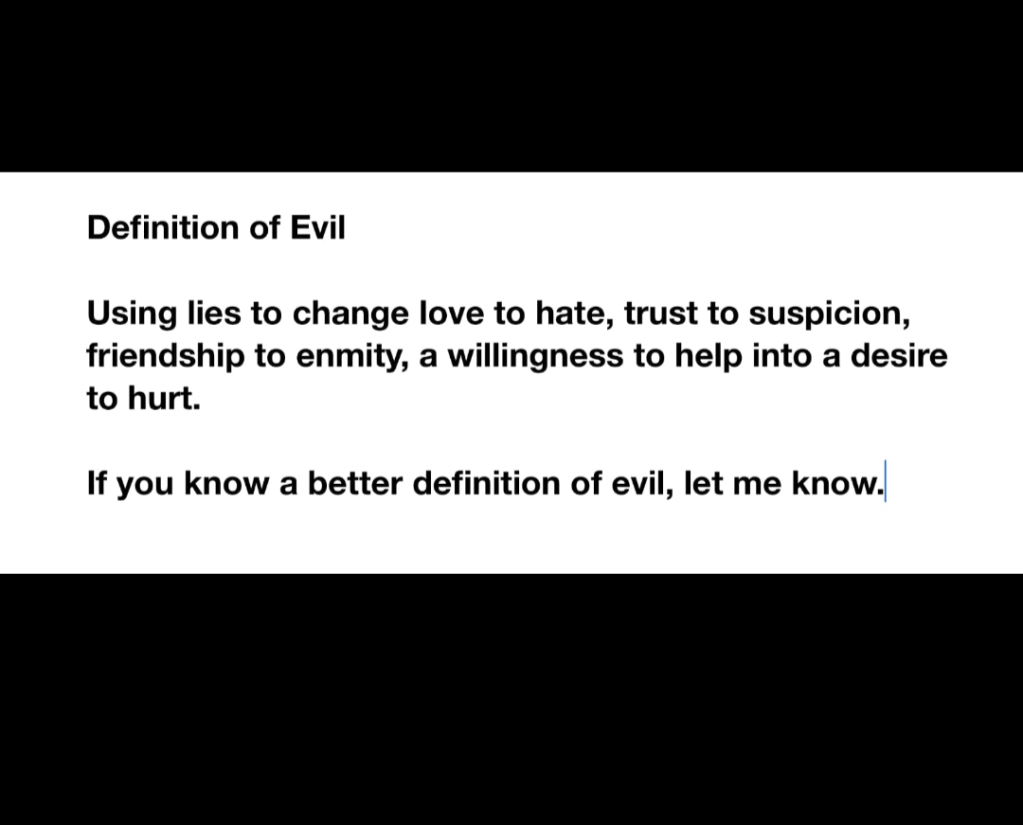
That human evil arises from unbearable pain and searing humiliation in the person who practices it is not hard to observe. Peck’s book was case study after case study of people who routinely hurt others brutally and convince their victims, themselves and everyone else of a lie that leaves the perpetrator completely blameless. He isolated human evil, describing these people of the lie, as well as I’ve ever seen it done. Evil is always based on inhuman, mercy-negating lies.

The story that stuck with me was of a suicidal young man who was brought to Peck by his concerned parents. The parents had a plausible story for the boy’s depression. Peck eventually spoke to the boy privately and learned the truth of the precipitating event — the parents had given the boy a gift, the gift rifle from them to his beloved older brother, who had recently used it to kill himself. The parents went into a rage when this story was revealed, as if it could have explained anything, and immediately terminated therapy for their depressed son. Such is the nature of the lies destructive people routinely tell to hide their rage and the shame that provokes it.

It is one thing to read about this foul trick in a book. It is much more powerful to experience it unexpectedly in your own life. It is viscerally unsettling to find yourself close to this kind of destructive desperation. It smells like death and conjures atavistic images of devils and eternal darkness. Get a good whiff of this evil and it will take a very long time to get the stench of it out of your nostrils. You are unlikely to completely recover without expert help, help I am still trying to secure.

Case study from my own life: old, beloved friend reacts with rage to what she perceives as her friend’s defiance. Leave aside the entire concept of defiance — a stubborn refusal to yield to the will of another. Just look at the display of rage — a focused, hostile glare of the kind described as ‘if looks could kill’ directed at you for long, silent minutes, as her husband tries to gently translate her glaring silence, explain why she is too upset to speak. It is not a transient moment of rage, it continues, through the end of the tense negotiation and ends with a snarled refusal to compromise in any way and a closed bedroom door.

Never go to bed angry at a loved one is very good advice. You eventually learn that these two do it all the time, the one who must never feel defied and the martyred appeaser, silently locked in an angry struggle when they go to bed and when they wake up the next day, and the day after that.

Now, granted, having an ugly side of your relationship seen this way by dear, long-time friends is objectively embarrassing. It should not be the end of friendship, or anything like that, but it is something to be talked about afterwards. If it is actually felt as humiliating, the impulse to lie, and blame the witness, becomes irresistible. The alternative is acknowledging that you have no idea how to resolve conflict, how to deal with anger, are locked in a hideous farce of a beautiful relationship that everyone must admire, an admission that you need help.

The one who must be right at all costs forces all the other family members into therapy, because she cannot be wrong, will not be challenged, will do whatever needs to be done to feel right, superior, beyond reproach or even criticism. She simply will not tolerate defiance, and she will NEVER go to therapy because she is perfect the way she is. All of her friends and colleagues tell her so.

If her son is depressed, to the extent that he must be hospitalized for it? Sadly, the young man inherited his father’s depressive DNA instead of her genetic predisposition for happiness and high achievement. She and her husband have been the ideal parents to this hypochondriacal, oversensitive, vacillating, embarrassingly unrealistic young idealist, as everyone who knows them knows. If their former closest friend, the aggressively, threateningly defiant one, is told by a mutual friend that the boy is in a mental ward, that is betrayal. It is none of his fucking business! He is DEAD to us, DEAD. What do you not understand about DEAD?

The funny thing about being dead is that if it happens to you while you’re still alive, well, you’re a dead man talking. You are right now reading the words of a dead man (which will be true enough, by and by, if you happen upon these words once I am truly gone), a dead man about to go to the kitchen and get a cold drink. Kind of funny, this kind of death, in an ironic kind of way, no?

The person who is not damaged to the point of destructiveness is always the last to understand, the game of people damaged enough to be evil is always to the death. There is no irony at play when the Nazi says “we are going to kill every last one of you, Jew.” Nazi irony is of a special kind, winking to its cohort and the world — “Work Liberates” on the gates of a slave labor/death camp, “Special Handling” stamped on the passports of those transported to such workers’ paradises and so on. Every evil must be accompanied by the lies that make it possible. With the wonderfully flawed human understanding that if you honestly believe that a lie is true — it is not a lie.