Fair Play

My sister, raised in the same war zone I came up in, vowed that her children would not grow up to be fearful people.   Her conscious goal was to instill confidence and agency in them.  They both seem to be doing fine in that regard.

She expressed the great terror she felt recently blinking at the prestigious job offered to her daughter through the lens of learned maternal fear.  She reported that her “fear-based” worldview left her paralyzed, nauseated, blinded to the many auspicious facts about this prestigious job offer.  I reminded her of her goal with her kids and how it seems to have worked out well.   I predicted her daughter would do fine in that 100 year-old Florida magnet school with the award winning jazz band and debating team, that they wouldn’t have offered her the job if they didn’t intend for her to succeed.

“I want to thank you so much for what you said the the other day.  I can’t tell you how much it meant to me.”   I told her that anyone looking at the facts, and knowing her, could have said the same.  Apparently nobody did.  I was glad my comment made her feel good.

We commiserated about how aggravating, and gallingly common, it is not to have even a cursory response to something we’d put time and effort into.

“I don’t know how you can continue to do what you are doing, with no pay and, especially, with no appreciation for the hard work you do,” she told me sympathetically, before promising to look over the last few things I sent her, particularly the curriculum, and give me some feedback.

“I have a day off tomorrow and I’ll check gmail and look at what you sent me, and I’ll send you my two cents,” she said.

That’s what she said, a couple of days ago.


Holiday

“So, are you saying his father literally machine gunned people into a mass grave?” she asked, brow bent.  

“Well, that was the weight of the old man’s painful confession the night before he died,” he said, already up on his toes, dancing in that half mad way of his.  

“So you’ve taken poetic license to his confession and transformed it to guilt over machine-gunning families into a mass grave?” she said.  

Philosophical license,” he said, one finger in the air, head cocked like an old school pedant.

“You’ve taken license with the facts again,” she said.  “I thought you’d taken a vow not to write fiction.”  

“It’s not fiction.  What the man did to his own children, at the moment when they most needed a human response, was inhuman.   Instead of empathy he fought them, denied them, dismissed their feelings as stupid. He beat them down when they tried to express grief when they learned of the slaughter of their entire family when the family tree had all but one limb hacked off, was uprooted, the ground burned and sown with salt.   On this blackened dirt the bones of his aunts and uncles skittered on windy days.”  

“According to him these things may have happened, but they were the kind of trifles a mature person doesn’t waste time crying about. His children came to him grieving over a trauma to make a child vomit and he snarled adamantly that they were insane to grieve.”  

“So in your mind browbeating his children was the same as machine gunning the entire family into a ditch and feeling justified as he did it,” she said.  

“Yes, but it wasn’t just the browbeating.  The browbeating fit the pattern– take a trauma, deny it, tell anyone who may be traumatized they have no right to feel that way but that they are insane, and cowardly, in fact, to have any feelings at all about it.”  

“A very damaged individual,” she said, “but not necessarily a machine gunner of families into mass graves. You want to be careful before you go there.”  

“Nancy,” he said, “a person who is damaged this way, if he still has a soul, dies with terrible regrets.  He deeply regretted that he had lived his life in a black and white world.   The black and white world is a zero sum game where many atrocities are permitted.   After all, it cannot be black when it is white, nor white if it is black, right is right and wrong is wrong.  In fact, he told his son with sorrow, hours before he died, ‘I think of how much richer my life would have been if I’d seen life in all its gradations and colors…’  In a black and white world it sometimes becomes necessary to murder another person, even thousands of people at once.  In a nuanced and just world it is never OK to murder thousands of people at once.”

Nancy looked at him.  

“Ask God, if you believe in God, and you’ll get the same answer: there may come a time when a killer must be stopped from killing and deadly force becomes necessary to prevent an atrocity.  No God worth praying to would ever assure you– unless you see the world as black and white– that sometimes it’s perfectly fine to destroy an entire city in the name of some greater good.  There is no godly answer to the murdered souls of the dead children, old people, invalids, babies, workers in that city.  You want to say you are justified in war to slaughter an entire population?  God does not smile upon you, if you do.”  

“I thought you stopped drinking,” she said.  

“Nancy,” he said, “be serious.  I’m trying to get you to understand why I chose the metaphorical machine gun as the instrument of his towering, seething, white-hot rage, rather than a much harder to fully describe verbal whip he actually used. Brutally using words to cause pain is one way of being furious and self-righteous, but how much better is actually physically machine gunning a perceived enemy, on the lip of a mass grave he would later insist meant nothing.”  

“He insisted the mass grave meant nothing?”

“He waved his hand, Nancy,” and he waved his hand, “and he said ‘those people were mere abstractions, nobody ever knew them.  You have no right to claim to be effected by the loss of those people you never even met,’ and he smirked as he said it.  And it was true that I’d never met them, they were all killed more than a decade before I was born, almost exactly 13 years, actually.  The year of my birth would have been bar and bat mitzvah year for the infants who went into that ditch along with the dozen great aunts and great uncles wiped out by Ukrainains as Nazis gave instructions.   My grandmother Yetta knew them very well.  They were her six brothers and sisters, and their families, and her parents, if they were still around in 1943, and all the children and extended family, and also the same for my grandfather Sam’s six brothers and sisters.”  

“Wait a second,” she said, “so this guy you were referring to in the third person was actually you?”  

“No need to be so literal about it,” he said.  “Fact is, on his deathbed an old man expressed regrets, and whipped himself over having been such a cruel bastard during his life, stubborn, judgmental, enraged, unfair. This is the profile of the guy, who, finding himself behind the gun, turns and fires it, wiping out anyone who might stand against him.”  

“Which is only logical, after all,” she said.  

“It’s logical,” he said, “but not everybody sees the world as an implacable enemy worthy of death.  Not everybody is capable of actually swinging that big gun around, training it on the terrified faces, and, rejecting all of the many reasons not to, heeds only the imperative to pull the trigger.  And if they are capable of it, it will bother them on their deathbed when they have only their vanishing, irremediable lives to consider, and they’ll be filled, sometimes, with terrible, almost unbearable regret.”

“I see what you mean,” Nancy said.


The possibility that most of them are sadists

On his deathbed he expressed tormented regrets, spoke for the first time of things he’d found impossible to talk about, tried to make his peace.  “I must have been insane to believe I was doing something good when I machine gunned those people into that ditch.  I pray that God will forgive me, for that one, at least,” he said.

“You did the best you could,” his son said, “God will understand.”  He gave the old man some water.  “Besides, since when do you believe in God?”  

“It’s not God so much I believe in now, but justice.  It seems impossible that there is no reckoning for the bad things we do here.”

“It is our pain that makes us do the bad things we do here,” said the son.  

“Pain also brings forth the best of some people,” the dying man observed sadly.  

The son nodded, heard the rest of the old man’s unspeakable confession.  He listened with special attention to the detailed apology for the years of truly regrettable cruelty to his own family.  Knowing that death was about the dying man’s needs and not his own, he mildly told him he would have done better if he could, closed the old man’s eyes after the dying man breathed his last.

At the time he thought of this belated conversation as a blessing to both of them.  Years later he realized the blessing had probably been much greater for the old man, being forgiven and let off the hook as he opened up, for the first and last time, to express his regrets for the pain he’d caused.  He’d given the man an easier death.  “Why was I so mild, letting the old killer off the hook?” he sometimes wondered.

Eventually the son looked at patterns in his own life, questioning his largely unnoticed attempts to be mild above all else.   Mildness is easily mistaken for passivity, which is widely hated in a competitive society where people are judged largely on their ambition and accomplishments in the marketplace.  He wondered if he’d been unconsciously attracted to people like his father, collected as his friends a group of unrepentant sadists who would possibly be filled with regret on their deathbeds, but not a moment sooner.   Had he surrounded himself with smiling but angry friends who were the least equipped of anyone to understand his desire to be mild, the first to point out what a pussy he was when he got in a tight spot and resisted lashing out, as any self-respecting person would?

“It’s an oversimplification to call us sadists,” said the dead man from his grave.  “Do you think we derive pleasure from defending ourselves and our righteousness at all costs?  It’s a reflex to protect ourselves, first and foremost.  It’s not about sadistically taking it out on our victims, for our pleasure.  We feel they would have done it to us if we didn’t strike first, so we hit them hard to keep them off balance.  It’s paranoia, maybe, but not necessarily sadism.  The entire pleasure, if any, is in not being victimized again.  Plus, we are completely overwhelmed by our own demons, it’s not about others, it’s about us.”  

The son was sick of hearing the dead man’s opinions, but they had to be considered nonetheless.  “On the Asperger’s spectrum is probably a better way to think of some of them.  A chap who calls to report on and get solace about his problems but seldom inquires about his friend’s troubles.  ‘Ah, but your troubles are well known!’ he’ll exclaim, full of bonhomie, then back to his recitation, the reason he called.”  

“I have to talk to you, at least you listen,” one tells him, “nobody else lets me talk. Do you have any idea how painful it is not be be listened to?”  

“I never worry about you,” says another, truthfully, but oddly nonetheless.  

There was one with a great sense of humor, an unappreciated person of great talent with an even greater need to be right, who decided the best course, when he was trying to be funny, was to look at him with a slightly disgusted expression and slowly shake her head.  Why laugh at his attempts to make her feel better when it was so much easier, and so much more satisfying, to make him feel like an asshole?  Nobody ever gave her anything.

He was able, without rancor, to shed the most destructive of these old friends when the time came to cut the ties.  No need to curse or express disappointment, it was a rational act of delayed self-preservation.  If a friend acts consistently hurtfully, is unrepentant and ignores requests not to behave that way, it is time to take your leave.   Wish them well and head for the door. Few will wrap their arms around your legs as you go, experience teaches that their pride always prevents this.

As a result of being more selective in his friendships, there were days when the only voices he heard were his own, often asking himself out loud who the hell he was talking to, and the dead father’s voice.  It was a heck of way to take a vacation, but better than fighting, he reasoned.

He could see the old man as a strong young man, setting up his machine gun, hear him cursing the people he was about to shoot, and going about his business feeling quite justified.  “These people were scum, they’d have done the same to me in a second, if they could have,” he said, acrid smoke hanging in the air, his accomplices shoveling soil into the ditch.

My father’s take

As a boy, when I first learned of the Nazi period, and saw black and white filmed documentation of the worst of their handiwork, I vomited.  An appropriate response for a nine year-old that seems as appropriate now, almost fifty years later.  Some nightmares followed and then, the reality that Nazis come to power from time to time and lead mobs to do unspeakable things, and that many enraged sociopathic types scattered through daily life are glad to do their personal versions of these things with whatever power they can amass, became the background of my life. The continuing news from all over the world, Rwanda, Sudan, Iraq, the former Yugoslavia, Cambodia, El Salvador, East Timor, Syria and too many other places to list, keeps the reality alive and sickeningly well.

Hitler is supposed to have reassured his colleagues, some time before the meeting in that villa in swanky Berlin suburb Wannsee where the Nazi brain-trust secretly worked out the best way to go about the “Final Solution” — a plan that sounded like a possible public relations nightmare to some of them — “Don’t worry, gentlemen.   After all, who today remembers the slaughter of the Armenians?”   An excellent question, Mr. Hitler.  What about them?   He was speaking twenty-five years after the massacre of an estimated million Armenian souls, by the Ottoman Turks.  

It is now a hundred years later and the story of the genocide against the Armenians (the word ‘genocide’ was coined, in 1943, to describe what was done to the Armenians) comes as a surprise to most people who hear of it.   I myself knew very little about it, beyond the death marches, mass starvation, concentration camps and the fact that German officers witnessed, sometimes in horror, the brutal deportations carried out by their allies, the Turks, during World War One.  Then ambassador to Constantinople Henry Morgenthau wrote of the sickening slaughter, and how it was smiled on by Ottoman officials, in terrible detail.   The ongoing massacre was apparently regularly written about in the NY Times and widely deplored.  But the world was too busy strafing and gassing each other, and cheering the carnage or dying of typhus, to notice as trainloads of Armenians, packed in cattle cars, were taken to concentration camps where they could be gathered to die more efficiently.  

Today genocide is so common we use the shorthand “Ethnic Cleansing”, a phrase almost as innocuous sounding as “collateral damage”, the shorthand for that unfortunate externality of war, the murder of non-combatants like babies, five year-olds and senior citizens.  In recent years revisionist “scholars” have been claiming the Nazis didn’t really kill people in death camps and surely one day there will be those who deny these other sickening atrocities ever really happened.  Like the state-sanctioned mass killing of the Armenians, though it clearly happened, it’s very controversial now, to some.   Tutsis mass murdered by Hutus? What?

I saw my father cry twice.  Once was at the seder table where he was overcome while dedicating a cup of wine to those slaughtered by the Nazis.  His face turned almost purple as he struggled not to cry, and he wept suddenly and violently before quickly pulling himself together.  My little sister and I watched helplessly as this etched itself indelibly in both our souls. 

“Those people were abstractions, for Christ’s sake, you can’t claim that we were personally effected by Hitler, we never knew any of those people, their letters just stopped coming one day, that’s all, it didn’t effect our family,” my father insisted dismissively (and ridiculously) years later when I brought up the murder of our entire extended family, on both sides.  He had been a twenty-one year-old Jewish kid stationed in Germany immediately after the war, a war that had wiped out his mother’s entire town and his father’s as well.  Of his feelings about being there he said little, though my sister can also tell you the name of the little dog they adopted on the air base, Schickelgruber, and what happened to the poor mutt when it got under the moving wheels of some heavy vehicle, maybe a plane.

I have always been given to brooding, and thinking too much, it must be admitted.  “Think less– do more!” is a mantra I would do well to get in my heart, like today when I am writing this instead of researching and writing things much more practical and badly needed.  Still, reading yesterday, for the first time, what actually happened to my grandmother’s large family, and my grandfather’s, and seeing the names of family members in survivor accounts, chills me too much and I cannot do otherwise. 

Marched to a prepared ravine on the northern end of town, after two years of random killing and death by starvation, ordered to undress (but for some reason to leave their underwear on) and lie face down, they were shot and covered with dirt by local haters who were paid in the clothing of the murdered to make a devilish layer cake of fresh corpses and earth.  Then another terrified group was ordered to undress, lie on top of the previous thinly covered layer of dead bodies, be shot, another layer of dirt, more bodies, repeat as necessary until, by the time I was born, all that would be left of the local Jews was a canyon full of loose bones on the outskirts of Vishnevets.  Among them the scattered bones of every member of Sam and Yetta’s families who were still alive in August of 1943.

Abstractions.

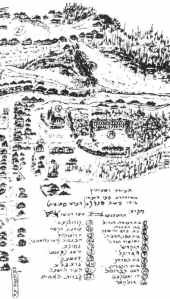
Map of My Grandparents’ little town

Vishnevets

It may be too small to see here, and the half image is oddly distorted and cropped (click on it to see entire map), but on the key provided with this hand-drawn map of Vishnevets you can see, along with the post office, synagogue, cemetery and hekdesh (poor house) a large blot on the northern end, top left center of map, marked in Hebrew “brothers’ graves”, where the victims of the most recent slaughter in that town were buried together in a pit. The English words printed on the map there, “mass graves”, need no translation.  The mass grave was necessitated by “Nazi brutality and cruelty”, (enthusiastically carried out by local Ukrainians), in (August) 1943, according to the monument at Mt. Hebron cemetery in Queens, NY, erected by the Wishnevitz Brothers Benevolent Society and the Wishnevitz Ladies Auxiliary. 

Other information about the unlucky town is summarized in this on-line excerpt from the book of memory:

In 1500 the town was destroyed by Ivan the Terrible. In 1653 the Jews were killed by the Tartars. By 1765 there were 475 Jews in the Old City and 163 in the suburbs. In 1847 there were 3,000 in Wishnowitz.

I could not stop myself from reading the gut-wrenching survivor accounts, determined to get a clear picture of exactly how my grandparents’ families were murdered.  It chilled me to read their names mentioned in one survivor account:

March 16, 1943

On that date, which was a Tuesday, the order was given to set up a ghetto. The buildings to be included in the ghetto were marked. According to the order, the ghetto had to be constructed in three days. The Jews were assigned to build the ghetto with their own hands and with materials they had to supply.

To make sure the order would be carried out in full, two hostages were taken: Yakov Markhbeyn and the writer of these lines. Any diversion from the details of the order would jeopardize their lives.

The ghetto encircled a narrow part of the town and the length of one long street. It extended from Alter Layter’s house to Beni Mazur’s house and from the road leading to Lanovits to the entrance to the Old City.

The gruesome details of the massacre, which I learned for the first time a moment ago here:

At night we could talk, and we asked the two young men from Vyshgorodok to tell us what had happened. And the two young men from Vyshgorodok told me what they had seen with their own eyes-how Vishnevets Jewry had been destroyed-and here is their story.

All the people were brought to a ravine behind the Old City on the road leading to Zbarazh. The ravine served as a readymade grave, with a capacity that met the Nazis’ needs. The ravine had been prepared by Ukrainian farmers. They stood with their tools, clearing the surface of the ravine. They leveled it, removed small mounds, scraped the stones from the sides, and dug the walls. They covered the bottom with the stones and soil they had removed from the walls in order to create a kind of crushed-soil foundation for the victims.

Once the foundation had been prepared, the first group of Jews was led to their burial place.

Two policemen ordered them to take their clothes off and remain in their underwear. They undressed, piled up their clothes on the side, and were then ordered to lie down in a row in the ravine, face down.

When they were all lying face down, the policemen ran over them with their submachine guns in their hands, shooting bullets into the heads of the people who were lying down.

Afterward, they inspected. They walked from person to person and with a handgun killed those who didn’t die immediately, using the gun butt or a bullet shot into the center of the skull.

When they were done with one group, they brought the second, and so on.

The Ukrainians walked over the bodies inside the ravine with horrifying skill. They lifted the bodies that were not level and laid them straight. The Germans sat on the walls of the ravine and supervised the work. They gave the orders, and the Ukrainians executed them.

The farmers took over after the Ukrainian policemen were done inspecting and leveling the layer after the last round of shooting. They covered the layer of bodies with soil in order to place another layer on top. They used shovels to do this. They covered it with a thin layer of soil, and the area was ready for another row of bodies. The clothes piled up on the side were given as a gift to the farmers in exchange for their work. Immediately, they collected the victims’ clothes and loaded them onto their carts, and while the others were busy with their work of killing and taking care of the bodies, they set off to sell their booty.

That was what the two young men from Vyshgorodok told me, and it is the utmost truth, because while they told us their story, they were very detailed and corrected each other so as not to distort what their eyes had seen.

========

It was with another shuddering thought of ruthless fate that I recalled that Beni Mazur’s house was likely the same place where my grandfather Sam grew up, and narrowly escaped death by typhus during the epidemic after World War One.  If my grandfather had not escaped death from typhus (which killed at least one other family member and caused the deafness of one of his parents, and which he referred to as a “very bad item”)… you know the rest.

From A Heck of A Book of Fate, Brownie

It’s a book about the invisible hand of fate, extending its fickle finger here, tickling a cooing baby there. 

In 1921, or possibly 1923, Yetta Marchbein, Yetta “Marrowbone” (her father was a butcher), about 20 years old and full of ambition and idealism (the Bolsheviks billeted in her home during the Revolution had been gentlemen and also inspired her), crossed the Atlantic Ocean from some European port, having made her way there, alone, far under the deck, terrified for life by the rats who walked the partitions there between the bunks.  She, alone, of her large family in a muddy little shtetl in the Ukraine called Vishnevitz, would be alive twenty years later.   The rest disappeared without a trace into the nightmare that was Hitler’s fondest dream. In the U.S. she’d take the Americanized name of her cousins, Miller, and two years later, long before the slaughter of her family and town, marry her strong, frightened fiance Sam Mazur, also from Vishnevitz, who followed her to the U.S. on a ship that embarked from Bremen during the presidency of Warren G. Harding.  The Mazur family, Sam’s six brothers and sisters, father, mother, extended family, was murdered along with the Marchbeins and the rest of the Jewish town of Vishnevitz.  There is a monument in the cemetery in Queens, behind the gates of the Vishnevitz Benevolent Society, where Sam and Yetta are buried, commemorating the slaughter there.

Sam and Yetta Mazur were my mother’s parents.  They had one child, a girl they named Helen, who, as soon as she was able, changed her name to Evelyn.  Evelyn grew up on Eastburn Avenue in the Bronx, a once thriving street with one end at the stylish Grand Concourse.  Eastburn Avenue, at some point in my mother’s childhood, was cut in half, literally, and its neighborhood destroyed by Robert Moses and his Cross Bronx Expressway.  In that apartment house, where the Mazurs lived on the first floor, a family named Stamper also lived.  Yetta and Dinch Stamper (who called each other “Mazur” and “Stamper”) became lifelong friends.  There is a great photo of the Mazurs and the Stampers, probably from before they had children, relaxing on the grass somewhere, in front of dense trees, dressed in the style for going out on Sunday in the early 1920s.

Dinch Stamper had been born Dinch (Diana) Gleiberman in a town in Belarus called Truvovich, a Jewish hamlet about 300 km. north of Vishnevets.  The Jews of Truvovich met the same terrible fate as their landsmen in Vishnevets, wiped away with barely a trace, Truvovich now erased from the map.  Dinch had come over by ship years earlier with a cousin named Chava Gleiberman, youngest sister of my father’s Uncle Aren.   Aren had arrived here a decade earlier from Canada after fleeing involuntary service in the Czar’s army and the Russo-Japanese War.  Chava, a good-looking, deeply religious red-headed Jewish girl, had her hopes for a happy marriage dashed when Aren’s wife broke up a romance with a Jewish postman in Peekskill who’d fallen for Chava.  When Chava’s indentured servitude to Aren and his wife ended a marriage was arranged hastily with a man named Harry Widem, a man my father described on his deathbed as “an illiterate country bumpkin completely overwhelmed by this world.”  What my father probably didn’t know about were the routine beatings, with club-like boards, that young Harry had received daily from his step-mother in the mud-floored farmhouse in Connecticut where he was raised.   What I didn’t learn until recently was that Harry spoke English with no accent, unlike Yetta and Sam whose Yiddish accents and inflections spiced my childhood.  I never met Harry and Chava, both died before I was born.  I am named after my father’s father Harry (Eliyahu in Hebrew) and my sister after Chava.  What is now well-known is how much Chava despised her husband, and that she whipped her oldest son, Israel, without mercy, from the time he could stand.

The hand of fate, gentle reader, spared these two couples, Sam and Yetta and Chava and Harry, my grandparents, while the rest of both of their large families (several of Harry’s siblings and half-siblings in the US survived to produce families, as did Chava’s brother Aren, who has dozens of descendants here and in Israel) disappeared into the night and fog the world remembers hazily as World War Two.  The good war America fought against unequivocal Evil.  

My parents met, of course, in that apartment building on Eastburn Avenue in the Bronx where my father, and his younger brother Paul, would visit their cousin Dinch and her family.   During these visits my future father spied my future mother, the beautiful, dark-haired, popular and completely haughty, Evelyn Mazur.   She had an active social life, many boyfriends, and considered the shy, skinny guy from Peekskill a laughable hayseed, and besides, he was clearly poor as a church mouse.  In time she would agree to go out with him (to get the insistent Yetta off her back) and would watch, amazed, as he transformed himself from hick to urbane, witty, increasingly sophisticated boyfriend, fiance and later husband.  They would build a middle class life together, she’d come to think of him as the most secure and brilliant man she’d ever known and he would (when not making her cry) give her all the credit for transforming his life into one worth living and striving to improve.

If Yetta, Chava and Sam had not left Europe before the slaughter of everyone they knew (Chava lost her brothers Yuddle and Volbear and her sister Chaski as well as the rest of her family in Truvovich), had not Harry (who came to the US as an infant) survived the passage and a childhood of blows to the head with whatever wooden truncheons came to hand, Evelyn and Israel would not have been born.  If they had not come to be, and meet, and procreate, neither would I have.   If the bleeding my mother endured one frightening day late in her time pregnant with me had been worse, if this, then that. 

The hand of fate, gentle reader, including its fickle, tickling finger.   More details to follow, perhaps, if fate and the spirits will it.


My boy hisses at me

My boy hisses at me with surprisingly threatening teeth for somebody that small. I have tried to be an affectionate and supportive father to him, and also a friend and caretaker, but it seems to make no difference. It is a question of temperament, I suppose, his and mine, and beyond either of us to change. I know very well that I am not the only man to have had this kind of difficult situation with his kid.

There are a few factors that complicate our relationship as well, and I’m aware of these. He’s not my natural son, I had nothing to do with his coming into the world and that lack of biological connection can be a factor. I basically found him, helpless and hungry, and we adopted him. Sekhnet is very attached to him, and the two of them cuddle, snuggle, and are thicker than thieves, but he has always regarded me with some distrust. There’s another thing, and I know this adds a poignant note, and may strike some as hyperbole but I mean it literally– we are of different species. This does not affect his relationship with Sekhnet, but it seems to come into play in his and mine.

When I reach out to him he hits me. Softly at first, then with his claws unleashed. Sharp damn fingernails the wild little bastard’s got. Then there’s the hiss, resembling a cobra’s hiss more than anything else, the mouth wide open and those sharp canine teeth ready, like fangs. He will not hesitate to sink those fangs into a hand, if it comes to it. Rough little bastard, and outside of making his feelings perfectly clear by his expression and actions, he never says a word.

A Deadpan Judge

I had a certain reputation, I suppose, that persists to this day, as a man with a conscience who would occasionally work for free.  This judge, who had seen me in action working in this capacity, had his friendly court attorney call and pitch me an easy pro bono case.  Would I mind if she sent me the file?  It would be a one appearance case, and the judge would consider it a great favor if I would consider it, and he would accommodate my schedule.   This judge was better than most.  We put the case on for a day when I was going to be in Brooklyn anyway and I appeared and met the tenant.

The tenant, who the law did not consider a tenant, was distraught, a man about my age, a combat veteran and a shell of the self he once imagined he might become.  He was about to be evicted from his home, the law on the case was open and shut.  It was not that he was behind in the rent, he’d been paying it all along, since he’d given up his apartment and moved in to take care of his aging mother almost two years earlier.  The judge’s hands were tied.   The story was rather simple and unfortunate for him, under the New York City Rent Stabilization Law.

If the tenant had been living with his mother for at least two years prior to her death, or probably also prior to a disability that necessitated admission to a nursing home, he would have had a clear legal right to succeed to the lease his mother had with the landlord, under the same terms.  This is called the Right of Succession.   He had given up his place and moved into his mother’s apartment to take care of her as her health deteriorated.  As her dementia increased he was forced to bathe her, feed her, carry her to and from the toilet, change her diapers and calm her when she got upset.  After about a year and a half he could no longer provide all the care she needed and had her admitted to the dementia ward in a public hospital not far from her apartment.  The poor person’s version of a nursing home.  

“I need you to visit the tenant, his mother, and come back and report to the Court if there is any chance of her moving back into the apartment to live with her son again,” I think is the mission I was given by the judge.  The judge was grasping at the last straw to keep this unemployed veteran from becoming homeless because he’d done the right thing for his mother, even if for a few months less than the law required him to do it in situ in the subject premises, her rent stabilized apartment.  

The hospital was a fifteen minute walk from the court house.  It was spring time, I remember pastel buds on the trees and a carpet of green buds on the shady Brooklyn sidewalks.  Birds and squirrels probably went about their business on this mild and sunny day, but I didn’t notice.  The man and I spoke as we walked the tree lined streets to the hospital.  The conversation was somber as I explained the legal situation and he told me more about his life and limited options.

We walked for what seemed like miles inside the hospital building.  The building was like something out of the Ottoman Empire, could have been hundreds of years old, with ringing corridors and a labyrinth-like structure inside.  We came at last to the ward where his mother was housed, a ward he visited every day.  The nurses greeted him by name, and he smiled back at them.  We entered a tidy room that smelled of urine and disinfectant.  He approached an old, smooth-faced woman in a wheelchair, pulled a chair next to her and leaned in to put his arm around her.  Her expression barely changed as he stroked her back and called her “mommy” and kissed her.  She seemed to like this, even as it was clear she had no idea who he was.  He began to cry quietly as he held her, tears running down his face.  There was no point asking her any questions, I’d arrived too late for that.  I probably spoke to the head nurse to confirm the medical situation that was plain enough for a child to see.   I said goodbye to the man, who remained with his mother, and walked back to the courthouse alone.

I got back to the court room shortly before the lunch break.  As I walked in the judge nodded, raised his eyebrows and motioned for me to come forward.  As I did I said “Judge, if I had a heart that could still be broken, it would be in fifty pieces right now.”  

He looked at me with sympathy and said “I have no doubt of that, counselor, but I also have no idea what you’re referring to.”  He had about fifty other cases before him that day and the details of the one I was there on were not something he could call to mind instantly.  I refreshed his recollection and he sighed.  We both knew I’d have to surrender the apartment now, and arrangements were made, either that day or on a day a week or two later, with the landlord, a very sympathetic man who owned a small building, and his attorney, who was also pleasant and respectful.  I don’t recall the details now, the son probably got a couple of weeks to move out.  It must have been on a subsequent court appearance, because I’m quite sure he thanked me and we shook hands.

Letting Go of the Dying

Four years ago today my mother died.   She had been in a deep sleep at the Hospice by the Sea (miles from the sea, but a nice place nonetheless) for almost 24 hours, sleeping through her 82nd birthday.  She eventually breathed her last and was gone.

Last night I spoke to an old friend whose mother, at 90, has been suffering from Parkinson’s Disease for many years.  She long ago lost the ability to move without pain and has been bed-ridden for the last few years.  In recent months she has virtually lost the ability to speak.  When she could still speak she would frequently tell her daughter that she wanted to die.   Of course, dying is not as easy as merely wanting to die.

“She makes her wishes pretty clear though,” my friend complained, after confirming that her mother is silent most of the time, except when crying out in pain.  It bothers her, the way her mother clenches her teeth against food and water, for example.

My friend’s sister is a doctor, she arranged for intravenous hydration and nutrition for the dying woman, as well as blood thinners and other medications to prolong the dying woman’s life.   The bags of nutrition cost $100 a day.   There has been trouble getting people to keep the port clean, very hard to find skilled nursing people who will also stay for a 12 hour shift, and overnight.  Unless one has unlimited funds, of course, which my friend and her family don’t.  So the two sisters perform most of the medical procedures.

I spent some time listening to my friend’s intense frustration with Hospice, which was reluctantly invited into the picture last week.   The social worker and nurses, as described, sound like a bunch of insensitive bureaucrat assholes.  On the other hand, they are dealing with two adults who will not honor their mother’s expressed wishes and are doing everything possible to keep her alive as long as possible.

“My nephew’s graduation is June 4,” my friend tells me wearily, and that’s one reason they want their mother to live a few weeks longer.  Not that she will be at the graduation, but it would be very inconvenient for everybody to have a funeral in the short time between now and the graduation.

On the other hand, two weeks is a lifetime of misery for a woman in chronic pain whose daughters are spending thousands of dollars to make sure she lives until at least June 5th.

“She’s so angry,” observed my friend.

I told her the story Mickey Rourke told to James Lipton.  He’d been very protective of his little brother for the kids’ entire life.  The younger brother had some deadly disease and clung to life for a long time after he should have been dead.   Rourke sat by his bed every day.  The hospice nurse called him into the kitchen.

“And I knew what she was gonna say.  She told me my brother had lived months longer than anyone she’d ever cared for with his disease and told me he was clinging to life because I wouldn’t let him go.  She said I had to tell him it was OK to go.”

“Jesus,” said Lipton, “she said that to you?”

“Yeah, so I went in and said ‘it’s OK, I love you and you can go.’”

“How long did it take him to die after that?” Lipton asked.

“About 20 seconds,” said Rourke.

She was impressed by this story.  It is an impressive story.   But she is not ready to let her mother go.

I told her the story from the beginning of Sherwin Nuland’s excellent How We Die.  I admitted to her that I’d never read much of the highly lauded book, but told her about the unforgettable opening chapter.   

Nuland, a resident, emerges from a hospital room drenched in sweat and close to hyperventilating.   An older doctor calms him and asks what happened.  Nuland described a terminally ill patient, in his nineties, who went into cardiac arrest while Nuland was making his rounds.  He’d spent twenty minutes frantically performing every heroic measure possible to bring the man back from death, but had been unsuccessful.

The older doctor reminded him that the patient was in his nineties, waiting to die from a wasting disease.   He asked Nuland what kind of favor he would have done the old man by reviving him to live a few more hours or days when his wait to die was now over.

My friend was impressed by this story too.   But she is still not ready to let her mother go.

I told her other stories, about my father’s death, and my mother’s.  About how hard it is to let someone you love go.   I told her that as they approach their deaths their final autonomy is all they have left, that it must be about their wishes, and not our wishes for them.  And how approaching death from a terminal disease often follows a pattern.  The person begins withdrawing from the world and eventually loses the desire to eat or drink and just wants to be done.

“If you expressed a wish not to eat and drink, which is one of the final signs that a person is ready to die, and you were hydrated and given nutrition against you will, you wouldn’t like it,” I pointed out.

“No,” my friend said, “I wouldn’t.”

We spoke a little longer and in the end, before wishing her strength and urging her again to get rid of the Hospice if they didn’t quickly shape up, I stated the obvious.  “You and your sister are not ready to let your mother go.”  She agreed.  I wished her a good night’s sleep and told her we’d talk soon.   She sounded grateful for the conversation in an otherwise terrifying void.

But I’m sure another box of nutrition and hydration supplies is being ordered today, as I reflect on the relentless sorrows of this world.

Happy Birthday, Mom

Today, if my mother was alive, she’d be 86 and in her 27th year of endometrial cancer.   That’s just bookkeeping, mere facts, a logical and stupid way to begin.

One year we flew to Florida on May 20th, Sekhnet and I, and rented a car at the airport.   We drove to my parents’ gated retirement community and somehow gained entrance without having the gate call the residents to verify that we were not smiling predators posing as children and coming to kill and rob the condo owners.

We arrived and parked at the far end of their parking lot, out of sight of their windows.   I dialed my parents as we walked up to the apartment and Sekhnet and I wished a hearty happy birthday and expressed our regrets that we couldn’t be there to celebrate in person.  Then we rang the doorbell.

“Goddamn it,” my mother said, with her ready Bronx attitude of frustration at an interruption, “somebody’s at the door….”

When she opened it we were standing there, phone in hand.

Her mouth popped wide open in the most comical expression of surprise you can imagine.   Although her mouth was open wide enough to swallow a small dog, she had a wry Bill Maherish smile around the edges of it, and in her eyes.  She looked for a moment like one of those nutcrackers in the shape of a person with the impossibly open lower jaw.   I can see that expression now, so can Sekhnet.

My mother began to laugh “you rats!” she said, hugging and kissing us.    My father appeared behind her, making humorous, sardonic remarks.   Ginger, a small poodle shaped like a football, began clicking her claws on the hard wood floor by the door.

All of them now long gone;  my father nine years, Ginger the same, my mother will be gone four years tomorrow.

I pause today to think of how proud my parents would be, even if terribly concerned about my long-term survival, to see the progress of my program, and my determination.   They would not be any more excited about the actual animation than anyone else is, but I think they would understand that their son, long struggling against a world of darkness, brutality and ignorance, has found a way to bring the things he values most into the lives of children who get very little chance to ever experience these things.   I think my mother would be proud, and excited for the possibilities immediately before me, now that I have proved the success of this program with perhaps 100 kids in four or five different settings.  

Even if she didn’t have much faith in my prospects for the future, she would listen willing to be convinced that I have already done much of the hard work to produce something amazing.   “Elie, you’re not curing cancer, but this is pretty good,” she might agree, when I was done persuading her of the great value of what I am doing and how much satisfaction it brings me, in the midst of the fearfulness of this wholly invented, marvelous and scarily shaky vehicle I am dragging around with me.

Happy birthday, Mom.