A Note on Eli as My Father’s “Father”

Eli was the closest thing my father ever had to a father and the source of 95% of what little I know about my actual paternal grandfather.  Eli described my enigmatic grandfather as being completely deadpan, his face ‘two eyes, a nose and a mouth’.

“Well, that’s about right, Elie,” said the skeleton.  “Eli was the closest thing I had to a role model in that house full of frightened shtetl Jews, the only survivors of massacres they avoided by sheer accident.  Eli, whatever his other faults, would not hesitate to stand up to someone who wanted to knock him down.  That was an amazing thing to see, as a kid, a tough American-born Jew who lived on his own and didn’t take any shit from anybody.  Of course, it had its dark side, as any of his kids will gladly detail for you.”

I remember the faces of his three children, all in their fifties by then, sitting in the front row at his funeral as I began to read my notes.   They knew I was his good friend, and in some ways the child he’d never had.   They all smiled and nodded gratefully when I ad libbed that had Eli raised me I most certainly would not have been able to say, without hesitation, all the good things I was about to say about our departed, sometimes savage, loved one.

“Well, he was pretty much hated by his kids, and not without good reason. He was a tyrant to them all, it was always his way or the highway.   He was also pretty much shunned by his grandchildren too.  You remember when he told you ‘just what the world needs, another goy…’ when his half-Christian grandson was named Connor Steven?   He was a very black and white fellow, our cousin Eli, and he loved few things more than a good fight.” The skeleton sniffed the air and chuckled.

You know how we act as unconscious surrogates in many cases, finding and serving as the family members and needed confidants we lacked as kids?

“Yop,” said the skeleton, picturing himself and others in those roles over the course of his eighty year life.

I realize in some essential way that I served as the interactive kid Eli never had, someone who didn’t reflexively dismiss him, and that he, in some odd way, was the father I’d never had, someone who actually considered the things I said.  He and I could fight bitterly without becoming enemies.  

“Well, I’d say that’s true.  Your mother and Eli had love at first sight, and they fought constantly, bitterly, gave no quarter.  Their fights were violent slug fests, no holds barred.   Afterwards they’d laugh, and hug and kiss, and say they’d never forgive each other, and their eyes would twinkle as they looked forward to their next knock down drag out battle to the death.

“In fact, your mother was about the only person who could ever go that far with Eli.  You saw how threatening he got when anyone crossed him, even at 85, 86.  His face would turn magenta, white foam would instantly form on his lips, his grey hair would stand up like porcupine quills.  He’d become, like you said at his funeral, savage as an angry panther.  

“Like when he backed into that car in a parking lot, and the driver jumped out, and he snarled ‘you’d better get back in your fucking car, bub, before I forget that I’m 85 years-old and come out there and beat the shit out of you!’ The other driver got right back in his car, as anybody not insane would have done.  

“But your mother had absolutely no fear of Eli.  My brother and I, even as adults, had some healthy fear of him.  When we sat down to eat as kids he’d yell ‘go run and wash your goddamned dirty hands!’ and we’d run, boy.  It was run wash your hands or get a smack, and it wouldn’t be a love tap, either.” 

My cousin and I were in Peekskill a couple of months back, when you gave me the cold shoulder at the grave.  

“Surely you didn’t really expect me to talk in front of Sekhnet and your cousin.  The game would have been up if I’d started speaking from my grave,” said the skeleton.  

Of course.  Anyway, the point is that when we stopped by your house at 1123 Howard Street I recognized the place from the home movie Dave’s son had transferred on to a DVD that I watched at the Nursing Home with my uncle shortly before he shuffled off this mortal coil.  In one scene Azi, at around thirteen, is smiling on the porch, and your mother and Aren are there as you pass by, crew cut and tanned, looking healthy and fit in your yellow t-shirt.  

“Well, why wouldn’t I look healthy and fit?   I was probably 28 or 29 when that was shot,” the skeleton thought for a moment. “I have no idea who shot that home movie.  Oh, of course, it must have been David.  Nehama was on the porch at one point, she came out of the screen door with a big smile and did a turn for the camera.  Dave was the only one not in the movie, and he was also the first one to get new technology, because he was rich.  He had the first nice car, the first television set, the first home movie camera, an 8 mm, probably from Germany.”

I mention 1123 Howard Street because when we stopped by it was a two family house, with a separate door and stairway to get to the second floor.  It seems this was likely a later addition to the place, along with the siding, but it made me wonder about the living arrangements at 1123 Howard.  

The house must have belonged to your Uncle Aren, who must have lived on the first floor with his second wife, Tamarka, and their children Nehama and Dave.  Which makes it likely that you lived upstairs, with your parents and Paul, and above your living space there was some kind of attic where the Jewish transients would stay, and piss out the windows, and shit in paper bags.  

“That is a mystery I cannot give you a definitive answer to, Elie, since, as you may have realized yourself by now, I can only really tell you things that you have already discovered for yourself.  Hopefully Azi will answer that question since you emailed it to him just a couple of hours ago,” said the skeleton quietly.

Yum Kipper

In Hebrew, the words are pronounced Yom Kippur, Yome Kee-Poor, but where I grew up, the Yiddish speaking Jews of my family always called The Day of Atonement “Yum Kipper.”   No atonement was ever actually attempted, or only very, very rarely, and with the usual conditions and caveats, but the holiest day of the Jewish year was a day my father mortified himself by fasting and praying every year.  

Even most secular Jews retain some feelings about Yom Kippur.   Sandy Koufax famously wouldn’t pitch in the World Series on Yom Kippur, when his start fell on The Day of Atonement one year, though I have no doubt he ate bacon cheeseburgers with Don Drysdale from time to time.  My mother always had a coffee in the morning, and maybe a piece of toast.  She didn’t quite fast, though she ate lightly.

Where I grew up there would be a long service in the morning at Hillcrest Jewish Center where the thousands in membership dues the family paid each year, to give their children a rude Jewish education, also gave them the right to buy seats in the synagogue for the High Holy Days.  

I don’t know how much the package was to have a seat for the biggest show of the year in the temple, but my father, as I recall, opted to sit in one of the hundreds of folding chairs they set up in the gym.  One year, I remember, he had a seat in the Ferkauf Chapel, in an alcove under the main sanctuary but a floor above the gym.  It was slightly more upscale, with carpeting and without the faint chlorine smell from the pool down the hall you sometimes got in the gym.  My mother never went to shul, my sister and I were forced to Junior Congregation for a few years, and never went again, so my father only bought one of the costly high holiday seats.  Fittingly, I suppose, he prayed alone at Hillcrest every year.

The seats in the main chapel were for local millionaires and my father wasn’t going to be gouged for the right to pray in the first class cabin.  I’m sure even those seats in the gym weren’t cheap. I remember seeing Caroline and Ralph there once, in that overflow crowd, fasting and praying in the gym while rising and please being seated in a wave with hundreds of others.  They, like my father, like the immense crowd of local Jews in their best clothes, jammed into every room of the Jewish Center, went every year, religiously.    

One year, my father reported that a woman fainted in the gym during her Yom Kippur fast.  She’d been asked to rise one too many times, I guess.   The faces of the Jews at Hillcrest were indeed solemn, as if acutely aware of exactly what was going on in the heavens above them as Yom Kippur came to an emotional climax.  

In Jewish folklore The Almighty sits over an unimaginably immense ledger, like an all-powerful accountant, reviewing, during the Ten Days of Repentance, the good deeds, bad deeds and borderline deeds of each Jew.   Based on their repentance, their generosity in forgiving those who seek it from them, their devotion to good works, their pious obedience to their Creator, or their failings in these departments, they’d get marked down in The Book of Life for a good year or a bad year in the one about to start.  

Jews have ten days to straighten out their accounts, the ten days from Rosh Hashana to Yom Kippur, also known as The Days of Awe, to make amends,  to repay debts, to seek forgiveness, to forgive those who seek it.  In my experience, among the Jews I’ve known, this is rarely done in a terribly soul searching way.   It is very hard to have the humility to do all of these things, to be aware of every hurtful thing you may have done and humbly seek forgiveness for them, and it is not often done, except among people who really love each other, and even then, it is not the norm to go into detail.   We assume, by our love and continuing friendship, that we forgive each other, I suppose.  

But even many of the most casual Jews fast on Yom Kippur.  Even those, like me, who find the rituals of worship empty and many of the ancient commands lacking in soul.  As for fasting, I don’t speak for the others, but I have always done it, am doing it now.   I also made a practice of walking down to Hillcrest toward the end of the evening service every year to meet my father and walk him back to break the fast.  

The shul goers would get a break during their day of fasting and praying, a few hours of downtime after the grueling morning session.   My father generally took a nap, I’m sure many others did too.  Fasting and praying is hard work.  

I suspect that final afternoon into evening stretch of praying while fasting, and knowing that the Holy One, Blessed Be He, was fixing to make the final notations on your page in the Book of Life, and then actually seal your fate for the coming year with a giant seal, had to be very emotional.   It all leads up to a tremendous, long, sobbing blast on a ram’s horn, at that exact moment God seals the Book of Life, everyone’s fate sealed for the coming year.  

Fasting is enough for me, and walking down to meet my father and walk him home after his second long bout of praying was the only other Yom Kippur ritual I observed.

There would be a swarm of Jews outside the synagogue, as though a concert had just ended in a giant hall.  In the last of the dying sunlight I’d recognize a few, sometimes say a brief hello, but everyone on the sidewalk in front of Hillcrest was distracted, slightly drained, hungry, thinking about getting home, darting this way and that, as soon as the sun had completely set and there were three stars in the sky– bagels, lox, soup, fruit, thick slice of tomato, water, coffee, fresh orange juice, schnapps.   Food rarely tastes as good as those first bites after twenty-four hours of fasting.  Anybody I ran into while searching for my father was understandably not in a mood to schmooze, which was fine with me too.

I would find my father in this swarm of dazed, hungry Jews fanning out from Hillcrest in every direction, and we’d walk home along Union Turnpike. It was not a long walk, five or six blocks.

Only one year did we have a meaningful talk I still remember.  I initiated it and it was a very important talk for me, for my relationship with my difficult father and his with his difficult son.  We sat in the living room, my mother in the kitchen, the food all ready to eat, everything smelled delicious.  All the stars were in the sky, it was past time to eat, and we continued to talk instead of breaking the fast, and he continued to pretend not to understand what I was talking about, he went into all his tricks.  

It took quite a long time, maybe an hour or more, and my mother never appeared in the living room after she’d greeted us and saw us locked in this conversation, but eventually, after displaying a forbearance that surprised us both and untangling all of his tactical diversions, I got my point across, he agreed to do what I had asked, and we went in and broke the fast.  

I have written at length about this conversation, and I will do so again, but a hungry Sekhnet is on her way, and I have to be ready when she gets here.   We have a vast fruit salad to assemble before our friends arrive home from shul to break the fast a few hours from now.  I have to say, I can already taste that first swallow of pulpy orange juice.

The D.U. and Rosh Hashana

The D.U. was the Dreaded Unit, my father, who died in April of 2005.  Rosh Hashana is the Jewish New Year, it means literally “head of the year”.  This year is 5777 on the Jewish calendar.  There are still a few literal-minded, God-fearing Jews who believe that it was 5777 years since God created the heavens and the earth in six days, resting on the seventh, but I can’t imagine there are very many of them.

For all I know Chava, my father’s mother, believed that.  Belief, of course, is a funny thing, not really amenable to debate or logic. The things we live by are like that, they can only be changed by an experience that makes a deep enough impression.   Belief is like anger, I suppose, or love — it resides in a deep place in the brain, in the soul.  

If you love someone, it’s not the end of the world if they say something you might find offensive coming from somebody else. You understand completely where they’re coming from.  If you are disposed to become enraged, you will see provocations everywhere, no matter how imperceptible these might be to others.

I suppose it’s the same with God.  My friend’s parents spent the years 1939-45 as teenagers and young adults in Poland at the mercy of the Nazis.  The Nazis, I hardly need to say, were not known for mercy, which they despised as a race-weakening Jewish vice.  My friend’s mother had been pushed out the back door with her much younger brother by her parents and told to run as the Nazis burst in the front door.   They survived in hiding, and living by their wits and their luck, for the entire war.   His father wound up in a concentration camp and was eventually promoted to the Major League team at Auschwitz.  The mother came out of the war an atheist, quite reasonably believing there could be no God after what she’d experienced.  The father came out of Auschwitz deeply religious, eternally grateful to God for the miracle of saving his life, another reasonable conclusion.

It’s hard to know what my father’s view of God was.  I know Chava was very religious and he was raised in a strict, joyless, loveless home where every commandment of God was taken very seriously. Every one but the crucial unwritten ones about loving each other, being kind, forgiving those who seek your forgiveness.  

Because he was raised as an orthodox Jew, my father continued to go to High Holiday services every year until the end of his life.  He would fast and pray in a synagogue all day on Yom Kippur.  At the end of his life he waved feebly and shook his head when I asked if he wanted me to say kaddish for him after he died.  

Kaddish is a prayer of thanks to God, uttered in Aramaic, a language only a few scholars can understand today.  Traditionally the male child says kaddish for a dead parent every morning, not long after sunrise, for a year, in the company of at least nine other Jewish men who will also chant the haunting prayer with the mourner.  

My father waved his hand weakly and said it made no difference to him, he really didn’t care.   Sekhnet and I said kaddish together every day for thirty days after he died anyway.    In the event, I guess, that if his soul was hovering nearby, he’d be touched and feel loved.

I feel like my father instilled in my sister and me what I consider the most important teachings of our religion, though he didn’t try to impose anything regarding the rituals.  When we tasted bacon at a diner, and loved it, he didn’t object when my mother began frying bacon in the kitchen at home, as his mother, Chava, rotated angrily in her grave.  He didn’t eat it, but he didn’t raise any objection.  He was, we all were, primarily secular Jews, Jewish humanists.  

We celebrated Rosh Hashana with a big meal, our small family gathered around.  Sam and Yetta, my mother’s parents were there, Eli and his wife Helen, and my uncle Paul and aunt Barbara, my cousins Jon and Ann.  We did the same at Passover.   During these annual meals he instilled in my sister and me the moral essence of the occasion.  

Passover was about identifying strongly with the oppressed and fighting oppression, for we were once slaves to Pharaoh in Egypt. Rosh Hashana was about a new start, getting all of our ethical affairs in order, making sure God knew we would try to do better in the coming year by making amends, apologizing to those we’d hurt and granting forgiveness to those who sought it from us.  

Which, actually, you know, is fucking hilarious.    

It is way easier to rise and please be seated, and rise, and turn to page 79 for the long standing silent prayer, and be seated, and please rise, and shiver with awe as the holy ark is opened, and bow your head in unison with the congregation when the appropriate words are chanted, rip your sleeve to show your penance, and sing in a chorus of praise to God, than it is to go up to someone you’ve been mean to and humbly apologize.  I don’t believe I ever saw my father do that, nor, in my experience did he ever forgive, himself or anybody else.

I think of that today because good people, hurt, routinely act viciously.  They cling righteously to their angry justifications for why the hurtful event was not their fault, why you were the actual cruel perpetrator of anger and hurt, not them.  They will mutter a half apology while blaming you for being hurt and not unconditionally accepting what they consider a completely sincere semi-apology.  They utter what Harry Shearer styles an if-pology,  

“If you feel I did something bad to you, and I’m sure you feel I did because of what a relentless prick you’re being to me now, then, truly, I am deeply, deeply sorry.”  

You can take an apology like that, swallow it with a little sacramental wine, and blow it out your ass like the fart it was to begin with.  

“Couldn’t have said it better myself,” said the skeleton of my father, not without a slight blush of pride on a very chilly Rosh Hashana night on his lonely hill in the boneyard.

Sibling Rivalry

I asked my dying father to say a few words to his daughter, right after he told me how proud he was of both of us.   His expression of pride in us took me by surprise, and I knew my sister would want to hear it amplified for her.  

You can hear his pause on the recording, as he gathers his thoughts.  His thoughts do not seem to be anywhere within reach.   I turn off the recorder.  He drinks some water.  I turn the recorder back on.

He begins succinctly prosecuting his ancient complaint about her complicated choice, a difficult one she’d made several years earlier, one that he could never understand.  He was reiterating that if he lived to be a hundred years old he would never understand how she could have forgiven the things she had.  I signaled for him to stop.  I reminded him that his views on the subject were well-known.   I asked rhetorically if he thought it was right to reduce someone to the sum of one choice you didn’t agree with.  

I asked him to say something that might make his daughter’s understanding of all this a little easier.    

We both had a pretty good idea that this was going to be his last real chance to talk to anybody.  I offered to leave the recorder on and go walk down the hall, if that would make it easier for him to say what I hoped he’d have to say to his only daughter. He told me it was no problem for me to stay, though his thoughts were clearly clotted.  He was, for the first time since I’d arrived, at a loss, actively trying to put his thoughts in order.  He seemed stumped.

It was tough sledding, impossible, really, to get anything out of him that my sister might be able to put to much use.  He was very close to his daughter, but also very punitive toward her.  He had a way of making her feel invisible, which is a terrible power for one person to hold over another.   It’s hard to imagine something more elementally cruel than erasing somebody.

That night each observation he made about her could have been said about himself with as much truth.   He was talking about his own bottomless insecurity, portraying it as her’s, something beyond cause and effect, a mystery no-one could ever understand or explain.   It struck me as very deep and ironic then, it strikes me the same way now.   Very deep and convoluted shit.

It is even more complicated to describe without details.  The details are not mine to make part of the official record. I respect and defend my sister’s privacy, even as, I, obviously, am not as private a person. 

You can hear me on the recording, like a border collie, patiently nipping at him, redirecting him again and again away from the one path he kept veering towards– that one decision he could not get past.   In the end, with my constant herding, taking his most educated guess,  he chalked up her utter inability to accept praise as the result of sibling rivalry.  

Yes, that was it, now that he thought about it, sibling rivalry, one hundred percent.  “She felt she could never live up to the impossibly high standards we had for you, which you could easily do but were too perverse to apply yourself to.”

I had an image of my father, as a boy, already irrationally convinced, as he would still be seventy years later, that he had been the “dumbest Jewish kid in Peekskill.”  

“The dumbest Jewish kid in Peekskill?” I asked, incredulous, “how is that possible?”   Many bad words applied to my father, but dumb was not among them. 

“BY FAR!!!!” he snorted, without a shred of doubt.  

I see him in that dim room on Henry Street in Peekskill that I picture, a freeze frame from a nightmare, dust motes hanging in the airless shaft of light, the ceiling impossibly high overhead.  He is reaching for the raw chopped meat, which is in a bowl.  

His hand clenches around it, his other hand clutching his weak, undersized younger brother by the back of the neck.  He shoves the raw chopped meat into his terrified little brother’s mouth, stuffs his mouth full.   Paul sputters, his eyes wide behind thick glasses, chokes, tries to spit the raw meat out.

“Best ass whupping I ever had,” says the skeleton with a laugh.  “You know, for a kid who had the shit beat out of him every day for no reason, it was a beautiful thing to finally get whipped for something despicable I’d actually done.  I suppose I cried a little, but even at the time I was thinking ‘goddamn!  I can’t wait to tell my kids about this one!’   

“And, yeah, as far as the biggest obstacle your sister faces in her life– it all goes back to sibling rivalry, without a doubt.”

Abuse Victims

“You make it sound like my betrayal of you and your sister was the same as my mother’s betrayal of me,” said the skeleton peevishly.  “I’m not even saying my mother betrayed me, but by your portrayal, you know, I’m interested in how you do this calculation.”  

It’s simple arithmetic, dad.  You were a baby who needed to be held and protected.  You got whipped in the face instead.  If that’s not betrayal, I don’t know what qualifies.  

“Fine, my mother betrayed me,” he said.  

What’s fine about it?  I don’t mean to employ your tactics by picking at one word out of context and making it the entire focus, but what the fuck?   You’re making a concession to me that your mother whipping you in the face was a betrayal?  Like “fine, I’ll grant you that, it doesn’t matter.  Finish making this point so I can set up and knock down the next one”?  What the fuck, man?  Are you trying to prove that even after death you are the same as you always were, unchanged by your deathbed regrets and insights, that there is no hope for anything better, ever?   Still trying to fucking win an unending argument?

The skeleton just grinned, or grimaced, or whatever the hell that expression was supposed to mean.

I can understand the roots of your anger, I really can.  You grew up in extreme deprivation, nobody should have to struggle in that kind of need– maybe the worst of it all was the emotional deprivation you had to contend with.   There are poor people who grow up in loving families, who laugh together, play music, enjoy other things besides those that money can buy.   The children of these families are loved for who they are.  You never had that, you were hated and whipped from your earliest memory.  I get how painful that is.    That pain never goes away, I understand that.  

“Well, that’s very understanding of you.  Of course, at the same time, knowing the roots of my reasonable anger doesn’t excuse the cruelty I practiced, and perfected, I might say, on you and your sister.”  

No, and your mother’s nightmare life, which included, after an unimaginably hideous childhood, during her frustrated adulthood in a miserable and humiliating arranged marriage, the murder of her entire family and the complete erasure of the little settlement she came from, while it sheds light on how she could become crazy enough to whip you in the face and withhold all love from her infant child, is no excuse.  Hitler’s father was a brutal, merciless, autocratic piece of shit.

“Fuck Hitler,” the skeleton and I said in unison.  

Agreed.  But you asked me to show the equivalence of your mother’s abusiveness and your own.   It is more ticklish to portray the full dramatic impact of your technique than it is in the case of physical violence.  All we need to say about the abuse you endured was that your mother whipped her baby in the face.  Clearly, there have been lifelong repercussions from your abuse as well, it’s hard to dismiss the destruction you inflicted on your children, even as it’s tricky to describe.

 “Go ahead, then, lay it the fuck out, then,” said the skeleton.

Against your advice, and in spite of mom begging me, I went to movie night at that Young Judaea Convention in Hampton Bays.

“Oh, here we go… Johnny One Note, yes, I was mean, oh, your father was so damned mean to you…” said the skeleton.

If I had my guitar I’d play a bit of One Note Samba for you, but I dare not digress.   You were screening the movie ‘Let My People Go’ for an audience of Jewish teenagers from Nassau and Suffolk counties, the Nassau-Suffolk region of Young Judaea you oversaw.   I wanted to go to the movie.  You told me I couldn’t go. Mom became tearful as I insisted on going, she knew what I was about to see.   Truthfully, I had no idea, how could I have?  I was only about eight, maybe seven.  I’d been told to act like a fucking man so many times by then that I was putting my little foot down.  Whatever the hell it was, I was old enough to deal with it.  

“Were you old enough to deal with it?” asked the skeleton.

No, I wasn’t, obviously.  Nobody is old enough to deal with it.  You and mom were certainly right to try to protect me from seeing what was in that movie.  Mom cried, helplessly and your attitude, after you saw my determination, was “well, fuck it, if you’re such a big man, go ahead and see the fucking movie.”

“Admittedly a weaker position for a father to take than explaining, ‘look, there are some terrible things in that movie that you will never be able to unsee.  Think of the worst nightmare you ever had then multiply it by a million.  There is filmed footage of real things that happened, not that long ago, that are so much worse than the worst thing you can imagine, that I have to beg you, for your own sake, for mom’s sake, to wait a few years before you look at these kind of images.  They are very upsetting, and you’re still a bit too young to make any fucking sense of them.  I’m forty, and if I live to be a hundred and forty I’ll still be too young to make any sense of them.  Listen to your mother, she’s crying for a very good reason.  She’s protecting you.  Let her protect you, Elie.’    

“I can see now that would have been a better, much more compassionate, mature, fatherly way to have responded.  Instead I just told my lifelong adversary:  ‘fine, it’s your funeral, pal.  Don’t say your mother and I didn’t try to warn you.'” 

I think my sister was with me when the movie started.  I guess if I was going to go she demanded her right to go.  To her credit, and she must have been in kindergarten, or first grade, she left after a couple of minutes.  Mom might have been there too, trying to convince us both to leave with her, if so, they left together.  Either my little sister sniffed which way the wind was blowing or she just got bored.  But I sat, determined to endure whatever was coming, with the empty seat next to me, the faces of the teenagers around me, virtually all of whom were smoking cigarettes.  

The smoking  cast a fog in the air that helped catch the dust motes swirling in the light of the projector, and added a grim dimension to the proceedings on the screen.  The screen cast light back on the audience, illuminating the concerned young faces staring glumly ahead in that hotel ballroom.

What we were watching was a Zionist propaganda film.  I’m not saying that what it depicted was not true.  It all happened.  I call it propaganda because of its single-minded intent.  It drove the audience toward the only logical conclusion:  a despised and persecuted people, mistreated, vilified and murdered for centuries, needed a land of their own where they could defend themselves against a world of enemies.  

It was not an unreasonable conclusion at all, but the entire film was constructed to drive the point home using every weapon in the filmmaker’s arsenal.  The music and visuals were carefully chosen for maximum emotional impact, the narration was alternately stirring and ominous, as the graphics on the screen changed from drawings of slavery in Biblical times to renderings of the twice destroyed temple in Jerusalem, to Babylonian carvings of Jewish hostages, to crude Medieval depictions of Jews going about our wicked, Christ killing business, draining blood from ritually murdered Christian children to make matzoh for Passover.

“Ridiculous, ignorant anti-Semites.  The blood libel makes no goddamn sense.  You make wine from the blood of Christian children, not matzoh, isn’t that self-evident? What the fuck is wrong with those stupid, unreasoning haters?” said the skeleton.

I was feeling pretty complacent about this parade of ancient injustices until the depictions of the Spanish Inquisition, the black and white woodcuts of the auto de fe and atrocities like that, Jews flayed alive, water-boarded, burned alive at the stake, their crudely rendered faces crying to heaven, for not embracing the all-loving, all-forgiving God of Catholic Spain.  I felt my stomach beginning to tighten.  Then we had the famous Ukrainian national hero Bogdan Chemlnitsky…

“… for whom a town is named not far from where Grandma and Pop grew up …”

… leading armed bands on horseback into unarmed little Jewish villages and murdering, raping, plundering.  Things were getting worse fast, even an eight year-old could see that.  Then suddenly there were photographs, and I began to feel a little queasy.  The music began to sob louder, the narration became scarier too.  

There was a photo of French Jewish Captain Alfred Dreyfus, victim of false charges and a kangaroo court, sentenced to life in prison for treason by anti-Semitic elements in the French army.  Liberals of the day like Emile Zola cried out against this lynching, but Dreyfus was legally lynched, even though exonerated after years in prison.  Then there was the familiar face of Theodore Herzl, father of modern Zionism, with his mighty beard.  A few inspirational lines of his were read aloud, while the truth of what he spoke was shown on the screen.  Photos of pogrom victims in Russia and Poland, stretched out in death, were like an overture to what was about to come.

Suddenly we see Adolf Hitler, a face every Jewish kid knows from a very early age.  Hitler is pissed.  I see the tears beginning to stream down all the faces around me, glittering in the reflected light of the movie screen.  Hitler is screaming, gesticulating wildly, pounding the lectern, he’s clearly insane, and the audience on film is roaring his name, raising their arms.  This is not going to end well, I recall thinking.

Then we see Kristallnacht, an organized, nation-wide pogrom against Jews in Germany that fired the starting gun for the orgy of official government hatred that was now released.  The maniac is overrunning Poland, unleashing blitzkrieg, plunging the world back into the Great War that, according to Hitler, Germany never lost, that Jewish traitors ended by treacherously stabbing the victorious German army in the back.  

Then we see another proof of what a madman Hitler was, in case a little overkill was needed.  We see him smiling demonically and doing a mad jig when he learns that France is now in Nazi hands.  I would not learn until thirty years later that the jig had been created by a filmmaker working for the Allies in their office of wartime  propaganda.  

Watching Hitler do that jig was maddening, I recall even as an eight year-old taking a little time-out to get mad, saying “whoa! wait a minute… that’s just sick!”    It turned out the famous jig was nothing more than a single triumphant foot stomp from a German newsreel.  The editor took the single stomp and repeated it a dozen times in a row.  Now Hitler was not stomping in triumph, he was dancing an insane jig.  The filmmakers of ‘Let My People Go’ may have known that, or maybe not, but it suited their purpose so they made a point of featuring the mad jack-booted “jig” at a strategic point in their story. 

In a moment it didn’t matter what they knew or what they didn’t.  Now there were film clips of sick, skinny Jews keeling over dead on filthy ghetto sidewalks, smiling Nazis clipping beards and earlocks off somber old Jews as German crowds laughed, a boy about my age, in an iconic photo, arms raised, surrendering to armed Germans who pointed their guns at him.  Then, as the violins on the soundtrack rose and wept, the very images my mother had sobbed imagining her sensitive little boy seeing:

A grainy black and white film.  A man in a cap, his sleeves rolled up, wheels a huge wheelbarrow full of rubbery, naked human skeletons covered with unnaturally pale skin.  He smokes a cigarette as he wheels the wheelbarrow in the brilliant sunlight.  He reaches a ramp, at the top of a mass grave.  He grunts as he exerts himself to upend the wheelbarrow.  The naked skeletons jiggle down the chute into the open pit, fall on top of other dead, starved, sickeningly rubbery bodies.  He throws the cigarette into the mass grave after them.

I rise out of my seat, stomach churning.   I see that everyone in the audience is sobbing.  These tough teenagers are all bawling.  I’m just a little kid.  I start running up the aisle, get to the elevator.  I’m becoming hysterical as I wait for the car to come.  Maybe I run up the stairs, I burst down the hall, find the room, pound on the door.  My mother is crying, my sister is staring at me as I shove the door open.  I open my mouth to speak and a stream of vomit pours out.  My mother hugs me, weeping.  Unlike with my other nightmares, there is nothing she can say to reassure me about anything. 

“Okay, that is truly, truly terrible.  It’s unforgivable that I didn’t act like an adult, I’m truly sorry,” said the skeleton.  “I dread to ask: do you remember what I did after that?”  

Right after that, no.  I have no recollection at all.  You were probably even quite sympathetic, probably expressed remorse, spoke quietly, soothingly, as you often did at such times, told me that’s why mom had begged me not to see the movie.  You surely took the teachable moment to instruct me that here was a perfect illustration of why your parents always have your best interests at heart and why you shouldn’t fight about everything.

“Advice that would have served me well as a father, not everything is a casus belli, for fucksake.”  

As predicted, I had nightmares for a long time after that.  I recall one vividly where I lived the helplessness of being in a living nightmare– enemy soldiers with guns, blindly obedient to an all-powerful psychopath, coming to get us.  There was nothing we could do, in our comfortable house in Queens, when they stormed in, right through the screened-in back porch.  They were wearing those Nazi helmets and they just took us, there was nothing we could do.  I was desperately trying to think of something to do, but it was useless at that point.  They just grabbed us.

It was some time after that I realized that Grandma and Pop, who had each been one of seven children in a Ukrainian town called Vishnevitz, never heard from any of their brothers or sisters back in Europe.  “The letters just stopped coming,” was what you told me when I asked.  It’s what happened when I probed that ranks as pure abuse.  Do you remember?

“Elie, don’t,” the skeleton said.
Eesh Tam veh Yashar

One of the difficulties of having only a little context– we reach conclusions that might be out of context.  The cliche “a little knowledge is a dangerous thing” is out there for good reason. Although men like Mr. Hitler did their best to destroy the last of a long culture, and almost succeeded in my case, we continue.  I come from a very old tradition.  Evolving for centuries and followed for many generations, I know very little about the inner world of this tradition.   I speak and read a useful bit of Hebrew, (though my reading is fairly primitive), so I have some tools for understanding a little, if not a wealth of context.

Thus, as I stood in front of my grandfather Eliyahu’s grave in Cortlandt, the headstone crammed together with the markers for other paupers’ graves, I read the Hebrew words:  Eesh Tam veh Yashar, a simple, straight man.  These words stung me, knowing the abbreviated history of this sad man I am named for.  Eesh Tam veh Yashar!   Here lies a simple, straight man.  It struck me as a kind of cruelty.

“It’s an old and nonchalant form of cruelty,” said the skeleton cheerfully.  “In the shtetl you were called by your distinguishing trait, there was Chaim the Deaf Boy, Yussel Shlep-foos, you know, he dragged one leg because he’d had polio, Fat D’vorah — because in that little town also lived Skinny D’vorah and Birthmark on her face D’vorah.  My father was, no question, a simple and straight man.  Two eyes, a nose and a mouth.  Come on.”

It bothered me because I knew the word Tam, simple, from the Passover Haggadah.  Tam, the simpleton, is one of four types of people in the world, the sages have said in this venerable old book.  Teaching ethics by giving examples of contrasting types is a device the sages were fond of.  There are some excellent and useful examples of this scattered through the teachings, the one about four types in relation to Anger and Forgiveness from Pirkey Avot is my favorite (I will post that one later).

In the case of the four Passover types and their capability to understand, and what our duty is to each as far as recounting the story of the exodus from slavery to freedom, it goes like this.  There are four types:  wise, wicked, simple, and one who does not even know how to ask a question.  

What is our duty to the Wise Son, Chah-Cham?  To the Wise Son you must take pains to tell everything, down to the smallest detail.

 The Wicked Son, Rah-shah, who scoffs at everything, what is our duty to him?  You shall answer him caustically.

This teaching, of course, always bothers me, because it essentially means you dismiss the nonbeliever as wicked since he does not obediently follow God’s laws.  You do not take pains to show him the wisdom and love that is lavished upon the Wise Son whose wisdom is reflected in his eager obedience to God’s will.  You answer the Rah-shah angrily.  In the original Hebrew the way to deal with the Wicked Son is to metaphorically “blunt his teeth.”

“Well, admittedly, there is a fine line, sometimes, between the Chah-cham and the Rah-shah.  One man’s Rah-shah is another man’s Chah-cham; it’s in the degree of respect and knowledge in the challenge the person presents.  There are those who strive to understand, and question to gain insight and wisdom, and others whose only delight is mocking and feeling superior.  That’s probably what they were driving at, don’t you think?” said the skeleton.

That’s a charitable and reasonable view.  I can go with that.  Then we come to Tam, the Simple Son.  This child gets essentially the same answer as the Rah-shah, but without the bite to it.  You tell him, since he’s simple, that you are following this traditional ritual of the storytelling meal because of what the Lord did for me when He brought me out of Egypt.  

Which is very much like what you are instructed to tell Rah-shah, that God did this for ME, except in the case of the Rah-shah, you make a point of letting him know that had he been a slave in Egypt God would not have seen fit to release him from bondage because he’s the kind of despicable, unredeemable jerk who deserves the lifelong punishment of slavery.  

“Well, you paraphrase, of course,” said the skeleton.  

That’s what I almost always do, yeah.  Anyway, the only category below Tam is the child who does not even know how to form a question.  This represents the person who goes along with everything without having any intellectual tools to try to understand the world around them.   The child who does not even know how to ask is portrayed as a very young child, a baby who hasn’t learned to speak yet.  

“Well, Ben could have had them carve ‘sheh aino yodayah leeshole’ on my father’s grave, if he’d really wanted to be a prick.  Tam is an upgrade over ‘too stupid to even form a question’, no?” said the skeleton.

Much better, sure.  But here’s the surprising point of this story.  I was at a memorial service yesterday for a friend’s mother who died a few days ago at almost 98.   There was a selection of old black and white photos in a tall frame that we began looking at after the service.  One photo was of a large, impressive gravestone inscribed almost entirely in Hebrew.  We puzzled over it for a moment.  I puzzled more than Sekhnet, since I didn’t have my glasses with me. 

She turned to me, raised her eyebrows and said “eesh tam veh yashar,” pointing to the words inscribed in the large, dark stone. 

I’ll be damned, I thought.  Here’s what google translate teaches us about the phrase:  א’ש תמ וישר     “An upright man”  “perfect and upright”   “upright and just”.  

I’ll be damned.

Eliyahu

Eliyahu was the name of my father’s father.  I am named for him.  He was named after God’s favorite prophet, Eliyahu, known in English as Elijah the Prophet.  We were named for the humble, supremely loyal prophet whose name means, as Wikipedia teaches: Elijah: אֱלִיָּהוּ, Eliyahu, meaning “My God is Yahu/Jah.”  Wikipedia also teaches that it is said of that when dogs are happy for no reason, it is because Eliyahu is in the neighborhood.  Eliyahu is generally associated with reverence, hope and love.

If you go far enough back in our uprooted family tree people actually believed that righteous men like Eliyahu were so loved by the omniscient, omnipotent Creator that He chose to converse with them, have them convey His wishes to humans.  The prophet Eliyahu was apparently God’s most beloved,  although his namesake, my unlucky grandfather, a poor and meek man all his life, died at fifty-five of liver failure though he never drank alcohol.

“Well, my father was an unlucky man, no question.  In the bigger picture, though, this takes us back to Harari’s book Sapiens.  Our troubled, violent, insane species has believed any number of remarkable and awesome things to make sense of life in a terrifying world,” said the skeleton.

John Lennon called God a concept, by which we measure our pain.

“John was a clever bastard,” said the skeleton.

There is irony — and I know, I know, where is there not irony?– in your father having that name, and in my being named after that father, by a man who quickly came to regard his baby son as an implacable adversary, both named for a prophet whose mission, in preparing humanity for the coming of the Messiah, is to return the hearts of  fathers to their children and the hearts of children to their fathers, as it is written, in Malachi 4:5-6:

“Behold, I am going to send you Elijah the prophet before the coming of the great and terrible day of the LORD. He will restore the hearts of the fathers to their children and the hearts of the children to their fathers, so that I will not come and smite the land with a curse.”

“That’s our Lord,” said the skeleton, “do this so I will not have to come down there and smite the land with a fucking curse.  My favorite is when he threatens the disobedient that they will eat their own children if they continue to disobey Him.  He sticks that in the middle of a long, long list of blood curdling curses that He will bring down upon those who do not believe in His infinite love and mercy.

“But, look, this is all well and good, and ironic, sure, irony is the most plentiful element in the universe, certainly the Jewish universe, but the fact is– you were an implacable adversary.  That’s my fault, I realized about 47 years too late, but my understanding of such things was limited, unfortunately.  I was raised by an implacable enemy myself, as you know.  I’m talking about my mother, olav hashalem (may she rest in peace).  

“My father was a nonentity, a self-erasing man who just didn’t want to be beaten up any more.  I have no idea what he ever thought about anything, he was mostly silent, though when he spoke, as I recall it surprised you to learn, it was without a trace of a Yiddish accent.  

“Would he have returned the hearts of fathers to their children and the hearts of children to their fathers if he could have?  The jury will have to remain out on that one.  I will say that you, personally, seem to take this crucial mission seriously, even if it is manifestly impossible in our world of fear and hatred, and the genius moral justifications for why we are right to fear and hate.”   

Hmmmm.  Well, I can make use of all that somehow.  As Nike says, or maybe it’s Adidas: Impossible is Nothing.  Fuck impossible, dad.  I’m going for the impossible.  

“Clearly you are,” said the skeleton, “that’s my boy.  But look, Elie, everything that cannot be imagined is impossible — until it is imagined and articulated, and that previously unimaginable leap is taken.  I’m not talking about supernatural belief systems, I’m talking about all human progress.  It all starts when the unimaginably is imagined.

“We have a language that is capable of communicating virtually anything we can imagine, plus tools like drawing to show things we are unable to fully describe.   The universe inside a human imagination is virtually without limits.  But we use only a tiny fraction of our minds, only a sliver of our stunted imaginations.

“Look, by all means, use the concept of Eliyahu, friend of the poor, righteous man, servant of God’s benevolence, if it helps you.  This conversation we’re having now, much as I came to wish we could have had many like it while I was alive, look, we both realize this is all in your head now.  

“But there’s something larger here– you are moving toward understanding something most people cannot even imagine exists.  There may be a way to forgive someone who has brutalized you and draw out their deeper humanity, see beyond the pain they inflicted to their actual heart of hearts, access the great love they have hidden, even from themselves, if it is important enough to you.  

“I’m not talking about friends who cross a line and become toxic.  You just have to get away from those people.  But if your parent has poisoned part of your life, well, nobody can really help you with that but yourself.  I commend you, and by doing that, of course, you commend yourself, for grappling with this seemingly impossible thing.”

I suddenly saw my grandfather’s face, which I recognized from the two photos I have of him.  It was a mysterious, mischievous face that betrayed nothing.  It was truly, as Eli said, two eyes, a nose and a mouth.  He turned to me.  

“You’re imagining all this,” he said, with only the faintest hint of a smile.

History, Anyone?

History is a story.  It is woven from an infinite number of facts, fictions and pieces of stories, fervently believed and often in dispute.  Dramatic details tend to become recorded in history, though they are just as easily deleted completely, which may shock you, at first, if you participate, with two hundred thousand others, in a historical moment that is never recorded in the New York Times.

“The New York Times is the first draft of history, Elie,” said the skeleton, who read the paper cover to cover every day of his adult life.  “It also serves the masters it serves, as you know very well.”  

It struck me the other day that the Grey “Lady” is a reasonable voice for reasonable people who are reasonably comfortable.  If that’s your world, they are speaking to you, and for you, and making the objective-looking, well-written  record future historians will pick from.  

“Fair enough, but I thought you came here to correct the historical record, somehow,” said the skeleton.  

I did.  Following up with Azi, who has done a lot of research on family history, I learned that your mother came to the United States, with Gene’s mother Dinsche, on the Grosse Kurfurst, a steamship that embarked from Bremen.   Your brother found this out on Ellis Island, where he presumably saw a passenger manifest that had them leaving Europe on November 8, 1913 with 1,481 others.

According to Gene, who got the information from his mother, she and Chava left Europe on the last ship out before World War I was declared.  That ship, the Grosse Kurfurst, left Bremen again on July 11, 1914, two and a half weeks before World War I began.   The voyage was twelve days, according to Gene, so they and 357 other passengers arrived at Ellis Island (Dinsche, Chava and the other steerage passengers did, anyway)  mere days before the war kicked off in Europe.  The Grosse Kurfurst, as Gene had said, spent the remainder in the war in America, as shown by ship schedules which do not record any voyages until after November 1918.

“Which story do you like better?” asked the skeleton.  

That’s a no-brainer, dad. Then there’s the fantastical theory that Aren, Fishl and Fleishman dashed across Asia, crossed the Pacific, found their way to San Francisco and on to New York City, in 1904.   Wyatt Earp was Deputy U.S. Marshal in Tonopah, Nevada at that time.  How did these three Russian/Polish Jews hightail it 3,000 miles across the prairies and the Rocky Mountains to the slums of Lower Manhattan?  Why would they?  

“You would have recalled this detail if Eli had mentioned it to you.  You know you would,” said the skeleton.

 Azi debunked this for us.  Nehama had told him that Aren came to America on the Hamburg-Amerika line’s Patricia.   He arrived in New York (records show this ship sailed between Hamburg and New York in those years), according to Nehama, on December 25, 1904.   All she knew about his desertion from the Imperial Russian Army on the eve of the Russo-Japanese War was that “the train with the troops went in one direction, we took the train in the other direction.”  The train with troops would have been heading east, toward Japan.  Aren and his fellow deserters went west, to Hamburg.

Interesting,” said the skeleton.

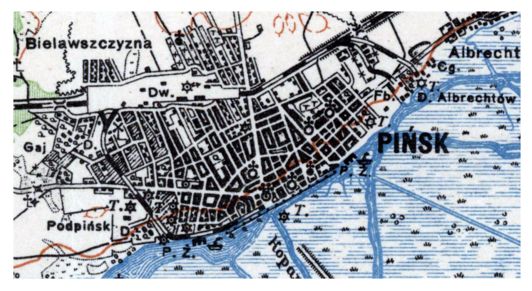
As for Truvovich, Vuvich and Misititch, this is the best clue I’ve found so far, a map of Pinsk from around 1925.  If you follow the main N-S street down to the Pina River at the bottom of this selection you will see, just on the other side, a short ferry-ride away, a spot in the marshes marked with a Jewish star and a capital T.

Truvovich maybe

“Star marks the spot of that muddy hell-hole, you say?” said the skeleton.

Death Benefits

These conversations with the skeleton of my father snuck up on me the first few times.   At first the skeleton simply interrupted, popping up to give me a detail from his point of view.   I indulged him when he had something to say and, also, when he had little to say.  

I came to look forward to our discussions, even as I was aware they were taking place in my imagination.  His answers had the ring of truth to them, he could be disarmingly honest and diabolically dishonest at the same time.  

He sometimes surprised me, like when his tone turned mid-sentence, the familiar merciless prosecutor yielding to the humble, remorseful man he became as he was dying.   The skeleton is once in a while the carping bully but more often he speaks in the voice of the man with the too-late perspective of suddenly having less than a day to live. That second voice is the one he would have preferred to have had all along.  The skeleton character speaks for both sides of my father,  what he was and what he could have been. 

By the time I got the call that he’d been rushed to the Emergency Room, yellow and unable to move his legs, I had begun to heal.   Our confrontations had made little sense to me as a child, all I knew was that the war was constant and unavoidable, except for the unpredictable ceasefires with a few hysterical laughs thrown in.    

I would come to know this hideous dance by the supremely ironic name my grandmother Chava used to describe the violence between my father and his brother: “seenas cheenam”  senseless hatred born of jealousy, pettiness, inexplicable malice.  

Seeing my father suddenly dying jarred me fully awake.  The experience in the dying man’s room is about person who is dying, not about anyone else.  He had things he needed to say.  I made it possible for him to say them.  Luckily for both of us I had attained at least that much empathy and common sense by then. 

I’d begun to see by that time, thankfully, and I was almost fifty already myself, that he had been unable to do better, would have done better if he’d been capable of it.   My father tried to explain, during that last conversation, that “on one level it was really nothing personal”.  I didn’t really get it at the time. This is a hard idea to truly grasp, but I think I’ve come to understand it.

Treating people badly is often the first reflex of people who’ve been treated badly themselves.  They will lavish the bad treatment on anyone they can safely do it to, a child is ideal.  Making the victim feel like it’s his/her own fault for the mistreatment is a satisfying two-fer my father was a master of.   He never recovered from being a two year-old, whipped in the face by his enraged mother.   How does one go about recovering from something like that?

Add to it the unutterable rages and sorrows that bubbled up from the lost souls of our murdered family in those doomed little Eastern European towns, rising like poisoned gas from the mass graves of our indecently slaughtered ancestors.  These unspeakable things can only be raged about.  The dead themselves, if they could speak, would bitterly complain it was so unfair and terrible, what they did to the powerless people who gave us life, people who only wanted to live, like everyone else.

                                                  ii

When my mother died, five years  and 22 days after my father died, I learned my sister and I were entitled to free grief counseling anywhere in the United States because our mother had been a patient at Hospice by the Sea at the end of her life.    My sister saw somebody in Florida, she went a few times.  I went every week for several months to 32nd and Broadway to sit with an Episcopalian priest named Paul who was an excellent listener and a kind man.  He recommended a book he’d found helpful — Death Benefits, by Jeanne Safer.  It was a book I marked up extensively when I read it.

The big idea of the book is that once a loved one dies their life can be seen, for the first time, as an organic whole.   There are gifts and lessons left behind when a loved one dies, from even the most miserable and ungenerous of them.  Seen in the context of one’s life and values, these gifts can be cherished and put to good use.  

Jeanne Safer had begun to see this after her own larger-than-life mother died.  Being a therapist, she had a wealth of patient stories as illustrations of death benefits large and small.  There was an overweight woman whose critical father’s death freed her to live a healthier, more satisfying life.  A frustrated accountant quit a job he hated to do what he’d always wanted to do, become a chef.  Old jury-rigged terrible things replaced by better, more refined and useful things by processing difficult lessons and seeing the gifts inside them.   

As I said, I took a pencil and bracketed sections of text that seemed particularly important or profound to me.  This is my practice when I want to mark text to find later, instead of underlining.  Underlining ruins a book, sometimes even crosses out some of the words it wants to remember.  I curse the underliners of library books, a tribe of unthinking, selfish morons.  A penciled bracket next to the text makes the section easy to find, in conjunction with a bookmark with a note and page number.  A bracket in the margin does nothing to make reading the prized section any more difficult.

I found the book very helpful.  I realized I’d learned many excellent and useful values from my parents, had inherited valuable traits.  I loaned my marked-up copy of the book to an old friend whose mother had died within weeks of my own mother’s death.  She never read it, and it was with a bit of drama, not without some ugliness, that I got it back a year or two later.  

I loaned it to another old friend who had lost her mother.  I never heard a peep about it and, in spite of her later promise to send it back to me, it vanished like the muddy little hamlets in the marsh where my grandmother’s family went into the night and fog.


Historical Revelations over shumai

Had dinner the other night with my father’s first cousin once removed, Gene, who grew up, from the age of five, in 1933, in the same Bronx apartment building on Eastburn Avenue where my mother lived with her parents.   Gene’s wife Sally grew up on the other side of the Concourse, just a few blocks away.   Sekhnet and I ate with them in a Chinese restaurant in Teaneck, where they have lived for many years.

I learned that Gene and Sally, like my parents, had little real information about their parents’ lives before they came to America, or about the families left behind. Gene’s father Morris had been one of eighteen children in a Polish town near the German border. Nine of the eighteen lived, including his father’s twin sister.  

Of these children only young Morris made it to America, having been sent for in 1909 or so by an uncle in New York.   He arrived after a two-week Atlantic crossing; was greeted by his uncle, who, three days later, died. Thirteen year-old Morris had to make his way alone in New York, learned the needle trade, became a union shop steward and a Communist.

“Stamper was a Communist,” my mother always said, without any judgment attached.  Although, it turned out, according to Gene, that after von Ribbentrop signed that pact with Stalin’s underling Molotov in 1939, the fatal non-agression deal between mass-murdering Josef Stalin and soon to be mass-murdering Adolf Hitler, Morris Stamper resigned from the party.

My grandmother Chava, Irv’s mother, had come across the Atlantic, with Gene’s mother (Morris’s future wife), on one of the last ships to leave the port at what was then probably called Danzig, now Gdansk, before the outbreak of World War I.     This was in the summer of 1914.

I was mostly listening, and filing details away, but I got the impression, from Gene’s description of his mother Dinsche as a brave, beautiful “leader” and Chava, two years younger, as a complaining, far less intrepid type, that it was due to the spirit of Dinsche that the two were able to cross the Atlantic in steerage during the summer of 1914.  

Dinsche had regarded the crossing as something of an adventure, charming the crew and getting special privileges for the two of them.  Chava, apparently, complained about the food, though the food they got was better than the food most people in steerage received, thanks to the socially adept Dinsche.   After their German-registered ship discharged its passengers in New York it was quarantined in the U.S. for the duration of The Great War.

As for the muddy hamlet the two of them came from, Truvovich, a place no longer found on any world map, it had been one of three such tiny Jewish hamlets located across the river from Pinsk, in a swampy area, as far as I can tell.  The other two doomed hamlets were Vuvich and Misitich.   Pinsk at the time was a town of about 70,000 people, about 30,000 of them Jews (of whom 37 are known to have survived the Nazi occupation).  

It was a short ferry ride from Truvovich across the Pina River (though Gene called it by a different name). It must have been after a ferry ride to that metropolis, in the earliest decade of the twentieth century, that Leah and Azriel were immortalized in a photo studio in the two large portraits Chava dragged with her to the New World in 1914.

The most amazing bit of history Gene imparted, along with descriptions of his childhood train trips up the Hudson River to visit Chava and her kids in Peekskill, was about my father’s uncle Aren’s Marco Polo-like voyage across Asia, the Pacific, the entire American continent just after the turn of the twentieth century.   If I’d heard this amazing and unlikely tale, I’d forgotten it.  

Aren had three children, Eli, by his first wife, who died of complications from Eli’s birth, and Nehama and Dave by his second wife. Aren sent for his little sister Chava in Truvovich after he remarried. Eli, I did the math just now, was about six when he went with his father to greet his beautiful, red-haired aunt in NYC and the two fell immediately into lifelong love.

Aren’s story I heard mostly from his son Eli. I spent many days, often until late at night, talking with Eli in the final years of his life.   Much of the talk was family history, the entanglements and devilish details of it.   Aren had arrived in New York City in around 1905, I had understood, where he learned to vulcanize rubber. Getting in on the ground floor of the brand new automobile industry, he would work with cars for the rest of his life.

I knew Aren had escaped from conscription in the Czar’s army around the time of the Russo-Japanese war, which history books tell us was in 1904-05. In those days a Jew drafted into the Russian army served for thirty years, absent early release via death or dismemberment in battle (partially untrue, actually, see note*).

Aren and two friends, Fischl Bobrow and Fleishman, decided not to be among the 40,000-70,000 dead Russian soldiers in that war.  They escaped the Imperial Russian Army together and arrived in the United States.  It’s possible Fleishman opted for Canada instead, which is where I think he settled.  I believe Fischl was the eventual connection to the Widems, Irv’s father’s family, from outside of Hartford, Connecticut.

According to Gene, their flight took them across Siberia, the Pacific (or perhaps the Bering Straits) and eventually to San Francisco.   San Francisco in 1904 or 1905, before the Great Fire of April 1906.  I picture Aren now, arriving in California, having crossed the massive Pacific Ocean somehow, a trip of about 6,000 miles.  Then he heads east, presumably on the transcontinental railroad, for another three thousand miles.  Next we hear from him, Aren’s in Manhattan learning to vulcanize rubber.     A few years later he sends for his little sister, who becomes my father’s mother, and the rest, as they say, is history.


* Apparently Jews, who were not allowed to serve in the Russian army until 1827, had been drafted for a twenty-five year hitch prior to the reforms of Alexander II.  Therefore Aren and his friends were likely only in for a five year military stint at the time of the Russo-Japanese War.  They were not alone in disobeying the Czar’s military orders.   From the summer of 1905 to the fall of 1906 there were apparently 400 mutinies in the Imperial Russian Army.

Things were made worse for the Jews at this time by circulation of the infamous forgery The Protocols of the Elders of Zion, published in Russian 1903,  confirming the worst about The Chosen People, in the minds of many, and unleashing a renewed flood of pogroms.