At least two possibilities

One is that you truly have a great idea that can help many people, have carried it hundreds of miles on your back, over a thousand obstacles.   The only trouble is that you haven’t been able to sell it yet.

Another is that you’re already dead, your idea as dead as you are, your failure to convincingly sell the idea to anyone a clear indication of those deaths.   Everybody knows of your death but you, that’s the reason for the forced smiles when you make a joke.

There are other possibilities, of course, many of them, but those are two.


Is there anyone whose insight you value more than your own?

The title above was one of the questions asked during a screening interview to evaluate my eligibility to participate in a research study about Cognitive Behavioral Therapy (CBT).  The theory of CBT, as far as I can tell, is that once you become aware of thought patterns that keep you locked in undesirable situations you can begin to change the way you think about those situations and find solutions that seem impossible as long as you continue to think of things from that unhelpful cognitive point of view.

So the graduate student reads that question:  “is there anyone whose insight you value more than your own?”   These are posed as yes or no questions, so I answer with an unequivocal no.   I think of everyone I’ve ever met, what they understand of life, how they live, what their deepest values are and why they sometimes must put certain of those values aside in the onrushing exigencies of life, and my answer remains an unequivocal no.  

Thinking further, I imagine everyone I’ve ever met would likely answer the same way, given the yes or no format.  Unless one has a wise counselor in their life, a sage parent, a mentor who sees the big picture and restores perspective, a religious person connecting them to a meaningful philosophical viewpoint when they become perplexed.   I wonder if the question were posed “do you believe you know anyone smarter and more moral than you are?” if the answer would remain the same.

I muse in this fairly pointless way as the snow continues to fall outside and I wait until it’s done falling to shovel it up.  It’s either clear the sidewalk and driveway or cause tremendous additional stress to someone I love, who would be forced drive through hell to get where I already am and do it if I don’t.  It is the least I can do, and as I love doing the least I can do, it is a blessing to wait for the snow to finish falling so I can do that eventually.

Fatigue and the difficulty of recharging the batteries

Long have they urged us, originally in hoary Latin, not to let the bastards grind us down.  The bastards constantly and tirelessly grind.   Grinding us down is their only goal.  They do a hell of a job and it takes a fresh, happy energy not to be ground down sometimes.

Of course, it is supremely fatiguing, this death by a thousand abrasions.  It’s impossible to energetically engage every one of the many outrages that are paraded by us every day.  We have outrage fatigue, in this world where they are hatching one outrage after another, using devilishly sophisticated machines to crank them out faster and faster.  

Some days it is not possible to energetically engage even the smallest of these outrages.   The question I ask myself today, as my wheels spin so far in the sluggish air: how do I recharge my spirits?

I have been musing on the scam that is the Patient Protection and Affordable Care Act and the seeming impossibility of getting out of paying hundreds of dollars I do not owe, in addition to hundreds in monthly premiums I do, feeling myself frozen in place, stymied, angry.  No outlet.  Go fight City Hall, asshole.  Has nobody granted me the serenity to accept the things that get to fuck me with no remedy and know the difference between the things I am right to actively engage?

Global warming, the organized, vociferous denial of fact, a government whose corruption is surpassed only by the insatiable, murderous greed of those who corrupt and control it, poverty, war, lack of civility, humility, gentleness, creativity in our public discourse.  The war of each against all that is thrust upon us every day.   We are living in a mined out coal mine where the air has turned noxious and it doesn’t take a coughing canary to tell us which way the toxic wind is blowing.

How do I recharge my batteries today?  Yesterday I played the guitar for a few hours, an excellent thing to do.  But, while it did me a world of good at the time, did nothing to recharge my batteries.  

Going to work is the most widely practiced universal therapy out there.  That I do not go to work is a big factor, too much time to muse, since I am not hitting snooze, having coffee and dashing off to work.   If everything in one’s day is optional, a kind of haze can set it.   There is a good reason that many people fear leisure, dread retirement, the feeling of being unproductive, useless, if not working in some capacity.   I am on the other end of the scale with that one– if I could play productively every day I’d be a very happy boy.

A very happy old boy.

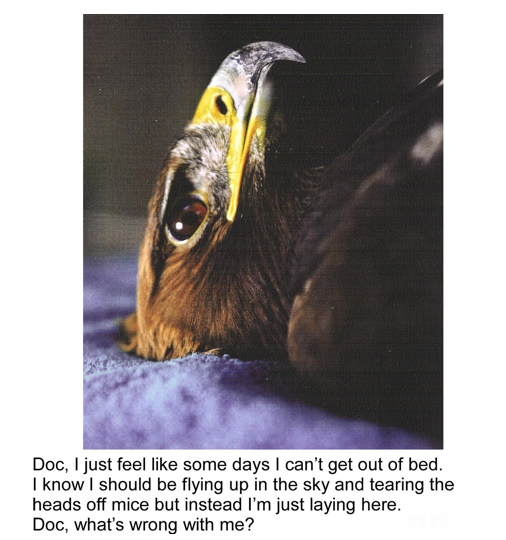
Depressed Eagle

An old friend from High School I’ve seen only a couple of times in the decades since emailed to apologize for being out of touch.  He referred to this blahg as a window into my tortured soul and then supposed he could unsubscribe.  Fortunately for me, he was inspired by the endless scroll of arguably depressing musings here to create and send this, which cracked me up.   May it have the same effect on y’all:


Picture 2

A Few Thoughts on Madness

My only visit to a locked mental ward was to see a friend incarcerated in Elmhurst Hospital in Queens.   When I left I waited for the elevator in a dingy space between the ward for men and the ward for women.  A woman was screaming, part of her face visible behind the medieval looking screen over the tiny window in the metal door.   From the sounds of it she was being tortured while the guards read magazines, ostentatiously pretending not to notice.  It took a long time for the elevator to arrive and the woman begged for my help the whole time.

I’d been visiting a friend who had been committed to this ward for refusing to be admitted voluntarily after a few weeks of increasingly bizarre behavior.  This meant that police with guns came to the suburban house where he was holding court, arrested him as a possible danger to himself and others (it’s unlikely he actually was, though he was clearly crazy) and took him to a room where they held him for several hours as they processed his paperwork and decided what to do with him.   We watched him for a rueful moment through the one-way mirror.   I remember he just sat there, still, and we saw him in profile.

The locked ward in Elmhurst, where the State in its mechanistic wisdom brought him next, was a scary place.  It was more a prison than a hospital, I thought during a short visit before he was transferred to a less restrictive section of the hospital a few days later.  Our friend seemed to hold his own there, pacing, glowering, vibrating with an energy that was disconcerting to watch.  It was an energy that most of the ambulatory men in that large, dingy day room seemed to have.

Before witnessing this breakdown I had a romantic notion about the fluid line between madness and sanity, seeing it more as a social construct involving conformity than a hard line.  I learned that it is, at times, a hard line; there is little subtlety involved when someone is having a full-blown episode of being batshit crazy.  There are plenty of eccentric, pain-filled, maladjusted, tormented, impractical, melancholic, aggressive, self-destructive, absurdly demanding people in the world who nobody would claim are completely mad.   It may be said that most lives, examined for more than a moment, are tinged with irrationality, ruled by destructive beliefs, misperceptions, shifting angers, ill-shaped grievances, avoidance, bottomless sorrows.  Or maybe this only describes the people I have met.  There is always that possibility.  

Anyway, this friend emerged OK, went back to work, continued courting his new girlfriend, soon to become his difficult wife.  Things were fine until a few years later, when I had a series of shrill, early morning calls from the difficult wife demanding that I drive to Greenpoint and take care of my friend, who was barking mad again.

When I arrived at their door she pushed him out, without his keys or wallet, and locked the door behind us.  This woman is vicious, full of self-important opinions, demeaning, demanding, narcissistic, reserving the right to rage.   A thoroughly unlikable person.  Though we got along for fleeting periods of time over the years, I think of her, for shorthand’s sake, as Hitler.  She is certainly as implacable as the famous psychopath.   Although, on that day, after a few minutes with my friend, I realized that she had been pushed to this desperate, if harsh, maneuver.  

My friend was clearly manic; he was cheerful as hell, spoke quickly, his great intelligence swerving the conversation from one difficult to grasp idea to the next. His eyes glittered with a combination of merriness and malice.  He had partially shaved his head, giving him an excellent look for his new attitude.  He was very thin, clearly had not been feeling the need to eat for some time.  I tried to get him to eat something at the nearby McDonald’s, but he wisely declined.

Fifteen or twenty hours later, at my wits’ end by now and realizing that the only help for my friend would come from skilled professionals, I made him a plate of pasta in my apartment.  He agreed that he should eat something.  Then as he sat down he turned to me and said something so provocative, so vicious and uncalled for, so perfectly aimed at my greatest vulnerability, that I grabbed him by the scruff of the neck, lifted him from the chair and slung him toward the door of the apartment, intending to shove him into the hall.  I am not proud of this moment, though neither am I unduly tormented by it.  Every human has his or her limit, and that now forgotten cruel comment as I was trying to get my insane friend to eat something was mine.

He grabbed me by the throat.  I grabbed him by the throat.  It was a moment when raging insanity was about to prevail.  In a moment of inspiration I lurched forward and kissed him, on the lips.   He laughed.  I relaxed my grip on his neck, he let my neck go.  I patted him on the back, told him to go eat, and went into the shower to blow water out of my face and try to regain myself.

A few hours later, somehow, I had him at the mental hospital, this time without police.  No locked ward this time.  He was restrained on the gurney, however, and I recall seeing him in profile spit a Haldol pill into the doctor’s face.  They wheeled him away.  The next time I saw him he was in the hands of a psychiatrist who became convinced my friend had been misdiagnosed as a schizophrenic.   Treated as bipolar, on a long-time regimen of Lithium, he has had no recurrence of mania in the twenty or so years since.

Knowing that Lithium is eventually fatal, he weaned himself off the drug.   He’s been maintaining himself with Zen meditation, achieving a certain clarity that included the realization that one can not live a happy life sharing a home with Hitler.   He finds comfort in cult-like settings, he tells me, and has found a nice group of people he meditates with.  He found a woman there he is very fond of and has a lot of sex with.   His wife broke the window of his rented room in a jealous rage over this and he obtained a restraining order against her.  She somehow got one against him.  The divorce is not going to be smooth sailing, but then, how could it be?

We check in from time to time.   The dispirited period I am going through makes it harder than usual for me to reach out, but we talk every month or so.  He reports that he is mostly content.  I nod, since regular and good sex with its steady flow of life-restoring endorphins will have that effect on a person’s outlook.  

The last time we spoke he was keen to taste the single malt I keep on a high shclf and have been refraining from drinking, being depressed enough without imbibing depressants.  He began singing its praises.  He does not keep it at home, fearing to fall into the bottle himself, but loves to drink good stuff from time to time at the home of a friend. I told him I’d prefer not to drink, and explained why, but later gave him a snort, against my better judgment, which led to having a few myself.  I felt like shit the next day and haven’t touched it since.

Had a call from him the other day, for the first time since.  “B is such a good friend to you,” he said, “he helps you with your business, and brainstorming, and trying to get your apartment shaped up, he hauls boxes of things to Good Will, puts his back into it, really cares about your well-being.  He seems like such a good guy and I feel bad that I’ve made such a bad impression on him.  He probably sees me as a guy who is always sucking around looking for something from you.   Dragging you back into well-worn bad habits you’d just as soon pick up.  To him I must look like Lampwick from Pinocchio, my ears slightly donkeyish as I persuade you to uncork the bottle, pour us just a drop.”

I agreed that this was likely the case, refraining from saying there was a certain accuracy to the image.

“I’d appreciate it if you could let him know that I’m not really that way.  If I ever meet him again, and I hope I do, I’d hate to think he has such a poor opinion of me.  Would you set him straight?”

We talked for a while more, he described the likely end of his period of unlimited sex, how the younger woman was very practically looking for a mate her own age, to have a child with, and how he could probably not hold on to her much longer.  He told me she was compassionately trying to set him up with another woman in the group, and that he had certain hopes for this new one.   He observed in passing that I am depressive.   I described some semi-comical recordings I’d made recently, and an aggravating piece by the often aggravating David Brooks that I had annotated.

“Send them to me!” he said emphatically.  I had stopped sending creative things to him because of his penchant for remaining silent.  We have been over this time and again in the past, my sensitivity to the easy slight of silence, when even “nice” or “ah hah” suffices to break the bitterness.   My father had been severely abused as a child and his cruelty translated often into the strategic, viciously ungenerous withholding of attention or comment.  This regular practice had sensitized me to the chillingly brutal power of complete silence in response to a query or creative effort.  I have stopped sending things to people I rarely hear back from, particularly those who attempt no creative work themselves.   His silence had become conspicuously dependable. “Send them to me,” he said again.  I told him I would and later that day did.

“By the way,” he said, by way of providing an excellent punchline, “I was thinking… if it’s OK with you…. you know, heh…. that I could come by for a drop of that excellent single malt today.  I have a few hours before I have to go see my girl.”

Neither of us laughed then, though it is very droll, if you think about it.  As droll as the silence into which the things he asked me to send him dropped.
Freakshow

If you had a camera in here, recording my steps around this crowded apartment, you would see the steps circling endlessly back to this chair with the excellent view of this computer screen.  To either side of the screen, and in front of the keyboard, drifting piles of beautifully colored ink drawings, like sand dunes seen through a prism.

“Why don’t you shut the computer off and just clear off the kitchen table?” a reasonable voice asks.

The camera would show me nodding, powering the machine down, stepping away from the computer, into the kitchen, looking at the table.  An hour’s work, one would estimate.  Put the blood pressure monitor somewhere, take away the power cord from the macBook, put away the cable for the iPod.   Remove the two wire book stands, collapsed and interlocking, lying interspersed with various small items, most of which, although they’ve been there for years, should be discarded.   Move away the cutting board, unplug the disconnected phone, put the unit in the electronics recycling bag.  

Then just go through that raft of papers, most of which can be thrown away or shredded after a glance. There is even a prize at the bottom of that Crackerjacks box, in addition to a clear work space to prepare food, eat a meal not propped on your lap.  Under those hillocks of papers, hopefully, is the card with the new return address of your old friend’s widow.  You’d like to write back to her, wouldn’t you?

But first, the steps lead back to the computer, power it on again, just a little sit here, see what’s doing, just a moment.  That snow storm, winter storm warning still in effect, what time is it now supposed to hit Queens and when do I need to leave here in order to shovel out from under it without being caught in it?  Etc.

This is all undeniably a bit freakish, and worrisome.  Just a moment’s pondering and I see it is just a fragment of a larger freak show all around.   We leave aside things like $81,000,000 paid to two psychologists to reverse engineer a torture program nobody seems very upset about.  Here there is a car going 75 mph on the interstate, accelerating onto a lane of hidden ice with the thought to go 80 in the HOV lane.  Here is a man issuing periodic and alarming reports from hell, describing a relentless monster wife and an unbearable life, now suffered for over twenty years.   There a man tells his longtime wife that their marriage has been over for a decade and shakes his head at her angry display of shock.   Here a man calls an old friend and complains that he is often seen as using the man, dragging him back into the weeds of bad old habits. He urges his recovering alcoholic friend to intervene, for the sake of his reputation, tell them it isn’t so, that he is a good friend, and then… by the way, if you don’t mind…. if I could prevail on you … do you still have that bottle of excellent single malt?   The examples are too numerous, the exceptions too few… it is all a gorgeous, swirling landscape of barely concealed madness.

There must be some kind of way out of here, said the joker to the thief.  I will just tap here a few seconds more and now …. if you will excuse me… I must be…. on my way.

Apathetic Paralysis

“Don’t say ‘can’t’,” she said again.  “It’s not that you can’t do things, you can.  It’s that you don’t make yourself do them.”  

“A distinction without a difference,” he said.  

“No,” she said, “saying ‘I can’t’ means you’re incapable of doing them and it is far different from not making yourself do things you are clearly capable of.”  

“Is it really?” he said. “If I don’t do something I am clearly capable of, something I want to do, something it frustrates me not to be doing, doesn’t it mean, for all practical purposes, that I can’t do it?”  

“It means you won’t do it,” she said.  “It doesn’t mean you can’t”.

“The beggar says to the woman in the mink coat ‘please help me, I haven’ t eaten in three days’….” he said.

“And the woman says ‘force yourself”.   Yes, you are very witty, Shlomo, but better to use your energy for seriousness at the moment,” she said.  

“Energy?” he said.

The conversation was a circle, it moved like the hands on a clock that had long ago given up trying to keep time.  It would move in a circle and stop, sit in the dark, and when the light went on again, it would continue to pointlessly circle.


As The Walls Close In

Our happiness, or unhappiness, we are often reminded, flows directly from how we view the world.  That glass– half full or half empty?  Life, full of cool, even miraculous, possibilities or a grim waiting room for inevitable depressing decline and death?

Of course, this kind of either-or thinking, so prevalent in our culture, can be as unproductive as it is simplistic.   It’s true we are better served taking pleasure from small things than being tormented by what Professor Bukowski astutely called “that swarm of trivialities that can kill quicker than cancer, and which are always there”.  But our lives here are complex and, at least for some of us, defy the kind of easy logic that tells us it’s better to look on the bright side than the dark side.   Better to be active and productive, solving problems as they arise, than paralyzed by shifting, hazily understood affective disorders.  These mood disorders, a quick check of the internet informs us, can not be detected by medical tests.

When I was a kid Batman was on TV, a colorful, campy live action version of the comic book.  Many episodes ended in a cliff-hanger, the Dynamic Duo trapped in a room with the water rising, the floor and ceiling slowly moving toward each other to crush them, the walls, spiked with swords, closing in.  Viewers were exhorted to tune in next time at the same bat time, same bat channel.

The walls closing in would begin the next episode, and just as things were a second from fatal, Batman’s ingenuity, gadgets, fearlessness and physical prowess would save the day.  They’d get out of the trap and go kick the bad guy’s ass. 

I struggled out into this frigid day with the image of the walls closing in.   The walls are not closing in.   Metaphors are one thing, the walls actually closing in are another.   I did a little research to see if the Cognitive Behavioral Therapy study was still going on at a local psychiatric institute.  I’d been given a doctor’s name and number yesterday, more than a month after I’d made several inquiries.  I called and haven’t heard back yet, so I did a bit more research about the study on-line.

Cognitive Behavioral Therapy (CBT) is, and I couldn’t say it better myself:  a “structured, short-term, present-oriented psychotherapy for depression, directed toward solving current problems and modifying dysfunctional (inaccurate and/or unhelpful) thinking and behavior.”[1]

I’d prefer this action oriented, insight based approach to the usual psycho-pharmaceutical one so often endorsed by well-paid, highly respected snake oil salesmen.   You can read a thorough review of the effectiveness and testing of these pills here.   Placebos, it has been demonstrated, are more than 80% as effective as the patent drugs for treating things like depression, dysthymia, anxiety disorder.   (Which reminds me, I have to stop putting off reordering my organic placebo– it always gives me a tiny jolt of hope when I take it every morning).

I read about the study and was suddenly stopped in my tracks.   The first step, after a psychological evaluation to determine your level of affective disorder, is to pop you head first into a long, claustrophobic metal tube, where amid frightful banging, your brain will be scanned to get an image of the “before” brain.

“Fuck that,” I found myself saying, shrugging out of my skin and preparing to hop on to my skeleton, waiting alertly on all fours, to gallop off screaming into the night.

A Ridiculous Fear

“What exactly are you afraid of?” she asked with mostly hidden exasperation.

“They’ll turn me down for the study,” he said.  

“But you don’t want to be in the study.  Don’t you keep sending people copies of that great review of the books exposing the lucrative hoax of psycho-pharmacology?”  

He nodded.  “I do, and I believe, as the cited studies show, that the placebo is 84% as effective as the patent drugs they prescribe, to maximize ease and profits instead of the difficult probing for solutions to the person’s problems.”  

“And you have already been taking a placebo for months, and noticing it makes you feel slightly better once you down it every day.”  

“I have, yes,” he said.  

“So what exactly is your fear?” she asked.  

“I’m afraid I will not present as depressed enough to qualify for the medication study, and I’ll be stuck in this semi-depressive state forever,” he said.  

“You realize how ridiculous that is, I trust?  You are against the medications, but afraid you’re not depressed enough to qualify for the medications…”  She looked at him and he shrugged, noncommittal.   “I can tell you one thing– you are depressing enough to qualify me for the study.”

“What a mean thing to say to a depressed person,” he said.

“Well, gee,” she said, “I’m no psychiatrist or anything, but, scary as this will no doubt be to you, you seem to present just fine, making jokes, watching movies, following the news, showering every day, your weight staying the same– you could lose 15 pounds, you know, it wouldn’t hurt you– you’re not sleeping 3 hours a night, or ten.   You’re just…. how do I put this gently?”  

“This should be good,” he said.   

But he never got to hear it, the phone rang and she leaped nimbly off the hook to talk to a friend for an hour as he tapped the screen of his iPad, spelling words against the clock, losing badly, and playing again, badly, then again.


angell_1-062311.jpg

All The Time in the World

Beware, if you think you have all the time in the world.  You are afforded a very small slice of all the time in the world, and before you can blink they are shedding tears for your passing and heading toward the buffet table.

My grandmother, long gone, used to watch a soap opera called “The Days of Our Lives”.  I remember the name because the opening featured an hour glass with the sands rushing down it.   “Like sands through the hour glass,” intoned a sonorous actor’s voice, “so are the days of our lives.”  The miracle of the internet lets you click here and hear it for yourself.

The nostalgic sound of that clip can bring tears to a sentimental eye.  My mother, for example, would probably sob to hear it, reminded of her mother, newly retired and quickly hooked on the afternoon melodrama, reminded of being 37 herself when the show first aired.  She’d be thinking this seemingly ten minutes after being 37, suddenly 78, a 21 year battle with endometrial cancer behind her and not much happiness ahead.  “So are the days of our lives,” would have socked her in the kishkas, the music would have twisted the fist.

Since we do not have all the time in the world, how do we justify time wasted?   The days we accomplish little or nothing?   We can take some solace in the paycheck we’ve earned, if we’re working, or in a job well done, if we do a job well.   In the things we’ve created, a family, a nice home, a business, nice craft items.  In the progress we’ve made toward becoming kinder and smarter people, if we have made such progress.  

Or we can brood and set variations of our brooding into type, watch them march across a computer screen, tinker with the tipsy words, arranging them this way and that until we’ve made them coherent enough, post them on the internet for a guy in Eastern Europe to read.  Yes, we can also do that, I suppose.