We may not question that the greediest and most ruthless among us have every right to rule, since they are the fittest, the most motivated, the most special and the most entitled. If you only have $100,000,000 there is no reason you shouldn’t have every right to go for ten, a hundred or a million times that. It is only jealously on the part of losers that could account for a failure to realize that acquiring more money than you can spend in a hundred lifetimes is simply the highest expression of freedom. Ask the Free Market, consult the Invisible Hand, consider the Finger.
Your new doctor agreed you were right to want to rule out cancer before undergoing another operation on the same organ. You take an MRI. A few days later a bot will send you the MRI results, because — of course they will. If it’s bad news your doctor will call, and sure enough, the next Monday morning, his office calls to wake you with the news that your doctor needs to speak to you. He can talk by video in one week. You put it in your calendar and try not to worry until you get actual bad news. A few days later the office calls to tell you that the doctor will be doing surgery during your appointment and will have to reschedule. Of course. He can talk to you the following week, they tell you. You put it in your calendar and try not to consider it, though your sleep suddenly turns brittle and you wake exhausted each day.
You must get the idea of murderous corporate medicine out of your head. Doctors have to work for large medical corporations in a capitalist system in order to practice medicine — the equipment and facilities they use are fantastically expensive. If a doctor is too busy for two and a half weeks to give you bad news, whose fault is that? He is busy saving lives and earning his keep at the corporation by performing surgery. It is absolutely nothing personal, and you have to understand that. If you are a whiner who needs a doctor to hold your fucking hand, whose fault is that? That’s why the market created “concierge doctors”. Pay or quit whining.
This is simply the way the modern, end-stage capitalist world works. You can bang your head against it or shut up about it. Or you can write a meaningless blahg post that three or four people might read. It’s really up to you, in this exceptional land of the free and home of the brave.
Medicare, the health care partnership between private insurance companies, pharmaceutical manufacturers and the government to protect the health of people over 65 (or with certain disabilities) is promoted as the solution to health care coverage for Americans of all ages. At 69, and dealing with Medicare now for a few years, I find this idea appalling, especially since the only solution to protecting the health of the old and the sick is a single payer system that cuts out all the parasitic middle men who profit off disease and our legitimate fear of death.
Citizens of a democracy deserve decent health care as a right of citizenship, like in every other wealthy economy (and formerly Iraq, Libya and other third world “shitholes”). But, lest I forget, America is exceptional.
Every year, between October 15 and December 7 (a day that always lives in infamy now, thanks to Medicare) purchasers of Medicare insurance are urged to shop on the marketplace and find the best suited plans for themselves. You can compare prices and, in some cases, actual coverage. It is no fun navigating the website, shopping for the best “deal” that should be provided to you automatically as a lifelong tax payer. Each of us should get the best deal available from our government, the one we fund, the one that is supposed to watch out for our best interests.
The economic reality is that, in a consumer society, if you need a few pills, you will pay 50 cents each. If you buy a billion pills, the price is 3 cents each. This is simple capitalism, economy of scale. The more you buy, the less each one will cost you [1]. Medicare buys a trillion pills a year, but is prevented, by a right wing/corporate law signed by Dubya, from negotiating prices with pharmaceutical companies based on that economy of scale leverage.
And so old people are forced to enter this kind of virtual mall, after October 15th of each year, where you can search for the best deals before the annual December 7th final deadline comes crashing down and you can choose nothing until the following October 15th rolls around because, fair is fair and rules are rules.
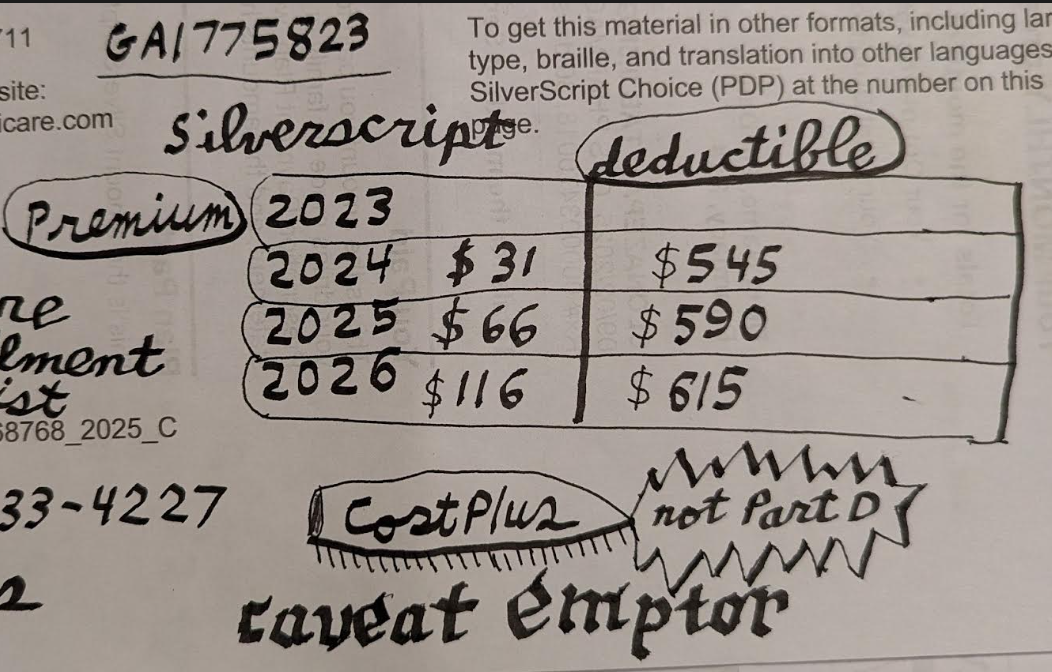
Part D of the alphabet soup that is Medicare is the prescription drug plan and every Medicare recipient must choose a Part D plan (or get it included in the problematic, loophole-ridden, insurance company sponsored Medicare plans known as Medicare Advantage). Prices for Part D vary wildly. In 2024 I chose the cheapest drug plan available, Aetna Silverscript, for $31 a month. Then:
You see profit margins here that would make Jeff Bezos and Elon Musk insanely jealous. Over 100% price increase in 2025 and then, a tic below another 100% price increase the following year. All perfectly legal here in the land of the free and the home of the brave, as long as you get a letter from that corporation informing you that your premiums will double and you will get only slightly less coverage.
A billionaire named Mark Cuban set up a company called CostPlus that will mail you prescription drugs, at 15% above cost plus handling and mailing. You can calculate the approximate cost on their website. The four generic prescription drugs I take will cost under $100 every three months, less than $400 for the year. No deductible, no insurance, just the prescriptions. I signed up online. There is a form for my doctor to submit to them, and the drugs will be shipped to me every ninety days.
I called Aetna to cancel my Part D with them, after visiting the marketplace and seeing annual prices, under our American “freedom of choice”, from $1,000 to $3,000 for the identical drugs (cost of drug copays plus premiums). My once modest $31/month plan was now up there with some of the most expensive. The woman I spoke to at Aetna was lovely, but she was not a trained disenrollment specialist, she explained, and so couldn’t take my cancellation order. She gave me another number to call to speak to a “Medicare disenrollment specialist”, and after checking, at my request, confirmed it is a 24/7 number.
In the wee hours of the morning I decided to make the last aggravating December 7th related call of the year and get that particular pile of steaming scats off my plate. When I called the 800 number it came up like so:
Who the fuck is Valley Organized Physicians? Fuck if I know, but they answer the phone “Medicare”. The person I spoke to patched me through to a disenrollment specialist named Kevin. Kevin and I wound up talking for almost an hour. He somehow had instant access to every prescription drug I’d bought in the last three years. His job, apparently, was to sell me a Part D plan, as I learned when he read me the complete list, suggesting that some, if not many, would be hard to get without insurance.
Kevin warned me that unless I enrolled in a Part D program with creditable coverage that met the minimum standards of Medicare, I’d be subject to a potentially large lifetime monthly fine that would add several dollars, or even a hundred or more, to my monthly premium in perpetuity should I need Part D coverage in the future.
I told Kevin I had no idea what “creditable” meant in that context and he explained. If the prescription drug program you enroll in is not recognized by Medicare, it’s not creditable and you will pay a monthly fine for the rest of your life if you cancel a creditable plan at any time during your years on Medicare. Way to watch out for the old and vulnerable, you fucking corporate psychopaths, I thought. But since Kevin was being so nice, we continued to amiably bat the ball back and forth.
Kevin laid out the worst case scenario to make me understand the risk I was taking by going with a non-creditable plan. Say in five years you decide you need Part D, for some expensive medication, let’s say (which, admittedly, Part D might not cover, but exceptions can sometimes be made for medical necessity). Well, currently the penalty is 39 cents a month times twelve (since you can only fix this once a year). That penalty number keeps going up. So in five years time, Kevin told me, I could be looking at a penalty of maybe $50 a month, maybe $100.
I pointed out that if I realized it was a mistake to opt for CostPlus and bought a Part D plan at the next available date (October 15, 2026) I’d pay $4 a month penalty for the rest of my life. Meantime, Aetna had increased their premium price for their basic plan 100% one year and 100% the following year. I asked him how it was possible that an insurance company can double its rate year after year with no regulation by Medicare.
Kevin had an answer worthy of a Republican congressman speaking to a FOX audience, there are many factors, market forces, which are impossible to regulate, or predict, or even consider, he told me. In other words it’s hard to say and above our pay grades to understand or do anything about. I told him it was not hard to say that costs for Aetna had not increased 200% in two years.
I expressed dismay that Medicare imposed no regulations on what private insurance companies could charge. He agreed that it was not unreasonable for me to be dismayed, but that there was a reason, somehow, beyond our feeble human understanding, apparently, that corporations can’t be regulated but consumers must be charged lifetime penalties for not buying creditable plans from approved insurance companies providing benefits consistent with the minimum standards of Medicare Part D.
Kevin told me to look for a zero cost Part D plan, then checked and said there were none available in my area. He tried to sell me a $35 a month plan, from Healthspring Assurance, which, with the drugs, would cost me only about $720 a year. He agreed there was no guarantee that Healthspring wouldn’t double its premium next year, but that’s why there is a period to compare prices once a year and the requirement of a letter informing the customer that the price was about to double.
He was trying to help me out, he said, after explaining he could have disenrolled me as soon as I called, but he was warning me of the potentially dire consequences of uncreditable disenrollment. I said that in dollars and cents, the difference between $300-400 a year for generic prescriptions, and even the bargain price of $720, would seem to more than offset the penalty for a year or two.
Eventually, after a long chat, he told me he would disenroll me. There was no confirmation number, no proof we’d ever had a conversation of almost an hour (except on my phone, but again, who the hell is Valley Organized Physicians?), I’d get a letter from Aetna confirming I’d been disenrolled, he told me. We bid each other a polite goodnight.
We got off the phone, it was now 4 a.m., and my head immediately fucking exploded. Every narcissist I’ve ever known has told me I’m too sensitive. Maybe the despicable freaks are right about that. I was unable to tune down my outrage enough to get to sleep, the pill I took at 5:00 allowed me to finally drift off around 6:30 a.m. for a few hours of sleep. I’m too sensitive, goddamn it, and it’s messing with my health.
Talk about a “disgusting abomination” (Elon Musk’s petulant name for Project 2025’s Big Ugly Bill that will kick millions of working and disabled Americans off their health insurance programs and let more children go to bed hungry in the richest country in the world, among other abominations)… the first actual casualties of the world’s wealthiest insane refugee from the end of White Supremacy Apartheid in South Africa, in his role as head of an illegally constituted government “department”, are the non-white children of Africa. Who would have thought an insanely greedy megalomaniacal proponent of the Great Replacement “theory” would be instrumental in killing tens of thousands of black and brown children by starvation, toxic water and disease? An estimated 103, mostly children, are dying EVERY HOUR. 24 hours after I post this more than 2,400 more poor people will be dead.
American corporate media is tastefully silent about the ongoing mass deaths– mostly children, that Trump’s illegal impoundment of funds allocated for USAID are causing worldwide. It’s as if all the world’s children are now Palestinian children, born into a world of terrorism, and the media of the world can’t bear to report on their maiming and killing.
In officially parting from the insane white supremacist Musk, Trump’s White House leaked the shocking news that superfreak AI glitchbot, often almost, semi-convincing human impersonator Mr. Musk, who appears whacked out of his mind during awkward public appearances, was actually high as a cyberkite on a daily cocktail of mind-altering drugs.
Senator Sheldon Whitehouse had a good image of these destructive, lawless, whining, endlessly transactional andcombative “winners” during a committee hearing:
“It strikes me that what we have here is a team that has taken the field and engaged in unprecedented numbers of fouls, unprecedently flagrant fouls, and when the refs blow the whistle on the unprecedented number of fouls the partisans of the team committing the fouls call out the referees for the unprecedented number of whistles they blow.”
Sounds about right. USA! USA!!! Make America violent and suicidal again!
Breaking news: since John Roberts and the Federalist Five ruled that no presidential pardon can ever be questioned in a court of law, Donald Trump gave the first ever presidential pardon to a corporation. Some bitcoin outfit incorporated in the Seychelles that had some trouble with authorities over shady dealings, money laundering, trifles. They got an absolute, blanket presidential pardon. Even if Trump committed a crime in granting the pardon (say he was paid $50M for the pardon by these bitcoin bros), pardons are part of his core presidential powers, so — absolute immunity, even if he took a $50,000,000 bribe to grant the unappealable pardon. Suck on it, cucks.
Meantime, a few words about the modern, American global corporation. I’m thinking about corporate medicine since a recent run in with a urological corporation, the biggest in the USA, apparently, whose top local branch biller shanked me in the urethra with a rusty ice pick a few weeks ago:
You can’t avoid the word psychopath to describe the corporate person. A psychopath cannot feel empathy or regret and acts only in his own self-interest. Very few psychopaths are serial killers like the ones we see on TV. Most are charming, determined, ambitious, highly intelligent, strategic, great salesmen, fearless entrepreneurs, CEOs, top surgeons, pundits and the highly focused leaders of many professions. James Fallon, affable neuroscientist and expert in the psychopath’s brain, who discovered he was a psychopath at the age of sixty, lays out the entire constellation of psychopathic traits. The thing that convinced him he was a psychopath, after the familiar PET scan of that distinct brain and the unanimous answers of all of the people in his life indicating that he was indeed a psychopath, was that he truly didn’t care about the conclusive diagnosis.
In order to understand the nature of corporate medicine, it’s necessary to grasp the essential personality of the Supreme Court-created “person” that is the modern corporation. The case for the psychopathy of corporations is made beautifully in a 2003 documentary called The Corporation, (now available for free on youTube, highly recommended). Corporations possess all the attributes of psychopathic serial killers. These traits, as outlined by an FBI profiler of serial killers, are: callous unconcern for the feelings of others; incapacity to maintain enduring relationships; reckless disregard for the safety of others; deceitfulness: repeated lying and conning others for profit; incapacity to experience guilt; failure to conform to social norms with respect to lawful behaviors. It is ridiculous to expect the human representatives of such a “person” to “first do no harm” since the entity they serve cannot feel empathy or regret and has only one concern – maximizing profits. It is better to bill for an unnecessary, painful operation without doing any prior tests, and to hurt the patient, than not to bill at all.
A corporate “person” has only one legal duty, according to the Supreme Court, to maximize shareholder profit. To this end a corporate person, unburdened by empathy or regret, often has a high tolerance for what economists call ‘externalities’, the unfortunate downside outcomes of corporate profit-making activities. The price of settling a class action lawsuit from a community downstream whose children are poisoned by lead, or any toxic bi-product of the corporate product, for example.
The corporate “person” is a complete psychopath. Corporate culture encourages the human embodiment of its essential character to rise to leadership positions. The corporate structure keeps every psychopath working for it free from personal liability for anything. Fair is fair. The corporate personality also explains a lot about the severe, mechanical, sometimes deadly, practices of corporate medicine. The awful truth is that we are currently living in the judicially-approved, psychopathic billionaire-created Age of the Corporation, in other words, the Golden Age of Psychopaths.
Corporate medicine is medicine conducted, primarily, for the profits of shareholders in the corporation. Health insurance, healthcare, pharmaceuticals, death prevention in general, forms the most lucrative sector in the American economy. To be sure, decent medical results are required, usually, for a corporately held medical group to stay in business, but make no mistake: the primary goals of the board of directors and CEO of the corporation are for doctors to see as many patients as possible, do as many expensive tests and surgical procedures as possible, bill for every contact with a patient and make the most money for the corporate “person” that employs the medical staff, invests in the medical technology, conducts public relations and fundraising in the community to be seen as self-less healers.
You will notice fewer hospitals with an ombudsman or patient advocate. These skilled professionals calm down patients who are upset, make them feel heard, resolve conflicts that can complicate healing. They also avoid lawsuits against hospitals and doctors. None of these outcomes are as important as a good security system to remove agitated patients who demand things of doctors or medical staff. I will be writing about death by corporate medicine again soon, but for the moment, here’s one example of corporate medicine that might seem subtle, though it doesn’t feel that way to the patient.
The patient (me) was scheduled for an emergency cystoscopy, the insertion of a miniaturized camera into the penis, down the urethra and into the bladder. I’ve had these before, they sound much more nightmarish than they actually are. The phrase associated with things like cystoscopies is “most patients tolerate” the procedure, often with an initial grunt. I was nervous about this emergency test, since my urethra was still painful from an unnecessary surgery conducted on me two weeks ago by a surgeon who, although charming and a great salesman, never did any test before plunging into my urethra and tearing the tissue therein.
I was told by my new urologist that if I arrived one minute after my appointment time the emergency cystoscopy would not be done. I arrived ten minutes before my appointment time. I then waited ninety minutes for my appointment. During those ninety minutes I urinated five times. I was nervous, and annoyed to be kept waiting this long. I had to go again and again because my bladder doesn’t empty easily, but every one of these pisses was pretty much pain free, especially compared to the relentless pain of the last two weeks. Then I was escorted in for the cystoscopy. I told the attendant that a lab report on my recent urine culture was back and that if I had an infection I probably wouldn’t be having a cystoscopy. He turned us around and took me into a regular consult room.
When the doctor finally arrived, I had one thing to say, a final word to clear up our initial misunderstanding. I told her I needed ninety seconds. I wanted to make it clear that I respected her longtime colleague, and my longtime urologist, and that we’d been having a mutual bad day the last time I saw him, that I was under pressure from recently diagnosed kidney disease, the inability to walk and other medical issues. She cut me off about ten seconds in, I was by now, apparently, her last patient of the day. She was not interested in rehashing any of this, she said. She told me I had a massive urinary tract infection and that was the cause of my pain. Obviously we weren’t going to insert a scope into a painfully inflamed urinary tract.
I could have been told that ninety minutes earlier, by the doctor’s smart, engaging personal receptionist. The knowledge that I wasn’t going to have to tolerate a painful (initially) procedure might have saved me two or three trips to the bathroom. It certainly would have spared me some anxiety. But that kind of thing is strictly the patient’s concern, not anyone else’s, in a corporate setting where your doctor is seeing twenty other patients a day.
Because I had urinated so many times while in her office, because I had a massive infection, the doctor assumed that I was still in as much pain as a few days earlier when I was still recovering from an unnecessary procedure (as the surgeon conceded afterwards, I need a different one) that had torn tissue in my urethra. Based on the lab results of a urine culture and her assumption about urinary urgency and pain, she prescribed the Cipro and told me to take two pills, phenoazopyridine, three times daily, to help with the urgency and pain of urination.
I was unable to convey to her that balancing my water intake (after days of trial and error, 48 ounces seems to be the sweet spot) is the best way to keep the urine flow going throughout the day. I began telling her that my previous experience with phenoazopyridine had left me unable to urinate at all for hours at a time. If the goal was, as she said, to keep urine flowing to help protect my kidneys, and empty my bladder as much as possible, this drug, which had not worked for me pain-wise either, was not one to take. She quickly dismissed my experience and encouraged me to take it three times a day, whatever it said on the box.
Updating this post just now I seem to have deleted my final paragraph. Had the doctor asked me my level of urgency to urinate and pain during urination, instead of making hasty assumptions about what I needed to do, I’d have given her a pain score of two on each of those, as opposed to a solid 7 to 8 several days ago, when my torn urethra was still inflamed. I didn’t need pain medication for the infection, only the antibiotic to cure it. I won’t be taking phenoazopyridine again, and I’ve regained much of my ability to urinate as before after last night’s dose, but … seriously, what do you expect from a doctor who works in the setting of corporate medicine? She doesn’t get paid to schmooze or ask patients about their feelings, there’s absolutely nothing in it for a doctor with a tough quota to meet every day.
Next time, remind me: corporate medicine’s denial of any mind/body, affective/corporeal, emotional pain/physical healing connection.



 gratuitousblahg