Note for Phil Trombino

“Write it, print it and send it to Phil, motherfucker,” said the skeleton of my father from his grave off that quiet road north of Peekskill.   This struck me as a good indication of his impatience, I don’t ever recall him referring to me as ‘motherfucker’.

Dear Phil:

Eliot Widaen here, son of your former colleague at the Human Relations Unit Irv Widaen.   That is, if you are indeed the Phil Trombino who had that magical 1967 season at Iona College when you hit like Ted Williams, torching the league at a .441 clip.   I’m hoping you are, and that you’d be willing to talk to me about what you recall of the workings of the Human Relations Unit and any good stories you might have about Irv (I’m writing a memoir of his life).   You can reach me at this address, or by email (here), or by phone or text (here).   I hope you are well and I look forward to hearing from you.

“Was that so fucking hard? What did that take you, ninety seconds?” said the skeleton.  

I wasn’t counting, dad, but it was probably around ninety.  

“Shut up, print it and mail it, damn you,” he said, slouching back into his eternal bed.


The Conventions at Hampton Bays

I have reached the stage in trying to write a complete life of my father when I need the insights of other people who knew and loved him.   It’s time to put on my journalist hat and reach out to them for corroborating details and information I don’t have any other way of getting.    There is Phil Trombino, a younger colleague of my father’s from the Human Relations Unit (I don’t know how close they actually were, or how long they worked together, though I know my father liked him very much), there is his close friend of many years Benjy and a fellow in the East Bay named Rom who knew and very much dug my father’s routines when Irv was the director of Nassau-Suffolk Young Judaea and this guy was a teenaged member of the youth movement.  I will attempt now to write a door for this man to walk through, into my telling of the story of Irv Widaen’s life, by way of introducing this narrative to him.

“You’ll send it to him, presumably, and then call, meaning many more weeks will probably pass before you actually get your head out of your ass and contact him,” said the skeleton of my father from his grave in Westchester County.  

Yes, quite possibly.

“You still haven’t sent that postcard to that Trombino you found, about an hour from your apartment, to see if he is indeed the Phil Trombino who hit around .400 that year in college baseball at Iona, to find out, if he is, if he’d be willing to talk about his time at the long defunct Human Relations Unit.”

No.

“Needless to say, you haven’t reached out to Benjy since the night before mom died,” he added, needlessly.

Needless to say.   Now back to this portal I am trying to construct today for Rom, who you knew as Bruce and later Peanuts, a guy I was always much closer to (I never recall even meeting Phil) that I also need to contact.

Nassau-Suffolk Young Judaea, like all the other Young Judaea regions around the country, held periodic conventions.  A convention of as many kids as they could convene would be held at a camp or hotel and would take place over a weekend.   Buses and cars would bring members of the youth movement together from clubs all over the region and an executive committee (the exec) would make a schedule of lectures, discussions, speakers, films, proposals, entertainments for the weekend.   When my sister and I were little we attended a couple of these conventions at a hotel in a place called Hampton Bays.   It was at one of these conventions that I first encountered the guy I am talking about, a young teenager called Bruce at that time.

Here is what I recall, from November 22, 1963, which must have been a Friday.   We were driving out to Hampton Bays for the “convention”.   My little sister and I had no idea what a convention was, we were about to see.   My mother was in the passenger seat, most likely with the brilliant mutt Patches on her lap, and my sister and I were in the back.   I was seven years old, though it’s hard for me to believe I could have been that young at the time.   We stopped at a diner for lunch and the kid at the counter, who looked uncannily like a skinny version of JFK, thrust his face forward, a weird, pained smile on his face, and asked if we had heard.   I guess everyone else in the place was in shock and we didn’t seem to be.   The president had just been shot!  The soda jerk was crying, as were many others in the diner.

My memory of that convention was mostly of sitting by the hotel office in the cavernous front hall, staring at a black and white television at the end of a long extension cord.   I could not stop watching.   I believe I was watching the live broadcast from Dallas on Sunday when they brought Lee Harvey Oswald out and a bull-backed Jack Ruby lunged forward and pumped a couple of pistol shots into Oswald’s abdomen, a moment captured in a famous still photo of Oswald’s sudden mortal agony.  One of the cops holding Oswald’s arm recoils too, with an arresting expression of shock on his face too.

Ten years later I would be on a new kibbutz in the Aravah desert in Israel, volunteering to help pick their first bumper crop of tomatoes.   It was common for kibbutz volunteers at that time to be assigned a family, a kibbutz mother and father to visit and hang out with.   The kibbutz was brand new, and the members, most formerly American Young Judaeans, were only five or six years older than me.  The kibbutz parents I was assigned were Ruthie, a kibbutznik on loan from another kibbutz, originally from Brazil, and a guy from Maryland, Howie Katz, a bright shining soul of infinite good cheer.   Howie spent much of his time on the kibbutz naked, streaking from place to place, sometimes slipping on a pair of shorts.  

The teenager I knew as Bruce, then Peanuts, now Rom, had served in the army with Howie, survived the explosion of their tank in Sinai, was also a member of the kibbutz.  Rom was still on active duty somewhere, I think, I don’t recall seeing him on the kibbutz when I lived there.

Howie and I both returned to the US a few months later and we remained good friends for the rest of his life.   Howie’s best friend, it turned out, was Rom, this fellow I am carving the portal for.

Rom corrected me, shortly after Howie’s sudden death in 2010, about Howie being my father though he was only three years older than me.   He was actually five years older than me.   Rom knew this because they were the same age and because his first image of me, Irv’s son, was at a convention in Hampton Bays when he was a in high school and I was a little kid, maybe in second or third grade.   I am assuming that convention must have been in 1964, when I would have been eight and Rom, then still Bruce, would have been thirteen, probably the youngest Young Judaean at the convention.

Which would help explain why I noticed him by himself several times during that convention, outside the dining room, with his cane (hockey injury), imitating Eddie Giocamin as he narrated his game winning slap shot over and over, using the cane as a hockey stick.   “Giacomin, slap shot, score!!!” he said as my sister and I laughed.  (I discover now that Giacomin was a goalie, thus it is unlikely that my memory is correct, though I do remember him saying “slap shot, score!” and “Giocamin!!” several times as he slapped the imaginary puck toward the goal.  Giacomin must have been saving all those attempted goals.  I’ve never been a hockey fan.)

By 1964 the Beatles had landed in America and I was a big fan, especially of the irreverent John Lennon.   This guy looked a bit like John, had the longish hair (as did I, in a child’s Beatle haircut), the wire frame glasses, the longish nose, the wry expression.  He was also funny.  Standing up shakily, using the cane as much as a prop as for support, he slurred “sure didn’t taste like tomato juice”, a reference to an ad for V-8 then common on TV about someone slipping the actor a spiked tomato juice.   Well, you will say, that’s not what the ad was suggesting, it was about the superior taste of V-8, made with eight delicious vegetables.  Still, I recall the line, recited in a drunken manner, and it made my sister and me laugh, as he took a couple of exaggeratedly drunken steps, glancing at us from the corner of his eye.   Each time we passed him he would put on a little show for us.  Whenever my father passed he’d say “get your ass back in the dining room, Bruce,” in passing, in that sly, breezily hassling way of his, not really seeming to care whether Bruce actually did it or not.

Years later I ran into him again as Howie’s best friend, in San Francisco.  He’d been entrusted with filling Howie’s new waterbed, in the second floor walk up, and seeing how slowly it was filling, he took a stroll.   When he came back he did his best to deal with the waterfall he’d accidentally caused.  Howie laughed telling me the story.  Rom is a great musician, keyboard and harmonica player extraordinaire, and I would get a chance to play a bit with him over the years.   His dry sense of humor was intact, along with his humanism and sense of fair play.  A very decent and likable fellow.  

I called him when Howie died, to warn him that I’d inadvertently informed (through his mother) a former friend of Howie’s death.   This guy was a famously difficult fellow who had angrily (and unfairly) written Howie off as a pussy-whipped wimp and was now headed to the funeral, and that I was so sorry.   Rom reassured me that it would be fine and also recounted picking up Howie’s daughter at the airport, knowing he had to be the adult for her, and be strong, and then sobbing all the way back to Howie’s widow’s place by the Old Highway and the waves of the Pacific Ocean.   

We had talked briefly after my father died, five years earlier.  He told me my father was a great guy.  I started to describe another side to the old man, the tremendous obstacles he labored long and hard to construct in the paths of his children, in this world of stumbling blocks, but Rom gently brushed it aside.   He had nothing but fond memories of Irv, who was a great guy, and funny as hell.   I was a great guy, too, for that matter, he pointed out.    And that was the end of our discussion of Irv.

It would be interesting, and perhaps illuminating, to hear details from Rom, about his memories of the great guy who was my old man.   How Irv looked from the point of view of a thirteen and fourteen year old kid who was not his own son.   Their paths crossed a few years later at the camp my father directed, where Bruce, now Peanuts, was seriously injured in another accident.     I can see that clearly too, how Irv must have looked to someone he simply affectionately shot the shit with, but details from Rom could add flavor to this telling.

“Good enough, motherfucker, now send it off to him,” said the skeleton of my father, encouraged to see things moved forward 1/4 of an inch in the endless telling of his tale, before it’s too late.
Current Events

It just occurred to me that during elementary school we were regularly assigned something called Current Events as part of our homework.  The assignment was to read a newspaper or magazine article, stand in front of the small class of mostly well-to-do children (my small, boutique public school was at the time the top rated elementary school in New York City, according to my mother) and give an oral report on “current events”.

My father always took an interest in these current events assignments, often clipping out candidates from the New York Times, which he read front to back every day.  He taught me the importance of attaching the date to every artifact of “current events”.    He impressed on me that newspaper reports are the first draft of history, among the first sources historians study to get the full story many years later.   The date of an article is significant as more information becomes known and it’s sometimes fascinating to follow how a story changes over time.  

For instance, a few days ago Trump’s pick for acting Attorney General, Matthew Whitaker, was not commonly known as the former CEO, (and apparently sole employee) of the Koch-funded (the rest of the donor list is “dark money”) Foundation for Accountability and Civic Trust (“FACT”), earning about $1,000,000 [1] donated by secret conservative donors in the three years preceding his appointment as AG Jeff Session’s chief of staff.   Whitaker just amended his financial disclosure form to include this income, according to recent reports. [2]   So an article written two weeks ago about possible conflicts of interest would not have included this interesting bit of conflict of interest for America’s current top law enforcement officer.

As I tapped in “current events ” in my previous post about Trump and the Muslim Brotherhood (the president is a lifelong secret member, people are saying) I flashed on myself at eight and nine years old, standing in front of the class, a thin scroll of newspaper clipping hanging from my hand, as I reported on current events.   My next thought was about the oral book reports we occasionally were called on to deliver.  

I was infatuated with baseball starting in third grade, the baseball bug bit me hard.  I studied the Hall of Fame, learned the history, memorized stats, followed the box scores in the paper every day, read many baseball biographies.  One day, in third grade,  I stood in front of my small class to deliver my report on a great biography of baseball immortal Jackie Robinson I had just read.  I was saving a big laugh line for the end, as the format called for talking about one dramatic moment in the book.   The moment I chose was when young Jackie Robinson was chased off an angry white guy’s lawn with words to the effect of “get off my property you little nigger.”  

Never having heard the word, it struck me as hilarious, easily as funny as Commie, another word I’d never been exposed to, until a friend of my mother’s described in horror one of the hate letters she got (they were proponents of school integration) that had a big red COMMIE written on the envelope (yeah, people were jerks in 1964).   For years afterwards my mother gave me shit for laughing uncontrollably every time my friend Rob or I called somebody a commie.

“Get off my property you little nigger” did not turn out to be the hilarious punchline I’d imagined it would be.  Nobody laughed, though I thought I’d delivered the line pretty well.   My teacher, Miss Mary Richert, regarded me with undisguised horror.   The little school had just been integrated that year, we had four black kids in our class, Bryan, Felice, Rani and Gayle.   Bryan was, in fact, my closest friend in third grade.   I don’t recall their reactions, odd to say.  Bryan certainly didn’t seem to hold it against me.   A week or two later our permanent record cards were being angrily amended by Miss Richert, in view of the whole class, furious that we had stayed behind in the gym to continue playing after the rest of the class marched back upstairs for math.

The notations Miss Richert wrote on our permanent record cards, Miss Richert, a teacher who clearly loved both me and Bryan, have haunted us both to this day, casting a very dark shadow over both of our lives, and I know I speak for Bryan too when I say this.

[1] New York Times and Washington Post reported the earnings at $1.2 million,   CNN put the figure at $900,000.   Either way, a comfortable three year salary for a man charged with actively opposing Hillary Clinton and the Democrats.

[2] CNN reported, nine days ago:

During his tenure, Whitaker was one of only two people on the payroll, and he made a total of $717,000 from 2014 to 2016. Funding for that salary and all of FACT’s work has come from mostly untraceable donors. Over a three-year period, FACT received $2.45 million in contributions, and all but about $450 of that came from a fund called DonorsTrust, according to IRS filings. Contributors to DonorsTrust are mostly anonymous, except for well-known conservative financier Charles Koch.

“In other words,” wrote the Center for Responsive Politics, “an organization ‘dedicated to promoting accountability, ethics, and transparency’ gets 100 percent of its funds from a group that exists mainly as a vehicle for donors to elude transparency.”   source

yesterday’s update from CNN

The lesson of my father’s life

The painful regrets and too late apologies my father recited the night before he died dramatically illuminated mistakes to try to avoid in my own life.    My father had a quick wit, was sensitive, well-read, thoughtful, well-spoken.    He also saw the world as black and white, a zero-sum game that had only winners and losers.

“That’s not really how it is, Elie,” he told me in that weak dead man’s voice the last night of his life.  “I wish I’d been able to see the many gradations and colors of the world,  I think now how much richer my life would have been…”

As he was leaving the world he regretted his maniacal focus on being a “winner”, a silly abstraction in a game that everyone, in the end, must lose by giving up life, consciousness, all possessions.  Being a winner to my father meant never tolerating disrespect, and, more precisely, never losing an argument.   He was a strong, confident debater, even if he reflexively exerted this well-exercised power on his young children.   He deeply regretted this lifelong mistake and the merciless burdens it placed on his children, expressing his sorrow in a weak voice about sixteen hours before he breathed his last breath.

He came by his obsession with winning honestly, early in his life, but I think the word ‘winning’ is more properly rendered ‘surviving’ or ‘maintaining integrity’.   He’d been born in desperate poverty, raised by a cruel, violent, religious mother and a father of few words whose main concern was not getting beaten any more.   My father told me that he and his little brother were earmarked as classic losers, the sons of a brain damaged man, from day one.  Their future was decided by their uncle and his brilliant son and daughter — the Widem boys would go to trade school, learn to work sheet metal.   They were fit for nothing higher, in the opinion of the people in charge of the family.    Both made it to college, graduate school and the middle class, in spite of the odds against them.

 The fear and the indignities of their childhood never left them.  It didn’t help, of course, that all but a couple of their many aunts and uncles were slaughtered in a Belarusian hamlet that was wiped off the world map forever.  

“Elie, not to be a prick or anything,” said the skeleton of my father from his grave in Cortlandt, New York, “but didn’t you recently write over a thousand pages about my life already?   Presumably there were lessons in there too, I mean, in a sense, wasn’t that why you started the process in the first place?”    

Yes, of course.   My focus today is a little different, though.    

“Not seeing the sad parallels between my essentially solitary life and your own?   Locked in an endless battle to be conclusively right, in spite of your dedication to non-harm, or what did that little Indian guy who slept naked with his naked teenaged nieces to show he could overcome lust call it– ahimsa.   You know, you can be absolutely right and at the same time blind to the effect your insistence on being right has on others.”    

Jesus, dad, you’re reading my mind.   What I’m thinking about glancing from the computer screen to the window out into the grey afternoon, are the choices we make, how we use our time.   Not everyone is wired to think deeply on the things that vex them.    

“Well, I had a large part in wiring your brain that way, providing endless vexations for a small boy with a curious, nimble mind to brood upon.   Your imagination is a blessing and a curse.   Imagine less, sometimes you’re better off.   Look, clearly, you’re imagining these words of mine now, I am now but a long-time skeleton, a literary conceit, and maybe, at this point, also a tired one.   A rubber crutch, if you will.”

Funny as a rubber crutch, the jokes that killed vaudeville… 

“Yeah, listen, Elie, you write everyday but nobody is all that interested until a book or an article comes out of it.  Nobody you know is capable of being interested in that ton of verbiage you produce, even if most of it is well-written, even if some of it is genuinely insightful.    As that alcoholic dispatcher at Prometheus used to sympathetically tell you all the time, whenever you complained —  ‘nobody cares, nobody cares.’  

“A writer writes not for the handful of readers he or she knows, they write for people they don’t know, and they get paid to do it.  You grasp this, and yet, you are constantly disappointed that nobody you know gives a shit.  Nobody you know gives a shit, only you can care about this uncontrollably prolific output.   Trust me on this.  Get some of your writing in print and they will be very happy to be happy for you, even read it.  Were they not all happy for you when you got a few words published and paid for?”

Yes, they were unanimously happy for me, every one of them.    They read each of those hamfistedly edited thousand word pieces, loved ’em.

“I know what sent you to the keyboard to write this today.   You’re wrestling with a need to be right that suddenly seems to you uncannily like my need to be right, a need you correctly condemn as primitive and conflict-producing.   The need to be right is deeply human, it’s also at the root of most human conflict.   Most people when they begin fighting with an old friend, have the same fight a few times, conclude the other person is not worth fighting with and walk away.   The person who keeps fighting is an unreasonable jerk, not a friend.  Done.  

“You don’t do this, though, do you?   You’re always looking for some kind of deeper principle about the way friends should treat each other, why this person is not a friend but a deluded, clueless antagonist.   You write thousands of words about it, like you’re insane.  You think you are working out some dark puzzle about human nature, but, seriously, Elie, what the fuck?”

That is what I am wrestling with, all of the above.   If we are to live principled lives, isn’t it necessary to clearly understand the principles we live by?

“That depends on how many angels are dancing on the head of a particular metaphysical pin.  Yes, you’ve come to the same conclusions about particular people that I did when I was alive.   We disagreed about my need to condemn and walk away from them, and years later you came to the same conclusion I did.  So what?   Why should this concern you?   The old lady who constantly lied, taught her daughter to lie, who in turn taught her son and insane daughter to lie— where is the mystery in any of that?  The woman who did not know how to not fight kept irrationally fighting with you?   Quelle surprise, monsieur!   as we used to say in Peekskill.  What is this sudden torment today?”

I want to nail the lids on the coffins of a trio of glowering vampires.  

“God bless you, then, son, that’s what you do with vampire coffins.   Why even agonize a second about taking a stake to the undead?   Take a hammer, or a rock, and nail that shit closed, bang! done, next case!    Lights, camera, action!  Enough with the Hamlet routine– be done.”

The chill that is making the trees outside this window tremble creeps into this room.  The fading light outside a premonition, touching me lightly with Isaac Babel’s cold, dead fingers.    The imperative keeps goading me — to find a resting place for my thoughts.

Psoriasis

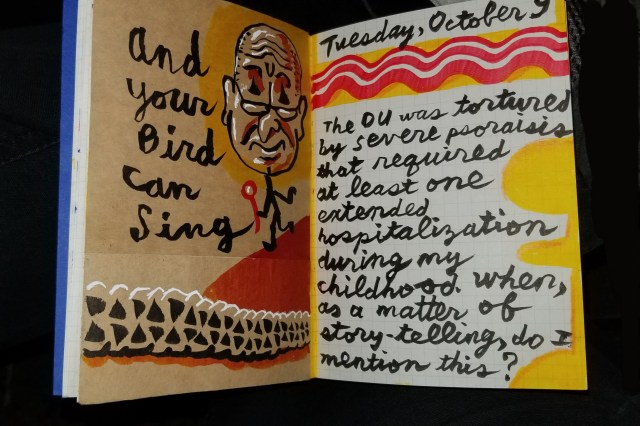
My father was tortured by severe psoriasis that required at least one extended hospitalization during my sister’s and my childhood.  It was an unusually severe case.   Many people with psoriasis have scaly patches on their elbows, forearms, their scalp.   My father’s lifelong friend Benjie had psoriasis on his arms, and sometimes his hands, for much of the time I knew him.   My father’s psoriasis covered virtually his whole body, which was red, with white scales on it.  The itchiness of the scales caused him to scratch, and when he scratched, flakes would fall off.   It was like a biblical plague, really, and judging by the ads for psoriasis treatments I get on my phone lately (since visiting a doctor about my newly diagnosed arthritis), many Americans still suffer from it.  

The scales itched and my father scratched.   He would frequently use a stand-up vacuum cleaner to suck the scales off the floor of the living room, dining room and kitchen.   I realize now that was one reason we generally didn’t have carpeting on the first floor.   The electric broom would get hot with use and the scales, exposed to this heat, would give off a mildly sickening smell of burning flesh.   It was a particular sweet smell I can still remember very clearly decades later.

This is one terrible feature of my father’s life, a poorly understood torment of a disease he suffered from.   There was apparently a strong correlation between the severity of the disease and the stress my father was under.   After he retired and moved to warm, humid Florida the scales disappeared completely.  But from the age of thirty-two (the year I was born) on, when things got too stressful, and the weather was particularly cold in New York City, my father’s skin would crack and bleed.  When this happened he checked himself into New York Hospital where they treated him with steroids, special baths and rest.   I recall visiting him there, I was maybe 14.   The view over the East River from his hospital room, which was on a very high floor, was amazing.  

The visit to his hospital room was not without drama.   My mother, for reasons she took to her grave, insisted I wear a certain pair of blue pants to visit the hospital.  These were the kind of pants they used to call slacks, as opposed to the jeans I always wore.  I tried on the blue pants and they ballooned grotesquely in several places.   I did a turn in the living room to show this and my mother was unimpressed.   I changed out of the pants, back into jeans, and my mother had a shit fit.   My refusal to wear the hideous pants was the proof, apparently, that I did not love my father enough to wear a pair of nice slacks to visit him.   As often happened, the fight became ugly.   I don’t recall which pants I eventually wore for that visit, but I do remember my father lying in the hospital bed and the magnificent view, the nearby UN and Long Island, stretching to the horizon across the shimmering East River. 

Ironically, the hideous blue pants were later tapered by my sister, who nobody knew was a naturally gifted seamstress.   One day, without any training, she was suddenly able to do precise alterations of clothing.  In their altered form I liked them as much as any other pants I had at the time and wore them frequently.   If only the alteration had taken place before the visit to my poor father at NYU hospital!

My father and Fred Koch

“Look, Elie, I’ve been thinking about this too, obviously,” said the skeleton of my father from his grave at the First Hebrew Congregation of Peekskill cemetery.  “I think, if you want to sell your book, you have to set my lifelong, losing struggle to see justice and fairness in America against the lifelong winning struggle of my near contemporaries, Charles and David Koch, to make sure that justice and fairness, such as they will be allowed at all, are exclusively on terms advantageous to their vast fortune.”

I don’t say no, I think it’s probably a good idea to seize the political moment, make it topical, that may really be the likeliest way to market your life, the way to properly brand you, but… you know, the other critique I sometimes get is that too much of what I’ve written is too political, too historical, filled with too much contemporary news-driven drama that will soon make it dated.

“Dated,” said the skeleton, “no idea is sadder to a dead man than that…”

A Westchester County turkey vulture made a lazy circle in the sky overhead.

“OK, obviously, we don’t need to talk directly about the horrors being wrought by this wealthy hateful imbecile and his ass-licking inner circle.   But the long arc of my life is fair game, the things that were going on during my long life led directly to this point in history.   How many people, do you suppose, know the ongoing history of the backlash against Brown?  

“You were a baby when the shit started really hitting the fan on that one, as I was pelted with rotten eggs for the temerity to speak, in New York City public schools, mind you, in favor of the desegregation of our public schools.   That’s a book right there, the struggle of white people not to have their children sit next to black children in schools, a struggle being fought as vigorously today, on the segregation side, as it was in 1955.  

“Since every movement needs a name, some racist cracker, Senator Byrd from Virginia, I think,  coined “massive resistance”– that was their rallying cry, the principled men and women who opposed federal tyranny and resisted the Supreme Court order to desegregate the schools ‘with all deliberate speed’, a phrase that has become as ridiculous, over the many decades, as “fair and balanced” as the motto of right wing state TV.

“You remember I told you and your sister not to buy Sugar Daddies, Sugar Mamas and Sugar Babies?   Robert Welch, the guy who owned that candy company, got together with Fred Koch and a few other rich reactionaries and founded a society of extremists called the John Birch Society.  I know you remember me telling you about that, and you and your sister stopped buying that candy, though you both loved it.  

“You know, reading about the John Birch Society and its roots never occurred to me when I was alive and had a computer, but you can ask Jeeves who John Birch was, I forget.   I think he was some fundamentalist martyr, a Christian shahid, but I don’t recall the specifics.”

Pretty close, this from the John Birch Society website:

Put simply, John Birch was a devoted Christian missionary who heroically served in World War II and was killed by Chinese Communists 10 days after the end of the war, when he was only 27. Communists that were supposedly WWII allies with the U.S.

“Just like a fucking commie, isn’t it, Elie?” said the skeleton, face as deadpan as a grinning skeleton’s face can be.

As your friend Robert Welch told the assembled at the founding meeting of the John Birch Society, the increasing evil in the world:

… has caused me to give up business career and income and any prospect of ever having any peace or leisure again during my lifetime, is due in large part to my admiration for John Birch; to my feeling that I simply had to pick up and carry, to the utmost of my ability and energy, the torch of a humane righteousness which he was carrying so well and so faithfully when the Communists struck him down.”

“Ah, the ‘torch of a humane righteousness’– what the world needs now, like love, sweet love itself.  Yeah, baby.  You know, that first meeting was the year your little sister was born.  Basically, for your entire lives there has been a passionate movement, gathering steam, funded by the inheritors of vast wealth, finally attaining the power to make this great American experiment in democracy a done deal.   It’s taken them the span of your lifetime, but they are finally in a position now to impose, as Lenin did, a one-party state.  If only they can nail down a few loose corners before they die, put at least one last conservative think tank trained zealot on the Supreme Court, they will die with smiles on their humane, righteous faces.”    

As if on cue, the turkey vulture released a long stream of excrement.  As the plume fell to earth my father’s skeleton pointed.  

“I rest my case, Elie, restrict immigration.”

Do we know if vultures shit while flying?

“I assure you that your boy Walter Mosley would not lose a second of sleep wondering about a detail like that,” said the skeleton.   The skeleton, I believe, was also a fan of Mosley’s.  He loved Elmore Leonard too.

1924

1924, the year my father was born, was the height of the reborn Ku Klux Klan, the Second Klan as it had sometimes called (the hateful organization took a nap until Woodrow Wilson came into office, it appears).   Klan membership reached a peak of  almost two and a half million the year my father was born, in a nation of 114 million.   One of the Klan’s pet projects, restricting immigration, was made law in the 1924 Immigration Act, then known as the Johnson-Reed Act. [1]  

Luckily for the baby who’d grow up to be my father, his mother-in-law and father-in-law had arrived from the Ukraine, then part of the Soviet Union, which they referred to from lifelong habit as Russia, in 1921 and 1923.   His own mother had come over from Belarus on the eve of World War One.   Outside of those parties, and the mysterious man who was found to marry my maternal grandmother and contribute DNA to the fetus who’d grow up to become my father, everyone left behind in Europe was killed.   Without a trace.  

The closest thing to a trace I found of any of them was a reference in a New York Times travel piece to tiny fragments of crushed bones blowing from the side of a ravine on the north end of Vishnevitz.   Those were fragments of the bones of those taken to that ravine, forced to lie down and shot.   The next group was forced to lie on top of the dead and wait for their bullet.   I read, in the online Yizkor book of Vishnevitz, what happened to those poor Jews in the months leading up to their eventual slaughter that August night in 1943, any surviving members of my mother’s large family among them, some of the most horrific details I’ve ever read.   No word was ever reported about the fate of the muddy little hamlet across the Pina River from Pinsk where my father’s mother’s family was killed.  The hamlet itself left no trace on modern, or even contemporary, maps.  Like it never existed at all, except that my great uncle and my grandmother were both born and raised there.

My father’s father was never able to make a living in the teeming slum of New York’s Lower East Side in the mid 1920s.  Uncle Aren, older brother of my father’s mother, took the family up to Peekskill where he supported them.   In those years before the Great Depression hit, my father’s family was among the poorest in Peekskill.   When the stock market crashed and suddenly everyone worldwide was scrambling for jobs and food, my father’s family fortunes fell further still.

My father grew up in what he always called ‘grinding poverty’.  A poverty as unimaginable as life in that muddy hamlet south of Pinsk in the days before darkness closed in forever, as hard to truly picture as the march to the Ukrainian ravine where everyone was to be killed.   Growing up in dire, humiliating poverty left deep scars in my father’s life.   His identification with the poor and the powerless was no pose, no effort for him, it was in his blood.   That he instilled this identification with the poor and the powerless in his children strikes me as pretty remarkable, as neither my sister nor I ever experienced even a moment of want in our lives.

When FDR proposed a Second Bill of Rights, Freedom from Want was a right of American citizenship, a human right. [2]   Those who profit from poverty, which allows employers to have every advantage in the workplace, would not move one more step toward this Communistic anti-democratic freedom from want business.   Without want what kind of limp whip are you holding over the pathetic masses who have no choice but to eat the crap that is served them, in whatever portion the boss deems fit.  Shoot, we’re a country founded on slave labor and indentured service of various stripes!

In 1924 there were no Child Labor Laws, no Minimum Wage laws, no forty hour work week, no agency overseeing workplace safety, no national right of collective bargaining.  In 1930, if things had been better economically, my six year old father could have started a Dickensian life as a gainfully employed urchin.   There was no law to prevent it, until he was fourteen.   The Fair Labor Standards Act was New Deal legislation enacted in 1938. [3]  It was the first time rules were set restricting child labor, setting out a pathetically inadequate minimum wage, a forty hour work week and many other things we now take for granted.

As I dig through some of the history surrounding my father’s life it is hard not to see unsettling parallels to the world as it is today.   Immigration, and restricting it, is suddenly a popular talking point on the right.  Racism, apparently, is nothing to be ashamed of or shy about expressing as these same cynics sell the idea of Making America Great Again.    Restricting the rights of workers, with state laws like Right To Work (think “Arbeit Macht Frei“), only doing what’s right by the job creators.   Giving huge tax gifts to the wealthiest humans and corporations while millions of American children live in dire poverty and two hundred million more adults are one twist of fate away from homelessness — only fair.  Blaming immigrants for the deep troubles inflicted by America’s greediest and most ruthless on the rest of us– fair is fair.  As Groucho once ad libbed, during an argument with the Italian accented Chico, “I rest my case, restrict immigration!”

On this eve of the holiest day in the Jewish year it strikes me that my father’s life is also a reminder that racism is a very common evil.  Jews sometimes dwell on anti-Semitism, as well we might, but it is one more form of racism.  It has a venerable and twisted history, yes, it has certain features that seem unique, OK, but it is made of the same material that all racism is made of.   Fear and hatred, used by the greediest and most ruthless, to focus anger away from them and on to a people that can be bullied, menaced and, in certain emptily cathartic moments, killed.    Racism is always the same.  It is used to keep the powerless divided.   It works like a charm, better than a rabbit’s foot in the old watch pocket.


[1]   “The Immigration Act of 1924 limited the number of immigrants allowed entry into the United States through a national origins quota. The quota provided immigration visas to two percent of the total number of people of each nationality in the United States as of the 1890 national census. It completely excluded immigrants from Asia.”   source

[2]  The economic freedoms were the right to a decent job that provided income for food, clothing and leisure, the farmer’s right to a fair income, freedom from unfair competition and monopolies, a right to housing, medical care, social security and education.  A quaint and dreamy list, by today’s more rugged standards, proposed toward the end of FDR’s life and quietly consigned to the footnotes of history, as here.  

[3] The FLSA establishes minimum wage, overtime pay, recordkeeping, and youth employment standards affecting employees in the private sector and in Federal, State, and local governments. Covered nonexempt workers are entitled to a minimum wage of not less than $7.25 per hour effective July 24, 2009. Overtime pay at a rate not less than one and one-half times the regular rate of pay is required after 40 hours of work in a workweek.      source

Copy for the book jacket

I visited the website for Jeanne Safer’s literary agent.   Safer writes insightful, useful books on difficult subjects, how to deal with a toxic sibling, what there is to celebrate at the death of a difficult parent, when not to forgive.   I admire her writing on these taboo subjects and figured her agent might be a good place to start my search for an agent for the difficult book I am wrestling with.   The agency has a query page that reads, in pertinent part: 

We love discovering new talent and welcome your query.

If your project is in keeping with the kinds of books we take on, we want to hear from you. In non-fiction, we represent narrative, popular science, memoir, history, psychology, business, biography, food, and travel.

So far, so good.  But they don’t want me to send them my svelte 1,700 word evocation of the book I’m writing, they have a better idea.

Synopsis (up to two paragraphs).   Briefly pitch your project, indicating what makes it unique and compelling. Imagine writing the jacket copy for your book.

I wrote one the other day, 319 words, two paragraphs (the second actually two paragraphs)  pretty good, but not really the jacket copy they were looking for.   I will try again now.

The Book of Irv is a son’s memoir of his father’s life, a life that ended with terrible regrets.   It is a meditation on anger and the power of reconciliation, even when it arrives tragically late.   Irv Widaen triumphed over a childhood of grinding poverty during the Great Depression to live the American Dream.  He was an idealist with a deep commitment to bending the moral arc of history toward justice.  A specialist in Human Relations, he brought warring gang leaders together.    A man of great empathy and a quick, irreverent wit, he quickly won people over.  His own children referred to him as the Dreaded Unit, or the D.U..

The D.U. saw the world as a battlefield.   He fought his children to the death over dinner every night.  Almost his entire family was massacred back in Europe during World War Two; there were other unspeakable, inescapable terrors in his earlier life.   Heartbroken and desperate, he viewed life as a zero sum game.   He did harm to both of his children by constantly denying their feelings, while imbuing them with the highest ideals about fairness, identification with the oppressed and kindness to animals.  The Book of Irv interweaves his personal story with the turbulent history of his times.  His pessimistic insistence that people cannot fundamentally change is set against his realization, as he was dying, that he should have had more insight.  At the heart of the book is the dialogue the difficult father and troubled son should have been having all along.   The D.U.’s skeleton smiles in his grave to finally have this chance to be heard.

264 words

The DU was not generous

My father, the Dreaded Unit, was not a generous person.  He gave us things, he provided a nice lifestyle for the family, he didn’t begrudge us what we needed or wanted, he just was not personally generous.   It seems easy enough to blame this on the “grinding poverty” he experienced until he was drafted into the Army.   Though the most generous kids I ever worked with were always the poorest.   My sister’s experience working with children has been the same.   We both, at different times and in different places, taught classes of well-to-do kids and classes of poor kids.   Certain rich kids were prone to grabbing the last cookie and shoving it into their mouth.   Poor kids always seem concerned that everyone gets a fair piece.  Of course, I over-generalize, there were wonderful rich kids and poor kids who were complete dicks.   When it came to sharing, and my sister will back me up, the poor kids unfailingly shared, rich kids not such unfailing sharers.  So my father’s poverty by itself does not explain his difficulty being generous.

Generosity is a trait, like kindness and fairness, that if not planted young has a hard time growing later in the depleted soil of a love-starved soul.  My father told me as he was dying, in that weakened voice as his life force ebbed, that he’d had never had any idea how to show affection.   “I’d never seen it done,” he told me, a slight pleading in his tone, alluding to the house of violence, poverty and madness he’d grown up in.   His mother and father never touched each other.   No affection was ever shown.

These days I am trying to learn each of the lessons of my father’s tragic life and put them into practice to live a better life.   Being unforgiving is closely related to a lack of generosity — you will not extend the pardon you yourself would want to be given in the same situation.   It is a terrible thing never to forgive.  I watched my father do it all his life, the man never forgave anyone, starting with himself.   Unforgiveness feeds a deeply destructive need, the need to feel completely vindicated in one’s anger.  We see it played out on a mass level today with our vengeful Insane Clown President, as Matt Taibbi dubbed him when writing about the 2016 campaign.

I am always impressed by generosity.   I recall going to the home of a Palestinian who lived in East Jerusalem, in the Old City.   He took everything out of his refrigerator, he and his children literally emptied it, and put it all on the table in front of us.  “Take, take,” he said, smiling, gesturing at everything.   There turned out to be more to the story, but this kind of generosity, holding nothing back, is a beautiful thing.   

What does it cost to be moved by something beautiful somebody has just done and saying “beautiful”?   The thing is beautiful, is there a price to saying so?   I don’t know, I can’t see one.   To some people, I suppose, it costs a lot.  It appears that way, anyway.    Maybe it’s related to envy, or distraction, or simply being bitter, I don’t really have a handle on that kind of reticence.  My mother didn’t have it.   She would read something I’d picked out for her and smile and say “it’s wonderful”.   I could tell she meant it.   My father would read the same piece looking for the fatal booby trap I’d hidden in there, the tell-tale adjective that would show the rigging about to collapse on his head.

What does it cost to give the benefit of the doubt?   You can give it once, be disappointed, give it again, remaining hopeful.   After enough disappointments you will stop extending this generous courtesy, but what does it cost to give it in the first place?   It requires trust, I suppose, a certain faith that good will is going to be returned.   It often is.   It often isn’t.   I think more often than not, good will is reciprocated.   My father did not think so.   It was hard for him to make himself vulnerable in any way.    

As he was dying he said:

I know a lot of people are sorry for what they did, yet at the time you don’t see anything but just a battle which there has to been winners or losers, and there’s no gradation.

 I know when we had our differences, I realize that it was nothing personal in the classic sense but I also know that it’s the only way that I could live… like I told mom, we always had these battles where she’s saying “we’ve got enough money, we’ve got enough money” — for me it was never enough. I’ve got to make sure that every dot is dotted, every ‘t’ is crossed because I don’t want her to want a thing.  So, it’s kind of a lifetime battle, I don’t know, I think now how much richer my life would have been if I hadn’t seen it as a battle—good versus evil.

I know we should have had this talk ten, fifteen years ago. I couldn’t reach that level because I was really thinking that it was going to be a battle and that there wasn’t any way I could make it into a dialogue, and that’s my fault. You’re supposed to have some fucking insight.