The Trouble with History

young Irv Paul HermanMy father was passionately interested in politics and history and was an avid lifelong reader of the New York Times (which he read daily in its entirety) and many other publications.  Against all odds, the “dumbest Jewish kid in Peekskill” wound up, a few years after World War Two, in the doctoral program at Columbia University where he was mentored, unhappily, as it turned out, by Richard Hofstadter and Henry Steele Commager (my sister reminds me– I’d forgotten about Commager), two titantic twentieth century historians.  One of them was his thesis adviser (I believe it was Hofstadter) and threw successive pails of cold, dirty water on his dream of becoming a professional historian.  

My father wanted to write his thesis on a theme from the Revolutionary War but Hofstadter was writing a book (one of thirty five influential volumes he’d publish in his illustrious career) on something else, maybe the Civil War, and needed research done for that.  The titan overruled my father’s wishes and assigned him to basically write a chapter for that book.  

He pecked away at it for a while and, newly married and working full-time,  eventually put it aside for lack of appetite, settling for a Masters Degree in History, instead of his doctorate.  His adventure with his famous thesis adviser had made him realize an unsettling truth about poison academia and he was not ready to swallow it.   If he was bitter about it, he said nothing except that one time he explained it to me.  On the other hand, if he was bitter about being whipped in the face daily as an infant, he never said anything about that either, not even once.    

But one thing I learned from him, in addition to a love of history, or a morbid fascination with it, anyway, is the importance of primary sources.  It is one thing to reconstruct events relying on memory alone, but it’s a far better thing to have the actual building materials at hand, materials prepared contemporaneously with the events they describe that refresh your recollection, as they say to witnesses.  Knowing the answer the lawyer asks: “will this help refresh your recollection?” as she hands the memo book to the witness.  And the cop looking up from his notes is a much more credible witness, or is shown to be that much more of a liar, as the case may be, because he’s actually looking at what he wrote the day the guy was allegedly choked to death by his former colleague.

Compare the impact of these two paragraphs, the one I wrote before I realized I had the actual quote from my father, transcribed, and the words of my father himself on the same subject.  You will immediately recognize the power of primary sources.  

My paragraph:

Destined, by the successful, brilliant son and daughter of his Uncle Aren who “ran the family”, to go to trade school with his brother, he escaped into the World War, part two.  “Nehama and Dave ran the family, and they had decided that my brother and I were too dumb to do anything but menial work, so we were going to trade school to be trained as rude mechanicals.”  

What he actually said, eighteen hours before his last breath:

 My life was preordained by my uncle and my aunt, Nechama and Cousin Dave.  If I got through High School my ultimate aim as far as the family was concerned: learn how to write and read and they’d sign you up for the NYA, Sheet Metal School, cause we were too dumb to think about going beyond trade.  All of us had to have a trade, it’s not like, well, you have a brain, we’ll help develop it.   You try to avoid the ultimate fate that life has dealt to us and inside you there’s something that says “there’s got to be a better world than this” but we weren’t permitted to dream beyond making a living.  

Poignant shit to be thinking about as you lay dying.  It actually chokes me up a little, still, because reading it I can hear his voice straining to say it that last night of his life, between gulps of water to soothe his aching throat.  In fact, if I wanted to, I could listen to his words in his own voice right now.  He had the foresight to ask, as soon as I arrived in his hospital room that last night, if I’d brought the digital recorder I’d bought for him.  He was a historian to the end.

But the larger point is, each of us only remembers so much.  What we remember is colored by everything else that has happened to us.  Even immediately after an event that two people were present for, their memories will diverge.  Each will notice different things.  

“Did you see his shoes?” one will say in disbelief about the maniac who just streaked past.  The other will have no idea what kind of shoes the naked maniac was wearing.  But to the first person, the fact that on one foot the guy was wearing a blue sneaker, and on the other an over-sized red, sequined pump, will be the most strikingly weird part of the whole picture.  The other one, staring at the maniac’s face, twitching arms and swinging genitalia, will have no idea how the other even had time to take in the shoes, much less what the shoes looked like.  The first will have a hard time believing anyone could have missed those shoes.

How much more difficult is it to write a full, nuanced history of anything?   Immediately after the Civil War historians generally told the story from the victors’ point of view, as is the general practice in writing history.  Reconstruction-era historians were unanimous:  slavery was evil, had to be stopped, its practitioners violently stood up for their right to continue this evil, we took up arms to stop the wicked insurrectionsts.  We amended the Constitution to ensure the rights of the newly liberated.  Bravo for us, we took the side of the angels and kicked their genteel, slave-holding Johnny Rebel asses!  

Would you be surprised to learn that within a short time there arose an influential school of historians who would swing the pendulum back, write from the point of view of those aggrieved Southerners unfairly deprived of their wealth, their personal property?  Sirs, have you no shame?   I don’t remember  at the moment what this once-famous school of history was called, I discovered these rascals during my research for a long, heavily footnoted article I wrote during law school, but their version of history held sway for several generations.  

Then the pendulum swung back, fair is fair, and another school of historians debunked that revisionist school of thought, quite thoroughly, to my mind.  But then, I am prejudiced.  We are all prejudiced, which is part of the trouble with history.  

And with biography, especially hagiography.  Gandhi, almost always held up as a saintly exemplar of the power of moral force focused through non-violent collective action, had another side to him.  You will look at him slightly differently when you recall what he told the Jews of Europe as Hitler was rounding us up. 

“You must not become like them, you must not become violent.  You must show, through your moral courage, that you are as fully human as they are.  Your moral force will stop them, force them to reckon with you as humans with souls the equal of their’s, they will not be able to keep killing you.”  I’m paraphrasing, as I picture the generally humorless Heinrich Himmler cracking up to read this sage Gandhian advice translated into German.

“Yes, the Great Gandhi is right: show us your moral force, Jews, you will become irresistibly human to us.  Then we’ll have a look at your naked, moral asses as you walk in a quiet, orderly line into the showers.  Nothing to fear, Jews, we get it, believe us.  Just clean up a bit after your long ride, and then we’ll all have appetizers and a good laugh about the whole thing, over drinks while we wait for the waiters to bring us a sumptuous dinner.”

There’s nothing funny about this, you might say.  My father would disagree, though he wouldn’t be guffawing about Himmler’s imagined speech either.  The only defense we always have against unspeakable horror, an admittedly limited one, is speaking of it satirically.   My father the historian taught me that.
A Talent for Malice

I have written another piece on this subject, but, as I recall, it really doesn’t touch what the actual talent for malice is.  It is proving a bit hard to describe.  

Anyone can be malicious at times.  Many people, if not most of us, have good reason to act with a bit of malice from time to time.  Humans, as a species, are pricks, as often as not.   Somebody does something really bad, and does it again, and a third time, it’s natural to feel that tightening in the face, the clenching of the muscles, the desire to return the favor.  Any brute in this moment can shove somebody, snarl, take a threatening pose, say something mean.  Some have no hesitation to pick up a fist or a weapon and carry out their malicious business post haste, in the most immediate possible way.  But a talent for malice is something else.  Talent holds a person to a higher standard, requires something special, beyond the ordinary, something more refined and original than the predictable lashing out.  

The above strikes me as somewhat generic, an intro that probably cannot stand as anything more than a note for the rewrite.  If the reader is to feel anything about it, the talent for malice must be shown in the form of a story (he said in a note to himself).  Otherwise, and as it currently stands, it reads as little more than a didactic high school reading comprehension test paragraph without the multiple choice questions below it.  I will try to supply an illustrative anecdote or two when I rewrite it, but I must continue to grapple here with what the talent for malice actually is.  As with other elusive things, we can get closer to describing it by showing what it is not (he said, pedantically.)

Pat Conroy’s father, who expressed his rage with good old- fashioned beatings, with two hard fists, clearly had no talent for malice.  My friend’s father Stan, who beat the boy like a drum, and sometimes the boy’s mother as well, like a tambourine, and made bank tellers cry— you could see from twenty feet away what a hack at malice this unredeemably angry dick was.  The genius of someone with a talent for malice is to deliver the poison while seeming, to the person he’s poisoning, reasonable, calm, cool, even likable. THAT is a talent for malice since it doubly victimizes, first by injecting the poison and then by having the victim castigate himself as paranoid and vindictive, trying to blame this reasonable, nice person for slipping him the poison.  

A talent for malice leaves the malicious party with complete deniability and, better still, able to pose as the injured party, unfairly accused, standing defiantly on the moral high ground, an excellent spot from which to continue innocently emptying his bowels on the other.  It is not, by the way, a talent for anyone but a desperate person or a sadist to be proud of, but it’s a talent nonetheless.

My sister mentioned that she was an adult close to forty before she fully understood the abuse she’d suffered at the hands of her father.  THAT is a genius for malice, that’s how good our father was at it much of the time.   I don’t want to say my father was always a genius at it, or even that he displayed his talent brilliantly all the time, just that he had the talent in greater measure than anyone else I can think of and some moments of brilliance.  

This moment was not one of them, and, knowing well how he operated, I feel bad to this day that I did not do more about it at the time.  My niece was a young girl, probably four or five.  If her little brother had been born by this time he was deep asleep in a crib somewhere.  I don’t recall him being on the scene, it’s possible she may have been about to turn four, though I’d have to run this by my sister to be sure of the chronology since the numbers are not adding up, somehow.  

She was in her pajamas, posing on the staircase, looking adorable.  The next day we’d all go out to dinner and she was finally going to get the little purple bicycle she’d been pining for, the one she’d picked out a few days earlier.  She was very excited about her birthday dinner in a restaurant and her dream bike.

My father and I sat on a couch at the foot of the stairs.  My sister and her husband stood on either side of the bottom step as my sister asked the birthday girl where she wanted to eat for her birthday.  She thought for a moment and picked out a local restaurant.  My father smiled and said he didn’t think that was a good place to go for her birthday.  

She was disappointed, and her mother and father, instead of joining with her uncle to say as one: “let’s go there, that sounds great,” told her to pick out another place.  I sat on the couch next to my father watching my niece slowly wilt on the staircase.  There was no particular reason I could see that this restaurant was any less appropriate than any of the several others nearby.  I said as much, but with no real knowledge of the situation, and , after reminding everyone of the birthday girl’s right to pick her favorite place, didn’t insist.  

“Your grandpa doesn’t want to go there, where else do you want to go?” my brother-in-law asked.   This whole dance was very odd to me, if not unfamiliar, and I watched it with mounting discomfort.  By now my niece was on the verge of tears, nobody, it seemed, had her back.  This was a sickeningly familiar scene to us all.  Nobody had anybody’s back, as long as the power was seemingly in one arbitrary person’s hands. My niece’s unhappiness was something that could have immediately been fixed with a small portion of mercy, or even a dab of common decency, or common sense.  How about just a reason why the place was not going to work?

My father, smiling, then showed a dull flash of his talent for malice.  “You show me a little girl who insists on going to Scampy Shrimp and I’ll show you a little girl who doesn’t get that purple bicycle her grandparents bought her.”  

Talent! you will snort.  This is nothing more than garden variety coercive sadism out for an evening stroll.  And perhaps you are correct to snort.  But it is more complicated than I can explain at the moment, clearly.

My niece accepted an unacceptable alternative and went upstairs very unhappily to go to sleep.  I followed a few minutes later, to kiss her goodnight.  She had been crying when I came into the room and quickly pulled herself together.  I sat at the edge of her bed for a moment and asked if she was all right.  She smiled gamely and said she was.  I turned out the lamp, patted her, told her not to worry, we’d go wherever she wanted, and headed downstairs.  My father and I left and drove back to the apartment he shared with my mother, in nearby Wynmoor Village.

The next day I found out that my niece had vomited not long after we left.  I didn’t blame her at all, hindsight being twenty-twenty. Nothing in the situation seemed hard for me to understand, except perhaps why my father was being such a prick to the little granddaughter he adored.  

When you are punched in the stomach, it’s hard to be mistaken about what has just happened, hard for the puncher to credibly deny, particularly if the punch is caught on camera.  The only discussion after you catch your breath is about whether you possibly deserved the punch or not, whether anyone does.   A sock in the gut is rather unambiguous, if also inelegant.  The person with the talent for malice has no need to resort to such crude methods to extract full malicious satisfaction.  A job done with a subtle, undetectable touch, smug deniability, and the chance to make the other person feel like the asshole again for being hurt, are the keys to this full satisfaction for the talented practitioner of malice.

Here is really all that’s required, if you have the reservoir of malice already and are looking for a tap to turn to let it pour into someone’s drinking cup.  Wait for a moment of vulnerability.  If you know someone well, you will probably not have to wait long.  When you see it, simply say nothing, instead of showing the weakness of empathy, the only thing the vulnerable party really needs.  

This is beautiful in its simplicity and it works every time, I can assure you.  Then you can have your wife shake the kid while she yells, to the rhythm of the shaking: “what-did-any-one-ever-do-to-you-to-make-you-so-fuck-ing-ang-ry?!!!”  Fucking beautiful, really.  You won’t even know what has hit you, in many cases, until years later, and then, only if you’re lucky.  I’ve been very lucky that way.

“Eviscerate”

Talked to my sister just now, for two hours and change, and she observed how much of writing takes place when you are walking around, how the thoughts that  come into your head while you’re doing other things will later be arranged to fill out the body of what you write.  I’ve experienced this a lot lately, focused, as I’ve been, on telling the story of our tragic father as completely as I can.  Sometimes, I told her, I’ll have to stop walking and jot down a phrase to remind me of a story I need to write out about the old D.U.  

This was my father’s method, too, when he spoke at a funeral. He’d have an envelope with a few fragments of phrases written on the back, in his tiny, precise print lettering, each fragment would be a story he would tell in his natural voice, with no need for any further notes.  I’ve made this comparison before, but this is how Django used to play guitar.  He’d learn the rough contours of the song and extemporize the rest as he went.    

At one point in our long talk my sister used a word that made me laugh, reach for a fine-tipped brush and brush the word onto an index card.  She asked if I remembered her husband’s description of our father’s utter mastery in a duel.  I told her I did and we both laughed and she painted the picture again for us to enjoy:  our father, stretched out on the couch, relaxed, reading the newspaper, the sword in his other hand, yawning without looking up, nonchalantly clanking his sword as my brother-in-law flailed away.  And then, she said, the old man would just eviscerate him.

“Eviscerate!” I said, laughing and reaching for my brush pen.

My sister said “yeah, he would eviscerate him, every time,” and I laughed harder.  I’ve described this image earlier in these pages, but without the punchline, that perfect ‘mot juste’.  

Our father would, after reading the last obituary in the New York Times he was reading, casually thrust the point of his sharp sword into my brother-in-law’s stomach and draw a few quick circles, disemboweling him.  He’d pull the sword away and bloody entrails would come with it.

Eviscerate!  My god, if there ever was the perfect word to describe the thing, there it is.

Unspoken thank you note and my father’s funeral

Last night the demons that kept me awake were roaring, with hot, stinking breath, about my vanity, and the folly of trying to write a moving portrait of a dead man nobody knew, as if there was some value to it.  Moreover, at almost sixty, hissed the demons, even the dead man would agree it was idiotic to believe a glorious new chapter of your life could begin by somehow writing and having some publisher buy and promote a book that would make strangers cry.

At the keyboard earlier today I didn’t need to tell these demons to pipe down.  They were nowhere to be seen, not even as an afterthought.  They were as silent and unscary as gargoyles on the facade of some far away cathedral, monsters designed to cow superstitious Christians of the dark ages into submission to the Church.  

Walking up Sixth Avenue afterwards, listening to recently dead Pat Conroy’s incantatory love song to the writers he loved most, even, and especially, a now mostly neglected once-famous writer it was apparently long fashionable to bash, I could not wait to get back to the keyboard, thinking of the unwritten novels of his dead idol Thomas Wolfe, buried in the ground at 37, a ferocious writer who died before he’d lived enough to write the masterpieces he would have surely composed at fifty and sixty, masterpieces buried with him, sadly unwritten.

But, inspired though I was by the trance Conroy’s words put me into, I wasn’t hurrying back to this keyboard in hopes of writing a page of some imagined masterpiece.  It was the matter of a simple thank you note I’ve never written to somebody who did a great kindness a decade ago that urged me on.  

We do not, as a rule, make a point of mentioning such unspoken gratefulness to each other, especially long after the fact, but that doesn’t make remaining silent the right thing to do.  I have a few overdue notes in this category, but this is by far the easiest one to dash off, in the form of an anecdote.   So, because it is the least I can do, which is always my pleasure, let me do that now, after one last horn blast of needless introduction.

I’ve thought of it several times in recent days, out of the blue, perhaps because I’ve been mulling over the life and death of my father, maybe because I intend to hold forth when people gather in June to celebrate my first sixty fitful years on earth, a prospect, my holding forth, that Sekhnet looks forward to with eye-rolling dread.  It is one of several thank yous I have meant to give, but have not given, am unlikely to ever give, except perhaps in a place like this where it is likelier not to be received at all than it is to be read after I’m gone.

I got a call late one morning a few years ago that an old friend’s father had died.  I was, for some reason, not at work that day (dry only to those familiar with my deeply devout Protestant work ethic) and, being less than a mile from where people were gathering for the funeral, dressed appropriately and dashed over just in time to miss the service and catch a ride in the procession to the cemetery.  I had never met the deceased, but I’d imagine he was a funny, warm and good man, since that’s how his son had turned out.  His son is one of the funniest people I know.  

A short drive to New Jersey later I found myself, along with several Yeshiva students, who were dressed identically in black suits and in black hats, carrying the coffin of my friend’s father on our shoulders, over the dirt, to his waiting grave.  He was surprisingly light in his traditional pine box.   The Orthodox burial was a bit off-putting to me, in the way most orthodoxies are, and I recall standing by my friend’s wife and his mother at one point, over where they were forced to stand with the other women, at a certain distance from the men who were going about the serious, manly business of finishing the burial of their fellow Jew.

My thought now is what an honor it was, to be able to silently repay my friend’s kindness in this way.   What kindness, you want to know?  A few years before his father’s funeral, he and his wife had showed up unexpectedly at my father’s funeral, a surprise that touched me greatly.  We’d been friends for a long time, but we see each other rarely and, to my memory, have probably called each other, at most, a handful of times.  Yet there they were as the cantor was chanting over my father’s grave and I was moved to see them there.

But the kindness I was repaying as I carried his father’s body to his grave, and helped lower him in, and throw the first few shovelfuls on his coffin, happened after my father’s actual funeral.  

After burying my father we left the boneyard in Cortland and went back to nearby First Hebrew Congregation of Peekskill where a local kosher deli had gouged us for the corned beef and pastrami sandwiches, pickles, cole slaw, the parve pastries and the two or three dollar cans of Doctor Brown’s soda.  My father would have loved the spread, while not neglecting to make a subtle, yet trenchant, comment about the generous mark-up provided as a special courtesy to the mourners.  LIkely also a little reference to the monopoly the synagogue had granted this deli, the only kosher place within miles, for catering all events at First Hebrew.

Directly on the other side of a folding wall from where the food and drink was laid out there was, my friend and I discovered, a small gym with a basket at each end.  While the rest of the adult mourners were speaking well of the dead, hearing stories of his last days, consoling my mother, eating and catching up, my niece and nephew, then thirteen and nine, had nobody to talk to.    Finding a basketball, with the help of the janitor, we challenged them to a game.  Being two spunky kids they happily accepted our challenge and the four of us stepped around the wall.  

As the mourners continued to eat their turkey, roast beef, pastrami and corned beef, while my sister was being consoled, and the rabbi came by, and whatever else was going on, the four basketball players ran up and down the court in our funeral clothes.  It was a raucous game, with my friend’s antics quickly turning it into a hilarious circus.  It lightened my heart to see the children who had just stood somberly beside their grandfather’s grave laughing, particularly my nephew, who, to this day is not easy to crack up.  In spite of our clowning, we kicked their asses, I’m glad to say.  

And that’s why, a few years later, I felt so fortunate and so honored to be carrying his father’s coffin.

Strength

My father always projected an image of strength when he spoke about himself.  His hair, his barber Saul* had told him, was strong enough to break his scissors.  His threshold for pain, he always maintained, was extremely high.  The potent gases he produced, gases that rendered his strongest friends helpless, were but one more proof of his powers.  He had convinced our mother that he had the strongest ego of any man she’d ever met.  She told us as much.  My sister and I scoffed, protested, dismissed the laughable notion as worse than ridiculous.

The strongest man in the world suffered as much as anyone I’d ever met.  He was also one of the most sensitive people I ever knew.  He would be the first to admit that everyone has demons, even as he positioned himself to be a demon to the little sprouts he was raising.  Most things are beyond human control and frustration at our powerlessness is what drives us to desperate acts of unintended cruelty, he might have said.  

Actually, he probably did offer that very insight during an angry lecture at some point.  That point would have been when one of his children tried to ask him for his help.  Any display of vulnerability by people old enough to express themselves fully was very discomfiting to him.

He was perfectly correct about the demons.  Every human has at least one or two lurking, stalking, expert saboteurs waiting for the perfect moment to spring forth and insist that there will be no sleep for you this night.  Demons, by their nature, are elusive, hard to describe, they tend to recede in the cool light of day.  If they even can be compared, why would one bother?   Each person’s demons are perfectly designed for them, ingeniously suited to disturb in their uniquely customized way.  Your demons are fairly easy to vanquish, I can tell you exactly what you need to do to overcome them.  My demons– well, those are some undefeatable motherfuckers. 

My father had the unenviable advantage of possessing major demons whose origins were uncommonly easy to spot, though he kept the sources zealously hidden.  He had other ways of battling them, he intimated, and it was pointless to reveal anything about them in any case.  His efforts to always appear strong caused him to literally crack at the seams from time to time.  His skin would begin to come apart, bleeding from many fissures.  He’d eventually need to be hospitalized.  In the hospital he’d surrender himself to be taken care of in a way he never could be cared for in his own home, where he fought an eternal war never to be weak, never to need anyone.    

He was no different from many men of his generation in that need to appear strong, always in control.  It was not part of the culture for men of that time to spill their guts like weak little sob sisters, admit fear, express a need to be understood or appreciated.  It was simply not part of being a man, acting all sensitive.  Before the age of the metrosexual man, men who seemed to openly crave understanding were seen as weak, effeminate, girlish.   Even in the modern age of such men, too much of that is still seen as the mark of a whiner.

“The army didn’t make anyone a man,” my father used to say with disdain.  “That’s an idiotic cliche.  If you weren’t a man when you went in, you weren’t going to be made into one by the army.”   The implication of this was clear– he had been a man at eighteen when he was drafted into the Great War.  

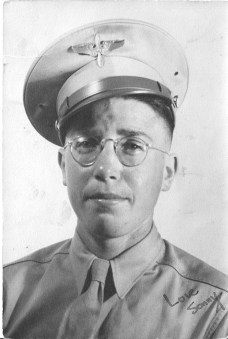
There is a lushly gradated photo of this young man, a perfectly lit bust in a pale dress uniform, looking out from under a curiously tilted enormous looking dress hat, taken probably when he was nineteen.  It is a beautiful shot I will share with you.  We can look into his eyes and see that, indeed, a picture is worth a thousand words.  He has inscribed it to his mother “Love, Sonny.”  Here, have a look:

Irv circa 1942 dress uniform

While we were preparing for my father’s funeral, I found a shoe box full of photographs of him in the army.  In the black and white photos  he looks trim and fit, with shiny jet black hair that would break a barber’s scissors.  In almost every shot (with the exception of the obviously posed studio shot above) he is smiling, laughing, smirking charismatically.  Truly, by the looks of it, a man enjoying the happiest days of his life.  He looked like he didn’t have a care in the world.  A GI at home with his comrades in some kind of cool summer camp, surrounded by other men who just plain liked him.

Somewhere in those photos, most likely, is Darius White, reputedly from Eagle Crotch, Arkansas, whose dismissive catchphrase, and the reason my father brought him up, was “ah, bat-shit!”   Nobody seemed to mind being called a “Draftee Bastard” by the enlisted men and, as far as my father’s recollection, the anti-Semitism, while there, wasn’t too bad either.  If the United States Army Air Forces had been integrated during our country’s heroic war against racism, some of my father’s best friends would have undoubtedly been the “night fighters” he never got to serve with.  

Viewing the snapshots of his life, outside of that one where he is grinning like Moe of the Three Stooges, with his arms around his little brother, about four in the photo, and another kid my uncle identified for me as Herman, and one frozen moment on a picnic blanket, wrestling a shiksa he was no doubt also doing some undocumented nude wrestling with, the army photos undoubtedly show the happiest days of his life.  

On the other hand, I had an eye-opening experience a while back, after looking through all of my mother’s maybe 15 large family photo albums.  There is a series of photos, spread across two pages, where I am beaming in each one.  My face is illuminated by the ineffable pleasure of being alive.  In one I’m standing between my parents’ living room and dining room with my arm around a cousin I haven’t seen in thirty years, a cousin whose father was famous for his Cheshire cat smile, and we are about as happy as two people could ever look.  I have my little aunt under one arm in another photo, and I am glowing with good will, optimism, happiness.  

None of this seemed like me at all.  Concerned, I did some research and realized with shock when these photos had been taken.  During the darkest winter of my life, when I was turning thirty, a failure in art and life.  I’d watched a glib, superficial classmate from art-school suddenly become a wealthy, international superstar artist and it finally broke me.

My father was very concerned, naturally, to see his son broken.  I recall at one point he took charge, had me move back into the house, since I’d planned to travel and it wouldn’t be fair to the friend I’d promised to sublet my apartment to to force him to find another place to live because I was too fucked up to keep my word.  Too weak and indecisive to resist, I moved back into the house of demons where I had already spent many a sleepless night.

I walked, that’s one thing I remember doing.  Some days I must have walked ten miles or more.  I dreaded speaking to anyone, which is an odd thing for someone who has always loved stringing thoughts together and puffing them glibly out of his mouth.

One day my father had me type a letter for him.  He dictated it to me in the kitchen and I tapped it out on the great portable electric typewriter my mother later gave me.  I typed faithfully until a typo appeared in the word “sincerely” at the very bottom of the letter.  There was no white-out in the house and I apologetically informed him I couldn’t correct the mistake.  My father had a temper tantrum.  

Thinking of this reaction, it does not seem the reaction of a strong man, or even that of a generic adult.

A friend with an extra bedroom in his apartment called and urged me to move in.  I did, and not a moment too soon.  I continued walking, and avoiding people, but I played more guitar in that empty, resonant apartment than I ever had before.  

One afternoon at a bithday party in Queens that spring, at the home of an older artist I’d become lifelong friends with since meeting her at age eleven or twelve, (it was her birthday, only reason I’d agreed to go),  a pretty girl asked me if I would call her.  She was wearing a white dress, seemingly with nothing under it, and I had been trying to be inconspicuous while craning my neck to see down the open neck of it for a better look at more of her caramel colored skin.   I was at a loss for how to answer her.  

I finally said, “well… it would be hard, since I don’t have your number.”  She found this funny somehow and wrote out her number for me, which I managed to call a day or two later.  A couple of nights after that we were sitting at the edge of the fountain at Lincoln Center making out like two hungry teenagers.  

“You’ve got to come home with me,” I told her, suddenly knowing what to say again.  She protested, there was a guy named Michael Rappaport who was in love with her, she wasn’t sure.  

“I’m not Rappaport,” I said taking her by the hand and leading her to the subway.  In my apartment afterwards I could not even faintly remember why I had been so depressed, for months, a couple of days earlier.  Everything in the world suddenly seemed possible, easy even.  

My father, knowing better, would have scoffed at this fleeting illusion.  He’d have been strong enough, presumably, too look right through it to the essence of things, the inextinguishable horror and powerless disappointment that would always be there for people like us. 


* Saul may well have been an Auschwitz alumnus, though I will never know.  He was a European Jew with an interesting accent and a very low key affect.

The copy of Dream Boogie that I read

I read a hardcover copy of Peter Guralnick’s excellent, at the time brand new, biography of Sam Cooke during a visit to my recently widowed mother in Florida.  I probably read the bulk of it sitting in the padded swivel chair my father had spent hours in every day, in the guest room where the computer was.  I recall my father’s reluctance to get a computer and my mother’s excitement to acquire one.    

(I can feel already that this will be a quick, twisty ride down tortuous roads, rather than a focused slice of anything, but so be it today.  I am overdue to get out of this chair anyway and it can’t be helped.)

My mother wound up having little interest in, or use for, the computer, but my father wound up really enjoying it.  He quickly discovered he could read the New York Times on-line, as well as the Jerusalem Post and several other publications he liked to read cover to cover every day.  He could follow Syracuse’s sports teams and get news about who was drafting their stars.  He spent hours every day at the screen, in that very chair, even tapping away with a single crooked, arthritic finger to compose the occasional short e-mail.  I got a steady stream of lawyer jokes from him during my three breezy years in law school.  

I am thinking of that hardcover copy of the Cooke biography, though.  I got it from my brother-in-law, who had a talent for acquiring unmarked, hardcover copies of brand new books of interest.   He sometimes loaned them to my father, who read voraciously, as does my brother-in-law.  But it occurred to me today that I got that book from him.  Made me think, and then think again.  

Anyway, out of this chair now and into the street, to walk in the fresh air of the city of my birth.

Addressing Ticklish Issues

It’s fairly easy, most of the time, to be honest in general terms; it is in the sticky particulars of interpersonal matters that honesty can become tricky.  

For example, it would be impossible to paint a truly accurate likeness of my father without going into the details of his relationship with my brother-in-law.  In the intricate back and forth of this twenty year relationship you could actually get to see my father at work, his strengths and weaknesses illuminated from many angles.  In fact, I can’t think of another relationship that would show as clearly how my father went about his business, where he drew non-negotiable lines, how he actually operated, the highly practical, yet still uncompromising way he sometimes managed to finesse his discomfort.

Even in this carefully vague outline, you should be able to spot the trouble.  Assuming my sister loved her father, which she did, and assuming she loves her husband, also true, you should be able to imagine her apprehension, about now, if she were reading these words.  I feel like I would have to send anything involving my brother-in-law to him to read before I could ever think of passing it by my sister, let alone sending it out for anyone else to read.  This presents other problems, while portentously adumbrating a host of still other problems.

I take a cautionary tale from Pat Conroy, if such a tale is even needed.  I’d never read Conroy, who I first heard interviewed and reading his wonderful My Reading Life only after his recent death, but I like what I’ve heard.  He seems like a writer of integrity who loved stories and language, wrote directly, and, to hear him tell it, always searched for the deeper truth.  He also fought lifelong battles in many ways similar to the ones I had fighting to overcome years of struggles with my father, though his father practiced his uncompromising version of fatherhood in a much more physically violent form.  A wonderful bite of Conroy, from his website, is at the bottom of this post.

When he published The Great Santini, which portrayed his demanding, violent father quite frankly, his parents got divorced, Conroy’s own wife divorced him and his father’s side of the family stopped talking to him.  Never spoke to him again.  Dead.  His father, a brutally tough Marine who expected as much from his sons as he did from the fighter pilots he trained, and hit them as hard whenever he deemed it necessary, referred to himself as “The Great Santini”.   In that book and movie (neither of which I’ve seen) his brutality and abusiveness is apparently unflinchingly portrayed.  

Conroy’s father, needless to say, was not thrilled about what he heard about the book and didn’t read it for a long time.  He rightfully feared what his first born author son would have to say about him.  My father had a similar reaction whenever my mother told him I’d written something wonderful.  He’d sniff it, read it cautiously, looking for any tell-tale adjective that proved how much I hated him.  

With Conroy’s success as the writer of The Great Santini, and then having his book turned into a successful movie, his father eventually came around, though it took many years.  The making of the movie The Great Santini was apparently an early turning point.  Conroy’s father was greatly mollified when he was called to the set to spend time with Robert Duvall who would play him in the movie.  

“I made Duvall a star,” he used to brag and he played up his Santini persona for the rest of his life, parlaying it into modest fame and a bit of money.  He actually had a radio show in the South where he gave tough advice on parenting, leaning toward unapologetically kicking the child’s ass as needed.  “Spare the rod, you know the rest,” may have been his motto.

Conroy’s success went a long way toward making peace, when they were both adults, with his unforgivably harsh father.  Still, Conroy had a few mental breakdowns along the way, severe enough that he was out of commission and his life seemingly hung in the balance.  

I have had only one breakdown of any note, and while I felt like I was out of commission for a few months, my life never hung in the balance.  It was thirty years ago and I cherish it, in a way, as a very dark, almost fond, memory.  Proof of the sickening old adage “sweet are the uses of fucking adversity.”  I learned a couple of very important life lessons during that dark winter, things I live by to this day.

Honesty is an excellent thing, until somebody gets hurt.  My sister has from time to time done a passable imitation of Jack Nicholson telling a lip-pursing Tom Cruise that he can’t handle the truth.  “You can’t HANDLE the truth,” she would bark at appropriate times. My sister is a very good mimic.  She can do scenes from My Cousin Vinny switching seamlessly between an excellent Joe Pesci and a dead-on Marisa Tomei.  Her Fred Gwynne as the judgmental southern Judge is more than passable too, now that I think of it.

But I digress, which is what I often do.  I digress.  One story leads into another, but the benefit of words on a page is the ease of going to the top and tracing the stories back to see what you were originally on about if anyone gets entangled in the digressions.  I don’t need to do that in this case, I know very well where I started just now, and what I am still tap-dancing around.  

More about this topic another time, when I am not so pressed to leap into some kind of action after a full sedentary day spent reading and writing.   In the meantime, read this Conroy bit, it is beautifully written:

When I was thirty years old, my novel The Great Santini was published, and there were many things in that book I was afraid to write or feared that no one would believe. But this year I turned sixty-five, the official starting date of old age and the beginning count down to my inevitable death. I’ve come to realize that I still carry the bruised freight of that childhood every day. I can’t run away, hide, or pretend it never happened. I wear it on my back like the carapace of a tortoise, except my shell burdens and does not protect. It weighs me down and fills me with dread.

The Conroy children were all casualties of war, conscripts in a battle we didn’t sign up for on the bloodied envelope of our birth certificates. I grew up to become the family evangelist; Michael, the vessel of anxiety; Kathy, who missed her childhood by going to sleep at six every night; Jim, who is called the dark one; Tim, the sweetest one – and can barely stand to be around any of us; and Tom, our lost and never-to-be found brother. My personal tragedy lies with my sister, Carol Ann, the poet I grew up with and adored…

I’ve got to try and make sense of it one last time, a final circling of the block, a reckoning, another dive into the caves of the coral reef where the morays wait in ambush, one more night flight into the immortal darkness to study that house of pain one final time. Then I’ll be finished with you, Mom and Dad. I’ll leave you in peace and not bother you again. And I’ll pray that your stormy spirits find peace in the house of the Lord. But I must examine the wreckage one last time.

— From the memoir

Having A Catch

There is something wonderful, and meditative, about having a catch.  Throwing the ball back and forth is a good way to loosen up the arm and works just as well as a metaphor.  I remember as a kid watching Mantle and Maris tossing the ball to each other in long arcs over the lush grass expanse of the Yankee Stadium outfield; later seeing Dwight Evans in right field in Fenway tossing a hard ball back and forth to a beefy security guard who wore no glove.  It looked like they’d been doing it for years.

The catch takes on a harmonious rhythm, requires not a word and it is also the world’s simplest metaphor for what people want in general: I throw you the ball, make it easy to catch, you throw it back so I can catch it and I throw it back to you.   What could be simpler, really?  The satisfying pop of the ball into the glove, if you’re throwing a ball that wants a glove, a tasty bonus.

I remember one early summer evening my father suggesting we have a catch.  I popped up, got the gloves and a baseball and we tossed the ball back and forth for a while in the street in front of the house.  I must have been nine or ten.  We threw the ball to each other straight and true until it got too dark, even with the street lights, to see it well enough to throw and catch from that distance. A lovely memory, and all the more precious because it happened just that one time, as far as I can recall.

I remember another catch with my father, when I was a few years younger, in the driveway, that was more typical of fun times with dad.  I had not thrown a ball ten thousand times yet, as I would do in the next few years.  I still threw with that spastic imprecision that celebrities sometimes demonstrate throwing a ceremonial first pitch when nerves make the sixty foot toss to the professional catcher, trained to catch or stop virtually anything, impossible.

If you had heard only the soundtrack, and ignored my father’s much deeper voice, you would have thought he was the seven year-old.   He had to keep chasing the ball, several feet each time, as it went over his head, past him on the left, past him on the right, into the hedges.  He complained each time, as though I was a demanding and sadistic teacher giving him an aggravating test in a language I knew very well he didn’t understand.  

Finally he’d had enough with the bending, and stretching, having to chase the ball a few feet (his back was to the garage, so he didn’t have that far to chase it) the frustration of trying to have a catch with someone who clearly didn’t even know how to throw a ball. Or, worse, knew very well how to throw, but was just being a little asshole about it, making his father suffer.

It’s this metaphor of not having a catch that sums up what gave the old man the most regret when he was dying.  Finding me without hostility, calm, accepting, probing gently when I didn’t understand what he was trying to say, he lamented at one point that he hadn’t been mature enough to have these kinds of conversations with me fifteen years ago.  I was close to fifty at the time.  

I remember thinking: fifteen years?   A pretty modest thing to settle for when weighed against the first thirty-five viciously adversarial years.  I also recall realizing pretty quickly that I’d have taken fifteen years, or five, or even a few months, to have the kind of discussion we were finally having as the last sands of his life were passing through the hourglass like on the opening sequence of that soap opera my grandmother loved.

“Like sand through the hourglass, so are the days of our lives.”

“Well,” says the skeleton philosophically, “while you are alive you can turn the hourglass over, as you are doing now in remembering and setting out these details.  That’s one reason I always loved history, the do-over aspect of reading and getting new insights from it.  It really never got tired for me.  You know how the story ends, Malcolm with a chest full of bullets, his hands up, urging the arguing Muslims to calm down, realizing a split second too late they are the agents of misdirection, creating a diversion to draw everyone’s attention to them as the man with the shotgun plants himself in front of Malcolm, the other two begin shooting with pistols.  You know how it ends, but you can’t stop reading, the way you are plowing through that book on Muhammad Ali and Malcolm X now.  You know Ali is going to cut Malcolm dead on that street in Accra, with Maya Angelou watching in horror as the boxer sides with the murderous hypocrite and abandons his about to be martyred friend to death, but you still can’t stop reading.”

And it’s true, these memories that move us are the materials of our life and our only pathway to understanding, what we are given to work with.  A frustrated parent too preoccupied to realize the child throwing the ball badly is not doing it on purpose to be a prick.  The kid doesn’t know how to throw the ball yet, too young, doesn’t have the motor skills yet.  Maybe you take five steps toward the kid, instead of standing beyond the range of the kid’s puny arm, insisting madly that he do it right and stop acting like a little asshole.

“Well, this is the kind of catch that’s much easier to have sometimes when the person you’re trying to have it with is no longer there,” says the skeleton.  “I mean, you realize now that it was nothing personal, it’s not that I chose to act like such an asshole when you and your sister were young.  I mean, nothing personal as to you and your sister, I would have done the same to any offspring, no matter who they might have been.  Of course, it happened to you so you have no choice but to take it personally. And you did something I never came close to managing to do, you found a way to forgive someone who had done vicious things to you over the course of many years.”  

Rattle on, bone head.  Forgiveness is something we do for ourselves, primarily.  It’s not personal either.  I would have forgiven anybody who was supposed to be my father who acted the way you did, to the extent I was lucky enough to partially forgive you in the few months before you suddenly went into the hospital to die.  That limited forgiveness was enough, I soon saw, to enable you to say necessary things you had never come close to being able to say.  Death and a son who was mild and not glaring at you were both in the room, gently helping your final confession along.

I have written more than 60,000 words so far in this draft, told a few dozen anecdotes, and have done little, so far, to illustrate in a way that would touch anyone’s heart the core of violence and destructiveness in you, dad.  It’s not my intention in this exercise to reveal precisely why it was so fitting when my sister named you the Dreaded Unit.  It will become necessary, at some point, to lay out a few wrenching scenes that show your full brutality.  You were always the D.U., true, but you were also always the little kid with the eternal torment of knowing he could never forgive anyone for anything.  Most of all yourself.

That’s the part that’s the most alien to me, being unable to forgive yourself and, at the same time, being unwilling to change anything about yourself, and I thank whatever great spirit there is to thank for such things that I am not tormented by that particular sickness: self-hatred.  

In my mind I hear third-grade students I once taught remarking on my patience, being referred to in another school (I was told by a colleague) as “that teacher who likes kids.”  I recall the comment of a great guitarist I played with about how much he appreciated the space I left in the mix of our two guitar jam.  The old friend who took a moment to single out and thank me for the way I always listen carefully to her concerns.  These three things, by themselves, are enough reason not to hate myself.   Certainly my father had as many as that. 

There is the case to be made that the life I live, particularly the ragged outward signs of it, demonstrates that I live a life of some kind of perverse self-denial, reflecting anger at myself.  I suppose one could argue that, from a superficial examination.  If I loved myself truly I’d tackle this five foot tall mess all around me, throw out ten or twenty contractor bags, force the landlord to make repairs, etc.  I’d make money and have a job that showcased my most specialized skills and paid me well for them.  I’d be more ambitious about promoting myself (it would be hard to be less ambitious).   I’d take more care in my wardrobe, instead of having comfort as my main criteria when I select what I wear.  I’ll grant all these things, though I still don’t understand how someone can hate themself. 

This book is about my father, but, naturally, one can’t write about a subject so close without also writing about oneself.  I am giving you a view of a man you never met, and in my telling I am also showing you the imprint he left on my life.  That is the deeper purpose here, to show by the son the man left behind what the essence of the real father was.   If you laugh at some of the anecdotes it makes me glad.  My father was a very funny bastard.  But if at the end you do not also cry, to understand the fathomless tragedy of this talented man’s life, and, while I speak of my father’s life I’m aware that the same can be said of mine, I will not have told this story properly.


Sam Cooke, Malcolm, Ali

My father’s favorite singer was Sam Cooke.  He bought every new Sam Cooke album as soon as it came out, carrying the disk home in a flat bag from the Sam Goody’s in Brooklyn he passed on his way home from work.  We would listen to the sides over and over on the turntable in the living room. Nobody ever sang better than the smooth, soulful Sam Cooke, and nobody before him, apparently, with the possible exception of Frank Sinatra, ever had a better handle on the business side of their musical careers. 

There is much to say about this remarkable man, a supremely graceful musician who never sang a wrong note, or a note without its full emotional impact, a master pop songwriter and producer, a nurturer of young talent,  a cross-over artist often credited with inventing soul music, an icon.  I read and recommend the great biography by Peter Guralnick, Dream Boogie: The Triumph of Sam Cooke, which came out very shortly after my father died.  

It may have even been released a week or two after my father died (first hit on google informs me it was published three years after Irv died, another site says it was released about a year after, the third gives the publication date, very authoritatively, as a few months after he died.  Fucking internet…).   Many times while reading it I thought what a shame my father had never gotten a chance to read the wonderfully detailed account of his musical idol’s life.  I need to peruse a copy of it to find and accurately set out the scene I’m about to describe from almost eleven year-old  memory.

It was a scene that struck me with particular poignancy.  After Cooke wrote and recorded the classic “A Change Is Gonna Come”, which became an anthem of the Civil Rights movement, a symbol of the struggle almost as famous as King’s “I Have A Dream” speech,  he sat with his guitarist listening to the playback.  He turned to him, I believe it was his longtime friend and collaborator Leroy Crume (though, if it was his guitarist, google suggests it may have been Clifton White, who played on most of his albums including the beautiful Mr. Soul)  (and, if it wasn’t a guitarist, it was most likely S.R. Crain who sang back-up on the recording) and said “this is good, isn’t it? You think my father would like it?”  

And his friend said to him “Sam, your father would love it.  He would be very proud of you.”  Sam died two weeks before the track he performed live only once was released as a single.    

NPR tells a nice story of the origin of the tune, and they quote Guralnick, but without that anecdote, which, I have to say, reading it shortly after my own father’s death, got to me a bit.  I have not been able to verify on-line that his father, Reverend Charles A. Cook, was actually gone by the time he wrote and recorded the tune, but that’s the internet for you.

I thought of Sam Cooke just now because I read today that he was seated ringside at the Cassius Clay- Sonny Liston fight in Miami in February 1964.  Malcolm X was also at ringside, already cast out of the Nation of Islam by Elijah Muhammad, and hoping that a victorious Cassius X, a man who fondly regarded him as a wise older brother and good friend, would  be his ticket back in.  Sam Cooke and Malcolm exchanged greetings before the fight and were both with the victorious new twenty-two year-old world heavy weight champion at his private victory party at the Hampton House Hotel.  

The three opted to stay at the colored Hampton House for the party, also attended by football great and Richard Pryor friend Jim Brown, rather than a more upscale party originally planned for the Fountainbleu, Miami Beach’s swankiest hotel.   Cooke, at the height of his powers, had, in fact, managed to talk his way into a suite at the strictly segregated Fountainbleu, having his manager make a scene until Cooke got his suite there.  But the celebration took place in the colored part of town where the new champ was much more comfortable.

Before the year was out, after an infamous summer of riots, Cooke would be dead at 33, shot by the night manager of the seedy Hacienda Motel in Watts as he banged on her office window, wearing only a sport jacket, screaming that a hooker had stolen all his clothes and his wallet.  His last words, according to the woman who killed him, were “lady, you shot me!”

My father mourned this death, even as he gave a dark laugh when he described the crude attempt, by the Amsterdam News, I think it was, to draw some clothes on the naked, dead body of Mr. Soul.

Malcolm would be shot dead almost exactly a year after greeting Sam Cooke at the fight and the after-party, after being marked as a traitor worthy of death by The Messenger, Louis X (Farrakhan) and others inside the Nation of Islam (with assists from the FBI, NYPD and others).  Clay would become Muhammad Ali not long after the fight, and, under orders from The Messenger, shun his former mentor Malcolm X, regarded by the hypocrite Elijah Muhammad as a traitor, liar and hypocrite, a man worthy of death.  

Once Ali, who my father also got a big kick out of and quoted at the table,  turned his back on Malcolm in blind obedience to the so-called Messenger, the rest, as they say…


Two, three or four sides to every story

Truth exists in various shades and titrations.   If truth could be had pure and unfiltered, and it’s hard to say if it could be, people would revolt, as they do, by adding in other truths to filter out the hard ones.  Is it true that animals have souls?  What is a soul?  Put more concretely, do millions and millions of animals like cows and pigs suffer greatly from confinement in tiny pens, separation from their babies and being herded to violent, bloody deaths so that we can have affordable meat?  

OK, sure, yes, they do, it’s true, they may very well suffer greatly.  And we, of course, wouldn’t like that either, being penned into tiny cells, having our offspring seized at birth, being herded to our murders. We wouldn’t like that at all.  If we related too much to the feelings of animals destined to be meat we’d make the inevitable comparisons to Auschwitz and we’d be appropriately outraged.  

So, in order to make the plain truth less horrible, more palatable, if you will, we add in other truths, and slightly adulterated truths: their meat is delicious, in proper portions and cooked the right way it is very nutritious, humans have always eaten animals,  many animals eat other animals, our digestive tracts were designed to assimilate the proteins of meat, our teeth enable us to eat meat, people need to eat meat to survive, animals have much less self-awareness than humans, grass fed cows and free range chickens at least have a nicer, more natural life, etc.

My father joined PETA (People for the Ethical Treatment of Animals) after his retirement when he had time to reflect on this industrial cruelty to animals.  Although  he continued to eat meat (I believe he stopped eating cow, and he had only once tasted pig), he ate meat much more sparingly and with a sense that it was wrong.  

I’m not saying vegetarians are more moral than carnivores and omnivores, we have the easy example of Mr. Hitler to debunk that idea, but in order to eat and enjoy meat we have to forget that the dish on our plate was once part of an animal that felt affection, and sorrow, and fear.  And, more than that, an animal that had lived a life of unimaginable pain and despair in order to be sold to us as meat for as low a price as we are able to pay.  

I make all the necessary arguments when my shrimp dish arrives in a restaurant, and I’m challenged to reconcile eating once sentient sea creatures with my moralistic refusal to eat birds and mammals.  I make some causal, slightly sheepish remark about their lack of higher consciousness– though I know the argument to be complete bullshit.

I do this because our kind can never do anything in good conscience without justifying it, no matter how feebly.   This brilliant piece by David Foster Wallace says it all, in the moment he describes the supposedly unfeeling lobster’s clear preference for not being boiled alive.

Anyway, away from this uncomfortable animal/meat truth metaphor, and eschewing further practical arguments against the industrialized mass-killing machine that gives us affordable meat (preservation of the rain forest, reducing our carbon footprint, more efficient use of farm land, reducing diseases caused by diets of fatty meat, eliminating world hunger, etc.) and leaving aside the strong case for not eating fish either, let’s have a look at a controversy I’ve touched on regarding my father and his blond former friend and colleague.  The subtle but undeniable nature of the truth may emerge, Rashomon-like, from their contrasting views of the terminal event in their friendship.

My father was very close to Gladys.  My sister would probably agree that he loved Gladys, from the way he talked about her at the dinner table.   They got each other, had similar dark senses of humor, could talk on the phone for long stretches, although they didn’t do it often, and laugh at terrible things.   Gladys had divorced her husband after she got tired of being beaten on, but not before taking a frying pan to the man’s head.  My father loved this image.  I suppose part of him wished he’d grabbed the violent little tyrant who called him Sonny and given her head a couple of playful passes with a light skillet.  

Gladys had sadness in her life.  “Irv, I’m a barren woman,” she’d told my father, explaining a lot in a few words.  My father and Gladys got each other and deeply appreciated each other, it was an uncomplicated mutual friendship.   It might have been the deepest friendship either of them ever had.

My father and his blond friend had a more complicated relationship.  Unlike Gladys, she both idolized (at first) and competed with my father.  My father both supported and undermined her at every turn.  It was simply his way, how he had learned to do it.  She was a talented folk singer with a beautiful, pure voice and my father encouraged her to sing, although surely never without a quip about how neurotic she was to be so self-conscious with such a beautiful voice.  This way he was able to compliment her and make her feel even more self-conscious at the same time.

I heard her perform before fairly large audiences a couple of times and she was great.  My father invited her, a young WASP, to a Young Judaea function where she sang for an appreciative audience of Jewish teenagers.  I remember that performance very well, my sister and I were sitting on the floor a few feet from her.  She moved that crowd with her guitar, her beautiful voice, her passion.  She led sing-alongs in the second part of her show that brought smiles to every face and it was inspiring to hear all those voices joined in hopeful song.  

It was only later that I found out that she’d vomited shortly before the performance and was covered in cold sweat as she began singing those songs of social commentary and protest I remember so well.  I can still hear her beautiful voice singing “here’s to you, my rambling boy, may all your rambling bring you joy…”

In hindsight it seems inevitable that the two, once so close, would have a falling out, just as it seems inevitable now that my father and Gladys, who had a much more uncomplicated friendship, never would.   Inevitable, also, that irreconcilable sibling rivalries would rear up among these three surrogate family members, with my father in play.  My father was a man who always took sides in the zero-sum world he lived in.  

The three were at a conference where they would be presenting their work to some large, important audience.  They had divided up what each of them would present and how they would present it.  The conference was a big deal, as I recall it was sort of the culmination and validation of their years of work as the Office of Intergroup Relations at the Human Relations Unit of the Board of Education.  The conference was at a hotel somewhere, and very prestigious, as I remember it.

It’s not hard to imagine the case of nerves each of them must have had right before they took the stage in that big auditorium.   That there was some controversy over how they’d present their talk is undeniable now.  There was disagreement afterwards over what the exact agreement had been.  Evelyn (why pretend that’s not her name, or that she had no name?)  got up to present her talk moments after either Gladys or my father had completely undermined the points she was about to make.  

According to my father, that was Evelyn’s insane perception and her insistence on being right and far from what had actually occurred.  The “agreement” she remembered was nothing more than what she had wanted to present all along, the very points they’d argued about.  She had rejected the good counsel of Gladys  and my father, become more and more contentious, and insisted on doing it her way, no matter what the rest of the group thought, no matter what the consequences for the group might have been.  

It was, according to my father, part of her pathology, an escalation of her war to be right no matter what. That she quit the Unit soon after was, to my father, the proof that she was creating a pretext to feel like the innocent victim and to leave in righteous anger and start her next career, as a therapist, a career in which she could never be told she was wrong by anyone, unless that person was insane.

Evelyn’s story is equally straightforward.  They had discussed how they’d present their work and each agreed to present a certain aspect of it.  Everything had been agreed to beforehand.  Evelyn had written and practiced delivering her remarks in accordance with that understanding.  She was doing what they all agreed she should be doing.  She even ran the speech by Gladys and my father shortly before the conference and they both told her it was good to go.  

Then, right before she took the podium, one of them, in their remarks, cut the legs out from under her by undermining everything she was about to say.  They  had changed the script on her with no time for her to make any adjustments.  Her speech, in this sudden new context, was now ridiculous and humiliating to deliver.

As she got ready to speak she was flooded with the terrifying feeling of having been betrayed by two people she loved and trusted.  She could not remember a worse betrayal, she said, since early childhood.  Her childhood, as she told it, was as horrendous as my father’s had been.  In both cases it was their mad mothers who had made their early lives hell.  As she took the platform, she felt like she was again standing in that hell.

I assume that both of these stories, Evelyn’s and my fathers, are essentially true. It’s not that the truth lies somewhere in the middle, either.  Was there a misunderstanding?  Apparently so.  Was there anxiety, and rivalry, and the ultimate taking of sides?  Yes.  But undeniable truth is there in both accounts, and it is not somewhere in the middle.  

This Solomon-like splitting of the baby so characteristic of our dualistic culture is one of the root causes of human idiocy, it seems to me.  The truth is not to be found by a judicious balancing of both sides, though truths may weigh on both sides of an argument.  The truth is in large part what was honestly felt by each of the parties, what motivated them to act as they did, and to feel justified.  In this case, I don’t see anyone as lying or even distorting.  

They are telling the story as they each perceived it and there is not even anything inconsistent in the two versions, except for the placement of blame and what is emphasized and what is left out.  I can readily accept the basic truthful contours of both versions of this story.  

In other cases there is much more truth on one side than on the other.  Often this is most inconvenient, of course, and gives way to emotional screaming instead of actual intelligent discussion.

While it’s true that most scientists who study the climate predict dire events including disastrous sea level rise, and that many attribute much of the effect to the carbon human industry pumps into the atmosphere, there are other scientists who downplay the human role in global warming.  The truth, as presented on fair and balanced outlets like Fox News, lies somewhere in the middle, we are told.  The “debate” is shaped by its framing: there may be reasons to be alarmed but the alarmists must not be allowed to prevail over skeptics who deserve to have an equal say in the debate.  

Which is probably as close as a profit driven corporate entity like Fox can ever come to the the truth of a given issue, given the demographics, the sponsors, the particular market place for their ideas.  As a result, instead of an earnest search for solutions to vexing problems we get this “both sides of the debate must be heard” kind of infotainment. In the post-Fairness Doctrine age in which we live, Americans remain the most obstinate deniers of human involvement in climate change of any nation on earth.  Climate change may be already dramatically playing out across the globe, but we suspect the motives of those who keep trying to make it front page news.

In fact, current day Evelyn will send you a series of learned articles actually proving that the whole climate alarmist thing is financed by people like Al Gore and George Soros who have a devious political agenda of their own.  Though I disagree with that position, and it’s pointless to argue with someone who believes it with unshakable faith, her reflex to be right does not necessarily invalidate her view of what happened at that long-ago conference with my father and Gladys.

Nor, of course, does my father’s story seem lacking in truth.   We see things as we must and in light of our lived experiences.  Is it possible to be an honest, gentle, sensitive person who protects the weak, loves babies and animals, is a champion of social justice and also be a brutal and destructive prick capable of doing exactly what Evelyn accused him of, and worse?   Absolutely.  

You will see a vivid illustration of this when I describe my father’s vicious behavior toward my shy, vulnerable one-time girlfriend, Francoise.  She was a beautiful caramel colored girl, the daughter of a French mother and an angry black G.I.   His treatment of her the first time they met (and the only time) is a hideous example of a white ‘race man’ dedicated to racial equality, whose best friends were blacks and a hipster who hung out with blacks (who ended up driving himself into a fatal one car crash when his daughter was about to give birth to an arrogant black guy’s baby), behaving like Archie Bunker, Lester Maddox and George Wallace, rolled into one silent, glowering Jewish guy with mutton chop sideburns.   I will untangle that last, long non-sentence for you in the coming days.