My Father’s Driving

The question was asked the other day what kind of driver my father was and my immediate answer was that he was a terrible driver.  As often, with immediate answers in particular, the simple answer is just the simple answer, far from the best one.   My father was never in any kind of traffic accident, that I can recall, not even a fender bender.  Statistically, and in the most important single category of driving– getting around without killing anyone– that makes him a pretty good driver. 

Of course, like everything else in life, the real story is in the stories.  My father favored powerful cars, eight cylinder engines when he could get them, usually Buicks (though the first car I remember was a large, bulbous Pontiac, pale orange and off-white, like a creamsicle– they called it the Lox Box).  He drove  powerful six cylinder Cadillacs in his later years.  He liked being able to quickly accelerate away from danger.  This also gave him the ability, at will, to floor the accelerator and lurch quickly into another lane to infuriate a driver there, sometimes a long line of drivers.  

“He never was in an accident, but there were crashes all around him on the highways,” my sister would say, recalling his Magoo-like obliviousness to the screams of road rage and middle fingers jerked in the air from the windows of the cars around him.  This was particularly pronounced in south Florida, where road rage is considered obligatory by many drivers (he also gave them fits in the Boston area whenever he was there).  

Florida highways have that combustible mix of cautious old people, fearful of their diminished reflexes, driving too slowly, and younger people, pumped up and in a hurry to drive 80 mph whenever possible, even in heavy traffic.  My father liked to drive at a decent speed, he certainly wasn’t a tortoise on the interstate, but he had his own ideas on how fast to drive.  

My father, gunning his powerful American gas guzzler, would gravitate to the fast lane where he would drive at around the speed limit, or fifteen to twenty miles an hour below the speed of the traffic.  This caused friction on the road, though it did not seem to concern my father greatly.    

Sometimes his driving defied explanation.  My sister reminded me of this the other day, when she urged me to add a few details.  

“He would sometimes brake in the middle of a long straight away for no apparent reason.  I remember him doing that several times driving north on Lyons Road.  I could never figure out what caused him to jam on the brakes with a clean and clear road ahead of him, no lights or other cars in sight.  Once, I remember him trying to drive straight ahead in a right turn only lane that merged directly onto I-95.  I think we all almost lost our lives with that one.  He couldn’t understand all the honking and yelling that his poor decision caused.”

There was also his tendency to apply a twitchy, lead foot to the brake pedal.  I suppose it was a style thing, as much as anything else.  He apparently liked lurching to a jerky stop.  That must have been it, otherwise he would have learned to gradually apply the brakes to decelerate smoothly at traffic lights, stop signs, to avoid rear-ending the car directly in front of him.   He’d often accelerate towards a traffic light that was turning yellow, the better to come to a sickening last minute stop when it turned red.   He would pump the brakes many times while slowing down, which caused a wave of nausea to travel through his passengers.  

A joke comes to mind:  I want to die quietly in my sleep like my grandfather, not screaming in terror like the passengers in his car.  

When my father was driving terror was not usually a problem, though you could wince from time to time when a screaming maniac would drive by, face twisted into a savage mask, narrowly missing the side of the car.  The real danger of driving with my father was nausea.

My sister has the best story to illustrate this.   My father was driving with my sister and her young son, our father’s beloved grandson.   The boy was maybe three or four and he sat in the back.  A man of few words to this day, at twenty (and his habit of choosing only the words that need to be said has made him an excellent poet), my nephew was a quiet boy.  

My father apparently didn’t have the air-conditioner on high enough in the back so the back seat was stuffy in the Florida heat.  His young grandson, uncharacteristically, complained a few times about the oppressive heat back there and also about the bumpy ride.  “Grandpa…” he implored, more than once when his grandfather jerked the big car to a sickening stop.  

The combination of the nauseating driving and the airless heat in the back of the car eventually got to the boy.   When my father finally stopped the car, his grandson threw his door open and vomited on the pavement.    Once again, the boy of few words spoke eloquently for all of us passengers in my father’s car.

FDR’s Four Freedoms and Irv’s eternal horror

I can picture my teen-aged father, on January 6, 1941, huddled around someone’s radio, probably his uncle Aren’s (I assume my father’s family was too poor to own an expensive piece of furniture like a radio) listening to Franklin Delano Roosevelt’s State of the Union speech.   Radio broadcasts were new at the time, it undoubtedly still seemed like magic to hear a president’s voice, broadcast live over radio waves, somehow entering a receiver built into a large fancy box and emerging, alive, from a speaker, to be heard in its every nuance in millions of American living rooms, over speakers in the streets.  

I can imagine my young father drinking in the part of the speech about the four essential human freedoms that American democracy, indeed common decency, was built upon.   Irv would have been a senior in Peekskill High School, going on seventeen, and the president’s words about Freedom from Want would have stirred his impoverished young heart.  

“Well, you have to understand, here was a patrician, literally to the manor born, who fought against the inborn corruption of his own class to actively expand the unheard of concept of common decency for the masses, he was actually creating America’s social safety net during the New Deal,” said the skeleton. “I was aware, even then, that most of FDR’s speech was a politician’s rhetoric to help bring the skeptical nation to an acceptance of the need to fight fascism, to join the side of the European democracies against militant, hell-bent totalitarian regimes.”  

“Still, the reason FDR was so loved by so many was because he was willing to incur the hatred of those who regarded him as a class traitor.  He told them, the same merciless fucks whose adult children and grandchildren are robustly yet casually screwing us all today, he said it with that great smile of his, ‘I welcome their hatred!’*  I remember that ecstatic moment from a newsreel I saw when I was about twelve, and the crowd at that rally went absolutely wild, as many of us in that theater yelled when we saw him say it on the flickering movie screen.”

“He challenged basic assumptions held by the rich.   Why is private college still and forever the exclusive right of the children of the well-to-do?   Because we can price the children of the riff-raff out and keep it pure, pass on our ivy garlanded love of higher learning, and higher earning, to our own DNA.  It’s always been us against them, since earliest homo sapiens war parties, but FDR articulated something more.  That’s why he was elected four times, he was fighting for the basic freedoms of the common man.” 

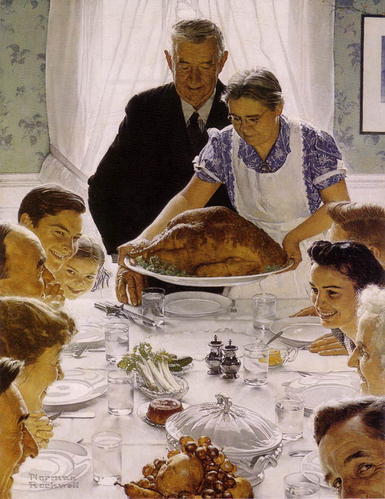
Today one has to go to google to find out exactly what these then famous Four Freedoms even were.  Sure enough, there they are, immortalized in the famous Norman Rockwell paintings, those strikingly realistic evocations of a mythical American life.  The famous one where the fat, perfectly browned turkey is being served at a big table, with the beautifully rendered greedy faces of the children at the end, one smiling lustily almost directly at the viewer, is his depiction of Freedom from Want.  One picture = a thousand words.

rockwell_freedom_from_want

“Yeah, FDR told us that the right not to go to bed hungry, in a world of abundance and super-wealth, was a basic human freedom.  Of course, any self-respecting billionaire will tell you exactly where to fuck yourself on that proposition.  Go down FDR’s list of the old enemies of peace, the first paragraph of your footnote below*,” said the skeleton. “It is now, what, eighty years later, and… hah! what do you know?!!  Same Dick Cheney types treating the government as their own piggy bank, the forces of selfishness and lust for power fucking away with insatiable, mechanized erections.  Ruthless, inhuman forces still in control of our great democracy, you say?  I don’t mean to single out Mr. Cheney, you understand, just because he’s such an unrepentantly evil motherfucker, and not even a born member of that social class FDR betrayed, still, you take my point.”

Preaching to the choir, dad.  I couldn’t have put it any better myself, self-evident as that is to say, of course.  The reality of this impossibly slippery slope of self-serving privilege and the constant rewriting of history to suit their purposes is no doubt part of what finally broke you.  

“Play the game the right way, take advantage of every bit of luck you get handed, work hard, work harder than everybody else, work as many jobs as you need to work, struggle, fight hard against ignorance and hatred, try to be a decent person and… oh, fuck, I was putting myself under so much pressure to live the American Dream that I fucked up both of my highly intelligent kids, oh, shit, and now, here comes Dick Cheney, oh, God, no…  look at that famous self-satisfied smirk…”

“And they’re not enforcing the Voting Rights Act anymore in the former Confederacy since we’re now so clearly post-racial and the f-ing ‘n-word’ is no longer tolerated, except in private among whites and among the n-words themselves, of course, and we don’t need to regulate Wall Street speculators any more, the Free Market will insure fairness, you dig, and there’s nothing wrong with a little pre-emptive ten year war on some anonymous brown bastards who hate our freedom, even with no actual causus belli, think of all the jobs we create in the lucrative war industries, and it’s so judgmental to call us ‘war profiteers’, you fucking glib, hateful class warriors, and oh, blah blah blah…  You want Hope and Change?  Vote for the charismatic black guy who will break your heart in more ways than you ever dreamed possible.  Yes, in the end, the seeming futility of it all broke me in half like a fucking dried out stick.”


*  “We had to struggle with the old enemies of peace—business and financial monopoly, speculation, reckless banking, class antagonism, sectionalism, war profiteering.

They had begun to consider the Government of the United States as a mere appendage to their own affairs.  And we know now that government by organized money is just as dangerous as government by organized mob.

Never before in all our history have these forces been so united against one candidate as they stand today.  They are unanimous in their hate for me—and I welcome their hatred.

I should like to have it said of my first Administration that in it the forces of selfishness and of lust for power met their match.  I should like to have it said, (crowd cheers begin to drown him out) wait a minute, I should like to have it said of my second Administration that in it these forces met their master.”

Reading these lines is nothing next to listening to his powerful delivery of them, hear the actual 1936 speech here.

Niggardliness of Spirit

It is understandable, if you grew up wanting, that as an adult your first impulse might be to hold on to the things you have, rather than to offer them freely.   This was certainly the case with my father.  My sister and I often noticed his difficulty giving.

Make no mistake, we had all the food, clothing, birthday gifts and other essentials that were needed, our hard-working father provided a materially comfortable middle class life.  It was his reflex to withhold, especially things that cost nothing and should have been easy enough to give, that we always noticed.   On some fundamental level, it pained him to be generous.

A cheapness of spirit, what the Brits might call a meanness of spirit, a stubborn, deeply held reluctance not to give the very thing that was needed most in that instance.  This held true for things that cost nothing but a moment’s consideration.  It was always hardest to understand his often-irresistible impulse to withhold those tiny, infinitely precious things.  Praise of any kind, for example, was very hard to come by.  

“Well, I never had praise in my life, never,” protested the skeleton.  

Hitler was mercilessly beaten by his unredeemed asshole of a Prussian autocrat father, big fucking deal.  It’s not hard to understand where the shit impulse comes from in those among us who cling to and justify our monstrousness.  It is quite a different thing to see it as a justification that means anything, except maybe to the justifier.  

“Well, that’s a little harsh,” said the skeleton.  

Well, my apologies to Hitler, then, dad, but you do get what I’m driving at, don’t you? . The horrific specifics of the humiliation a person has undergone may explain a lot about their later attitudes and behavior, but it doesn’t satisfy us as any kind of moral justification.  We can understand, and shake our heads, as we do with the poor beaten little boy who grew up to be fucking Hitler.  Of course, I’m not comparing you to Hitler in…  

“Of course not,” said the skeleton with a strong fruity over-note of slightly fermented sarcasm.

Once, you must remember this, we were walking down to the Dead Sea, I think it was, during your visit to me in Israel in my after high school year.  Mom and my sister must have gone on ahead, you had me hang back for a second at the rent-a-car.  You had something important to tell me.  You begged me, a skinny, angry teenager who regarded you with coldness at that time, not to become like you.  

“Let your mother, and other people who love you, show you affection.  Don’t push them away like I always do,” and you began to cry.  Tears as bitter as the corrosive, super-salty Dead Sea itself.  

I’d only seen you cry one other time, at a seder when speaking of those leaders who hated the Jews, and who rise up in every generation to kill us and try to destroy us, and how infamously they almost succeeded in recent times.  

As we walked the rocky, arid path downward I recall saying nothing, leaving my impassive mask on.  The mask of a kid who’d been brutalized by the man now crying at the impassive monster he’d had a significant hand in producing.

Fucked up, yes, but the point remains.  It is an exhausting struggle to overcome our pain to become fully human.  Much easier to blow up when some asshole steps up, how about I shut your fucking mouth for you, fuckface?   Easier, being eternally deprived of a kind word, to clam up when your child looks up expectantly: how did I do, dad?  I get these things and, hard ass that I am, give almost no allowance for the painful experiences that stunted your ability to refrain from doing to others what is hateful to you.  

People put in the hard work to overcome those things, learn to practice kindness, to apologize when they hurt somebody, to listen sometimes, even when they are not that interested, because they feel the other person’s need to speak and the pain behind that need.  

“Your father got much better toward the end of his life, as far as letting me show him affection,” my mother told me, not that long before the end of her’s, “he’d let me kiss him, if I held his head.”

It’s a good idea to hold the head of a dangerous creature and have a good grip before bending in close for the kiss.  

“We are all dangerous creatures, Elie, that’s what I was trying to tell you.  And if you have no teacher in the art of human decency then you somehow have to grow into your own teacher,” said the skeleton.

“To the extent that I see you doing that, I applaud you.  We’ve had our differences, and on some deep level I still don’t truly wish you well, but I have been impressed by some of the strides you’ve made.  May you live long enough to take the rest of the steps you need to take.  Don’t be like me, Elie.”

Subtle Harms

Hateful actors snarling directly in your face are hard to miss, and, when it comes time, you can at least get your hands up to defend yourself against them when they’re overcome by the need to do you violence.  It’s the subtle blows, delivered by those who profess to hold your best interests at heart, blows made to feel like something you yourself have brought on, somehow, that can really cripple you.

“Spoken like a man who has never been whipped in the face every day for the first couple of years of his life,” observed the skeleton.

Sad though it feels to me today, a grown-man on the edge of old age with the skeleton of his dead father on his knee like a chipper, razor-thin Charlie McCarthy, it’s a point that needs to be made again.  To say it more clearly: it’s a point that I need to make again.  

Jackie Robinson’s widow, Rachel, told Ken Burns’s team that she always saw, and continues to see, the subtle racism of the north as more detrimental, more destructive, than the openly racist style practiced by the genteel defenders of their traditional way of life in the south.   She pointed out that it’s much easier to see and fight good old-fashioned in-your-fucking-face racism, like not being allowed to use a bathroom, than the falsely smiling kind that denies it is anything but bad luck that bad things keep happening to unlucky blacks in cities where there are no laws, rules or even customs against them.  You can’t hit what you can’t see, though it will continue to hit you at will.

I muse about this, even as I remain unable not to provoke those who simply accept their own faults, smile about their own anger, reckoning these as small things that have not hampered them in any terrible way.  As long as you can get up every day, hit the heavy bag, the speed bag, do a little road work, spar, get ready for the next bout, what need for time-wasting introspection?  Who, outside of a self-pitying fool, would spend hours every day probing their own wounds, trying to get to the bottom of mysteries so deep they can never be plumbed? Even the Bible observes that a fool’s main desire is to lay his own soul bare. 

One has to respect their right to this satisfied opinion, or, at least to accept that this opinion is tightly held.  People who don’t seek insight into their actions are less interesting to me, and less compelling as characters or friends, than those who struggle toward understanding.   I am becoming an intolerably pompous and demanding person this way, it seems to me lately, but one has to respect my right to choose those who seek sometimes uncomfortable understanding over those who are always satisfied.  Or not.

The ass-whippings my father got from his tiny mother were direct and violent.  They came without ambiguity, explanation or commentary– what, after all, is more eloquent and self-explanatory than a series of unrestrained lashes across the face?   Most people I know who have gripes against how they were raised grapple with things much more ambiguous: being constantly undermined, slighted, mocked, ignored at key moments when it was most crucial to have been heard.  

Here, take your pick.   Which would you rather be, as a two year-old and for the rest of your days — teased and ridiculed or beaten?  Slapped hard every morning, noon and night or the victim of acerbic sarcasm?  Hardly seems there is much to choose there, most people would take the words.  

Get up every morning when the alarm rings, use the bathroom, do a few stretches, shower, try to eat a healthy breakfast, head to work, work, go to the gym, come home, try to have a healthy dinner, watch some TV or read a good book, go to sleep at a reasonable hour, do it again.  Try your best, when you can, not to do what is hateful to you to the children in your home, but, since nobody is perfect, and feeling guilty afterwards is always easier than doing the right thing in real-time, why agonize or obsess about any of it?

“Well, you hit on an important point, Elie,” said the skeleton, “it is much, much easier to apply the lash of guilt to yourself afterwards than to always overcome the urge to yank your kid’s arm out of the socket in a crowded supermarket when the kid is being irrationally insistent.  The supreme challenge of raising a kid, I hardly need to point out, is something you’ll never understand as well as a parent.  People do the easiest thing, almost always.  Look at you right now, tapping away here, putting words in my mouth instead of attending to a hundred more important things.  You can feel you’re doing important work, somehow, but that’s what everybody feels when they’re out making a living.  Which, I point out gratuitously here on your ‘gratuitous blahg’, you have never done, except in a few moments of weakness, when you absolutely had to.”

You see what I’m saying?  There are words that can stop you in your tracks, perfectly timed reminders that echo from long ago, being heard countless times:  you will fail, you are doomed, others may be worthy of the love and respect of the ticket buying crowd, have interesting things to say, things they say winningly– but people like us are born to lose, and there is no anarchistic glory in that either, no matter how proudly you might have it tattooed onto your giant bicep.  

Look it at this way: I am determined to struggle against these destructive voices, the famously forceful indifference of a world that professes to have only two categories: winners and losers.  Winners win and losers lose, simple as that, loser.  If you have to agonize over which is which, or why this is the case– hah!  You have already lost!  Loser.

Or, best of all, and most disgustingly succulent to a fellow like me, sensitized to it as my father was to that tiny twitch in his mother’s face right before she swung around and pulled open the drawer to grab her favorite whip, silence.

Not, of course, the majestic silence of nature that fills one with awe in a black night with a million stars winking overhead, but the peevish silence of humans, who most often cannot shut the fuck up, but who manage to clam up completely when it is most important for them to nod and say something as simple as “nice.”

 We are a competitive, often vicious, species and there is little benefit, except sometimes in the moment, to give another person any reason to feel courage or hope.  One more reason a true friend, an indispensable ally in the war of each against all, is so rare.

Irv Chimes In

“OK, so at this point you’ve written, let’s see, at last count, 91,180 words for this planned Book of Irv.  You’ve started another website to begin sorting through that mountain of words, which interested readers, so to speak, can find here  (along with a handful of nice photos of me) and… what?  Do you really, and I say this in all seriousness, do you really expect anyone to give even the rumblings of a shit about the life of your brilliant, bitter, complicated, charming, malicious father, no matter how engagingly you set it out?”  The skeleton looked idly off to the side as he said this, having no eyes to make contact with in any case.  

“You know, it’s an act of almost hilarious hubris, for a man with your long proven track record of non-participation in society, to think that suddenly you’ll be able to sell your idea of an engaging and soul-troubling book to a reputable publisher, be paid a few thousand dollars to complete it, with the help of an insightful and generous editor, see it published, well-reviewed, tour the disappearing bookstores and elitist universities promoting it, talk to Terry Gross and Leonard Lopate, and, somehow, get to carry on my work, whatever the hell that was.  Your own well-chosen words, Elie, from the other site:    

It is my foolish intention to carry on my father’s work by writing a book to move the hearts and minds of its readers and help to launch the non-profit of my dreams, a collaborative student-run workshop for the children of the doomed.  

“Not exactly approved by the marketing department, and we’ll get back to the ‘children of the doomed’ line in a little while. Presumably, this book will also serve to fully explain why you devoted the last five years of your life to dreaming up, fine-tuning and conducting this now dormant student-run animation workshop for public school  kids in poor neighborhoods.  After describing, in maniacal detail, how your father instilled this difficult mission deep in your heart.”

Well, yes.  I’d make sure to inform Terry Gross’s people of that larger motivation.  I’d have to write an epilogue or something covering that, so she could ask me about it.  

“You do recognize how mad and unlikely of success this plan of yours is, don’t you?” he asked with skeletal stoicism, even as he flashed his now eternal grin.  

“You know, I recognize that you can write, you could always write.  It used to torture your sister, being compared to you, because you did whatever you wanted in school with seemingly no effort, while she had to work like a dog. In fact, in all my years teaching, I don’t think I ever had a student who put in as little effort as you consistently did, outside of the many kids I had to fail.  And that’s saying a lot.”

Back up a second, dad.  We talked about this the last night of your life, my sister feeling compared to me and how hard she had to work and all that.  In fact, you used the same cliche then: work like a dog.  Let’s clear up the record here:  you agree that my sister also writes very well.  

“Oh, absolutely, she’s extremely bright and articulates her thoughts crisply, no doubt about it.  I’m just saying.  It’s one thing to have that ability, quite another, as you’ve noticed with your few attempts to close sales on your talents and ideas here and there, that selling is a completely different exercise than clearly setting out a complicated truth, moving someone’s heart or letting your creative spirit soar freely.”  

Mmmm.  Maybe better to just talk about the fucking children of the doomed, at this point, than to linger over the daunting challenges I’ll be facing as soon as I start trying to flog this book in the marketplace of screaming, idiotic ideas vying for clicks.  

“We’ll get to the children of the damned in a moment, but I have a suggestion for you first.   Those two irrelevant (to my story) pieces you linked to in that long post yesterday about the talent for malice– the ones about your former friend Andy with the mental health issues — why not stitch them together with a little living connective tissue and send them off to some place like The Sun?  There’s a dramatic arc to that as a story, much of it already told, this mentally ill eternally needy little brother mooching off you for decades, manipulating you with much of the same psychological set up as your dear old dad– the relentlessly dark wit, the fierce self-hating intelligence– and how, in the end, the only way to resolve things with him was with brutality.”

“Interesting story, I think, and it’s almost ready to stand on its own, would take little work for you to shape it into a nice piece.  And maybe you could make a couple of grand selling it to a place like that, get your foot in the door, even at this late date.”

“Same with some of the chapters you’ve written for this book about me.  How many books have you read with that long catalog in the beginning crediting where the individual chapters were originally published?  That would be the way to get started, I would think, not that I’m any kind of expert on these matters.”

I vow to you now that I will order a copy of the Writers’ Market, like I’ve been planning to do for months.  Before this day is over.

“OK, that’s a start.  I won’t mention how many times you’ve inked that phrase into your little notebooks since February, with that optimistic little eternally unchecked check box next to it.  Look, I know your life is a bit of a challenge but look at it this way: you’re trying to do something important with your life, put your talents to their fullest social use, and most people must be content to work at jobs they hate if they pay enough– and those are the luckier ones.  The masses of people work in shit jobs they hate and don’t get paid nearly enough to do.  There’s something to be said for being the kind of idealistic idiot you stubbornly continue to be, plus, you have the funds, for the moment, anyway, to go for a life of integrity as hard as you can.”

You wear me out, old man, as you always did.  I’m going to open another window in this browser and order the Writers’ Market.  Then I’ll come back and we’ll say a few words about the children of the doomed, the children of the damned, and also, a few about the children of the goddamned.

A Talent for Malice — an illustrated pass

“You are really missing the mark so far with your attempts to lay out a talent for malice.   You’ve hardly really explained it, let alone illustrated it.  Frankly, I’m disappointed.  I thought you’d attack it with more gusto, having a bit of the old talent for it yourself,” yawned the skeleton from his eternal lounge on the hill.  

We’ve talked about this many times, part of the ongoing debate about how much we can really change our natures.  

Your position was always that our basic natures, our predispositions and reflexes are hard-wired and can’t be fundamentally changed.  Our upbringing, you said, only hardens these innate characteristics.  If, for example, you harbor some fond hope of being nurtured by your earliest caregiver and instead she whips you across the face every day, there will be immutable lifelong consequences.    The sensitized impulse to rage against this hurt whenever even slightly provoked, and the provocation might be imperceptible to anyone not so programmed, never leaves you for a moment.  

My position was that we can make significant changes in our lives, difficult and subtle as this process may often be.  We change ourselves by learning to master the reactions we regret, stay away from situations and relationships that set us off.  By learning to take  a breath when our reflex is triggered, instead of reacting first, we can avoid some of the worst of what has always followed.  By learning how to react better we can improve the way others react to us, breaking the cycle we find ourselves locked in.

“How’s that mastery changey thing workin’ out fer ya?” said the skeleton, in a surprisingly pert Sarah Palin impression.  

At the moment, and to be entirely truthful, it feels a bit thin, even as I know it is an often subtle matter and one requiring constant attention.  I still wake up sometimes, in spite of years now of trying to master the urge to strike back, flooded with fight or flight chemicals, thinking about an unavenged assault by some despicable coward, some intolerably weaselish violation I could have easily thrown back on them doubled but refrained from doing in the name of some higher impulse I imagined at the time.  That mastery changey thing is not workin’ out fer me at all at the moment; I have the strong urge to inflict pain.  

“That’s my boy!  That’s what I’m talking about!” chirped the skeleton happily,  “Come on, have at ’em, there must be some deserving target you can scald with rage today.  How about that Irish cunt of a manager at Tekserve, now wasn’t he a useless and manically provocative glowering turd after they negligently disabled your work computer?  What about a damning Yelp for the owner of that pretentious shit hole on twenty-third street?  A  tart, corrosive portion of condensed slime poured publicly, and irrefutably, over the reputation of that place would not be out of order, would it?  Oh, let’s not forget the guy who ran that useless depression clinic at that hospital on the East Side?  Come on, a self-important psychiatrist, with grant money up the wazoo, non-responsive to the excellent case you made for the galling lack of supervision, the fraudulent conversion of almost nine hundred of your dwindling dollars for less than useless amateur ‘therapy’?  Perfect, imagine the letter you could write to reduce him or her, or the entire twitching hierarchy, to quivering rage…”

Well, you make a good point.  Those folks deserve to be held accountable, no doubt.  But strangers, no matter how deserving, are not the proper targets for my spleen, even if I was determined to put aside my vow to do no harm and extrude some bile today.  Those jerks at Tekserve and the hospital are truly random jackasses, a few out of the millions out there, conducting shoddy but well-promoted businesses, prospering in a climate of inattention, unaccountability and a credulous belief in credentials and hype. The guy who runs that clinic probably has a PhD from Stanford, Harvard or Brown, you know the type, the tireless and undeserving self-promoters you always hated so much.   I can picture the impeccable corporate ass-kisser shrink as an unctuous, ambitious student, unequaled in the classical French art of analingus, no doubt.  But these people are random strangers, and it is truly pointless to vent at them.  Even if my smooth stone hits them squarely in the eyeball, or in the nuts, who gives a crap?  

“A talent for malice is a terrible thing to waste, Elie,” observed the skeleton.  

I thought of you recently when I watched the documentary ‘Best of Enemies’, the story of the televised Gore Vidal-William F. Buckley, Jr. debates during the 1968 Democratic convention in Chicago.  Both men were true masters of malice, they took a deep, personal delight in slowly plunging a sharp stiletto into the carefully selected ganglion of an adversary.  They truly savored the moment, slowly twisting the blade.  Vidal won the early rounds and as Buckley got more frustrated he became an easier and easier target for Vidal, who had done his careful homework while Buckley, apparently, counting on his genius for a quick riposte, took Vidal lightly.  

We are then treated to that magic live TV moment when Buckley is reduced to hissing ‘faggot’ through a feral sneer and Vidal smiles serenely at Buckley and then at the audience at home, his work now done.  The filmmaker later shows a much older Buckley, in his last television appearance, looking haggard and miserable and telling the interviewer he’s lived long enough, that he looks forward to his death.  When Buckley dies Vidal is unable to hide his glee, publicly wishing his old enemy a pleasant time in hell.  

“Marvelous,” says the skeleton, “I remember those wonderfully hateful debates fondly.  Talk about your slingshot stone hitting the guy in the nuts.  I remember that moment when Buckley lost it and that sublimely smug, superior little grin on Vidal’s face.  And that ugly slip couldn’t have happened to a nicer guy, or a more despicable spokesman for the forces of well-bred reactionary politics that have always run this place, or, in the case of Vidal, to a more provocative faggot, for that matter.”

Marvelous?  I don’t know.  Entertaining, true, but where is the marvel in that kind of vicious one-upsmanship?  It’s not what I’m going for any more, now that I know better, after years of incessant warfare.  I want peace now, not malice, no matter how elegant or irresistible.  If there’s a door to the room I’d rather find my way to it and go somewhere else than stay in a stinking room slugging it out with a vicious, sweaty moron hell-bent on somehow prevailing, the more the plain facts are all arrayed against him, the more desperately he will flail away.  I’m done with vampires, dad.

“OK, I’ll grant you all that, and healthy decisions, one and all.  But you come here today with a head of steam, after another night’s sleep too short by three or four hours,” said the skeleton, “how about you tell your dear old dad what is bothering you so much?  I never listened when I was alive, true, but I am all ears now, to the extent a skeleton can be all ears, at any rate.  Come on, Elie, dish.”

‘Dish’?   A man of constant surprises, my father; who knew he’d filed away the old gay term for “give me the good gossip, girl”?  I know his favorite gay sex advice columnist was Dan Savage, I mean, who could really compete in that category, but still, I can’t really picture Dan ever using the term.  ‘Come on, Elie, dish.’  Kudos to the gaunt fellow in the dirt bed.  Nicely played, Skeleton Irv, sure, why not?  

While there’s no point at all to expend effort engaging maliciously with aggravating assholes I’ve met in passing, I suppose I could take a few moments to put a long-overdue stake into the heart of another unredeemed vampire I once befriended.

OK, so I’m having lunch with your nervous friend the other day, the son of those old friends you had me throw out of your house into the snow one night more than twenty years ago.  We were not seated for more than a moment, when, out of the blue, I suppose because such talks are naturally divergent affairs where thoughts pop up, are mentioned, and any one of them may become a subject of conversation, he says “not to harsh your buzz…” and then does exactly that by beginning to describe the vacation in a Florida love nest a former very close friend is now supposedly enjoying.  

It only took a sentence or two from him before I questioned his point in bringing this fellow up, especially when we were about to eat.  I reminded him that I had no interest in this person whatsoever, especially about his sex life, except perhaps to wish him venereal disease.  The tiny bone that had been placed crosswise in my throat by my friend’s unthinking reference to this uncomically disabled clown having sex in a Florida house his clearly desperate fellow-cult member girlfriend apparently owns seemed to remain long after he’d apologized and we went on to other things.  

Later in the meal, in reference to this ongoing outpouring of words trying to describe my father’s life and times in a way that will hopefully both illuminate and remunerate, he mentioned this same once-good friend.  “He’s been reading it and he thinks it’s probably a good thing for you to be writing it,” he said.  

I believe I nodded at this, don’t recall saying anything, except perhaps to mutter a ‘fuck him’ and opine that when one has shown a stranger many years of nothing but sincere friendship, and is repaid in the shitty coin that is the self-hating friend’s only currency, it is no mystery that only hatred and coldness would remain afterwards.  

To my friend’s credit he didn’t make any reference to my attempts to practice ahimsa or the strange incongruity of a man of my professed beliefs being so unforgiving.  It was as if he anticipated what I was going to say next, which was some recognition of those very things.  I told him that the worst of it, and what tore things irreparably, was that my final act of friendship, reaching out as soon as I’d recovered myself after his final betrayal, with the arguably generous impulse to hear him out, was rewarded by a cowardly attempt to bully me over the phone, followed by his last words in an email six months later:   I do owe you an apology but am being stingy about giving it.

My friend agreed that all this was bad and said he no longer had any doubt about the sincerity of my eternal malice toward this fellow.  I nodded and told him I had no more thoughts about my one time close friend, outside of knowing how easily I could calmly punch him in the face at this point if he ever spoke to me again.  And that I trusted that all of this should now be about as clear to my companion at lunch as I could possibly make it.  

At some point, earlier in the conversation, in connection with the love nest in Florida, I’d casually revealed a confidence this guy had shared with me, the self-regarding jerk-off, and realized only later that, since he has been reading this stuff, I might well have an adorable, even irresistible, opportunity to sling a smooth stone smartly into his fancy testicles, if my annoyance over having to hear about him at lunch would not leave me in peace by the next day, which has now arrived.  

“Oh, man, this is getting good!” smiled the skeleton.

I add that this confidence was not revealed to me after a disclaimer of any kind about keeping this possibly embarrassing personal detail between us.  I always honor those agreements, even with people I have no need or obligation to protect anymore.  But this hideous detail was told to me matter of factly, and the fact of the matter is that I have no idea why I had to hear it at all, though it was one of those uncomfortable things one cannot unhear.

“Well, come on, then, deliver the kill shot, don’t keep us hanging,” urged the skeleton.  “You see you can’t change this part of your nature, and it flows perfectly from the early part of your life.  I was sadistic to you.  You gave me endless chances to hurt you and I couldn’t resist.  You have to be fair, though.  What is more irresistible than a vulnerable person begging for the very thing you never got?  That’s what malice is all about, Elie, choosing the perfect time to do the most lasting harm, to inflict the deepest possible hurt.  It’s the essence of malice- causing maximum pain.  Take a break from that ahimsa business, it’s not helping you at the moment anyway.  Unleash your inner Irv, go ahead, show them what the talent for malice is all about,” the dead man urged his still-living son.

Fine, here you go.  If you want the full emotional effect, read this first, and then this. The latter caused a reader to remark that it was a good thing the guy depicted in these two didn’t own a gun.  The second could certainly stand alone as a demonstration of my talent for malice and a fitting tip of the cap to my dear old dad, a master of the art form.  Here’s a last tip of the cap to you on this subject of the talent for malice, pop.

To my friend at lunch I mentioned, in passing as we moved on from the ill-raised subject of these long-time doomed lovers in their ticking time bomb of a romance, (she, much younger than he, had told him from the start that she wants to get pregnant and would be looking for a father closer to her age than to her father’s)  that I wondered if our friend was finally able to ejaculate during sex with her.  He’d told me about the marathon fucking sessions and how he could never come.  He’d have to go home to relieve himself afterwards, in the privacy of his own thoughts.  I don’t believe I bothered to add, then or to my friend at lunch, that I’ve read that this kind of sexual dysfunction is an expression of the deepest kind of rage and self-loathing.

“Wow, he never told me that,” said my friend, “I guess you guys had a much closer relationship than I’ve ever had with him.”  

Sad to say.  And all the more reason I do not hesitate now to picture myself bashing the smilingly enraged fellow directly in his superior unmistakably English face.  I entertain this violent image only for as long as it takes to cleanse my mental palette, which I have hopefully done here, though I feel no better having followed this ugly impulse.

“That’s my boy!   Good to have you back,” beamed the skeleton proudly.  “That, son, is a talent for malice, finally painted in glorious detail.  And really, though, don’t you feel better now?  I know I do.”

There’s no feeling better about malice, old man, no matter how torrentially one pours it on.  It is one of the worst, most destructive things in the world, an endless sucking sinkhole, no matter how much one might otherwise appreciate its particular application.  One masters one’s talent for malice only to his own detriment.  

“Ah, don’t be so hard on yourself, Elie.  Wasn’t that you telling me just the other day that the world is not black and white?”


Keep Your Eye on the Teetotaler

I wake up hours before the alarm lately, not rested but propelled to the keyboard with some new idea for how to continue working on this puzzle.  The room I work in is dark, the puzzle pieces are tiny, and few, most of the puzzle is missing, its outlines hazy, melting into shadow.  Still, there seems nothing more crucial as I enter my seventh decade than assembling this puzzle into a form I can show you, a person I’ve never met, and pointing with a small smile to its most subtle sections. 

In one way there couldn’t be a more mad project, I suppose, because, if you look at it dispassionately, what is it that drives a person to speak to people who are nothing but abstractions, truly?  In a more immediate way, though, I can’t conceive of anything more important than this assembling of my own understanding of things that have long vexed me.  It is the tiniest flicker of a fresh insight into how to wrestle with this difficult puzzle that pops my eye lids open long before I’ve had enough rest lately.

“Only a neurotic would conceive of assembling one’s own understanding of his vexations as an important project,” says the skeleton, with a quiver of his native suspiciousness.  “More to the point, how is putting together the puzzle of my tormented life going to help you assemble any understanding of anything at all?”  

You might as well ask grandma what the point of all that vodka she took in and poured out through her sweat was.

My father and his mother-in-law loved each other like devoted child and doting parent, they admired and protected each other fiercely.  He always called her Mom. At the same time, my grandmother was prone to drinking huge quantities of vodka and my father, a teetotaler, never touched a drop.  He used the word ‘teetotaler’, as quaint to me as ‘dipsomaniac’, which may have described grandma, with her urge toward intoxication.  

“They were having a few drinks, you know, getting loose and laughing, but I’m a teetotaler, so I drank root beer and made a few cracks from time to time,”  he said, describing a colleague’s retirement party, and then explained to me that a teetotaler was someone who didn’t drink alcohol.  Google can reveal the origin of the word in a couple of taps, but I would rather picture the twenty-six year-old teetotaler’s mindset in America in 1950.  

There has never been any shame attached to a hardworking American coming home and kicking back with a little booze, a cocktail after a long day at the office, a couple of beers with the guys after the whistle at the salt mine blew, a bottle of wine with dinner.  Some of our greatest writers and thinkers were no strangers to hangovers, the most charismatic slugger of his generation hit more than a few home runs hung over.  

Even during that thirteen years of national hysteria, spanning my father’s childhood and the Great Depression, when ambitious criminals made their fortunes selling illegal alcohol, a newly banned substance that millions loved, there was never much widespread shame attached to coming home and having a few drinks, or drinking at a party.  We are still living in a century-long, bloody trillion dollar failed experiment in prohibition of most competing intoxicants, and shame has long been systematically attached to smoking the preferred weed of Mexicans, jazz musicians, Negroes and degenerate whites, but that pathetic hypocrisy is a sickening subject for another time.  The point is, people have long loved to savor a substance, like alcohol, that gives them a relaxing buzz and alters their thoughts and mood accordingly.  

Not my father.  He was a teetotaler, as he would proudly tell anyone who asked why he didn’t want a little sangria, or a cold beer.  In my experience he never had so much as a beer.  At Passover, when we are commanded to drink four cups of wine during the long ceremonial meal celebrating our people’s journey from physical and spiritual slavery to freedom, that elusive and slightly intoxicating state, my father nursed a single cup through the service, having a sip each time the Haggadah told us to drink the next cup of wine.  

My best theory: being in control, and at peak readiness for the ambush that was always waiting for him, was uppermost in my father’s mind at all times.  It made sense.  His trusty sword was always at the ready, it was nothing for him to make a few quick arcs in the air with it and nonchalantly disembowel anyone who came at him.  He was ready, and it was important to him to keep himself sharp.  Who knows what a couple of ill-chosen drinks might do to his matador’s reflexes in a world of constantly charging bulls?  

“Well, you say that with a certain mockery, but everybody has their demons, and their own ways of dealing with the relentless fuckers,” said the bones of my father, his now claw-like hand pushing a dusty shard of a tiny puzzle piece across the dirt.  “To you, I’m sure, it makes more sense to have a few puffs of that nepenthe and improvise with your guitar, dreaming of things that never were.  A chacun son gout, as the Frogs say, but for me– I valued clarity of mind above all else, why mess with that?”  

Fair enough, I say.  On many subjects that clear mind served you very well.  A pretty good argument can be made, on the other hand, that a certain stiffness of habit closed off entry to many other important human experiences to you.  In the end you came to regret your often rigid view of things.  Seeing the world clearly as an eternal battle between black and white, ignoring the million gradations, in the end, and as you realized, is not a very clear way to look at life.  To put it more starkly, it would be fair to say you regretted being closed minded as you were measuring out your last few breaths.  

“Well, that’s fair to say,” he said.  “I’m trying to see how getting drunk would have improved my chances for understanding things any better.  You’d have to admit that’s a fair question.”  

The question is fair, and it’s a good one.  And it shows me again how you taught me to think of things from as many sides as I am able, in spite of your reflex to reduce things to a deathbed regrettable “my way or the highway”.  

First let’s reframe your sneakily tendentious question a little.  If your goal is to end the discussion, reducing the other side to absurdity is one of the standard ways to go.  The question is not whether it is better to be unshakably sober at all times or sloppily drunk.  The proper question is whether it is better to refuse, on principle, to join the festivities, to hold oneself always slightly apart because of some moral standard you hold yourself to, or to be able to relax and share some harmless relaxation, as much for the sake of full participation and putting everybody else at ease as for anything else.  

Your buddy Russ, a life-long drug user, told me once that he didn’t get much of a kick from marijuana any more.  His preferred drug at the time, apparently, was cocaine, the hopped up drug of success and achievement for many people back then.  “I’ll take a toke just to keep the pipe going as I pass it around,” he told me, “but that’s not really the buzz I’m looking for these days.”  He told me this as he was proffering some of his preferred drug on the end of the tiny blade of an old pocketknife.  Coke was never my thing, a drug that made you nervous, vigilant, eventually paranoid.  I prefer gentler kinds of intoxication, but that’s just me.  

“Look, I never held that against Russ, he liked to get high, I never judged him.  It just wasn’t for me, losing hold of reality like that,” the skeleton said.  “You know, he was probably high half the time he was laughing his ass off at our house, but it didn’t change my enjoyment of our times together.  And, more to the point, I didn’t need to be high to love our times together.  You do get that, don’t you?”  

Focus, for just a moment, skeleton, on the phrase Russ used “to keep the pipe going”.  He didn’t particularly like getting high on weed anymore, it didn’t do it for him, didn’t scratch the itch.  But he’d puff on the pipe when it was passed to him for the sake of keeping it going for the guys around the circle.  There is a social element to sharing an intoxicant, like drinking a toast.  The man at the hard-drinking beloved departed’s wake who won’t lift a glass with everybody in their good friend’s memory?  

“The origins of anti-Semitism, right there.  To polytheists it was nothing to add a conquering god to their pantheon of deities.  ‘Zeus kicked our ass fair and square, a powerful god, we’ll put him on the altar above all of the gods we continue to worship’.  Jews, the first monotheists, we presented a problem.  We could not bend our stiff necks to a false god, we’d rather die.  Our enemies have always been happy to oblige us in that.  Flowing from that problem of clinging to the one true God, and reducing all other cherished beliefs to bullshit, millions were put to the sword, washed away in a two thousand year long tsunami of blood, splashing away now, even as you wrestle in that dark room with the puzzle that was your vexing father.”

You are still one stiff-necked motherfucker, my father.  I would be nothing if I could not give you that.

Giving A Voice to the Dead

“You know,” said the skeleton, “that at this point I can’t actually talk.  You’re aware that this conversation is taking place in your own mind, that it’s imaginary.  The dead cannot really speak, you know, outside of the little remembered voices they leave behind in the souls of those they’ve acted upon.  I’m not talking about voices we imagine we can hear after reading a hagiography of a guy like Gandhi, you know, the Mahatma, the Great Souled myth man, I’m talking about the remembered voices the actual man left in the minds of those two nieces he slept with naked to prove he was finally beyond sexual desire.”  

Whoa, slow down there, bonester.

“There’s a darling I look forward to watching bleed to death on the editing room floor,” said the skeleton.  “This dialogue you are engaged in with me now, you are aware that you are creating it?”  

Well, I could hardly not be aware of it, as you know if you think about it for even a second.  

“Human memory is a famously feeble and selective thing.  What I think you’re trying to do is construct a healthy dynamic where we could have actually had the conversations you are trying to have with me now.”

We are just now capable of having the conversations you wished for as you were dying, you might say.  If we’d started fresh that next morning in the hospital after our long chat, with another chance to have a real exchange, and the day after that, I think the realizations you were struggling toward would have become more than the irreconcilable regrets and self-lacerating apologies you expressed as you tried to explain your life to me during that last night of it.  

“Well, I don’t know about that.  I would have liked a few more chances to actually exchange ideas, you know, but at that point, it was a bit late in the game for me.  It’s hard to die knowing how badly you’ve bungled key things that people with any shred of human insight know to do naturally.  I was lying there thinking of all the damage I’d done to the people I loved, and it all seemed senseless to me, my entire embattled life, a great waste of the potential I didn’t even know I had until I got into the Army.”  

Exactly why I am struggling to put these things together now.  I can feel the end beginning to reach for me and I need to say the things I haven’t managed to say, in this little hiatus before the segment ends and the beaming little cartoon pig stutters “th-th-th-that’s all, folks!”.  I remember laughing off my sister’s concerns about turning forty, almost twenty years ago, whew.  I told her how the numbers are just milestones, arbitrary round milestones.  Yet now that my sixtieth birthday is advancing towards me on rocket-powered skates I’m feeling those six decades.  At sixty you actually begin to think in terms of decades.  Literally, decades, ten year chunks of a life gone by, seen in the rear-view mirror of life.  And as the cliche has it– they rush by in those chunks.  A blink ago I was forty, still thinking I had a lot of time.  Now I am aware of the time I no longer have.

“That’s the nature of this ‘merciless arrangement’ as Joseph Conrad had it– go look it up, Elie, it will make you sound smart, google will give you the actual quote in five seconds.  ‘Droll thing life is– that mysterious arrangement of merciless logic for a futile purpose.  The most you can hope from it is some knowledge of yourself– that comes too late– a crop of inextinquishable regrets.’  There you go, the old Polack could really string the words together, n’est-ce pas?”

Fuck, he could have written those words for you, dad.

Do you remember, when you turned sixty mom had me make an invitation to your party, which was in the back yard on 190th Street?  I made collages from old photos, you at all different ages, your head on cartoon bodies.  I had a drawing of mom, with her beaming photographed face as the head, holding you like a struggling puppy, with your face from an old photo.   You stood nearby in an army uniform, with an 8 mm camera to your eye, filming the goings on, the several variations of you I had cavorting on the card.  You remember that?

“Yeah, it was a great invitation.  You had me saying ‘be there or be square’ and the RSVP card had several boxes to check; I’ll be delighted to attend, I’ll attend but I won’t be delighted, I won’t be there, please take my name off your mailing list.  Funny shit, my man.  You did have a sense of humor back then.”

Well, we grow out of these things, dad.  Now I’m serious as one of these undiagnosed cancers that are slyly nipping at me.  

“Why don’t you make an appointment with a fucking dermatologist?  Didn’t I also have several of them removed from my nose, while I was dying of the liver cancer they first diagnosed six days before I died?  Don’t fuck around with this.”  

You’re right, and it’s a long story, and there’s no excuse, even though there’s a complicated and aggravating reason I haven’t been able to make the appointment the last few months.  But, anyway, I have to wrap up here for the moment, I missed a call from your grand-daughter, we’ve been playing phone tag, and I want to get back to her.

“What’s that little redhead up to?” asked the skeleton with a smile.

“She texted me just now: Omg completely forgot to call yesterday don’t kill me :(((“

“Tell her you’re sorry you got her text a moment too late, fuck, if only she’d texted you a few hours earlier.  Tell her that the hit men are already on the way.  Hasta la vista, man.  Back to my dirt nap.”

How’d the Tigers Do?

“Did you catch the scores?” my father would ask me, fairly regularly during the baseball season.  I’d tell him the Yankees lost, and so did the Mets, I’d give him the tallies.   He would always ask me “how’d the Tigers do?” That I never had any idea, no matter how often he asked, seemed to be an eternal disappointment he needed to have reaffirmed regularly.  I felt momentarily bad about it each time but I simply did not register how the Detroit Tigers did when I caught the scores on the radio.  

I don’t mean to trivialize his hurt or his need to regularly confirm that, on this very basic level, I seemingly had to show him over and over that I simply didn’t care about his feelings.  Ignoring the fortunes of my father’s favorite team, playing home games in a city six hundred miles away, was not something I did consciously, but it also showed a certain returning of the favor.

“OK, I get that.  I get that now that I’m dead, of course.  All things are made clear to the dead, wait til you see it, you’ll love it, not that there’s a damned thing you can do about any of your great insights once you’re resting in peace.  My advice, keep doing what you’re doing while you can still do things.  Try to do better, try as hard as you can not to do to others things that you hate being done to you.  Two wrongs don’t make a right and an eye for an eye leaves everyone blind in the end,” said the too-late-wise skeleton.  

It was hard for me to remember to listen for the Tigers score because they played half the time in Detroit and, outside of the fact that Hank Greenberg, the New York City born, Bronx raised Jewish slugger played for the Tigers during my father’s childhood, they were just another team forty years later, a team whose fortunes meant nothing to me.  Except, of course, that I knew my father continued to root for his childhood team, as most lifelong fans do.  

My father idolized Greenberg, a Jewish giant who ignored the anti-Semitic slurs of virtually everyone in baseball and hit home runs like Babe Ruth.  In 1938, when my father was fourteen, his hero threatened Ruth’s single season home run record by clouting 58, with a 59th wiped away in a game that was rained out before it became official.  When my father was eleven Greenberg had become the first Jew ever to win the Most Valuable Player award. Plus he lead his team to the world championship that year.   He was the first Jew ever elected to the Baseball Hall of Fame, and remained the only Jew inducted until Sandy Koufax joined him a generation later.   I always knew about my father’s great identification with the Jewish superstar, though, after my father died, I was a little shocked to discover, printed beneath his photo in the 1941 Peekskill high school yearbook, Irving “Hank” Widem.  

Catching the Tiger scores, however, was beyond me.   It felt like actually driving those ten to twelve hours to Detroit to get the score of a game I didn’t care about at all and carrying it back to my father at the kitchen table.  He’d read it in the paper the next day anyway.  But he always asked and I don’t think I ever told him the score, though I might have once or twice.  He always reacted with the same mild, fatalistic hurt.  His facial expression said “sure, why would you do anything nice for me?  Why be considerate of this tiny thing your father asks you about almost every day of the long baseball season?”  

His facial expression had a good point.  Why would  a kid, relegated to the role of eternal adversary before he even knew his first words, feel the need to be considerate of his prosecutor father’s tender feelings?  Added to that, could anything be more trivial than a mid-season baseball score, that most transient of statistics in a season that had expanded to 162 games a year during my early childhood?    

I suppose, on the other hand, that the evanescence of these scores made my ignoring of them all the more poignant to my sentimental father.  The score of an individual game lives for a brief moment of a single day as something new, then is almost always forgotten.  To not even register the numbers 4-2 when they are spoken over the radio?  What could be crueler confirmation of indifference?

I guess the only way I could have been crueler would have been by not answering “how’d the Tigers do?” at all.  Silence as response was something my father had a strategic genius for deploying with devastating effect. In our last real conversation, two years before the gentle one he participated in from his death bed, he told me snippily, and irrationally, “you have to respect my right not to respond to this letter.”  

“Respect?” I said, “I acknowIedge that you once more don’t intend to answer, but I am not obliged to respect a father’s decision not to say a word on a vexing matter his son has taken great pains to express as clearly as possible, in a letter written three months ago, now delivered four times.”

“I never got that letter,” my father had told me the first time I asked him about it.  I sent another copy, emailed a third copy.  The copy I handed him in the den in Florida that day was a fourth copy of the original letter.

“Oh, that letter,” he said with feigned nonchalance, “yeah, I read that letter.”  

I made the universal Jewish sign for “nu…?”,  “and therefore…?”

He paused, his jaw tightened.  “You have to respect my right not to respond to this letter,” he said.

It was as though I’d just asked him, expectantly, “how’d the Tigers do?”

Keep the Faith

For a number of years, whenever taking leave of a friend or colleague, or sometimes saying goodbye to my sister or me, my father would say “keep the faith”.  I assumed this was a sign passed back and forth between fellow-travelers on the road to freedom.  I thought of it as a remnant of the struggle against slavery, perhaps, or emanating for an imagined African past when powerless people were autonomous brothers and sisters in their own land.   He said it with a smile, and a bit of irony, but I think there was sincerity there too, as he said it all the time for a while.  

He had other phrases he used often, but none that carried even a molecule of the hope and longing of “keep the faith”.  Anytime he was pressed to guess what was in a wrapped box he was handed he’d say “a combination egg and beat slicer.”   Whenever asked how he liked a presentation he’d been dragged to against his will he’d generally say “it was better than being poked in the eye with a sharp stick”.  

He’d sometimes utter nonsense words in response to nothing in particular.  “Tangan-yeeka, Tuskegee, British Empire!” would suddenly burst out of his mouth sometimes, without apparent sense or explanation.  “Lumumba died for freedom,” would pop out of his mouth from time to time, its possible connection to anything recently said completely mysterious.  A line out of context, perhaps from Lenny Bruce, with an arch German accent “haf you rrrrrrelatives in Chermany?”.  “Jonathan Trrrrask,” would also rattle out of his mouth sometimes, rolling the ‘r’ with great relish.   “Up your nalgas with a meat hook,” was another one I recall.  It was only decades later that I learned the Spanish word nalgas meant buttocks.

“Keep the faith” had, among all these throwaway phrases, a ring of truth and sincerity to it.  It was, looking back, almost like he was reminding himself of the vital importance, and extreme difficulty, of keeping the faith, whatever that faith might be, however vital it was to keep it, in the face of a world that seemed designed to destroy all faith.  In the final years of his life it seemed that most of his faith had been turned to bitter dust.

“Well, you watched the trajectory of your father’s faith over the course of your life, and it was a pretty sobering trajectory,” said the skeleton.  “When I heard Malcolm X speak, in his last phase, once he’d come fully awake and cast off the blinders of Elijah Muhammed, there was a faith there so strong you could actually grasp it, you could hear it in Martin Luther King’s speeches.  There was a faith in the undeniable power of truth.  It makes me feel like crying now, even as I’m out of the game, to think of the loss of faith and hope as time marches on without truth amounting to a hill of dung.”  

“Was America’s long persecution of its minorities a Human Rights issue, rather than the more innocent-sounding Civil Rights matter, as the post-Mecca Malcolm insisted?  Of course it was.  Was King going to Memphis to support the striking garbage men, after eloquently opposing the immoral war in Viet Nam a brave, if foolish thing to do — if he intended to live to see his grandchildren?  Once King became a critic of the machinery that keeps everyone in line, rather than meekly getting his head kicked in for the right to sit at a segregated lunch counter, they had to kill him.  Once you begin uniting former enemies around the suffering they endure from their common oppressor your death is inevitable.  The certainty of the murder of anyone speaking too much truth got to me, beat me down in the end.  Not that I was ever in danger of being killed, the worst I experienced was being called a fucking commie kyke and threatened by parents who didn’t want niggers bused into their kids’ school, but I felt the surging power of their hatred, got a nice whiff of it.”  

“You know, looking back over my long life, I had little hope of anything as a child.  My options were about the same as a kid in the projects, only I was a Jewish kid in a small town, part of a little insular minority of kykes, and there was only so much trouble I could get into.  I can only imagine the horrors and dangers faced by poor kids in a city Housing Project somewhere.  Then I had a once-in-a-lifetime stroke of luck, World War Two, my ticket to a larger world and higher education.  I never had any hope of leaving Peekskill, and then, I’m a former sergeant in the Army Air Force that helped defeat Hitler, having deep discussions with Richard Hofstadter about the nature of history.”

“And I had a period, around the time I met your mother, when I felt like I could conquer the world.  I had a Masters Degree in history and a firm grasp of the historical moment, with a sense that I could help bend the world toward justice.   The euphoria of those days is hard to describe to you, since you saw the gradual disappearance of virtually all hope in me by the time I was old.  Picture the world in 1950, Fascism defeated, or so we all believed, a wave of prosperity that was truly raising all boats, a shining era of once every hundred years optimism.  Everything seemed possible.  You got a little taste of that at the tail end of the Viet Nam war years when you’d cut High School and participate in a mass demonstration somewhere against the draft.  Of course, as always, poor kids wound up in a jungle swamp over there getting their asses shot off, but the sense that by uniting, marching together, showing unshakable conviction, you could change the world, or at least political decisions, was palpable.”  

“I remember when you went to Central Park in 1970 for the first Earth Day.  Imagine if those millions of marchers worldwide had actually begun to influence policy makers, oil refiners, war profiteers, toxic industrial polluters, the alternative energy industry then in its infancy, back in 1970.  The first thing Reagan did when he got into the White House in 1980 was rip down the solar panels Jimmy Carter had put on the roof.   The right wing was at war against anything that would curtail its masters’ corporate profits.   It’s 46 years later and amid rising temperatures and escalating natural disasters all over the world, droughts, floods, earthquakes, tornadoes in places that never had them, we have billionaires pulling out their biggest guns to create the false belief that ‘climate change’ is actually some kind of scam foisted on the public by an illegitimate Muslim president who hates our freedom and wants to kill job creation.  The ignorance that is sold to credulous Americans every day is enough to make you take a meat hook to your own nalgas, Elie.”  

You’re singing to the choir, dad.  

“Well, it’s a hateful song.  I was singing another song for many years.  It was a much better song that this one.  The key might be to somehow keep on pushing, though I can’t tell you how.  You had a great idea for that program with public school kids, having them run an autonomous collaborative workshop.  This program really could demonstrate important and heartbreaking things about the potential of kids marked for a life of early death.  You were pushing a huge rock up a steep hill, and I don’t think running out of strength to keep pushing it is any kind of shame.  Still, it’s a shame.  You live in an America with one value: materialism.  I know you don’t need me to tell you that. Still, I see you struggling against it.  I wish I had not been so locked in my own deathly battles for the time we were on the earth alive together.  I know that’s a lame wish from a skeleton on a hill in the countryside, but I wish I could have been less of a hindrance and more of an inspiration to you.  Being a true inspiration is hard work, my brother.”  

I understand that.  I take every drop of inspiration I can get, from wherever I can get it.  Keep the faith, dad.