A Chat About Nazis

“Oy boy…” said the skeleton, as soon as I mention the subject.  “Here we go…”  He took a long pause, something the dead do with ease, then continued.

“You know, Elie, you’re trying to do something very ambitious here, with this whole project, now an unwieldy three hundred page monster thrashing against being organized into a narrative.  I feel you taking a breath, bracing yourself to try to run up this steep hill of a subject.  ‘A chat about Nazis’, well, that’s pretty quaint and casual-like.  Sure, we can chat about Nazis, let’s.  But the reader will want background, which, of course, you can link to, and I will want a chance to think about what I say, since you are putting it down as my final word on the subject.”

Odd to say, perhaps, but I have to agree with him.  A chat about Nazis is a bit ambitious feeling today.  It’s a fairly stupid title for this, in any event.  “Hey, dad, let’s have that long overdue chat about the Nazis, shall we?”  What is my father supposed to say about the Nazis?  

“Well, I suppose I could point out what you often do, about their original party platform, in around 1921, with its one very reasonable plank.  One out of twenty something that was not the typical Nazi stuff we came to know so well.  The Socialist element in the early party wanted to fight the tyranny of monopoly capital, the huge conglomerates who could undersell every mom and pop store in the country and take over all the business.  Like Walmart today, or any number of big corporations whose fantastic wealth enables them to put every small business in the area out of business.  Like your buddy Bill Gates, the inventive computer entrepreneur who became a billionaire and hired an army of lawyers to fight and bankrupt every other inventive computer entrepreneur who came along.   Adolf and his friends rooted out these idealists pretty quickly, there’s usually only room for one Hitler in a small political party.  But, I suspect, this isn’t what you really want to chat about,” said the skeleton.

There’s a show on cable TV called Ray Donovan.  Ray is a stone-faced tough guy who fixes problems for rich people in L.A. and has no problem taking a dozen punches in the face to get the job done.   His father, played brilliantly by John Voight, is a likable sociopath, a career criminal hated by Ray.   When the elder Donovan gets out of prison and tries to renew ties with his family Ray eventually hires a hit man to kill him.   The father talks his way out of being killed and confronts his son about the attempt on his life.

A priest, killed by Ray in an earlier episode, had fallen in love with young Ray, made him feel special and eventually molested him.  

“You remember what you did when I told you about it, Mick?” Ray asks his father, who demanded to know how his oldest son could hate him enough to want him dead.

In that moment Mickey Donovan shifts his eyes in a way so familiar to me I did a double take watching it.  

“Oh boy…” said the skeleton.

“You told me I was a fucking liar and you beat the shit out of me,” says Ray, his father still shifting his eyes.  “You were dead to me right then, Mick.  Killing you now is only a formality, to protect my family.”  

I don’t recall Mickey Donovan having any response, beyond the shifting eyes. Now that I think of it, the first thing the elder Donovan did when he got out of prison in the first episode of the show was kill a priest, trying to make amends, though he killed the wrong priest.  

“You don’t make amends,” said the skeleton. “I was wrong, I told you what a horse’s ass I’d been, and that covers this Nazi business too.”  

The Nazi business was this:  My father told me I had no right to feel personally upset about the Nazi mass-murder of our entire, once large, family.  I was in elementary school and inadvisably had gone to see a Zionist propaganda film called “Let My People Go.”  It was at a convention for the Nassau-Suffolk region of Young Judaea, a nationwide Zionist youth movement for high school kids.   My father had by then become director of the region, in addition to his full-time job at the Board of Education.  He is remembered with love by many of the kids he worked with in those years.  I saw one recently who has only the best memories of Irv, a funny, bright, hip bastard if there ever was one.  

“Your mother begged you not to go,” said the skeleton, “but, of course, nobody could ever tell you anything.  You always knew best.”  

This isn’t about the movie, Mick, it’s about what happened a short time later.

“Mick….” said the skeleton.

Feeling the cold breeze up there now, no doubt, sorry about that.  Grandma was one of seven siblings, so was Pop.  Your mother had two brothers, Yuddle and Volbear, and a sister named Chaski.  I have no idea who of your father’s family were left behind in Europe.  It took my eight year-old brain a few days to put it together but I asked you, once I had, if the killing of all these people in our family made us kind of holocaust survivors.  Do you remember what you told me?

“Yes,” said the skeleton, not looking anywhere in particular.  

All a horse’s ass can do is fart and shit.  What you did, dad… it’s still almost impossible to understand.  

“I know,” said the skeleton quietly, “I basically beat the shit out of you and called you a fucking liar.”  

The reader deserves to know that this was a metaphorical beating.  My father did much better in the physical violence department than one might expect from an infant whipped across the face by his mother in his earliest twitching memories.

“This betrayal of mine is hard to write about,” observed the skeleton.  “You could direct the reader here for some of the details, I suppose, but your real work seems to be ahead of you, figuring out how to fit this puzzle into a nice, tidy box, walk the reader through meeting me, liking me, seeing the dark side of me.  The dark side is where all the real action is, of course.”

Maybe we can walk through this together.   Your young son asks you with great trepidation about his mother’s twelve aunts and uncles killed by Ukrainians while the Nazis supervised and you brush it off.  “Abstractions,” you say, looking shiftily away like Mickey Donovan.  

“Look, what is it you want now, fifty something years later?  Do you expect closure or something?  Nobody gets that, except in a Hollywood movie.  Did my apology to you the last night of my life give you any fucking closure?  I would have liked to think it might have, but as the years go by I think you’ve come to see that last conversation as more of a blessing for me than it was for you.  You did me a great kindness, you had every right to be as merciless to me as I’d generally been to you, but they don’t give medals, or even closure, for generous acts of human decency.  You just do them, and congratulations to you for not being as big an asshole as the person you did them for was.”

You were twenty or so, stationed in Germany right after the Nazis surrendered.  You were in the land where people had very recently marched in columns, their arms raised like erect dicks, saluting the world’s most famous mass-murdering psychopath.  In the nation whose armies had invaded Belarus, the Ukraine, where special units composed of the most dedicated fanatics supervised the systematic destruction of what remained of our family.   I understand you had no way to process any of this.  You had to just fucking suck it up.   You had a job to do, which was whatever the Air Force said that job was.

“Look, I’m certainly not proud of how I reacted when you asked me about our family and the mass-murders.   Of course you were right to be upset.  Of course I was wrong to tell you that you were being a melodramatic little pussy to be upset.  I couldn’t handle it, and I know you get that.  What is it you fucking want me to say?” asked the skeleton, becoming a bit testy at last.  

Nothing, really.  I’m making a record, that’s all.  We live by stories, we understand the world by stories, our memory is organized into stories.  This story is one of the hardest to tell and the hardest to understand that I can think of.   You are born into a family that, only thirteen years before you were born, was reduced from dozens of people to a handful.  A once large tree pruned down to a single branch, the leaves trembling, the bark shuddering.  What are you to make of this?   What are you to make of this?
The Incident at James Madison High School

I must find Phil Trombino, it’s true.  Phil Trombino is a living primary source.  There is little on-line about the Human Relations Unit, its day to day operations, no trace of the sensitivity sessions I imagine, based on my father’s descriptions during the lulls in fighting over dinner.   Phil would have been in the room when the Unit went down to James Madison after the incident that began on December 7, 1973, thirty-two years to the day after another that would live in infamy.

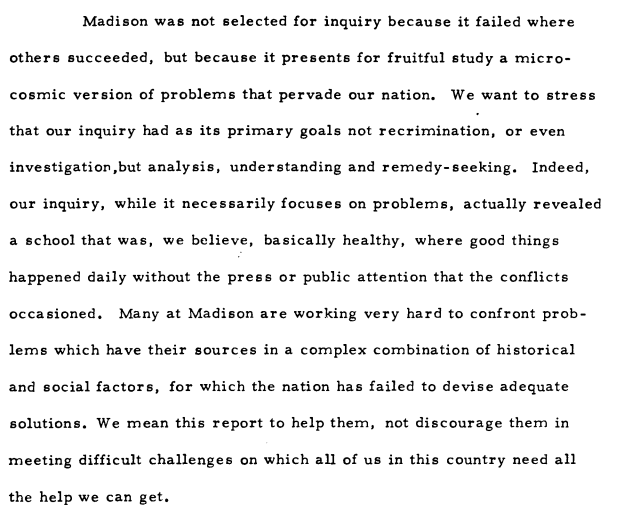
The investigation into the incident, where blacks and whites squared off several days running in a Brooklyn high school that had almost ten years of integrated coexistence by then, can be found on-line, you can read all about it here.  Within a few days 100 policemen would be called in to keep a lid on the unrest.  I got as far as the last section of the introduction (page 4) when I was stopped in my tracks by the tone of the report.   Here is one section, containing language that seems inconceivable in the age of corporate spin we now all live in:

Madison HS report

“Analysis, understanding and remedy-seeking?”  What?  What kind of idealistic jerk-off seeks that in a report on who is to blame for a riot?

“We mean this report to help them, not discourage them in meeting difficult challenges on which all of us in this country need all the help we can get.”

“Challenges on which all of us in this country

need all the help we can get.”

Challenges that more than forty years later we have all but abandoned working on, in favor of pointing fingers and fixing blame.  My father is grimacing in his grave at the abandonment of the ideals that animated this report, the creation of the Office of Intergroup Relations, his years of hard, doomed work.  

“It does make a man wonder: for what was I pelted with rotten vegetables, called a fucking kyke Commie cocksucker, cornered by snarling, red faced New York City racists who bumped me as I left the auditorium?  Why bother sending those two New York City cops with me the next time?  Why bother explaining Brown v. Board of Education to rooms full of parents and teachers who simply and unequivocally hated niggers?  And nigger was the word that foamed on every lip in those days.  Jack Roosevelt Robinson?  Nigger. No other way to put it.  We’ve come so far as a politically correct society, of course, we’re, you know, all post-racial and shit, now white people lose their jobs for hate speech for failure to refer to that magic word as the “n-word”, you know, but the condition for actual n-words on the ground, the masses of them?  They’re fucked, vilified, feared, loathed.  Thugs, yo.  Them n-words is fucking thugs, yo, you know what I’m sayin’?”

Calm down, dad.  I know what you’re saying.  You’re singing to the choir director.  The children of the poor are largely doomed.  Doomed.  There are less dramatic ways to say it, but none are as concise or accurate.  If you are born into poverty, as you know, your chances of dying an early death in poverty are incalculably greater than your chances of escaping poverty.  America, America, God shed His grace on thee.  

“You remember you had nightmares after that piece in Mad Magazine?  Wow, I just thought of that, Elie.  Mad magazine had a version of that song, illustrated with photos, and over ‘crown thy good with brotherhood’ there was a shot of a cemetery where all the grave stones had swastikas painted on them.  I think that same spread had a lynched body hanging there somewhere.   You must have been nine or ten.  It was not long after we passed the display windows along the Time and Life building at Times Square and you saw that magazine with piles of starved extermination camp inmates on the cover, you were up a few nights after that one.”  

Well, yeah, I’ve never had much love for fucking Nazis, dad.  It’s not as though they didn’t kill every member of my family on both sides except for the few who made it here to the USA, USA!   But we can chat about that another time.  I’m reading through the report of the racial tensions at James Madison– I was already out of high school by that time, and this report reads like something out of the Freedom Rides down in Alabama.

“Uppity Negroes, Elie, never satisfied with their station, you know what I’m sayin’?”    

So I get to this part– rumors fly that black high school girls are trapped by a white mob in a local luncheonette, in Brooklyn, 1973, and police are called in to stand between angry whites and angry blacks in front of the luncheonette, which was closed and empty.  And Benjamin Tucker, a black community relations officer in plain clothes, is struck by a white cop, who “mistook him for a student”.  Presumably struck the black man with a baton, probably in the head.  The report is silent on this.

“New York City, Elie, at the dawn of 1974.  I was fifty, starting to get tired.   You believe, and you fight, and even though your ideas are right, and your ideals are unshakable, you will get beaten down when nothing changes.  I think I was in NYU hospital again that winter, I don’t remember.  You wonder what the fuck any of it means, after a while.  Benjamin Tucker, I met the guy when we were at James Madison.  He was angry as hell, I remember he said to me ‘Irv, I’m on a street corner in Brooklyn, working, and I get cracked across the skull from the blind side by some fucking Bull Connor wannabe because he thinks I’m some nigger high school kid?  Crackers in Brooklyn hate niggers just as hard as those white boys down in Allybama.’  And he was right to be angry.  I had absolutely nothing to say to him, except ‘You’re right, Mr. Tucker.’  That’s what I had to give him, the respect of calling him Mister.  Nice fucking world, you know?”

OK, dad, calm down, calm down.  It is a nice fucking world, if by nice you mean infinitely fascinating.  I’m going to read the rest of this New York City Commission on Human Rights report and then go for a stroll, to think about all these nice things, and I’ll check in with you later.

“Catch you later, I’m eatin’ a pertater,” said the skeleton, sinking back into its long nap.

Basic Assumptions of Human Relations

from the report on creation of the Human Relations Unit (regarding the brainstorming sessions for NYC educators on three successive May weekends in 1967):

Finally, before they embarked on their project, the participants were given certain basic assumptions with respect to quality integrated education prepared by the Office of Integration and Human Relations.  These assumptions, which served both as a common frame of reference and as a “jumping off” point for the deliberations, follow:

1. Quality integrated education is the most desirable education for our democracy and the most realistic for our nation and world.

2. The development of good racial attitudes is important for every child, regardless of race, creed or national origin, and each school bears a major responsibility in such development, regardless of the pupil population of that school.

3. Quality integrated education is more easily achieved in a desegregated school, although with special effort many of the elements may be made to apply to segregated schools.

4. The development of academic skills must be a major goal of quality integrated education.

5. A successful program of quality integrated education requires belief in and commitment to its goals, as well as an understanding of the responsibility of the schools as one of the most important agents of our society in achieving these goals.

6. Adult fears, suspicions and disbeliefs concerning the values of quality integrated education must be met by a staff confident of these values, a program devoted to securing them, and an opportunity for adults of both races to participate in such a program.

7. Adults with an understanding of and belief in the values of quality integrated education must be reassured that the school system and staff have that same understanding and belief.

8. The search for additional avenues of desegregation must be never ending.

9. Similarly, the search for improvement in quality integrated education must be an ongoing process which is the responsibility of each and every member of the school system.

10. Our schools must exercise a major part in the leadership which inculcates in each pupil, each parent and each member of the community a sense of responsibility toward the achievement of quality integrated education.

source   pages viii-ix

Board of Education’s Office of Integration and Human Relations

Human relations was the term used to describe a desired state of harmony between different ethnic groups in America during the heyday of the Civil Rights movement of the 1960s.  It was in use in 1968, when I was twelve and my father was forty-four, when he was working at the New York City Board of Education’s Human Relations Unit.  Human relations and intergroup relations meant black students would be allowed to go to the same schools as white students, and that all reasonable steps would be taken to ensure that ancient and present anger and grudges did not interfere in the relations between these young humans or with their education.  The animating idea was that all children have potential and that it is a crime to waste that human potential.

Not to be an asshole about it, but the landmark 1954 Supreme Court decision that had finally done away with the hateful “separate but equal” doctrine in public education was already older than I was in 1968.  The Court had called for desegregation of public schools “with all deliberate speed” and, like many things the law solemnly proclaims, it amounted to a kind of mockery.  

The weasel words “with all deliberate speed”, well-meant, no doubt, but… as they say, you cannot legislate morality, and if local whites sincerely hated local blacks it would do more harm than good, perhaps, to send in troops with bayonets and defend the little Negroes from the wrath of the children of their fellow poor people who hated them.   How, in fact, could we police every playground, bathroom, elementary school cafeteria, even if we wanted to?    

A better approach, it seemed at the time, was to create groups to study the problem, issue reports, and form Human Relations programs.   New York City had a program, so did several other large cities including Los Angeles and St. Louis.   My father joined the Human Relations Unit as an experienced high school teacher with a proven talent for interacting with students, as he had for years as faculty liaison of the G.O. at Martin Van Buren High School.  The G.O. (“general organization”) was the student organization at Van Buren and my father was its faculty adviser.  He worked closely with student leaders, at least one of whom, Mike Levine, by name, called him at home regularly during dinner hours.  

Thinking about this now, my father’s move to the Board of Ed headquarters on Livingston Street in Brooklyn from the nearby high school in Queens, was his chance to make a difference in something he believed in.   He received the same teacher’s pay and benefits and commuted two or three times the distance to and from work every day, but was finally able to use his talents to do more than inspire the occasional high school social studies student.   He was returning to the front lines of tikkun olam, repairing the world, doing God’s work, fulfilling his potential to help bend the arc of history toward justice and fairness.

They did some good work in the world in those years.  Angry Italian kids, their high school turf forcibly invaded by unwanted Negro kids and Puerto Ricans, on top of the insult of the dark brown kids, literally rioted.   Cops were called to the school, the place was put on lockdown.  My father, his black hair spilling over his collar in the back, his thick sideburns showing a certain counter-cultural panache, strode into the school with a young, blonde WASP on one side, an Italian guy on the other side, a black man, a hispanic woman.  Into the vestibule of the Brooklyn shit-hole they went, getting dirty looks from the kids as they entered.

“Dass some shit,” one of the passersby would hear the black haired Jewish intellectual type say, and the tiny door would begin to come open.  

“You are free to express yourself freely here,” the big Jew would tell them.  “I’m not squeamish about language, but I am about dishonesty — I have no use for a fucking liar.  Use the words you need to express yourself, but please, out of respect for the rest of us, don’t try to feed us any bullshit, all right?  Our bullshit detectors all work very well. We have a problem at your school that can be fixed, mostly by learning that we have a lot more in common than we are led to think we do.  We are all going to fix a bunch of the problem together this weekend.  It’s going to be fine, but first we have to talk.”  

And they would talk, in sensitivity training sessions, in role playing sessions.  

“You want to know why the word ‘nigger’ is offensive, motherfucker?” the black kid would say to the leader of the Italian kids.  And my father and his trainers knew to hang back at that moment, I suspect.  This is a great moment between the leaders of the two gangs.  My father would make a note in his head, and at the proper time he’d begin.

“‘Motherfucker’ is one of the most fascinating and powerful words in our language.  Tony, you said it’s a fighting word, the last, irresistible, provocation before fists fly, which it certainly is.  Lamar gave us two or three other meanings for ‘motherfucker’.  The word is like holding lightning in your hand, if you think about it,” and they would talk about who the real motherfuckers were, and who just thought they was real motherfuckers, and soon every motherfucker in the room would be nodding their heads, some of them laughing.

 “Do you make the feeling behind a word more or less powerful when you forbid its use?”  I could hear my father asking.  “Lamar, would you prefer Tony call you a nigger or an ‘n-word’?  Any preference at all between those two?”

“Fuck no,” says Lamar, “let the nigger call me what he wants, but let him say it with love.”  And Tony bursts out laughing, he never realized what a funny motherfucker Lamar was.  The two had been implacable enemies, the most charismatic of their respective warring tribes, and now they were each seeing the other as a highly intelligent, witty young individual.  Like the Jew said, they actually did find out they had more in common than they thought.

“You know, as far as my people were concerned, and I mean the White Anglo Saxon Protestants who actually run this country,” said the blond folk singer, “Italians were niggers too.  I mean, no offense, Tony, but Italians were one tiny step above niggers, in the same category as garlic-eating Jews like Irv over here.   American history has not been pretty, in fact, in many ways it’s been very, very ugly, but going forward the future belongs to us.”

As they broke for lunch students who had never talked to each other began to chat.  The food was way better than school food, the setting, in a country campus somewhere, was a bit magical for these city kids, made them feel special.  Breaking bread, talking frankly, having adults who were not trying to micromanage and control everything, who let them talk the way they talked… these things were all good.  Friendships emerged.  The fighting at their school would stop.  For a year or two.  The friends would graduate and their little brothers and sisters would start attacking each other.

“Well, you’ve captured some of this, Elie, but you know who you really need to speak to if you want a primary source, don’t you?  You have to find and contact my man Phil Trombino.  Phil was there, he’d be sitting next to Tony as Evelyn was telling him Italians were actually niggers.  Tony would look at Phil and Phil would raise his eyebrows and nod.  ‘Ain’t dat some shit?’ Phil’s familiar expression would tell the Italian kid.  The Unit really was a great idea, until Nixon and that ventriloquist’s dummy Reagan and all the rest of them repackaged the narrative and made guys like us the problem, and, if you think about it, when have we not been the real problem?  Nixon had plenty of guys like us on his enemies list, the paranoid, drunken fuck.  Call Trombino, Elie, seriously.  This is a story that should be told, and who better to tell it than you?”

Anger Poisons Everything

Anger, unchecked, poisons everything, eventually.  My father learned this too late, hours before he died.   Unprocessed anger exerts a relentless downward force on the shape of a human life, I have seen it in action many times, felt it in my own life.  Why is a fifty year-old or seventy year-old filled with enough anger to distort their view of the world?  It would take a long time to explain, in the individual case.  You would have to know details an angry person would not be apt to reveal.  Anger, as we have seen, makes a person intractable and unwilling to compromise, let alone share.

Anger can gather slowly, building its case over many years, but once it reaches a certain point it turns a relationship irreversibly toxic.   Anger is poison.   Taking it in a small dose every day will not make you immune to its venom, it will eventually turn everything you look at irredeemably sour and then begin killing everything you once loved.

I watched the laughs my father shared with several highly intelligent friends turn to silence, watched the friends turn to ghosts who were never mentioned again.   I couldn’t know, at nine years old, what I would learn decades later– that most friendships also have a life span.   It is rare to have lifelong friends, and it takes a certain optimism and willingness to overlook faults to keep friendships alive.  

Irv had neither optimism nor a willingness to overlook faults, yet he managed to have a couple of lifelong friends, Arlene and Russ, whose friendships were only ended by their early deaths, and his surrogate son and business partner Benjie, a close and beloved friend until Irv’s own death.  We see in these relationships my father’s ability to be a good friend.

I understand now what my father was too bitter to really explain to me when I was a child.   We start off full of good will towards a person we like, and as we find things we have in common, and enjoy each other’s company, point of view, sense of humor, begin to do each other favors, we develop a friendship.  Many things can come into the picture to dampen these feelings of generosity toward one another.  The feeling that creeps in and always administers the final blow is anger.  And as we give the coup de grace to a dying friendship we always feel completely justified.  Always.

I think of our puny, vulnerable early homo sapiens ancestors, at the bottom of the food chain, on the run, terrified, enraged, banding together to survive.   You can fast forward through history to this very moment and you will find the masses of people, while individually decent and often quite loving, capable of every insanely human cruelty our terrified prey animal ancestors committed.  We are right to call these primitive emotions.  Among the earliest, for a hunted group, is the survival imperative to draw a thick, indelible line of hatred between us and another group member who betrays us in a moment of need.

I remember my father’s rage at his best friend Harold, a man with a genius IQ and an endless store of subjects for intelligent discussion, a man of great humor and jest.  Harold put a price of $75 on their friendship, humiliated my father and caused him to lie clumsily to his beloved mother-in-law, and she knew her son-in-law was lying.  My father’s hatred of Harold after that last straw was absolute.  My father would dismiss the idea of hatred, seeing it as an admission of weakness, but the effect was the same.  Harold was dead to him.

Fifty thousand years earlier it would have been a large stone down on Harold’s head, enough times to make the body stop twitching.   It is literally this way when the feeling of betrayal is upon us.   We have more civilized ways of killing, and it’s generally done symbolically, but the former friend is just as dead to us, if the betrayal is hurtful enough.

And, of course, the beauty part is that there is no arguing with a righteously angry person.  My father had to endure an excruciating series of moments when my grandmother found the Chinese furniture items Harold had fawned over and purchased for the ridiculously low price of $75.  “Why is that furniture in the attic, Irv?” asked my grandmother, clearly confused and hurt.  

My father, unused to lying outright, had to invent a clumsy cover story on the spot when Yetta, full of hurt, asked him to explain.  The truth, if simple, was unspeakable to my father in that moment:  Harold had changed his mind, my father had sullenly paid him the $75 back — after Harold’s fatal argument that he’d been cheated, somehow–  and, my father, unwilling to part with things his mother-in-law greatly loved, stored them in the attic.  She had never gone up there.  

And then one day, looking for something else, she apparently pulled the chain that lowered the folding wooden steps, climbed up and was shocked to find her beautiful things covered with dust in that filthy attic.  Harold then had to die, if he was still partially alive at that point.  It was not only that one incident, of course, the $75 price tag on their friendship was only the last straw of Harold’s vicious pettiness.  He was always a cheap fuck and now that my father hated him the old story about Harold pulling down the blinds on the classroom door and beating the shit out of Junior High School students who defied him was a lot less funny.  In fact, it was as good a snapshot as any of the arrogant, brutal piece of shit in action.

I do my best to preserve the old friendships I have left.  I cherish each one and guard it as best I can.  I call friends I haven’t heard from in a long time, I extend the benefit of the doubt to those I’ve always shared warmth and laughs with.   I have also come to understand that an emotional juncture may come and mutual harms can easily be exchanged that a friendship cannot recover from.

“After all, Elie, does it make a difference to you, on any level, if the person you considered a good friend ignores your reasonable need out of a deeply felt general obliviousness or is sending you a personalized message that your feelings are not important enough to pay attention to?” asked the skeleton.  “How effective is this defense: he didn’t act like an asshole because he meant to hurt you, that’s just the way he acts?   If he’d realized that doing what he did to you was hurtful, he’d feel terrible.  Poor baby, you dig?  No, Elie, there comes a time when you pick up a large stone and just bash their useless head in.  Done.”

“You like the ship metaphor, I’ve noticed, throw ’em over the side, let ’em wave goodbye, or give you the finger, from your wake as the sharks close in.  You know, at some point, when you see they have made your life toxic, that it’s a matter of survival.  We do what we need to do to survive.  Bukowski’s list of that swarm of trivialities that kill quicker than cancer and is always there has a line for people who insist they’re your friends.   Got to be smart about that, we don’t get many people in our lives who can become true friends.”

The larger question remains, dad.  How do you live to be eighty without dealing with a terrible temper and a lifelong sensitivity to a perceived slight? I will pick this sticky one up another time, I have to get on with other things now.  

“Go out into the world and live, my child,” said the skeleton in an ineffably wispy manner.

My Father’s Intellectual Curiosity

I had a thought about this just now, as I quickly googled “insula” to find out more about this region in the brain where nuance-banishing anger is said to reside.  My father took quickly to the computer, but he was over seventy when he ordered one for his den, and the verb “google” had not yet been coined.  He could, conceivably, have known about Alta Vista, Ask Jeeves and other earlier, more primitive search engines that were around at the dawn of Google, learned how to do boolean or real language searches, and done a bit of on-line research.  Somehow, I don’t think he did much, but it makes me wonder about his intellectual curiosity.  If an accurate and effortless to use search engine like Google had been up and running in his day, how much would he have typed into it?

I know that he read a number of periodicals and dailies on the computer screen every day.   I know he got a perverse kick out of listening to Rush Limbaugh bend the facts to whatever explosive drug-addled theory he was bloviating about on any given day.  My father was engaged with ideas and politics and saw events in a historical perspective.  He was an avid, and blazingly fast, reader of books.  I truly don’t know what he would make of this:

In each hemisphere of the mammalian brain the insular cortex (often called insula, insulary cortex or insular lobe) is a portion of the cerebral cortex folded deep within the lateral sulcus (the fissure separating the temporal lobe from the parietal and frontal lobes).

Probably not much, since he wasn’t that interested in science as a subject.  In fact, there is little of interest in the above, really, except that the cerebral cortex seems to be where much of the higher consciousness action in the human brain takes place.  

“And, of course, the frontal lobe is the one that’s poked at and destroyed during a good old pre-frontal lobotomy,” said the skeleton.  “Although, as you rightly suspect, it’s hard for me to work up much passion about the lateral sulcus.”    

Correct me if I’m wrong, but your curiosity was more about events and personalities than anything else.  

“Well, read this entire wikipedia about the insula.  And, just as it starts getting interesting you get to the debate among neuroscientists about the role the insula plays in addiction, for example.  And you see what vain assholes these scientists are, how intractably proprietary about their highly specialized areas of jealously funded expertise they are.  I get disgusted pretty quickly when I come to that kind of discussion.  So, yeah, I prefer to read about events, and mobs, and the people who whip up mobs, and the way the movement of the pendulum of history is influenced by increasingly sophisticated hucksters.”  

Fair enough, but I also remember you being fascinated by Elizabeth Kubler-Ross’s stages of grief.  You found that fascinating.  

“Well, because it’s so true.  I mean, you can feel yourself going through the stages when a loved one is slipping away.  You’re in denial, then you’re angry, then you start trying to make deals, somehow, and then you feel defeated and depressed, Death is going to win and there’s not a fucking thing you can do about it, and the cold shadow of your own inevitable death passes over you, too.  And, in the end, acceptance, because there’s nothing else you can do, you have to go on living.  It’s profoundly human, and it’s elegantly simple.”  

True.  But it’s funny that you were not fascinated by or receptive to other things, equally profound and as elementally simple.  

“OK, look, I see where you’re going with this.  All roads lead to this, don’t they?  Your father was a very bright man, interested in many things, with deeply held humanistic beliefs but with a blind spot for what was most important in life.  This blind spot made him a monster, on some fundamental level.”  

Is that not a fair summary?  

“Oh, yes, it’s fair.  But I mean, don’t you get a little embarrassed to be pushing this one theory for your whole life?  Isn’t everybody on some level a monster?”  

Uh, no, I don’t think everybody is on some level a monster.  Everybody on some level might be a little near-sighted, prejudiced toward their own needs and conclusions, hampered or disabled in some way, but a monster?  No, not everybody is a monster on some level.  

“Fine,” said the skeleton breezily, “I’m just wondering about how you’re proceeding here.  Why would anybody want to read a book about a monster?”  

Well, if this was a book about a monster, I wouldn’t be wasting my time.  Although, obviously, there’s a big market for monsters.  A good chunk of the entertainment dollar is spent indulging our fascination with monsters.  Think of the most hideous thing you can, an ex-Nazi surgeon who did research on Siamese twins, years after the war, becomes obsessed with creating human centipedes, stitching together lines of humans, ass to mouth, one long digestive system.  Three movies in the Human Centipede franchise, everybody got paid, millions saw the hideous movies, loved them.  Human motivation?  The monster scientist was a Nazi, ’nuff said, let’s get on with the monstrousness.  

“OK, so you’re giving the human side to the monster here?” asked the skeleton, with a pang.

No, your story is a tragedy, straight up.  A man of great intellectual gifts dies believing he was somehow the dumbest Jewish kid in his little town.  A man of almost limitless compassion to animals believes his infant children want to do him harm.  It wearies me to add to this list, but you get the idea.  

“A tragedy, certainly.  I can go with that.  Do you remember that little girlfriend you once had, the artist?  She wrote and illustrated that little book you must still have somewhere: The Man with the Tragic Flaw.  It was about you,” said the skeleton.  

Like father, like son, as they say.  I was just wondering, if the research had been available to you about the damage to the actual physical brain done to children who survive abuse, how interested you’d have been in it.  A kid exposed to violence as a baby has her actual DNA changed by the trauma.  You can hear this doctor describe it.  As intuitive as Kubler-Ross’s stages of grief.   Dr. Nadine Burke Harris:

“Children are especially sensitive to this repeated stress activation, because their brains and bodies are just developing. High doses of adversity not only affect brain structure and function, they affect the developing immune system, developing hormonal systems, and even the way our DNA is read and transcribed.”

(her fascinating talk is here)

“Yes, look, of course this is fascinating, and also self-evident.  I just don’t see the connection to…” the skeleton paused, “of course I see the connection.  But, I mean, aren’t you embarrassed to be playing this one note samba for all these years?”  

You know, dad, it’s a funny thing about this one note samba.  I didn’t make up the melody, of course, I learned it.  It’s ingenious, the way this one note plays against all these different harmonies.  I never tire of it, because as I learn one part another one comes up to present new challenges.  Embarrassing?  No.  I don’t have to apologize for the song that plays in my head much of the time.  Particularly since it explains so much about the world and how it really works.  

“What did Samuel Beckett say about men being bloody stupid apes?  Is that what you’re talking about?” asked the skeleton.  

Insight, man, it can take decades to gather enough of it to light a fart on fire.  Play this one note samba long enough, dad, and certain deeper truths are bound to emerge, if you remain open to them.  I had nothing to do with your conclusion, based on the laughing grunts of a pediatric quack, that you were right to believe your ten week old baby hated you and was enraged for absolutely no reason.  I just got the benefit of it, so to speak.  Had I known then, at ten weeks, that your DNA had been deformed by repeated whippings in your baby face, I’d have been less implacable, I suppose.  Even an angry baby can understand something as simple as that, you know.  

“Fine, I get what you’re saying.  Now, if you’ll excuse me, Elie, this dirt is calling me irresistibly for my mid-day nap.”


The Blue Pants

I must have agreed that the blue pants were fine when my mother picked them out in the store.  I’m sure I just wanted to get out of there at that point, I was never a big one for clothes shopping.  If the clothes are comfortable, that’s 90% of the game for me.  I must have tried the blue pants on, and they fit, and I was urging my mother to get us on the road, I didn’t want to look at shirts.

I had never worn the blue pants.   The color was a bit on the hideous side, a sort of sickly greyed out light blue, and the material too was suspect, sort of a fine burlap. They sat in a drawer while I wore the jeans I preferred, the other pants I had.    

It was springtime, I must have been ten or eleven, and my father was in the hospital in Manhattan, getting treatment for his psoriasis which had flared up.  When this happened the skin all over his body cracked and bled.  It was torture and, even with his high threshold for pain, it was impossible for him to move around while bleeding from a thousand cracks.   The enforced rest was good for him, it took the pressure off.  I don’t recall all the treatments they gave him, cortisone, sun treatments, tar baths and wrapping him in plastic were all involved, but after a few days he’d come home feeling much better.

We were going to visit him and when I came down in my worn pants my mother asked if I’d change into my blue pants.  Presumably my father would like them better than the ones I was wearing.  It would please him, for some reason, to see me in the nice blue pants.  I probably argued a bit, went and changed into the blue pants and was immediately horrified.  The waist fit, the length was OK, but these pants could not have been fashioned on a human body.  The model for these pants must have been a thin- waisted, long-legged rhinoceros.

I’d never seen anything more ridiculous, as I turned side to side in the long mirror on the bathroom door.  It was like I was wearing a bag of some kind.  The ass of the pants stuck out like a whoopie cushion.  There was a baggy section around the fly that made the pants protrude oddly in the front.  The pant legs, which were enormous at the top, tapered ridiculously as they went toward the shoes.  I simply could not bear it.  I changed back into my other pants.

“What happened to the blue pants?” my mother wanted to know when I got back downstairs.  I told her impatiently that they were unwearable and she got angry.  It was just another brutal proof of how far I’d go to show how little I loved my father.  She embellished on this theme for a while, getting more and more overwrought.  I truly don’t remember in the end which pants I wore to the hospital, but I know there was a huge fight about the blue pants.  

When we got to my father’s hospital room, on an upper floor with a magnificent view of the East River and Queens, with Brooklyn in the distance, it was as if news of my truculent stand on the blue pants had reached my father before we did.  Here was another proof, as if one more was needed, of how little the son cared for his father’s feelings.   It showed, once again, the lengths to which the boy was willing to go to demonstrate to his father how little he loved him.  

Truthfully, outside of the view, and my father’s sad reaction to my latest act of treachery,  I recall very little about the visit to that room in NYU hospital.  The incident with the blue pants would be brought up many times over the years, become a rallying cry as memorable as “Remember the Alamo” or “Lumumba Died for Freedom”.  It always stirred the patriotic feelings  of the partisans around the dinner table.  

“It’s like the blue pants,” my father would say to my mother, resting his case.

In an ironic twist, some time later my sister began to display a rare talent for tapering pants.  I don’t know where she came by this skill, it must have come from our grandmother who was an expert tailor and worked without plans of any kind.   My sister had me put on the blue pants one day, made some markings, or pinned them, and a short time later handed them back, completely wearable.  I wore them many times after that, though the damage I had done in the original battle over those pants could not, of course, ever be undone.

Anger does not compromise

Homo sapiens was a puny prey animal that, by sheer Ty Cobb-like will  and guile, became the top predator in the food chain.  Homo sapiens did not come by its heedless dominance through introspection (nobody ever does).   We organized, believed, followed ruthless leaders, waded through rivers of blood, did whatever was necessary to conquer and take what was needed.  We are not always a very nice species, I’m afraid.  Some of our traits are primitive indeed, none more primitive than our reflex to get angry.  Anger played a key role in survival, and genetic selection, and all that, but… still.

My father was angry his whole life long, uncontrollable outbursts of frustration and temper were common.  At the same time, he was very smart and something of an intellectual, weighing arguments, informing himself about all sides of a matter, speed reading the New York Times cover to cover every day, like Popeye sucking down a can of spinach.  In his retirement he spent hours daily reading any number of periodicals.  He also listened to Rush Limbaugh, who reminded him of hate-spewing 1930s radio blowhard Father Coughlin, and would chuckle sometimes observing Limbaugh’s cheerful, brazen manipulation of whatever facts he was handling.  

I wrote the other day about my father’s black and white thinking, in spite of all this time he spent weighing everything he could find.  “My way or the highway,” is most often the credo of idiots, but my father felt this way too, and was far from an idiot.  

Except in his primitive attachment to his own anger.  Anger that, without a doubt, tormented him even more than it damaged those around him.  It was a double whammy– feeling the anger in the first place, which hurts, and then shoving down the insight that your outburst has once again done damage to those you love.  So you justify your helplessness, instead of working to understand, to master the urge to rage.  And it enrages you that you are powerless to stop raging, of course, and this pours gasoline on the fire.  Succumbing to rage, of course, is often the way of the average homo sapiens.

Hard to unravel this at the moment, but these words from a recent discussion Bill Moyers had rung a bell in my head when I heard them yesterday, and fortunately Moyers always has his chats transcribed on his website:

Democracy doesn’t work if everybody’s angry at everybody, because anger literally stops us from wanting to compromise. Anger emanates primarily from the insula in the brain. And when the insula is activated, we don’t compromise. When we are anxious, which is the amygdala part of the brain, that’s okay. We can be anxious about stuff and we’ll still be willing to compromise. But when we go toward this dark anger, and a majority do, everything stops and that’s really my diagnosis of why the country is in so much trouble right now.

It also works as an explanation of why my father was so inflexible much of the time.  The insula, whatever the hell that is, once inflamed, makes a person rigid.  There’s science coming to the support of philosophical observation.  

When we are angry, says science, there is no convincing us of anything.   We rage and only those who agree that we are right to rage are welcome to comment.  I feel this way sometimes, hey, you hurt my feelings and offer a dozen reasons why I shouldn’t be hurt, I’ve got one answer.  Fuck you.  There’s only a limited range of reasonable motion possible, apparently, when the insula is activated.

This is not to say that a willingness to compromise is always a good thing or that anger is always a bad one.  Is it right to be angry about slavery, corruption, mistreatment of the vulnerable? Is it ever right to compromise with Nazis?  These are reasonable and sticky questions.  

There are others, also sticky, that are not very reasonable, and the blindness to reason may be a function of an angrily engaged insula.  Is it right not to compromise over the important matter of what it means when your son refuses to wear the blue pants for a visit to the hospital?  That may be one of those times when it is better to let the insula relax, take a few breaths, look at the matter with an eye toward soothing the anger.  A compromise aimed at making everyone in the house cut each other a little slack is hard to see as a bad thing.

The function of the anger center of the brain, and how it shuts down the impulse to see another side to things, explains a lot about one of the most vexing contradictions of my father, Irv.  It explains a lot about everyone.


Irv in Connecticut, circa 1946

My father’s father,  a quiet man named Eliyahu who lived as a silent shadow, as he lives now seventy years after his death, grew up in a dirt-floored farmhouse in Connecticut.  The farm was outside Hartford.  I recall a childhood visit to my father’s aunt and uncle on that farm, as far as I can tell.   The aunt was named Elsie, and they had at least one cow.  There was a cartoon cow in TV commercials at the time named Elsie the Cow, the adorable mascot of Borden’s, I think it was, which is why I remember Aunt Elsie’s name.  I don’t think I met her more than a couple of times, maybe twice.  Her husband might have been named Uncle Peter.

I remember that visit to the farm, which I always associate with Elsie the Cow, mostly for the moment I stood behind their actual cow and watched as the cow’s tail lifted stiffly, slightly above eye level, to reveal a puckered star shaped asshole, like a giant asterisk, actually.  To my amazement the asterisk began to get bigger and bigger.  I could not look away.  It became gigantic and I instantly saw why.  A large cow plat dropped out of it on to the ground.  It fell straight down and landed safely in front of me, followed by the same mesmerizing procedure and another.  To a boy raised far from livestock of any kind, this impressed the hell out of me and I remember it clearly more than fifty years later.  

The modest farmhouse had regular floors when we visited, but my mother had been there when the floors were still dirt.  The point is, the farmers on this farm were not the kind who lobby Congress, hire illegal immigrant hands to do the dirty work or get paid huge subsidies not to grow certain crops.   This working farm was out of a life I’d only seen in black and white photos taken by WPA photographers during the 1930s, regardless of the upgrade to the floors.  My grandfather had grown up literally dirt poor and when his step-mother clouted him, he fell on to a dirt floor.  

After my father left the army he was loathe to return to Peekskill, which is not hard to understand.  He went to live in Connecticut, where he also had family.  I suppose the fact that he had a few uncles and aunts up there made it attractive to him.  I have only the haziest knowledge of this period of his life.  It appears, doing the math, not to have been a very long period, since by 1951 he was already at Columbia, a graduate student in history, struggling with Richard Hofstadter’s ego, after completing a four year degree at Syracuse.

“He was pumping gas up in Connecticut,” Eli told me once.  “He was also pumping his landlady, this young shiksa widow he was renting a room from.  Drove his mother insane, as you can imagine.  He’d just come out of the army and he’s wasting his life pumping gas and making love to a shiksa several years older than him.  Tante Chava wasn’t having it and she sent me up there to bust it up.”  

Eli told the story like his insane aunt’s reaction was completely logical and her command to go ‘bust it up’ the most reasonable thing in the world.  

“I went up there and gave him a good talking to, you know, I straightened him out.  I told him he was wasting his life, and we packed him up and I got him the hell out of there.  He then got accepted to Syracuse and did very well there and was on his way.”  

Funny to remember my father’s still bitter words on the last night of his life — about how he and his brother were slated for trade school to prepare for the menial jobs their talents fitted them for.

I have a few old black and white photos from my father and mother’s earlier lives, preserved in a shoe box and never put into any of the dozen large albums my mother assembled of all the A-list photos, that suggest another story entirely.  The story of my father’s first romance.   The first two are here.  

The thought of unearthing and scanning the other two is a bit unnerving to me, since they are somewhere in this impossible tangle of papers, boxes, books, CD cases, clothes, drawings.  But, as they are each worth many thousands of words, and shed an important and rare light on the protagonist of this book, I will try to find them.  

In one, my father is being visited at college by this pretty, almost cartoonishly Christian-looking woman.  It suggests there was an enduring relationship between them, or at least hopes for one.  She made the long trek up to Syracuse to visit him at least once.  I assume the photo was taken in Syracuse, since I don’t recognize the building they are posed in front of as being on the Columbia campus.  

In the other photo my father is smiling with a happiness unrivaled in any photograph of him.  It is springtime in the photo, he is on a picnic blanket, struggling good naturedly with a pretty young woman.  His glasses are off, meaning he could only see a very short distance.  It is likely the young woman has just pulled them off of his head, since he was rarely without them.  A thin arm is around his neck, as though trying to choke him.  He has a pretty good grip on the slender blonde’s waist.  She, also laughing, is diagonal across the picnic blanket. 


Absolutist Values (sketches)

(sketchy, and rambling both)

There is something about being uncompromising, particularly when applied to historical figures, that seems heroic to us.   My father certainly saw it as weakness to compromise about non-negotiable things.  Backing down from a moral position was something he saw as a deep personal failing and something he could not bear.  This gave him a tendency, in spite of the keen appreciation of nuance and subtlety that was also a big part of his make-up, to be absolutist about his beliefs.  

This created a tension he could not resolve, except by clinging to his belief in the right.  On a fundamental level, he saw the choice as simple: my way or the highway.  To his credit he did come to regret this simplistic stance as he was dying.  

“Well, the world’s not really like that, Elie,” he said weakly but with conviction when I reminded him of his black and white positions throughout his life.

In the days after WWII when colonialism was collapsing and the phrase ‘self-determination’ gained currency in discussions of human rights, itself also a new concept, it was thought, by some scholarly type I read in college, that the highest form of human freedom was possessed by a man willing to die for his beliefs.  

This strikes us as a sickening idea today, when men willing to die for their beliefs are also eager to kill for them, and not only that, but kill as many innocents as they can take with them.  This is what black and white thinking leads to, somehow:  the right to live without being blown up by a fanatic confers the right to blow up anyone who might have any possible connection, or even no connection at all, to anyone who might blow people up.

This is the cul du sac that the supremely human idiocy of black and white thinking ultimately drives one into.  While fair accommodation and a willingness to compromise are key steps to improving most things, the idea of principled compromise, which actually takes greater strength than absolutist thinking,  has acquired a stink.  

I’m not referring to the kind of poisonous compromise made between slaveholders and their fellow drafters of the charter of modern human liberty, though it was probably the best the parties could agree to at the time.  I’m referring to any compromise to resolve a real-world problem in today’s climate of “political” intolerance and anger.  The compromises between loved ones, for example, struck for the sake of getting along.

The false dichotomy of either/or is almost always the way things are phrased in our winner/loser society, it often seems impossible to resist.  Boots on the ground, or drones?   This bowl of stinking shit or that one?    You’re for us or against us, you love our freedom or you hate our freedom, you see the world as it is or you see it the way you want it to be.   A genius gets to think outside the box, the rest of you morons, pick the side of the box you want to huddle in and fight it out amongst yourselves.

I recall the moment when my father tore the bonds of affection between us, using this idiotic dualistic technique.  It was at the dinner table, I must have been in high school, perhaps Junior High, when he brought up the odd either/or hypothetical:  would you rather be loved or respected?  

The senseless hypothetical hung in the air for a moment while I wondered about this arbitrary and stupid choice.  Why only one?  How could a father think one possible without the other?   I remember looking at my sister as the answer was about to come.  My father then chose the wrong one.

“I’d rather be respected,” he said, and I recall my great disappointment, even disgust.  Sacrificing love for respect did not seem a remotely respectable thing to do.  I felt the love torn once more and, as for respect, there was little question of that choice being respected.  Years later I’d see this same choice illustrated starkly, in a book I never read, by Machiavelli.

In The Prince (1513) Machiavelli describes the characteristics of a leader:  

One ought to be both feared and loved, but, as it is difficult for the two to go together, it is much safer to be feared than loved, if one of the two has to be wanting …. men have less scruple in offending one who makes himself loved than one who makes himself feared.  For love is held by chain of obligation which, men being selfish, is broken whenever it serves their purposes, but fear is maintained by dread of punishment which never fails.  Never.  

This may be good advice to a prince leading a principality during a time of war among city states, but to a father?  It is safer to be feared, and easier to gain respect, perhaps, but the fearless make themselves vulnerable, no?    Can a person who wants to be safe above all ever be respectable?

My father once exploited aspects of this fear/respect thing, and a shifty black and white dichotomy, to rob me and my girlfriend, visiting from far away, of a stolen night of blissful young romance.  I should never have let the old bastard talk to her, not that I could have stopped him, she was flattered and spellbound.  The talk went on and in the kitchen, as I watched, sickened, as he amiably took our night of love apart piece by piece.  

He charmed her as he convinced the young woman who was about to stay the night at our house, a girl I was crazy about and looking very much forward to sneaking into bed with as soon as everyone was asleep, that while his son (me) was not immoral, I was amoral, choosing to make moral stands, or not, as circumstances demanded.   From here, putting our make-out session into an arbitrary moral zone, it was a short step to steeling her to take a principled stand for chastity, which she later did, and not allow herself to be manipulated by an amoral person, like myself.  This is one of the most gratuitously asshole moves my father ever made to directly torpedo my happiness and optimism about life.

It’s hard to care very much about the abstraction of a fight, unless you have a beautiful dog in that fight that you love very much.  I had a very beautiful dog in that fight that night, and the bout went to my father, unanimously, but why was there even a fight to be fought?