Irv and Mom

The woman who gave birth to my father always called him “Sonny” just as she always whipped him in the face when he was first learning to stand.   There was a terrible distance between Irv and his mother Chava, I always got the feeling, though Chava died young a few years before I was born and so I never got to meet her.  I don’t get the sense that my father ever trusted his mother or felt very close to her.  Why would he have?

It was his mother-in-law, Yetta, who he called Mom.  My father adored Yetta and Yetta loved my father unconditionally.  In Yetta Irv found a mother’s tender love for the first time.   Beyond that, he was Yetta’s clear favorite, the number one son she’d never had, my mother being her only child.   Yetta was a dynamic, opinionated, bright and talented woman who inspired hyperbole.

“Your grandmother could make a battleship with a needle and thread,” my father rose to the heights of poetry to tell my sister and me.  Yetta had worked for a famous designer, Helena Troy, perhaps (my mother would know the name, but she’s silent on the matter now) attending fashion shows to steal the ideas of other designers, which she would smuggle out in her head, committing them to memory and making the mock-ups without patterns or, apparently, any hesitation.  She was a genius dressmaker, had been since she was a girl.

“She had a business in Vishnevetz, making clothes.  She had several women working for her, she was still a teenager,” my mother told me once.  It didn’t surprise me.

“Grandma could have been the first female president of the United States, if she’d been born here,” my mother told me from time to time.  I never gave it any credibility, Grandma was not, to my knowledge, a great reader, or a serious student of politics, or a born organizer or a party stalwart or any kind of expert in the distasteful arts all professional politicians must master.  She had strong beliefs she was deeply committed to. She was blunt, brutally honest and unable not to be.

“I know, I know,” she would say sympathetically, smiling warmly, waving her big hands after a cruel remark came out of her mouth, “the truth hurts.  I know, I know….”

That Yetta and Irv deeply loved each other there could be no question.  In fact, I’m pretty sure Yetta had a hand in choosing Irv as a husband for her rebellious daughter Evelyn.   Evelyn had been born Helen, didn’t like the name and changed it to Evelyn.  A beautiful girl, extremely bright, with a good sense of humor and a lively personality, Evelyn had numerous suitors.  Yetta locked horns with the most persistent of these suitors, a handsome, dashing, headstrong fellow named Art Metesis, a young man her daughter was madly in love with.

My mother and Art wanted to get engaged, may have already become engaged.  Yetta would not hear of it.   Like Aren and Tamarka busting up young Chava’s romance with the red haired Jewish postman, like Chava and Eli busting up young Irv’s romance with that Connecticut widow, Yetta apparently busted up the romance between her daughter and Art.

After my mother died I searched everywhere for the blue leather- bound poetry journal I remember my mother having when I was a kid.  In the very last box I found not the notebook, but a folder with about a dozen poems, most of them corny ones written for her fellow senior citizens on special occasions.  One poem was a passionate love poem I scanned and sent to my sister.  My sister blushed when she read it and said it was surely not written to our father.  It had, to the best of my knowledge, been written to Art Matesis.

Art was hot-blooded and so was Yetta, when it came down to it.  There was a horrible scene in Yetta’s kitchen on Eastburn Avenue, just off the Concourse, and nobody was backing down.  At the climax of this shouting match Art apparently crushed the glass he had been holding in his hand, in a show of superhuman strength, and left, one imagines, cursing and bleeding.  As far as I know my mother never saw Art Matesis after that.

I don’t know how long it took, but Yetta eventually convinced her daughter to go out with Stamper’s cousin Irv.  Stamper was Yetta’s good friend, Dinsche was her name, and the Stamper she married was a Communist and all around good guy.  Dinsche grew up in Truvovich and had come over on the same boat with her cousin Chava, my father’s mother.  

Chava would bring the boys on the train from Peekskill and they’d visit their cousins a few floors above my mother’s apartment.   My mother’s kitchen window looked out over the courtyard of her building, it was on the first floor.  She glared at the two hicks from Peekskill as they walked toward the front door, following behind their evil looking little religious mother.  

Yetta eventually convinced Evelyn to go out with Irv, who Yetta thought was a wonderful boy.  Evelyn eventually relented and went out with the hick, just to get Yetta off her back.  To her amazement the hick was urbane, funny, self-effacing and seemingly interested in, and informed about, everything.  They went out again and had another great time.  Yetta welcomed Irv with great shows of warmth that must indeed have warmed him.   After a short while Evelyn and Irv were going steady, then engaged and then married. They made a handsome couple on their wedding day.  My mother adored Irv, maybe more than Yetta herself did.  

My mother almost always took my father’s side and so, for the most part, did my grandmother.  There is only one incident I can recall when Yetta took my side against both of them.   I had been on crutches for a month, and my first day off crutches, on a blazingly hot Saturday, my father kicked me out of the Jewish camp he directed and made me walk a few miles up hill to the nearest restaurant to wait out the Sabbath.    

Ironic, the timing of the injury that put me on crutches.  The near severing of my left flexor hallicus longus,  the long tendon on the underside of the foot that moves the big toe, happened on Father’s Day, 1978.   The Yankees had just had their asses handed to them in Fenway Park, I’d been in the bleachers watching the Red Sox use the Yankee pitchers for batting practice, launching countless home runs over our heads.  

We were cooling off after the game in an icy pond in Wellesley.   When I put my foot down, feeling for the muddy bottom, I felt a sharp sting.  My friend almost fainted when I held my foot up, urged me not to look at it, there was blood everywhere.  He had me keep pressure on it as we rushed to a doctor.   Apparently the sting had been a slice from a razor sharp broken bottle on the bottom of the pond, the severed tendon was hanging out like a gruesome white tongue.   When the shock passed, and the pain killer wore off as the sun was coming up the next morning, I woke up in agony that must have been similar to crucifixion.  I hopped into the next room and woke my friend who dashed off to a 24 hour pharmacy and brought me more pain killers.

The doctor had warned me not to put any weight on the foot for at least a month.  “If you do,” he said, “you will never dance again, never run, never walk properly.  You will tear that flexor, which is more than 3/4 severed already, and that will be that.  If you let it heal, you will be fine.”   He didn’t have to tell me twice.  I had no intention of never again chasing down a long fly ball in the outfield of Inwood Park.

I’d been off crutches a day or two when my girlfriend’s father offered me a ride past the camp where my parents worked.  They were on their way to a bungalow a few miles away.  I hadn’t seen my parents in a while, and the plan was that the following day my girlfriend and I would spend the day at camp, where she had also gone, and head back to the city in the evening.  For some reason, a loudmouth I knew slightly also hitched a ride with us.   My girlfriend’s father dropped the two us at the camp and continued on with wife and daughter to the bungalows.  

The loudmouth immediately began braying loudly like the donkey he was, trumpeting our presence as we walked, waving his muscular arms over his head like a returning hero calling for applause.  I told him to keep the noise down, not really sure about coming into the camp on a Saturday, although we were walking, not riding in a car, which is forbidden to religious Jews on the Sabbath.   He told me to calm down, that my father was the director of the camp and that nobody was going to do anything about it.  He continued to bray and strut triumphantly.  

Word of our arrival reached my parents’ cabin before I did, and my father was already furious when I got there.  “What the hell is the fucking thought process here?” he wanted to know.  

I explained that we hadn’t driven on camp property, were obeying the laws of the Sabbath, I’d told my acquaintance to be cool but he was, apparently, incapable of it, and so forth.  My father was not having any of this.  

“You know exactly how this makes me look, and you did this deliberately,” my father said.  “I can’t have one set of rules for the camp and another set for my son.  You can’t stay here. You have to leave.”  

My mother protested, “Irv, it’s a hundred degrees outside, there’s no place for him to go within miles, he just got off crutches, can’t he just stay in the house until Shabbat is over?”  These were all reasonable  arguments, but my father was having no part of them.

“Well, good shabbas and fuck you too,” I said, leaving their little white cottage, the screen door slamming behind me.  Up the long steep hill on the rocky road, along the gravelly shoulder of the parched highway for a couple of miles.

When my grandmother found out about this, she was outraged, did not take kindly to my father’s position.  My mother tried to justify it and Yetta uttered the immortal line, in Yiddish.  “You stick to his ass like a wet house dress!” she said.  The ass being a tuchis and the wet house dress being a nassah shmatta, a wet rag.

Outside of this one incident, however, I remember no other time Yetta found fault with her beloved son-in-law Irv.
Truvovich to Vishnevitz

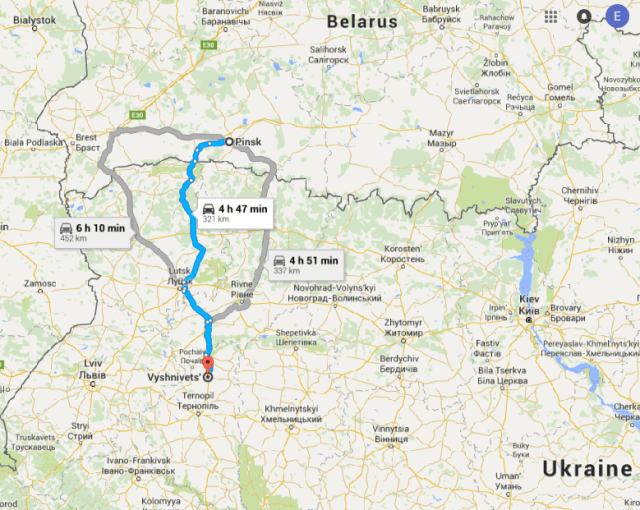
My father’s mother came from Truvovich, just across the Pina River from Pinsk, as far as I can tell.  My mother’s parents came from Vishnevetz, about 200 miles due south of Pinsk.  

Today the 321 km. can be covered by car in under five hours.  In 1922, the last time any of them where there, the trip, by horse drawn cart, would have taken about thirty-three hours on the dirt roads, assuming they followed the route of the later highway.  The horses would have had to stop every so often, so it would likely be a trip of four or five days.

In any case, it would take a well-calibrated time machine to make that trip to visit anyone in my family.

Screen shot 2016-07-08 at 8.13.54 PM

Looking for Truvovich

“I don’t know why it actually matters where it was on the world map,” said the skeleton.  “It’s gone, irretrievably, and all the people who lived there, outside of Aren and my mother, they were disappeared along with the place itself.  

“You found out the dates the Jews of Pinsk were massacred in those aktions, as the Nazis used to refer to those long days of genetic cleansing, you wrote to Azi about that.  Find the email,” said the skeleton.  

The pertinent part of the email reads:

On 4 July 1941, the Nazis occupied Pinsk. Within a few weeks they established a Judenrat and in the first week of August conducted aktions, murdering about 11,000 Jews by gunshot and burying them in mass pits. The Pinsk ghetto was established on 1 May 1942, and more than 3,600 of its some 10,000 inhabitants worked outside of the ghetto. On 29 October–1 November 1942 the ghetto was liquidated, with approximately 10,000 Jews shot to death. Less than 200 essential workers and others were herded into a “mini-ghetto” in Karlin and murdered on 23 December 1942. When the Soviets liberated Pinsk on 14 July 1944, they found 17 Jews surviving in hiding.

“So, does it make you feel better to know what happened to Chaski, Yuddle and Volbear, if they were still alive, and to any children and grandchildren they might have had?  In those years they would have all been around 60 years old, if they’d lived that long in Truvovich,” the skeleton either yawned or grimaced, it was hard to tell.  He could have been roaring too, I suppose.  

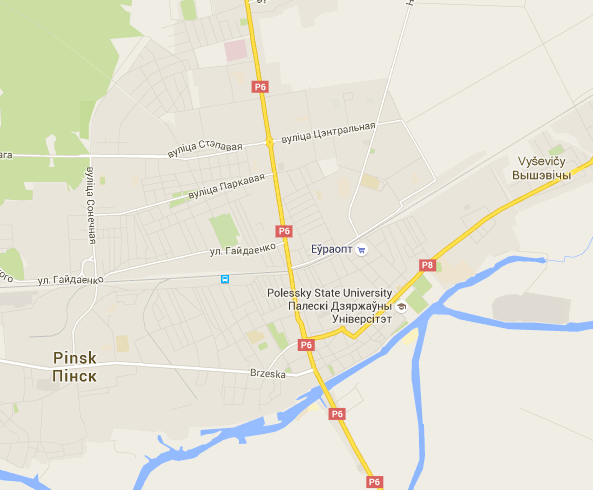
No it doesn’t make me feel better, not really.  For some weird reason knowing that Truvovich was probably on one of these three spits of land divided by the Pina River, on the southeastern border of Pinsk does make me feel a tiny bit better, though I’m sure I could not say why that is.

Screen shot 2016-07-08 at 1.32.21 PM

Preface [stab #1]

When Pat Conroy died, NPR played a piece of an interview with him that struck me.  He said that he writes to explain his life to himself.  I realized I’d been doing exactly this, in concentrated form, for a couple of months at that point, for years, in one form or another, before that.  

Conroy, a highly successful writer from a young age, with a series of valuable mentors and all the adulation and reward a writer could want, found himself paralyzed and suicidal at various times, unable to overcome the traumas of his earlier life.  His father had been an angry, brutal man.  

My suffering has been much less acute, though my father, without using his fists, hit as hard and as relentlessly as Conroy’s paternal tyrant.  Relative suffering, I believe, is largely a matter of luck.  I think Conroy must have known, as I know, that one can never fully explain this inexplicable life to oneself, coherently as one might set out parts of it for somebody else.  

I am attempting to describe the contradictory life of my father as clearly, colorfully and three-dimensionally as possible.   I hope this account will be engaging and, also, resonant and useful to others who have experienced the terrible accident of a damaged, inconsolably angry parent.   Although my father and I were adversaries for virtually his entire life, we are adversaries no more.  For his whole life he was determined never to lose, even to someone who posed no threat to him.  It was an idiotic determination, but I no longer judge him for it.  

In the end, he was grateful to have been so wrong about the possibility for human growth, something I demonstrated one last time as he struggled to make sense of things in those final hours of his life.  The tragic poignance of his life overwhelmed the anger of it, at least for me.  The lesson I take from the long struggle with my sensitive, insightful, witty, often willfully blind father is that one can overcome almost anything, given enough motivation.  His life gives me abundant motivation.

 My father’s funeral service was conducted by a gentle soul with a beautiful voice who had long been liberated from the need to earn a living.   When he left the work place for good over creative differences a former colleague observed that it’s probably easier to have artistic integrity when your wife is a millionaire.  Today, for a variety of irrelevant reasons, I am no longer in touch with the gentle volunteer cantor who so movingly read the eulogy at my father’s open grave, chanted so hauntingly.  I am confident he isn’t aware of my silence. 

My father was a very judgmental man.  For his part, he would have snorted derisively about this kind of gentle, pampered soul, seemingly buzzed on his talents, the humble servant of his artistic passions and others’ appreciation thereof.  I have to own the judgmental tendencies the old man imbued me with.  They will no doubt be on display throughout this ms.  I leave it to an able editor to one day comb through these pointed prejudices, leaving only those that advance the telling of my father’s story.

It was not long after I began writing these pages that my father’s skeleton began piping up.  Although long dead, he understood my project immediately, and though he sometimes expressed paranoia and anger, sometimes scoffed, he remained keenly interested in the project from the beginning, as one might expect the subject of a biography to be.  As often as not he was gracious and understanding, as he might have been had he been given the chance to proceed from the last conversation of his life, the first time he’d ever apologized for the harms he had inflicted.   More than once his comments or insights surprised me, even as I had apparently made the words come out of his sardonically grinning skeletal mouth.

“You are walking a tightrope, Elie,” the skeleton said. “Trying to make the reader care about a person who was in many ways a monster.  I realize the supreme difficulty of that.  The things I did to you and your sister were not normal, not healthy, were in no way defensible or excusable.  The fact that I lived to be almost eighty-one without ever apologizing for the harm I caused, or even taking responsibility for my sometimes insane actions, is enough to make most people close the book on someone like me.  

“That I was only able to ask forgiveness at the very end of my life, through the dumb luck of having a son who had done hard work to reach a place of acceptance, is pitiful. If you hadn’t been so mild that last night of my life, I’d never have been able to tell you how sorry I was.  You allowed that spark of decency in me to burn as a flame one time before I breathed my last.

“I have to give you credit for attempting this seemingly impossible work.  I don’t know exactly why you are doing it, or why start with my story, but I appreciate the fair treatment you are trying to give me.  God knows, I never treated you very fairly.  

“I know you understand, finally, what I tried to explain to you the last night of my life. The enmity I expressed toward you was truly nothing personal, as hard as that is to understand, coming from the person who is supposed to be your father.  You grasp what Arlene told you that time on the hill near her home: it wasn’t you– it was me.  You could have been any kid in the world, I would have acted the same way.  Nothing I ever did held my demons at bay for more than a moment.  You and your sister didn’t have a chance against the demons I was battling.  I give you credit for a life long struggle not to be the kind of person I was.”

Life long struggle it is.  Bon voyage and enjoy the trip.

Leah and Azriel

My father’s mother, Chava, came from the doomed Belarusian (then Polish) town of Truvovich.  More of a hamlet than a town, from what Eli told me.  As far as I can tell it was on an elbow of the Pina River just southeast of Pinsk, a short ferry ride from that Polish city.  My uncle always said the family was from Pinsk.  My father’s cousin Gene told me that Truvovich was on one tine of a three tined fork in the river, on the other two tines were Vuvich and another muddy hamlet with a similar name.

There is no trace of any of the three hamlets anywhere now. My numerous searches, and the searches of a friend in Poland and my cousin in Israel, who spent a day with the researcher from Yad Vashem, have all come up empty.  There is one further source, a large format world atlas my friend’s uncle had, printed circa 1935.  The town should be in there, now that I know where to look.

I have seen two pictures of my paternal grandfather, whose place of origin in Eastern Europe is unknown to me.  I’ve seen perhaps a half dozen photos of my grandmother, born and raised in Truvovich.  I was surprised when my uncle told me to make sure to take the two framed portrait photos of his grandparents when we were emptying his house for sale.  He was in assisted living at the time, needing the assistance because he lost the use of his legs after his stroke.  

His mother had, apparently, lugged the two almost life sized head shots, in their heavy wood and glass frames, across Poland to the port and then across the ocean and from Ellis Island to her brother’s home, then to a couple of slum dwellings on Manhattan’s lower east side, then to the house on Howard Street in Peekskill where she lived out the rest of her life.  

My uncle was a meticulous man, and though he hadn’t seen the photos in a long time (and I’d been unaware of their existence until then) he told me they were in one of three places.  I was intrigued by the existence of these portraits of my great-grandparents.  My search of the attic, basement and other likely storage place, like my search for Truvovich, turned up zip.  

As we were leaving the house for the last time something told me to look in the sunroom.  For some reason, probably related to her encroaching dementia, my aunt had locked the sunroom.   We unlocked it and went into the airless chamber.  Looking around there was really no reason to look behind the white wicker couch against one wall of the pretty much empty room.  Yet that’s where the two portraits stood, against the wall behind the couch.  I studied their ghostly images (probably captured in a photographer’s studio in Pinsk early in the twentieth century) and tried to imagine their life in that vanished little town.

Leah and Azriel Gleiberman, my father’s maternal grandparents.

image

Notes

“If this will help get you out the door today, I’m all for it,” said the skeleton.  “Not that it’s nice out there, or worth going out, or anything like that, but if you need to get going– get going I say.  You show me a man who sits around typing when he needs to get going, I’ll show you a man who sits around typing instead of getting going.”

I need to write about the terrible eating habits you taught me and my sister.  

“Well, that comes straight from my childhood of grinding poverty.  I was very proud of you, you remember, when, as a little kid, you ate ten hot dogs at that Fourth of July parade at Wading River.  That’s a pretty distorted kind of pride, if you think about it for even a few seconds.  You could write about my bad eating habits, sure, why not?  Especially if it helps you get a handle on your own poor eating habits.”

Also, you were about to ask me who the Book of Irv is really about, you or me.

“Wait, I’ll send you out the door with this one.  You are the living Book of Irv, since you’re the repository now of all that once was me.  You know more about me than anyone alive today, with the possible exception of your sister, and possibly more than anyone alive ever.  You were always a scholarly type, by that I mean you were always interested in trying to understand things most people would just have said ‘fuck it’ about.  You brood about things, turn them over in your head, study them.

“I would say, truly, the Book of Irv is about this discussion, about the importance of discussion, dialogue, a dialogue between us, between us and the reader.  A trialogue, if you like.  The central tragedy of the book is that we could always talk, even when we were in the middle of a battle, and it makes it all the more heartbreaking that instead of embracing you as a friend and comrade, as you deserved, I held you at arm’s length and cursed you as my enemy from before the time you could even talk.

“That, as much as anything, is why I truly didn’t give a shit about much as I was dying, outside of telling you how sorry I was about the whole thing.”


Perhaps I was too hard on you

I thought about a question I was asked by a once close friend right after my father died.  “Did you let him have it?” he asked, “did you tell him off for good one last time?”  

The question struck me as insane.   I answered him that my father’s death had been about him, not about me.  He was the one who was dying, I said, and I’d done what I could to make his passing easier.  I cannot imagine the difficulty of leaving this fucked up world.  

“Well, you acted like a mensch,” said the skeleton of my father, “and you helped me a lot in those last hours and I am forever grateful, if such can be said by a dead man.”

I’m wondering now if I was too hard on you, judging you so harshly all those years for telling me to suck it up and be a goddamned man, when I was eight or so, and sick to heart after learning about the murder of everyone in our family left in Europe.  

“You were not too hard on me, what I did was inexcusable.  Even if you can understand it now, more than fifty years later, it does not excuse my behavior.  You were a boy, a sensitive kid, and had just learned about the most nightmarish thing any child can learn: in this world there are gangs of laughing people who will murder whole families of people and dance over their dead bodies.  Across history, and in my lifetime, many of these gangs have been delighted to kill Jews, like our family.   What kind of world is that?  

“You go on a class trip to the United Nations and get the pep talk about a new world risen from the ashes of World War Two, a world where diplomats will now work together to keep the peace.  While they’re working together to keep the peace there are gangs of laughing people murdering huddled victims all over the globe.  At the U.N. brows are furrowed, ancient enemies debate who deserves to be avenged by mobs with crude but deadly weapons, resolutions are blocked by powerful nations.  There has been more widespread war and mass murder since Hitler than ever before.  It’s just what homo sapiens does.  When in doubt, wipe ’em out.  Put your finger anywhere on a world map, chances are pretty good there are armed gangs killing another group of people.

“But, as I mentioned the other day in connection to my mother’s life, I was terrified to think about it very much.  I was afraid to think about it at all.  I was the man in the house and I was supposed to be strong, go out and hunt and bring home the food.  I was frightened that if I opened that door to the horrors of the recent past I’d never be able to close it.”

I can understand that.  I searched for hours yesterday for any clue about the doomed little hamlet your uncle and later your mother escaped from.   Not a trace of it on the internet. How is that even possible? A settlement across the river from Pinsk, seventy years after people lived there, gone without a murmur? Of the tens of thousands of Jews who lived in Pinsk we have the grim statistics, the dates on which the “aktions” took place, how many were killed, etc. We presume they marched your mother’s family off to be shot with the rest of the Jews in the area, took a giant rake and raked the muddy little hamlet into the nearby swamp.

“Well, you see, that’s what I couldn’t consider.   I never met my Uncle Yudel, Aunt Chaska, Uncle Volbear. Only Yudel ever made it to the United States. Aren sent for him at one point, then Yudel got sick. ‘America is no place for a sick man,’ Aren told him, ‘here you have to work’, and he sent him back to Truvovich where he eventually met the fate of everyone else back there. Yudel came to America and was sent back before I was born. I never even heard the story until Eli told it to you.

“I don’t know whether it’s a blessing or a curse for you, and you probably don’t either, having an endless hunger for these kinds of details. You seem to have an ability to probe into these things without screaming. That, coupled with too much time to probe…. I literally can’t imagine the torment of that. I always worked two jobs; when I wasn’t working, I was exhausted. When I had a little energy I’d read the Times cover to cover, listen to the news, read one of the many left wing publications that were published back then. Then, thank God, it was time for me to go to work.

“Whatever I may have thought of the fate of my aunt and uncles, of my grandparents (who were probably long dead before the local anti-Semites got a crack at them), of the earlier life of my mother, it was like the twitch of a horse’s ear.   I’d flick away the thought like a horse flicking away a black fly. Really, what is the point of imagining such painful things?   Better to work.”

Arbeit Macht Frei, baby. You know, I understand that this is the way of the world.

“If I may cut you off, you are working right now as you tap out these words. You have always worked, you just don’t get paid most of the time, or you’re paid pennies on the dollar. You work in silence and your work is greeted with queasy, confused silence. I don’t know how you do it. Nobody who thinks about it for a minute knows how the hell you do it, or why you do it. I’m not looking for your explanation, I’m just sayin’” said the skeleton.  

Fair enough. Not everybody has the stomach for what I do. I don’t seem to have a choice, it’s what I was designed to do.   Part of it is being kept in the dark about the most compelling parts of the story. I have to fucking know. Knowing won’t give me much, I know that too. But I have to know everything I can.

“You poor, poor bastard. And I did this to you,” said the skeleton.

Well, don’t be too hard on yourself. You couldn’t consider the things I am working with, they would have reduced you to sobbing helplessness. You leave all that to your over-sensitive little son, it’s fine.   I got it. I will always have it.

Dreadedness

My father’s most formidable armor was dreadedness.   He would get an implacable expression on his face to show he was ready for your worst.  The look was very much like Clint Eastwood’s iconic expression of hatred and superiority.  I suspect you could have shown a photograph of my father’s face at such times to a native of any culture in the world and they would have said, in their language, “dreaded aspect”.   That fearsome aspect, perversely, invited the attack he was now grimly prepared for.   Bring on your worst, lay on MacDuff, let’s see what you think you got, punk.  

My sister reported once getting a telephone message from our father and that his voice alone perfectly conveyed his dreaded aspect.  “From the first word I began to cringe and after a few seconds I wanted to rip my eardrums out just to make it stop… it was…” and as words to convey her horror failed her, she pantomimed how horrible it was, gesturing around her ears with an agonized expression on her face to show how desperately she wanted the relentless, dreaded voice to stop.  

That he was not always like this should be clear by now.  He was also funny, smart and capable of great kindness and sensitivity.  He was not only the monster that is easy to sum up as the D.U., the Dreaded Unit.  It’s just that if you see this expression on a parent’s face, and their readiness to angrily back it up, it’s impossible to forget.  You know this persona is waiting, ready to loom and do battle at any time.  

Did he show this dreadedness daily, weekly?  I really couldn’t say, more than weekly, possibly less than daily.  The fact is, he showed us this hard face often enough that we both know it very well and to this day are sensitive to the nuances of this dreaded aspect whenever we glimpse it in the world.

The thing that’s impossible to understand as a child is that this super tough pose that says “I am ready to, and capable of, smashing your face without lifting a fist” is not something a human really chooses to assume, especially with their own children.  It is a reaction related to the fight or flight reflex.  It comes about not out of toughness as much as from fear and anger.  

The anger was somewhat understandable, the fear behind it much more subtle and impossible for a child to get a glimpse of in any case.  I didn’t get any insight into the fear until I was close to forty years old.  

Eli, during one of my regular visits to his tidy one bedroom cottage in Mount Kisco, NY, revealed the main source of my father’s terror, anger and combativeness.  He revealed it reluctantly, an eye witness who had mulled over the decision to testify for decades, who stepped forward to give crucial information during the final moments of the long sentencing phase.  At this point he and I had discussed many other matters, this revelation was clearly not one he was anxious to make.

“Listen,” he had told me in his gruff voice when we began recording some of the sessions, “these things I’m telling you are for you, for whatever use you can make of them in your own life, and for your sister, nobody else.  I’m telling you these stories to help explain some difficult things that are impossible to understand, so you can start to make sense of some of these complicated, insane, twisted stories, the sometimes cock-eyed, convoluted and unexplainable behavior of certain members of our family.”  

He could see I understood this and then, because I was writing all the time, he added  “these are not stories you should write about, in any form, until everybody in them is dead.  People would be hurt by many of the things I’m telling you, even if you think you are presenting them very objectively and with perfect fairness, or even if you think you’re fictionalizing them.  The people you write about will know it’s them, and they’ll be hurt, and they won’t forgive you.  I’m telling you these personal details to explain impossible things for you.  When everybody is dead, the stories I’m telling you are your’s to do with what you like.  While we’re alive, not a word.  You understand?”

I did, even as the piece I wrote about him immediately after he died was a tissue of pure bullshit.  I was in the process of completing work for a Masters in “creative writing”, which the New York authorities had deemed functionally related to teaching third graders and which put me on a slightly higher pay level with my Common Branches teaching license.  I’d included an Eli character in my thesis, my adviser had told me the dynamic character deserved his own book and convinced me to remove the character from the narrative that became my thesis.  I wrote a fictionalized short story about him instead.

In trying to weave reality into fiction, and explain the sort of lovable rogue Eli was, I made up a completely implausible story involving Eli, his millionaire half-brother’s yacht (Dave never had a boat that I know of) and a semi-drunken sexual escapade with his half-brother’s beautiful young Brazilian wife, conducted on deck, under a tarp, while the cuckold slept in one of the cabins beneath them.  It was an absurd story in just about every way, and conveyed almost nothing of Eli, certainly nothing of his character.  There was barely a whiff of psychological truth in it.

I was idiotic enough to mention the short story to Eli’s oldest daughter at the funeral and even stupider to mail her a copy when she told me she’d love to read it. After all, I was a cousin who had befriended her difficult father and had known him well, spoken of him with great nuance and love at the funeral.  She hoped that whatever I’d written might give her an insight or two into her own supremely problematic dad, now that he was gone.  She had no reason to suspect that in the piece I’d mentioned to her I’d been not only an unreliable narrator, but a deliberately and artlessly lying one.  

I described an invented confession of an unspeakable betrayal that had never happened.  I added, in my hubris, ‘he reported this to me with a deep regret that demonstrated, beyond any doubt, the truth of his story”.  The truth of the story I had completely invented, a story that never could have happened.  Eli was a rogue, but not that kind at all.  What an asshole move on my part it was writing the story and then sending it to Eli’s daughter.

 The deep regret with which he described this illuminating event in my father’s early childhood left me no doubt that he was revealing something painfully true that he had witnessed more than once.  

For some reason I picture the room very clearly, although it’s a room I’ve never seen, a room that was never described to me.  I see an austere room with a high ceiling and dark wood all around.   There are dust motes drifting in the slanting shaft of late summer afternoon light coming through the one narrow window.  The room is virtually airless.  It is a room from a nightmare of poverty, fear and violence.   My tiny, red-haired grandmother is seated at the head of the table, at a seat Eli described as her seat.  She always sat there, the way we always sat in the same seats around our family dinner table.  Next to her seat was a drawer.  In that drawer she kept the heavy, canvas wrapped cord for her iron.  

Eli paused to make sure I remembered what these heavy, rough cords were like.  I did, I’d seen a couple during my early childhood, from before the age of ready plastic and rubber for insulation of electrical wires.  These frayed, abrasive cords were much thicker and far less flexible than a modern day power cord.  They were round, not flat as most power cords are today.  They contained numerous heavy wires and the insulation was a series of wrappings, the outermost being a kind of rough burlap.

From the time my father could stand, any time he did anything that displeased his tiny, religious mother, a woman who as far as I can tell led an unhappy life of limitless frustration, she would yank open that drawer.  Her little hand would grab the rough, heavy cord and she’d swing it violently into the young boy’s face.

“In his face?” I asked Eli.

He nodded with infinite sorrow.  There was a pause as we looked at each other.  Then he said “after a while, all she had to do was rattle that drawer and he’d….” and the eighty-five year-old popped out of his chair and stood straight up, quivering in fear, eyes cast to the ground.

A light went on in the universe when I heard that story. Things I had no chance to understand suddenly came closer to my grasp.  I was flooded with empathy for my little father.  Imagine being a one year-old, a two year-old, and being whipped in the face by your own mother?  

“My mother, may she rest in peace,” he always began any story about her.  There were almost no stories about her.

ii

We had dinner the other night with my father’s first cousin, Azi, and his wife Sue.  It was a wonderful time.  We had a few great laughs and Azi, who greatly resembles my father, although a much more easy-going version, reminded me of him uncannily when he cracked up laughing.  My father could be reduced to helpless hysterics when he found something hilarious.  My sister and I suffer this same helplessness at times, when something is truly too funny to be able to stop laughing about.   Azi didn’t fall into this state, but we had a couple of good long laughs during our leisurely dinner.  

I mentioned the manuscript I am working on, this Book of Irv that is now about 450 pages long.  I described how, about 100 pages in, my father’s skeleton suddenly started piping up.  I told them I’d thought it was a bit of stagey device at first, these conversations with a dead man, but soon found myself looking forward to the daily talks with the skeleton, conversations that often surprised me.  Yes, these were talks I wish we’d had when he was alive, but these written ones were the next best thing.  I told Azi I woke up every day looking forward to talking with the skeleton, hearing what he had to say.  

He smiled and later asked me if I’d put any of the pages on line.  He seemed very happy that I had.   I told him I’d send him the link or he could google bookofirv, one word, and it should pop right up.  The following afternoon I sent him a link to the intro, along with a few follow-ups to our chat during dinner the night before.  I included two names of siblings of our grandparents’, Yuddle and Chashki, that I hadn’t found in his on-line family tree.  I expressed my surprise to learn, from his family tree, that my father, like him, had been named after Azriel, my father’s grandfather and Azi’s great grandfather.  I told him how much we had enjoyed the chance to have dinner with them.

What follows is likely the paranoia of a child over-sensitized to signs of dreadedness and reasons for dread.  Or, maybe not.

Late last night I googled bookofirv and, to my dismay, it popped up right above a link to gratutiousblahg with its catchy, pugnacious description:  warning: gratuitous fucking f-word and passive voice use, and another one called Fucking Moods.  I then clicked on Book of Irv and found, to my surprise, that it had been visited seven times that day, by one reader, in the United States.  This struck me because the site is generally visited by zero visitors on any given day.

The intro I’d sent him the link to had not been visited directly, which is indicated in the WordPress statistics when a link to a particular page is clicked on.  I assume it must have been Azi reading through the entries, looking at the photos, before my email reached him.  It may all be pure coincidence.  It’s possible Azi may not even have regular access to a computer during his visit to the States.

Or, it’s also possible, says the son of the Dreaded Unit, that the expression Azi had in a couple of the photos we posed for after dinner– probably a completely inadvertent micro-expression like the ones we often have in photos we are not ready for– the only glimmer I’ve ever seen on his face of my father’s dreaded aspect– and my sister was struck by this glimpse too, was a grim foreshadowing of his reaction to my emerging portrait of his beloved first cousin.  

As the last family member alive, outside of my sister and me, he may well have been offended by references to Tamarka, his grandmother, after all, a woman he undoubtedly loved, described in only the unflattering context I knew her from. Mentioning my father’s surprising lifelong bitterness toward Azi’s mother might have hurt him too. 

“What did I tell you, schmuck, about writing these things about people who are still alive?” I can hear the angry voice of Eli rasp.  “Even if everyone else is no longer alive, this guy is the son and grandson of the woman your father had little good to say about.  You both took my side against his mother?  Really?  She moved to Israel when you were a kid, how much contact did you have with her?  Asshole, do you think before you do things, even at sixty goddamned years old?”

“Eli,” called the skeleton at the top of the hill to his cousin in his grave below, “you’re a fine one to call somebody else an asshole, having been, not exactly, shall we say, a model of discretion during your long battle of a life.”

“You’re only talking that way, Bub, because you know I can’t come up that hill and kick your goddamned ass,” said the skeleton of my father’s first cousin.  “And because you know how much I love you, which would not, by the way, prevent me from knocking the shit out of you, if I could somehow get up there, which, unfortunately for me and lucky for you, I can’t.”

The Democracy Game Show

“You’ve lived long enough now to have observed a few things about democracy,” said the skeleton, squinting against the sunlight that was flooding his hilltop in Cortlandt, New York, brilliantly illuminating his tombstone.  “As Winston Churchill quipped, between stiff drinks, democracy is the worst system of government in the world, except for all the others.  Quite the wag, that Winnie.  On this sunny Sunday, why not discuss the nature of our exceptional American democracy a little?”

Sure thing.  As I learned from you, satire is often all we have.  

“Well, it’s a pretty poor substitute for power, I’ll grant you that, but I’ll take a nice pointy skewer from Lenny Bruce or Richard Pryor over even the most eloquent speech by your brilliant orator friend Mr. Obama.  We’ll get back to your post-racial president later, I suspect, but first allow me a general observation about democracy.

“Your friend Thomas Jefferson, the refined renaissance man who never dignified the pernicious rumors of his thirty year miscegenation with a beautiful, light-skinned piece of his property, spoke of raking the educable few from the rubbish,” the skeleton gave a small chuckle.

“I was, it turned out, one of those educable few, so was my brother.  Look, they raked me out of the rubbish, via the GI bill, et, voila!   If I’d had more of an ability to smile as I was fed shit I might have become a college professor.  It’s the wrong way to see it, of course, smiling as I’m fed shit.  It would have been better to have just seen it as paying dues, but we only pay the dues we can afford to pay, as you yourself know very well.”  

No argument here, dad.  I’ve always lived on a very tight budget for dues paying.

“So you have an American genius like Jefferson, with his hundreds of inherited slaves and I believe thousands of acres of inherited land, surveyed by his father and his father-in-law, and later by him and registered as his property.  And you have masses of people in the colonies who don’t have jack shit, as they used to say.  There could never be enough seats in the newly created University of Virginia for all these folks, and most of them, frankly, wouldn’t know a book from a block.  Although, for the rabble they were, the masses of Americans were surprisingly literate back then.  

“So, really, there was a pretty sizable pile of educable material in that heap of rubbish that could have been raked, but what are you going to do with masses of highly educated poor people anyway?   Once you’ve read all the great works of literature, philosophy and history, acquired the habits of critical thinking,  you’re not going to be content working as a brute all day and drinking grog all night.   How do we preserve life, liberty and property (forget the ‘pursuit of happiness’, you know what I’m saying?) for those who have it while making sure the brutes don’t rise up and grab any of ours for themselves?  Give them beautiful platitudes and keep them as ignorant as possible.

“We create a nation everyone can take pride in, dedicated to the proposition that all men are created equal and endowed by their Creator with certain unalienable rights.   We create a government of, by and for the People.  In civics you learn that the will of the People is carried out by elected representatives on the local and federal level.  And blah, blah, blah.  But of course, you remember when I convinced you to enroll as a Democrat, because the only meaningful vote you’ll ever get is in the party primary?  Well, that was the last of my idealism talking.  How many meaningful primaries have you voted in?  You got to vote for Bernie Sanders this time.  Did it feel great?  I hope so.

“Anyway, let’s cut to the chase– what does it take to have capable elected officials working intelligently to solve difficult problems, making meaningful compromises to advance social progress, protect the environment, ensure domestic tranquility?   Educated, critical thinking voters evaluating the candidates based on what they actually believe in and what they have proven they can do. How often does that happen, Elie?   We are given the choice at election time between two shrewdly marketed brands already in debt to the people who put up billions to brand and market them, or more succinctly, as Lewis Black put it so memorably, two bowls of shit.

“Even our best presidents have been custodians of the status quo, protectors of privilege, it’s built into our two party system.  Take FDR, a class traitor and great president by almost anyone’s assessment.  His New Deal, while radical and a great improvement over what existed before in our Darwinian democracy, was largely put into place to prevent a Communist uprising here.  People were sick, tired, depressed, angry, organizing, ready to smash something.  Super-rich speculators had sucked the country dry as they have been doing from the day they arrived here in the land of opportunity. Sure, some of them had jumped from sky scrapers when they lost fortunes, but those were only the weak ones.  The stronger ones figured out how to remain rich. The rest of us?

“You read Harold Lasswell’s description of how, from the beginning, mass media has been used to sell things to the American public by manipulation.  Newspaper guys like Hearst sold war, and then when the great progressive Woodrow Wilson found it advantageous to take America into the World War he turned things over to George Creel, the advertising genius.  And Creel’s Commission tirelessly turned the tide in a very short time– an isolationist nation was lining up to fight the fucking Hun who was chopping the arms off kids in Belgium.  

“None of it ever happened, of course, the atrocities that were widely reported, but the truth cannot be allowed to stand in the way of greater truth, which in that case was to get America into that great war before it ended.  We were about to fight a war to end war, a war to make the world safe for democracy, or safe from democracy, or whatever the hell you want it to be– it will be the greatest, most glorious, most exciting war ever!  

“Until you get over there, of course, and it’s a filthy slaughterhouse worse than the battlefields of our Civil War — a war like all American wars, including the Revolutionary War, that the wealthy could literally buy their way out of serving in.  The piles of excrement next to the stinking trenches were as tall as mountains.  A hundred years later nobody has a very good explanation for why there was a world war in the first place, except that the greediest in every civilized nation were intent on exploiting the uncivilized nations without interference from every other civilized nation.  That and the billions the U.S. had loaned to Britain and France, money that would have been lost if Germany won the war. 

“Your democratic voters, if they had the true picture, would never have sent their children to be butchered in such a meaningless war.  Advertising and propaganda to the rescue.  Hitler was on the losing side in the war to end war and he was no happier about being a loser than most losers are about it.  To his accursed credit, he learned a key lesson from unscrupulous Allied propaganda in the World War, which had succeeded gloriously where more truthful, honor-bound German propaganda had not.  You read that section of Mein Kampf, where he wipes the rabies slaver off his lips and writes about how gloriously effective the lies of the Allies were.  

“Photo of a pile of dead bodies outside a Brussels hospital?  They died of disease, sadly, but why not put those corpses to good use with a nice inflammatory caption?   Slaughtered by the Hun!  Poisoned because they were witnesses to the Kaiser’s blood thirsty men’s butchery of the Belgian children.  The lies were better, the Allies found, if there was a certain internal consistency to them.  What did Lasswell say?  ‘hacking and gouging were leitmotifs in the war to the East’?   Pure bullshit calculated to enflame rage, and Hitler admired it greatly, would put the lesson to great use.  Make people hate, and fear, and they’ll do whatever you tell them needs to be done.

“That was one reason there was so much skepticism here about the rumors of the death camps once Hitler got things back up to speed in Germany.  Americans had heard the brutal lies before, the human skin lampshade story had already been used in the World War chapter one.  Fool me twice, what did Dubya say about that?”  the skeleton paused to watch a car raise a cloud of dust coming down the dirt road into the cemetery.  

“Oh, my,” said the skeleton, “we have guests!”

I don’t recall you going on this way when you were alive, to be perfectly honest about it.  

“Well, shit, I would have, Elie, but, if you recall, we were kind of lifelong adversaries.  We agreed about most things, you understand, but the one thing I could not abide was the existential threat you always posed, or that I thought you always posed.”  

You do realize how insane that sounds, don’t you?  

“Yes, of course, as I was dying it became crystal clear to me how insane that was,” said the skeleton.  

It looks like those guests are coming to visit Benny Peritsky, dad, so you can continue your remarks on American democracy.

“Well, let me sum up then.  The most essential thing for an effective representative government is an informed, intelligent, critically thinking electorate.  Free public education is supposed to educate our future voters in how to think and evaluate.  You can judge for yourself how well that’s working out for you.  Freedom of the press is supposed to ensure that the voters are well-informed.  Of course, the press, in all its modern mass media forms, is mainly interested in the bottom line, profit.  People tune in to what scares and outrages them, and to what titillates them.  That’s it, you know, if it bleeds it leads.  The details about an innovative environmental idea that can save tens of thousands, or even millions, of lives in rural areas every year?   Show us the slow-motion sequence of that maniac mowing down gay dancers in that Orlando nightclub again.  Holy shit!  Did you see that?  He took a pledge to ISIS right before he started shooting.  Holy fuck!  They’re coming to kill us!”

Indeed they are, pop.  And that’s one reason I am so grateful to have a president who runs the most transparent administration in history and works closely with the press to make sure the American public always has the truth on every vital issue.  

“Except when he’s threatening whistleblowers with the death penalty under Wilson’s 1917 Espionage Act, of course, or keeping top secret the number of children in Yemen and everywhere else his drones are killing and maiming every time he signs off on his secret kill lists,” said the skeleton.

Jesus Christ, dad, do you still hate our freedom so much?

Religion, the opiate, meant little to Irv at the end

Irv was raised by a very religious mother.  I have no idea if his father was religious, his father’s wishes never seemed to come into play.  The home my father and his little brother grew up in was ruled by the strict orthodox laws of Judaism, in their most brutal and austere form.  The family was kosher, and regulars at the little synagogue at the narrow, church-like, white painted First Hebrew Congregation of Peekskill where the father swept the floors for a few copeks a week.   The poor mother, who could often not feed her family, insisted on giving charity every week, which she paid out from the coins in her little Tzedakah (“justice” “mercy” “good deed” “fairness” “piety” “alms” or “charity”) box.  

The synagogue sent Jewish transients to their house to board there overnight, as a way of generating a little income for the poor family.  These were Jewish hobos who traveled looking for work during the Depression.  Apparently many were drunks and they’d piss out the windows or literally throw their shit around like drunken chimpanzees.  When they caused too much of a ruckus Irv’s mother would scream for him to run and get Eli, who lived nearby.  Eli would come over and bodily throw these bums out in the street, administer an enraged warning or a thrashing, depending on the needs of the situation.  

In the army corporal Israel (his name was actually Azrael, but the army didn’t make such distinctions) remained as kosher as it was possible to be as a grunt.  He lived on side dishes during meals when they served pork.  As an adult he kept more or less kosher, although not strictly so, by any means.  He ate Chinese food, for example, but always beef or chicken.   He didn’t stop his wife from frying up some bacon for the kids whenever she liked, though he was never tempted to taste it.  “I’m so hungry, I could eat pork!” was one of his stock phrases.  He never did, until, one night, and to my great disappointment, somehow, he tasted a little Szechuan pork and found it delicious (which it was).  He never tasted it again, to my knowledge.

He explained the laws of Kashrut (“kosherness”) to my sister and me in a memorable way.  He summed them up as laws of mercifulness.  It was exceedingly cruel to boil an animal in its mother’s milk; this was the reason Jews didn’t eat diary and meat together.  Kashrut insisted that animals must be slaughtered as painlessly as possible, he explained.  Though years later I’d see a chicken slaughtered in this manner by a farmer in Israel  and the way it ran, without its head, plowing the dirt with its neck, did not make it look like a very painless way for a living bird to become a delicious chicken dinner.

As a boy Irv was taken to the small shul regularly and no doubt endured the endless services there, rising, being seated, rising, being seated, rising.  I can picture his mother looking on from the women’s section of that sexually segregated congregation, boring a hole in the side of her son’s neck with her stern gaze.  I imagine the services in that tiny synagogue must have been as dry and stultifying as some of the worst services I’ve endured over the years.  My father’s religious upbringing was devoid of joy, as mine would be, to the extent I endured my Hebrew School days.  

He never tried to impose his religious views on his wife.  She was a proudly secular Jew and had no use for the superstitious rituals of the orthodox.  It went beyond that, really, she couldn’t refrain from colorfully expressing her complete disdain for their ignorant ideas, rigid ritualism, small-minded prejudice, and mostly, to her, their mind-numbing, self-righteous stupidity.    

My mother came by these views honestly.  She got the beginnings of them from her mother, who had fallen under the spell of the Marxists who came to the Ukraine right after the revolution and established a Jewish Youth Group for the Jews of the Vishnivetz area, spreading the message of cooperation, universal brotherhood with fellow workers and hope for a much better future in a world justly ruled by workers.  Of course, this movement lasted only a short time.  Within a few years all of the Jewish fellow workers in Vishnevitz would be slaughtered by their Ukrainian fellow workers, at the urging of their fellow workers from Germany.

My father, to his credit, never challenged my mother on any of this.  Partly, I suppose, because he agreed with most of it.  For her part, my mother never gave him any grief for going to synagogue on the High Holidays, though it was understood that she wouldn’t be caught dead rising and being seated hypocritically during the endless proceedings.  My mother also participated robustly in the Passover seders every year, usually as the host and chef for two large gatherings.  The story of the exodus from slavery to freedom was meaningful to her, even if all the rituals and prayers were a little tiring.  

The moral and ethical essence of every religion is how mercifully its adherents apply the mostly merciful teachings of their holy books.  The good of all faiths share a similar worldview, it has often been noted.  Their god teaches them to love justice and mercy and to help others as much as they can.  Their teachings command them to overcome their worst impulses, exercise restraint and strive to be better people.  There are many religious people who are wonderfully compassionate examples of a higher spiritual awareness.  

Other deeply religious individuals take time out from other good works to put non-believers to the sword, excommunicate them, burn them as heretics, torture them, disembowel pregnant heretics and send their unborn children to hell with them.  These murderers always believe they are doing God’s will, as insane as it indisputably is, for example, for followers of Jesus, the Prince of Peace, to kill each other over the language the other Christian sect chooses to pray to their mutual Messiah in.  

Jesus, I always imagine, is weeping in heaven over the behavior of the more insane of his followers and the trillion dollar church industries claiming to carry out his merciful teachings while endorsing many forms of human cruelty.   It’s unfair to judge all religious people on their sometimes rabid leaders or on the acts of a few million of them over the centuries, perhaps, but– hell, life’s unfair.

“Well, as President Kennedy said, ‘life’s unfair,'” my father used to say.

Dig it.  Whatever else you can say about the incomparable adventure that is life, it is unfair.  The most important ingredient of a religious life, or any life, for that matter, it seems to me,  is love.  Without love you get the Crusades, violent Jihad, the Hundred Years War, the Thirty Years war, etc.   I can hear my mother snarling about the murderously self-righteous of all religions, ignorant fuckers happy to kill to prove how all-merciful their imaginary  God is.

My father shed most of the trappings of his religious upbringing over the years.  By the time he was in the hospital, waiting to die, he expressed no religious feeling at all.  I asked him, that last night of his life, if he wanted me to say kaddish for him after he died.  He shrugged, told me it meant nothing to him one way or another if I chanted the mourners’ prayer of praise to God (in Aramaic, a language nobody alive understands) for thirty days after his death, or for a year, as the orthodox do.  He assured me he really didn’t give a shit about kaddish, or any other religious matters.  I believed him.  

The following story illustrates the depth of my father’s final belief about religion as well as any story I can think of.

While he was becoming increasingly bitter and pessimistic during the last years of his life, he came to more and more regret the lack of intimacy with those he loved, as he sadly reported from his death bed.  He explained that he had never seen affection shared in the home he grew up in. “I had no idea how it was even done,” he croaked.   He was always affectionate to animals, playful with young children he encountered.

 “He always loved small kids and little dogs, probably because they posed no threat to him,” my sister once observed, astutely.

As often happens in life, my parents found an inventive way to find the love and intimacy that was so hard for them to achieve with their own loved ones.   Interacting with strangers, being loved unconditionally and showing the children of these strangers unconditional love, was a blessing they shared with a young couple who had repudiated their own parents when they were born again into fellowship with Jesus.

My parents had been volunteering to help teach reading for the first grade class of the teacher who had taught both of their grandchildren.   They had both been impressed by this dedicated teacher’s kindness, and the way she instilled care and cooperation in her young students.  They went to read books to the children in the years after their grandchildren attended her class. They also helped the children crack the code of reading, working with them one on one or in small groups.

“She’s a lovely woman,” my mother told me once, “and she has created a very kind atmosphere in the classroom.  The kids really treat each other remarkably well and I have to credit that to her.”  I could tell there was a punchline to this compliment on the way.

“But I have to say, in terms of teaching the children math, and reading, or anything, really, besides how to treat each other– which I’ll grant you is also very important– she seems to be a moron.”  And she described with illustrations the parochial stupidity of this very kind woman.  

“Plus,” said my mother, laying down the trump card, “she’s a born again Christian.”

My father was uncharacteristically subdued in the face of this opinion.  He basically agreed, but to him, it seemed, the social development piece was more important than the lack of skills this experienced teacher imparted.  

In any case, at some point they met the parents of one of the more learning challenged kids.  My mother had told me about this kid she was working with, beautiful, and very sweet, but seemingly incapable of grasping anything when it came to reading.  The letters of the alphabet seemed to mystify this little sweetie completely.  To my surprise, my parents soon became close friends with the parents of this young born again Christian girl, often visiting them at their home. 

They were very loving to the young girl from school and her younger siblings, bringing them presents, spending a lot of time with them.  My sister contrasted this to their less effusive relationship with her children, their only grandkids.  Another of those surrogate situations, clearly, trying to get right with strangers what was difficult or impossible to accomplish with actual loved ones.  I heard some stories about this young born-again couple over the last few years of my father’s life.  

For one thing, the couple did not talk to their own parents.  Their parents and they had disowned each other, they were no longer in contact.  Their parents, clearly, were determined to go to hell, and there was nothing the young couple could do about that.  The time they spent with my parents was clearly cherished by them, they always made my parents feel at home, and treasured.  My mother chuckled over what a good-natured imbecile the husband was.

“They were arguing with us once about evolution.  You know, born-agains believe that humans and dinosaurs lived together 6,000 years ago, when God created the Garden of Eden.  I was laying out the theory of evolution, and the time frame, the millions of years over which all these changes took place, all the scientific evidence and Lisa kept shrugging it off as secular humanist propaganda.  When God is on your side, you know, the sky’s the limit in what you can believe and God will provide the facts, if facts are even needed in a life of blind faith.  So Lisa is making these ridiculous arguments and she calls on Hector, who was in the kitchen, for some support.”

“And Hector sticks his head out from behind the kitchen wall, with a banana in his hand and half of it in his mouth and says ‘you’re not going to convince me that I came from a monkey.’  And he looked exactly like a monkey.  Even Lisa cracked up, it was too perfect.”

“He did.  He looked like Curious George,” said my father “except without the curiosity.  He’s a delightful guy, but as closed minded as they make them.” 

This closed-mindedness, the ultimate fatal flaw in anyone who’d cross my father’s path, it was the one thing impossible for him to tolerate, seemed no obstacle to a loving relationship with this young couple.  It was kind of mind blowing, but at the same time, having no dog in the fight, I felt glad they at least were sharing this love with people.  A net gain for all involved, I figured.  

My parents never reported any overt attempts to convert them.  They spent many a pleasant time with them.  I never met them, or was particularly interested in meeting them, but I regret that now.  They would play a disturbing role in my father’s final hours and I’m sorry I wasn’t on hand to do as Eli would have done with guests in his aunt’s home who insisted on their God-given right to fling dung.

When my father was suddenly hospitalized, six days before his death, they came to visit him at the hospital– on the last, or possibly second to last, day of his life.  I wasn’t there when they arrived, sleeping late the day after our long conversation on the last night of my father’s life, as far as I can recall.  My sister was there, unfortunately I was not.  My father was very weak, hardly able to speak.  They arrived with a group of people from their church, including the kind but stupid first grade teacher my parents had volunteered to teach reading for.

According to my sister, who cannot be doubted in this account, they formed a circle around my father’s bed.  They prayed to Jesus to accept his soul and they had my father, a lifelong Jew, secular humanist and lifelong scoffer at the doggedly defended superstitions of other religions, agree that he would allow Jesus to be his personal savior.  

“They made him accept Jesus Christ,” my sister told me in horror, “and he did.”  

I tried to reassure her that he’d been too weak to put up a fight, that he was trying to be kind to them, but the image disquieted me greatly too.  I told her I wished I’d been there, to kick them out of his hospital room.  The nerve of those fucking fanatics!  

“He accepted Christ as his personal savior,” my sister told me, aghast.

I suspect the old man was philosophical about this acceptance of an imaginary savior.  Maybe he was hedging his bets.  I’m sure when he looked into those expectant, loving faces he thought, “yeah, what the fuck, sure, Jesus, yeah, OK.”  He probably nodded, which caused a ripple of horror to go through my sister.  She was in too much grief at the moment to do more than cringe in horror.

The proof of the depth of their dedicated, if superficial, Christian charity would be seen soon enough. Not once did they visit or contact my mother, the grieving widow.  Not in the days immediately after my father’s death or at any other time during the last five years of her lonely life as a widow.  They did not seem to give a shit about saving my mother’s soul, now that my father was tucked safely by the bosom of his personal savior.

My father, with his large, funny persona, had apparently been the drawing card to this loving relationship.  It would not be the only time my mother would be abandoned by those dear friends who had been so close with the couple.  My father, for his part, would not be in the least bit surprised by this betrayal by avowedly religious people.