History, Anyone?

History is a story.  It is woven from an infinite number of facts, fictions and pieces of stories, fervently believed and often in dispute.  Dramatic details tend to become recorded in history, though they are just as easily deleted completely, which may shock you, at first, if you participate, with two hundred thousand others, in a historical moment that is never recorded in the New York Times.

“The New York Times is the first draft of history, Elie,” said the skeleton, who read the paper cover to cover every day of his adult life.  “It also serves the masters it serves, as you know very well.”  

It struck me the other day that the Grey “Lady” is a reasonable voice for reasonable people who are reasonably comfortable.  If that’s your world, they are speaking to you, and for you, and making the objective-looking, well-written  record future historians will pick from.  

“Fair enough, but I thought you came here to correct the historical record, somehow,” said the skeleton.  

I did.  Following up with Azi, who has done a lot of research on family history, I learned that your mother came to the United States, with Gene’s mother Dinsche, on the Grosse Kurfurst, a steamship that embarked from Bremen.   Your brother found this out on Ellis Island, where he presumably saw a passenger manifest that had them leaving Europe on November 8, 1913 with 1,481 others.

According to Gene, who got the information from his mother, she and Chava left Europe on the last ship out before World War I was declared.  That ship, the Grosse Kurfurst, left Bremen again on July 11, 1914, two and a half weeks before World War I began.   The voyage was twelve days, according to Gene, so they and 357 other passengers arrived at Ellis Island (Dinsche, Chava and the other steerage passengers did, anyway)  mere days before the war kicked off in Europe.  The Grosse Kurfurst, as Gene had said, spent the remainder in the war in America, as shown by ship schedules which do not record any voyages until after November 1918.

“Which story do you like better?” asked the skeleton.  

That’s a no-brainer, dad. Then there’s the fantastical theory that Aren, Fishl and Fleishman dashed across Asia, crossed the Pacific, found their way to San Francisco and on to New York City, in 1904.   Wyatt Earp was Deputy U.S. Marshal in Tonopah, Nevada at that time.  How did these three Russian/Polish Jews hightail it 3,000 miles across the prairies and the Rocky Mountains to the slums of Lower Manhattan?  Why would they?  

“You would have recalled this detail if Eli had mentioned it to you.  You know you would,” said the skeleton.

 Azi debunked this for us.  Nehama had told him that Aren came to America on the Hamburg-Amerika line’s Patricia.   He arrived in New York (records show this ship sailed between Hamburg and New York in those years), according to Nehama, on December 25, 1904.   All she knew about his desertion from the Imperial Russian Army on the eve of the Russo-Japanese War was that “the train with the troops went in one direction, we took the train in the other direction.”  The train with troops would have been heading east, toward Japan.  Aren and his fellow deserters went west, to Hamburg.

Interesting,” said the skeleton.

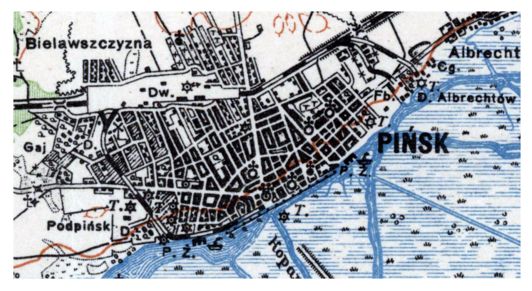
As for Truvovich, Vuvich and Misititch, this is the best clue I’ve found so far, a map of Pinsk from around 1925.  If you follow the main N-S street down to the Pina River at the bottom of this selection you will see, just on the other side, a short ferry-ride away, a spot in the marshes marked with a Jewish star and a capital T.

Truvovich maybe

“Star marks the spot of that muddy hell-hole, you say?” said the skeleton.

Death Benefits

These conversations with the skeleton of my father snuck up on me the first few times.   At first the skeleton simply interrupted, popping up to give me a detail from his point of view.   I indulged him when he had something to say and, also, when he had little to say.  

I came to look forward to our discussions, even as I was aware they were taking place in my imagination.  His answers had the ring of truth to them, he could be disarmingly honest and diabolically dishonest at the same time.  

He sometimes surprised me, like when his tone turned mid-sentence, the familiar merciless prosecutor yielding to the humble, remorseful man he became as he was dying.   The skeleton is once in a while the carping bully but more often he speaks in the voice of the man with the too-late perspective of suddenly having less than a day to live. That second voice is the one he would have preferred to have had all along.  The skeleton character speaks for both sides of my father,  what he was and what he could have been. 

By the time I got the call that he’d been rushed to the Emergency Room, yellow and unable to move his legs, I had begun to heal.   Our confrontations had made little sense to me as a child, all I knew was that the war was constant and unavoidable, except for the unpredictable ceasefires with a few hysterical laughs thrown in.    

I would come to know this hideous dance by the supremely ironic name my grandmother Chava used to describe the violence between my father and his brother: “seenas cheenam”  senseless hatred born of jealousy, pettiness, inexplicable malice.  

Seeing my father suddenly dying jarred me fully awake.  The experience in the dying man’s room is about person who is dying, not about anyone else.  He had things he needed to say.  I made it possible for him to say them.  Luckily for both of us I had attained at least that much empathy and common sense by then. 

I’d begun to see by that time, thankfully, and I was almost fifty already myself, that he had been unable to do better, would have done better if he’d been capable of it.   My father tried to explain, during that last conversation, that “on one level it was really nothing personal”.  I didn’t really get it at the time. This is a hard idea to truly grasp, but I think I’ve come to understand it.

Treating people badly is often the first reflex of people who’ve been treated badly themselves.  They will lavish the bad treatment on anyone they can safely do it to, a child is ideal.  Making the victim feel like it’s his/her own fault for the mistreatment is a satisfying two-fer my father was a master of.   He never recovered from being a two year-old, whipped in the face by his enraged mother.   How does one go about recovering from something like that?

Add to it the unutterable rages and sorrows that bubbled up from the lost souls of our murdered family in those doomed little Eastern European towns, rising like poisoned gas from the mass graves of our indecently slaughtered ancestors.  These unspeakable things can only be raged about.  The dead themselves, if they could speak, would bitterly complain it was so unfair and terrible, what they did to the powerless people who gave us life, people who only wanted to live, like everyone else.

                                                  ii

When my mother died, five years  and 22 days after my father died, I learned my sister and I were entitled to free grief counseling anywhere in the United States because our mother had been a patient at Hospice by the Sea at the end of her life.    My sister saw somebody in Florida, she went a few times.  I went every week for several months to 32nd and Broadway to sit with an Episcopalian priest named Paul who was an excellent listener and a kind man.  He recommended a book he’d found helpful — Death Benefits, by Jeanne Safer.  It was a book I marked up extensively when I read it.

The big idea of the book is that once a loved one dies their life can be seen, for the first time, as an organic whole.   There are gifts and lessons left behind when a loved one dies, from even the most miserable and ungenerous of them.  Seen in the context of one’s life and values, these gifts can be cherished and put to good use.  

Jeanne Safer had begun to see this after her own larger-than-life mother died.  Being a therapist, she had a wealth of patient stories as illustrations of death benefits large and small.  There was an overweight woman whose critical father’s death freed her to live a healthier, more satisfying life.  A frustrated accountant quit a job he hated to do what he’d always wanted to do, become a chef.  Old jury-rigged terrible things replaced by better, more refined and useful things by processing difficult lessons and seeing the gifts inside them.   

As I said, I took a pencil and bracketed sections of text that seemed particularly important or profound to me.  This is my practice when I want to mark text to find later, instead of underlining.  Underlining ruins a book, sometimes even crosses out some of the words it wants to remember.  I curse the underliners of library books, a tribe of unthinking, selfish morons.  A penciled bracket next to the text makes the section easy to find, in conjunction with a bookmark with a note and page number.  A bracket in the margin does nothing to make reading the prized section any more difficult.

I found the book very helpful.  I realized I’d learned many excellent and useful values from my parents, had inherited valuable traits.  I loaned my marked-up copy of the book to an old friend whose mother had died within weeks of my own mother’s death.  She never read it, and it was with a bit of drama, not without some ugliness, that I got it back a year or two later.  

I loaned it to another old friend who had lost her mother.  I never heard a peep about it and, in spite of her later promise to send it back to me, it vanished like the muddy little hamlets in the marsh where my grandmother’s family went into the night and fog.


Historical Revelations over shumai

Had dinner the other night with my father’s first cousin once removed, Gene, who grew up, from the age of five, in 1933, in the same Bronx apartment building on Eastburn Avenue where my mother lived with her parents.   Gene’s wife Sally grew up on the other side of the Concourse, just a few blocks away.   Sekhnet and I ate with them in a Chinese restaurant in Teaneck, where they have lived for many years.

I learned that Gene and Sally, like my parents, had little real information about their parents’ lives before they came to America, or about the families left behind. Gene’s father Morris had been one of eighteen children in a Polish town near the German border. Nine of the eighteen lived, including his father’s twin sister.  

Of these children only young Morris made it to America, having been sent for in 1909 or so by an uncle in New York.   He arrived after a two-week Atlantic crossing; was greeted by his uncle, who, three days later, died. Thirteen year-old Morris had to make his way alone in New York, learned the needle trade, became a union shop steward and a Communist.

“Stamper was a Communist,” my mother always said, without any judgment attached.  Although, it turned out, according to Gene, that after von Ribbentrop signed that pact with Stalin’s underling Molotov in 1939, the fatal non-agression deal between mass-murdering Josef Stalin and soon to be mass-murdering Adolf Hitler, Morris Stamper resigned from the party.

My grandmother Chava, Irv’s mother, had come across the Atlantic, with Gene’s mother (Morris’s future wife), on one of the last ships to leave the port at what was then probably called Danzig, now Gdansk, before the outbreak of World War I.     This was in the summer of 1914.

I was mostly listening, and filing details away, but I got the impression, from Gene’s description of his mother Dinsche as a brave, beautiful “leader” and Chava, two years younger, as a complaining, far less intrepid type, that it was due to the spirit of Dinsche that the two were able to cross the Atlantic in steerage during the summer of 1914.  

Dinsche had regarded the crossing as something of an adventure, charming the crew and getting special privileges for the two of them.  Chava, apparently, complained about the food, though the food they got was better than the food most people in steerage received, thanks to the socially adept Dinsche.   After their German-registered ship discharged its passengers in New York it was quarantined in the U.S. for the duration of The Great War.

As for the muddy hamlet the two of them came from, Truvovich, a place no longer found on any world map, it had been one of three such tiny Jewish hamlets located across the river from Pinsk, in a swampy area, as far as I can tell.  The other two doomed hamlets were Vuvich and Misitich.   Pinsk at the time was a town of about 70,000 people, about 30,000 of them Jews (of whom 37 are known to have survived the Nazi occupation).  

It was a short ferry ride from Truvovich across the Pina River (though Gene called it by a different name). It must have been after a ferry ride to that metropolis, in the earliest decade of the twentieth century, that Leah and Azriel were immortalized in a photo studio in the two large portraits Chava dragged with her to the New World in 1914.

The most amazing bit of history Gene imparted, along with descriptions of his childhood train trips up the Hudson River to visit Chava and her kids in Peekskill, was about my father’s uncle Aren’s Marco Polo-like voyage across Asia, the Pacific, the entire American continent just after the turn of the twentieth century.   If I’d heard this amazing and unlikely tale, I’d forgotten it.  

Aren had three children, Eli, by his first wife, who died of complications from Eli’s birth, and Nehama and Dave by his second wife. Aren sent for his little sister Chava in Truvovich after he remarried. Eli, I did the math just now, was about six when he went with his father to greet his beautiful, red-haired aunt in NYC and the two fell immediately into lifelong love.

Aren’s story I heard mostly from his son Eli. I spent many days, often until late at night, talking with Eli in the final years of his life.   Much of the talk was family history, the entanglements and devilish details of it.   Aren had arrived in New York City in around 1905, I had understood, where he learned to vulcanize rubber. Getting in on the ground floor of the brand new automobile industry, he would work with cars for the rest of his life.

I knew Aren had escaped from conscription in the Czar’s army around the time of the Russo-Japanese war, which history books tell us was in 1904-05. In those days a Jew drafted into the Russian army served for thirty years, absent early release via death or dismemberment in battle (partially untrue, actually, see note*).

Aren and two friends, Fischl Bobrow and Fleishman, decided not to be among the 40,000-70,000 dead Russian soldiers in that war.  They escaped the Imperial Russian Army together and arrived in the United States.  It’s possible Fleishman opted for Canada instead, which is where I think he settled.  I believe Fischl was the eventual connection to the Widems, Irv’s father’s family, from outside of Hartford, Connecticut.

According to Gene, their flight took them across Siberia, the Pacific (or perhaps the Bering Straits) and eventually to San Francisco.   San Francisco in 1904 or 1905, before the Great Fire of April 1906.  I picture Aren now, arriving in California, having crossed the massive Pacific Ocean somehow, a trip of about 6,000 miles.  Then he heads east, presumably on the transcontinental railroad, for another three thousand miles.  Next we hear from him, Aren’s in Manhattan learning to vulcanize rubber.     A few years later he sends for his little sister, who becomes my father’s mother, and the rest, as they say, is history.


* Apparently Jews, who were not allowed to serve in the Russian army until 1827, had been drafted for a twenty-five year hitch prior to the reforms of Alexander II.  Therefore Aren and his friends were likely only in for a five year military stint at the time of the Russo-Japanese War.  They were not alone in disobeying the Czar’s military orders.   From the summer of 1905 to the fall of 1906 there were apparently 400 mutinies in the Imperial Russian Army.

Things were made worse for the Jews at this time by circulation of the infamous forgery The Protocols of the Elders of Zion, published in Russian 1903,  confirming the worst about The Chosen People, in the minds of many, and unleashing a renewed flood of pogroms.

The Brutal Finality of Silence

It’s been noted, astutely, that the opposite of love is not hate, it’s indifference.  Both love and hatred require tremendous emotion and engagement with the object of the emotion.  Indifference?

“Yeah, yeah, it looks profound at first blush,” said the skeleton, “but given the choice between a mother who whips you in the face and a mother who is merely indifferent?”    

Context is everything, as you have noticed during your long dirt nap, as you may have known all along.  You tell a story with your life, hopefully.  Oddly enough, that helpful young woman from Farrar, Strauss and Giroux was not all fool, the story of life is about change, evolution, becoming a more nuanced and able person, learning from a lifetime of mistakes.  Becoming more humane.

“Well, your friend Adolf bragged in Mein Kampf that his philosophy of life, his weltanschauung, was fully formed by the time he was fifteen.   He had hardened into the mature genius he would later become by the time he was a pimply, enraged adolescent.  Impressive, no?”

My point exactly.  The mark of the complete asshole is a refusal to change, no matter what transpires.   It may seem like a small thing, but when I used to accompany Francoise on guitar and I’d make her so nervous and self-c0nscious she’d sing out of tune, I came to recognize something ugly in myself I had to change.

“A little spark of the man who made you, eh?” said the skeleton.

Which was transmitted to my father directly from the woman who made him, who had in turn had received it from Leah, Azriel or some combination of people in Truvovich prior to her journey to a life of misery and privation here in America, starting in the summer of 1914.   It’s a choice between a cycle of blame and anger or striving for change.  

“Well, blame and anger are much more immediate, they’re right there in front of you in a given moment.  Anger is tangible and blame is straightforward, they’re satisfying in some immediate way.   Change is subtle, chimeric, it moves backwards, forwards, sideways, it’s unpredictable, often invisible.  Rage is dependable and easy to hold on to.  

“That’s not to disagree with what you’re saying, that it’s better to learn not to be a complete asshole than to insist on your right to be one.  It’s just not something that most people feel they have the luxury to do.  Or the self-confidence to try to do, maybe.

“Look, we fought about this your whole life– how much people can or cannot meaningfully change.   We’re born hard-wired with certain abilities, talents, predispositions, reflexes.   Not everyone is born with the same degree of equanimity, for example.  Some babies are more easily frustrated than others, they’re cranky little fucks and they give their parents a hard time from day one.  Other babies are by nature placid and easy-going.  

“You can change many of the surface things about yourself, I’ll grant you that, but the deeper ones, the hardwired reflexes — it’s an open question.  I’ll leave it at that, it’s a coin toss, although my personal view is that the propensity to easy anger, for example, can’t ever really be defeated.”  

Fine, but you overcame the understandable impulse, instilled by your violent, enraged little mother, to whip your own children in the face.  You never did it.  

“Well, I never used a whip and lashed either of you in the face, though what I did was just as bad, really.  You know, when I think of those brutal skirmishes around the dinner table I’m ashamed of myself.  I was the fucking adult, even though I acted like a two year-old.  All you and your sister wanted were parents who had some wisdom and sympathy to offer.   How powerful are the words ‘I understand’ to a child who has just poured their heart out to a parent?   Those are two words you and your sister never heard from us.  That’s my fault, you’re supposed to develop some fucking insight as you go along.”  If a skeleton had eyebrows, he would have furrowed his.

This brings us right back to the point I was getting at above.  Being shouted down when you’re trying to express your frustrations is aggravating as hell, but at least there’s engagement.   Worse by far, oddly enough, is getting no reaction at all.

“Well, that’s why you started acting out so much in school, class clown, playing the harmonica in class when the teacher was trying to teach, ostentatiously pretending to sob every time the class sang ‘Puff the Magic Dragon’– a song about pot, by the way, according to a long time urban myth, anyway–  all the rest of that attention-seeking behavior.  

“Your mother would get into shouting matches with you and your sister, I learned early on how much more effective it was to just clam up at crucial moments.  Elegant, simple and very direct way to whip a child across the face with complete moral deniability.”

Well, moral deniability is important, I’ll grant you that.  As long as you can deny moral responsibility, you’re home free.  Hey, do you remember mom shaking me that time, demanding to know…

 “‘What did anybody ever do to you to make you so fucking angry?!!!’ and she chanted it rhythmically as she shook you by the shoulders.   That was great.  I mean, you have to love something like that, looking back on it,” said the skeleton cheerfully.  

Oh, I do, absolutely.  That was great, makes a cool anecdote, even struck me at the time as brilliantly insane.  You know, the mother shaking the upset kid and demanding to know what his fucking problem is.  It’s classic.  But you were the real stylist in that scenario.  Do you remember what you were doing?

The skeleton said nothing, just regarded me with that inscrutable rictus.  

Exactly.  

“Well, I did a pretty good job fucking you and your sister up with that silent movie sphinx routine.  And look, the beauty part was, by doing nothing I could always insist I hadn’t done anything. You know, what could be more satisfying than having the person you abuse believe they did it to themselves?  You say nothing, it’s their word against your non-word.”  

Yeah, like Switzerland during Nazi times.  Neutral, you know, fair is fair.  We don’t like the Nazis, we don’t dislike the Nazis.  We are even-handed, you know, and we are nobody’s enemies.  We don’t take a moral position, we deal strictly in wealth and discretion.  They were ahead of their time, the Swiss.  

And you know, it worked.  It was years before it dawned on me that the Swiss were not peace loving people who took a principled stand that two wrongs don’t make a right.   They were the bankers for the fucking Nazis.  

“You know, Nazis are going to give you a lot of shit about the constant Nazi trope in this ms.,” said the skeleton, “not to mention the fucking Swiss.”

Well, at least I won’t be like Switzerland about it, eh?


Irv as Eulogizer

I have an old friend who, on the side, studied to be a rabbi and for years worked a second job as the rabbi for an old congregation in Revere, Massachusetts.  A very bright guy, well-read, hilarious, sensitive, it was no surprise to discover what a wonderful funeral speaker he became.   He writes out his eulogies, it turns out, and reads them word for word.  He’s an excellent reader of his work, writes clearly in his own voice.  You would never know he was reading, his delivery is so smooth and natural.  He’s one of the best eulogizers I’ve ever heard.  

I did a memorial service for my mother, speaking largely off-the-cuff, and I felt I did a pretty good job of conjuring her life, her personality.  

My father, as I have mentioned, was on another level entirely.

He worked from notes of a few words.  “Prisoners” might be written on the index card, or the back of an envelope or other scrap.   We found some of these in his suit pockets after he died, usually written in a sharp pencil in his small, clear print.  He would glance at the key word and then launch into the story, fully formed in his head.  

“As a 22 year-old in France, during the Battle of the Bulge, Phil and his platoon captured some Germans behind enemy lines.  It was one of those things fate places in your path, in the fog of war, as they say, things that happen at random and change the course of your life.  Phil’s lieutenant ordered Phil and three other young G.I.s to take the German prisoners to the other side of the hill and shoot them.  They had to keeping moving fast through enemy territory, they were cut off from their unit, surrounded, and had to catch up, the lieutenant said the prisoners would jeopardize all their lives,  it was us or them, no time to lose.  Phil and three other young Americans marched the Germans over the hill, young Germans the same age as they were, frightened, begging the Americans not to shoot them.  Phil and another guy executed the prisoners, the other two Americans couldn’t shoot the unarmed men.   Every night for the rest of his life Phil saw the faces of the German soldiers as they were begging for their lives, as they were dying.  He never had a full night’s sleep for the rest of his long life.”

I wasn’t at that funeral, so I didn’t hear him tell the story.  He told it to me at one point.  But I am hardly capturing anything but its contours here.   When my father told the story at Phil’s funeral it was silent in the chapel, except for the sniffling and sobbing.   A moment later he had everybody laughing, the tears still in their eyes, wetting their cheeks.  Then a somber story had everyone dry eyed, then another laugh.

“He could do that at any funeral, he didn’t have to like the person, or even particularly know them.  He hung out with Phil, mom was friends with Louise, and he liked him, but he could have done the same kind of moving eulogy for someone he hated.  He just had that gift, you could wake him from a sound sleep, put him in a suit at a funeral and he would do the same thing,” my sister once said.

I’m not sure about that.  I’d only seen him at work eulogizing people he loved, Arlene and Eli.  Both times he seemed uncertain when he stood at the podium.   It was almost like he was a medium, unsteady at first, the hazy connection wavering and out of focus. Then he would find his note and begin to sing.  

Not to make any moral comparison to the most compared man-monster in the world, certainly in my world, but just as an image– I’d read that the early Hitler speeches began very much this way.  He spoke to many small crowds at first and whenever he gave a speech he’d start out tentatively, halting, slightly confused, almost disoriented.  He felt out the crowd in these first wavering, incoherent moments.  Sometimes a crowd did not respond to hatred of the Jews, for example, he would see that and shift ground to another topic.  The writer compared him to a geiger counter, a sensitive instrument calibrated to measure invisible forces, taking the reading of the crowd and, once he had the pulse of the room he’d leap into that flow state, transforming instantly into the performer the crowd wanted.  He was mesmerizing.

My father’s intent was not to mesmerize, it was to create a personal, living connection to the recently deceased loved one, express the loss that everyone was struggling with.  At his best, the person who had just died would be standing in the room, laughing or crying with the rest of the mourners.  I saw him do it with Arlene and I saw him do it with Eli.  

“Tell them about my eulogy for Eli,” said the skeleton.  

The funeral was at some odd hall near Yonkers Raceway, on the service road of the highway, near where the Major Deegan turns into the New York State Thruway.  It was a sunny Spring morning in 1995.   I’d written a page or two of a eulogy, which I can cut and paste into this account, though I don’t have it here with me.  I got up to read it and, seeing Eli’s three adult children looking up from the front row, a generation older than me, I improvised an important disclaimer.  

I read to the surprisingly large crowd that Eli and I had become close friends in the last years of his life when I visited him often in his tidy cottage in Mt. Kisco. Knowing how brutal he’d been to his children I added “it would not have been as easy to have been such good friends with him if he had raised me, of course”. I saw the grateful nods, in unison, and the smiles of his children.  They were now ready for what I had to say.  

I am not a great reader of my words, though I’ve improved recently, reading sections of this ms. to Sekhnet almost every day has been a big help.  I read the pages about Eli, as you will read them here (insert pages) and they gave a condensed, colorful, realistic slice of the fierce, loving, hating character.  I went down the three steps and back to my seat, receiving a few smiles and pats on my back as I went.

My father got up next, and I will never forget how dazed he appeared when he first took the stage.  He fumbled for a moment, gathering his thoughts, his feelings.  He glanced at a card, told everyone he’d flown in late last night, made a few notes while thinking about Eli, who was pretty much a father to him and his brother, he shuffled an index card and a torn envelope. Then he began to roll, and Eli was alive in that hall, brutal, funny, honest, deluded, vain, generous.  You could hear his rough voice commanding his two urchin cousins, Irv and Paul, to run and wash their goddamn hands before they sat down to eat with him.  It was all there in a long improvisation.  I’ve never seen anything I can really compare to it.  

“Tell them what I said,” the skeleton said.  “It’ll help you paint the portrait of this important character in my life.”

I have to say, honestly, I am not a good enough writer to do it justice.  

“Please,” said the skeleton, waving his hand in the universal Jewish ‘feh’ motion of dismissal.  

I’m not trying to make excuses, even though the funeral was twenty one years ago, even though I could be forgiven for not having any details at this point.  There are two things here, memory and writing ability.  I am trying to say that in addition to not remembering any specifics, I don’t have the ability to convey what you did, the way you did, at Eli’s funeral.  All I can do is describe the effect.

 “Well, you’re being modest,” said the skeleton.  “Which is not a bad thing, of course, except in our society where modesty is considered a form of inferiority complex that needs to be treated pharmaceutically with something like ‘Abilify’.   Look, you can’t afford to be modest, not if you want to sell this ms. to some publisher.”

I get that.  At the same time, as I am selecting remembered facts from your life, from Eli’s, from my own, I’m aware of the limited amount of material I have to work with, even though we’re talking about lives of over eighty years each, and sixty now in my case.

“Said the man who has been working steadily with the mere 480 pages worth of limited material he has set out to work with.  Look, the problem you’re going to have is not the amount of material, it’s going to be making a coherent story out of it.  What did that haughty little bitch, the Ivy League literature graduate granddaughter of Farrar, Strauss or Giroux, write to you way back when she rejected your unsolicited sample of Me Ne Frego?  You’ve got to find that letter, Elie.  One more reason to cull that vast nest of papers in that mass of collapsing plaster you live in.

“She wrote, after reading a few sample pages, that while it was well-written it did not contain that dramatic arc that every good narrative must contain: the moral transformation of the main character. Your narrator was much the same at the beginning of that ten page sample as at the end, in her dispositive opinion.  You remember that?” the skeleton smiled, or yawned, or yelled.

Obviously.  Which reminds me of that great remark you made when I asked how your brother was, my uncle.  

“‘Let’s just say he remains unchanged’,” quoted the skeleton.  “And I note here, about primary sources, the only reason we remember that throwaway line is that you jotted it on a telephone drawing you were doing while we were talking and never threw it away. And so it lives on, capturing that fleeting moment.  

“And there, in that captured moment, the basis for your fear of throwing away the hundreds of thousands of jottings that litter your place, I suppose.  The hoarding is a stand in for fear of death, like workaholism, like consumerism, like every desperate, compulsive behavior we do instead of enjoying life– we push ourselves and keep slapping a thin veneer of bullshit over everything that reminds us– one moment we will breathe for the last time and then….” the skeleton held his thumb against two fingers, then released them into the air.


Redacting History

I will speak in generalities here, because the particulars are too harmful to discuss openly.  I  understand the irony in this better than most, feel the grotesqueness of it more stingingly than most, I imagine, but there we are.  I don’t want to get into a fight about any of it at the moment.   Pat Conroy lost half of his family after he revealed details of his father’s insane brutality in The Great Santini.  

People who love somebody don’t want to hear that he’s actually got an Adolf Hitler side, and they’ll kill anyone who persists in highlighting the resemblance, particularly to outsiders.    Conroy was dead to his father’s side of the family after publishing that book openly detailing their beloved relative’s monstrousness.  They were furious that Conroy insisted on describing a trip to the E.R. after a near fatal beating from his highly respected war hero father.  

Conroy and his father eventually reconciled, due largely to the immense success of that book and the movie with the charismatic Robert Duvall as the brutal elder Conroy.  Such reconciliations with toxic people who learn from life and actually try to mend their ways are exceedingly rare, however, and matters of extraordinary grace and luck.

The other piece, of course, is that nobody is simply Adolf Hitler, outside of maybe Mr. Hitler himself.   You can portray a difficult to forgive side of somebody while also recognizing many excellent, admirable qualities in that person.  It is not always easy to do, but it can be done.  We tend to view people on a kind of moral see-saw, balancing their good and bad attributes until something tips it one way or the other.   Somebody saves your life, it’s easier to forget the many faults that used to annoy the shit out of you.  

So, while I don’t believe that the truth will set you free, except in rare cases, I know that lies will keep you tied up in knots and make it impossible to ever free yourself.  That’s my point here.  When people are crippled by shame or guilt, they lie, construct alternate explanations, elaborate rationales for why they are not crippled, or why the fact that they’re crippled is of little consequence: pay no attention to those twisted, shrunken limbs, I am Superman!  

Back in Egypt guys working for the new Pharaoh and his dynasty would go into the tombs of the preceding Pharaohs and scrape the faces off the paintings on the walls, literally erasing these once all-powerful god-kings from history.   This is how we do it, homo fucking sapiens.  We live by stories, myths, and whenever necessary, we scrape the previous records right off the walls of history, replace them with myths that serve us better.  

Millions of people killed by the Nazis?  Bullshit!  It was only a few hundred thousand, and they died of disease and insanity, they were subhuman filth, and liars.  There were no gas chambers, no crematoriums.  Six million Jews?   Jew please!  There you go, again, it was more like two million, at most, you lying goddamn Jew.  Ten million Africans killed during the American trans-Atlantic slave trade?  Prove it, bitch. It was no more than a couple of million, and they were mostly the psychos who wanted to kill their captors, plus the slave trade was necessary to the Land of the Free’s prosperity, and, anyway, it was outlawed more than two hundred fucking years ago!!!!  

Not all re-writing of history is bad.  Evil myths need to be corrected, rewritten.  Homosexuality, for example, was long considered a form of deviance punishable by ostracism, beating, imprisonment, even death in many parts of the world, including the U.S.A. (where, in fairness, death sentences were rare, and not strictly legal) until very recent times.  While still persecuted in many places, it is now recognized in many countries as a naturally occurring sexual preference whose practitioners deserve every right to practice, openly, legally and, in an increasing number of places, with marriage equality.   These former deviants now have the same right to love each other, under the law, that heteronormative couples do.  Not bad, not bad at all.

So, leaving aside the generalities of myth, and with sadness, because describing the particular relationship I am thinking of would show more about my father’s life and beliefs than any other I can think of, and because I witnessed 100% of it as an adult myself, I scrape this descriptive relationship off the painting of my father’s life on the tomb wall before I even paint it.  I redact it.  So what can I actually tell you about it without actually telling you about it?  That is what I’m trying to figure out.    

When someone is angry, and they never get to explain the causes, it creates a loop, a kind of insane loop.   They appear to be irrationally angry, since they cannot openly discuss what they’re angry about, it will never make sense to anybody since the cause of it, however reasonable, however clearly understandable, remains hidden.  They cannot seek help, or even sympathy, because they keep the cause of their anger secret, become complicitous with their tormentor.  Repression of a shameful and damaging secret is a route to madness, I’m pretty sure, or at least to an unbelievable amount of pain and misunderstanding.  

I once loaned a large sum of money, my life savings, actually, to a man who expressed great gratitude and promised he’d pay it back quickly.  He did not pay it back, quickly or otherwise.  When I pressed him he admitted that he owed many people money, that I was actually at the end of a very long line, that I’d have to wait, perhaps a year or more, before he could start paying me anything at all.  

I told him I was going to go to the others in the line and tell them about the tight spot I was in and that I needed to go to the head of the line.  He tried to extract my promise not to do that, told me it would be humiliating to him, and an unforgivable betrayal.  I would not let myself be convinced that the stream of steaming piss on my leg was a sudden targeted, body temperature mini-rain storm.   He became very angry about my inflexibility, my self-righteous refusal to recognize the tight spot he was in, what an unbearable position I was putting him in.  

If he had been my size, I’d have bashed him in the face when he started to rage at me.  Being much bigger than me, I just cursed back at him and did what I could to get my money back, which took years and cost me a lot of money.   More than that, it caused a lot of anger and resentment all around.

After this, it was impossible for me to ever see this guy as someone I could trust.  He made a habit of lying whenever he was in a tight spot and was very often caught in these lies, which at least a half dozen times involved the unauthorized transfer of thousands of dollars.   He was never repentant, always made an excuse for why it was the other person’s fault for being a fucking judgmental prig, forced people close to him to keep his shameful acts secret.  After years of this, I was done with him.  How can you keep having conversations with somebody who reflexively says whatever he feels is necessary to get himself out of an untenable position he’s put himself in?   

On the other hand, depending on how this person is situated in the world, it makes things more or less complicated.  I had a friend play peacemaker with his wife and her sister.  The two women had a long simmering rage against each other and the peacemaker’s work lasted a very short time, with ugly repercussions for him.   There are certain toxic types that we simply must avoid, for our own sake, for theirs.  For their sake because “fuck you, you don’t get to poison my life.”  My father considered such people without integrity and therefore without value as human beings and avoided them like the plague they arguably are.

But I have already said too much here, and revealed little enough about Irv, except to say, he was acutely aware of the point where things became toxic with another person, and although he was able to appear civil, and even casual, there was no mistaking the depth of his actual malice, even as he bantered cheerfully with a person he despised.

Two Jiggers, Elie

It’s an odd exercise, memory.   Things float in, connect with other things, sometimes the fragments form stories, other times they’re just fibers stuck between molars, impossible to remove and impossible to stop worrying with your tongue.  

I’m often told what an excellent memory I have, yet others regularly remember things in detail that I’ve completely forgotten.  It could be that those who praise my memory don’t recall the many things over the years I have irretrievably forgotten.  Maybe I do have a better than average memory.   I told a fragmentary little fifty year-old story to a friend the other day and observed that it belonged in the Book of Irv.  Afterwards I had no recollection of the story.  Then I remembered it.  Here it is.

My father got home from work one day with a funny story.  It was funny and it was bad, a bad story, though we had a good laugh about it back when I was about ten years old.  A black colleague of his was on his way home to Rochdale Village.  From the subway he took a bus to reach his apartment.  On the bus was an ad for Bacardi Rum, I think it was.  It had a recipe for mixing a popular new drink.   The recipe called for two jiggers of rum, a jigger of something else.  

“You actually looked up a jigger, didn’t you, to appear more erudite,” said the skeleton.

A jigger or measure is a bartending tool used to measure liquor, which is typically then poured into a cocktail shaker. It is named for the unit of liquid it typically measures, a jigger or shot, which measures 1.5 US fluid ounces (1.6 imp fl oz; 44 ml).[18] However, bar jiggers come in other sizes and may not actually measure a fluid jigger.

“A fluid jigger,” said the skeleton, impressed.

“He tells me ‘I’m heading home, tired as hell, and of course there’s no seat on the bus, why run enough buses to Rochdale so the people can sit down, you know?  I’m standing there and looking at this Bacardi ad that’s right in front of my face and some little asshole with a magic marker has corrected the sign to make my fucking day.   I’m reading ‘take three niggers Bacardi dark, two niggers Bacardi light, two niggers this, one nigger that.’  I’m standing on a bus, in my neighborhood and I can’t get away from it, you know what I’m saying Irv?  It’s literally in my face.  Irresistible to the little fuck with the marker, perhaps, but, I mean, Irv, what the fuck?'”

The skeleton, completely sympathetic to his friends’ torment, nonetheless gets a hearty laugh out of the story when he tells it to us.  So do I.  

“It’s hard to see him as funny,” my sister said the other day, “since he was so cruel.  He could be really sadistic.”  

“Your sister is a fluid jigger,” said the skeleton. “Look, obviously, humor is a defense mechanism and its hilarious or not depending on the context.  It often comes at the expense of somebody else, quite often a person with more power, or someone perceived as having more power, or trying to get it– you know, to take them down a peg.  What we can’t do in the world, which is a brutal place, we can do with a droll aside to the person next to us.   It must be said with a straight face, because when the person next to you cracks up he gets a rifle butt in the ribs, a kick in the stomach when he’s on the ground.  You must look forward as he’s getting his ass kicked for laughing, and show no emotion whatsoever.”

What are you talking about, dad?

“Humor is a defense mechanism.  It’s the best there is in many circumstances, and there’s nothing like a good laugh to cleanse the emotional palate, to remind you of the sweetness of life, even, and especially, when life is most bitter.  It’s a good defense mechanism, except against things like clubs, nooses, brass knuckles, guns.   I mean, you can laugh about those things, but don’t get caught laughing.  That’s all I was saying.  

“A joke…you remember those sections you read about humor in the Third Reich.  There was state sponsored humor, you know, which you’d hear on the radio, or told by the local gauleiter and such, how funny it was that Jews actually thought they were loyal Germans, things like that.  Which is kind of funny, in a sick way, if you think about it.  Nazi humor was not to everybody’s taste, but as long as they were winning a lot of Germans found it hilarious, or pretended to.   There was another school of humor that could get you killed.  People made jokes about Hitler, Goering, Goebbels, at the risk of their lives.  

“You remember what the ‘Hitler Cut’ was, right?  Castration.  If they heard you refer to the Hitler Cut, one of the Fuhrer’s favorite correctives for bad comedians, you’d get… that’s right, the Hitler Cut.  Funny, no?”

Not really that funny, no.  Some would accuse me of being obsessed with Hitler as it is.  

“Well, why wouldn’t you be?  He was the driving force that whipped centuries of anti-Semitism into the frothy intoxicating sludge swilled by countless murderous mobs over the course of his thousand year Reich.   Some of these hopped up people killed our entire family, outside of the half dozen that made it here, to the Land of the Free and the Home of the Brave.

“But you know, on a more serious note, maybe your sister was right.  I mean, on the one hand, I was funny, I made a lot of people laugh.  I had a quick wit, let’s say, I was irreverent and I saw the dark side of things clearly and mercilessly.  On the other hand, how funny can somebody be if they also are cruel? That’s a fair question, you know?   Now that you know Bill Cosby was a serial rapist who drugged otherwise willing women so he could diddle them while they were unconscious, do you still find his pudding commercials that adorable?   I remember you had this discussion with your mother, could someone be a great artist and also a Nazi?”  

Interesting you bring that up.  I had a great moment of clarity on that issue the last time I saw Florence Siegel.  I’d gone to visit her in Brooklyn, she was 92 and living on the ground floor of her daughter’s brownstone.  The question came up and we both immediately agreed that it was impossible to be a great artist, or any kind of artist, if you were a hater of any kind.  Negates whatever else the pretentious fuck is attempting to communicate, pollutes it, makes it disgusting.  It was so clear to both of us in that moment, it was hard to imagine my mother and I had ever puzzled over it.  Three days later Florence was found dead, the New York Times spread in front of her and a bowl of M & M’s next to her.  

“Way to go,” said the skeleton. 

Shopping for Grandma’s coffin with my father

I had nothing to do with the inscriptions on my grandparents’ tombstones.  My father’s parents were gone long before I arrived, and my mother’s parents, buried in a section marked by a monument to the slaughtered Jews of Vishnevitz,  got the standard beloved parent and grandparent things chiseled into their headstones.   Thinking about it now, they were the only two family members of their generation to be buried in coffins.  

It was my father’s parents’ headstones in a parched area of the First Hebrew Congregation of Peekskill cemetery that got me thinking.  My grandfather was immortalized in Hebrew as a “simple, straight man.”   I don’t recall at the moment what is carved into my sainted paternal grandmother’s stone.  It was “simple and straight” that I read and translated off my grandfather’s headstone that caught my attention.

“Yeah, Ben came up with those epitaphs,” said the skeleton, from his grave on top of the hill, closest to the road but also above all the other graves in the cemetery.  “He was a rabbi, he knew Hebrew.  I guess with my father that was the best Ben could do.  You notice they’re buried in a crowded little area at the bottom.  That was the pauper’s section, you see how the stones are crammed together down there, some of them are crooked?”  

I had noticed that.  I also took care to come up with accurate Hebrew epitaphs for my parents after my mother picked out their headstone.  My father is immortalized on his headstone as “איש צנוע ונבון” a modest, brilliant man.   My mother’s inscription, which I labored long to find, reads “לב  של משוררת” heart of a poet.

But this is years earlier, when Yetta died a long, painful, clawing death from colon cancer.   She died in the bedroom I grew up in.  I remember how deathly her feet looked after she finally gave up the ghost.  They seemed unnaturally long, stretched, the toenails dark.  My parents were at that time considerably younger than I am now.  I went with my father to the funeral parlor on Queens Boulevard.  

The solemn salesman in the dark suit took us into the coffin showroom.  He guided us toward tasteful, beautifully finished coffins, with polished brass, or even gold, handles and trimming, some costing thousands of dollars.  Years later Sekhnet’s cousin, who died suddenly at 62, was buried in one of these Cadillac coffins, a stately mahogany model that gleamed next to the open grave.  It appeared to be top of the line.  His grieving sons had a lot of money and his dying wife, who had never expected to have the love of her life go before her, probably endorsed the expenditure.   

“This is a beautiful model,” the salesman in the black suit said.  My father and I pretended to inspect a $4,000 model, my father cutting his eyes toward the price tag and nodding to me.   We eventually selected a more modest one, I don’t remember the price, but it was one level above the plain pine box.  The coffin salesman, who clearly worked on commission, was disappointed.  When he saw where this sale was heading, he had pointed to a shoddy looking particle board coffin behind the door and said, dismissively, that it was their least expensive option.

“Did you see how that floor model of the particle board coffin had a warped lid?  I mean, you couldn’t even hammer the pegs in to get that sucker to close,” chirped my father cheerfully as soon as we left the disappointed ghoul at the funeral home.  We laughed about it, and the whole solemn dance the respectful slug in the black suit had performed for us.

“When I go, I want a plain pine box, remember that,” said my father that summer day in 1979.  

I did.

The $64,000 Question

There was a televised game show of this name, around the time I was born.  It was one of those hits of early TV that everybody stayed inside to watch when it was broadcast live.  The streets would become deserted, apparently.  Crime numbers dropped to zero while the show was on.    President Eisenhower did not want to be disturbed during the $64,000 Question.  The producers of the show would soon enough be hauled before Congress for fixing the show, but that was after a few years of fabulous success.

One night at dinner my parents described my father’s appearance on a live TV game show.  The show could not have been, I’m sad to say, the famous $64,000 Question, which I just read up on, but due to that show’s popularity it’s safe to assume there were many imitators.  My internet research did not reveal the name of this imitator, but my father was a contestant on the show.  Either I was a very young baby when he was on TV or it was just before I was born.

On this show the contestant stood in the gondola of a hot air balloon.  If he answered the question correctly his winnings went up.  Each time he answered incorrectly a tether rope holding the balloon to the ground would be cut.   When the last one was cut the balloon floated up out of camera and the contestant was done.

My father stood in the gondola and answered the questions.  I don’t recall how well he did, although he certainly did not win life changing money.  He had an excellent memory and a good command of history, current events, sports and general trivia.  They cut a rope whenever he missed a question.  He was hanging on by one rope when he missed another question.

My mother was watching this on live television, with everyone in the neighborhood.  My parents lived at the time in a garden apartment complex called Arrowbrook.  They were one of the first couples to get a TV, from what I understand.   Everyone gathered to watch my father on the game show.   One family was Mexican, as far as I can recall.  They had a little boy.   

When my father missed that last question they cut the last rope and my father waved as he floated off.  The little boy called out “bye bye, Irv!”


Redacted and Misdirected

It is very difficult to ever know, let alone fully relate, the complete story about anything.  This is especially true when recalling a parent, relying on memories of your early life, seen through the veil of your own perceptions and in light of how the events remembered affected you, how they played out later.

There are facts, actual events, specific words spoken, which can be shown with some degree of certainty (as with a recording or in a letter or diary), then there is the way these undisputed facts are spun by each party according to their needs and how they play into everything that follows.  When reconstructing our past each of us is, of necessity, an inventor relying on a good deal of conjecture, based on our experiences and prejudices.

“That’s a proper observation at this juncture.  That’s what critical history is supposed to be, the nuanced exploration of historical artifacts, placed outside of conjecture and prejudice, shown in light of the actual effects the artifacts produced and good luck with that enterprise.  Life is much more an art than a science, as I’m sure you’ve noticed,” the skeleton said.

“You were brought up short when your sister was momentarily stunned when you mentioned my keen sense of humor yesterday.   How is it possible, you wonder, that your sister could not remember the many great laughs we had together, even on some of those merciless battlefields where we spilled each others’ blood?”

It was surprising, I have to say, that she had no immediate recollection of your dark sense of humor.  You were almost always a prick, and grimly determined to win every ‘battle’ at any cost, there was no price too high for you to pony up, but you were also, without a doubt, a clever, funny man with a distinct and sardonic wit.  

I reminded my sister of how Arlene and Russ would howl at your tossed off remarks.  I reminded her of Murray Susskind, gasping for breath, completely at your mercy that night he came to dinner.  Over and over he wheezed “oh, that’s funny!  oh, that’s funny!!!!” as he struggled to breathe and howl at the same time.  We thought at a certain point he might die of laughing while trying to explain how funny it was.  My sister barely recalls that.

“Go figure,” said the skeleton.  “Memory is a funny thing.”

I’ll tell you something that’s not funny– crucial things that are never told.   You taught me on the one hand to operate like a critical historian, get the facts, primary sources whenever possible, weigh the competing versions, give credence to the version that aligns better with the agreed on facts.   At the same time, you gave us a very spotty, redacted version of things that was tailored to your need to control every narrative.

“We’re back to the abstractions that were your mother’s twelve murdered aunts and uncles and their entire families?” asked the skeleton wearily, warily. 

That’s the most striking example, yes, but it’s one example.  Look, I understand you were at a loss to tell your nine year-old that he was right to be upset by the shooting of everyone in his mother’s family, not to mention everyone on your side of the family.  This was not ancient history, after all, it had happened about 20 years before I found out about it.  OK, you couldn’t open that painful can of worms, fair enough.   What you did, though, was much worse than just clamming up about a difficult subject.  

“Here we go,” said the skeleton, “haven’t we already had this out, haven’t I already apologized, told you it was unforgivable?  What is it you fucking want from me now?  I’m dead, if you haven’t noticed.”

When you redacted those people from history you felt it necessary to give me something else to chew on.  Your reaction was not to acknowledge an unknowable horror and explain that it was impossible for you to think about what happened to them because the pain was too great; you turned it into a chance to tell your son that he was being an overly dramatic little wimp whining about a few dozen people with his DNA, not one of whom he never knew, who were, tragically, machine gunned into a ravine.  

That’s what I was left with, from the authoritative source that was my father, that I was being the whiny asshole for inquiring, for having strong feelings about, the terrible subject.  That is what is necessary for the reshaping of history, recasting the story completely into a counter-narrative.  You made the story about my weakness, as a narcissistically dramatic nine year-old, not someone seeking to understand an incomprehensible horror you could not touch yourself.

“Well, you were a kid with a hyperactive imagination, subject to nightmares, and that was my sick way of trying to protect you,” said the skeleton.

A sick way, we can agree now.  What was the necessity of making me feel like a weak, melodramatic little turd for asking about the slaughter of our entire family?   It closed the subject once and for all.  Like you were saying: suck on that, asswipe.    

“Well, that’s a harsh way to put it,” said the skeleton, “but accurate, I suppose.  But you are making a larger point, I suspect?”

I am.  The most brutal enemy of the seeker of truth, or at least understanding, is secrecy.  In our origin myth, we the People are an informed populace participating directly and knowledgeably in deciding the issues that effect us all.  In reality, the information we have to base any real discussion comes to us in a carefully controlled trickle and our influence on policy nil.  The record we get access to is increasingly redacted, classified, off limits.  There can be no free and open discussion about facts that are hidden.   

This was the way it was in our house growing up.    You redact something shameful and then, whenever there is an attempt to dig deeper, you bury it in further attacks on the digger.

“Well, I was a master at that redirection, misdirection.  I really was.  Not to pat myself on the back, but framing the discussion, as it took you more than forty years to figure out, is 99% of winning the argument.  That’s why conservatives have spent millions and millions creating terms to frame every debate: right to life, death tax, collateral damage, friendly fire, Second Amendment.   ‘A well regulated militia, being necessary for the security of a free state…” spun, by the brilliant and destructive Scalia, is now an undisputed American individual’s right to keep and carry guns and ‘Second Amendment’ is all you have to say.  Redirection is most of the game, and redaction certainly helps in that, the less real information available, the easier it is to misdirect the conversation,” said the skeleton.

“When you don’t want discussion of something uncomfortable, shift the ground.  It is no longer about a secret kill list that the president signs off on now, launching deadly attacks in dozens of countries by drone, it is about disloyal Americans seeking to endanger national security by prying into these highly classified national security areas.  You see how that works, right?  It’s not about whether killing all these people is right or wrong, whether it makes us safer or increases the resolve of those who hate us, it’s not a question of a precedent an American president can be happy to set for President Trump, it’s about keeping the entire program as secret as possible.  I know I’m preaching to the choir director,” said the skeleton.  

Indeed you are, pop.  I heard a JFK speech yesterday that spoke so eloquently to this very issue.   As to the importance of free and open access to the facts the citizens of a free society deserve to know, JFK said it all, then they killed him.  

The very word “secrecy” is repugnant in a free and open society; and we are as a people inherently and historically opposed to secret societies, to secret oaths and to secret proceedings. We decided long ago that the dangers of excessive and unwarranted concealment of pertinent facts far outweighed the dangers which are cited to justify it.

…No President should fear public scrutiny of his program. For from that scrutiny comes understanding; and from that understanding comes support or opposition. And both are necessary. I am not asking your newspapers to support the Administration, but I am asking your help in the tremendous task of informing and alerting the American people. For I have complete confidence in the response and dedication of our citizens whenever they are fully informed.

I not only could not stifle controversy among your readers–I welcome it. This Administration intends to be candid about its errors; for as a wise man once said: “An error does not become a mistake until you refuse to correct it.” We intend to accept full responsibility for our errors; and we expect you to point them out when we miss them.

The text of this wonderful speech to the American Newspaper Publishers Association is here.   

“Yeah, it was a great speech, justly famous in its day, one more reason the people who loved him so much loved him.  You know, he was fucking all kinds of women in the White House, and the press kept quiet, he was doing plenty of secret things, like all presidents do, but this was a great statement of our democratic values.  JFK was a lot like Obama in that way, off-the-charts rock star charisma, intelligence and elegance in stating our deeply held beliefs,” said the skeleton, watching a red-tailed hawk make off with dinner struggling in its talons.

“You know, Elie, it’s virtually impossible to tell anyone’s story in a way that makes sense.  A man with all of my gifts should have done a much better job as a father.  Instead of using my powers for good…” the skeleton continued to watch the raptor carry his next meal away.

As I told you as you were dying, you did the best you could.  That’s all a person can do, the best you can.  Do we hope to be better than we are?   The most idealistic among us, for sure.  

“How do you keep idealism alive in a world that stomps it lustily with every step?” asked the skeleton.

The $64,000 question, dad.  

“Hey, tell them about my appearance on that game show, would you?”

OK.