Let me get this straight, Elie

“Let me get this straight, Elie,” said the skeleton of my father.   We’ve been chatting regularly the last couple of years, the skeleton and I.  A long overdue conversation, you might say.   My father’s skeleton has been resting in his dirt bed now for more than twelve years.  He finally has time for contemplation, to consider the things he wished he’d said and done while he was walking among us.

“Yes, yes,” said the skeleton.  “But I want to try to understand something specific here, Elie, while you natter on in your blahg about every random gargoyle of injustice you encounter– and, it goes without saying, the less income you have the more stinking injustice will be thrust into your face to deal with.   I want to know what you actually expect to accomplish by telling the story of my life.  Your plan involves the telling of this story… and then?”  The skeleton raised an open hand and turned it palm up.  

“OK, you write this definitive, historically accurate, politically informed story, themes as urgent today as they were in 1932, and you manage to do a second draft you’re pretty happy with.  It’s now a fairly snappy read, a story someone would be interested in reading.   It pulls together all kinds of interesting historical moments, personal and national, illuminates them from cool angles, fits them into an ongoing puzzle of human irrationality and hope.  It works in the difficult question of how a person can truly forgive an abuser and learn to live a better way.  A good read, thoughtful, measured, thought–provoking.   Done and done, you could say.  Then, all you have to do is find an agent and then a publisher so you can both get paid.  

“But let’s assume your primary aim was to write the complex story of your complicated father as clearly as possible, to understand the relationship and set the issues out calmly, for yourself and anyone else, with no regard for the commercial success or failure of the manuscript.  If so, you would appear to be almost done with this project and we’d have to call it largely successful, in the manner of Bear Bryant’s moral victory– which he disparagingly, and accurately, compared to kissing your sister.  But I’m trying to put my finger on what exactly you aim to do with this Book of Irv, what your real hopes are for this thing you’ve been working on, systematically now, for the last two years.”  

Sell it to the highest bidder, obviously.  

“Well, you say that, but that has always been a distant after-thought for you, getting paid by the high bidder, or by any bidder at all, for that matter.  How much of writing this manuscript was motivated by a need to get some corporate princeling to pay you for your time tapping out little lines of carefully marshaled words several hours every day?   I’m trying to understand what, exactly, it is you hope to get out of finishing this book.  What role a need for recognition as a writer plays in your motivation.  How you think the success of this book might change your life.”

Part of my motivation, seriously, is to say “fuck you, Hitler.”   I reclaim your life, and your unknown life stands in for a brutally culled generation, a tiny handful left from a huge family on both sides, thanks to Mr. Fucking Hitler.  The rabid madman published an unreadable doorstop of a screed called Mein Kampf, after becoming well-known for a failed authoritarian coup he defended stirringly at his public trial, and lived off the royalties of that giant piece of dreck for a decade.  Until he actually took power and started carrying out the insane proposals he ranted about in the book.   

“Whoa, Elie, ‘fuck Hitler?’   That’s really the best you can come up with?   Buy this book because, fuck Hitler, yo?” the skeleton did a stiff armed Seig Heil and then let his skinny arm go limp.

Part of it, yeah.  Testifying.  Kill my whole family, you insane asshole, but since you didn’t manage to kill my parents, or me, I get the final last word.   You know one big reason why our family was so insane?  Every relative left behind where we come from was killed by mobs, factions whipped to murderous frenzy by that master of marketing and self-promotion, Germany’s savior, the charismatic psychopath Mr. Hitler.   There are white douchebags right now buying copies of Mein Kampf, hanging pictures of that foaming-at-the-mouth Alsatian bitch in their dens, next to the mounted heads of animals they’ve killed. 

“Seriously, Elie,” said the skeleton.  “I take your point, but still.  Hitler’s the best you can do?  You’re going to dedicate the book to mom and Hitler?” 

Hah, funny you should say that.  The thought did cross my mind, though I realized at once it would be problematic. 

“Obviously,” said the skeleton.  “But your little Hitler pivot doesn’t distract me from trying to get the honest answer to my actual question.   We’re not on some network talk show where you can get away with that kind of shit.  We have all the time in the world, all the time left in your world, anyway.  I want to know how important getting this ms. into print, and being paid for it, is to you.   

“You know, we can dance around and around– and I can go for days, now that I’m but a skeleton– or you can honestly weigh how important getting paid is to you, how pressing the need to be recognized for honing your ability to write about what moves you.”   

Both things are important to me.  I’ve been paid a couple of times for writing, $250 a pop.  It felt great.  Once the words are published they are something everyone in our consumer society can understand.  Send the link to the mangled prose, worked over by the same ham-fisted hack who gives the thumbs up or thumbs down on paying you, and every friend you send it to will write back with a happy ‘atta boy!’   Write something equally moving, send it to the same group of friends, and the reaction is a kind of chagrined silence.  The question hanging in the air is: what the fuck?  Get paid for this work and send me the link, I’ll be happy to see it, but this…. I don’t have any way to talk about this if it’s just a page from your diary…   

“That’s the world, Elie,” said the skeleton.  “Until a paid critic for a well-respected journal writes appreciatively about your important work, how is anyone to know how good or important it really is?  You can bitch about a materialistic, shallow, clueless consumer society where all creativity must be commodified before it can be grasped, a culture best conjured by the images in a zombie movie– or you can sell that bitching.  Are you serious about selling your bitching, sir?”

Serious as Hitler, dad. 

“How important is the conversation you will have with strangers, once the book is out in the public?” 

Clearly, also very important.   Strangers are ultimately who I am writing for.  My friends will be happy for me, a few will even read the book cover to cover.  But the real audience for this book is people who never heard of Irv Widaen.   As far as they go, he’s a fictional front man for the telling of a story much bigger than the conflicts of his individual life.   The larger conversation, that’s really what I am excited about.   

“Clearly,” said the skeleton.  “So excited you’d engage in a two year chat with a dead man, for lack of a more suitable interlocutor.”   

One small step better than talking to the wall, I think you’ll agree. 

“You’ll get no argument from me, Elie.  How important is your fantasy of talking to Terry Gross and Leonard Lopate about the book?”   

Fairly important, I guess.  For multiple reasons.  Leaving aside the marketing angle, and getting to speak directly to their demographic, I think they are both excellent interviewers and I’d enjoy talking to them.   Beyond that, they don’t talk to just anybody.  Sometimes you’ll hear an interview that seems to contradict that, but in general, they are asking nuanced, intelligent questions about things that people have written, sung, acted out.   Would you not have looked forward to a chance to talk to somebody like that? 

“Oh, absolutely,” said the skeleton, beginning to slump back into his grave. 

Well, there you go, dad.  Anyway, let me catch you later, you seem to be slouching toward a well-deserved nap. 

“My reward,” said the skeleton, settling back into the dark earth of his grave.
A thousand words

young-irv-paul-herman.jpg

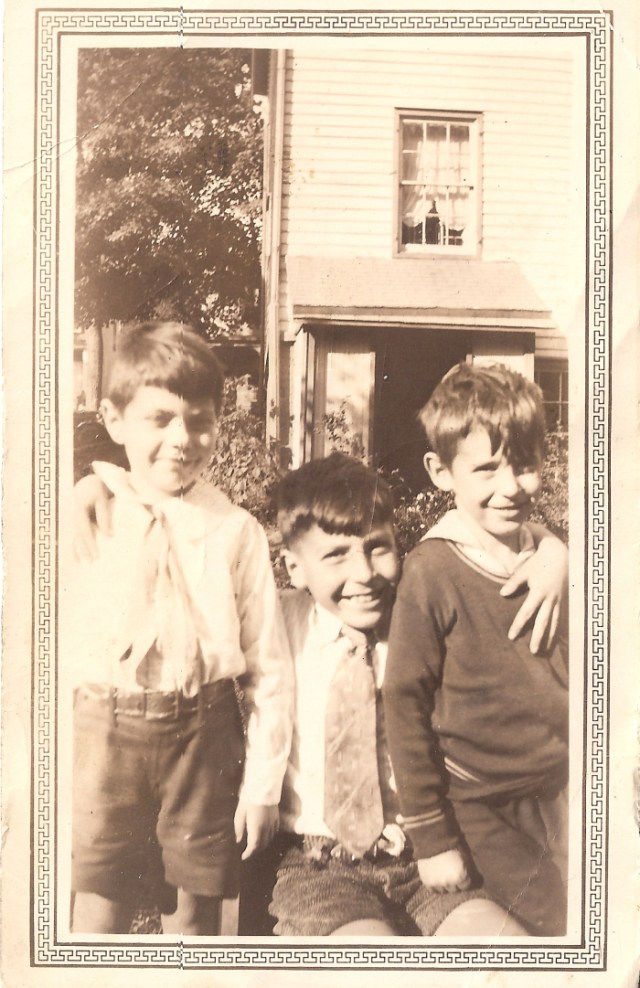
This photograph, taken at the nadir of the Depression, showed up in a box of photos we looked through after my father died.  My father is in the middle, hand on the chest of his little brother Paul, the other arm draped around the shoulder of the urchin in the white shirt.  They are all in short pants, and the two older boys wear ties, likely for school.   I asked my uncle who the other boy was.

“That’s Herman,” my uncle said.  

That was about all I learned.  Herman was a friend who moved away from Peekskill not long after this picture was taken.  I have no idea who took this picture, a person rich enough to own a camera, or if there was a particular reason it was taken on that sunny day.  Maybe it was taken because Herman was moving and wanted a memento of his friends the Widem boys.  I have no idea whose house that was behind them, it could well have been the house on Howard Street into which Uncle Aren put the impoverished family of his youngest sister.

I look at the photograph through a forensic lens, as an artifact of deep archeological interest.  It is one of a small handful of photographic clues I can study.   My father is clearly much bigger than his younger brother and Herman.  He is sitting, or squatting, and almost the same height as they both are standing.  I put my father’s age at seven or eight, based, in part, on my uncle looking five or six years-old.   I’m thinking Herman must have been my uncle’s friend, though they all seem very cozy and friendly smiling for the camera.   

The expressions and attitudes in photos, of course, can be grossly misleading.   I think of a series of photos I found in an album of my mother’s, taken during a festive dinner at my parents’ house.  I am beaming in every one of the photos on that two page spread.   Grinning from ear to ear, my arm around my aunt, interacting with everyone with a huge smile on my face.   The over-the-top happiness I am showing in every picture made me wonder what the hell I was so happy about.  I did the math to figure out when the pictures were taken.   Right in the middle of a six month period that felt to me like a profound depression, a time of personal darkness when I was monosyllabic and dreaded everything.     

So I don’t put too much stock in the tender hand on my uncle’s chest, the smiles all around.    My uncle flinched around my father right up until my father was on his death bed.   It appears he had reason to flinch.  The one story my father told, with some glee, from his unbearably awful childhood, was about the time he stuffed his brother’s mouth with raw chopped meat.   Apparently well worth the ass-whupping he no doubt got for it, he chuckled about it decades later.   So the tenderness for the camera, while charming, even endearing, doesn’t convince me very much.  

Although, it must be said, when my father was dying, once I arrived in Florida, all he wanted to know is when his brother was getting there.   I picked my uncle up at Ft. Lauderdale airport and from the time I brought him to the hospital the two Widem boys clung to each other.  My sister and I were both struck by the poignance of that.  After my father died, my uncle sat with his brother’s dead body, accompanied by my brother-in-law, until the hospital finally made arrangements for the body to be taken downstairs to be watched over by the Chevrai Kadisha, the Jewish burial society, eventually sent over by the Florida affiliate of the funeral home in New York.  

What strikes me from the photo, outside of my father’s terrible haircut, the inexpert work of some family member, no doubt, is that my father, with his 20/400 vision, is still not wearing glasses.  My father always wore glasses, he was legally blind without them.   Late in his life a new laser procedure corrected his vision to virtually 20/20.  For the first time in his life he didn’t need glasses to see beyond a foot or two, to drive.  

“He looked so weird,” my mother told me, “that I made him get a pair of glasses with clear glass lenses and he wore those.  I was so used to him with the glasses, he was almost unrecognizable without them.”  

I remember the instant splitting head ache his glasses gave me the one time I tried to look through them.  I have his last pair of glasses in my baritone ukulele case, where I put them when I took them off his face minutes before he died.   The lenses are, indeed, clear glass.

But here’s my father, as a school kid, with no glasses.   He’s looking at the camera, and the person instructing the boys to hold still and smile, and he’s seeing only a blur, benignly smiling at nothing he can see.    How long would it be before the boy who grew up to become my father would get the glasses that saved him from life in the retarded class at that Peekskill elementary school?  

There is nobody alive to answer most of the remaining questions I have.  There are only the educated guesses of an amateur sleuth.  And not a dispassionate sleuth, by any means.

 I am understanding, slowly and by unsteady steps, that we don’t grasp anything important about deeply emotional things in a hurry.   The pieces of the story we think we have start to come together in their own time, if enough focus is applied to them, if we are fortunate.  The pieces that can never be known for certain become more or less likely after they are considered again and again, compared to other pieces that feel like they fit right.  

I don’t pretend to understand how this process works, or even if it works, but it feels to me, some days, like the story of my vexing father is beginning to shape itself into a book.

Raised to Fight

I was my father’s primary adversary from before I could remember.  We rarely had a conversation that wasn’t contentious, or had some element of sparring.   I am told that I was born “with a hard-on against the world.”  That was the phrase both of my parents always used, my father who fought me from the git-go and my mother who dearly loved me.  I don’t recall my early, pre-verbal provocations, but they were famous in family lore.  

“When we brought you home from the hospital the crib was on my side of the bed,” my father told me.  “You’d stare at me through the bars of that crib with these giant, black accusatory eyes.  You would just lie there staring at me.   You’d never even blink, every time I looked over, those two black eyes would be staring at me.  After a few days we had to move your crib to the other side of the bed, to mom’s side.”  

It rang a bell.  I remember as a new-born thinking ‘who the fuck is this asshole?’  I eventually admitted as much to my father, it seemed fitting under the circumstances.  It was the way it was, the way it had always been, the way it would always be, until the last night of my father’s life.  

“Well, don’t take dad’s word for it, Elie,” my mother explained.  “Some babies are just born angry.  You were a very angry baby.  One day when you were about ten weeks old you turned bright red, and you were completely rigid, and crying, with your mouth wide open like you were trying to scream.   We got very alarmed.”  

“Your little fists were balled up and your arms and legs were straight out, you were stiff as a board, and red as a beet,” my father said.

“We rushed you to the pediatrician, who took one look at you and burst out laughing.  He said he’d never seen it so young, but you were definitely having a temper tantrum.  ‘This baby is definitely having a temper tantrum,’ he told us.  He really got quite a kick out of it.”

I’m so glad he got a kick out of it.  I remember him from that day, actually, and recall thinking, as he threw his head back and laughed through his donkey teeth — too bad I can’t talk yet, I’d love to register a stinging complaint with the medical ethics board against this arrogant asshole of a pediatrician.

My parents blew past all the obvious questions, relieved and vindicated by this pediatrician’s expert opinion.  Did this excellent baby doctor, I wondered years later, offer a theory as to why a baby only ten weeks old could be so angry, outside of plain, native orneriness?

Was it possible I could I have been freezing, or thirsty, or had a diaper rash, or something like that?  A terrible itch, a broken bone, perhaps?   Could I have been trying to scream, ‘would you please feel my little feet, which are ice cold, and throw my blankie over me?  I know it’s been a hot summer for you, and the cool breeze feels wonderful to you, sitting outside, chatting with your friends, but I’m skinny, just a couple of months old, don’t weigh much, and I’m freezing my ass off…’

                                                                              ii

I write this account of my father’s life and times in the form of a dialogue, mostly, because that seems the best way to show him in action.  My father had a certain way of expressing himself, inimitable, really, and I have tried to convey it as faithfully as I can here.  He could bullshit with anybody, was adept at conversation.  He enjoyed chatting, was very knowledgeable about many things and he had a quick wit and a dark sense of humor.  

The fact is, he’d have very much enjoyed a lifetime of shooting the shit with me, he told me as much as he was dying.  He took the blame, said he’d felt me reaching out many times over the years, but he’d been too fucked up do anything but fight.  He took the blame for that, regretted it.   Expressed his regret very sincerely.  I had no reason to doubt him.

                                                                     iii

I was writing this ms. for almost two years when I had a revelation about my father’s mother, my grandmother Chava.  It became obvious to me that my father got the way he was honestly, as his violent little mother created him.  I recently saw it from her point of view.

She died a few years before I was born so all I know of her is that she was barely five feet tall, had red hair (and according to Cousin Eli had been a beauty), was very religious and had a famously violent temper.  I learned that she had regularly whipped her infant son, my father, across the face with a heavy cord.  She also called him “Sonny”.  I conclude from these things that she was an enraged psycho of some kind.   But I eventually came to envision her life from another angle.

Eli told me she’d fallen in love with a Jewish post man, while living with and working for her older brother Aren and his second wife in Peekskill.   According to Eli, this red haired Jewish postman was smitten with Chava, and Chava liked him.  Also according to him, Aren and his wife busted up the romance.   “She didn’t want to lose her slave.  Chava was indentured to them, paying off her passage from Europe as their live-in maid, and she told my father to get rid of the postman.  And he did.”

Years later a marriage was arranged by Aren for his little sister, now on the verge of becoming an old maid. The groom was a man without prospects, Eliyahu Widem.   As the punching bag of his father’s second wife, he had learned to duck and keep all expression off his face.  That was about it, from what I can tell.  Chava found herself living in dire poverty, in a rented hellhole on Manhattan’s teeming, disease and crime-ridden Lower East Side, married to a cipher.

Her new husband drove a herring wagon, the horse clopping from store to store.  When the horse stopped in front of a store, he’d get down and wrestle a barrel of herring inside.  When the horse died he went out with a new horse. The new horse had no idea of the route, neither did my grandfather.  When he returned at the end of the day with a wagon full of herring barrels, he lost that job.  

At some point in the story Chava delivered a still-born girl, or perhaps the infant girl died after a few days.  I can picture the dark, scary tenement, and Chava’s depression and mounting desperation.  I can imagine her, a year or so later, naming the new baby boy, a huge newborn who must have been a difficult birth for the tiny, terrified Jewess.  I can picture it now.  “Israel, Azrael, Widem, Widaen, I don’t give a fuck.  As soon as this kid can stand on his own legs I’m going to start knocking him down.”

And she did.

Azraelkeh

I grew up believing that my father’s name was Israel Irving Widaen.     Apparently this followed the traditional naming scheme for a Jewish boy back then.   The given first name, I learned today, was designated his shem kodesh, or holy name, the name used to call a Jew to perform religious duties.   You’d be called by this name to read from the Torah, for example.   The second given name was the secular name, the kinnui, used every day, hence: Irv Widaen.  He told me his name was Israel Irving Widaen, signed his name I.I. Widaen, or sometimes Israel I. Widaen.  

I don’t know when I discovered this, probably while worrying over the inscription on my father’s grave stone, but his given shem kodesh was not Israel (Yisrael) but Azriel.  It rang a bell, I’d heard older Yiddish speaking relatives sometimes refer to him as Azrielkeh (little Azrael).  

Interesting side note, Azrael, or Azriel, Jeeves informs us, is often identified as the Malach Ha-Mavate, the Angel of Death, in the Hebrew bible.

Israel, Azrael, Iceberg, Goldberg… what is in a name?  I don’t know.  My father’s father had come from somewhere in Eastern Europe, as a very young boy, with the name Eliyahu (something) Widemlansky.   The boy’s name was quickly cropped, American-style, to Harry Widem.  There is an extended Widem family living in America today.  When I was a kid I met Harry’s half-brother Harry, a widower (or possibly divorced) and his brother Peter, who lived on a farm with his wife Elsie.   They lived in Connecticut, as I’m sure some of their offspring still do.  

Uncle Harry, I recall hearing, from Eli, had a leg amputated later in life and was possibly dying from the same horrible disease when, depressed and at the end of his rope, he walked into the Connecticut River one icy winter day during my childhood and drowned himself.  He was a big man, physically imposing, maybe 6′ 4″, who once worked for Isaac Gellis, purveyors of kosher delicatessen meats.   I know this because the one time I remember meeting him he gave me an Isaac Gellis pencil.  I began drawing with it immediately.  I remember the logo on the oversized white pencil had a cool Hebraic flair.  I remembered correctly:

Screen shot 2017-09-16 at 2.20.48 PM.png

My father could have just as easily been Azrael Irving Widemlansky.  His brother was Paul Widem, called by the diminutive Pesachl by his mother.  My father was Israel Irving Widem all through his childhood, is recorded by that name in his 1941 Peekskill High School yearbook.  That was his name until his first drill sergeant in the U.S. Army addressed him as Private Widaen.  He tried to object but the leather-lunged instructor told him he was a maggot and to shut his goddamned mouth.  At some point he was promoted to Corporal Israel, as the southern boys called him, and later sergeant, as I recall, but kept the name Widaen at the end of the war.

The misspelling resulted from his mother’s hesitation with English, a language she appears never to have mastered.  When she gave birth on the Lower East Side in 1924 she was asked the spelling of her last name.  Widem became Widaen on my father’s birth certificate, as the nurse rendered it, though that spelling didn’t come into play until Selective Service used the name on his birth certificate to draft him into the Second World War.  I suspect Israel/Azrael might have been a similar deal.

His story was that all of his GI Bill benefits were under that name and that he was told a name change would hold up going to college by a couple of years.  I doubt the whole truth of this story now.  The Widem side of the family, outside of my uncle, his wife and their two kids, was rarely mentioned during my childhood.  I recall meeting my father’s uncles once or twice, a cousin or two, and then– nada.  I don’t know how many Widems there are today, or where any of them live.  

I recall a kid named Curtis, a cousin I met when I was maybe eleven.  Curtis was a few years younger than me, and he also loved to draw.  We sent drawings back and forth for a while after I met him.   I remember my father referring to one of his generation of Widems as an arrogant asshole.  That was many years before my father died.  My uncle and first cousin were the only Widems at his funeral. My more gregarious uncle (a meek-seeming tyrant, as it turned out)  was also not in touch with any Widems.

The family I know, and a very small group it was, were the Gleibermans, the descendants of my father’s Uncle Aren.   If not for Aren going AWOL from the Czar’s army during the Russo-Japanese war, boarding a westbound train with two fellow Jewish deserters while the rest of the army went East, there would be no Gleiberman relatives of mine in America, or anywhere else.  Aren, in America since 1904 or 1905, survived the slaughter of the rest of his family back in Europe, as did his youngest sister Chava, who he sent for on the eve of World War One.  Of the rest, there is no trace, although I learned the names of my grandmother’s siblings who were left in a muddy hamlet south of Pinsk:  Volbear, Yuddle and Chashki.  Of these people there is no trace. 

My father was ashamed of his father.  Eliyahu was a cipher.  Alone of my grandparents, I have no idea where he came from.   He was illiterate, I learned as my father was dying.  Hours before his death my father described his father more completely, and more charitably, than at any other time.  His full description is as follows, “my father was an illiterate country bumpkin completely overwhelmed by this world.”   Eli described his mysterious, deadpan face as “two eyes, a nose and a mouth”.   The picture speaks for itself.  

It’s not surprising that my father accepted a new name, a neologism unknown in the United States, as per my bureaucrat uncle’s exhaustive search of the Social Security database.   My father did not want to look back at his former life, he did not particularly want to be associated with his father’s family, though he stayed in touch with his three cousins on his mother’s side, the Gleibermans.  

I was thinking of my father’s mother, my grandmother Chava.  All I know of her is that she was barely five feet tall, had red hair (and according to Eli had been a beauty), was very religious and had a famously violent temper.  I learned that she had regularly whipped her infant son, my father, across the face with a heavy cord.  She also called him “Sonny”.  I conclude from these things that she was an enraged psycho of some kind.   But I envisioned her life today from another angle.  

Eli told me she had fallen in love with a Jewish post man, while living with and working for her older brother Aren and his second wife in Peekskill.   According to Eli, this red haired Jewish postman was smitten with Chava, and Chava liked him.  Also according to him, Aren and his wife busted up the romance.   “She didn’t want to lose her slave.  Chava was indentured to them, paying off her passage from Europe as their live-in maid, and she told my father to get rid of the postman.  He did.”

Years later a marriage was arranged by Aren for his little sister, now on the verge of becoming an old maid.   The groom was a man without prospects, Eliyahu Widem.   As the punching bag of his father’s second wife, he had learned to duck and keep all expression off his face.  That was about it, from what I can tell.  Chava found herself living in a rented hellhole on Manhattan’s teeming, disease and crime-ridden Lower East Side, married to a cipher.  

Her new husband drove a herring wagon, the horse clopping from store to store.  When the horse stopped in front of a store, he’d get down and wrestle a barrel of herring inside.  When the horse died he went out with a new horse. The new horse had no idea of the route, neither did my grandfather.  When he returned at the end of the day with a wagon full of herring barrels he lost that job.  

At some point in the story Chava delivered a still-born girl, or perhaps the infant girl died after a few days.  I can picture the dark, scary tenement, and Chava’s depression and mounting desperation.  I can imagine her, a year or so later, naming the new baby boy, a huge newborn who must have been a difficult birth for the tiny, terrified Jewess.  I can picture it now.  “Israel, Azrael, Widem, Widaen, I don’t give a fuck.  As soon as this kid can stand on his own legs I’m going to start knocking him down.”  

And she did.

My Father’s Penchant for Frustration

“It’s not fair to call it a ‘penchant’, frustration was not something I sought, or liked,” said the skeleton of my father.

Fair enough.  Except the internets inform us that ‘penchant’, in addition to meaning ‘liking, fondness, preference, partiality’ also means ‘weakness, inclination, bent, bias, proclivity, predilection, predisposition.’  

“Okay, fine.  I was predisposed to be tortured by frustration,” said the skeleton.  “Although, ‘penchant’ really is the wrong word, Elie.  I wasn’t partial to being frustrated, it wasn’t some guilty pleasure, it was a tic, not something I leaned toward out of any sort of preference for it.  I was compelled, you could say.”

I’m thinking of this because I just gritted my teeth the way you used to during the last few minutes of a frustrating 17 minute chat with a bored customer service rep for the Apple Bank, after the requisite five minutes with a series of bots and an infernal loop of muzak, to reset a log-in password I’d not been informed needed to be changed until I got a ‘this account has been locked’ notice with the helpline number.   It is a more and more common feature of the corporate world, saves these fucks real money having a robot tell you how important your business is to them, please continue to hold, or press four to go fuck yourself.  In your day, they were just perfecting the bottom line corporate techniques that are ubiquitous now.  

“There was a time, long ago, when a conversation like that would begin ‘I’m sorry you’re having trouble, we’ve had a lot of calls on that, I can help you.’  I know I was never one for an apology, but the culture itself now considers giving an apology the equivalent of consenting to anal sex,” said the skeleton.  

True, and yet, some part of me still somehow expects an apology when I follow inartfully drafted directions, and then, instead of any kind of mealy mouthed ‘I’m sorry’ when the thing still doesn’t work, get blamed for being impatient when I follow all the prompts and am still denied service.  

“As that affable alcoholic dispatcher at Prometheus Courier Service used to say, ‘nobody cares… nobody cares’.”    

He said it with the saddest smile, a really well-meaning smile.  

“Well, it was wise, in a way, because, as a rule, nobody cares.  You think that humorless drone you just spoke to, who blamed you for not reading some junk mail sent out in May, when all your other correspondence about on-line banking was conducted through e-mail, cared?   She told you that you should have visited the website and read about the planned renovation, the necessity for every customer to agree to a new internet policy, change their password and follow new security procedures.   It doesn’t matter who’s wrong or right.  She certainly doesn’t care one way or the other if you are locked out of the bank’s website.  It’s your problem.”  

Yeah.  I was speaking to someone with a crap job who is badly paid, hates her job, listens to frustrated or abusive customers all day long, goes home, gets snarled at by her powerless, frustrated, abusive spouse, goes to work the next day to do it all over again.  

“Nobody cares, Elie, nobody cares.  If only I had really digested that when I was alive.  It could have liberated me from the wheel of frustration I was so often lashed to, expecting people to do their jobs properly, to not be fucking idiots.  That’s why I loved that Red Foxx bit where he was being dicked around by phone support, you know, on Sanford and Son, and, in exasperation he finally asks the person he’s talking to if she’s a recording or a human.  When she tells him she’s a human he says ‘I’m a human too!’   How much more could people relate to that now?!”  

It depends if they’re recordings or people, I suppose.  

“You know what, Elie?  It’s time to read those sixty pages you harvested yesterday and cut them down to ten, start sending them to corporate types to read.   Distasteful as that might seem, that’s the work you should be doing right now, not venting to some imaginary skeleton.”  

You make a not unreasonable point.  

“Please continue to hold, your business is very important to us,” said the skeleton, extending a middle finger.


Omniscient Narrator

A vulture did a few slow turns high over the graves of my father and my uncle.  The big bird had a bored, slightly smug look on his featherless face.

“Well, you always did like that high shot,” said the skeleton of my father. “You know, you’re always trying to get an overview on all these slippery, murky, hidden things down below.   There’s a certain hubris in speaking as though you grasp the overview, don’t you think?”  

It’s the only way I can understand anything, looking for connections, fitting pieces together to form the larger puzzle.  

“OK, but it’s also, of necessity, something of an illusion.  I get that you want to be the omniscient narrator, doesn’t everybody?  But maybe you’re as unreliable a narrator as I was a moral actor.   That surely has occurred to you, that the so-called objective view of me you’re trying to give is actually a very un-objective view, a tendentious, casually ax-grinding view.  I know you have considered this, that you’re an unreliable narrator,” said the skeleton of my father.    

You know, do you?  

“Obviously,” said the skeleton.  “Another problem you have, outside of having no idea how to construct and sell this book, no matter how well-wrought certain sections of it may already be, is this precious ventriloquist act you’re doing with your poor father’s long-dead skeleton.  Leaving aside the macabre aspect, it borders on the adorable sometimes, don’t you think?”   The skeleton put a finger to what used to be his cheek, bit down in a grotesque, but also almost cute, imitation of an adorable teenaged girl mugging for the camera.    

All problems, yes, yes.  An unreliable ventriloquist narrator with an itermittently adorable though unreliable puppet.  

“Unreliable?! I think I’ve been quite compliant here, for the most part,” said the skeleton.

I know you do.  

“So today you cut and pasted, harvested, so to speak, the pages you have written here since last time you collected them, back in late May, the day before your kidney biopsy, actually,” said the skeleton.  “What’s the actual page count now?”    

Somewhere around 930, I think.  

“Nice, now you can drown in this insanely long first draft the way you are splashing among your ten thousand papers in your hovel,” said the skeleton, by way of encouragement.  

I’m planning to read those 60 or 70 pages most recently written, cut them down to 15 or so, send them to some agents.  

“Sure you are,” said the skeleton cheerfully.  

Look here, I can only do what I can do on any given day.  

“You had that little rock song back in the day with a pertinent lyric:  My daddy tried to warn me, my father said ‘son, it ain’t no fun being a poor boy.’  You spend more time fighting the health insurance company’s bullshit, trying to get health care and dodging creditors who may or may not have legitimate health care-related claims against you, then you do focusing on your current career as an unpaid writer.  What the fuck, man?”

My daddy tried to warn me, my father said ‘son, it ain’t no fun being a poor boy.’  

“Yeah, yeah, yeah,” sang the skeleton.   The vulture continued to circle, looking down with hooded, Sonny Boy Williamson eyes.

“And the kicker is, you’re not even a poor boy…” said the skeleton of my father, “thanks to the hard work your mother and I did, while you brooded and day-dreamed about not being a sell-out.  I’ll give you this, Elie, you never did sell out.  That and your paid up metrocard will get you on the platform to wait thirty minutes for the A train.  Yo, you know what I’m talking about.”  

Fuck, if I do.  

“You remember the old one about the beggar telling the rich lady he hasn’t eaten in three days,” said the skeleton.  

‘Force yourself,’ she said, flashing a concerned expression.  Yes, yes, yeah, yeah, yeah.  On the other hand … I’m outta here, dad.  

“As you wish,” said the skeleton of my father, as the vulture swooped and added a note, some kind of low groan.

I Never Sang for My Father

During lulls in our nightly dinner table war my father would sometimes grow sentimental.   He’d tell me, with a petulant air, that I ought to read the play “I Never Sang For My Father.”   I guess he had read it, and found it moving, unbearably poignant, and maybe something he, a guy who’d never sung for his father, thought might spur me to treat my father more kindly.  

“It was worth a shot,” said the skeleton of my father.  

I had the book in my room, I remember.  You must have given it to me at some point.  It sat on the bottom shelf of my bookcase, gathering dust.  I don’t ever remember so much as picking it up.  

“Well, that’s you in a nutshell,” said the skeleton.

I found myself suddenly thinking about this as I played a tune from Oliver! last night.  I was at a party years ago where the host had the score, and I jotted down the chords to “Where is Love?”, a beautiful melody beautifully harmonized by the composer.  I transposed it into D recently, which made for some very cool open stringed Djangoish melody playing options.

“You lost me there, Elie,” said the skeleton.  

Well, as a guitar player, I’m not really the person to explain this, but for every note you sing there are other notes that harmonize it, sound good with it.  When you sing a C note you can add an E and a G, a basic three part harmony that will almost always sound good.  On guitar you play the three notes together and you have a major chord, you don’t even think of the harmony under your fingers.   You can also add a note like D, which is the second tone in the C major scale, usually voiced as the ninth in a chord, as long as the flat seven is also there.  Anyway, the guys who wrote the score for Oliver! really knew what they were doing, like those guys who wrote the hits for Johnny Mathis.  It was a sophisticated arrangement, is what I’m saying, very jazzy.  The chords, simple in themselves, the harmonies, played against each singing note made the song much more beautiful.  

“OK, and what does that have to do with the price of chopped meat in Peekskill?” said the skeleton.  

You instilled a love of soul music in me, I trace it directly to those Sam Cooke records you used to bring back from Sam Goody’s.   The way Sam took his time, warbled around those harmonies in the arrangements, man!   You couldn’t resist a one or two bar imitation of him at the table sometimes.   “I-i-i-i-i-i wish … you…. blue-birds….”  

“Nobody sang like Sam Cooke,” said the skeleton.  “You know, if I had it to do again, I would have taken up a musical instrument, I think.”  

You wouldn’t have regretted it.  I was always trying to learn to play well enough to be an instrumentalist.  

“Meaning?”  

I didn’t just want to learn to strum along accompanying myself as I sang, I wanted to be able to play the entire arrangement on guitar, the chords, the bass line, the little moving lines, the melody, counterpoint, etc.  As a result, I never sang much, for you or anybody else, I focused on my playing– not that I couldn’t also have been singing all that time.  The greatest pleasure for me, comparable to singing, is bending a melody note to make it sound like Sam Cooke’s singing.  

“Very bluesy, but I really don’t have much sense of why you’re bringing any of this up,” said the skeleton.  

Mom was told, by some asshole choir teacher in the Bronx circa 1934, that she was a ‘listener.’   This bitch made mom self-conscious about singing, something she loved to do.  Look, most people like to sing, some people love to sing.  You, yourself, could not resist sometimes, would be swept away for a few seconds, sing a little snippet of some song you loved.  You’d sing a few soulful syllables, then, boom!  Lips clamped, the faintest trace of a smile, back to whatever we were talking about, acting like nothing had ever happened.  

“‘Music, sweet music,’ as your friend Mr. Hendrix sang in ‘Manic Depression’.”  

One of the few, if not the only, rock songs ever written in 3/4 time.

“Whatever,” said the skeleton.  “You’d better get over to your doctor’s office, find out the latest on what’s happening in your blood.”

Yahvold.

Do Animals Have Souls and the Nature of Fascism

“If you live with an animal, there is no question of whether they have a soul.  Look at a photo of any of our pets over the years, the way they look at the camera.  Can you tell me those dogs didn’t have souls?” said the skeleton of my father.  

I couldn’t, no.  But many would say, those who don’t feel any great connection to animals who walk on four legs, that we are projecting our human feelings on to creatures who don’t have deep, complex feelings of their own.   You know, it’s one of those eternal debates– are they acting out of reflex and instinct, using animal smarts learned over centuries to get what they need from humans, or are they motivated by things like love and loyalty?   

“It’s like Satchmo said when they asked him to define jazz.”  

Yeah, ‘if you gotta ask, daddy, you ain’t never gonna know’.

“Jeeves won’t find that quote for you, as you may have discovered.  It’s one of the great apocryphal quotes out there, some say it was Fats Waller who said something like that.   That’s the nature of history, though, Elie, some of the most famous things ever said were never actually said.   ‘You could look it up,’ as the Old Perfessor used to say.  Not that you’ll necessarily find it.”   The skeleton turned to watch a commotion between several birds.  

“Tell me those little bastards don’t have souls,” said the skeleton.  

Not me, I won’t tell you that.  You know, I feel bad when I kill a cockroach.  I see one running across the sink, and I rush to kill it, but I don’t want to hurt it, I want it to die instantly.   I say “nothing personal, man, it’s just that you’re a loathsome insect” or something like that.  I don’t want to see it in agony.  If he avoids the first death blow, makes a desperate three legged dash before I finish squishing him, I always apologize for the clumsy kill.   When I die, I want it to be quick, you know.  Boom!   If there’s a law of karma, I’m trying to abide by it. 

“Well, that’s very nice, Elie, but I think it’s a little crazy, too.  Anyway, just like there’s honest disagreement about whether animals have souls, and the argument can become quite heated — like in the battle between the meat and dairy industry and PETA-types — the nature of fascism, and who exactly is the fucking fascist, is now hotly in dispute.  You can look up ‘fascist’  in the dictionary, it seems like there shouldn’t be much of a dispute about it, that it’s easy enough to see, but the word itself is electrically charged and, in democracy, used primarily to enflame passions.”  

Fascism is an authoritarian system, headed by a demagogic  leader, a militarized state where citizens are unquestioningly obedient to the leader’s will and mobilized against a perceived enemy.  The fascist state relies on the use of force to ensure compliance and there are close ties between big business and the State.  Usually xenophobic and highly nationalistic, often racist as well, fascist regimes are famous for their harsh punishment of dissenters.

“Yep, that’s pretty much it.  You have a born-wealthy CEO-type used to getting his way, used to being popular, fond of military generals, his best friends the richest businessmen and celebrities in the country.   He vows to keep the nation safe, and powerful, and make it great again.   During his campaign he cheerfully tells the world that he could shoot somebody on Fifth Avenue, and the suckers he has supporting him would literally not care, they wouldn’t even blink.  They are the best people, the best people!

“It’s fair to say that Trump’s administration leans toward the authoritarian side.  He’s not used to a group process, anyway, or politics, as such, let’s just say that.  His administration has two controversial American generals in posts not usually filled by military men, Chief of Staff and Secretary of Defense.   His Secretary of State was, until he quit to become Secretary of State, the long-time CEO of the world’s largest and most lucrative fossil fuel company.

“His leadership style is based on personal loyalty.   His billionaire cabinet, all ill-equipped for their important roles, are people long used to having their way and not being accountable to anyone below them.  Amazing as it sounds to say it, Trump makes Dubya and Cheney look like idealistic democratic leaders.   Applying the fascist label to Trump, as he continually praises authoritarians around the world, is hard to resist.   But it’s intolerable to his supporters to believe that just because he embraces racists, extreme military solutions, laws favoring the richest, seems to admire autocratic ‘strongmen’ like Erdogan and that murderous asshole in the Philippines, he is something close to a fascist.  The label has to be slapped on the faces of those who call their leader a fascist.

“Obama was a fascist, a dictator, a tyrant, do you remember that?  He was portrayed as a Nazi, a brown-skinned man with that Hitler mustache wouldn’t have lasted ten minutes in the party.  The charge that he was a Socialist was equally ridiculous.  Still, throw enough shit at the guy and things begin to stick.

“He was attacked by so-called birthers, led by the braying fellow who would succeed him, who claimed he was ineligible to be the president.  They accused him of being a secret Muslim, as if that were another shameful lie that would disqualify him from the presidency.  After repeatedly vowing to block all of his proposed legislation, and even denying him his constitutional duty to appoint a Supreme Court justice, when he began to issue executive orders, they attacked him as a totalitarian, a bully, a tyrant, Hitler in blackface.

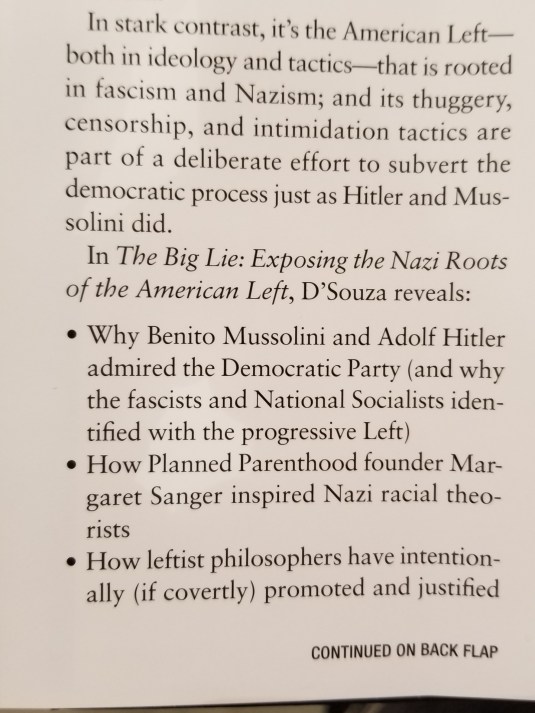
“Hey, in Costco the other day, you saw that best-seller with the conservative Christian idiot’s argument that the Democratic party is the actual heir to the Nazi party, admired by the fascists in the thirties, to this day the most fervent proponents of fascism in government.  You can read all that on the book flap, the Big Lie is the one being spread by liberals, who treacherously oppress the democratically elected president and claim he’s a fascist.  

“The book jacket implies that this popular right-wing Indian-American author will convincingly demonstrate that the left are actually the violent fascists, while the  Republican party, in contrast, has always been the party of ‘small government, political liberty, and economic freedom.’   Plus, not only did Hitler and Mussolini love and admire the Democratic Party, but Margaret Sanger, founder of Planned Parenthood, inspired Nazi racial theory.   So there!  In other words, eat shit, fuckface– I know you are, but what am I? ”  

Dinesh D'Sousa.jpg,

You’ll have to excuse me today dad, my attention span is really shattered by this anniversary of September 11, 2001.   

“Your’s and everybody’s,” said the skeleton.  “Living in a post-9/11 world, in a state of endless, infinitely lucrative war.  Since this posing gasbag was inaugurated, less than nine months ago, the U.S. has killed about as many brown civilians as Al-Qu’aeda killed Americans on September 11th.  The notorious Communist organ Newsweek– note the red banner– gave the number, as of July, at over 2,200 or an average of twelve civilian deaths a day. 2,996 is the number given for Americans killed on 9/11. Reminds me of that great, probably apocryphal quote of Stalin’s: the death of one man is a tragedy, the death of a million is a statistic.”  

Like I told the paternalistic nephrologist– if you get bad side effects from the chemotherapy she proposed you personally scored 100%, no matter that the odds were 40 to 1 against you getting the side effects.  

“That’s correct.  If you’re the last man to die for a mistake… there you go.  If you’re the sole survivor of a Yemeni family wiped out by a hellish man-made catastrophe brought against you by American munitions delivered by the Saudi air-force with strategic support from the American military: medieval disease, bad water, bombed home, shrapnel, white phosphorous, septic wounds … could I blame you for devoting yourself to violent revenge against America?”  

I don’t think so.   It’s all, as always, a question of whose ox is gored.  

Mel Brooks had that profound image of the difference between tragedy and comedy.  ‘Tragedy is when I break a fingernail.  Comedy is when you fall down a manhole and die.’  It’s whose ox is gored, and if you believe your ox has a soul.  Or if it has no soul, I suppose, how much of a monetary loss you suffered when your ox was gored.   That second formulation is more how it usually works.   You can’t put a price on a soul, unless you’re a poet or a mystic, but the body itself is worth its weight in organs and elements, and the labor it can perform.”  

You know, I get very few comments by anybody who may be reading these pages where I’m struggling to put together your portrait.  The most consistent, of those few, is a concern that I am ruining things by injecting ‘current events’ with their short shelf-life.   As a student of history…

“Yeah, you can call it current events, or you can call the various spins partisans put on events the first draft of history.”  

Sekhnet will see something Aaron Sorkin wrote a decade ago and find it prescient, it seems to describe exactly what this asshole-in-chief and his destructive appointees are doing right now.  Even though, in terms of history, the things he wrote about were well under way, had been going inexorably in that direction for some time.

“Well, it doesn’t take Nostradamus to predict the direction things are going, particularly when you have a deliberately dumbed down, distracted consumer culture, a commercial culture based on misdirection, with a political ‘dialogue’ framed by ads from ‘think tanks’ and highly paid ‘pundits’ who talk shit.  Especially when you factor in the deep history of racial hatred, denial, calculated distortion and division that has always been close to the heart of our great American experiment in democracy.  

“Like my boy Rush Limbaugh taking a handful of pills and spouting on about how liberal Nazis are exploiting natural disasters like these recent devastating hurricanes to advance their anti-freedom myths about human-caused climate disruption,” said the skeleton.

Add in the marketing funnels and targeted content sent directly to the phone of every American, according to their data-mined preferences, via ‘social media’, and you have the perfect storm.  

“You could argue that it would be irresponsible for you to ignore these things when we check in,” said the skeleton.

I don’t want to argue anything anymore.  

“Too late for that, Elie.  It’s in your nature.   Weren’t you the guy who started the day searching for the margin of Trump’s electoral college victory?  Impressive numbers, too, very efficiently done, a true surgical strike.  That fucking Robert Mercer really is a genius of data crunching.   Four swing states that netted him a decisive 75 electors in a democratic election he lost by almost three million votes.   He won three of the four states by a fraction of a percentage point.  He had margins of victory of 0.23% (Michigan), 0.72% (Pennsylvania), 0.76% (Wisconsin) and a whopping 1.2% in Florida.  According to Wikipedia, he won by 78,000 votes in three counties in Wisconsin, Pennsylvania and Michigan, a margin that gave him the 46 electoral votes of those states, with elegant economy — less than two thousand votes per elector.”

Do animals have souls?  

“Yes, absolutely.  You know they do.”   

Do Yemeni children have souls?  

“Please, Elie.  I mean, I feel your pain about all this, as the great neoliberal William Jefferson Clinton famously used to say, on his way to amassing a fabulous personal fortune, but… I mean… really.  Yeah, Yemeni children have souls.  Of course.   But you may as well apologize to the cockroaches in your kitchen sink as worry about those poor kids.  

“There was probably someone just like you in 1943, a person of tortured conscience, with too much time on his hands, agonizing into his notebook about the souls of little Jews who were being stomped into the dirt without a trace.  Unless that person conveyed his moral torment in a stirring and memorable phrase, had it published by a large media outlet, quoted by some famous opinion-maker, that little bit of civic minded anguish would meet the same fate as the Jewish kid caught with a smuggled loaf of bread under his coat, in some muddy shithole in Poland.”

Ain’t dat some shit?   

“Yop.   Happy marketing to you, Elie, and have a blessed September 11th.”

With that, the skeleton of my father fell back into the soft dirt of his grave, a big smile on his face, or whatever that expression was.


Waking from a Nightmare

The fucker shot me, by surprise, right there on Seaman Avenue.  We had a deal, I’d already given in, he was walking me at gunpoint to the subway, I was carrying the bag of evidence, ready to hand it over to the boss so he could cover up his crimes.  We were walking toward the subway on Dyckman Street, it was a nice day, we were making small talk.  

The guy stepped in front of me at the corner of Academy.   I stopped, waited for him to speak.  He said “you stupid fuck,” then shot me in the liver.  I fell to the street, feeling betrayed, thinking what a dick move that was.  Then I was awake, shaking my head.  It was all just irony after I woke up, no wound, no sweat, no shuddering, not even an after-shudder.   I’d learned, as an adult, to shrug a bad dream off.  

“Well, that’s what you’re supposed to do, Elie.  I don’t know where you learned it, but that’s one thing I never learned to do,” said the skeleton of my father.  “It wasn’t nightmares, per se, it was my daily, demon-ridden reality.  I never mastered the dispassion you need to recover from trauma, I was always flexing my muscles, weaponizing myself against any possible attack.  

“As your sister pointed out, if I lost a quarter it was the same, to me, as if you or your sister had been killed.   Sounds insane, and I suppose it is, but that missing 35 cents change from buying my newspapers would drive me crazy, I’d stalk from room to room cursing, turning the house upside down in an inconsolable frenzy.  Can I appreciate how insane that is, now?  Of course.  Could I have done anything about it when I was alive?  I never learned how.”

The only hope we have here, it seems to me, is waking from our personal nightmares.   I have little hope of convincing a world determined to annihilate itself, and everyone I care about, not to do it.   I can choose my personal reactions, somewhat.  That’s all the control we get in human affairs.  

“You know, Elie, it occurs to me now, as five hundred and thousand to one storms become more and more common, as the denial of human-made climate disruption grows shriller and more insane with each sweeping devastation — they do love to double down, these ignorant zealot fucks– that in seeing an enemy as an alien Other there is no chance of ever finding compromise, let alone wisdom.  

“We never talked about this, but in 1942, 1943, when the Nazis swept toward their ill-fated invasion of Russia, the Soviet Union, they crossed the area where my mother’s family was, in Belarus, and simply stomped all of them into the swamp where no trace was ever found.  As you know, after more than a decade of putting every available clue together, looking for a trace.  To the south, in the Ukraine, they finished off grandma and pop’s families, and you discovered exactly how horribly the end came to all of them.  

“A year or so of starvation, freezing, lice, disease, barbed wire separating them from the Christians, random murder, and then a march out to the ravine for the survivors.  Amid the banging of drums and the shouts of the drunken peasants some cries and whimpers could be heard all the way back in town.  Those were the sounds of grandma and pops’s surviving siblings and their families, as Ukrainians lined them up in rows, made them kneel, shot them in the back of the neck.  We never spoke of any of this, of course, and I and everyone else was dead before you learned all the details, finally, but there’s a point here.”  

Got you covered, dad.  The Jews of that area, not far from Khmelnitsky, a town named for famous Ukrainian nationalist and pogromnik Bogdan Khmelnitsky, had been persecuted for centuries.  In Vishnevitz, every so often, Ukrainians would ride into town, beat up and kill Jews, rape the women and girls, smash the Jewish houses and stores.   Then, when grandma was a teenager, Bolsheviks marched into the area, fresh from overthrowing the Czar, spreading the intoxicating story of world workers united, controlling their destiny, free from the polarizing hatreds of the past.   Grandma was swept up in it, along with many other hopeful, idealistic young Jews in that area, for reasons too obvious to explain.   This was around 1919.

Fast-forward to the 1930s.  The world economy had collapsed, there was a world wide depression, mass desperation.   The Communist government in the Soviet Union was consolidating its power on the surrounding areas, areas long disputed between Russia and Poland.  Including the Ukraine, at one time Russia’s “breadbasket”.  Stalin was in charge now, not exactly a political or moral philosopher.  Heavy handed, murderous, ends justify the means, psychopathic-type with a big mustache.   He decided to starve the Ukrainians into submission, killed millions with his forced starvation regime.   Made them starve next to mountains of their own wheat, guarded by machine guns, ready to be exported to hungry Russians.  

No surprise, a few years later, when the Nazis marched in, that Ukrainians would rally with the world’s most fervent anti-Communists, the Nazis.   Many Ukrainians were more than happy to lynch Communists and put bullets into Jews, aiders and abetters of the equally hated universalist Reds, and they felt supremely justified.   Not only was it no problem for them to take this bloody revenge, the ones who did so participated with zeal.  

“And to this day you shudder at the mention of Ukrainians, picture them like wild, demented monkeys, nimbly scrambling over the dead bodies of the Jews in that ravine, as their Nazi overseers grimly nodded,” said the skeleton of my father.  

Yes, but it’s pretty much an involuntary shudder, a mental picture that comes reflexively.  A second later I recall that there were always also loving, sensitive, decent Ukrainians on the scene, even as their vicious, enraged neighbors were burning Jewish kids.  

“Well, isn’t that special?” said the skeleton.  “I don’t mean to mock you, Elie, but, really, what the fuck?”


Childhood Nightmares

I’d wake up in terror frequently as a kid, heart pounding after a nightmare.   I developed a lifelong reluctance to fall asleep during those years.  I’d lie awake in bed with elaborate fantasy scenarios playing out in my imagination.

“Well, the escapist fantasy is understandable, it was better than thinking of those guys in the attic, over your bedroom, maneuvering that giant wheeled guillotine up there,” said the skeleton of my father.  “You thought one night to reverse head and feet, to avoid being decapitated, you turned around in bed, then realized, with a shudder, that your feet would be chopped off, which was almost as bad as losing your head.  Curled up in a tight ball didn’t help either, you realized that being chopped in half was pretty fucked up way to go too.”

I guess my choice was an image like that, and the bad dreams that followed, or the even more horrifying recognition that I was a little kid in the hands of a real life madman.  

A real life madman?  Isn’t that a bit harsh?” said the skeleton with an exaggerated sniff.  

Harsh it is, harsh it was.  As a kid you have no way to make sense of constant hostility focused at you.  I suppose the nightmares were my way of somehow trying to make some kind of sense of  it.  I can only imagine the nightmares you used to have as a kid.

 “I have no memory of them.  My waking life was nightmare enough,” said the skeleton.  “You know, I take your point about the nightmares, I never thought of them that way.   You recall I used to reassure you when you woke up drenched in sweat.   It’s fairly easy to reassure a frightened child that he’d only had a bad dream, that he was awake now, everything was okay.  The underlying reality that gives rise to nightmares — you’d better live a long life, dedicated to steady interior research, if you expect to get any useful insights into that.  I gave you a gift the night before I died, did I not?”    

Yeah, you did.  

“I knew it was important to you that I acknowledged that I’d felt you reaching out to make peace with me many times over the years, and that I, not you, had been the immature asshole.  You, from an eerily early age, were trying to be the flexible adult, I was always rigidly trying to be the invulnerable two year-old.   That’s an unnatural situation for a child to be in, a disorienting role reversal.   I knew it would be useful to you to hear me admit you’d been right all along in your approach, and that I’d been the fucking idiot.”

Hence those early years of frequent nightmares, other faceless terrors.  I was surrounded by fearful shit, hostility that defied any rational explanation but was always presented with the irrefutable evidence of its rationality and I had no ability to grasp that irreconcilable contradiction, until I got older, and got more and more angry about it.  

“Well, there is an undeniable use for anger,” said the skeleton.  “It provides adrenaline, it fuels the ability to fight.  It may never allow any insight, or the possibility of positive change, but in a pitched battle, it can be helpful to remain angry.  Look, the many bad things that can be said about anger aside, it’s preferable to depression.”

Depression is anger turned against the self, they say.  Which makes a certain amount of sense, if you think about it.   Anger grants no quarter, no pardon, no excuse or mitigation.   Anger is unipolar– I am right, you are an asshole. Imagine that force turned against yourself.   Every thought is immediately answered by an internal voice that tells you, harshly, “shut the fuck up!”    

“Your brilliant, borderline psychopath classmate in law school gave you the exact term for that, ‘internalizing the victimizer’.  That’s how it’s done, Elie.  You hear the voice over and over as a kid ‘everything you touch turns to shit’, ‘you may win this battle but you’re going to lose the war’ — all the rest. It becomes a self-running script you start unconsciously reading to yourself whenever you face a stressful situation.  

“There’s a common cure for that, of course.   Work.  If you think keeping yourself constantly on the clock doesn’t work, think again.  It worked for me, no time for self-pity or self-examination, I had a second job I had to get to. Your mother, who you believe was depressed for much of her life, got up every morning, made breakfast, took a shower, went off to work.  She didn’t fall victim to it again, in a big way, until I checked out and she spent five years mostly alone at the end of her life.  Which, of course, anybody could understand would be depressing.  It’s lonely to be a widow.”    

Yes.  At the same time, a few days before she died, when I managed to get her an appointment for physical therapy– which they’d denied on the bullshit grounds that she was too demented to recall the therapist’s instructions– she was visited by a nurse and two other women from the hospice.   They went into the bedroom to speak with her.  I was in the kitchen, out of earshot.  Suddenly I heard them all laughing.  The nurse came out with a big smile as they were leaving and said “whatever you want to say about your mother, she is certainly not demented.”   They were still chuckling as I let them out on to the catwalk.

 “And the relevance of this little reminiscence?” said the skeleton.  

Yes, it was understandable that she was depressed, particularly toward the end of her death from that wasting, pinching, painful cancer.  At the same time, she still made a room full of women crack up.  

“Well, some of the funniest people in the world are the most in pain,” said the skeleton.  “Doesn’t take being George Dubya Bush to realize that, does it?”

No I suppose it doesn’t.   You were, are, a very funny motherfucker, dad.  And in the most pain.  

“Yop.”