Placeholder

I spent the weekend, with ambitious plans, too distracted to do much, though I did do a mean version of Yer Blues for a while there downstairs.  My fault, really, being distracted, still letting petty, personal vexations twist and constrict me that way.  I am 62, it is past time to get much better at not being squeezed by extraneous emotions.  I’m not responsible for the misery of enraged, terrified, provocative people, I’m responsible for my own thoughts and actions, keeping my focus on what I need to do, in spite of all the noise all around.   

After all, the world is as the fox told Pearl in The Amazing Bone by the immortal William Steig (may he rest in peace).  
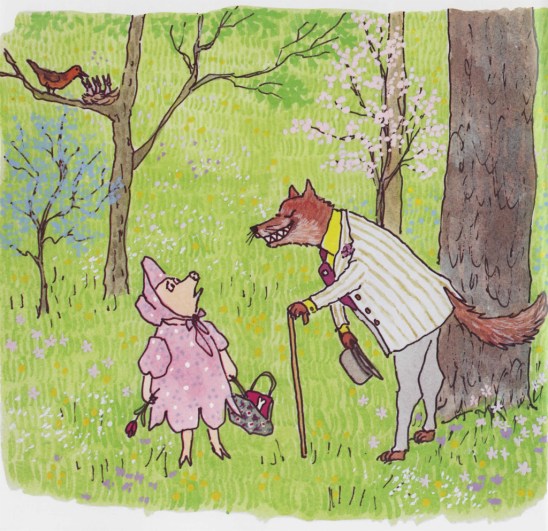
amazing bone.jpg

Pearl, the pretty little pig,  taken home by the smiling, courtly fox, is trussed and ready for the oven, flames already leaping inside the wood burning stove.   She pleads with the fox who is cutting up vegetables with gusto and whistling happily thinking of the tender, succulent pig he is about to enjoy.  Pearl pleads to the fox to spare her life.

“Why must you eat me, Mr. Fox?   I am young, I want to live.  Please!” The fox looks over at Pearl sympathetically. 

“Why are you asking me?” says the fox, “how should I know?  I didn’t make the world.”   (This isn’t the actual Steig line, the correct quote is below [1])  The fox finishes preparing his salad.   As he leads her to the door of the oven he offers further words of solace:

‘I regret having to do this to you’, said the fox. ‘It’s nothing personal’. 

It is the bone, it turns out, who says to the fox:

“You must let this beautiful young creature go on living. Have you no shame, sir!”

The fox laughed. “Why should I be ashamed? I can’t help being the way I am. I didn’t make the world.”  [2]

The wisdom of that “I didn’t make the world,” however cruel its particular use might be,  has always stayed with me. 

It’s an answer as illuminating as “because he can” to the question of why a dog licks his genitals or how a Supreme Court justice with a glaring appearance of impropriety can insist he has no legal or moral obligation to recuse himself from sitting to hear the case.  

“I didn’t make the world.”  

Truly.  I had no hand whatsoever in the making of this world.

My only work here these days is coherently setting down what I’ve seen, heard, learned, discovered, read, in an effort to understand as much as I can.  I don’t know what compels me, exactly, or why it seems so necessary to me to write down clearly as much as I can write  down in whatever time remains.  

I know it has something to do with this cosmic less than wink of an eye we each have to be alive in, this flickering miracle of consciousness we so briefly share.  How intolerable is it, therefore, to be forced to march in a column, for an insane reason, life and death decided by the worst and most violent humans on earth at any given time?   To wait a century or more for rights our Constitution provided for almost two hundred and thirty years ago?  Is it just me?  I don’t think so, my friend.

(placeholder)

 ii

A great book is like a fascinating conversation.   When you hear the voice of someone who reads a book with feeling, the author’s ideas coming out clearly in the spoken words, you’re having a conversation with those people.  The conversation of reading is as real as, and often much more substantial than, many actual conversations you may have with other living people.  Particularly conversations in these contentious, violent times, which can burst into flames quicker than you can say “wait…”.  

I have been listening to two fantastic audio books that I cannot recommend highly enough.   Eichmann in Jerusalem (Hannah Arendt) and Dark Money (Jane Mayer).   I intend to post full reviews of both here at some future time, hopefully some time this summer.  In fact, the NY Public Library is into me for two weeks of overdue fines already for the paper copy of Eichmann I have been making notes from. I have to buy a copy ASAP.  

(placeholder two)

iii 

I offer the following as an example of the kind of thing that, designed to eliminate stress, actually causes more stress, a kind of forgetful oversimplification that can lead to a fist fight.   It is the lazy mind’s approach to thinking.   Take a snapshot of the idea, and that’s the idea. The snapshot is the idea, get it?  If you hold the snapshot, the still frame from the movie, you’re holding the actual idea.   Nuance is for fucking eggheads, and, anyway, who can keep all that contradictory shit in their heads, you know what I’m sayin’?  The snapshot, on the other hand, is clear as the nose on your face.  Often the only possible response to a brilliant presentation of great nuance is “Fu-uh-uck YOU!”    That response often carries the day in the debate between a snapshot and the actual person in the photograph.

That’s just the way it is right now, when so many are angry, fearful, desperate, riled up, not going to take it anymore.   We didn’t make the world.  Consider, though, how limited the essential truth, if any, is contained in a single snapshot of anything.

There is a book called Man’s Search for Meaning, by Viktor Frankl.  I found it in the public library in Fresh Meadows back when I was in high school.  I read it and recall being very impressed by it.  An editor at Wikipedia did a wonderful job describing it:

Man’s Search for Meaning is a 1946 book by Viktor Frankl chronicling his experiences as an Auschwitz concentration camp inmate during World War II, and describing his psychotherapeutic method, which involved identifying a purpose in life to feel positively about, and then immersively imagining that outcome.

Toward the end of the book (a longtime international best-seller) Frankl writes, as I recall, that the highest form of personal purpose is one you’d be willing to die to defend.  I remember thinking as a sixteen year-old what a beautiful thing it must be to love someone or some value so much you’d die to protect her.  I also recall being a little troubled by the statement, even as a teenager.

Over the next few decades I’d come to see the danger of this statement, removed from the humanistic context of Frankl’s book.  Frankl was talking about defending decency against indecency, not endorsing some crackpot’s idea of hate and violent revenge that other enraged imbeciles would willingly die for.  But take that one statement by itself, present it as a snapshot of the book and you have the humanitarian Frankl advocating suicide bombing, killing abortion doctors, performing any of the many atrocities, undertaken for the sincerest of murderous beliefs, for which certain humans are rightfully abhorred.   These atrocities reflect badly on all of us humans, when you think about it.  Although we, none of us, made the world.

But dig how that works.  Out with the filthy bathwater, fuck the baby!    You read an entire book, enjoy and get engaging ideas from the author’s conversation, agree with virtually everything you read.  Then you find a paragraph toward the end that causes your brow to furrow.   You underline the sentence about being willing to die for your beliefs and put it next to a picture of fucking Mohammed Atta [3].   Then you take your snapshot: Frankl says Mohammed Atta is an example of the highest form of purpose and meaning in human life.   Based on that, the rest of the book can be dismissed as an intolerable incitement to fanaticism and murder.   You cast it on to the bonfire, along with Mein Kampf, The Art of the Deal, Atlas Shrugged and the rest of the worst of best-selling twentieth century dreck.

A stray thought: could this hateful principle, seemingly applauding fanaticism, have possibly come from the same book by the same Victor Frankl portrayed here?   Remove nuance from any conversation and all that’s left is simplistic folly, or worse. 

iv

When my weekend of agitated distraction was about to begin I had an ambitious, perfectly achievable, though challenging, plan.  I was optimistic about making a good start on it, with two days to myself, before my concentration was shattered by an intolerably annoying personal sideshow I was unable to put out of my mind for long.   My goal is a 3,000 word publishable abstract of my 1,200 page manuscript about my father’s life and times.  This would be published somewhere and I would send the enticing published clip out to literary agents to try to hook one to sell the book proposal, to get me some money, an advance from a publisher.   I will take the first step now:

the first draft is here  (placeholder)


[1]  I went searching for the exact quote, as I am bad at exact quotes in spite of having a better than average overall memory and spending hours daily carefully weighing words. You’d think I’d be better at quotations, but I really am quite lousy at getting them perfectly correct.   I get the sense, almost never remember the exact words.

My own copy of Steig’s masterpiece is buried somewhere in my apartment.   I found nothing on-line to enable me to give you the exact, perfect Steig quote (he was a master of language in addition to being a great artist). I provide a link to a short animated clip, an advertisement of the copyright holders for the very best of perhaps six hideous video versions of this marvelous book read aloud on the internet.   I am seriously considering plunking down my $1.99, this is a beautifully done animation and aloud reading of one of the great books of all time.

[2]   Excellent description and review of  the Steig masterpiece, complete with quotes (yay!) and selected illustrations:  HERE.

[3]  Mohammed Atta was one of the 9/11 suicide terrorists who flew two 747s  into the World Trade Center.  His face, in the single snapshot of him most people have seen, is a mask of hatred.   The nervous Sekhnet and I  were at JFK airport for a flight to Spain, around 2005.   She had some anxiety about the flight, and time pressure (due to my habit of arriving at the last moment), and asked me to arrive with her three or four hours prior to our flight time, to avoid stress, and I had agreed.  While she slept contentedly on a bench in the terminal I walked around aimlessly with our valuables, sullenly counting the wasted minutes.  Over the PA there was an announcement asking Mohammed Atta to please come to such and such a desk.  The announcement was repeated several times.   I was glad Sekhnet was asleep, and figured the name they were calling over and over must be a common one in some parts of the world.

Preface fragment no. 3 or 4 or 5

Two and a half years ago I set out to write a memoir of my father’s life, a complicated life that had always been a troubling puzzle to me.   He was a man of high ideals, deeply held beliefs about justice, a great knowledge of history, sharp, funny, a lover of animals, underdogs and soul music, particularly Sam Cooke.   He was also, when the mood was upon him, a monster to his own family, conducting a relentless war over the dinner table every night.  A story that I thought might take a year or so to write has so far taken two and a half years.  The manuscript I have to wrestle with now is almost 1,200 pages, goddamn it.   I am continuing to wrestle with it, in my way.

It was tempting initially to structure the story of my father’s life with his dramatic deathbed regrets the last night of his life saved for the end, a kind of cosmic punchline at the end of a life insisting he’d had no choice but to strafe his children whenever he felt cornered.   He was literally cornered there at dinner, he sat in the worst possible seat at the kitchen table, landlocked between the wall, the counter with the toaster on it and the refrigerator, with my sister blocking his egress.  I had the best seat, right by the door, and often took advantage of it whenever I couldn’t stand the heat and had to get out of the kitchen.  

I came to realize, as I worked on the book, that setting the story up that way, with the big reveal at the end, was no favor to the reader or any kind of worthwhile dramatic revelation, really.   Not to say it wasn’t dramatic, or a revelation, but not one to save to the end of the story.  It’s not really a suspense story, or a mystery, though it’s also a suspense story and a mystery.

My father was a perplexing riddle, true, but perhaps every father’s life must be a riddle to his children.   When you think of telling the story of any life, boiling it down to a book, you are talking about a riddle.  Every human life is a riddle, human history is a riddle without an answer and much of what we experience here falls into that category.  I’ve had to keep this in mind as I work in a darkened room, trying to put together a puzzle that is missing many pieces, under the dimmest of lights.   The fragments, I think, are probably story enough.  Then again, I am not the judge of how much of a story I have managed to tell so far.


You can read all of it, in no particular order, here.

The other site I refer to at that link, while it does have some good photos and a selection of somewhat evocative early segments, hasn’t been updated for maybe a year and a half.   Feel free to check it out, but be forewarned.

The Skeleton pipes up

“I don’t mean to push you, Elie, not at all… and it would be hard to do from this remote grave, even if I wanted to — but any thoughts on draft two of my book?” said the skeleton of my father from the lush green graveyard just north of Peekskill.  “I’d hate to see all this work you’ve put in become another albatross around your neck.  That albatross necklace must be getting pretty heavy by now.”

Heavy enough.  It keeps my neck strong, anyway.    

“To the cutting room floor with this bullshit.   Just a question, Elie.  1,200 pages is a lot to go through.  The other night you had the perfect ten second gem of a memory to include, but you didn’t write it down, and now….”  

Over the years I’ve largely lost that once ingrained good habit of jotting everything down, particularly things that came to me out of the blue, things that seem perfectly obvious when you think of them, then are prone to disappearing completely.  

“Well, those things happen as we crawl toward the grave, I suppose,” said the skeleton, motioning around him at the graves, his and everyone else’s.  

I have a sort of plan, and Sekhnet endorsed it the other day.  I need to buy several reams of paper.  We got a new printer that supposedly gets amazingly economic ink mileage.  I have to put the manuscript on an external hard drive, take it to the farm, print out the whole bloody thing.   Then work with pages themselves.  I’ve never seen the fucking thing on a page, only a screen, like the one I’m tapping on now.   It’s impossible to flip pages here, only scroll.   There is a metaphor there for our modern digital world, scroll only.  

“Yes, these algorithmically aided young geniuses, with the world’s assembled information a click away, never flip through books, through indexes, through a card catalogue.  They get exactly what they are looking for when they search, every time.  Specific information, delivered refreshingly free of context.   The human brain seems to be changing in accordance with this streamlined information/opinion delivery system.   I think it’s a good idea to have actual pages to read, mark up, re-order.   Get to it, man.”

I’ve got to find an external hard drive here formatted for the Mac, copy the current pages and selected pages.   Something has been bugging me the last week or two and I need to get it written out, out of mind on to page, put those black symbols onto this nice white screen.

“Use your symbols, Elie, and don’t let my story meet the fate of Whippie the Slave Dog, and your brilliantly simple animation non-profit” said the skeleton, with the proper note of poignance.    Whippie was an inspirational character and her story would have made a beautiful children’s book, in some alternative universe.

One Day on Fifth Avenue

I must have been seven or eight, I think.  I recalled this the other night and wanted to write it down but forgot about it until driving down Fifth Avenue in a friend’s car a few days later.   Driving along the long stone wall along Central Park the forgotten incident flashed through my brain again.

I don’t remember much else about that day, except that, apparently, we had gone to the city by bus, from Queens.   Maybe we drove in my father’s car and the Long Island teenagers my father took to the Jewish Museum had come by bus.   I don’t recall if my sister and mother were there, but why wouldn’t they have been?   This was more than fifty years ago.  

After visiting the museum we were waiting on Fifth Avenue for the rented school bus to take us back to Long Island.  This was decades before everybody had a phone in their pocket.   My father, the director of the Nassau-Suffolk region of Young Judaea, a national Zionist youth movement (my father was fond, in those days, of imitating Arab leaders who referred to citizens of the Jewish State as “Is-rah-ale-eee Aggressors”) had a group of restless kids from the rural counties east of Queens lined up on Fifth Avenue.   At some point he sent me up Fifth Avenue to see if the bus was coming.   I walked off northwards on a mission.

About a block or so into my quest I was approached by three or four black kids about my age, maybe a year or two older.   They moved in a group toward the wall and, being a suburban kid with no instincts about these kind of things, I veered in the wrong direction.  I quickly found myself trapped between the kids and the wall.  They demanded my money.  I didn’t have any money, outside of a few coins that were in my pocket, mostly pennies.  They took the change.  It was less than a quarter’s worth.  It may have been 8 or 9 cents, which, in those days, could buy you a candy bar and a few chunks of Bazooka gum.   

They demanded to look through my pockets.   I was wearing some kind of jacket and produced what was in the pockets.   Outside of some tissues, which I always carry, there’s wasn’t much.  There was some kind of small, flat box that slid open.  Inside the box was a tiny pad and the ends of a few pencils, small enough to fit into the box.  Even at that age I felt desperate if I didn’t have something to draw with on my person.   The would-be muggers examined the box in disgust, pencils stubs falling to the cobblestones by the bench along the long stone wall.  I recall one of them bent to pick up a pencil and hand it back to me.   After the robbery they headed south, toward my father and the teenagers waiting for their ride.  

From a short distance away I watched my father intercept them.   “Get up on the goddamned bench!” he commanded, and they obediently hopped up on to the bench along the park wall.   When I got closer he called out to me, as though I was a stranger, “hey, kid, did these boys take anything from you?”   I shook my head, then noted the few trifles (they’d left me my box with the drawing stuff in it).  My assailants coughed up some muddy coins, which my father handed to me when I reached him.

I remember him chuckling afterwards.  “They probably thought I was an undercover cop,” he said.   It didn’t occur to me at the time that he was an adult man, over six feet tall, and they were a small band of children, prowling the wealthy strip by the park, looking for some coins to buy candy.   I certainly don’t condone what the tiny predators were out there doing, but, I have to say, they were pretty decent about the whole thing, as far as that went.  As far as I can recall, it was the only time I saw my father act the tough guy in public.   It was more usual to see him acting this way, against the wall, back to the shelf with the toaster on it, firing live ammunition at me and my sister over the dinner table.

Mistake in my father’s eulogy

I wrote the eulogy of my father following the guidelines of the man who was conducting the funeral:  give the facts of his life, sprinkled with a bit of his personality.

My father read the New York Times obituaries every day.   Shortly after my father died my uncle handed me a long obituary he’d written and told me to contact the NY Times and have it published.   With my hands full, writing the eulogy, trying to coordinate the funeral 1,200 miles away, I smiled as I took the pages and gave my uncle the famous, ever so gentle silent  “fuck you” he’d no doubt received many times before.  My father never had an obituary in the NY Times, as far as I know.

I suppose I am making up for that now, or trying to, in setting down everything I know about the old man, part wonderful friend of underdogs everywhere, part monster.  

I recently read over the eulogy as delivered at the funeral.  The guy conducting it got a couple of details from my aunt and uncle that he added.   He added in some prayers, which he chanted beautifully.  But most of it were the words I’d written about my father.  The facts of his life sprinkled here and there with hints of his personality.

I saw one asshole mistake in there, a mistake I can easily forgive myself for, under the circumstances, but an assholish mistake nonetheless.   I refer to my father’s lifelong friend Benjie as “a colleague he met at Camp TY”, in the context of the two of them, along with my mother, opening the restaurant Tain Lee Chow, which they operated for a number of years.   I don’t even mention his good friend’s name.  What the fuck?  This is the guy I mystified right after my father was buried by a comment he had no hope of understanding as anything but the kind of weird “fuck you” I’d recently given my uncle about his absurdly grandiose obituary.  The details of that bizarre dis are here.

Benjie had done nothing, outside of being the son my father never had.   Benjie, for his part, found the father he’d never had.   It was a blessing for both of them.   I was an ungracious jerk to reduce Benjie to a faceless business partner.  How easy would it have been to add “my father’s lifelong close friend Benjie”?  Outside of that mistake, I think the rest of the eulogy was pretty good.  I have cut and pasted it below, since it apparently is nowhere else on this blahg.


EULOGY 

Israel I. “Irv” Widaen was born June 1, 1924 to Harry and Eva Widem in NYC.   The Widem family lived on Henry Street in Lower Manhattan for the first few years of his life. 

They moved to Peekskill when “Azraelkeh” was a young boy where he grew up poor with his younger brother Paul.  Began kindergarten in Peekskill speaking only Yiddish, played sports, mastered English, graduated from Peekskill High in 1941.   At least one member of Irv’s class went on to serve as Mayor of Peekskill.

Irv was a member, as was Paul, of Boy Scout Troop 33 of the First Hebrew Congregation and they marched together in Peekskill parades under a banner representing the First Hebrew Congregation.  

He was Bar Mitzvahed (and attended post-Bar Mitzvah classes) in the downtown First Hebrew Congregation on lower Main Street, where services are still conducted to this day, even though the “new” synagogue is on upper Main Street, where a plaque on the front of the new synagogue memorializes Harry and Eva Widem.  

 Growing up he idolized the Jewish slugger Detroit Tiger first baseman Hank Greenberg. His identification with Hank Greenberg was so strong that his schoolmates called him Hank and referred to him as Hank in print in the High School yearbook. He remained a lifelong Detroit Tiger fan.

Drafted into the Air Force in 1943 where, in spite of having almost no mechanical aptitude, he was sent to mechanic’s school and attained the rank of sergeant. He served after the war in Germany where his crew had a mutt they named “Schicklegruber”.

It was during WWII that his name became “Widaen” while the rest of his family remained “Widem”.  A spelling mistake on his birth certificate, relied on by the draft board, resulted in the new name.

 Irv graduated from Syracuse University on the GI bill with a BA from the Maxwell School of Diplomacy and Public Policy, and went on to a doctoral program in American History at Columbia. While at Columbia met Evelyn Mazur who lived downstairs from his cousin Dinch Stamper and her family on Eastburn Avenue in the Bronx.

 According to him it was love at first sight.

 Evelyn was the most beautiful woman he’d ever met and her love changed his life.

 After initial resistance Evelyn was won over and has always maintained that Irv was the most brilliant, funny, caring and wonderful man she ever knew.

 The couple moved to Queens after living for a while in Manhattan.  Eliot was born in 1956, followed by Abby in 1958.

 Irv taught Junior High School, then High School – at Martin Van Buren in Queens. At Van Buren he was the G.O. advisor and won the esteem of many a high school student.  

 In the early days of school integration in Queens Irv went from school to school to speak to hostile white parent groups about the need to bring black and white students and their families together.

 He was more than once pelted with the proverbial rotten vegetables and traveled with a police escort. His addresses to school principals were greeted with similar enthusiasm.

 He was selected to be part of a “Mod Squad” unit at the NYC Board of Education that intervened in riot plagued schools once integration began.  

 Along with a folk singing blond female WASP, an ethnic Italian, a Hispanic and a couple of Blacks, this mutton chopped secular Jew rounded out the Human Relations Unit.

 As Coordinator of Pupil Programs he designed and implemented sensitivity workshops that used role playing, and team building workshops conducted with humor and insight to teach the leaders of student factions to stop fighting each other.

 His team won over these hardened inner-city teenagers and peace reigned in the schools, until the students graduated and their little brothers began killing each other a few years later. He became a master of street talk, jive and playing the dozens in those years.

 He moonlighted as the Director of the Nassau/Suffolk region of a Zionist youth group called Young Judaea. He later went on to become director of their national camp, Tel Yehuda in Barryville, New York.   He directed the camp for more than a decade and became national director of Young Judaea.  

 He influenced many teenagers during his years as director, and kicked more than one of his son’s friends out of camp as well.

He also kicked his son out of camp once.

With a partner he met at Tel Yehuda he opened the first Glatt Kosher Chinese restaurant in Queens. He ran “Tain Lee Chow” for several years with his partner and a Chinese chef, named, coincidentally, Mr. Chow.

 He had a lifelong commitment to Social Justice, Animal Rights and the environment. He loved animals and he and Evelyn always kept a dog as a pet.   He did not care for cats.

 He was to the end of his life disgusted by the reactionary trend of American politics.

An avid reader of the New York Times — and a daily reader of the obituaries — once he retired and finally bought the computer his wife lobbied for, he added about five daily papers to his reading list and spent two hours a night on the internet. He subscribed to Sports Illustrated and followed college and professional football, basketball and the Detroit Tigers.

 He had suffered anemia and weakness for the last two years.   He always maintained that medical care in Florida was the worst in the world and that old people were treated as fungible cash cows. His final experience bore this out.

 In spite of seeing as many as seven specialists a month for years, he died from a cancer that went undiagnosed until he got to the emergency room.

 On Saturday, April 23, as Evelyn prepared the fish and matzoh ball soup for their quiet seder meal, my father woke up from a nap yellow with jaundice and unable to lift his head off the pillow or move his legs.   He was rushed to the emergency room.  

He was diagnosed immediately by the doctor who palpated his swollen abdomen, as swollen with cancer-related acites.

 He died the following Friday late afternoon from a badly damaged liver that led to the shut down of his kidneys a day or two after he was hospitalized.

 Once certain that medical intervention was futile he chose hospice care and died within a few days. His condition was inoperable, his decision to have hospice care was informed and intelligent.

 He had no self-pity about the sudden news of his impending death and remained sharp, never losing his lucidity, even in his final minutes.

He died peacefully.

A personal note from his sister-in-law Barbara:

 “Irv was the best man at his younger brother Paul, and Barbara’s wedding 55 years ago.

 He was a man who could be depended upon with grace and compassion when a family member was in need.

 Barbara has everlasting gratitude for the manner in which he came to her assistance when both of her parents died suddenly.

 He and Evelyn were always gracious hosts when visiting them, whether at Tel Yehuda camp, their restaurant, Tane Lee Chow, in Queens) or sightseeing throughout south Florida.

 Their energy was awesome.”

 He is mourned by … [short list of names deleted] … and will be missed by many whose lives he touched.


Lunch with cousins (& the grasshopper and the ant)

My ninety year old cousin Gene introduced me, at his birthday party yesterday, as his only living relative.    His wife, sister and daughter were also there, along with a brother-in-law and a son-in-law,  but his point was taken.   His father, one of eighteen siblings (nine of whom lived, for a while, at least) was the only one who made it out of the caldron that was Hitler and Himmler’s Europe in the 1940s.  His father had survived by sheer luck.   An uncle in the U.S. had sent his future father a ticket for a steamship.  This was around the time of the First World War.  That uncle died shortly after the thirteen year-old arrived in America.  That was it for that side of the family.   No trace was ever found of anybody else, and Gene searched on at least two trips to Europe.

My grandmother and Gene’s mother were first cousins.   They had come over together right before the First World War on a steamship called Korfus die Grosse.  I never met that grandmother, my father’s mother, who died young before I was born, but I remember Gene’s mother very well.   Dintch was a bright woman with mischievous eyes and prominent cheeks that were often raised in a wry smile.   She also lived to be ninety or more, if I recall.   The rest of our family disappeared into that marsh south of the Pina River, across from Pinsk in what was then Poland and is now Belarus.   There is no trace of any of them, or even the muddy hamlet they all lived in, as far as any of us have been able to find out.

Gene explained our exact degree of cousinly relation yesterday.   Since my father and Gene were the sons of first cousins, they are, apparently, second cousins.   This makes Gene and me second cousins once removed.   I believe the same relationship exists with my cousin Azi in Israel.  His mother and my father were first cousins, so their children, Azi and Azrael (Israel), both named for their common ancestor, my father’s grandfather and Azi’s great-grandfather, were second cousins.   Or something– I’m pretty sure my analysis is faulty, now that I reread it.  I have never been good at this cousin business, probably because I have so few of them it never seemed to matter.

Chatting in the restaurant with Gene’s sister, I couldn’t help mentioning the 1,200 page manuscript I’ve drawn up grappling with my father’s life.  Gene’s sister has only fond memories of the witty, well-spoken Irv, and of my mother, another colorful character, an opinionated, earthy woman who loved a good story and a good laugh.   Gene’s much younger sister expressed interest in reading it, as Sekhent put the sales varnish on it, that it’s a story of history, and memory, and forgiveness and blah blah blah (actually, all she mentioned was history, but she strongly suggested the ms. is way more than a cv of an unknown man going on 13 years dead).

As is her way, Sekhnet pointed out to the group at the table that it is much easier for me to keep cranking out new pages than it is for me to figure out how to package and sell the book I’ve already largely written.  That’s the hard work, she pointed out, making the obvious a little easier for all to see.  Hard work, she made plain, is something  I constantly shrink from.    Like the grasshopper I am, think of that parable of the grasshopper who loves to play guitar, and mocks his constantly worried, constantly working ant neighbor (until winter comes and the grasshopper begs in vain for some food), I continue tapping here, instead of reading the whole thing and plucking out a succulent 15-20 page slice to send out to literary agents and get to the next step.

Since I have promised to send Sheila the whole megilla, I figured I’d seize the opportunity to select a strong 15-20 pages and send her those first [I sent her a random 53 page sampling– ed].   It will be much easier for her to deal with an appetizing slice than more than a thousand pages of sometimes rambling prose.  

In my experience, people have a very hard time reading even a five page story, unless it’s published somewhere, in which case they are all pleased to send a good word.  I need to cut out a strong section to get to the next stage.  How I will do this, I have no idea.  I do know I need a cup of strong coffee before I get started.  That is the very least I need.  You hear me, Sekhnet, goddamn it?

The Right to Your Feelings

“I’ve been thinking about this a lot lately, Elie,” said the skeleton of my father from his quiet grave on the outskirts of Peekskill.  “And I know you’re taking a break from the long research and first drafting of my life story and all that.   Something just occurred to me.  In every case in our family, where rage lasted thirty, forty years, as long as it took, neither party would acknowledge the feelings of the other party.   It was like a mirror offense, if you want to think of it like that, each one denying the other one the right to their genuine feelings of being unfairly attacked. 

“Think about it, Elie, Eli didn’t speak to his sister for what, forty something years?  I think of other grudges in the family.   It always boils down, it seems to me, to a refusal to grant somebody else the right to their feelings.  I was as guilty of it as anybody.  More guilty than many, actually.  When you take the trouble to make yourself vulnerable and express how you’re feeling, expose your weakness, your fear, there is nothing more damaging, more infuriating than being told you’re crazy, off-base, an asshole.   I had that down to an art form, of course, because I could always redirect any discussion to whatever direction I felt it had to go.  I was an expert in that sort of conversational jujitsu.

“It seems like a small thing, not to tell a crying kid to grow the fuck up, not to say to a moody teenager that she’s a victim of hormones coursing through her, making her irrational, not to deny somebody’s right to a feeling, to just offer a soothing word.   What is hard about offering a soothing word?  Or just being respectfully quiet as the person expresses how they’re feeling?   Maybe we’re all ego-driven beasts designed to feel our own pain much more than anyone else’s.  I don’t know.   It is not always our reflex to soothe, even our loved ones, sad to say, especially our loved ones.  We may rush to offer a solution, but that is a much different thing than acknowledging the other person’s true real-time suffering.   Should be easy, like not killing, or not stealing, but there is nothing easy about sitting with another person’s uncomfortable feelings.   If it was easy, not as many people would be killing each other, killing themselves.

“So I guess that tit-for-tat insensitivity leads to the classic vicious cycle:  you were brusque with me when I was in pain, so, what goes around comes around.    ‘Now you want to cry to me, you insensitive motherfucker?  Who gives a shit about your tears?  What about my fucking tears?’  

“That is always the question: ‘what about my fucking tears?’   Like that great formulation by Mel Brooks: tragedy is when I break a fingernail, comedy is when you fall into a manhole and die.  

“It’s quite a world, Elie, quite a twisted work of fiction, and facts worse than the most twisted fiction.   As Eli told you ‘this world couldn’t be more cockeyed and fucked up if I’d made it myself!’  But you already know that.  All I wanted to add today is that the right to have your feelings simply acknowledged appears to be one of the most abused rights out there.  This inability to comfort others when they are upset… hoo boy, big source of conflict, of rage.   It’s not any great wisdom I’m laying on you, it’s pretty basic stuff, but I just thought this was a helpful way to phrase it.  Someone whose feelings are routinely dismissed often goes on to shut down emotionally when faced with other people’s troubles.

“When I felt bad as a young kid, I got whipped in the face.  Not really the response you hope for from your mother, of course, but there you are.  So much easier to picture the damage when you think of it as a refusal to grant someone the right to feel the way they feel.   You can’t argue with a feeling, if you’re a kind person, anyway.   The first line of help is let the other person express how they feel, take it in, acknowledge it.    You will be lucky to find one person in your life who has this essential skill, who makes a habit of listening.  

“Usually, of course, it’s ‘well, I think you should try to think of it, not as being whipped in the face, but as your mother having intimacy issues that have nothing to do with you, baby.   You shouldn’t feel bad that you’re whipped because you’re hungry, you see, because your mother has terrible problems of her own.  Maybe if you focused on her pain when you’re feeling like a victim, you’d realize that she has it much worst than you do, and you’d stop feeling so sorry for yourself.   Phew! your diaper stinks, kid.  You really should think about using the toilet, like everybody else.  Why do you want to go around smelling like shit?’

“Do you get the point I’m making here, Elie?” said the skeleton.

I did, but I said nothing, my mind and thoughts being far away at the moment.

“Asshole…” said the skeleton, reclining back into the soft earth.

Walking down the street where I grew up

Strolling in Queens the other day I turned the corner and walked up the hill to the little house I used to live in [1].  As I walked up the incline Michael Siegel or I used to sprint down chasing a ball that got away, or where we made our networks of twig and blossom dams to try to halt the flood from the sprinklers in its race to the Turnpike, I was thinking of that old cliche ‘you can’t go home again’.   My childhood house was right there, tastelessly retooled, with a car that left muddy tracks on the sidewalk parked at a rakish angle on the unkempt lawn.   “Classy,” I thought, as I snapped a picture for my sister.   The lawn is now mostly dirt.

You can’t go home again, unless you want to be arrested for breaking and entering.   Even then, of course, nothing remains of the home you once knew.  The people are strangers, the ones you shared the home with once now mostly dead, the decor is completely different, the smell of the place is unrecognizable.  A pointless exercise looking at what has become of your former home.  Home, of course, is kept in your heart, in the memories of the time you lived there.  The comfort you felt there you can feel anywhere, in a way, as the entire world is now your home.    

The little house my father grew up in was a place of abject misery.   His rough uncle Aren owned the house and paid the bills.  My father’s father had two eyes, a nose and a mouth, and tried to keep an unaccountably mischievous expression off his face as he shrugged through a life of extreme poverty.    There is a hint of that expression in his eyes in one of the two existing photos of the man I am named for.  

The photo is taken in the dark sanctuary of the First Hebrew Congregation of Peekskill where he worked as an unpaid janitor.   He wears a suit and a fedora, stands next to the wife, wedded to him in an arranged marriage, who hated him, his younger son on the other side of the wife, also in a suit.  My father must have been off making the world safe for democracy when the photo was taken.  That elusive expression on Eliayhu’s face, close to breaking out into a chuckle, but well-practiced in holding it together, one of the only clues I have about my grandfather.

There is no hint on my grandfather’s face that this is a man capable of rage.   It certainly was not allowed him, that much is clear.  I would imagine that only my grandmother screamed in that house.  In the little house I grew up in we all screamed at each other.   Progress, I suppose, if you want to think of it like that.  

I stood in the street between my old home and the Gerwitz house, and smiled to see the little jockey, much tinier than I remembered him, still holding his arm in the pose that he used to hold the lantern.  A wooden sign with the address, minus one digit, has replaced the lantern.  Gerwitz was a rich man, my father told me, but his former home, a showplace at one time, in the old parlance, has fallen on hard times. Like the American Dream itself, I thought, as I took out my phone again to immortalize the joint in a photo and share it with friends and strangers on a website here in Cyberia.

20180316_165914.jpg

Pretty shabby looking manse for the richest guy on the block.   Of course, during my childhood, having a million dollars made you a rich person.  Nowadays that’s like having a quarter.  Chump change.  A million dollars will hardly buy you membership and annual dues at Mara-Largo, if you intend to do anything else with your money.  Back when Gerwitz was rich a Cadillac cost $6,000, same as a year’s tuition at Harvard, at the time America’s most expensive university.   Nowadays… forget about it.  I don’t know where Sam Gerwitz got his great wealth, he may have been a lawyer, or possibly in advertising.  The source of his fortune is a mystery I have I no worries about.  Sad, though, to look at the shithouse his once-majestic showplace is now.

If you are born to a family with enough money, and you do nothing to get disowned, all you need to do is grow up, inherit it and watch your fortune grow.   You are entitled to feel entitled because you don’t rely on entitlements like the poor people, parasites who grow fat like tics sucking on the wealth of others.  

Back in Germany at one time these “takers” (as opposed to ‘job creators’)  were classified as “useless eaters”, they lived their lebensunswertesleben (“life unworthy of living”) until the state made the arrangements to be done with them.   The German State in the late 1930s started its infamous mass killing program with eugenic euthanasia, gassing mentally defective German citizens, clearing their madhouses and asylums of people who did not deserve to eat.  

The family members of the murdered were lied to about the cause of death of their random institutionalized defective.   Few others in Germany knew or much cared what happened to a weird and unproductive group of chance mutations, Mongoloid teenagers, demented men and women in their forties, fifties and sixties, the retarded, schizophrenics, adolescent catatonics. 

Civilized people, moral people– informed people who learn about a program to kill ‘useless eaters’ — people with feeling human hearts, of course, largely would not agree to their government rounding up, roughing up and killing society’s most helpless citizens.  It is a historically high bar, though, this simple morality.   When angry, desperate people are whipped up enough, and pointed at the enemy, as often as not the blood of the weak will run in the streets.


[1] The Little House I Used to Live In is also the title of a beautiful instrumental by Frank Zappa, a wonderful version of which he played on the Live At The Fillmore album I was in the audience for back in 1971.

Accepting Reality

I had a random thought just now, listening to the president’s bold new plan to meet his stable genius counterpart in North Korea (something the U.S. Secretary of State himself didn’t know about as recently as yesterday) that when I was growing up we knew virtually everybody on our block.

I thought of Sam Gerwitz, across the street, who my father told me was very rich.   He must have been, he and his wife had a little statuette of a jockey, a small white fellow (his face and hands may have been painted pink during my early childhood), on their front lawn.  He held a lantern illuminating the path from the sidewalk, a path to their front door with a large white column on each side.  He was exactly the kind of little jockey Frank Zappa sang about knocking off the rich people’s lawns in his gospel-tinged Uncle Remus.  

I thought of the Meltons down the street, their daughter Joy, and Pierre, their dog. My father came in angry one day after work, carrying his battered brief case. Pierre had apparently loped on to our front lawn and left a pile of steaming cannon ball-sized turds.   I don’t remember what kind of dog Pierre was, possibly a standard poodle, but my father was outraged that the Meltons let him run wild to gleefully defecate on the neighbors’ lawns.  Melton might have smiled, observing his dog taking the Arnold Palmer putting stance and letting nature take its course.  I just remember how outraged my father was, and who could blame him?

The point of these quaint recollections is that I could go down the block, certainly our end of the street, and name every family, and family member, in every house, the Bengles, the Ticks, the Weissmans.  Such is not the case for most children growing up today.

The Good Humor man knew our dog Patches and would front her a cup of vanilla ice cream (which he dutifully opened for her and placed within reach of her tongue) until a human came out of our house to give him the ten cents. “Patches would come running, along with all the neighborhood children, when the music from that truck started,” my mother reminded us.

In those quaint days on the leafy streets of Queens, New York, we led what seemed an idyllic childhood.  My best friend Michael Siegel and I built a series of forts (in peoples’ back yards), formed the Waterbugs– a secret society dedicated to running through every sprinkler they passed– made an intricate system of dams in the street when the sprinklers sent water in rivulets down the hill to Union Turnpike, played baseball in the street.   Nobody feared the Good Humor man, or any local shop owner, as far as any of them being a child molester.  It emerged, years later, that my best friend’s father was a pedophile, but apparently such a gracious host, so gentle and loved by the boys on the block that several stood crying as the cops led him away.

Not to imply by these sentimental little vignettes that life in those days was like the Great America our imbecilic president claims he’s trying to bring back.   Yes, I grew up in a stable neighborhood of well-tended lawns, on a quiet street where I knew everybody’s name.  But, as Woody Allen’s slippery character evasively answered in The Front, when asked under oath if he knew a certain suspected Communist screenwriter: when do you really know somebody?   Did the neighbors hear our screaming fights at the dinner table every night?

The public school I attended was segregated, a decade after the Supreme Court ordered an end to the racist practice.  I remember the first black children arriving at our school, on the E, F and G buses, at the end of a bitter war I also remember, during which my mother’s friend and pro-integration comrade Mildred Rose received a vicious letter with COMMIE scrawled across the envelope.  I recall Mildred’s horror as she told my mother, gasped the word COMMIE, the look of concern that crossed my mother’s face.  The word itself was one of the funniest things I’d ever heard. My friend Robbie and I began using it daily, calling each other and everyone else Commie and laughing at how it was always so fucking funny. 

Meanwhile, largely unknown to us, our government was engaged in an existential war on Commies everywhere, in the name of freedom, had been since a decade before our births.   In the name of freedom charismatic John F. Kennedy quietly sent military advisors and tons of weapons to help a corrupt Vietnamese regime fight the Commies led by Vietnamese nationalist hero Ho Chi Minh.    An invented pretext allowed Kennedy’s successor to escalate the war, a war to prevent all the countries of Southeast Asia from falling like dominos to Communism if Vietnam was lost to the godless Commies.  The “Domino Theory,” like “Manifest Destiny” before it, was good enough to sustain an unimaginably gigantic campaign of organized violence and mass murder for years.

Here is what I am getting to about accepting reality.   The reality then for me, as I became a teenager, was if the Vietnam war had continued another year or so, I would have had to figure out how to get out of the draft, like war-loving Dick Cheney, Dubya Bush and Donald Trump had, or be sent over there to fight for American freedom by burning the villages of Vietnamese Commie sympathizers on “our” side of the arbitrary line drawn on a map when the northern part was ceded to the Commies after the expulsion of the French colonialists not long before I was born.  

Much of my childhood had been spent watching atrocities on TV, exciting war news about a war no more sensible, or justifiable, really, than the First World War.   The scores ran like obscene basketball scores across the bottom of the screen.  Yesterday we won 1,396 to 55.  We killed 1,396 Commies, they’d only gotten 55 of us.  Later we learned how the scores were arrived at:  kill any Vietnamese guy between 12 and 60, score one for us.   All presumed fucking Commies.

I remember seeing a marijuana-related piece on the nightly war news, which we sometimes watched during dinner on a small black and white TV with rabbit ears.  The piece was a brief aside about the rampant drug use by American soldiers in Vietnam (thousands came back addicted to heroin).  A couple of smiling grunts demonstrated the ingenious technique of using a gun barrel as a pipe for smoking inhumanly large lungfuls of ganga.  They’d create a burning pile of the weed at the top of the gun barrel and one soldier would blow the smoke forcefully through the gun barrel into another soldier’s mouth.  They called it shotgunning.  I remember the poor bastard who’d been on the receiving end of the shotgun, an American kid caught in an endless jungle war in toxic quicksand, falling over backwards laughing, expelling vast, thick plumes of smoke.  The news correspondent mentioned the name of the god-forsaken place they were sitting and signed off.

There was a massive anti-war movement, and I attended many mass protests as did most people I knew, but the war machine raged on for years.  Many of us marched out of outrage against what was going on, the horrors being committed in our names, and fear for our fate if this insane war was not ended.   Our leaders spoke high-mindedly about ending the war on our terms, Peace with Honor.  One slogan the anti-war folks had was “Killing for Peace is like Fucking for Chastity.”  After the American attack on Vietnam (which included vast quantities of chemical weapons like Dow Chemical’s Napalm [1], a flammable flesh burning weapon from hell)  finally ended our leaders realized an all volunteer army was better for morale, and public support of any war.  The end of the draft had the great benefit of depriving millions of a personal stake for protesting American military adventures to wipe out godless Commies (today the enemy is “terror”) wherever they might be hiding.

Accepting reality means, on one level, accepting that there is really nothing we can do about the irresistibly obscene profits of those who make weapons.  Can’t sell the goddamned things and have ’em sit in a fucking warehouse, governments ain’t going to go for that on the gigantic scale we need to make it worth keeping the factories going full-time, keeping everyone employed in the munitions industry.  Got to have wars, constantly, everywhere we can.  It’s a sad reality, but military force is the only thing these evil motherfuckers understand.  When Trump dropped “the mother of all bombs,” devastating a square mile of Afghanistan, he got a standing ovation from the spokesmen for a nation grateful that he was finally acting “presidential”.

Talking piece of shit and chief apologist for our culture of gun violence Wayne LaPierre reminded me the other day, with his snide dismissal of godless left-wing attempts to cynically exploit tragedy and manipulate the public after every single isolated and unfortunate high-profile mass shooting of school children, of a long dead activist whose name has become a snarling point for patriotic right wing pundits: Saul Alinsky.  I reserved Alinsky’s 1971 Rules for Radicals from the public library and a few days later picked it up at the branch that is scheduled for demolition, as soon as all the ULURPs are signed off on and the checks are all cut to interested parties.  

The book is a guide for practical actions to steadfastly but nonviolently change hearts, minds, practices and laws.  During his prologue Alinsky states emphatically that the revolution he advocates has nothing to do with Communist revolution, although Communists have written virtually all of the manuals for revolution in the past century.  He states several times that violence is not a sensible option for affecting positive social change in a democracy.   He points out the failures of every revolution by force, how quickly the new oppressors entrench themselves in self-perpetuating power.   He makes the point that social change, imagining and creating a better world, requires overturning many core beliefs of the status quo.  

The U.S., at the time he was writing, had produced 1,600 tons of nerve gas.   We weren’t going to use it, of course, but we needed 1,600 tons of it since the Commies were intent on converting every American to a slave.  Follow that logic, if you can.  That deadly shit, the kind of stuff that, if his forces employed it, would justify a righteous attack on the murderous Mr. Assad in Syria, is now at the bottom of the oceans, waiting harmlessly for God knows what.  Nerve gas is an inhuman, universally condemned chemical weapon, although, it must be said, the U.S. still produces and sells White Phosphorous, which burns unstoppably through flesh and bone and the use of which is considered, by many, to be a war crime.

How does the world get better?   By people of conscience organizing, imagining a better future, creating effective nonviolent battle plans, improvising smartly, using the mass media to further our narrative of how the world should be.  I have not read very far into Alinsky’s book, but it invites me to imagine the world and the kind of principled action he is talking about.   You can’t kill your way to peace anymore than you can fuck your way to chastity.  

When I was eight racist police chiefs were turning high powered hoses on blacks who were intent on voting, using public bathrooms, walking on the sidewalk instead of the street, not being lynched for the crime of making eye contact with their white superiors.  I am now sixty-one and racist government officials still fight the idea that just because significant numbers of unarmed blacks are killed by the police every year, in numbers grotesquely disproportionate to the percentage of blacks in America, that we have a systemic problem here.  The problem is not widespread racist injustice, according to these officials, it’s fucking agitators, lawlessness, troublemakers, whistleblowers, goddamned ‘citizen journalists’ with their video phones, malcontents, racist black terrorists, Commies.

Homo sapiens, the descendants of apes who now rule the planet, calls itself “wise man,” sapiens apparently meaning wise.   We are wise enough to combine in huge numbers, animated by abstract beliefs, and do amazing things.  Sadly, one of the most common and consistent of these things is organized mass violence against other groups of humans, against any species or ecosystem we choose.  We were wise enough to rise up, from an insignificant prey animal, and organize ourselves, collectively, during the geological blink of an eye, into the apex predator on the planet. 

When President Obama vastly expanded the drone killing program his people came up with something called the Signature Strike.  It might have been Cheney’s people with that innovative idea, I’d have to ask Jeremy Scahill [the program apparently started in 2008 at the end of the Bush administration– ed.]  [2].   The theory is fairly straightforward: certain actions in certain areas are the signatures of terrorists and militants.  When we detect a pattern of such things we send a drone to kill the unknown persons who are engaging in things terrorists tend to do.  When we count the dead bodies, any male body between certain ages is counted as an enemy combatant.  As simple, and effective, as the body counts in Vietnam.   You hardly need a scorecard to know that if we kill more of them than they kill of us, we are winning.

We homo sapiens are capable of amazing things, creating transcendent beauty.   We can move each other to cry using words, sounds, sights, tastes.  We can laugh, and make each other laugh, by these same devices.  We are also the most violent, insane, unbending motherfuckers on the planet.   Can you imagine a better future?  We must get busy finding others who share this vision, organizing, successfully spinning our vision of a better future correctly in the mass media, influencing the perceptions, confirming the most decent innate beliefs of our fellow citizens.  

Failing this, we’re all fucking dead, my friends.   The New York Times may put a nice spin on much of this, you know, how freedom and progress are on the march, and the world is a pretty good place, never better, really, if you can afford to buy the things that make it worthwhile, of course, but none of their bodies are on the line, until every human body on the planet is on the line.  Which, one could argue, is now.


[1] Here’s a surprise for you, gentle reader:

In the 1960s, the Dow Chemical Company re-partnered with Badische, the German company that had produced Zyklon-B, the gas used to execute people in Nazi death camps, and formed Dow-Badische. Dow-Badische created and produced Napalm-B, an updated napalm consisting of “25 percent gasoline, 25 percent benzene, and 50 percent polystyrene”.[9] After news reports of napalm B’s deadly and disfiguring effects were published, Dow Chemical experienced boycotts of its products, and its recruiters for new chemists, chemical engineers, etc., graduating from college were subject to campus boycotts. The management of the company decided that its “first obligation was the government.” Meanwhile, napalm B became a symbol for the Vietnam War.[10]

[2]  Signature strikes began during the Bush years, in January 2008, as the US intensified drone strikes in Pakistan. When Obama entered office in 2009, his administration picked up where Bush left off and exponentially increased the number of drone strikes. During his eight years in office, Bush launched 51 drone strikes in Pakistan and killed between 410 and 595 people. Obama, so far, has launched 419 drone strikes in Pakistan, alone, and killed over 4,500 people in Pakistan, Yemen and Somalia since 2009.   (this was as of August 4, 2015)

source

Lydia T. Shize-kopf

My father had a playful side to him that popped into view once in a while.   Before he was married he used to wrestle with his little cousin Azi, a man who looks uncannily like him.   Azi was Uncle Aren’s grandson.   Azi told us recently that when my father got engaged, and brought his finance over to Azi’s house,  Irv took young Azi aside and explained that they wouldn’t be able to wrestle so much anymore as Irv now had a new wrestling partner.

My father rarely passed up a chance to hoist a small dog by the armpits and slowly rock the dog back and forth as the stiff armed dog gave him an uncomfortable look. I can perfectly see the look on my grandparents’ Chihuahua Bunny’s face as the little dog endured this odd swinging exercise.  Bunny’s arms and legs would be stiff, face staring unblinkingly at the man smiling and swinging him back and forth on the fulcrum of the little dog’s armpits.   There was nothing sadistic in this playful routine with the dogs or with the young Azi, for that matter.   My father had a good sense of humor and a playful streak that sometimes got the best of him.

“Lydia T. Shize-kup!”  he would suddenly say out of nowhere.   Her last name meant ‘shit head.’   He would say no more about Lydia, just her name, and it always suggested to me a hidden world of the man’s playful imagination.   “Jonathan Trrrrrrah-ahhhhsk!” he would say out of nowhere, rolling the “r” and giving a broad Germanic stretch to the “a” — another whole story never told.  Sometimes he’d ask, overly cheerful and to nobody in particular “have you relatives in Chermany?”   I was in a vast cemetery the day before my sixtieth birthday, strolling with friends in a historical graveyard in Brooklyn.  One of the graves was of someone named Trask.  I couldn’t help but chuckle as I heard my father’s exaggerated pronunciation and photographed the headstone for my sister.    “Seedy Moronni” was another one.   Each of these characters the star of some story that would never be written, or even sketched out.

The names of these characters bursting forth suggested to me recesses of my father’s imagination that were largely hidden from even him.   It reminds me of the way he’d sing, tunefully and with style, a tiny snippet of some song he loved.  “I-iiiiii wish you…. bluebirds….” he would croon to my mother in a Sam Cooke cadence as she served dinner.  Just those few notes, never anything more.  The songs he loved were pretty much worth loving.  Some of them I didn’t hear full versions of until years later and they turned out to be songs I learned and played.   “I’ve got a house, a showplace, but I can’t get no place, with you…” snapped off at the end of the phrase.    I Can’t Get Started is the name of that one, Ira Gershwin lyrics to a tune by Vernon Duke.  One of the few reactions to my guitar playing I ever recall from my father was his enthusiastic smile and calling out the name of the tune when I played the first few notes of  Do Nothing Til You Hear From Me.

I am writing these thoughts on a day when my eyes are tired, my hands and feet are tired, my legs and back are stiff.   Along with thoughts of my father’s mostly unexercised imagination are thoughts of my own taxed imagination.  I am at a loss to imagine how to proceed, on days like this.  My mind suddenly fixes on my medical predicament, which is unfolding in slow motion.   More tests the end of this month might or might not show my kidney function still unimpaired in spite of the persistence of all the side effects that alerted me to my mysterious, idiopathic kidney disease in the first place.  $88,000 worth of immunosuppressive liquid buys you a 30% chance of remission.  The upcoming blood and urine tests will show, perhaps, whether I have been lucky with regard to my kidneys.   On days like this, there is not enough coffee in my mug to fully wake me up.

“Lydia Sheiss-kopf!!!” shrieks the skeleton of my father, out of nowhere and with unaccountable mirth.