

Dearest Elliot [sic],
I got your letter yesterday and after trying to read the whole thing a few times, I stopped and just slept on it.
I tried to think about why you were writing it and why to me.
I can’t say I was able to make sense of it, but my heart clearly understood.
I felt how much pain you are in and how deep your suffering goes. It obviously didn’t begin with the event that triggered your divorce from your bosom buddy and the community that came with him. It began way back within your own family and all the unfinished business you carry like an albatross throughout all your relationships and life.
The letter was more like a purge than an invitation to a conversation.
I also don’t believe there’s anything I can say to you that will assuage your suffering. If you’re willing to unpack it all, you have to see a professional. I can tell you that Ilan found his peace many many years ago through meditation. I can attest to the change the man internalized over the years and the impact it has had on our life together.
If you’re comfortable with just being ‘right’ you’ll spend your life brewing and it will take it to the grave. If you want to find your peace, you know what you have to do. If you want to face your demons you have to find a neutral setting and do all the hard painful work that it takes. You can’t change all the people in your world, but you can change yourself and heal.
Think about it Elliot [sic]. Do you want to throw away the remainder of your years by being angry, by being ‘right’ or do you want to find your peace.
Only you have the answer.
With much love,
Redacted
I replied with more explanation of why I’d been so hurt and so forth. That night I had a call from the Flying Monkey, Redacted’s best friend and confidant. After that loving chat, I had no choice but to amend my reply:
Oh, one last thing. You asked why I sent you the pages you could make no sense of. A reason I forgot to mention in my previous email is that I consider you perhaps the sharpest and most perceptive person in the circle. I was hoping for understanding, which, clearly, you could not provide.
In replying to you a few days ago I made the same stupid mistake I’ve been making all along, since that hideous year bookended by two angry Yom Kippurs. I tried to use reason to persuade someone who had clearly made up her mind, based on the other party to my ugly “divorce” from X/Y having already persuaded everyone we know in common that they behaved perfectly and Eliot is, alone in the history of divorce and every other conflict, entirely to blame for everything that happened. When he’s frustrated he says the fucking f-word! And worse!
It was very clear from your moralistic response that you follow that interpretation, only one party has behaved aggressively and immaturely (from my point of view, I am not that party, of course – and I have the receipts, if anyone who has judged me unworthy of friendship were interested in being fair, or empathetic).
Consider for a second: if I was the enraged person you portrayed in your pitying judgment, would I have reacted as mildly as I did to what can fairly be seen as the judgment of someone who feels infinitely superior to me? Based on a false account imparted during a successful attempt to assassinate my good name among people I have long loved, listened to, made laugh? No feelings I might have about being unfairly judged and banished by an entire group of old friends, most of whom I never had a hint of a quarrel with, are appropriate — except as manifestations of a need for intensive psychiatric work?
When someone you care about is upset, you ask them what happened, you listen to them. You offer to help, if you can.
When someone is upset and you tell them they have no right to be upset, that they are wrong, and immature, and irrationally clinging to childhood pain, and unable to get past their previous abuse, are aggressively angry, unforgiving, hellbent on being right at all costs and trying to change everyone in the world but themselves, and are unwilling to do the hard work everyone else in pain has presumably done to become more fully human — well, you really shouldn’t sign that kind of message “much love,” darling.
I’ll leave our dear friend the final word on this ugliness (well, me, actually, but you know how I am).
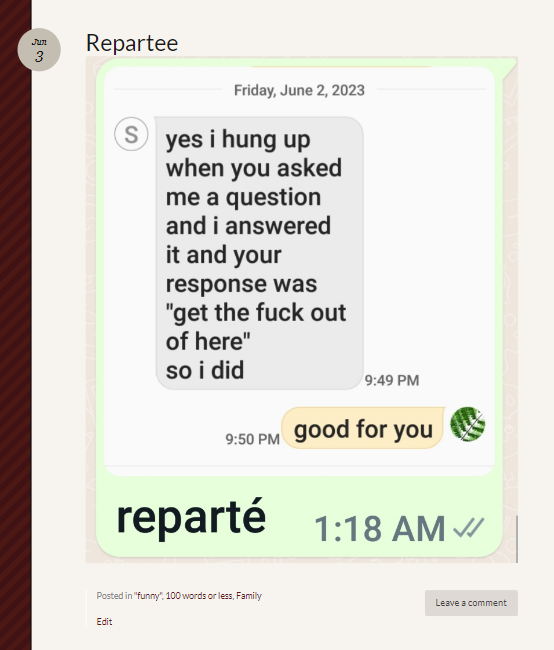
The only way to flush these hard feelings, dear Seedj, is by having the last word in a quiet battle with self-righteous, toxically clannish pinheads.
Since silence can mean many things, including “take the fucking hints already and fucking fuck off,” please do me the courtesy of clarifying your silence. It would be the fair, just and sporting thing to do, especially in the context of fucking fuck off to someone intent on continuing to try.

And not a moment too soon…

When the painful conversation you need is too heavy for your closest friends to bear, you need to have that conversation with yourself.
You have no choice but to bear whatever the fucking thing is, so discuss it as calmly as you can with yourself. You may surprise yourself with how gentle you can be with your raw and tender feelings.
She proceeds with the fair, impartial neutrality of Switzerland in World War Two.
Friendship is like our Republic, if we can keep it.
Both of my parents were damaged souls, as are my sister and I. It is a struggle to do certain things, because of the damage. To resist anger when we feel unfairly judged is hard for everybody, harder for me and it was harder still for my parents, whose struggle with intense frustration only ended when they died.
My parents were severely damaged because when they were young, instead of a soft hand on them when they were hurt, they got harsh blows from a mother who was very damaged and physically aggressive when angry. In the case of both of my grandmothers, I have no idea what damaged them. They were beating their children long before their entire families were murdered by other damaged people, following the lead of a charismatic uber-damaged person who told them to destroy everyone like my family.
Trauma is, sadly, a common part of our experience as humans, it is also part of our shared experience and history. Lucky are those few who grow up without experiencing any trauma. A girl can have a wonderful childhood, grow up to be a fairly happy young woman, and one day, minding her own business, fall victim to a vicious predator, which will traumatize her, no matter that her life has been so kind to her so far. Her trust in strangers will be snatched from her forever, she will never walk alone down a street again without fear.
Knowing that people who act like destructive assholes are acting out of their damage is little help, of course. Being damaged confers no right to damage anyone else, but it is also sometimes irresistible, to someone in great pain, to inflict pain on somebody else. I’m not just talking about whipping a baby in the face, breaking a sturdy wooden stick over a child’s ass or throwing them on the ground and kicking them over and over. You can inflict exquisite pain merely by refusing to extend mercy when it is asked for. The beauty of this form of sadism is its subtlety.
“You assume my silence means I am refusing to extend mercy, because everything is about YOU. I am very busy, I am thinking about a lot of other things, I have responsibilities and things I have to do every day, I have people who depend on me. Unlike you, I do not enjoy the leisure to sit and brood, and write, and draw, and play the piano, and cook, and imagine, while doing so, that I live in a better, higher world where creativity for its own sake is of great value. I live in the real world, and in that world you suck up your childish personal feelings, you forget about things you say ‘hurt’ you and you just move on like an adult, instead of being a pathetic, dependent, needy little worm. I am strong, you are weak, why would I surrender to you?”
Of course, you will seldom get this kind of detailed response unless you press someone for it. Once you get the indignant summary of their total innocence, and your utter unworthiness, you will know the story in better detail. The damage done to them made them ignore you when you needed understanding and sympathy. That’s easy enough to follow, but what do you do then?
I wake up thinking about this quite often. Friendships seldom last a lifetime, and when they begin to fray this is the kind of thing I wake up thinking about. Why is it so hard for a friend to just acknowledge that it was wrong to do something that hurt me, wrong to tell people an untrue story about our respective roles in the death of our friendship?
I consider the cycle: we are all sometimes hurt, develop defenses, get hurt again, build walls, try different strategies, get hurt again, fortify our fortifications. I think the only way out of the cycle, if we care about the other person in the conflict, is extending the benefit of the doubt, having an honest exchange, reaching mutual understanding. I also realize the vulnerability required in this process is impossibly threatening for some people. Too painful for those who insist they are what they are, take it or leave it, nothing fundamental can change about them, plenty of people love and admire them and that it’s your problem if you need more than they are capable of giving you. On one level this is absolutely true.
My father, a man who stuck to that formulation of life, had deathbed regrets about living that way. “I think now of how much richer my life would have been,” he said in that raspy dying man’s voice, “if I hadn’t seen the world as black and white, if I’d been able to see all the nuance, gradations and colors that are actually life…” Then he died.
Personally, I think making the effort not to die that way is important. Different strokes for different folks, I suppose. It is much easier to act like you’re not damaged than to live with the damage done to you and trying to heal it. That there, to me, is one of the great tragedies of the human world.