Category Archives: Ahimsa
Yoo Hoo
Living in the Moment
Easier said than done, of course, but worth focusing on if a person is to live their life as productively as possible. Nothing that happened a few days ago, or in childhood, should cast a dark enough shadow on the moment to prevent it from being lived fully. Easy to say, hard to do.
An action brings up a strong, familiar feeling that was so painful so many times? Very hard to remain in the moment, with that old tightness in the lungs, choking down the desire to strike back somehow. A friend keeps saying “remember, we are not helpless eight year-olds now.” True dat, though it’s something the feelings don’t always take into consideration.
Days spent stewing over the disrespectful, pugnacious, other-blaming “office manager” at the local tax-in-the-box where I have been trying to have my tax filed. Feet up on the desk, legs apart, ESPN flashing box scores on the screen next to him, a smirk like a sideways ass crack on his face, he said, after a week of zero service, lying and wrong information given “you can’t intimidate me by trying to get my boss’s contact info. I’m not giving it to you anyway.” He then added, for the benefit of his cow-faced associates, and to make his contempt crystal clear, “you’re the only customer I’ve ever had a problem with.”
That the problem he referred to was his failure to keep any of several promises to the customer, or to follow up, or to have the correct software installed for the half hour late appointment, or confidently giving the wrong advice regarding what needed to be filed, and the rest? Not his problem. The problem of the unreasonable customer, you dig?
I spent days unable to stop choking over having my nose rubbed in my “powerlessness”, even as a paying customer, or the 48 hour delay in his immediate supervisor getting back to me (I dug up her email address from a correspondence a year ago), pleasantly, only mildly defensive. I wrote back to her, making sure she forwarded our correspondence to her boss. Then, because we live in a society where nobody apologizes voluntarily, and offense is often employed to bolster defense, she felt compelled to add that my tax filing was a year late (I owe no tax, so that’s not strictly relevant) and that she “left a message immediately after i had completed the return with information provided and knew exactly what I needed to finalize the return. I will ask Michelle to call. Have a great weekend.”
To which I replied:
YOU knew exactly what you needed to finalize the return, you are just sharing that with me now, more than a week after my appointment. Have a great weekend
The meaning of that “have a great weekend” is universally understood in this context. Not ten minutes later, the call I’d been waiting a week for arrived. Michelle, the boss, eventually conceded that she was sorry that I felt I had not received good service.
I corrected her. She should not be sorry that I felt I had not received good service, she should acknowledge that the service I received was objectively the opposite of good service. She needed to acknowledge that anyone would have felt disrespected by the unprofessional treatment I’d received. That I was not looking for an apology because my sensitive feelings were hurt, but because I was put through an unprofessional and disrespectful series of aggravations that nobody, let alone a paying customer, should ever have to tolerate. She conceded as much, telling me that she was sorry and would talk to the jerk in question about his attitude.
And because I was reasonable, and didn’t browbeat her once I’d extracted the apology, things going forward will be fine whenever I get the paperwork this jackass told me I don’t need.
In the midst of it, when all that exists is an unwanted, undeserved hassle with a belligerent and unyielding moron, there is no completely putting it out of mind, no 100% focus available for the other difficult concentrated work a person in a tight corner must do to get out of that corner. In the moment, all is possible, truly, if you can focus completely on what you have immediately in front of you to focus on. Dealing with multiple moments at once, or several aggravating ones at once, is a recipe for bad karma, poor sleep and unhealthy eating.
Better to breathe, smile, remember what you love to do, and do it as much of the time as you can arrange to do it.
Reminder: there’s rarely a good reason to twitch
Yeah, yeah, the twitch reflex, I know, as primitive and deep as reflexes go. Something surprises you from the periphery: flinch! True, and a good practice, to err on the side of caution, good for survival.
But I am thinking about the times I feel hurried, and twitchy, and, moving quickly, sometimes stumble, when what I need to do is take a moment to pause, breathe, gather poise, realize that five or ten seconds are better spent doing this than starting to sprint with a shoelace untied.
An important thing I was reminded of yesterday, as I delivered well-thought out remarks in a rushed and not well-thought out way. A lot was going on, I had many things on my mind, the stakes in some ways were high– all the more reason to remember: take a moment to take it all in, smile, pause. Being gracious enough can often be lost when rushing, as it was yesterday. Be gracious, then breathe again.
Then, be gracious. Take a moment, smile, look around, breathe. Then, after a human pause, be gracious.
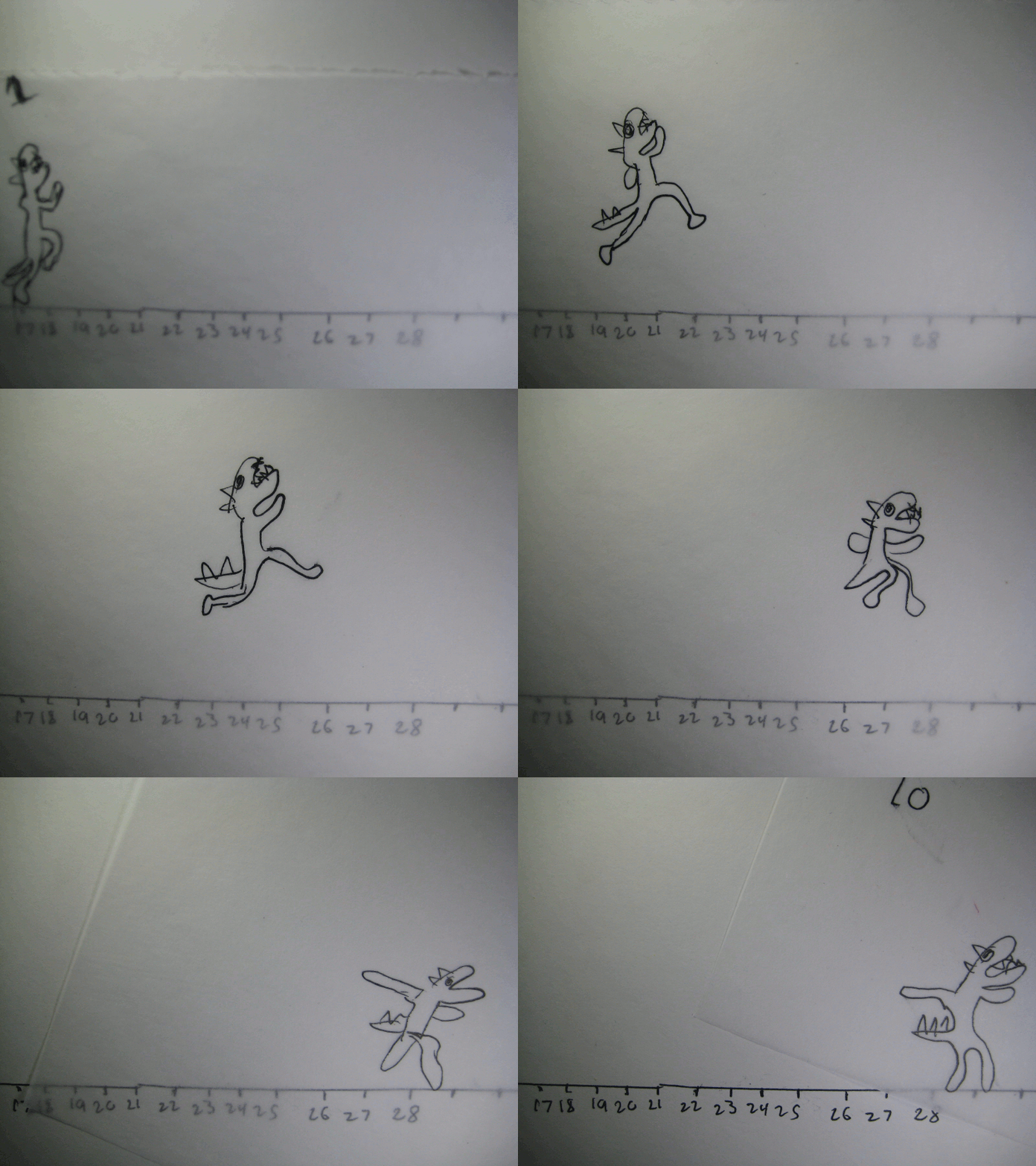
Edward’s Muybridge study
Gratefulness gently triumphs over sorrow
Gratefulness, that I got to see my old friend before she went, grateful that something pressed me to make sure I kept our long overdue appointment days before she kept her last one. Grateful for a lovely, lesiurely meeting, it turned from 11:04 pm to 1:00 a.m. in the wink of an eye and I was bundling into my filthy parka and she was remarking that I looked like an explorer. Grateful that she seems to have gone peacefully in her chair.
Grateful to have known her, and loved her, and to have been loved by her for so many decades. Grateful for the light she shed, and the love of her mysterious calling that she wore so lightly, and by her great example, taught me to wear lightly.
Grateful that she laughed and agreed when I asked her if she’d mind if I began to hold myself out as her protégé. She treated it as an absurd request I was playing for laughs. I was, she had a great laugh, but I was also dead serious. The woman was a major role model.
Somewhat Ironic Careers
We’ll leave my law license out of this one, I found a scrap of paper just now that had these words on it:
Human Relations Unit Sensitivity trainings led by my sensitive, brilliant father — always on guard against attack.
There were riots between ethnic groups in the NYC public high schools in the 1960s. Jets and Sharks, they’d square off and rumble, with violent consequences. A bloody nose or knife wound seems quaint by today’s standards, but my father’s mod squad would be called in and they’d find the leaders of these gangs and take them off to a weekend retreat. Role playing, a chance to hear each other, guided trainings done by a multi-racial, multi-ethnic team of idealistic former teachers.
“We were pretty successful at stopping the violence at one high school after another with the kids we worked with. The school would be peaceful for a year or two, until the kids we’d worked with graduated and their little brothers and sisters started killing each other,” my father told us, about the time he left that job for another equally stressful one.
Then, at dinner, the master of human relations and sensitivity training would go to work, reflexively doing what he could not help doing better than almost anyone else in the world. The insensitivity sessions the poor devil ran over dinner were legendary and unforgettable.
Talking to My Son After My Death
Eight, almost nine years in, I’ve learned a few things about this death business, and though I don’t think often of life, as such, in the way that living people do, I am slowly moving forward. I have been able to hear certain conversations and have plenty of time to muse about them, all the time in the world, literally. Yesterday you spoke of my attitude on my death bed and it struck me as poignant, the way you believe in certain things, and I’m going to address some of those beliefs now.
We had a life long debate about whether people could really change themselves. Your upbringing was hard, I was there, I saw it from the beginning, before the beginning. I played a big role in making that upbringing hard, of course, and am acutely aware of the obstacles I placed in front of you and your sister, how much heavier than necessary I made the rocks you push up the hill of your lives.
We cannot know, in some cases, what it was exactly that made our parents monstrous in the way they were. The stories from Europe were shady, muddy, obscured by smoke, and filth, and terror, they ended in the murder of everyone left there. I never got any details of how bad my mother’s life, may she rest in peace, was in that benighted little hamlet she left twenty or so years before it was wiped out by the Nazis. You found out, through diligent research, that she used to whip me in the face from the time I could stand, so something that was done to her filled her with violent rage. I appreciate the times you’ve said it’s a testament to my character that I never whipped you and your sister in the face, that it would have been understandable. I did equally terrible things, we both know.
As for our almost forty year debate on whether people can or cannot fundamentally change their natures, I have a few things to say. Problem one was our adversarial relationship, which largely foreclosed meaningful dialogue, and that was my fault. I projected many things on you when you were a baby and it set things in a very bad cast. I thought, for instance, that the way you stared at me from your crib next to the bed was accusatory. I can see now that this was an insane point of view. It came from my own carefully repressed terrors. The world is full of terrors, especially if your caregiver was a violent enemy. I have to apologize again, though I know you will say it’s not necessary. So we have the adversarial relationship standing in the way of a real discussion, turning it into a black and white fight to the death. The next problem is one of framing, the definitional problem. How do we define meaningful change?
It was your position that changing your outward behavior and reactions is a significant change for the better. I always countered that you may change how you act, but never how you feel deep down while you are acting. This is a clever debating tactic, perhaps, particularly if deployed with the skill I had to deploy such arguments, but beside the point, I can see now. It also effectively ends discussion of the nature of meaningful change. Of course how you react is significant, and changing your reactions is hard work. Of course you will have the same feelings deep down. Or maybe not.
I heard you say yesterday that the most recent troubled old friend you had to take your leave of (remember how you used to condemn me for casting people over the side? I guess you understand now that it is sometimes necessary to do this) left you with different feelings than past leave takings. You said you have no anger toward this person, just sadness. That’s real progress, I think, on an inner feeling level, and I found it credible, too. I salute you for this.
The insight that you may have been left with a sixty pound boulder to push up the hill, difficult but possible, and your former friend a hundred pound one, difficult and impossible for a person to roll, is probably correct. On many levels you continue to make progress, and on some fundamental levels she has made very little and is still very angry, critical and a bit ruthless– to herself and everyone else.
But the reason I set bone to paper today (no pen here in the grave, sad to say)– and I am conflicted about it now, is to address your feeling that I had changed on my deathbed, and so gave the final proof that people can change. Deathbed conversions are a cliche, of course, and they are a cliche because they happen so often. We are faced with the finality of death only once, no matter how many times we may fear it in our lives, when it actually approaches there is no mistaking it. When the end is near nobody can predict how they might react. Some see it as a blessing, and I have mixed feelings about that, although, to speak plainly, death has been pretty good for me. It’s true my consciousness is a bit hard to express now, and I can’t guarantee further communications, or even the end of this one, but in some ways it’s not bad. No worries, for one thing.
But anyway, what you saw as proof that I was capable of changing can be chalked up to the Grim Reaper grinning at me next to the bed. Your sister was probably right– if I’d have known about the liver cancer six months earlier, as opposed to six days before I died, I probably would have still waited until that last night to tell you the things I finally told you. Who knows? Your construction is more generous, that I would have come to those final realizations much earlier, have lived those last months differently. Due to the collective genius of Florida doctors we will never know. Your manner was indeed different in that hospital room, and I have to admit, your kindness to me, the way you kept trying to let me off the hook as I was apologizing to you for the first and last time, may be seen as proof that you were right about people being able to change for the better.
I don’t bring this last point up to undermine the progress you have undoubtedly made, at least I don’t think I’m doing that. It may be that we actually can’t change after all, though. Maybe I will always have to undermine you, in some way.
You told me, in the last real conversation we had, your last attempt to open a dialogue two years before I checked out, that my milder reactions to you had greatly improved our relationship, even if the inner feelings were the same. That I respected your wish not to be constantly bad-mouthed, often in the guise of giving fatherly advice, meant a lot to you, you told me. You offered this as proof that even I, someone who did not believe in change, could make changes.
At the time desperation forced me to be cruel. I actually laughed, scoffing at your naivete, telling you that my superficial change in reaction merely masked unchanged inner feelings. I drove the nail in by adding that if I ever honestly told you what I really felt about you it would do irreparable damage to our relationship. You could see that as just my desperation talking, and that would be fair, but I also didn’t have the insight to know any better. Which is a deeply embarrassing thing to have to admit now, almost nine years after my death.
But the point is, what if my behavior on my deathbed, the way I expressed regret, wished I’d been able to change, see the world in all its nuance and not just as a black and white fight to the death, what if all that was just a show put on to give you a fonder last impression of me? A manipulation orchestrated by Death, who was approaching on roller skates? You see, this possibility would mean that I was right, our changes are only acts, and deep down we are the same as we always were. Some things that torment you mean nothing to most people, it’s the way these things were instilled in you as a young child.
On the other hand, my stepping out of character to seek forgiveness that last night could be seen as proof that you were right, that by changing our reactions we can change the dynamics that have trapped us unhappily in our lives. That my relief at seeing you mild, and not angry or condemning me, as you had a right to as I went towards the grave, freed me to act differently.
This is one of those conversations that could go on, I suppose, though, in the ordinary course of things, if two people are not adversaries, certain agreements can be reached and the conversation need not be an ongoing battle over decades. I still think about my wish, that last night, that we could have had the kind of real conversation fifteen years earlier that we finally had the last night of my life. Fucking tragic, I know.
Sending A Bright Soul down into our world of Darkness
My friend the rabbi told a story at our friend’s funeral that explained our friend’s shortened life pretty well. A rare and luminous soul is created in heaven and the angels stand around admiring its beauty. As this is a rabbinic tale, there is immediately a dispute among them about the proper fate for this beautiful soul.
“This soul is too pure and perfect to be sent down into a world of darkness,” say a group of angels, “we must keep the soul here with us, where it will not be battered in the corrupt world below.”
Another group of angels petition God to send the soul down to earth, arguing that the light it will bring to the world of darkness is urgently needed.
God considers and explains that he indeed created the soul to spread light and love, and do good works, in the world below. He decides that the soul will be born in an earthly body and live below in the world of troubles, to help refine the world through good deeds. Reassuring the angels who want to keep the soul in heaven he adds “but his stay will not be long, since it will not take such a brilliant soul very long to complete his mission and he will be back here among us before you know it.”
The angels agree that every single day he is on earth, doing justly and spreading light, is a blessing.
As, indeed, is the case.
The Primary Feature of Depression
Crippling beyond all the other debilitating aspects of a depressed mood is the pervasive feeling of hopelessness. Without hope, you know, might as well throw in the towel. Things are horrible and there is no hope, no chance, of things ever getting better, in fact, they are getting noticeably worse. The darkness is complete and there is no hope for another sunrise, though the sun might very well rise again the next morning.
Hope can be extinguished in different ways, but it is a regular and gigantic feature of depression. Depression is said to be rage turned against the self, and I think it probably is. If the self-rage is there, and fear, and loss of hope– and no gentleness in how you handle your disappointment or frustration– good luck to you, baby.
False reason creeps in to justify the certainty of depression. If I try this it will go badly, things will be even worse, what’s the point? And truly, without hope there is no point to trying to do anything differently.
I remember this dilemma well, and without fondness. Pain every day, all day, no reason but suffering. Bunk dat, man. No reason to punish yourself. But learning how not to inflict that on yourself requires faith, which comes from hope. No hope? Good night.
 gratuitousblahg