So, in a nutshell

“I didn’t wind up painting yesterday,” she said, “but I looked at the colors and the brushes and I had a thought.”

“OK,” he said.  

“I realized what frustrated me so much the other day when you were probing about something that had made me angry.  I don’t mind the probing, but I object to the premise– ‘you believe you were wronged but there is another possibly equally valid side to the story and isn’t it possible that you are completely wrong, and in fact, the one who wronged the other person?'” she said.

“Not an unreasonable premise,” he said.  

“No, not unreasonable. Even something worth discussing.  Only there was one thing missing– you jumped to that premise without recognizing how hurt I was and that, possibly, I was entirely in the right to feel hurt.” she said.  “Even if I later realized I was wrong to be hurt, after reconsidering in light of your new insights, I was badly hurt at the time and you brought up something that was a painful experience for me. And brought it up with no expression of sympathy before trying to convince me I could have been wrong to feel the way I felt.”

“Yes,” he said, “but isn’t it equally possible that you were wrong?”

“Possible?  Yes, particularly if I was a thoughtless and emotional person who reacts to things impulsively.  Equally possible?  No, not even remotely equal.  If you heard my side of the story, which you did, and couldn’t admit you’d feel hurt too, which you eventually did allow, after an hour of batting back hypotheticals, you would have to recognize that I had good reasons to feel hurt.  You would have felt hurt too.  Might have acted much like I did, maybe better, maybe worse.  In the end, you might have convinced me to reconsider, but not if you didn’t at least acknowledge that I had a right to feel hurt.”  

“So this is all about you?” he asked.  

“Listen to me carefully: I am going to paint now,” she gave a wan smile and turned to head out into the garden.

“I will never have true peace with this person,” he thought hopelessly as she went.

What do you do with your rage?

“And what,” he asked, “do you do with your rage?”  

“What makes you think I fucking have rage?” she asked.  

“OK,” he said, “not rage… anger.  What do you do when you get angry?”  

“When I get angry I get silent.  I don’t believe in yelling any more, it doesn’t help.  The only thing that helps me when I’m angry is being silent.  I need to process it, think through what exactly is hurting me, why I am so angry, see if I can discover a way to not react with the violence I sometimes feel when I am hurt by someone I trust.”  

“What if the person you’re angry at needs to talk things out?” he asked.  

“Fuck him,” she said, “I truly don’t care when I’m hurt or angry what the person who made me angry needs or wants.  What I need and want is an apology, or failing that, silence.”  

“But that’s not very fair, I thought you’re trying to be mild and peaceful,” he said.

“The world is a circle of people justifying everything they do– everyone does it and here in the West it is a reflex, a tic.  We have to be justified, will argue hypotheticals to the death, we live in an adversarial system where every idiot makes his most vigorous argument.  There is always a reason somebody accidentally forgot, or was careless, or stupid, or hated themselves too much to realize you had troubles too, or got sick and couldn’t keep a promise, or was confused, or underestimated the harm they were doing, or said the wrong thing at the exact worst time, or acted like an asshole, racist or shithead believing sincerely that they were in the right the whole time.  Very few people do things believing they’re wrong, they do things they feel justified in doing, even if their justification is objectively feeble or even insane.  The first thing I need when I am hurt by somebody I know is the simple acknowledgement that they fucking hurt me.  It’s called empathy, also, taking responsibility instead of making an excuse. Does not seem like a huge thing to expect, if the person is concerned with my feelings, as I expect my friends to be, as I try to be toward them.”

“But you are capable of violence,” he said “and it scares people.”

“When have I ever been violent?  If people are scared they don’t know me, they are defensive, maybe, they’re scared how they would act if they were as angry as they think I am.  They compare their anger to mine and imagine what terrible things they might do.  I have no idea what people are scared of.  I use words and I try to use them as precisely as I can.  I often write them down and revise them until they are as clear as I can make them.  Words can sometimes hurt more than a punch in the face, worse than an arrow, I know.  I try to measure my words before I let them fly,” she said, “I make every effort to do better with my anger.  And anger, as you know, is a devilishly challenging emotion.  In fact, I see you can refer to it, and talk about mine, but not actually talk about your own.  It is easier to speak of mine, I suppose, since I express it more freely.”  

“Well, you do speak your mind,” he said.  

“Yes, I speak my mind,” she said.   “I would recommend the same to you, don’t be mad, don’t be passive aggressive, don’t dissemble, don’t complain I’m not listening while assuming you know what I’m about to say based on some memory of something I may have once said.  Don’t give me another hypothetical I can’t use while parsing and finding flaws in the one I give you.  Listen.  Use your great brain to hear what I am telling you, use your sensitive heart to feel the feeling I’m talking about– that’s more immediately important than the intellectual part.  I am not fucking Gandhi, it’s true.  Who knows if Gandhi even was Gandhi.  If there’s an afterlife Martin Luther King, Jr. has an excellent reason to be mad as hell.  MLK would be right to be raging up there at God’s right hand, in light of the almost ridiculous symbol he’s become in light of how little has changed for the masses of those he struggled for in the almost 50 years since he died. I couldn’t blame Martin for coldcocking God right now.  Gandhi too, for that matter, I wouldn’t blame him for kicking St. Peter in the balls.  I’m not them, or what they represent, but I’ve gone a long way toward becoming more like them.”

“Maybe not as long a way as you like to think,” he said.  “You’re still pretty goddamned angry, and scary too.”  

“As El Gato Ensombrerado said to the querulous fish in The Cat in the Hat, Spanish version ‘no temas, pececito’– ‘don’t worry, little fish’.  My father was an angry man, my mother was an angry woman, both of my grandmothers raged, one of them whipped her infant in the face, the other broke yardsticks over her kid’s ass.  I come from a home where people raged at each other, in a world with many styles of expressing anger including, frequently, deadly ones.  It is a daily challenge to do better, to get as far as I can toward being more patient,  more reasonable, milder.  It is better to forgive than to be stubborn about being right, it’s true.  But there is also a time when another person tears the fabric of trust and friendship, and argues like a lawyer, or a cornered rat, instead of empathizing with you for the harm they’ve done, and that’s the time to leave the room.  Only bad things can happen if you stay in that room, it’s a room where the air becomes toxic and never clears.”  

“Or you can work it out, truly be committed to being mild, forgiving, even when you have every right to be mad,” he said, “as you yourself are fond of writing in calligraphy.”  

“That’s true,” she said, “it is a good and noble aspiration and something I might do more if I was a fucking saint able to repair the torn fabric of a relationship that had grown toxic.  Which I am not.  Now, if you will excuse me, I have to go paint now.”  

“Wow,” he said, “right in the middle of our conversation.”  

“I’m sorry,” she said, “what exactly are we discussing that we are in the middle of?”

A whiff of fear stirred on the air around him and he said nothing.  Without any noticeable expression she went into the other room, presumably to paint.

The Point of Today’s Business Meeting

I have the product, the original and compelling prototype built and ready to be put in a package and sold.  Now I need to develop skill and confidence in the packaging and selling.   Today I have a meeting with a man who runs a well-funded nonprofit that uses the discipline of 3-D animation as a therapeutic tool for “at risk” and court-involved teenagers.   His organization has an office, where I will meet him, and a staff, including a Director of Programming, the job I had been mainly focused on for the first couple of years of my adventure in becoming the change I want to see in the world.  Maybe I will be introduced to his Director of Development, which is what fundraising is called in the corporate world.  I need to start meeting these money people and asking a lot of questions of them.

His organization is supported by grants from foundations and sponsored by several corporations.  It seems to have been remembered by wealthy people in their estate plans.  By all appearances it looks like it’s thriving.

What do I want from today’s meeting?  Mostly to get insight into how to raise money, and get the name of a grant-writer to talk to.  I plan to ask directly, at the proper moment, and for the rest of the meeting, actively listen.  It is the minimum I’d like to take from today’s meeting and I must be sure to get it.  Repeat: get contact info for his Director of Development and any grant-writers he knows.

Here are things I will keep in mind.

To speak little of my own program, answering only as much as asked for about it.  To draw him out on how he went about building his unique inspiration into a working expression of his idea that is helping many and allowing them to express themselves, learn skills, work as teammates and better their lives.  How he got it up and running– how he was inspired to turn his dream into reality and what steps he took.  What advice he might have for someone in the beginning of a similar project.

I know the short answer is that it’s possible to build charitable organizations, even those driven by vague or ass backwards missions (as with several I’ve seen), with sufficient funding.  If you start with enough money you can hire the people you need to take the organization pro in short order.  How to get funding is the million dollar question. 

The point of today’s meeting is to listen to this guy, draw him out, hear his ideas. Ideally end with him sympathetic enough to my goals to offer to be a mentor, talk on the phone, bounce ideas off of.  That he seems to be a man of few words indicates to me that I should not ramble on either.  I should pay attention to what he’s saying, be thoughtful, find areas of shared interest, ask engaging follow-ups.  

He e-mailed back quickly to invite me to meet, and though he didn’t mention having clicked on my website, he’s no different from several of my friends in that regard.  Even if I were inclined to hold that against him, it would blunt the point of today’s meeting if I had it anywhere in mind.  It is, truly, meaningless whether he finds my program cool or not, although hopefully he does.

Today I’d like to take the tour of his facility, if possible, hear the full explanation, see more work by his students.  The sale at this meeting is as subtle as the abuse many experience as kids and tricky to put into words.  But it is a sale.  The point of today’s meeting is to sell.

The person who made the introduction wrote “don’t let him get you to volunteer for him.”  I am forewarned.   The only other thing I know about the guy, really, is that he chooses to run a program to help “inner city” youth in trouble.  

That he chose to do this with his life and creative energy speaks very well of him.  I will applaud his mission and ask him how he got the drive to help these kids, tell him, if he asks, about going into that tenement in West Harlem that was right out of Bigger Thomas-world, the brutality and lowered expectations I witnessed there and at the Hugo Newman College Preparatory School there in Morningside Depths, the tremendous creativity I saw in the kids whenever they were given the chance to express it.

And remind myself to stay away from politics.  Keep my end upbeat and open. I’m there to listen and drink in advice and wisdom.  He’s the customer, and he’s by definition always right.  Going there today to exercise the patience I’ve developed in other areas, see what, if anything, this fine man has to offer that could help my organization. 

One thing I need to remember, this man was driven to be an artist before he started this organization, which. like mine, is  based on creativity.  He is among that small slice of people who are excited by creation, know the thrill of timelessness that comes upon a person when he or she is painting, drawing, layering parts on top of musical parts, composing, editing.  I need to go there and see where he’s at.  That connection to creativity could be the key to the whole meeting.

“Who’s in charge here?” the moments-before-angry faced teacher’s aid asked me in the workshop the day she filled in there for my absent assistant.   It was a rhetorical question, I could see by her smile that she got it.  The process was in charge, the organized chaos of creativity.  She was amazed that no adult seemed to be directing it.  There is no point to mention that to this fellow, he is a director in his program and imparting discipline is as important to his stated mission as freedom is to mine, maybe more so.  But the impulse to create, this is a key.

Got to trim my beard, get in some of my least shabby clothes, and head down there, with these thoughts in mind:

creativity

identifying with kids in trouble

turning ideals to action

grant-writer and Director of Development  

how did you find good people?

Mission Impossible

Breaking the impossible mission into small bites, each broken down into a yes/no question and working through an exercise based on the CBT thought record, with evidence for each answer.    

Is the idea or premise of the project sound?

Yes.  The premise that children thrive and are eager learners and peer-teachers when they are listened to and encouraged to be autonomous has been shown many times.  I have demonstrated this in dozens of sessions in public school after-school programs.  Take a look at Sugata Mitra’s great work for an engaging and much more scientific demonstration.  Teaching others yields the highest learning retention (90% vs. 30% for demonstration) of any teaching method.  (While this seems intuitively true, see this)

cone of learning

The organizing principle of the program is  basic and almost too simple to need much explanation.  People like to be listened to, children, in particular, need to be heard, have their competence acknowledged.   The role of adults at the workshop is primarily to listen to and encourage children’s ideas.  In a room where teamwork proves to be the most effective way to work, and is also much more fun than working solo, cooperation takes place naturally.  Where there is excitement to do something, and a working method in place, the thing will get done.

Does this translate to the educational and social development gains you tout for this program?

The evidence here is incomplete but results in the rooms where workshops have been held strongly suggest that it leads to these gains.  The potential of the program is great, and student enjoyment of it, and engagement with it,  almost universal, so far.

How is this program different than other programs that use animation with children?  

Those programs offer structured lessons taught by adult teaching artists who guide the children step by step through a given technique. They function in the traditional teacher imparts knowledge to student model where the student then demonstrates what they have learned by carrying out the instructions.  

In my program the children are the artists, with access to an array of materials and media, and they learn by observation, discovery and invention.  They quickly become the teaching artists themselves when they solve problems and help another student with something they’ve mastered.

Have you made progress marketing?

Yes.  I have redesigned the website which has been universally regarded as an excellent improvement over the old one and something that shows the program in action, expresses its essence colorfully and explains it, within ten seconds or so.  Czech it.

I am producing postcards, a brochure and a short, beautiful book in children’s book format showing the program in action.    I overcame many technical hurdles to design the website and get it on-line and, seeing the concept and shape of each of the other marketing materials I need to make, I am confident that they too will be beautiful and engaging.

Hate to ask a mean question, but have you had business cards made yet?

No.  While they are cheap to produce, and any card is better than none and I can always have a better set done later, I have been stymied by design challenges.  A pathetic excuse, I am well aware.  They are at the top of my list of marketing things I need to design, even though I did not include them on my list above.

Any luck going down your checklist of things you need to do to advance your mission today?  

No, none so far outside of this exercise.

Is it possible to sustain a strong belief, even with something that works exactly as you envisioned and designed it, and has the potential everyone you’ve been able to show it to has grasped at once, in the absence of another person who believes in it too?

No.  In the long run, no.  And this is a long run.  That’s why my next task is reaching out to several strangers to see what I can do in that crucial department of meeting people who will be engaged by the program and what it can do.   Truly, that is the most important single task ahead of me right now.

Will you get on it right now?

Yes, of course.

Rob:

I got your name from (  ) who met you at ( ).  ( ) thought you might be a valuable person to speak with about my program, an educational nonprofit I am in the process of launching.

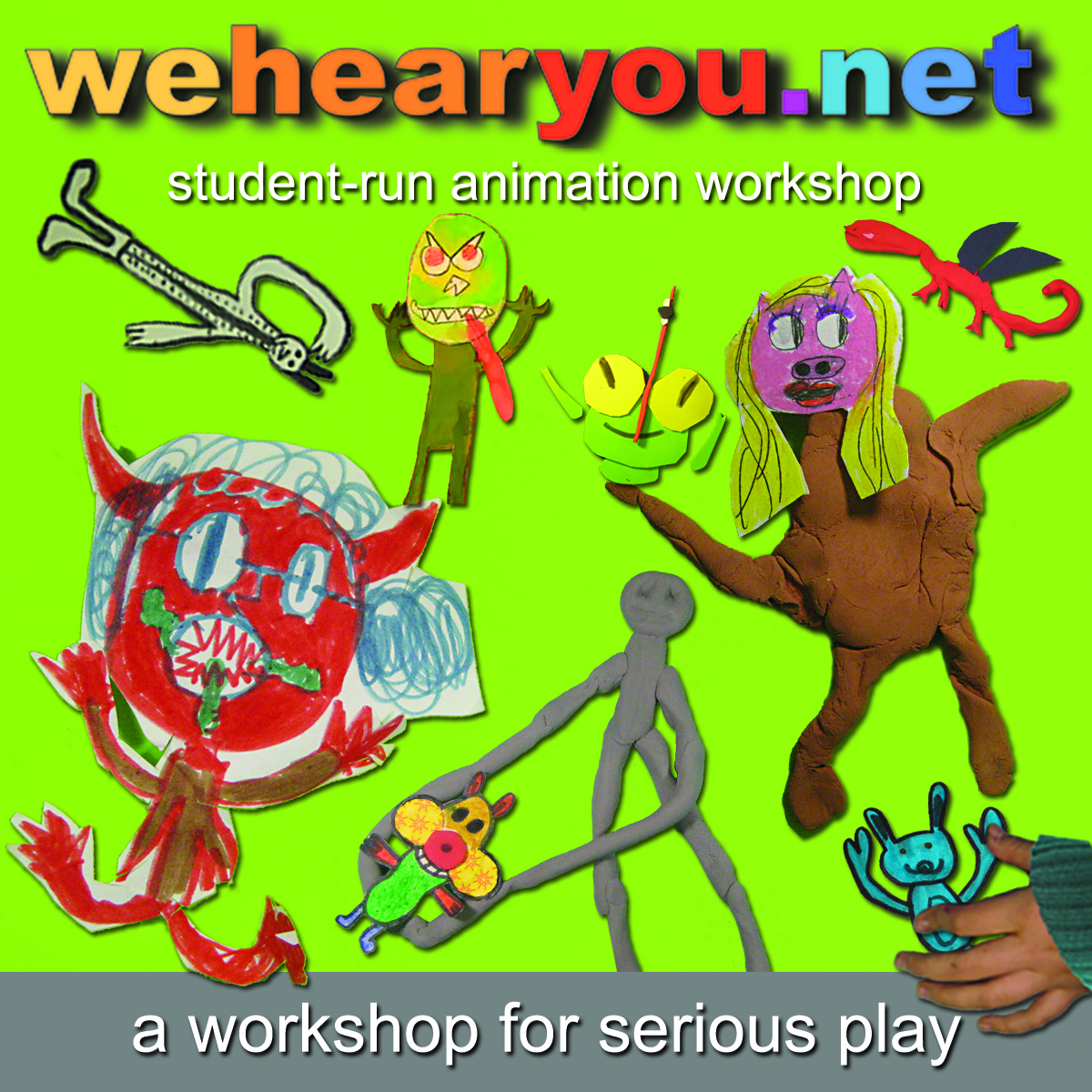
Based on the principle that adults listening to children is a powerful motivation, the wehearyou.net student-run animation workshop has been embraced by children (and in one case adults with chronic disease) in the dozens of workshops we’ve done. You can see some of their work here (link)

I am in the process of recruiting adult facilitators and collaborators.  I believe that Social Workers and Art Therapists have a skill set that would make them ideal in this role, and that they would also derive a lot from participation in the program.

If you’d be willing to talk to me, I’d be much obliged.  Email me here or call ( ) at any time.   

format for contacting organizations:
 
Discovered your program recently and admire the work you’re doing.  It’s amazing to me that [insert particular amazing thing here]  more people don’t see the connection between collaborative creativity and improved social and life skills.   Congratulations on your great work.
 
I’m in the pre-launch stage of a nonprofit program with a mission similar to yours, a stop-motion animation workshop for public school kids ages 7-11.   The kids collaborate, like a [compare to their actual work], and do all aspects of production, using computers to create what are essentially digital flip books.   You can see some of their work here:   http://wehearyou.net/
Of course, the animation is in a way a bi-product and organizing principle.  The real deal is the kids working as teams, teaching each other, spending a couple of hours in an encouraging​, creative space where imagination and technical precision are two interlocked aspects of good work.
 
If you have some time to speak with me, I’d be grateful to hear more about how you developed your program from the initial inspiration and first steps to a sustainable program.  
 
wehearyou.net works exactly as designed, kids take to it immediately wherever we’ve done it, but I could use some ideas and guidance about how to get it up and running on a wider scale.
 
If you’d be willing to talk, email me back or call me any time ​
at (  ), whatever’s easier for you. 
 
In any event, know that your success is an inspiration to my fledgling organization.

Book plate1-FINAL flat

How exposure to adversity effects the developing child

I’ve known people, my mother was one, who although very intelligent, open to considering new ideas, otherwise insightful, would rather kill you than acknowledge their own anger or the harm that was done to them in childhood.   Literally, repressing enough pain that they looked like they’d rather kill you than admit to being angry enough to smash someone.  

“We never fucking killed anyone, asshole!” they say as a chorus now in my mind, I can see their faces, not relaxed, calm or even, in some cases, recognizable as themselves.  

“‘Face twisted and contorted in hate,'” my sister quotes our father, and we both laugh.  It was a phrase we heard many times over the Rice-a-roni, flank steak and salad at our formica dinner table in Queens.  It was snarled, this peculiar phrase, and stated in exactly those words each time.  A very curious phrase to be repeated verbatim, if you think about it.

 “Twisted AND contorted,” my sister will say, and we’ll both have another chuckle.  But we were not chuckling then, during those terrible battles, nor am I chuckling about it now.  

My sister, working in a terrible school, is afraid to apply to move to a better one.  “It’s a concentration camp but I’m used to it,” she says, “and I don’t want to leave all my friends I’ve cried with for years.”  She agrees it would be better to make new friends she could celebrate with sometimes, instead of just crying and commiserating, but, in spite of being a master teacher, and someone who makes friends easily, she’s afraid to change schools.

“I’ve told your sister a thousand times what a wonderful teacher she is,” said my father on his deathbed, “but no matter how many times I tell her, it makes no difference.”  

“A thousand times?” I ask him.  

“Many, many times,” he says, remembering distinctly the time he told her that, at the assembly at the school where her class performed, and another one, more than one, besides.  To him that was a lot.  “I told her a thousand times,” seems to indicate that.  

“A thousand times,” says my sister with her trademark irony.  Not for nothing did she dub her father the D.U., The Dreaded Unit.  

“You are a whiner,” says an observer.  

“Do you hear me actually whine?” I ask the jury.  On closer inspection I notice the jury is composed of a couple of weatherbeaten mannequins, a decomposing cadaver, three skeletons and a few unidentifiable animals preserved by amateurish taxidermy and propped crudely on the chairs of the jury box.

The judge, for his part, is indescribably horrible.  Good thing this is a jury trial, I think to myself.

NOTES

How does it work? Well, imagine you’re walking in the forest and you see a bear. Immediately, your hypothalamus sends a signal to your pituitary, which sends a signal to your adrenal gland that says, “Release stress hormones! Adrenaline! Cortisol!” And so your heart starts to pound, Your pupils dilate, your airways open up, and you are ready to either fight that bear or run from the bear. And that is wonderful if you’re in a forest and there’s a bear. (Laughter) But the problem is what happens when the bear comes home every night, and this system is activated over and over and over again, and it goes from being adaptive, or life-saving, to maladaptive, or health-damaging. Children are especially sensitive to this repeated stress activation, because their brains and bodies are just developing. High doses of adversity not only affect brain structure and function, they affect the developing immune system, developing hormonal systems, and even the way our DNA is read and transcribed.

Nadine Burke Harris, MD

source

Illuminating Quote

“All violence is an attempt to replace shame with self-esteem.”

James Gilligan is a psychiatrist who spent years working with violent inmates and is the author of a series of books on our epidemic of violence.

Looking forward to checking some of these books out.

Truth and Reconciliation

Got a supremely annoying phone call from a former old friend.  I don’t know what the point of the call was, except to do the hideous dance one last time.  

In the course of an aggravating conversation he continually justified his unreliability, made oblique references to my over-sensitivity, laughed at one point when I was sputtering slightly to finish a point he’d interrupted a couple of times for shows of peevishness.  He was angry that I wouldn’t grant him it had been nervous laughter and not the passive aggressive enjoyment of a weak and angry person who had succeeded in making his antagonist mad.  How dare I presume he was being passive aggressive, how dare I not let him tell me why he was laughing while I was trying to control my anger!  

He told me I’d been vicious, in writing of his unreliability, characterizing it and him so uncharitably, no matter how hurt or angry I might have been.    “Sometimes writing can be much more vicious than speech,” he pointed out, “and the attempts to sublimate and refine the pain and anger are more damaging than just having out with it.  How hurtful do you suppose those things on the blahg were to me?”

I grant him the truth of that, as I grant him most things.  One thing I don’t grant is being shouted down when I am making a point.

“The first precondition of a meaningful apology is the recognition that the person apologizing has hurt the person he is apologizing to.  It is an acknowledgment of why the other person was hurt, a demonstration of empathy, followed by an admission that the behavior was wrong and some assurance of not repeating the hurtful behavior.   It’s like the truth and reconciliation commission in South Africa…”  suddenly I’m cut off by a loud voice.

“That was about murder and a system of brutality!  Nobody was killed or brutalized here!  You have this overblown tendency to make everything like that, everything is Hitler to you,” he thundered pre-emptively dismissing any point I may have been about to make.

I managed to finish my point anyway, though my lungs hurt by the time I was through, and not because I’d been shouting for more than a few seconds to break back in to finish my point.  

It is a funny thing about experiences that smell similar to the childhood abuse I experienced– I feel a certain burning in my lungs whenever I’m near it.

“If you won’t acknowledge how hurtful what you did was, intentionally or not, how important the thing you promised to help me with was to me, how many hours, literally days, elapsed before you even got back to me….”

“I called you seven and a half hours later, how is it my fault you never got that missed call?  Why didn’t you keep calling me when you didn’t hear back?  I had bronchitis!  You wrote vicious things about me on the blahg.  You…”

An imaginary friend winks, tilts his long necked beer bottle to me.

“You would have been much better off forgetting the Ahimsa shit for a minute and just calling this clown and saying what you had to say originally, when he started calling you a couple of days too late, and leaving wheedling voice mails, and calling your girl friend when he couldn’t get an immediate call back from you … it’s kind of funny that he kept referring to your ‘nine days of enraged silence’ toward him, that master of enraged silence.  I like when you counted off that it had actually been more like four or five days.  But you should have just said what you had to say, Dude, in as few words as originally would have sufficed.”

“We’re done.  You’re a cunt.  Been nice.”  

“Clean,” he said, and took a drink.

It’s true, that’s what this call amounted to anyway, with a residing pain in the lungs to show for my sad attempt to stay on the high road, give a stubborn former friend a chance to state his insufficient case for the hundredth time.

“You hanging up on me?  You’re going to fucking hang up on me now?  Hello?  hello?”  I can still hear the peevish fellow justifying himself, clucking about how vicious and unfair I am.  “After all, you’re not the only one with problems, I’m not the only one who doesn’t help you, your constant references to Hitler, no matter the context, are inapt, and what about…’bon voyage’?  ‘bon voyage’?  oh, nice…. hello, hello?”

Fooling Myself?

The young therapist told me today to add some daily “mastery and pleasure activities” to my daily schedule.  These are fun interludes that remind us of what we love and what we have accomplished.  Apart from not really keeping a daily schedule, I told her as far as a satisfying mastery activity I have this daily writing session that ends with a press of the publish button.  

I am always satisfied and feeling somewhat better when I press the button.  Not that every post is a gem, or even worth more than a cursory glance, some may go to disturbing places, but the exercise of getting the post ready for the “public” is something I’ve mastered.  By the time I hit “post” the writing is as clear and easy to read as I can make it.  At its best this blahg is my higher self giving good counsel to my regular day to day self, reminding me of who I am trying to be, how far I have come, how far I still have to go.

A few weeks ago an old friend wondered why I spend so much time tapping these posts (it’s really less than an hour a day, I would think) and suggested it is far healthier to interact socially than to live in my mind as much as I do these days.  He’s right about the social interaction– this online social universe is actually a nightmare world of mostly disconnection and narcissism.  I explained to him that the illusion of a social life is not why I write here.    A week or two later he read a couple of posts that he admired, that touched him.  He wrote to single them out.  

I gave him the back story of one, Listening, and described the inspiration, a fellow very active on social media who anxiously reads the blahg whenever we have some kind of trouble (this latest round goes back months, including several long, patient, useless discussions about the issues, as with F before the end, and there are several posts related to it).  He was also struck by the one about madness from a few months back, which was also inspired by my faltering friendship with this same chap.  

The night after the second seder, as I waited for sleep to come, I had  a choice: spend an hour figuring out how to send the fellow the precise kiss-off he earned and deserved (a waste of time and energy), or trying to get to the deeper question involved — understand and digest the harm done to me and process my feelings about it.  It is an important exercise, understanding my feelings and getting past the hurt to react as nonviolently as I am able.

Writing made me think about it more deeply, make connections, allowed me to take something positive out of the otherwise distasteful experience.  Looking beyond the personal to the larger principle involved was helpful to me, as was the exercise of making it clear to a reader, and in the process, more clear to myself.  I think the piece could be helpful to others as well in laying out the human issues involved– the damage of not being listened to, the fruitlessness of one-sided relationships for the person on the wrong side.

 
I understand that this fellow was rarely, if ever, listened to, except by me at times.  I appreciate that things are not black and white, that he has fine qualities, a sense of humor, decency and so forth.  Still, individual acts and failures to act, particularly when they come one after another, form a pattern that speaks much louder than promises and conditional apologies.  Hitler had it rough, but if I had a time machine I’d go back and break every bone in his body if I could.   Maybe go back earlier and make sure his dear mother had an abortion.

My friend and I, I hardly needed to remind him, had it rough growing up, but we help when we can and try not to hurt when we can’t help.  We don’t build a fanatical political party and death camps and all that other fucked up shit.  We don’t leave people we care about hanging. To those who can’t help being hurtful, good riddance.

 
Our first duty is to preserve ourselves, an extra challenge for those of us who were forced to learn on our own to become our own protectors.  Sometimes quietly subtracting an unwitting underminer is the most positive thing we can do for ourselves on a given day.