The Spirit of Rosh Hashanah Past

My father grew up in an orthodox Jewish home, in ‘grinding poverty’, as he always phrased it.  My mother’s cousin, whose family moved many times during the Depression to get a free month’s rent here and there, told me a few years ago “we were poor, but your father’s family was really poor.”  I don’t doubt my father’s childhood was a nightmare.  He was still clawing his way through it on his deathbed in a Florida hospital seven decades later.

His tyrannical, violent mother was the religious one.  I don’t know that his father particularly cared one way or the other, though he swept the synagogue for a dollar or two a week.  My paternal grandfather was described to me as eternally deadpan; his face simply two eyes, a nose and a mouth.   My father’s mother would give generously to the synagogue, even though they had almost nothing themselves.  Nobody there was in any position to question this practice.    

My father became less and less religious over the years.  Bacon started being cooked in the house at some point during my childhood (he didn’t eat it) and eventually, and much to my disappointment, somehow, he tasted pork in a Chinese restaurant.  He liked it, though, to my knowledge he only did this once.  Growing up we’d hear: I’m so hungry I could eat ham!  Something he got from his days in the army when Corporal Israel ate side dishes at meals of ham.  Like many modern American Jews, he took the High Holidays seriously, bought his expensive ticket and sat and stood and sat (“please be seated”) and stood (“please rise”) all day at the services I found so hypocritical and meaningless.  

My mother had no use for religion, although she proudly identified as a cultural Jew, could not have been mistaken for anything else, really, except, maybe, ethnic Italian.   My sister and I stayed out of the synagogue too, for the most part, after experiences there that probably turned off many to the rituals of our ancient religion.  I often said my experience at Hillcrest Jewish Center Hebrew School turned me into an anti-Semite, though that’s an overstatement for effect.  The heart of religion is good.  I’d have to think the heart of every religion is.   The practice is where the trouble generally comes in.  

I have a few friends who take deep comfort from the rituals of religion; I don’t.  I cannot look past the dark side, the crimes and bloodshed so many avowedly religious people take part in, with the monomaniacal self-righteousness that comes from believing God smiles on their horrible acts.  The examples are too well known to require any listing here.   But the experience of wonder, of gratefulness for the many gifts of this world, the impulse to create, to be gentle, to laugh, to share, to care, to repair what is in need of fixing, all these are encompassed by most religious teachings.  

The religious background I had was Judaism and my values were informed by its stories.  There are two Jewish holidays I find very meaningful and that have shaped my life to a great extent.  One is Passover, the holiday that commemorates the eternally incomplete journey from slavery in Egypt to freedom in the world.  A Jew is commanded to retell the story at the seder, an ordered meal that sets out a template for the discussion of values.  This was always a serious discussion in my childhood home, as it is at the seder Sekhnet and I now attend every year.   The value expressed is realizing there is no difference between the children of the rich and the children of the poor and oppressed.  

We are encouraged to take the lesson of our people’s persecution to heart: to identify with the stranger, the other, the underdog, the slave, the oppressed, and reaffirm our commitment to fighting for justice for everyone.   I find this holiday very meaningful and important.  It has probably influenced me more than it should have, I haven’t separated out the symbolism to the extent most practical people do.  

The other holiday I find profound and valuable is the New Year tradition of seeking forgiveness and releasing others from our anger.  We are commanded to make amends with those we’ve injured in the past year during the ten days of repentance, between New Year’s Eve and Yom Kippur, when our fate for the coming year is metaphorically sealed by our imaginary protector with the long beard, the Creator, blessed be He, who created everything miraculous and, because he is all merciful, left humans to figure out what to do about the Hitlers, Stalins, Pol Pots, Cheneys, the raping priests and bloodthirsty preachers.  

The blessings are all from God, the man upstairs; the curses of mankind, as theodicy concludes, are all the result of humans’ misuse of the free will generously bestowed by the Holy Name.  Yeah, yeah.   Fuck all that shit.  The part that interests me is the tradition of righting our psychic accounts at this time of year.  We are supposed to honestly search our lives over the past year for times we have behaved badly, acted wrongly, hurt others.  It is our duty to humbly seek to make things better, to apologize, forgive, offer peace instead of further bad karma.  Prayer and good intentions won’t do it, we have to humbly approach humans and keep our vows to act better.  

It is far easier to see the harms others have done to us than to take an honest inventory of our own hurtful actions and cruel inactions.  I see this more clearly every year as I ponder.  Also, how hard it is to forgive the unrepentant, even as I am challenged to sincerely repent for things I’ve done that I can’t imagine were as hurtful as they may well have been.    

I always think of one Yom Kippur when I went, as usual, to meet my father outside the synagogue after a long day of fasting and services, everybody ashen faced and bad-breathed, trudging off in the gathering darkness with quick, tottering steps to break their day-long fast.  I walked down there as services were getting out, met him and we walked back home, less than a half a mile along Union Turnpike in Queens.   I had a long list of bad things my father had done and would never apologize for, including many terrible failures that had undermined my sister and me over the years, but I’d formulated it as one thing I needed to put on the table.  I’m sure I’ve written out this story before, but I’ll offer the fast version of it here.  

I am reminded of this because my closest friend, a very good man, about the best man you can imagine, has too much pain from his mother’s long betrayals to find it in his heart to truly forgive her for her considerable limitations.   I don’t hammer at it often, though I’ve brought it up over the years, he will be gentle with her as she lays dying, there is no doubt, and it is a shame the healing won’t start until then.  Life is a very painful matter sometimes.  

Anyway, the particular Yom Kippur I’m describing my mother was putting the finishing touches on some no doubt delicious dinner and I sat across from my father in the living room.  I had fasted, as I always do on Yom Kippur, not in fear of God, if there is such a thing, but because it is a good practice, and I always think I should do it more than that one day a year.  If we never feel hungry how do we remember what it is that much of the world experiences every day?

My father was a brilliant, adroit and witty man.  He used these skills brutally much of the time.  His humor had a sting to it, more often than not.  His skills in constructing arguments were used to build impregnable walls around his vulnerable childish heart.  He regretted these things on his death bed.  But walking back from the shul that Yom Kippur he was silent as a sphinx, cautious, waiting to defend himself against anything I might say.  

What I said when we sat in the living room in the little house I grew up in was that I was glad to hear his fatherly advice, provided he stopped using it as a delivery system for his hostility.  I would no longer tolerate being reduced to the sum of my faults while listening to the harsh things “your friends are too spineless to tell you.”   Whether my friends had spines or not, I needed to be treated respectfully by my angry father.  I told him if this did not happen we would no longer have the pretense of a relationship.  I reminded him of my many attempts to make peace with him and he fought as hard as he could not to give a millimeter.  I was determined, and undeterred, and in the end he agreed that he would try to do better.  We broke the fast.

“That’s what you have to do with a bully,” my friend would agree, “be direct, do not back down, do not give in to fear or anger.  Keep pushing the fucker back, it is the only thing a bully understands.  Good for you.”   So, for the next fifteen years or so my father and I had a superficially better relationship.  

At the end of that fifteen years he revealed, during an argument in which he was for the first time overmatched, that he’d only pretended to change his feelings toward me, that if he ever told me what he really felt it would do “irreparable harm” to our relationship.  Checkmate, Dad, have it your way, you win.  And for the last two years, as unbeknownst to both of us he was steadily dying from undiagnosed liver cancer, we kept things cooly superficial.  In the meantime I realized how damaged he was, and that he could not do any better, that it was up to me to make some kind of peace with it.  I made some kind of peace with it, lucky for both of us it was a couple of months before he started actively nosediving toward death.

As he was dying, of course, he lamented his lifelong inability to be truly open to people, to experience real intimacy, to express love.   “I wish we could have had this kind of conversation fifteen years ago,” he said weakly toward the end of the last conversation of his life, “but I was just too fucked up.  It’s my fault, I felt you reaching out to me many times over the years…”.  I recall thinking at the time what a modest and pathetic wish that was– thirty-five years of senseless war and fifteen years of peace.

Of course, I’d take it now, fifteen years, five years, one year, a week, another 24 hours.  There is not time enough to heal certain wounds and it is an uncertain process at best.   We are all left to heal ourselves, as best we can, and to stay open and caring to those who share our best hopes for a good world.  There is no time to struggle with drowning souls determined to take us with them to the nightmare depths as they irrationally defend their right to drag us with them, but the time for healing– very important time.

Generativity vs. Stagnation, again

There is no shortage of irony here.  

I am striving to bring interactive creativity and fun into places where these things are spoken of highly but rarely practiced; myself, creative, yes, but not having much fun.  

The program I’ve already implemented is capable of injecting some encouraging news into the depressing discussion of American education, the non-discussion of real participatory democracy; I am a marginal participant not actively discussing the issue with anyone who cares.  

The program is therapeutic, I saw haggard women with chronic disease transformed into laughing girls at the end of our sessions; it gratified me, but, burdened with logistics, I was not laughing with them.  

I’ve solved dozens of logistical and psychological problems so far, though some very large, possibly insoluble, ones remain.  With the best of intentions, as I try to maintain my focus on promoting this inclusive, participatory program, I have somehow become a kind of hanging judge.  

Nuance has become harder for me to discern; holding multiple truths in mind, and choosing the one that casts the best light– not always possible.  I listen to the prosecutor making his relentless case, nod my unsmiling head.  Fine, I think, give the guy the chair, let the Court of Appeals worry about it, there are many worse tragedies happening everywhere.  Bang the gavel, next case.  

I’m not always able to refrain from doing what was so hateful to me watching my father do it:  reducing a person to the sum of his faults.  We are flawed, all of us, and gracefully accepting the flaws of others is an important part of being a decent person.  Whipping a fucking goat?   Really?  I take pride in not being the sort of person who inflicts harm, particularly on those with limitations.  Lately I couldn’t rest until I’d given a particular animal a hard kick in the ribs.  The thing was perhaps less than perfectly thoughtful, or even characteristically oblivious, but in either case, why the need to kick it? 

The seventh stage of Erik Erikson’s theory of psychosocial development is called Generativity vs. Stagnation.  Being productive, successful and involved in the world during the middle and later stages of adulthood versus being isolated and removed from the world, dogged by feelings of failure and hopelessness.  The eighth and final stage, Integrity vs. Despair, takes place at the end of life, looking back, when one feels satisfied at a life well and authentically lived or is bitter and full of regrets.  

I embarked on a project of encouraging expression, using free play as an educational strategy.   I undertook this ambitious project knowing nothing about how to plan and build a business, how to run an HR department, how to secure funding to hire professionals needed for several live or die jobs.   I have no connections or friends who can fill these gaps.

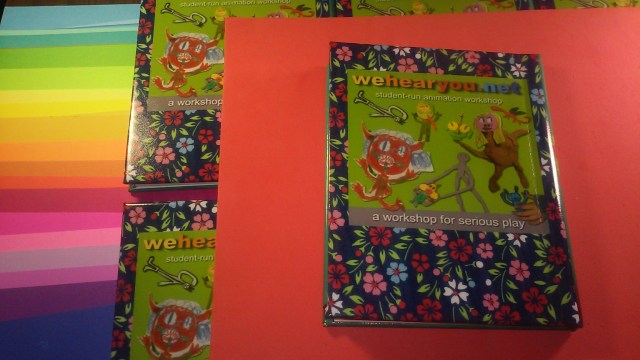
The program is a success, as far as implementing it in five minutes anywhere, as far as how easily it does what it purports to do.   The student-run workshop vindicated my best hopes for how it would work.  The creativity and competencies of young kids, and ailing adult women, for that matter, exceeded my expectations.   Yet, not having a network of people in a position to participate productively… so far enforced stagnation.  

Those who don’t understand what I am striving for, or who take no interest in it, who now quite sensibly avoid the subject, I can’t help thinking of as partial jerks, even as I know I have only a passing interest in all the details of their working lives.   I was surprised and touched when a hard-working friend took a few moments to enquire about the progress of my program a couple of months ago.  I told him the program itself, curriculum and all, works smoothly and wonderfully wherever we’ve done it, and that now I am focused on packaging, promoting and selling it.  

I described my initial hope– that kids would work together to produce original animation in a workshop setup where adults would set things in motion and step back as children learn and teach each other.   This big taste of autonomy fosters students’ confidence, brings out peer-mentoring and leadership skills.  It has happened quickly every place we’ve done the workshop, about a hundred times so far.  

Now that the program itself works smoothly, I told my friend, I am wrestling with the crucial tasks of packaging and promoting it.  I told him I’m optimistic that someone in di Blasio’s administration would be quite interested in the presentation that I have recently put together, that is just about ready to roll.

He told me he now understands the important goals I set for the program, the workshop’s many great applications.  He said he was impressed by how well thought out it was, acknowledged the tremendous amount of work I’d done and the ingeniously simple design of the program.  He wished me success, strength to my arm and told me he agreed that di Blasio’s people would be very interested in a program capable of producing a cadre of peer-teachers entering Middle School.  

This reaction was as wonderful as it was rare.  We have but one measure of success in our society and until friends read about the program in a NY Times piece, or hear a well-crafted moment about it on NPR, it is a dream I am dreaming alone as I sleep my fitful sleep.

One more note in the polyphony of my imperfect sleep: my attempts to avoid bitterness in old age seem ironic to me much of the time these days.  These attempts are hampered by the difficulty of living by words I have written on pages many times with various calligraphy pens, words I must inscribe in my heart as I find ways to become more actively and productively involved in the world:  cultivate mindful empathy.  Everybody we encounter is fighting a hard battle against killer odds.  Just because somebody almost never keeps their word, for example, is no reason to write off the rest of their virtues.  

Now, if you will excuse me, there are some kittens in the garden I have to go be sarcastic to.

kittens

The Opposite May Also Be True

Went back to buy the guitar today.  As I passed through the main room there was a quiet vibe in the electric guitar section.  A young woman played quietly with a phone propped on her thigh, maybe jotting down a song idea.   A guy, who looked, with tattoos and serious Scottie Pippen profile, like a possibly dangerous gang member, was playing some meditative lines that brought Jerry to mind.  A few other people played, thoughtfully, none of them too loudly.  I reproached myself mildly, perhaps I’d been too harsh the day before about those exhibitionist wankers I pictured driving themselves into dividers.

Into the acoustic guitar room where a guy was checking out a booming electric acoustic bass. I took the guitar into the other room, with the acoustic amps, and slid the glass door closed.  An introverted kid with dark hair dyed blonde on top sat facing the wall, a big acoustic/electric guitar plugged in.   The kid played some interesting open chords, paused as I got in tune.  I played for a moment and the kid started again, an open chord the young guitarist could not have spelled.  The raga bass note was D and it was not hard to find things to play that complimented the kid’s strange chord changes.

The notes you finger on the strings form harmonies, chords.  Some are basic ones every beginner learns, G, A, D, Dm, E, Am.   You can spell these chords by naming the notes you finger:  G-B-D-G-B-G forms a simple G major chord, spelled 1-3-5-1-3-5, the places of these notes on the G major scale.  You can make the harmonies fancier, and weirder, by changing a note or two of a familiar harmony.  You can also change the voicing, the order of the notes.  A G chord can be played with a B, its third (a strong harmonic partner) on the low string. Lower that B one fret to a Bb and you have a cool fingering of a G minor chord, with the minor third in the bass.   You can add notes to harmonies, subtract notes, play open strings that give unusual sounds — there are many possibilities.  Jazz guitarists can tell you that you have fingered an inversion of a C6-9 chord, called that because the notes added are the sixth and ninth degrees of the C major scale, but many guitarists, particularly young ones, just find cool sounding chords and mess around with them up and down the neck.

These odd chords and eccentric invented voicings are among the first amazing things creative young guitarists discover, and this young player was working with these ideas as I was checking out the guitar I was going to buy.   The young guitarist was not insistent, in fact was somewhat reticent, but from time to time some of those odd chords would flower into the air from the amp, a rhythm would be tapped out. I’d catch a chord and bend a bass note along to it, let it shimmer, then play a little run ending with the flavorful riff from Norwegian Wood.  It sounded good to me, this interplay, and it felt good, too.  There could not have been a greater contrast between this interactive guitar player and the showy jacked up masturbator of a few days earlier.    

I lingered, checking out the guitar, listening to this kid’s ideas, adding notes and ideas of my own.  The guitarist was making musical sense, there was logic to the choices and a sensibility, a poetry, that made it easy to follow.  Most importantly, he left generous patches of silence among what he was playing, inviting oxygen-rich spaces where music can breathe and grow.

It put me back in time to when I was first learning the guitar, the magic feeling when something accidentally turned musical.  I thought of my friend Paul, a young man who couldn’t spell even a simple chord to save his life (and once, when his life literally might have depended on it, he couldn’t be bothered to learn to spell) but who is probably the most intuitively brilliant and inventive guitarist I’ve ever met.  He’d stumble on a chord shape he loved the sound of and would soon fashion a song out of it, then another, then five variations on that.  I remember his beautiful solo arrangement of By The Time I Get To Phoenix, a song that caught his fancy, though he couldn’t have told you the key or the names of any of the chords he was playing.

This kid in the acoustic guitar room was no virtuoso, but he played with great taste.  The way he lovingly took a sound and played with it reminded me of Paul, of my own early experiments with guitars.   I could have played there until the store closed, the guitar was nice to play, the room was air-conditioned, the amp had a great reverb, our levels were perfectly adjusted so we could hear the nuances of what each of us was playing.  I suppose we played for about an hour.  

I got up, unplugged my new guitar and bought it.  As this was going on the kid left, head down, eyes avoiding everyone else’s.  I wanted to say “hey, you sounded good.  It was a pleasure playing with you.”  It would have meant a lot to the kid, I think.  My reflexes were too slow.  I said nothing to the kid, but I note here; things may be horrible sometimes, but without warning, the opposite may also be true.  Be alert for the small miracles that make the rest of this worthwhile.

Life’s Work

The pursuit of excellence for its own sake is regarded as idiocy in a society that values only the creation of value– that is, the creation of the dough re mi — money you can buy things with.  Things are given value according to how much they’re worth — in dollars and cents. Nothing could be more basic and immutable than this first law of the marketplace, no?   Why bother to write clearly, if not to hone your craft for money?   Why be meticulous about playing in tune, and in time, if nobody is paying — if, in fact, nobody is listening?   I am listening.    

I was checking out a guitar yesterday, a 3/4 size Martin that felt good in my hands, sounded good.   I’d been thinking about it, realizing I’d probably have to buy it, even though it’s not really made of wood. “How does it sound amplified?” I asked the kid with very long hair.   He handed me a cable and led me to a room with padded stools and amps.  

“It sounds good,” he said.  He was right.  Damn, it sounded very good. I began to play, now with a pick, now using fingertips to pluck the chords of One Note Samba; I strummed with my thumb, with the pick.  A nice rich, round tone.  The pleasure of playing this little guitar was considerable, my hands relaxed, playing things they’d played enough to play smoothly, improvising, checking out the harmonics.

Somebody came into the room after a few minutes and began to play another guitar.  At first I was annoyed at the intrusion, but when I realized the guy was playing a straightforward thing in E,  I played in E, some fills, a couple of chords.   It was OK, I could continue to check out the guitar.   My back was to the guy, he’d sat behind me.   He soon got very ornate, playing a fast, elaborate finger-picking piece that was tricky to follow.  He turned up his amp.  

It was quickly obvious that this was the common exhibitionist wanker in a guitar store, there are dozens of them, wailing away, fancying themselves gunslingers, striving for supremacy, the spotlight, the admiration of their flailing peers.   If you walk through the main room of any guitar store there are many of them, bashing away at guitars, in every key, in no key, with varying degrees of skill, playing over each other, all of them way too loud.   The cacophony is unbearable.   They get into cars, if they have them, tailgate, ride the horn, pass on the shoulder cursing as they go, spin out of control, ultimately wind up totaling their cars into a divider.  On a good day.

I never turned to look at him, unplugged the guitar and brought it back to the salesman.  I’ll buy it tomorrow, I decided, when I’ll be in the neighborhood next.

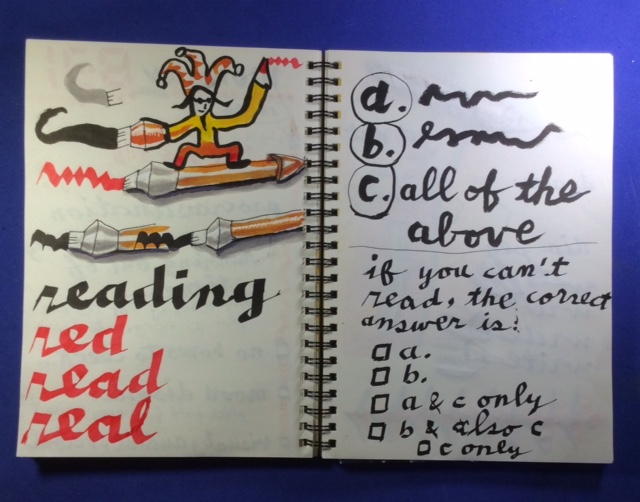
In the subway on the way home I am fleshing out an idea that struck me while walking across 18th Street.  I’d paused to write: reading is magic, think about it.  Marks on paper tell you what I’m thinking.

Picture that animated.   That’s what I was doing on the subway.  I drew a pen, took a brush and painted a shadow under it.  The train swayed, jerked, but I have always written and drawn on trains, am an experienced surfer that way.  It is a very rare stroke that goes wrong for me on a train.   I soon had a 3-D looking calligraphy pen drawn on the page.  I made a note to animate the drawing and then cut the pen out.  I’d take the cut out pen, dip it in a drawing of an ink bottle, the cruder the better, and write the words, in stop-motion, as though they were flowing from the moving pen:

Reading is magic, think about it.  Marks on paper tell me what you’re thinking.  

True.  A simple but powerful illustration of the amazing human invention of writing and reading — communicating anything you can think of to express using combinations of 26 symbols.  Also a powerful evocation of the potential of animation to get kids interested in literacy.   I drew in my book for about ten stops, was pleased and shut my eyes.  It felt wonderful to shut my eyes on that air-conditioned train.  

write ani

Inevitably I had the second thought, which caused my eyes to open and which I began to note on another page — in black and white.  

reading animation

We do not, as a society, give a fuck if you can read, have a rich mental life, consider ideas and solutions to problems you might not have imagined.  We do not, as a society, give a rat’s ass if you can write, beyond clicking a box assuming liability for any and all debts incurred in the course of your dealings with our corporation.  

Our society does not have work, or any productive use, for a good chunk of its people, tens of millions of them.  The young versions of these unneeded people are sent to schools to prepare them for a life where they are not needed.  The lesson many of them learn clearly is: fuck you, asshole, bend over and spread your cheeks.  Lift up the nutsack. Cough.  

Life’s work:  knowing this, all of it, and living calmly and productively, doing everything your talents allow to inspire, give hope, make a small ripple of change.  Death is waiting for you anyway, why be aggravated by the many aggravations this life dispenses so generously for free?

Etiquette as the Last Refuge of Scurrility

It’s wrong to abuse people gratuitously, or even trying to be funny.  There, I said it, fuck you.  Seriously, there is most often no humor in abuse, no matter how otherwise witty.  Abuse masquerades as humor to apply the talent for malice, seizing a jocular tone to wield the lash with the deniability of “only kidding… Jesus, stop being such a pussy.” A “roast” on TV can be occasionally funny, it’s all in good fun, blah, blah, but a roast in real life is rarely fun for the roastee.  It is uncomfortable for most people to be put on the spot.

If I put you on a spit and turned you slowly and lovingly over the flames, basting you with your own juices to keep your skin from burning, no matter how otherwise hilarious my patter was while doing this, I know for a fact you wouldn’t find it all that adorable.  We do this to each other from time to time, and it’s no joke, it’s a sign something sick is going on.  

Not to be all judgmental about it, but when someone who has just been kicked in a delicate place is crying, the most humane first reaction is sympathy, not a smirking admonition not to be a pussy.   “Everybody gets kicked there, whiner.  Stop fucking crying and finish listening to my problems, asshole.  I have problems too, you know.  I kneed you by accident, ACCIDENT– pussy.”

I am thinking about this because when being polite is the only reason for doing something, against many good reasons for not doing that thing, experience teaches that it is a mistake to do the thing out of politeness.  Being polite is a good thing, especially with strangers and potential assholes, and politeness has an important place in civility. Being polite as the only reason to do a thing?   A weak ass reason indeed, and almost weightless against any reason not to do the thing at all.    

Years ago, after an unhappy, brilliant, talented, witty and often abusive friend turned her abuse on me at a particularly bad time for me, I replied to her hurtful email with a long explanation of why I’d been so hurt by it.  She declined to respond to my wimpish complaint.  I never heard from her again.  It was the quiet whimper at the end of a long, troubled friendship between two damaged people.  

A year or two later, her husband’s mother died at 99 or 100.  The old woman had been severely demented for the last decade or two, and when she finally died, the husband’s sisters began screaming for him to do something.   He jumped up and applied mouth to mouth resuscitation to the dead woman, until, presumably, nurses intervened.

Sekhnet and I spoke to him shortly after learning, by email, that his mother had died.  He was very grateful to us for a long call that gave him some comfort.   I had nothing against him.  In fact, it had been a source of stress and pain to watch him severely verbally pummeled by his unhappy wife every time the four of us got together.  I always took his side, tried to pour some humor on the ugly situation, distract the wife from her assaults.   Sekhnet was also very troubled watching this brutality at every meeting.   When the woman turned that same whip on me one time too many, I was not having it.  That was the end of our long, troubled friendship.    Against my better instincts, I yielded to Sekhnet’s persuasion that I attend the wake in Chinatown.  It would mean so much to our lapsed friend’s husband who had just lost his mother, she convinced me.  Sentimentality and a misguided sense of duty and kindness triumphed over Reason and self-interest.

I have never had a reason not to regret going to that wake.  I rushed from something I needed to concentrate on to be there, and needing to rush off had distracted me from the important thing I’d needed to focus on.  I stood in line to have a meaningless hug from my former friend who made a smiling, breezy comment, only gently barbed, and it was the only exchange we had.   Her husband thanked me several times for coming, and even took a moment, at a family dinner after the wake that I should also have not been persuaded to take part in, to find out if I was still trying to do that ridiculous animation business with kids.  

I have never had a reason to think I did the right thing going to that wake.  I did the wrong thing, for myself, thinking it was the right thing.   Lesson learned, and now I move on slightly wiser.  

Politeness for its own sake?  Complete fucking lying bullshit.

If You Believe…

What is the harm in believing your adoring maternal grandmother and seeing yourself as a talented person uniquely qualified to leave something worthwhile for society when you go?  

I can see a few pitfalls in that sentence:  the blinded grandmother with her six dead siblings, dozens of nieces and nephews never seen, described in Yiddish letters that stopped coming in 1942 or ’43, buried with everyone else in that ravine to the north of town, has many reasons to be unreliable.  

My grandmother (my mother’s mother, not the one who whipped my infant father in the face, I never met that one, she died before I was born) was a talented woman, a dressmaker who could see a garment, remember it, buy the material (as she always called fabric) and put one like it together in a few hours, cutting with large scissors, working at her sewing machine and mannequin.  After she retired, between copious draughts of straight vodka, she could go with a wealthy neighbor to a fancy Miami Beach store and look at dresses.  They could pick out the general cut of one, the neckline of another, the detailing on a third, the material of a fourth.  She never made a sketch, kept it all in her head. Her customers always loved the dresses she made, but does that make her an authority on talents that uniquely equip one to tackle and carry out the impossible?   Hardly.

I believe that everyone possesses talents, many of which they are unaware of.  This loss to the world is largely the work of our capitalistic society — only major league talent that can beat the competition is talent worth paying for.  Everyone else with your unmonetized talents — you got a hobby you like, good for you.  I had a grandmother who wanted badly to believe that her only grandson was a genius destined for fame and wealth. She needed to believe it more than most grandmothers, with only her daughter, her granddaughter and me the last shot at keeping alive the genetic line.   I have not kept alive the genetic line, except in myself so far, though my sister has a daughter and a son.  

Back to my belief that many people have great talents they are unaware of, an example:

I was riding in the back seat of a car, behind the driver. There was music on the sound system, it sounded good, a woman singer or two harmonizing beautifully.  I knew this music, but was not aware of the version with the harmony singer on it.  I discovered it was the driver, singing live with wonderful pitch and a great voice, a woman who does not consider that she has any musical talent, a woman who’d be embarrassed if I told her how impressed I was.  Her husband, unaccountably and nonchalantly, also has a great voice, a remarkable memory for a tune he’s heard once — yet, also, no musician.   It mystifies me with these two: all of their children play instruments and are excellent singers.  Yet they…. well, I wouldn’t understand, as they tell me, since I’m a musician.

I consider talent a near universal thing, every individual possessing some particular gift, and it is sad to me that here in Free Market World so many of these talents are hidden, wasted, not contributing wonderful things in every area of life.   There are untapped and valuable talents beyond the easy artistic ones that come to mind.   Some have an innate talent for organizing information, a talent for talking soothingly to groups of people, a talent for seeing the larger structure and fixing problems others would take a long time to put their finger on, a talent for making people feel comfortable, for bringing out the best in them, a talent for peace, a talent for happiness, a talent for enjoying the best things in life.   These are all talents that, if cultivated and freely expressed, would make the world a much better, happier, more contented and peaceful place.

“Ah, there you go, typical… fucking dreaming again, as if utopian socialism ever had a chance in reality,” a reasonable voice will say.  “The world is the world, Darwin was essentially right, it is survival of the most cunning and ready to murder their rivals.  One look around shows the counterfactual nature of your absurd, idealistic, wish.   Evolution itself argues against it.”

Unless survival through increased insight and interconnectedness is true evolution– learning from mistakes instead of compounding them by revenge.    

“Oh, they will shoot you many times if you say that loudly enough, my friend, if you ever get enough attention for your wishful views, which, thankfully for you, is unlikely in any case,” says the voice of reason.  

“I’ve always held that seventeen bullets to the torso for speaking a powerful enough truth clearly is worth the price paid by those who smolder, volatile and ready to blow, living lives of desperate and unreasonable compromise under intolerable conditions.”

“Mmmmm…. a talent for the felicitous phrase, a talent for justification, a talent for recasting clear failure as something actually laudable…”

A talent for talking to myself.  A talent for ignoring certain hard realities as long as I can and then recoiling from them.  A talent for finding myself in a loop, shaking my head and going, “damn…..”

Back to my original question: is it mad, if you are uniquely situated to help, to carry on in spite of the seeming impossibility of success?   If you have an idea that can help people in need, develop it into a program that can contribute something constructive to the noisy and often misguided conversation being hollered all around, can give some joy, fun and sense of accomplishment to kids who are presently doomed to lives of tragedy that will seem longer than their twenty years…. do you not have a moral duty, if you have the means to carry out the program, to soldier on?

“You expect an awful lot of yourself,” says a device, weakly.

I have the tools.  I have the program, done successfully now one hundred times.  I have the written materials describing it, a curriculum, a website… I…. I….

I remember meeting my grandmother’s first cousin, George Segal.  George, creator of life-sized plaster casted people posed in evocative dioramas, is remembered today as a giant in American sculpture.   I met him twice as an adult, once in passing at a gallery on 57th Street, we walked west together toward Columbus Circle, and shortly thereafter as his guest at his farm in New Jersey.   He took me into the converted chicken coops, huge sprawling studios, rustic but comfortable even in winter.

“Your grandmother was very good for you, and very bad for you,” he observed sagely when we were sitting alone in one of his studios.

Somewhere in my many haystacks of papers I have the furious letter he wrote me after that visit.  You can practically feel the clench of his teeth at the monstrousness of someone who wanted to be an important artist but felt himself superior to the guardians of taste, the wealthy art collectors and the unctuous subculture that curates their collections.  They certainly did not deserve the bitter anger of someone who hated them but felt entitled to their money and respect.  These taste-makers were some of the greatest and most generous people in the world, he pointed out through clenched teeth, and worthy of respect and honor, not scorn.  

It had certainly worked out well for him.


Making Sense of Seeming Senselessness

My father, for lack of a closer example, and being dead, also, a perfectly cooperative one, never recovered from the traumas of his childhood, which were many.  

He appeared urbane, had a series of pretty good jobs, with some prestige, bought a nice home, had the respect of many people.  He had a great, dark sense of humor, he was witty, and very well-read.   He could converse intelligently on just about any subject.  He was affable and had an easy rapport with children.   He loved animals and took good care of any he came across.  The only tell of his early traumas was his need to fight and to win every fight.  

He was Fred Astaire in an argument, very light on his feet, smooth, quick, almost impossible to imagine anyone doing it better.  If you were not the object of his arguing it was hard to find fault in his smart, stylish ability to dispatch an opponent easily.  He never seemed to break a sweat or exert any effort at all.

His need to win every argument was the giveaway I noticed fairly early on.  I tried every way around it, since I hoped for more out of our relationship than an occasional laugh and the inevitable bludgeoning arguments, but until I was in my 40s, and had learned something about reining in my emotions, I had little chance of success.   I spent years piecing together the clues to what had made him this way; they did not yield themselves easily.   In the end, and aided by my discoveries, I was as good as the old man at making my points.  Law school put the finishing touches on it, because as much as anything else law students are relentlessly drilled in the smelly art of prevailing.   The prevailing party wins it all in court, the other party loses all.  Elegant in its simplicity even if grotesque in many of its implications.   

The old man needed to win, and if you were keeping score, he seemed to win virtually all of the time.   There was a cost attached, but he was glad to pay it.  A punchline of sorts will give you the point I am hoping to make here, if  I prepare everything for you correctly.  

My father’s first cousin Eli was American born (his mother died giving birth to him) and a rough and combative character who was incredibly warm and funny if he loved you.   If he didn’t love you he had no hesitation to thunder, turn purple, and possibly bash you in the face.   He did this even to people he loved, sometimes, though he and I got along well.  Our frequent disagreements sometimes turned his face purple, brought white spittle to the corners of his mouth and a ferocious panther-like expression to his face, but we never came to blows or stopped talking to each other.  “Eli and your mother fought all the way from Georgia to New York,” my father once cheerfully said of a car ride up from Florida.  Nobody loved each other more than Eli and my mother did, or fought each other more passionately.

Toward the end of his life Eli gave me some crucial background into the hitherto inexplicable behavior of his Aunt Chavah, my father’s mother, towards her oldest son, my father.  He did this to give me some insight into my father, and it worked.  Eli had gone with his father to the dock where a ship brought Chavah from Europe and they picked her up in his truck.   It was love at first sight.   Eli was a handsome young man and Chavah, the aunt he was meeting for the first time, was a red headed beauty who loved him immediately.    Her older brother, Eli’s father, was not as loving, even though he’d paid for her passage from Europe.  She was expected to work off the debt as a servant in his house.  

Her indenture went on for a few years, and would be continued after she had children and moved back to Peekskill (my father and his young brother dug their nails into the snake plants they were forced to dust, in an ongoing attempt to kill the succulents).   During her first years in service there she fell in love with the Jewish post man, also a red head.  He wanted to marry her, but Eli’s father broke that up.  “His bitch-on-wheels second wife would have lost her slave,” Eli pointed out.  

A few years later, when it was past time for her to marry, they arranged a marriage as mysterious as they come.  I have no idea who made the match or how the two sides even met each other.  The groom was a man from a primitive, dirt floored farm near Hartford, Connecticut who most considered dull.   Eli described the deadpan face of this man who died before I was born as “two eyes … a nose and a mouth”.   He then imitated a face that was just that.  

Eli insisted his uncle by marriage was very funny, and incredibly subtle, he’d simply had the life beaten out of him by a cruel and violent step-mother who hit him in the head with heavy boards and whatever else came to hand.  According to Eli, my grandfather had mentally checked out at a certain point to save himself.  The way Eli told it, he seemed to be the only one who could see this inner life in his new uncle.  My grandfather Eliyahu comes down to me as a tragic man who, having endured a very hard life, and great abuse from his step-mother and then his reluctant and furious wife, died young of liver disease though he never drank alcohol.   

Chavah, who had always had a temper, seemingly went into a permanent rage once ensconced in her horrific new life.  They were incredibly poor, even by the standards of the day in the crowded slums of the Lower East side.  After her illiterate husband lost his herring delivery job when the horse who knew the route died, and he returned at the end of his first day with the new horse with a wagon-load of undelivered herring barrels, Eli and his father drove down to NYC and picked up the hapless little family:  pregnant Chavah, Eliyahu and their little son Azrael, usually rendered Israel.

That one and a half year-old taken to his new home in Peekskill was my father, and terrible damage had already been done to him in the airless little slum apartment he was born in.  His mother had already given birth to a girl, a still born.  The baby may have lived a day or two, nobody alive now can verify this.   The newborn baby was dead and buried and then some time after that my father was born.  Chavah was tiny, my father was a huge baby.   Chavah hated her husband and seemingly carried a long building grudge against this large baby as well.  Whipped him from the moment he could stand, preferred method rough burlap wrapped power cord from her iron across his baby face.  Whap!   Stop looking at me, she might have screamed, in Yiddish.  Whap!

Eli, by then 18 or 19, and in their house all the time, had seen it himself many times.  My two year-old father cowering as his mother rattled the drawer by her seat at the kitchen table where she kept the heavy, stinging electrical cord.  “By then all she had to do was rattle the drawer and your father would….” and he imitated a terrified boy, standing at rigid attention, cringing as he waited for a few lashes in the face, averting his eyes.   I had a sudden, immediate insight into why my father was so relentless about never losing a fight.   And a flood of sympathy for the poor bastard that had been impossible to feel when he was bullying and hectoring and paying any price to win.  

I tried to hint at these things the next time we met.   “Eli’s full of shit!” snarled my father.   “Ask his kids what kind of father he was, he is so full of shit.  His kids hate him.  Sure, listen to his twisted version of history, he’s a great historian, he knows everything, he’s the expert on every subject, a man of great insight into everything.  A fucking bullshit artist — did he tell you about the many millions he made that he was screwed out of, always somebody else’s fault?  I’m sure he did.  His fantasy stories will answer all of your questions.  He’s a fountain of wisdom,”  and so forth.

And now the punchline, of sorts, that you have been so patiently awaiting.  After two years of inexplicable fatigue, my father found himself, the first night of Passover, waking from a nap unable to move and severely jaundiced.   My mother who had been heating up matzoh ball soup and getting ready to serve dinner,  called an ambulance.  The ER doctor knew immediately what the learned endocrinologist, hematologist and cardiologist that my father saw several times a month had been unable to figure out:  this patient is in the very end stages of terminal liver cancer.   He went into the hospital on the first day of Passover, a holiday of eight days, and was dead before the holiday commemorating the perilous journey from slavery to freedom ended. 

On what turned out to be the last night of his life I visited him in the hospital, stood by his deathbed where I found him waiting to talk.  After the pleasantries, and after he asked if I’d brought the digital recorder (we were both glad I’d left one there in the care of his wonderful nurse) the first thing he said was:  

Eli hit the nail on the head, everything he told you was true.  Only he probably didn’t paint it as dark and nightmarish as it really was…  

Then, the man who had insisted all his life that childhood was something an adult leaves behind in forging his own independent identity and life, said:  my life was over by the time I was two.  You don’t recover from that. 

I have been over and over this terrain many times, probably told versions of this very story a dozen times right here on this gratuitous blahg.  I’m thinking about it now because I had a reminder yesterday of the essential incomprehensibility of much of human behavior, particularly our own.  

An old friend expressed dismay that his loved ones sometimes don’t seem to realize that he has nothing but the best of intentions, no matter how else it may appear.  It saddens him that his old friend, and his wife, cannot easily see his good will and instead misconstrue things motivated by the best of intentions as antagonistic or hostile.   Those actions he intends to be supportive that are sometimes misread as provocative, a vexing human mystery.  

 As for my father, he expressed his very sincere regret that he hadn’t explored the many gradations of life instead of seeing everything as a black and white zero sum fight to the death.  He mused momentarily and sadly about how much richer his life, and the lives of those he loved, would have been had he seen the world in all its subtle variations.

He expressed this sorrowful insight perhaps seventeen hours before the sun went down and, in the orange and pink embers of a beautiful Florida sunset, the silhouettes of palm trees outside the hospital window, his last breath went out and no more came in.

Why I Brood, short version

Got to get this done in five minutes or less, finish the crucial work I can’t get to, be done with a series of invisible bones crosswise in my throat.

I spent my childhood often blamed for things I had no control over. Motives were ascribed that were not my motives.  I had to defend myself, at times, for things I hadn’t even done.   This was the work of my traumatized father, primarily, with the able assistance of my almost equally traumatized mother.  I am not complaining about this, merely stating how it was for my sister and me growing up.  My sister claims it was worse for me because I fought against it.  I don’t know if it was worse for me, I know it was bad enough for each of us.

Attempts to get the whole truth on the table: denied.   A child hasn’t all the tools to counter a determined and brilliant adult adversary in partnership with a loyal adult ally, also of great intelligence.  Over decades these tools can be acquired, along with a certain amount of insight, but it takes a lot of work and it can take a lifetime.

Fast forward 45 years or so.  Father on his deathbed says to his son, his lifelong adversary: you were right to feel betrayed and I was wrong to betray you.  I am so sorry I was such a brutal prick.  I am amazed that you seem able to forgive me.

The son says:  you did the best you could, I realize now that if you could have done better you would have.

The father (with a sigh):  I wish I’d been mature enough to have had this kind of talk with you fifteen years ago.  

Long pause.  

Now, if you will excuse me, son, I’d like you to help me die.  I have no idea how to do it.

“Nobody does, dad,” I told him.  

Ten minutes later I closed his dead eyes with two fingers of my right hand, then handed his oxygen tube back to the nurse who had silently come back into the room.