How You Do It

“What difference did it make to Azrael?” I asked him, when he told me how upset Azrael had been when an insect drowned in hot water while he was running a bath.   

“I asked him that after he came out of the bathroom,” he said.  “He’d been running hot water to rinse the tub when a bug he realized was alive a moment too late to save it died a horrible, plunging, drowning death in the pipes.    What he said to explain it to me was so simple it still strikes me.   He said ‘picture your own moment of death — would you like it instant and painless or prolonged and painful?’  I always think of that when I kill a bug, to this day.  That bug desperately swimming for his life away from the sucking drain could have instantly been put out of his mortal terror and unavoidable death by a merciful finger.  

“Azrael had been too slow to react when he saw the bug, at first he didn’t realize it was even alive.  Then he saw it struggling to swim in the hot water away from the drain.  Then he’d watched the bug get swept over Niagra Falls to die an agonizing death by drowning in the churning, unbearably hot water.  It impressed me how awful he felt about not sparing that bug such a miserable death.”  

“Instant and painless or prolonged and painful,” I said.  “I like that.  A no-brainer for a marketing/branding scheme exploiting that no-brainer:   ‘Quick/no pain or slow/maximum pain, your choice.’  It’s appealingly philosophical, too.”    

“Of course, life is not so black and white,” he said.  

“Exactly, which is why such idiotically phrased choices are so irresistible, anyone who’d choose the wrong choice is so obviously wrong.   I like the phrase, and I think we can monetize it, I think it’s a good choice phrase,” I said.  “Plenty of imagery and punch, the rubes will love it.”

“The phrase is fine, monetize away, I’m just sayin’,” he said.  

“You know, it’s not like Azrael was exactly into Ahimsa or any ascetic religious practice that would have made him so sensitive to a bug’s soul.  He ate meat, he’d curse, he was always rough breaking up a fight,” I said.   “He certainly didn’t shrink from hurting anybody.”

“He didn’t, but when you say Azrael ate meat, that’s funny, yeah, he ate meat.  He lived on meat, ate almost nothing besides meat.   He was a shoichet’s assistant, at a place down the street from the butcher’s, from shortly after his bar mitzvah, if I recall correctly, until he started working at the delicatessen,” my brother reminded me.  

“He was one tough son of a bitch,” I said.  

“Yiss,” he said.  

“And he always kept a dog.”  We both remembered Azrael’s dogs.

“Yiss,” my brother said.

Insights from a Jesuit

My sister alerted me to a recent Terry Gross interview with a Jesuit priest named Greg Boyle, Fresh Air from November 13, and said it was worth my time.  It was.  Then, as his new book “Barking To the Choir” is currently hitting the stands, Krista Tippett broadcast her chat with him.   I wrote to thank my sister, with cuttings from the transcript of Krista’s talk with Boyle, which I will provide here.

He covers some different ground with Krista Tippett, I’m reading the transcript, this just jumped out at me (and what a potent phrase that is below, which I emphasize for ye):

Ms. Tippett: One of the realizations you’ve said you made out of that is that peacemaking requires conflict. And while there’s lots of violence between gangs, there’s not conflict that you can define, like you can with a war.

Fr. Boyle: Yeah, it’s difficult, because I’m sort of the dissenting voice, I think, in the country at the moment, when it comes to this thing. And sometimes people will say to you, “Well, how can you be against peacemaking?” Well, obviously, I’m not against peacemaking. But I’m old-fashioned: I think peacemaking requires conflict, and it’s important to say that there is no conflict in gang violence. There’s violence, but there’s no conflict, so it’s not about anything.

So you want to understand what language is gang violence speaking? That’s important to me:

It’s about a lethal absence of hope.  It’s about kids who can’t imagine a future for themselves. It’s about kids who weren’t seeking anything when they joined a gang. It’s about the fact that they’re always fleeing something — always, without exception. So it shifts the way you see things.

Somebody, Bertrand Russell or somebody, said, “If you want to change the world, change the metaphor.” And that’s kind of how we want to, I think we need to proceed, in something like this. So if you think it’s the Middle East, you’re quite mistaken. If you think it’s Northern Ireland, wrong again. It’s about kids who’ve ceased to care. So you want to infuse young people with hope, when it seems that hope is foreign.

(as I wrote to my sister about this next clip)  WOW.  from the same interview with Krista Tippett:

So recently, I gave a talk, a training, an all-day training to 600 social workers, a training on gangs. I had two homies with me, and one of them was a guy named José. And he got up — he’s in his late 20s, and he now works in a substance abuse part of our team, a man in recovery and been a heroin addict and gang member and tattooed. And he gets up, and he says, very offhandedly, “You know, I guess you could say that my mom and me, we didn’t get along so good. I guess I was six when she looked at me, and she said, ‘Why don’t you just kill yourself? You’re such a burden to me.’”

Well, the whole audience did what you just did. They gasped. And then he said, “It’s sounds way worser in Spanish,” he said.

[laughter]

And everybody did what you just did. And then he said, “You know, I guess I was nine when my mom drove me down to the deepest part of Baja California, and she walked me up to an orphanage, and she said, ‘I found this kid.’” And then he said, “I was there 90 days, until my grandmother could get out of her where she had dumped me, and she came and rescued me.”

And then he tells the audience, “My mom beat me every single day. In fact, I had to wear three T-shirts to school every day.” And then he kind of loses the battle with his own tears a little bit, and he says, “I wore three T-shirts well into my adult years, because I was ashamed of my wounds. I didn’t want anybody to see them. But now my wounds are my friends. I welcome my wounds. I run my fingers over my wounds.”

And then he looks at this crowd, and he says, “How can I help the wounded if I don’t welcome my own wounds?” And awe came upon everyone, because we’re so inclined to kind of judge this kid who went to prison and is tattooed and is a gang member and homeless and a heroin addict, and the list goes on. But he was never seeking anything when he ended up in those places. He was always fleeing the story I just told you.

D.U. never had this, too bad he didn’t learn the last part:

Our motto, still, on our T-shirts is: “Nothing Stops a Bullet Like a Job,” but that does about 80 percent of what needs to be done. There’s still the other 20 percent, which is relational, and it’s about healing. And it’s about what psychologists would call “attachment repair,” because gang members come to us with this disorganized attachment. Mom was frightening, or frightened. And you can’t really soothe yourself if you’ve never been calmed down by that significant person in your life. And it’s never too late to kind of gain this, so they repair this attachment, and they learn some resilience.

Nice ending, she asks him to read the 14th century Rumi poem from his latest book.  Krista does a great job with these interviews:

Fr. Boyle: Yeah, I don’t know why I put it in my book.

[laughter]

And so now I’m living my nightmare of my interview with Krista Tippett.

[laughter]

Now proven myself shallow and uninteresting.

Anyway, it’s called “With That Moon Language.”

“Admit something: Everyone you see, you say to them, ‘Love me.’

Of course you do not do this out loud,
otherwise someone would call the cops.
Still, though, think about this,
this great pull in us to connect.

Why not become the one who lives with a full moon in each eye
that is always saying,
with that sweet moon language,
what every other eye in this world
is dying to hear?”

How It’s Done

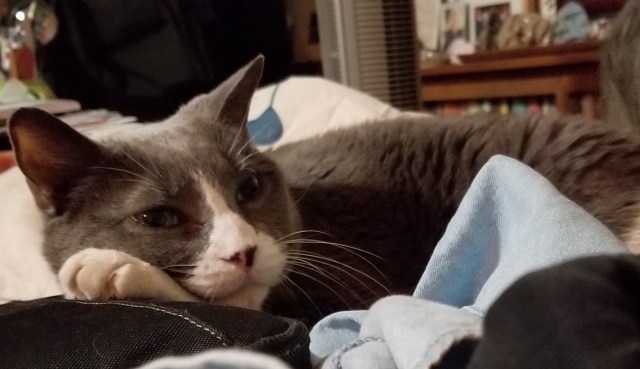
Our cat is dying of kidney disease, it’s chronic and incurable.  The vet told us we could keep him around for a while by sticking a needle into the skin of his back every day, attached to a line and a bag of liquid, and pumping some hydration into him.  In his experience, he said, cats in The Baron’s condition usually live six months to two years.   The Baron has only one kidney, it was discovered recently, but he’s been doing pretty well on the cat dialysis. [1]  Once he starts losing weight, the vet told us, the end is approaching.   

He lost his appetite back in June, a month or so into his kidney treatments.  The vet prescribed a drug called Mirtazapine, developed as an anti-depressant for humans, that is a known appetite stimulant for dogs and cats.  The Baron will not be forced to take a pill, but a vet tech, after wrestling with the determined cat to give him a pill, told us this drug also comes in a transdermal form, you rub it into the skin.   The only place a cat has skin is the pinna, the furless area inside each ear.   Presumably the pads of the feet are also skin, but the cat or dog would lick it off and the drug would not have the desired effect. 

We ordered the transdermal Mirtazapine from a formulary in Arizona, and after a stressful week or two of hassles,  the cat listless and eating very little, spoke directly to the pharmacist, Ashley, who was great.  She contacted the cat’s vet and immediately formulated the proper dose for his age and weight.  It arrived shortly after, in a pen that dispenses a perfect dose of the goop.  I massaged a small gob into his pinna, and soon his old appetite was back.   He gets the drug every three days, and his appetite and weight have been consistent.  The hydration, the cat dialysis [1], has been working pretty well so far and his quality of life is pretty good.  If you didn’t know he had a punched one-way ticket on the death express you’d think he was fine.   

He still cuddles affectionately with his female slave, Sekhnet, once all the lights are out, and he still puckishly claws and bites the hand of his male slave, when it lingers too long after giving him some treats or for the intolerable crime of attempted petting.  I sometimes point out to him that he is literally biting the hand that feeds him, but he glares at me so there will be no mistake: there’s more bloodshed in my immediate future if I continue trying to talk irony with him.  I have the scrimshaw on my hands and forearms to prove I’m not making this up.  Sekhnet always gets a good laugh out of my squeal of shock every time I repeat this timeless ritual with the imperious [2], well-armed Baron and get slashed by a fishing hook claw or cobra fang tooth – an always amusing example of the unlearned lessons of history, I suppose. 

The Mirtazapine pen was marked “Days supply 180”.  60 doses, three days apart.  I keep a chart on the wall to keep track of how many doses we give him and we were up to dose 45.  But the pen was empty.  I emailed Ashley, succinctly stating the facts and what we needed, trying not to sound peevish, and she got right on it.  The drug was formulated and in the mail overnight.   

Naturally, there was no explanation or any hint of an apology.  This is standard operating procedure in our culture, so it was no surprise.  The important thing was that we had the drug the next day, overnighted for the regular shipping cost.  Skaynes got his dose, a day and a half late, but, sure enough, his appetite returned. 

Here’s the thing that tickled and irritated me, both.   The information on the label on the new pen was identical to the printing on the first.  Only one detail was gone.  “Days supply 180”.  No promise, no basis for complaint for broken promise.  Like the uncertain duration of life itself, there was now no promise made, once it was pointed out that the earlier promise had been as solid and unimpeachable as a tweet from our current commander-in-chief.

[1] Sekhnet who is “in the business of accuracy”, as she says, points out that this is not dialysis in any sense of the word.  The cat’s blood is not purified by the process, he is merely getting hydration that relieves some of the stress on his kidney.

[2]  I get a great kick out of dictionary definitions sometimes.  My favorite is the great definition of “squeamish” from the dictionary I had in high school.   “Exhibiting a prudish readiness to be nauseated.”   Fucking genius.   I can’t accurately quote a line of Shakespeare, even those I love the most, but, like many TV commercials heard as a kid that I can recite verbatim, I’ll never forget that great definition.

I looked up “imperious” just now, since I am also in the business of accuracy, and before a great series of synonyms describing the Baron’s attitude toward his staff, was this thought-provoking definition: 

assuming power or authority without justification; arrogant and domineering.

“his imperious demands”

synonyms:  peremptory, commanding, imperial, high-handed, overbearing, overweening, domineering, authoritarian, dictatorial, autocratic, authoritative, lordly, assertive, bossy, arrogant, haughty, presumptuous 

What I love is the “without justification”.   Isn’t human history a continuous bloody scroll of those who assume power and authority without justification?   

Kings ruled by Divine Right, God gave them their indisputable powers, no matter how they came to the throne, God himself justified their bossiness.  Likewise hereditary ruling pricks like Barons and Lords derived their power from long custom, backed by force of arms.  The power to kill you, or have you whipped, is a pretty convincing justification for assuming power and authority, I guess.  “The consent of the governed” is the current fiction in democracy, but as far as “justification” look no further than these universally despised, or at least supremely disappointing, folks we have out there exercising power and authority, torturing some folks in our name and deciding how many poor people will need to die early so the super-rich can be even richer.

A fascinating conversation

Krista Tippett interviews neuroscientist Dr. Rachel Yehuda about the effects of trauma (and, sometimes, resiliency) passed down genetically from one generation to the next.  The interview, including a transcript, is here.  Rachel Yehuda is a pioneer in the field of epigenetics, which Krista describes:

epigenetics is the idea that not only do experiences lodge physiologically, but that physiological changes can actually be passed on to the next generation — transmitted generationally, trans-generationally. One helpful way, to me, that you’ve talked about epigenetics is, you said, “Think about genetics as the computer and epigenetics as the software, the app, the program”

The conversation is interesting throughout, but the second half gets very deep.  Krista begins:

This whole notion of generationally transmitted trauma, it gives a kind of a chemical basis for talking about what happens to populations of refugees, or African Americans in this country who have this history of generational trauma, or aboriginal peoples in Australia, or — I was reading about some work in generational trauma that Maria Yellow Horse Brave Heart did on the Pine Ridge Reservation, using the term of the “soul wounds,” the wounding of the Native American soul. This is science that is putting something to that phenomenon that seems to me to be quite new. It’s a more holistic way of describing what happens to human beings.

Dr. Yehuda: Yes, but it doesn’t all have to be negative. I think the purpose of epigenetic changes, I think, is simply to increase the repertoire of possible responses. I don’t think it’s meant to damage or not damage people; it just — it expands the range of biologic responses. And that can be a very positive thing, when that’s needed. Who would you rather be in a war zone with — somebody that’s had previous adversity, knows how to defend themselves, or somebody that has never had to fight for anything, but might be very advantaged in many other social and cultural ways?

Ms. Tippett: Right. So you’re saying that our — that there’s an intelligence in our bodies, behind this adaptation?

Dr. Yehuda: Oh, yes. There is a wisdom in our body, for sure.

Me:  And we have to be told this kind of basic human thing, in our culture, and hear it explicitly, to understand what we need as human beings, as sentient creatures– to feel, be listened to and heard:

Ms. Tippett:  … I’m so struck by the fact that this knowledge itself, just acknowledging the force of what has happened to us — that the force of trauma itself is a piece of knowledge that — I don’t know if you want to say it’s healing, but that it helps, that it’s kind of a — that it’s a building block to healing.

Dr. Yehuda: I think it’s a necessary prerequisite for healing. You have to do more than just recognize it, but you have to recognize it. We have a culture that goes to two extremes — they either completely dismiss something as “Nothing happened, don’t worry,” or they get very hysterical about what might have happened. And really, what we have to do is give ourselves a little time after an adverse event, to kind of take stock and not be so hard on ourselves, or not set expectations, and just listen to our bodies and give ourselves the space to be quiet and to heal and to see, to ascertain what has been damaged and try to counteract that by putting ourselves in the most un-stressful, healing environment that we possibly can have, to counteract some of that and promote a biological and molecular healing process that might forestall some of the epigenetic and molecular changes.

Ms. Tippett: I keep having this memory of an experience I had a couple months ago. I was in the city of Louisville, where they’re working on — from the mayor to the chief of police to the school system, they’re trying to figure out what it would be to be a “compassionate city.” And they’re actually using some science in this, they’re bringing some contemplative methods into schools — it’s very interesting and very holistic. And there was an — actually, a pastor, an African-American leader, who leads one of the — an important church there. And he said that one of the most important, transformative things that this mayor had done — that young people in his community had said this to him — was to sit with their grief.

Dr. Yehuda: Beautiful.

Ms. Tippett: To be — to dwell with the — and they may have used the word “trauma,” but just to let that be in the room.

Dr. Yehuda: Feel it. Feel it, instead of running to someone to give you a sleeping pill. Feel it. If you want to have that kind of a culture, it boils down to two words. It boils down to being able to ask someone, “You OK?” Just the idea that you are acknowledging the possibility that something bad has just happened to someone, and inquiring about them, is really, really at the heart of how military cultures really check up on each other. And in other healing cultures, you really hear a lot of people saying, “Hey, you OK?”

Their conversation ends beautifully, with one of the most profound statements I’ve heard in a long time.  I tip my hat to these two brilliant, empathetic women:

Dr. Yehuda: “How are you?” has become a pleasantry that is devoid of all meaning. But just really taking a second to inquire, in a real way, about how someone is doing — and even if they don’t tell you, and even if they lie to you, it will probably have a beneficial effect.

What I hear from trauma survivors, what I’m always struck with is how upsetting it is when other people don’t help, or don’t acknowledge, or respond very poorly to needs or distress. I’m very struck by that. And I’m very struck by how many Holocaust survivors got through because there was one person that became the focus of their survival, or they were the focus of that person’s survival. So how we behave towards one another, individually and in society, I think, can really make a very big difference in, honestly, the effects of environmental events on our molecular biology. [laughs]


The World is Easy Enough — when you handle it right …

Mr. Bockstein was most pleasant during our less than ten minute conversation just now (most of it on hold, granted, while he looked under the file number on the letter he mistakenly sent me).   He soon told me to forget about that letter, it had been sent to me in error.

The initial wait to speak to him was less than 40 seconds, which is great.  The wait when he looked up his erroneous letter to me, after I explained I’d received it in error and read him the reference number he’d assigned, was less than five minutes, again, quite reasonable.  The letter under reference number 1369393, it turns out, was not responsive to my complaint.  OK, mistakes happen. 

“Obviously it was meant to go to somebody else,” I said when he confirmed that his letter about my complaint against two entities I’d never heard of had been sent to me by mistake, “my concern is that I wrote a long and very detailed policy-related letter to the Attorney General and I’m not sure why I was getting a response from your subdivision of his office.”   

“Do you remember what it was about?” he asked me.  “Because I’m not finding…” 

“My letter was, the cover letter was two pages and there were about twenty pages of attachments. I was proposing legislation to remedy some terrible  oversight problems with healthcare and the administration of the PPACA in New York State, and my letter…”   

“Hold on, hold on,” he said, still trying to make sense of why he couldn’t find any trace of my complaint in his system.  Then he confirmed the spelling of my name and asked me to hold.  This time he remained on the line as I waited.  He was breathing in an exasperated manner because his computer was apparently buggering him while I held.   He let out one long, loud, exasperated exhalation, then continued to breathe more or less normally as I waited for him to find my name.   He let out another exaggerated breath and said imploringly “come on, computer, will you please?”   It was nice to be speaking to a human being, I thought idly to myself.   

“OK,” I finally said, “so actually, my question is how can that letter be placed in the hands of an assistant that reads policy and proposed legislation-related letters for the A.G.?”   

“Well, that would have to go to… hang on a minute…. did you file a complaint?”   

“No, I never filed a complaint with your bureau.” 

“You didn’t file a complaint about Healthfirst and the Marketplace?” 

“No, the letter discussed Healthfirst, and the Marketplace, and a number of other things.  It also discussed Blue Cross/Blue Shield and some systemic problems… basically it was a description of the cul du sac of consumer help that anyone who has any problem with health insurance finds himself in in New York State and it was proposing several ways to…”   

Mr. Bockstein, whose computer had apparently just released its uninvited, amorous, two-handed grip on his waist interrupted to give me the good news.  “Your complaint was assigned to one of our advocates.  Her name is Jennifer Lonergan and she will be responding to you based on your complaint.  As for that other one,  just ignore it.” 

“Well, I mean, I can certainly ignore it,” I agreed, “but I, you know, I was hoping it was not the end of a letter I spent a lot of time writing.”   

“No, no-no, no, no,” assured Mr. Bockstein at once, “your complaint has been assigned to an advocate, it’s being reviewed and the advocate will respond to you.”   

I confirmed the spelling of the advocate’s name, he gave me my correct file number and I thanked him very much. 

“OK,” he said affably enough. 

My recording ends with a long exhalation by me, a moment after I pressed disconnect to end the call with Mr. Bockstein. 


Most of us never grow up, Elie

My conversation with the skeleton of my father has grown quiet lately, which is a shame in a lot of ways.   I spent the better part of the last year waking up every day excited to continue our long overdue discussion.  It was the kind of talk we rarely had, but should have had regularly.  My father blamed himself, as he was dying, for not being capable of letting his defenses down long enough not to be a ‘horse’s ass’.   He was right to blame himself.  

Poignantly, and too fucking late, he acknowledged that he’d felt me reaching out many times over the years to have the kind of back and forth we started to have on the last night of his life.  Fucking tragic, truly, and the only other person who could fully appreciate the tragedy of it was the man who had just died.

I need to point out again that the idea of conversing with my father’s skeleton was not something I dreamed up, it happened of its own accord.  In fact, he spoke first.  It was early on in writing this manuscript, trying to recall everything I could about my father in order to try to describe the full scope of his complicated life.  

“Well, I couldn’t just let you make a hash of the historical record,” said the skeleton of my father from his grave atop the hill at First Hebrew Congregation cemetery north of Peekskill.  “Whatever liberties I may have taken interpreting personal history over the years, you will admit I was kind of a stickler for accurate historical detail.”    

Granted.  The devil, of course, is in the interpretation of those bare bones of what happened.   History isn’t a recitation of chronology, it’s showing events in perspective to help us understand the present, navigate the future, in light of the heartaches of the past.  

“Yes, of course, that goes without saying,” said the skeleton.  “Howard Zinn spoke beautifully, toward the end of his life, of the ideal role of the historian.  It’s at the end of a long, rambling post, as I recall.  You can cue it up, Elie, cut and paste it, right?”

Sure thing, though it’s really an aside here, isn’t it, dad?

“Fine, make a footnote, or appendix out of it, then,” said the skeleton.    

Done. [1]  

The past’s fugitive moments of compassion, what a beautiful phrase,” said the skeleton of my father, with that manic grin skeletons always seem to have.  

“OK, the point we’re discussing today, as you know, is that in fundamental ways adults never truly grow up.  I’m not saying this just to excuse my immature temper tantrums or to justify the way I emotionally abused you and your sister.  I’m thinking of that deep insight John Sarno expressed about how the subconscious has no sense of time.   An early traumatic experience is exactly as painful at fifty and seventy as it was at two and six.  These traumas operate on an emotional level, their pain is not lessened by the passing of years. 

“It was almost a hundred years ago now that my mother, the only one besides my uncle who escaped the massacre of their extended family, in desperation and rage, rose to her full five feet and first whipped me vehemently across my unmarked baby face.   Five hundred years from now, if anyone interviews me, the moment will be just as– for lack of a better word– fresh.  Do you think the victim of a lynching has any more vivid memory of anything in their life than those last horrible moments?”  

I never thought about it, but, it sounds true.  

“Well, you know, it’s the old ‘aside from that, Ms. Lincoln, how did you enjoy the play?’   These indigestible moments mark us, Elie.  The miracle is that anyone can move on at all.   That’s one reason leisure does not sit well with most people.  I don’t need to lecture you about this, since you seem driven to prioritize your life to have minimal security and maximum leisure…”

I think of it as productive work time and not being distracted by bullshit.  

“Well, OK, but it’s work you don’t get paid for.  Most people prefer to be working and getting paid to anything else they could do on an average day.  You work, you get paid, you buy things you want, put money aside, take a vacation, come back and work.   That’s the world, Elie.  You’ve always been a little queer that way, as if the world, from the beginning, owed you something for trying to see beyond the facade of this mysterious dung-heap of a world.”  The skeleton fixed me with an eyeless stare.  

And your point, sir?  

“No point, really, just sayin’.   When you were a kid, and you could draw like that, grandma encouraged you to believe you were already a great artist. What did George Segal tell you about grandma?   ‘Your grandmother was very good for you, and very bad for you’.”  

That’s ambition, dad, that’s a separate thing from the love of creation. George turned out to be a pretty angry guy himself, when prodded a bit.

“Well, just because you get world famous, and rich, doesn’t mean you’re not still a spoiled little baby pinched by all your original demons.  Look no further than this Whiner-in-Chief your idiot countrymen selected as their CEO — do you think he’s sick of winning yet?  That’s all well and good.  But, look, however intoxicating you find those moments of creation, without ambition, without getting paid and recognized for what you do well, love of creation eventually withers, becomes a bitter caricature of itself.”

Perhaps, but that’s another discussion for another time, dad.  

“Fine.   You know, when you were a kid and you watched mom and me interact with Russ and Arlene, I’m sure you felt you were watching four adults, finished with their maturation and enjoying adult life.   You remember going upstairs to go to sleep and the smoke from Arlene’s cigarettes wafting up the staircase to your bed, and the roars of laughter continuing downstairs until very late.   It was impossible for a kid to understand that those were also the laughs of five year-olds.  I’m not explaining this very well.”

Believe me, I get it.  It’s like the personalized demons we were talking about recently.  Things that terrify one person are blandly nonthreatening to another person and there’s no predicting who will be deeply afraid of what, who will seem brave about what.  My ultimate horror is finding myself trapped in an uncreative job I don’t particularly like, at the mercy of an employer who is free to act like an angry two year-old.  

“I can understand where you’d get that,” said the skeleton, “since you spent your childhood at the mercy of parents who were eternal two year-olds, on one level.   I was certainly that way, I think mom and you had a better relationship.  You didn’t have to confront that childish side of her as often.  Or maybe I’m rewriting history a bit, you can never tell.”  The skeleton turned to watch two turkey vultures, sweeping in long, lazy arcs in the sky toward the river.  

You know, dad, all this has made me think of other things I have to do today, to make myself feel productive.  I’m going to wrap this up and try to do some excavation on the right side of my desk, see what I can do about taming some of this horrific interior wilderness.  

“Strength to your arm, Elie,” said the skeleton, “and watch out for the natives.  They’re restless today.”


[1]    Howard Zinn:

“I wanted, in writing this book, to awaken a consciousness in my readers, of class conflict, of racial injustice, of sexual inequality and of national arrogance, and I also wanted to bring into light the hidden resistance of the People against the power of the establishment.   

I thought that to omit these acts of resistance, to omit these victories, however limited, by the people of the United States, was to create the idea that power rests only with those who have the guns, who possess the wealth.  I wanted to point out that people who seem to have no power — working people, people of color, women– once they organize and protest and create national movements, they have a power that no government can suppress.

“I don’t want to invent victories for people’s movements, but to think that history writing must simply recapitulate the failures that dominate the past is to make historians collaborators in an endless cycle of defeat.  And if history is to be creative, if it’s to anticipate a possible future without denying the past, it should, I think, emphasize new possibilities by disclosing those hidden episodes of the past when, even if in brief flashes, people showed their ability to resist, to join together, occasionally to win.

“I am supposing, or perhaps only hoping, that our future may be found in the past’s fugitive moments of compassion rather than in the solid centuries of warfare.”

The Politics of Rage

I, like many Americans, spend much of my psychic energy every day trying to keep the top of my head from blowing off.   This happens when a person is placed in a psychological pressure cooker of one kind of another.  In my case the present pressure cooker, primarily, is the near impossibility of seeing a recommended doctor to treat my serious kidney disease– an eventually life-threatening difficulty I’ve been stuck in for two months now as unknown damage may or may not be occurring in a vital organ/organs.  

Solving this vexing health problem would only relieve so much stress, of course.  I would still face the many frustrations of living in a competitive pressure-cooker of a society where people are pitted against each other in a zero sum war, while ugly partisan battles rage daily and the earth itself is becoming uninhabitable due to the incomprehensible greed of a few already immensely wealthy people.  We watch problems that should be intelligently discussed and solved go unaddressed, except for the televised bickering of well-dressed two year-olds spouting talking points, talking past each other to score meaningless points with those who support them, year after year.

The result of enforced powerlessness is resignation and rage.  These things sound at first like opposite reactions, but they are not mutually exclusive, they are two sides of a coin.  You feel hopeless and resigned, you brood about why you are in the situation you are in and you feel rage.   Your rage leaves you hopeless again, but it is building in the background for the next wave.  The rage and hatred at least provide a surge of energy, a phantom feeling of some kind of power.

In my case, I find myself hating frequently deadly American Corporate Health Care and the culture of personal greed that justifies countless preventable deaths as an acceptable cost of doing supremely profitable business.   When corporate medical providers and corporate insurance companies blame each other for the medical predicament I find myself in, I turn my hatred to the corporate “person”.   I understand that this legally created person is a psychopath, it exhibits every one of the DSM’s characteristics of the psychopath.  Callous unconcern for the feelings of others, reckless disregard for the safety of others, deceitfulness, repeated lying and conniving against others for profit, incapacity to experience guilt, etc.    

I can defend my hatred with countless examples.  It doesn’t help me solve the immediate problem, avoiding death by American health care, but critically analyzing the faceless entity that is nonchalantly and impersonally trying to kill me offers momentary relief from the feeling of being sodomized.  The confirmation bias comes into play.   Every time I see another example of corporate psychopathy, and there are many, I am confirmed in my view that the practices of these poisonous institutions should be tightly regulated instead of corporations being the omnipotent rulers of the “Free Market” that is the democratic world order.   I dismiss ads by Koch Industries that tout the wonderful, creative, life-sustaining, people-friendly company they are as the work of an amoral public relations agency making a shit load of money putting a good face on the hell-bent moral equivalents of Nazis.

Here’s the larger point, though:  

We live in the stubbornly gridlocked political dysfunction of a divided nation of self-interested partisans, bigots and haters of bigots, barking past each other, each side howling catch phrases to its base.  This hideous farce is currently presided over by the personification of unearned privilege and the idiocy that is marketed to Americans as success.   This “winner” was born rich, sought endless attention, finally attained it as an abrasive, wildly popular ‘reality-TV star’, and, through an aggressive, divisive campaign narrowly won the Electoral College (designed to protect slavery from the whims of the democratic voters) and took on his dream role of the most powerful man in the world.   His presidency is a symptom of the miasma of rage most Americans live in.

Everything I have said above about my hatred of the corporation can be said, in one form or another, by anyone who hates.   We do not believe anything without being able to justify it 100%.  As I can make my case against corporate psychopaths, someone who hates immigrants can make their case, someone who hates Muslims, or Jews, Blacks or homosexuals can make a case as tight as a noose.  The analysis may not be as convincing in each case, but a case is made and an undying belief confirmed.  

Trump appealed to the rage that millions and millions of white Americans feel, having been told over and over they are “privileged,” as they watch brown and yellow people, many who don’t even speak English, pushy women, transsexuals, foreign-born secret Muslim presidents, etc, moving ahead and “winning” while they are not, and worse, as they lose they are being held guilty for wrongs done long ago, wrongs they had nothing, personally, to do with.    It’s not hard to understand why many white people would be angry, watching the American Dream slipping away from them.

It’s hard to dispute that most Americans are worse off than we were a generation or two ago.  Certainly in terms of hope for a better life for the next generation.   Adjusting to that reality is maddening.  As the super-wealthy increase their wealth, the vast majority of Americans grow more economically insecure in our casino capitalist system while a government of millionaires performs disgusting theatre in a pay-to-play system that does not act in the interests of the screwed majority who voted them  into office.  

The candidates in the recent presidential elections spoke to that injustice to varying degrees.  Millions, particularly the young and most directly screwed, supported Bernie Sanders, who analyzes the situation astutely, speaks plainly and proposes humane solutions based on crucial systemic changes.   Millions who hated Trump did not bother voting for Hillary Clinton, the second most hated political brand in America, because she spoke the language of a corrupt insider, promising incremental change, the rising tide that lifts all boats, and empowering little girls to grow up to be rich, powerful women.  Trump, meanwhile, spoke nakedly to hatred and rage, making an emotional appeal to a mythical past when everyone knew their place, demonizing immigrants and angry minorities, and promising things he had no intention of delivering to suckers he correctly said would have supported him if he shot someone on Fifth Avenue.

Not all analysis is equal, of course, but the confirmation bias means we will select data that supports our thesis, ignore data that contradicts it.  Particularly, and this is worth noting again, when we are angry.  When we are angry, we feel perfectly right to be angry, there is no question abut that. Virtually everyone who voted for Trump still believes they were right to vote for him, that he is doing his level best to carry out his promise to Make America Great Again, in spite of being surrounded by traitors, liars, leakers and other cowards.  Trump is regularly throwing red meat to them, directly to their phones, confirming over and over that he is their man, working for them, no matter what.

Consider this example.   Black kid sneers at cop, or menaces him,  cop shoots black kid to death.   There is a big difference, legally and morally, if the cop felt disrespected or was in actual danger, or protecting others from imminent danger, but that is a question for a jury of one’s peers.  That is, if you can get a Grand Jury to indict a police officer who kills in the course of his duty to protect and serve.  Depending on who the jury is, we will have two very different outcomes.  

A jury of poor blacks will know other families who have lost a son to an angry cop, may have their own experience being treated badly by the police.  A jury of policeman will know other cops who have been killed because they hesitated to defend themselves with deadly force.  Conviction or acquittal, in a system based on ‘reasonable doubt’, will come down to where the trial is held and the composition of the jury.  Lawyers are paid big bucks to get the right venue for trial and pick the best jury.

That is not to say, of course, that everything is relative and depends on your point of view.  Something happened right before Michael Brown was shot to death in Ferguson, Mo.    Cop told him to “get the fuck out of the street.”  Brown may have said “back atcha, you fucking racist cunt.”  Brown may have moved menacingly toward the cop, punched him and made a violent move to reach into the car to grab the officer’s gun, as the cop said, justifying the six shots that killed the young man.   Just because we will never know exactly what happened does not change the fact that something objectively happened.  Here is one account  trying to piece together what actually happened.

If the officer had been wearing a body camera, and it had not been switched off, the entire incident could be viewed.   That video could have exonerated the policeman in short order, if the kid actually did reach into the car to grab his gun.

There will be Americans who sincerely believe that an angry black kid who curses back at a cop deserves whatever he gets.   Death sentence is fine with them.  They will be outraged that a black person would respond to “get the fuck out of the street” by cursing the cop, or making a menacing move toward him.  Unthinkable that anyone could curse at a police officer,  no matter what the cop may have done to the citizen, let alone shove or punch a cop.   I suspect  Trump got the vote of virtually every American who feels that way.  

We live in a culture of systematic manipulation, driven by the profit-motive, which never sleeps.  It is no surprise that the most toxic notions in the world are routinely sold here in America.  Millions here believe “Climate Change” is a hoax dreamed up by prosperity-hating commies like propagandist Al Gore.  No amount of evidence can change a view that is baked in and confirmed by everyone they trust.

A psychopath has no limitations on what he will say or do to get his way. That’s the liberating beauty of being a psychopath, or a corporation, for that matter.  If you truly have no regard for others, outside of taking their money, and no shame, you have a great advantage in a society that teaches there is only one measure of success:  unlimited fame and vast fortune.  

As for me, I continue to try not to let my powerlessness and hatred destroy me, and to keep the top of my head from blowing off.

What a mensch would do

There are few far too few mensches in the world, unfortunately.  A mensch will go out of his or her way to do the right thing.   A mensch listens to the whole story before putting their two cents in.  A mensch is patient, gives the benefit of the doubt.  A mensch is fair, and humble and doesn’t take advantage of people.  A mensch will not fight unless there is no reasonable alternative.  Like I say, mensches are rare, sadly.   Much more prevalent, particularly in a competitive, hierarchic, materialistic society like ours, are the dickheads, douchebags and motherfuckers, the winners who wake up every day ready to kick some ass.   Just look at the front page of any newspaper, you will see photos of an impressive collection of these types.  It is rare to see a mensch as a captain of industry or in any position of great power.

I mention the lack of mensches, and Hillel’s idea that in a land where there are no mensches, it is even more important to act like a mensch, as a backdrop to the following story.  If there was a mensch involved in the medical office I am going to describe, they could have done things much differently, much better, in a much more healthy way for all involved, particularly the patient. 

I was diagnosed with a serious kidney disease during the annual renewal period for Obamacare.   In light of this diagnosis, I decided to change insurance, pay many times more than I paid in 2016, in hopes of getting better medical coverage than I had last year.   The results have been mixed, though I am paying, literally, more than ten times what I paid last year for health insurance.  It’s an irrelevant detail for purposes of the following story, though, it annoys the shit out of me, so I mention it.    

In April, having been diagnosed with this disease four months earlier, I visited a nephrologist I’d contacted off a list given to me by a friend, who got the list from an acquaintance at a hospital.  This nephrologist had been the second or third I called, the first, I remember, only dealt with end-stage kidney patients, and I hopefully have a few years to go before that.  

The doctor seemed bright and personable.  I liked her.  The doctor had a hammer.   The only thing, she told me, that medical science has to cure my disease is immunosuppressive therapy, which comes in six month, twelve month and single injection form (though insurance doesn’t cover the very expensive one shot deal).  Some people, she assured me, have very mild side effects from the back to back to back infusions of steroids and the other chemicals designed to temporarily shut down the body’s ability to fight disease.  

They control for the suppressed immune system, inoculate you against the worst diseases you’re likely to get when the body’s natural defenses are suppressed.   For some reason, I was uncomfortable with this, particularly when the doctor explained it as an atom bomb or shotgun approach that temporarily takes out the whole broken immune system and, more often than not, fixes the problem when the system comes back on line.  A cure percentage was not available to the doctor.  When pressed she said it was closer to 50% than to 90%.   

My disease is idiopathic, which means the cause is unknown.   I needed more information.  I’d heard, for example, and the nephrologist confirmed, that 1/3 of patients who get this idiopathic disease have a spontaneous remission within the first year or two.  The disease, in other words, disappears by itself, as unexplainably as it appeared.

 The doctor, having only a hammer, told me I was wasting my time trying to get answers to all these questions and that hoping for remission was a crap shoot that could do permanent damage to my kidneys.   I was hung up on the fact that the disease was idiopathic, she said.  She tried to convince me that it was not idiopathic, because they knew so much about its progression and how to cure it.  She described the cure again, in great detail.  

At the end of her long presentation about her hammer I told her that since science doesn’t know what causes this membrane to grow on the filters of the kidney that, whatever they knew about a way to cure it sometimes, by definition the disease was still idiopathic.  She didn’t like the way I’d seemingly ignored her presentation of the cure.    

The doctor retested me, five or six weeks after our first meeting.  The test would confirm what the January and April tests had– I have a blood marker, some kind of antigen or something that comes up 99.9% in patients with my kidney disease, and only in the blood work of such patients.  

Still, though the test might well show that the disease was still progressing (and the retest would show it was),  I hesitated to commit to six months of immunosuppressive therapy, which she was urging me to start immediately. We had another discussion during that second visit, virtually identical to the first.   She dismissed the idea that diet, exercise, life-style changes could have any effect on the disease or improve my chances of remission without the chemotherapy.  She told me I’d be wasting time and money going to see a nutritionist or naturopath.   She had no studies to point me to.   At this point, realizing this was all she knew, and that my many questions could never be answered by her,  I probably should have thanked her and gone to see another doctor.  

Instead, I allowed her to convince me to have a kidney biopsy.   She explained to me in detail that a biopsy is the only way to know how long I’ve had the disease.  In an early stage, the tissue sample will show tiny dots, like pinpricks, of membrane.  As the disease progresses these dots become larger and larger and begin to grow on top of each other.  Eventually, toward the stage where you begin to have serious decrease in kidney function and are headed toward dialysis or a kidney transplant, the membrane is a thick coating over the nephrons.  By staging the disease, she told me, we would know exactly how urgent it was for me to begin immunosuppressive therapy, medical science’s only present treatment.  She sent me downstairs to the lab to retest my blood and urine.

A few days before the biopsy I had a call from the lab.  The doctor had neglected to check the box to have the coagulation of my blood tested, along with the other tests.  This coagulation test was needed before any biopsy.  I made an appointment and went back to the lab I’d been to a few days earlier.  A few days after that I managed to avoid a $2,100 charge to my credit card, demanded of me the afternoon before the biopsy,  prior to the biopsy.  I avoided this charge, though my final “out of pocket” responsibility for the biopsy is well over a thousand dollars.  

It turns out the biopsy cannot tell you how long you’ve had the disease, not with any precision at all.  The biopsy is, however, necessary protocol before the immunosuppressive therapy can begin.   The doctor told me I’d misunderstood, had unreasonable expectations, was very smart but had too many questions.  I resisted telling her she was acting like a fucking bitch, but we did argue.  We argued again the next time we spoke.  She told me again that I was being unreasonable.  

Being a lawyer, by training, I began to make a record.  I sent her a message that laid out part of my case, her repeated failure to return calls to give me test results, promises she simply didn’t keep.  She called me and struck a very defensive pose, which is to be expected.  She explained that she works at four different sites and rarely has a chance to check email or messages.  For my part, I was frightened and angry and not acting like a mensch, though my words in the text were very measured and I mostly kept my patience as she justified herself and explained why I was wrong.  I made my points.  The relationship between doctor and patient was now toxic and adversarial.  

She began to offer the conditional apologies Harry Shearer has helpfully styled “if-pologies”.  If you feel that I misled you about the biopsy, then I am sorry.  If you were hurt that I never responded to multiple messages and calls to my office to give you test results and that increased your anxiety, then I am sorry.  If your anxiety was increased by misunderstandings or miscommunications, then I am sorry.  I corrected her each time as to the form of these non-apologies, but it was a very wearying exercise.

After a few more defensive, blame-shifting ifpologies, I felt ready to punch her out.  I managed to summon the last of my cool, thanked her for calling, told her I was sure she was a very nice person but that I had to get off the phone.  My head was ready to explode, but I felt I had done pretty well under the circumstances.    

A few hours later, early Friday evening, when I’d finally calmed down, I had another call from the doctor.  She told me how upset our previous call had made her, how much I’d hurt her feelings by calling her a malicious person, etc.  I suppose one could call this playing the woman card.  It worked a little bit, I explained quietly that I had never called her malicious nor did I believe she was a malicious person.  Overworked, defensive, a bit dismissive and argumentative perhaps, but not malicious.  I told her I believe she is a good doctor.  It was truly a pointless call, although hopefully it made her feel a little better.  Her “unconditional apology” at the end was meaningless.

I went online and cancelled the appointment the doctor had made for me, without consulting me, on the Friday before my birthday.   During this appointment we would presumably discuss the biopsy and set up the immunosuppressive therapy. I’d already told her I was unavailable that day, but it was, in her words, another misunderstanding.  

I sent a message asking her to send my biopsy report to my general practitioner.  When I heard nothing back I followed up 24 hours later with a call to the Patient Advocate and was promised they would send it right away.   My doctor read the biopsy report and confirmed there was nothing conclusive about staging, though it did show very little scarring to the nephrons, indicating it had not yet progressed to the point it was doing any permanent kidney damage.  

Sekhnet got me a referral to a very experienced nephrologist from her beloved doctor of more than 40 years.  We highly value this wonderful doctor’s advice and I was looking forward to a second opinion from a nephrologist who could answer some of my questions and refer me to recent research on the efficacy of the treatment I was being pressured into beginning right away.  I want to make a fully informed decision before allowing them to pump steroids into my veins the first three days of every other month, while I sit with other chemotherapy patients.  

My bills for two visits to this nephrologist, blood and urine tests, and the biopsy are close to $2,000.  Good news for me, in a way, because once I rack up $2,000 out-of-pocket my insurance will kick in and begin to pay part of my future medical bills.  When I mentioned the expense to the nephrologist she told me she had nothing to do with the billing, had no idea an initial visit to her was billed at $860.  I made some snide comment about corporate medicine and she promised to look into getting me some reduction on my bill.  It was a promise made in good faith, and, naturally, never followed up.

Anyway, to the issue of menschlichkeit I promised at the top.   When I called to make an appointment with the new, highly recommended nephrologist I was told that, since he was, as luck would have it, in the same practice group as the first nephrologist, that the two doctors would have to agree that I could see the highly recommended one, since I’d already been a patient of the first.  The mentor, I was told, had to have permission from his protégé and would have to agree to see me.   I wrote to the first nephrologist asking her to expedite the switch so that I could continue my treatment.  The following day she wrote back:  I have instructed my front desk staff.  That was on June 22, almost a month after the kidney biopsy.   

Each time I called after that to make the appointment I was told I’d need to be called back.  Each time I received no call back.  On July 13 I finally had a call from the office manager, only two days after the most recently promised call back.  She told me it was an apparently inviolable office policy, that no doctor in the practice group would see anyone who had seen another doctor in the group, under any circumstances.  

She brushed off my comments about the unethical three week wait to deliver this news, if the policy was indeed inviolable the first time I called, while I’d been trying in the meantime to make an appointment and being told each time that the doctors hadn’t yet discussed it.  She offered to refer me to other nephrologists outside the group, and wished me the best of luck.  I resisted telling her to fuck herself as I said goodbye.

My reaction was rage.  I wrote a letter accusing the doctor I’d been referred to of being unethical.  I figured to run it up the food chain at the corporation he worked at, pressure him into doing the right thing.  It was a stupid idea, although my doctor endorsed it, in fact, recommended it.  I was talked out of  sending the letter.  

I thought of the belligerent retarded man I’d represented years earlier in Housing Court.  He stood on his right to smoke crack, play loud music and bring prostitutes to the room in the nursing home he’d inherited a right to when his mother, who he apparently helped care for, died.   He was angry every time we were in court, left me angry phone messages, sometimes several in a row, between court appearances.  When I finally settled his case, with no admission of wrongdoing on his part, and preventing his eviction, the judge congratulated me.  

A few days later I had a complaint forwarded to me by the First Department’s Attorney Disciplinary Committee.  The letter gave me two weeks to respond in full to the charges or face a disciplinary hearing and possible sanctions including the suspension of my license to practice law.   I read the complaint thoroughly.   It had my name spelled right.  My office address was given as the Bronx Housing Court.  The box for the complaint was entirely blank.  I spent four hours composing the letter defending my professional name against a blank complaint.  I eventually had a letter back from the First Department dismissing the blank complaint against me.  

I figured there has to be a similar procedure to make a complaint against an unethical doctor.  I have no idea if there is.  And anyway, I was urged, more important for me, as a man with a serious kidney disease, to find a new nephrologist in the phonebook than to fight these unaccountable, defensive, reflexively united, never at fault pricks.  

Here’s where somebody being a mensch comes in.  If the original nephrologist was a mensch she could easily have reached out to me by phone or message.  She could acknowledge that things were not going smoothly between us and persuade her colleague to see me, even if only for a single second opinion visit. To her mind, this would be an admission of defeat, of having proceeded badly with a patient.  She has established that she is not much of a mensch.   Like I say, the mensch is a rarity.

What of the doctor highly recommended by his older, highly respected mensch colleague?  How difficult would it have been for him, out of respect for this colleague, if for no other reason, to have contacted me and asked me what the problem was?  

Too much trouble, much easier to have the office manager call me back, after weeks of misleading delay, and wish me luck with some new doctors.  I researched this senior nephrologist online and found only one comment about him from a patient.  According to the comment he did not return calls, did not provide answers to patient questions, was abrupt and dismissive.  How well he has trained his protégé!  

It is rare to find a mensch.   For years doctors routinely removed the breasts of countless women who came to them with early signs of breast cancer.  It was standard procedure at the best cancer hospitals at one time, a radical mastectomy.   It is no longer standard procedure, thankfully, as advances in science, more women in the medical field and a greater recognition of the importance of treating the entire patient, feelings included, emerge.  

In the meantime, I’m determined to have a very nice day, and to go fuck off for a while, before I compose the original letter I should have written to this apparent douchebag of a senior nephrologist.  On the off-chance, you know, that he was recommended to me by a mensch because he himself, in some hidden region of his non-reptile brain, has the repressed spark of acting like a mensch.  In any case, that unanswered letter will be a better one to send to the medical ethics committee, if such a thing exists, than either of the two previous attempts at a letter.

Take it like a man, Madam

Years ago, as a disaffected undergrad at City College in Harlem, I enrolled in a course in the Women’s Studies department.   This was around 1979 and I was the only male in the small seminar course.  The professor was a brilliant woman named Joan Kelly-Gadol.   I remember her referring to a movie or a book by the title above.  The clever and evocative phrase stuck with me, apparently.  

As a side note, Joan Kelly (who, Wikipedia informs us, began teaching at CCNY in 1956, the year of my birth) died young, of cancer while I was still a student at City College.  She was a historian and the college instituted a prize named for her, to be given annually for best research paper by an undergrad in an elective history course.  I may have been the school’s first Joan Kelly Prize recipient when my history professor, the equally brilliant Walter Struve, submitted my paper on The Nazis vs. Degenerate Art on my behalf.  I realize now I was probably the first winner, since the prize was awarded in 1982, the year of her untimely death, and my last year at City College.

“Take it like a man, Madam,” says the overbearing person doing something that should not be done.    

Should is not a word one should use,” stresses the overbearing person. “What you should do instead of sanctimoniously invoking morals and ethics, those two amorphous, infinitely flexible man-made constructs, is shut the fuck up and take it like a man, Madam.”  

Words to the wise:  take it like a man, madam, whatever it is.  Whimpering only makes it more humiliating.  If you have lived in this world any significant length of time, you will know exactly what I’m talking about.