Anger, like longevity, has its place

My father, like most people who were viciously abused as children, was subject to rage.   When he was treated unfairly, received shabby customer service, when he confronted the most brutal things his government was doing (he spoke less of this category as time went on) when he felt disrespected, he could be angry for days at a time.  He’d marinate in his anger and hurt, ruminate, as they say now, chewing on the indigestible cause for his righteous rage like an agonized ruminant.  

He sometimes experienced physical manifestations of his anger and frustration.  During my childhood his psoraisis, which covered much of his body, would sometimes flare up.  His skin would crack and bleed, the tar baths and light treatments he took at home would no longer help and the only relief would come in a hospital.  In the hospital, the pressures on him and his frustrations greatly reduced, with only the job of getting better to focus on and many treatments employed, his tortured skin would recover within a few days.  

Being the son of an angry man, a father who often took his frustrations out on my sister and me, with projection often coming into play (my teenaged acne was my hate and rage oozing out through my pores, for example), I made overcoming my own anger a lifelong priority.  Yet any reader of these posts will quickly see that, while I have spent a long time consciously practicing my secular version of ahimsa, I am still angry enough to, for example, wish horrible retribution on pampered people who cheer America’s military might while ignoring the indiscriminate slaughter of innocents during air strikes of dubious military usefulness.    It is not a gentle thing to opine that it will take having their own children reduced to chopped meat in a drone strike to give them any insight into the highly destructive evil they are applauding and, in some cases, profiting from.

I realize now that it is not always desirable, or even possible, to avoid anger.   We are correctly taught that the only thing necessary for evil to flourish is for good people to do nothing.   Evil, injustice and indifference must be opposed.  It is best, of course, to do it effectively, without violence or escalation, without letting oneself be consumed by the anger.  Ahimsa includes speaking calmly and clearly to evil and indifferent people and being steadfast in continuing to do what needs to be done to change the intolerable situation.  One thing that is necessary for operating this way, or at least very helpful, is a like-minded community, or the whole-hearted support of at least one other person.

Driving in the rain with an old friend the other day the subject of anger came up, as it occasionally does between us.   Raised in a home where he was also subject to irrationally harsh treatment at one second’s notice, it is not necessary for either of us to make more than a quick reference to set the stage for a story of a near-confrontation with an abusive type.   We both have become better at dealing with overbearing, abusive types, but the frayed nerves and the childhood reflexes, the palpable danger of reacting emotionally to the situation, are all still very much there.  

He seemed mildly amused that I was “unable” to refrain from telling a harsh truth to a bureaucrat, the head social worker for a hospital where a ninety year-old friend of Sekhnet’s languishes in misery.   I acknowledged to the social worker that the old woman was difficult, pointed out how depressed she was, but was obliged to express my doubt that the social worker was taught in Social Work school to blame the patient for her own unhappiness.  I included this opinion in an email seeking, for a third time, an answer to a straight-forward medical follow-up for the old woman.  My friend smiled and shook his head, here I was, still unable to keep myself from throwing a little sterno on the old fire.

I spared him most of the details, just told him I was responding to a bad email written by a non-responsive jackass who was abusing a friend of Sekhnet’s and blaming an old woman for her situationally appropriate misery.

The details: instead of providing the results of the eye exam the woman had a month ago, and telling us why new glasses were not being made, as she promised, the head social worker once again promised to follow-up but spent most of the email detailing what a stuck up, miserable, uncooperative snob the patient is, how she refuses to make friends and to participate in the many monthly programs they periodically hold for patients.  A tour de force of blaming the victim, the best defense a good offense, ’twas like the breath of an unwashed asshole, venting. [1]

The old woman feels isolated and imprisoned.   She is depressed by the objectively depressing situation she finds herself in.  Many of the other patients on her hospital ward are demented, many speak no English.  The services they receive are minimal.  The food is rich in white flour and potatoes, noodles and potatoes are often served on the same paper dinner plate.  An independent, health-conscious and active woman into her late eighties, she fell and broke her hip and is now spending the rest of her life locked in this far from ideal Medicaid ward, a place she had no hand in choosing.  

Her one refuge was reading, but she can no longer see well enough to read.   After much exertion by Sekhnet and me, an eye exam was scheduled for her.  It took a few months but was finally done on March 25th.   She heard nothing further from anyone after the exam.  We followed up.  The head social worker responded that she would follow up to see what happened.  

When we followed up a second time we were treated to a long analysis of what a difficult, stuck up asshole our miserable friend is.  The question of her vision was never dealt with, except by another reference to following up with the medical department.   The social worker’s prose is appended at the bottom, read it for yourself.  She is a wonderful example of her type and very eloquent in expressing it.

This would seem to be a small evil, unless you are an old woman with no other options, kept against her will, in a Medicaid ward at a bare bones hospital on the Lower East Side.  I’d be within my rights, I suppose, to sarcastically thank the head social worker, who wrote to tell us she will no longer answer our emails since we misconstrue them and accuse her of writing things she never intended.  If you have the stomach for it, read her masterful prose poems below, judge for yourself.

I’d be within my rights, I suppose, to write, my toes still almost on the edge of the high road:  Hopefully you will never find yourself old and helpless and at the mercy of a merciless bureaucrat.   If you did, it would only be karma, and if that offends you, I deeply apologize for speaking the unflattering truth.

And cc the entire non-responsive correspondence to the director of the hospital, the hospital’s patient advocate (if any), the State Ombudsman, NYC Department for the Aging, the NYC Public Advocate’s office and anyone else who might give a rat’s ass or make this unaccountable corporate “social worker” have to defend her actions and non-actions.  

True, it seems like a lot of energy to spend, energy that might be better spent elsewhere, unless you consider the understandable despair of this abandoned old woman at the mercy of a system that clearly sees her only as a source of Medicaid payments.  Suppose she needs lasik surgery– that would probably come out of the Medicaid payments otherwise payable to the hospital for her maintenance.

The same way I find it impossible to forgive the unrepentant self-justifier, who, instead of acknowledging hurtful behavior, defends it with energetic hostility, anger at this type is still unavoidable to me.  The one thing to consider, in the case of this particular career bureaucrat gatekeeper, is if trying to hold her accountable will make things better or worse for our friend Margaret, locked up under the supervision of this creature.  

I would truly like the serenity to be able to stop thinking of galling, seemingly unresolvable, things like this, but they sit across my throat like sharp, jagged bones.  This is one of three or four such bones, crosswise in my craw right now, most related to the near impossibility of finding decent medical care at any price, and it is the only one I can theoretically do anything about at the moment.   Here the creature speaks for herself, in response to why there is still no report on the eye  exam, and then on why she will no longer answer our emails:

[1]  Ms. H_____ has rejected every attempt to have her involved in additional social situation.  She finds everything we offer beneath her.   Attempts to pair Ms. H______ with other residents (who have similar backgrounds and interest) to share stories and or for stimulation usually ends up with the other resident feeling bad about themselves because Ms. H_____ feels that they are not educated enough or somehow not smart enough for her.  I not sure what else the staff can do but continue to encourage Ms. H______ to engage and continue to invite her.

Getting Ms. H______ to attend her appointments is not without challenges.  She usually tells the staff that she will go later or tomorrow.  The staff reminds Ms. H_____ of the appointments in advance but still are faced with the stalling and delaying suggested by Ms. H_______ the day of the appointments.  The ophthalmologist has not indicated any need for eye glasses on his last consult 3/25/2017, I am asking for additional clarity as to why.  The team is aware of her upcoming appointment with the dentist on 4/20/17.

Ms. H______ is on the list to receive pet therapy, however pet therapy is a special event and not offered often.   I cannot tell you when the next pet visit will be at this time.  The recreation therapy department head is aware of the request and has assured me that Ms. H______ will be involved in the next pet visit.

her last email, which opens with a classic “if-pology”, if you are an asshole, I am truly, deeply sorry:

Good Morning

I apologize if that is how you and Ms. W______ have read into my email.   I was  stating facts of her behavior, I never blamed Ms. H_______.  Staff continues to encourage and support Ms. H_______ well-being.

Further updates to you and Ms. W______ will be done in person and with the team from now on.   I don’t want any further misunderstanding that emails often lead to.

I thank you for your response and continued support of Ms. H_____ and the Staff here at ______.

Oh, there will be no further misunderstandings, dear, none whatsoever.
Most of all, Elie, do what you love

It’s been a year since I began the manuscript I hope one day will be the book of my father’s life.  I think it’s time to try to summarize the main story line, as I would before a Moth story audience. 

My father always insisted that, on a fundamental level, people cannot change.  It was an insistence both tragic and maddening, even as I can now see the kernel of truth there.  This belief was a self-fulfilling prophecy, as they say.  We argued about it over the years, as I changed, as he remained stubborn in his insistence that the only change one can hope for is on the most superficial level.  

It was one of his favorite themes, dismissing all hope that things could ever be different, no matter how much one changed one’s actions and reactions. His life had taught him harsh lessons it was his sad duty to impart to my sister and me.  He was dogged about removing the illusion that one might evolve past one’s genetic predispositions and childhood difficulties.  

On the other hand, he always insisted that childhood injury had nothing to do with a mature responsible adult’s life.  You take responsibility for your own life, and your own happiness, and you don’t blame your parents, or whatever bad luck may have led them to be less than the parents you might have hoped for.  This duty apparently started, for a young man, around the age of eight or so, when it was past time to stop acting like a child and time to start behaving like a goddamn man, for fuck’s sake.   

This much out of context generalized detail and emotional nuance, of course, would be hacked through by a director from the Moth, who would keep urging me to get back to the essence of the story.  Make it simple, it’s a story, people have to be able to follow it from start to finish.

My father was an idealist, extremely bright, well-read, quick-witted and funny as hell.   He was also, sadly for my sister and me, a man crushed by a brutal childhood who could not help replicating the cruelty that sometimes flows from such terrible childhoods.  

“You can’t blame your childhood, or your parents, or bad luck, you have to take responsibility for your own life,” he always insisted.   At the same time, he also insisted a person could not change on any fundamental level– what you were at five you would be a fifty.   Even as a child this struck me as an idiotic and self-defeating idea.   We argued about it, me a child, my father a grown man.  Later as two adults we continued to wrangle over this issue.  

“I’ve seen a tremendous change in you,” my mother once observed to me during a discussion my father and I were trying to keep civil, about the difficulty of change.

“Well, you can change certain things, on a superficial level,” my father yielded, “but the baked-in responses, those genetic traits hardened by experience, the reflexes you are born with, things like a bad temper, which you have, no matter how you try to conceal it with your lofty vows to remain mild and so forth, remain.  You cannot change on a fundamental level, certain things will continue to enrage you if you are wired that way, you can only change the surface aspects of your personality.”  

I told him that if anger was a problem in life, in our relationship, and I learned to control it enough to maintain a dialogue instead of being drawn into a fight, that was a significant change.  

“Superficial,” he said, dismissing any benefit not reacting with anger could have for anybody.  “Deep down, you’re still mad as hell, boiling mad, like you were when you were a baby, and at five and as a teenager.”  

I finally saw the futility of having this argument with my father.  He was very smart, and very skilled at the art of verbal war.  He was always armed and dangerous.  There came a point when his desperation to be right at any cost became clear to me.  

Paint that specific moment in the den in Coconut Creek,  hand-delivering that third copy of the heartfelt letter he kept denying he’d read, month after month.  

“Oh, that letter,” he said with the casual nonchalance of a charismatic psychopath,  “yeah, I read that letter.”  

He paused to fix me with a look and then said ” you have to respect my right not to respond.”  

The hideous, specific flavorful details are needed for a reader to grasp the full exact truth this story is tying to convey.

I realized at last that there was no benefit to arguing against something he would defend to the death, no matter how mutually destructive that thing was.  

I believe we can change things about ourselves if we are miserable enough about the thing that needs to be changed, determined enough to do better.  I have seen changes in myself and in old friends.  They are the result of long, hard work and such changes are always works in progress, but I see the changes and their benefits.  I can also see my father’s point of view– restraining the impulse to be enraged is not the same as no longer feeling anger.  Even though learning to restrain and tame the impulse is the first step to a less enraged, contentious life.  

Whatever the case about changing oneself, it is 100% certain that one cannot change anyone else, and so in the end I realized that my poor father was a lost cause and that arguing with him was only throwing fuel on a fire that should not have been burning in the first place.    

Not to say I stopped chewing on the perplexing riddle of what made this anti-racist, friend of the underdog, funny, humane, otherwise very smart, hip and likable man such a brutal dick.  I spent many hours with my father’s first cousin, Eli, an old man living in a little retirement cottage about an hour north of me.  I’d drive up the long, twisty parkway to listen to stories about our family and my father’s unimaginably awful childhood.  

Eli loved my father in a way he couldn’t love his own children, to whom he was often quite brutal and from whom he was mostly estranged.  My father loved Eli, who was 17 years older, as much as he feared him.  Eli was a warm, generous, very funny man capable of great savagery when angry, which was often.  There was no doubt of their mutual love and there was no doubt of Eli’s genuine desire to give me insight I could use to understand my destructive old man and get along better with him.  It was through Eli that I finally got helpful insight into my father’s tragic life.

Predictably, my father was defensive and angry when I reported the fascinating conversations I was having with Eli.  

“Eli’s full of shit!” he said with great conviction, “he has his own twisted version of history.  Yeah, listen to Eli, he’s a great historian, did he tell you how many times he would have become a millionaire if some asshole hadn’t screwed him?  Ask his kids about him, what a loving soul he is– Eli has never been wrong about anything, he’s always the victim, always the righteous man wronged by vicious assholes, even when he’s smacking his kids around…”  He went on in this vein for quite some time.

This reaction did not surprise me.  After all, it was a yelp of pain.  It made sense to me now, in the context Eli had imparted to me, quietly and deeply aware of the full pain and horror of what he was telling me.   Eli’s beloved aunt was my father’s mother Chava.  Eli witnessed Chava’s violent rages many times including when she turned them on her infant son, from the time he could stand.  

“She had a drawer next to where she sat at the kitchen table where she kept the cord to her iron.  You remember those old cloth wrapped electrical cords they used to have?  Heavy cords, with a rough burlap kind of wrapping.  She would reach into the drawer, grab that heavy cord and whip little Irv across the face with it.  I saw this myself.  After a while all she had to do was rattle the drawer and he would stand like this,” and Eli did one of his uncanny imitations, a terrified child, rigid and shaking, eyes cast to the ground.  

This image was like a light going on in a darkened room.  I was flooded with sympathy for the poor bastard even as I knew that my father would kill us both before he’d ever talk about something this painful.  He was simply incapable of it, I realized thinking about his life from the perspective of a face-whipped infant.  It explained many things I could never understand.    

The last few years of his life, as my father was becoming greyer and weaker, hollowed out by the undiagnosed liver cancer that finally killed him, I pretty much abided by his wish to stick to superficial conversation.   We could talk about politics, a subject we were largely in agreement about, or history, something that fascinated both of us, but most of the deeper conversations were out of bounds and I stopped trying to have them.  Predictably, in a story like this, I got a life-changing phone call during dinner with old friends.  

We were gathered around a table to retell a story my father had told us every year, about the spiritual journey from slavery to freedom that our ancient ancestors had undergone.  In every generation we must learn this lesson anew– because we were strangers harshly mistreated in a foreign land we must never tolerate the mistreatment of anyone, if we have the power to oppose it.  

“The D.U. is in the hospital,” my sister told me.  “The E.R. doctor knew within two minutes that he was examining a dead man, he touched his swollen stomach, looked at me and said if your brother wants to see him, tell him to get down here right away.”  

There were two doctors around the table who gently reassured me that ascites, the accumulation of liquid that gathers around the organs at the end stage of something like liver cancer, could result from several different things (all pretty much deadly, as I soon learned), and that I should go visit my father and not assume the worst until I talked to his doctors.  I was on a plane soon after.  

I drove to the hospital at around 1 a.m. on what turned out to be the last night of my father’s life.  He was ready to have the conversation he’d never had the courage to attempt.

“You know those conversations you had with Eli, he pretty much hit the nail right on the head, although he probably spared you the worst of it.  My life was over by the time I was two years old,” he began.  “I felt you reaching out to me many times over the years, and it’s my fault I was too fucked up to respond to you like a human being instead of a belligerent asshole.”

The book of my father starts with this conversation and imagines what we would have shared if he had not died the next day at sunset.   I have been in regular dialogue with his skeleton for the last ten months or so and am happy to report our communication is now excellent.

Thank you.

 (imaginary applause)

Rewrite of To Whom it May Go Fuck Yourself

I came to realize the previous draft was lacking in at least two ways.  It was focused on the mind-fucking Patient Protection and Affordable Charismatic Presidential Candidate Legacy Enhancement Act, for one thing.  The focus on the soon-to-be repealed PPACA gave the whole letter a sour overlay of mootness.  

Equally important, the letter as written probably wouldn’t have inspired the A.G. to take any action and didn’t set forth the specific action I was seeking.   This one, I think, does better in those areas.

Here’s the rewrite, which is about as good as I can get it at the moment,  After I post it I will go back to gnawing at my ankle:

January 4, 2017

Office of the Attorney General
The Capitol
Albany, NY 12224-0341

Honorable Attorney General Schneiderman,

I’m writing to alert you to a massive consumer protection failure in New York State and to encourage you to take action.   There is no New York State agency where a citizen can pursue a claim of fraudulent denial of medical service against a health insurance company.

The need for state oversight is more important now than ever, with an incoming administration committed to dismantling government regulation in many areas.

I’ve admired the courageous and proactive steps your office has taken against the perpetrators of various frauds and urge you to consider this letter in the context of systemic healthcare-related fraud against a large class of vulnerable low-income and senior citizens of New York State.

Uncertainty about health care, lack of information about costs and the routine denial of medical services without explanation are all stressful. They negatively affect the health and quality of life of those mandated to participate in income-based “bronze” level health insurance plans in New York State.   As detailed below, NYS health insurance buyers are denied any protection against the practices of private health insurance companies, even when the denial of necessary service appears to be utterly fraudulent.    

This consumer protection emergency transcends the current health care scheme under the Patient Protection and Affordable Care Act (“PPACA”).   The president-elect’s threatened repeal of the PPACA makes it all the more essential for New York State to regulate private insurance companies.   The replacement for the PPACA, whatever it might be, will not eliminate the need for protection of vulnerable older and low-income consumers, the need will likely become even more pronounced.

 In googling your mailing address to mail this letter I came across the New York State Health Care Bureau, a couple of layers down on your office’s website. While that office no doubt provides a welcome shoulder to cry on, the citizens of New York State sorely need a regulatory apparatus that can make timely and binding determinations on when insurance companies cross the line into actual fraud against their mandated customers.  

 Of course, the creation of a regulatory agency is a matter for the legislature. A fraud investigation by your office into practices such as the ones described below would highlight the need for state regulation, and give momentum to the legislative process.  

As stated above, defrauded health insurance consumers (patients) in New York State have no forum where complaints can be resolved, outside of the NYS Department of Financial Services, which, it turns out, does not hear such complaints.

The fraud investigator there could not find a word other than fraud to describe the facts I set forth, but urged me to call the NY State Department of Financial Services Consumer Services Hotline. He assured me that they were the specialists in the area of health insurance. The recorded menu at the hotline, which I recognized from my first call many hours earlier, offers no option for resolving issues with insurance companies of any kind.  

On my original call to the Department of Financial Services, a long wait to speak to a representative yielded the number of the proper federal agency to contact.   Calls to the U.S Department of Health and Human Services are robotically routed to a NY State number that is, sadly, the office of Temporary and Disability Assistance, where some helpful party connects you to a fraud hotline, which turns out to be at the office of the Medicaid Inspector General, where the office of legal affairs is also sympathetic, but unable to help, and so forth.

 As for the PPACA, I understand that it was drafted by Liz Fowler, a career health industry insider who went on to a senior executive position with Johnson & Johnson immediately after her work on the PPACA was done. I‘ve witnessed the many attempts to repeal the law and thwart its implementation, rather than fix any of its original flaws, as most other complicated laws are tweaked and improved over time. Even so, the lack of any provision for oversight of corporations participating in the PPACA by New York State is grotesque. To a sixty year-old cardiac patient unable to see a cardiologist now for many months, the lack of oversight may also be deadly.

Although the situation I’m complaining of is personal and extremely aggravating, it is sadly typical. I’ve commiserated with many others who suffer under similar insurance coverage.  Erroneous bills are a common, if relatively innocuous, theme.

I receive bills that there is no way to resolve, most recently an invoice for $1,324 for a fully covered sonogram I had in August. The x-ray and kidney sonogram I also had that day were fully covered, the sonogram of another body part was not.   The billing issue was resolved with the insurance company (Empire Blue Cross) and the provider to a zero balance in October. Two months later, the full bill for $1,342 was sent to me again in a Third Notice.  

Nobody at Empire could give me the reason the provider had sent that bill, although the representative, who checked my account and called the provider again, informed me that, this time, it was my responsibility to pay it in full.   She offered to send a consumer handbook for my plan that would fully explain the reason, which she claimed was clearly set forth there, though she could not state it.

There is nobody in New York State to adjudicate this billing matter, outside of a judge on some court one must file an actual lawsuit to appear before, assuming one could find a cause of action.

Empire recently sent me an email warning of termination of my insurance for non-payment of December’s premium two weeks after their email confirmation of my payment for December and January.

More ominously, a patient can be denied medical service without explanation (site-specific provider NPI numbers and proper CPT pre-authorization codes notwithstanding), and there is nobody in New York State you can appeal to, except to the company itself.   Empire Blue Cross “Health Plus” recently sent me to two providers for needed medical services, a cardiologist and a physical therapy facility. Neither provided me with any service. 

I received the site-specific NPI number for the cardiologist, scanned and emailed the back and front of my insurance card, got pre-approval from his office. The consultation was halted ten minutes in and I was informed that my insurance would not cover the visit.   When I arrived at the nearby ‘physical therapy facility’ Empire had referred me to, it was a nursing home.  The director told me the facility offers PT, but only to residents.

The circuit of government agencies I have contacted in vain came full circle with the “consumer help line” the NYS Department of Financial Services Fraud Unit investigator had me call, which I immediately recognized as the very first number I’d called.   Here is a summary of that cul du sac:

NYS Department of Financial Services referred me initially to the US Dept of Health and Human Services which, supposedly, connected me to NYS Health and Human Services, although to an incorrect branch of that agency, the pertinent branch apparently having been merged into the NYS Department of Financial Services which took over all functions of the former NYS Insurance Department as well as oversight of banking and several other discrete* and seemingly unrelated areas.  

The NYS Department of Financial Services, one learns, has sole responsibility for oversight of health insurance companies, as well as all fraud investigations related to consumer fraud against insurance companies, and complaints about the practices of banks and brokers.   Everything but, according to John Marconi, a fraud investigator for the Department of Financial Services, investigations of colorable fraud committed by insurance companies against mandated health-care “consumers” in New York State.

My political and legal conclusions are beside the point. Whatever the reasons, the fact remains that in New York State in 2017, even under the PPACA, citizens whose health is menaced by private insurance company denials are denied any legal process to have these vexing, sometimes life-threatening situations resolved.  

Outside of a possible Article 78 (which government agency would you sue for relief, the Department of Financial Services?) or a class action under a private attorney general or qui tam statute, what is a patient trying to get an appointment to see a cardiologist since August to do under the Patient Protection Act in New York State?   At minimum an ombudsperson, or a few hundred of them, would be a good start.

As I stated above, I’ve followed your career from the start and have admired your principled engagement in the fight against injustice.   To have a legal right that cannot be enforced is to have no legal right.   While certain widespread injustice is accounted by some as a kind of ‘externality’, the lack of legal recourse for denial of purchased health care must not be allowed to stand in New York State.

I will be glad to do what I can to help your office take the first steps towards sorely needed due process for denial of health care for some of the State’s most vulnerable citizens.  I am open to being a plaintiff in any lawsuit the State might want to bring and to testifying in any proceeding.   I look forward to hearing from your office and stand ready to give any other details or assistance your office might require.

 Yours sincerely,

 B.B. Rebozo

 * teachable moment!  The previous draft had idiotically read “discreet”, an error imperceptible to homophone-deaf smell check

discreet:  having or showing discernment or good judgment in conduct and especially in speech :  prudent; especially :  capable of preserving prudent silence

discrete: separate


Letter to Whom It May Go Fuck Yourself

Office of the Attorney General
The Capitol
Albany, NY 12224-0341

Honorable Attorney General Schneiderman:

I am writing to enlist your efforts to remedy the lack of state oversight of health insurance companies under the Patient Protection and Affordable Care Act (“PPACA”).

I have admired the courageous and proactive steps your office has taken against the perpetrators of various frauds and urge you to consider this letter in the context of systemic healthcare-related fraud against a large class of vulnerable citizens of New York State.

Defrauded health insurance consumers in New York State have no forum where complaints can be resolved, outside of the NYS Department of Financial Services, which, it turns out, does not hear such complaints.

 The fraud department investigator there could not find a word other than fraud to describe what I detailed, but urged me to call the NY State Department of Financial Services Consumer Services Hotline. He assured me that they were the specialists in this area. The answering machine at the hotline, which I recognized from my first call, offers no option for resolving issues with health insurance companies regulated by the ACA, or otherwise.

 On my original call, a long wait to speak to a representative yielded the number of the proper federal agency to contact.   Calls to the U.S Department of Health and Human Services are robotically routed to a NY State number that is, sadly, the office of Temporary and Disability Assistance, where some helpful party connects you to a fraud hotline, which turns out to be at the office of the Medicaid Inspector General, where the office of legal affairs is also sympathetic, but unable to help, and so forth.

 I understand that the PPACA was drafted by Liz Fowler, a career health industry insider who went on to an executive position with Johnson & Johnson immediately after her work on the PPACA was done. I have witnessed the many attempts to repeal the law, rather than fix any of its original flaws, as most other complicated laws are tweaked and improved over time. Even so, the lack of any provision for oversight of ACA programs by New York State is grotesque. As a cardiac patient unable to see a cardiologist now for many months, the lack of oversight may also be deadly.

Although the situation I’m complaining of is personal and extremely aggravating, it is typical.  I’ve commiserated with others who suffer under similar insurance coverage. Erroneous bills are a common, if relatively innocuous, theme.

I receive bills that there is no way to resolve, most recently an invoice for $1,324 for a fully covered sonogram I had in August. It was resolved with the insurance company (Empire) and the provider to a zero balance in October. Two months later, the full bill for $1,342 was sent to me again in a Third Notice.   Nobody at Empire could give me the reason the provider had sent that bill, although the representative, who checked my account and called the provider again, informed me that, this time, it was my responsibility to pay it in full.  

Empire recently sent me an email warning of termination of my insurance for non-payment of December’s premium two weeks after their email confirmation of my payment for December and January.

More ominously, you can be denied medical service without explanation (provider NPI numbers and CPT codes notwithstanding), and there is nobody in New York State you can appeal to, except to the company itself.  Empire Blue Cross “Health Plus” recently sent me to two providers for needed medical services, a cardiologist and a physical therapy facility. Neither provided me with any service. 

I received the site-specific NPI number for the cardiologist, scanned and emailed the back and front of my insurance card, got pre-approval from his office. The consultation was halted ten minutes in and I was informed that my insurance would not cover the visit.   When I arrived at the nearby ‘physical therapy facility’ Empire had referred me to, it was a nursing home. They offer PT, but only to residents.

The circuit of government agencies I have contacted in vain came full circle with the “consumer help line” the NYS Department of Financial Services Fraud Unit investigator had me call, which I immediately recognized as the very first number I’d called.   Here is a summary of that cul du sac:

NYS Department of Financial Services referred me initially to the US Dept of Health and Human Services which connected me to NYS Health and Human Services, although an incorrect branch of that agency, the pertinent branch apparently having been merged into the NYS Department of Financial Services which took over all functions of the former NYS Insurance Department, as well as the NYS Banking Department.

The NYS Department of Financial services, it appears, conducts all oversight of health insurance, as well as all fraud investigations related to consumer fraud against insurance companies, and complaints about the practices of banks and brokers. Everything but, according to John Marconi, a fraud investigator there, apparent fraud committed by insurance companies against mandated health-care “consumers” in New York State.

My political and legal conclusions are beside the point. Whatever the reasons, the fact remains that in New York State in 2017, even under the PPACA, citizens whose health is menaced by private insurance company denials have no redress.  

Outside of a possible Article 78 (which government agency would you sue for relief?  The Department of Financial Services?) or a class action under a private attorney general or qui tam statute, what is a patient trying to get an appointment to see a cardiologist since August to do under the Patient Protection Act in New York State?   At minimum an ombudsperson, or a few hundred of them, would be a good start.

As I stated above, I’ve followed your career from the start and have admired your principled engagement in the fight against injustice.   To have a legal right that cannot be enforced is to have no legal right.   While certain injustice is accounted “the price of freedom”, the lack of legal recourse for denial of health care must not be allowed to stand in New York State.

I look forward to hearing from your office and stand ready to give any other details needed.

 Yours sincerely,

A. Schicklegruber

Merry Christmas From New York

I was headed downtown to visit friends in from far away.  After a groggy start to Christmas Day, a day that generally fills me with despair,  I was running late, well after the time I’d told my friend I’d aim for.   I had a twenty minute or so southward train ride to get there, then a short walk west.  

As you approach the elevated Number One line at Dyckman Street you can see up the track almost to the next station north.   If you see the southbound train coming around that bend, experience teaches you can catch that train if you run into the station, Metrocard in hand, and make a smart dash straight up the steep steps.  

I went through the turnstile and made my dash smartly, but there was no train.  The one I’d seen, apparently a mirage.  There was no train on the horizon either.  I noticed how winded I was, I’ve run up these stairs many times– this was the most winded I’ve been.  I walked it off.  

At the end of the platform a man was talking on the phone with his back to me.  He had a baby carriage with him.  The baby was also turned away from me, but I noticed how solicitous the man was, walking the baby carriage in little circles to soothe the baby.  I watched them absently for a moment, thinking of the human parent’s instinct, if everything falls right, to comfort their child.  I recall feeling impressed with how this guy was taking care of his baby.

The train came.  The man turned the baby carriage slightly to move his child on to the train.  I could now see that the baby was a full grown beagle, sitting very patiently upright in the baby carriage.   I made a note to tell this story to my friends when I arrived, but as things happened I forgot about it.

We exchanged handshakes, hugs and pleasantries and then my friend said “I have a small gift for you,” as if remembering some trifle.  He went into the other room and returned with the best gift anybody has ever given me, possibly the best gift anyone has ever given anybody.  “It’s really nothing,” he said, handing me a hard-shell ukulele case with the imprint of a palm tree on its shell.

Over the years my friend has mentioned a dream image he has, of himself, sitting on a porch somewhere beautiful at sunset after his work day is done.  His work would be gently but firmly bending wood, plying it, smoothing it, skillfully using tools to turn beautiful wood into a beautiful musical instrument.  In another life, he’d have loved to have been a luthier.  

A few years ago he took a course from a master luthier and made a tenor ukulele, out of beautiful wood, over the course of several weeks.  He sent me photos of it at the time and mildly self-effacing comments about the instrument when it was done.   I opened the case and there was the hand-made ukulele, a very beautiful one.  Everyone I showed it to later could not help stroking it.  It is lovingly detailed, with several unique flourishes, and finished to the texture of perfect skin or something like that.  It is so silky that it’s hard not to pet it if you hold it in your hands.   Everyone who held it did.

It plays beautifully, with a rich tone I haven’t heard from most ukuleles.   He also somehow rigged the lowest string to be in a lower octave, as on a guitar, making this uke a much more useful instrument to play melodies on.  I smiled as I played a little Django ending that had been impossible to play on my other ukes.  Sekhnet could not stop commenting on its beautiful tone, just as I could not stop playing it in the car after we left our friends.  

“What an amazing gift!” Sekhnet said, “I hope you really thanked him.”  I assured her I did.  I think I did, I’m sure I did, I had to have.  Of course, now that I’ve played it for hours, and re-tuned it to concert pitch, I’ll sing its praises some more when I talk to him tomorrow.  He’d looked at the label inside, with his name and the year he made it, 2009, and told me, since he never played it (although he certainly could), that I should have it, since I would play it.  I certainly am playing it.

I played it happily for an hour or so in the background with Sekhet’s family.  Each of them had admiringly held and petted the beautiful instrument, a few even strummed the open chord it plays if you don’t finger the frets.  I then played it all the way back to the city.  When we got back I was concerned that the constantly sleep deprived Sekhnet get some sleep.  I left her and walked to the subway to head uptown.

Being Christmas, it was only natural that the train service would be fucked up.   The high-tech interactive electronic information signs on the subway platform gave random misinformation.   According to the fancy new sign the next A train was a Brooklyn-bound one scheduled to arrive in 46 minutes (average wait is supposed to be about twelve minutes).  There was no information about any uptown trains at all.   “We’re working harder to serve you better,” I said finally to two other sour-faced men waiting for information on the uptown train to take them home Christmas night.

A moment later there was an incomprehensible PA announcement and a Brooklyn-bound A train rumbled in on the downtown platform.   Another announcement began as the Brooklyn-bound train was departing, making a great racket across the station.

The MTA had decided, in its infinite puckishness, to have the crackling, irrelevant, over-driven announcement delivered by the employee with the heaviest and hardest to decipher foreign accent.   I don’t know where this guy was born, but I’m sure the last thing his parents ever dreamed of for him was delivering this incomprehensible message to disgusted New Yorkers over the public address system moments after the end of Christmas Day. I have no idea what he said, but I do recall sincerely muttering something about fucking retards that I do not now feel very proud about having muttered.  

A dirty, smelly beggar was striking out as he made his way toward me on the platform.  He’d start to speak and get waved off.  I saw this happen a few times, found I had a single dollar bill in my pocket and thought “what the fuck?”   When he came toward me I handed him the dollar, which he dropped.  

Before he picked it up, he looked me in the eyes and asked “could you please help me out with two or three more?”  I told him I didn’t have it.  It was true.  My other bills were twenties, and outside of that, I had two pennies.  He continued down the platform and I was reminded of my dislike of people who don’t have the grace to say thanks. 

On the uptown A, which finally arrived, a large man asked “may I sit next to you?”  This is not a question anybody phrases this way on the New York City Subway.  It was the only seat in the car, and I nodded, almost imperceptibly, and without looking up from my book, only because it was the right thing to do.  

Then, because you know what they say about unpunished good deeds, he began humming in a soulful way, and turned his head toward me as I tried to read, which made his humming suddenly way too loud.  He began to sing, in the same manner as his humming, turning his head like a slow moving leslie-speaker to heighten the effect.  

He did that African spiritual-inspired melisma, making every quavering note a long, stylized, if cliched, statement of his soul.   After a few minutes of this I wanted to do something to make him stop. I thought about my vow to remain mild and kept reading.  

A seat opened across the way, and I took it.  I couldn’t hear his fucking singing from over there, and it was a relief.  Suddenly, I smelled ass, dirty feet, filthy clothes.  The smell was coming from the seat behind me, turned out to be a homeless woman.  But the smell wasn’t that bad, it was better than the fucking soul singer.  

The singer got off a few stops later and I went back to where I’d been sitting.  I watched the poor homeless woman, who appeared to be very much insane.  I thought of the almost infinite varieties of suffering in this world, and of God and the mythical baby Jesus weeping over it all, less than an hour after Christmas.  I  took out the ukulele, played a bit of Django’s version of “I’ll See You In My Dreams” and put the lovely instrument into its protective case as the train pulled into Dyckman Street.

As I walked up the hill to my apartment, carrying the perfect tenor ukulele my old friend had made, I thought of the blessings of this life. Those blessings are not the physical things everyone is taught to covet, of course, but what lies behind them, what we might call their spiritual dimension– what they represent in terms of our souls.   If the physical manifestation is also a beautiful thing, that’s ideal.

I thought of my friend’s ancient mother, now well-past ninety and noticeably much older than the last time I saw her, not that long ago.  She made mention tonight of her approaching death.  I’d never heard her speak of death, but when I quickly broached the subject of Trump, during a moment when her son had gone back upstairs to fetch something she’d forgotten, she told me that the only good in it for her is that this would be a good time for her to die.  

I told her that my mother, at the end of her life, had begged me to promise her that Sarah Palin would never be the president.  I made the promise and I’m as sure as it is reasonable to be that Sarah Palin will never be the president of the United States.  There are things as unthinkable as President Sarah Palin, but that’s an imponderable story for another time.

When I put her son’s ukulele in her hands she immediately began stroking it.   She admired it for a long time, and mused about how many other hidden talents her talented son had (he was cooking a delicious smelling dinner at the time).  

Later, sitting around the coffee table, my friend’s mother smiled, and pointed at her son and her grandson, huddled over the young man’s cellphone, looking at photos of some of the grandson’s recent architectural projects, I assume.   To her daughter, with a big smile, she said “kvelling…” This is Yiddish for a parent’s pleasure in seeing their child do something that makes them kvell with pride.  The daughter looked at her blankly and asked “who?”   

“Me,” said the old woman happily, as she pointed to her chest with a gnarled hand.

Anger and “The Insula”

Last word.

I will keep this simple.  I’ve heard (granted from a historian Bill Moyers interviewed) that there’s a specific part of the human brain, located in the primitive, survival-oriented region that’s sometimes referred to as the lizard or reptile brain, where anger is experienced.  Let’s call it the insula (or insular cortex), and assume, for our purposes here, that feeling anger is one of its primary functions.  

When the insula is engaged for anger, all bodily engines are mobilized for fight or flight.   Cortisol and adrenaline, already coursing through the system, are ready to be released in a flood, as soon as the insula gives the command.  The ability to see nuance and make distinctions disappears, along with the ability to compromise.  All the person with the glowing insula can see is rage and the enemy in the upcoming battle.  There is a clear evolutionary survival advantage to this hyper-focus.

It explains why it seems impossible for an angry person to acknowledge certain things that may seem easily seen.  An angry person, told that his ignoring three requests for a comment was hurtful, cannot process that information.   You would think anybody who had been ignored several consecutive times would feel hurt, at least slighted.  You’d think it would be an easy matter to put yourself in the other person’s place and feel and express regret for not doing the decent, human thing for a friend.  If your insula is glowing, and you never learned how to calm it, it is actually biologically impossible to do any of those things.

First of all, you will say, I don’t remember ever having ignored you, so I couldn’t have done it on purpose and you’re the aggressor for blaming me.  Second, you say I ignored you but it’s quite possible I responded to you, I think I did, and you just, for whatever reason, maybe to feel justified in your irrational rage, blocked it out.  Third, I don’t even remember if I even read the thing you asked me to comment on, it made no lasting impression in any case, so what’s the fuss about?  Fourth, you’re a fucking hypocrite, I sent you something you never responded to, even though I realize now I must have somehow sent it to an address where it never reached you.  Fifth, I will need your unconditional surrender before any peace negotiations can begin. Blah blah blah.

The effective thing to say, if you meant to have a sincere and lasting peace, and friendship, with the other, would be more like:  

Of course I’d be hurt if you did that to me, anyone would.  A friend should not have to beg another friend for feedback on a project they had a long, animated conversation about.  This is especially true between two writers who have discussed one of their projects. Three separate requests should have been enough.  It’s not necessary to send me the email string to prove I never uttered a peep in response.  It was wrong of me to question your veracity on that, I was angry and feeling desperate.   I was an asshole not to get back to you, a jerk to insist you should have contacted me for feedback a fourth time, and a fifth if necessary, and I apologize.   It’s not as though I’m working two full-time jobs and am overwhelmed by work, I’m semi-retired.  I understand it was hurtful, I didn’t mean to do it and I hope you will forgive me. Would it help if I read it now and gave you some notes you might be able to work with?  

The insula, glowing, knows only how to continue the do-or-die fight for survival.  God bless the reptile brain, when fight is needed.  Hard to be friends with an angry reptile, though.  I speak from long experience.


NOTE:

The frontal insula is where people sense love and hate, gratitude and resentment, self-confidence and embarrassment, trust and distrust, empathy and contempt, approval and disdain, pride and humiliation, truthfulness and deception, atonement and guilt.

The NY Times printed this, on June 2, 2007.  (source)


Knots

When I was a sprout, in the late sixties or early seventies, a brief period of creativity when there seemed to be wonderful possibilities for the human and natural world, there was a book called Knots.  It was written by a Scottish psychiatrist named R. D. Laing, about whom Wikipedia offers this great line:  Many former colleagues regarded him as a brilliant mind gone wrong but there were some who thought Laing was somewhat psychotic.

As I recall the short book was a series of poetic vignettes about things like Complementary Schismogenesis (“creating of division”), somewhat gnarly psychological concepts involved in relationships, laid out, with some wit, in simple, down to earth scenarios, or dialogues.  As I dimly remember the book, they were more elegant versions of things like:

Guy is very sensitive to being ignored, interprets silence as anger.   He writes a play about the pain of being ignored, asks his friend the playwright if he’ll have a look.  Playwright cheerfully agrees, takes the manuscript and never writes back about Guy’s play.  Guy asks the playwright three times for his feedback.   Each time he gets a short, witty reply unrelated to his play.

Months pass.  Guy gets another unrelated note from the playwright, complaining that Guy is now ignoring him.  Guy writes an arguably nasty poem about the playwright, or at least one the playwright might find insulting.   Playwright’s attention is called to the poem, which is tacked to a small door around the back, by a troll.  The poem infuriates him, he seethes about the unprovoked attack, attacks Guy as an oversensitive jerk for not simply asking a fourth time when he didn’t hear back the first three times. 

“Plus,” says the playwright, “I said I’d look at his fucking play, I didn’t promise I’d say anything about it, Jesus.”

Complimentary Schismogenesis, I am told, is when two opposites are locked in some kind of conflict, neither getting what they need out of the arrangement, the attempts of each to resolve it, coming from opposite orientations, only make the problem more intractable, tighten the knot.   The schism continues to deepen as the two struggle cluelessly in opposite directions to heal the underlying fissure.

If we assume everyone is somewhat fucked up, damaged by life, laboring under certain sometimes vexing disabilities, friends are those whose asshole side we are able to overlook.  The friend has other lovable qualities we value that counterbalance the bad tendencies we all have.  We extend the benefit of the doubt to friends, a benefit we do not readily confer on random people we encounter.  

I told a friend recently that whatever other problems we may have had with each other over the years, we both are confident that neither of us would, seeing the other strapped in the electric chair, throw the switch before insisting that every single witness had a chance to speak.  He agreed.

I got a short, infuriated email today, keeping it simple, telling me I must agree that I’m dead to the writer of the email.  I read it to an old friend who immediately suggested I call the guy and see if I could placate him.  I told him I’ve already written back, trying to be gentle, comparing the guy’s hasty, angry email to an arrow let fly in a spasm of anger, an arrow that can’t be called back.  I told him I’d replied as mildly as I could and wasn’t sure there was anything to be achieved by calling this angry fellow who had already done the prosecutor, witness, judge and jury bit in very short order.

During the call to my friend I had an email back from the infuriated man.  I was reluctant to read it so soon after his “you’re dead to me” note.  Curiosity finally got the best of me.  He placed conditions on our possibly remaining friends, reminding me again that, in his opinion, I had attacked him viciously.  As for what I claimed he had done, he certainly hadn’t meant to do it, if he even did do it, which he was not prepared to admit.  Plus, if I was hurt by his behavior, it was my own fault for not telling him he was being an insensitive jerk since obviously he hadn’t been aware of it.

It got me thinking about the nature of friendship, whether friends ever get the right to have a temper tantrum, ignore your needs and rant angrily at you until they are satisfied.  I suppose there are certain friends who have earned the right to do that one time, maybe twice, for good cause, and get a pass.  Then, since they are good friends, they calm down and apologize for their outpouring of anger, and are able to see the situation from your point of view and promise to try to do better in the future.

I have to think about this proposed detente more, since my general policy is once somebody shows me raw rage, that savage inability to empathize that is characteristic of righteous fury, there is really no coming back from that.

Or, rather, without an honest and mutually vulnerable exchange, there is only the possibility of returning to a false and fragile peace, ready to be set ablaze the next time a spark comes near the short, highly flammable  fuse. Another chance to prove to yourself, and intimates, that you have mastered the urge to strike back in kind, a fairly paltry reward for a very strenuous bit of forbearance.

Life As Metaphor

Thought I was on my way yesterday to meet a guy I haven’t seen in about thirty years.   A scamp texted that this likable fellow, who had been spotted recently, would be joining us for lunch.  As my life does not have the recognizable shape of most people’s I know, measured in a real-world career one can speak of, I thought of what I would say when he asked what I was up to.  I mused about this as I made the long trek by public transportation to a $40 snack with old friends.  

“I am living my life as metaphor,” I was planning to tell him.  He’d give me his patented puzzled look and I’d explain.

“For example, I founded a highly successful child-run public relations firm for the children of the doomed.”  

“Hell of a name for a P.R. firm,” he’d say.

“A metaphor,” I’d say.  

“From this you make a living, from the children of the damned?  Someone pays you for this?”

“Metaphorically,” I’d say.  “Of course, here in the literal world, everybody would know the first thing you need to have before even thinking about undertaking such a project is a funder — in addition to a name making no mention of the horrible fact that millions of American children, and billions worldwide, are in fact doomed, the children of the damned.  Some generous corporation or rich individual to pay people to do the work you have dreamed up for making the world a marginally more hopeful, playful place.”  

“From this you do not make a living,” he would say.  

“Again, metaphorically.  I’m alive, I’m making, I’m living.  Who’s to say my life dreaming in metaphors is any less rich than that of the billionaire who wakes early each day to go into combat for even more, and who once or twice a month sits on a board that decides whose big ideas will live and whose will die.  Which fledgling organization will wax rich and which will fall like the dry grass.”  

“Metaphorically speaking,” he would say.

“You were always a man who could grasp a metaphor,” I’d tell him.

“Metaphorically,” he’d say, with Talmudic precision.  “You got any more?”  

“One has a choice in life, I’ve discovered, between bitterness and happiness.  I choose to be happy, extremely and unremittingly fucking happy.  You got that, man?”  

“You are singing to the choir director, mein friend,” he would say, and I’d watch the famous Cheshire Cat smile spread across his gigantic, cherubic face like a metaphor for the Moshiach and the World to Come.

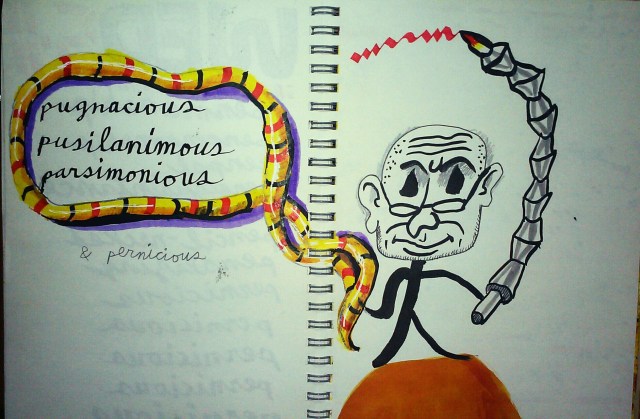
penmanship 101

20160512_035750-1~2

note to kids:  because there is no smell-checker for drawings, and visual artists frequently are not the world’s best spellers, the word “pusillanimous”, meaning ‘marked by contemptible timidity, cowardice’, has been misspelled above.  Sorry about zat.  Always spell that shit with two ‘els’, kids

The Actual Book

“The Book” itself, I realize now,  turns out to be something completely different than any of those three hypothetical discrete, daunting book projects I laid out the other day.  

For one thing, it has to draw all three themes together, for lack of time and because of the maddening specificity of the case it must lay out. Hatred, love, slaughter, mercy and play must be interwoven, weighed out chapter by chapter.  In the end you will have to care about it, see the work I am trying to move forward as animated by something very real and pressing, or the book is nothing.

The Book, this The Book of Irv (Book of My Father), pieces together a tricky puzzle, tells each strand of the history to lay out the unifying theory.  It is an attempt to explain the unexplainable, make clear things that are hazy at best.  

You cannot understand hate until you experience it directly, cannot love until you’ve been loved. Simple idea, though complicated to explain well.

Everything we believe has been sold to us. Everything.  

Our world is increasingly based on selling, from everything you can see with your eyes to the deepest beliefs you hold.  If I can’t package and sell I’m basically through, and the thing I must sell is, above all, a compelling story of the theory that moves me.   It’s got to move you, too.

The Book of Irv is equal parts beauty and horror; the fun and invention of play — the first and deepest mammalian bonding and learning– (and Irv was always playful with children and small animals) and the unspeakable horrors of hatred, the despicable civilities committed in the name of our American law.  The devil is, as always, in the details.  These historical strands need to be patiently, clearly set out, in order to give the reader the full context for consideration.

Irv as a unifying figure is ideally situated at the center of this explanation.   His life began in dire poverty, a Jew born in a New York City tenement who moved with his family to a shit hole in Peekskill.   He was an outsider consumed by outrageous injustice.  He fought racism in America after returning from a stint in our occupying army in post-war Germany after that modern nation showed how muscularly racism could be flexed, if insanity actually ruled.  

My father, for all his frailties, fought a fitful fight for social justice across decades, as he fought his kids, dominated his wife, quipped, raged at the inhumanity of the world.  He imparted to his children deep and important values that would influence the course of our lives, to our great detriment.   All this should be explained, the strength of this irresistible force that compels us both to work with the children of the fucked.  

The principle is straightforward:  poverty breeds despair, violence and fear.   Poverty stinks worldwide, kills millions and shortens every life it touches.   You want to heal the world?  Start by working on eliminating poverty.  Start with the kids.

In our modern world of unlimited wealth, poverty is a problem that can finally be ameliorated.  It won’t be, but that’s another story.  I suppose the thing that finally drove Irv to despair was his feeling of hopelessness.  Justice does not prevail, except sometimes incrementally, for moments in certain lifetimes, and without a community of comrades it is impossible to continue the good fight.  

Irv understood that the moral center of a society that can enslave millions solely to amass great wealth is indistinguishable from a culture that sends its believers scrabbling to cut their neighbors’ throats.    The names of the atrocities change over the centuries: impaling, shooting, lynching, drowning, whipping, but the song remains the same.

The Book of Irv must walk the line on this side of rant, unreliable narrator or no. Play must be at the center of it, because play is the only dependable relief from the oppression all around.  A tall order, friend, but while I am taking orders, why not?

“So you’re going to talk about this fascinating, all-explaining, theory unifying book you’re supposedly going to write, Dr. Bronner?  Or are you going to knuckle down and start writing it?”

I’m going to knuckle down and continue to talk about starting to write it, at the moment.  But first to get back to my long-stalled project to make some space in here.