Hi, Kid

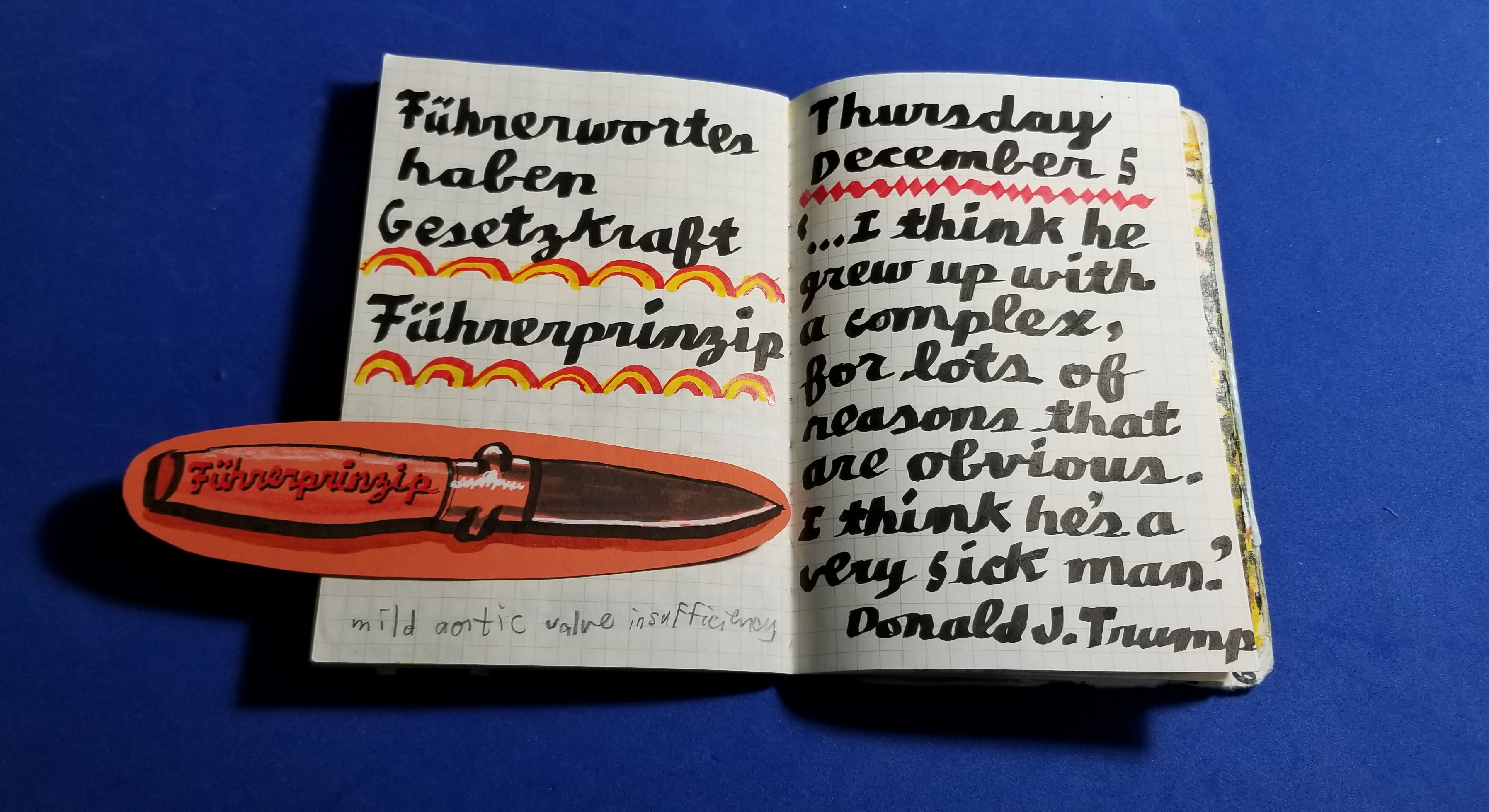


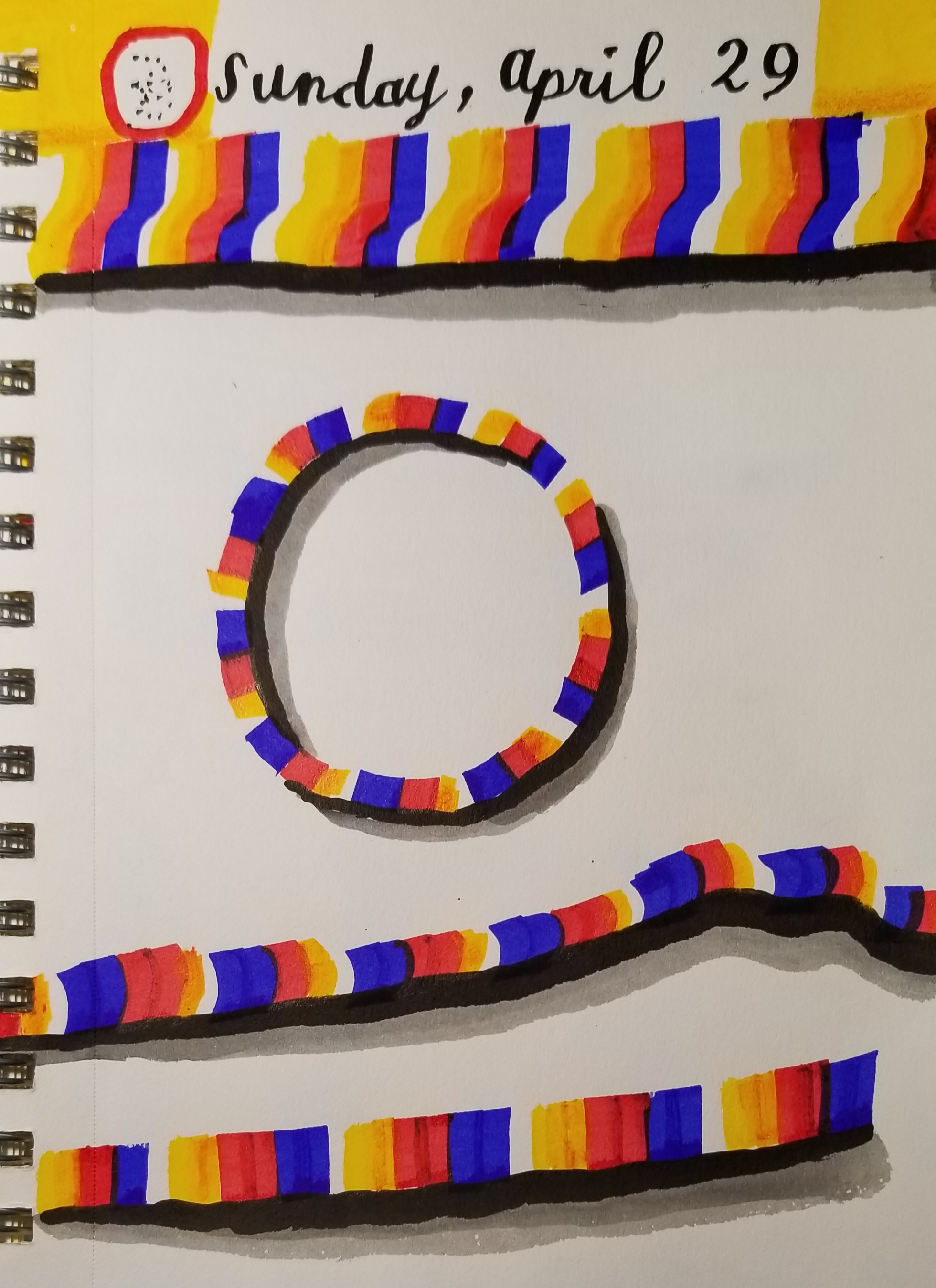
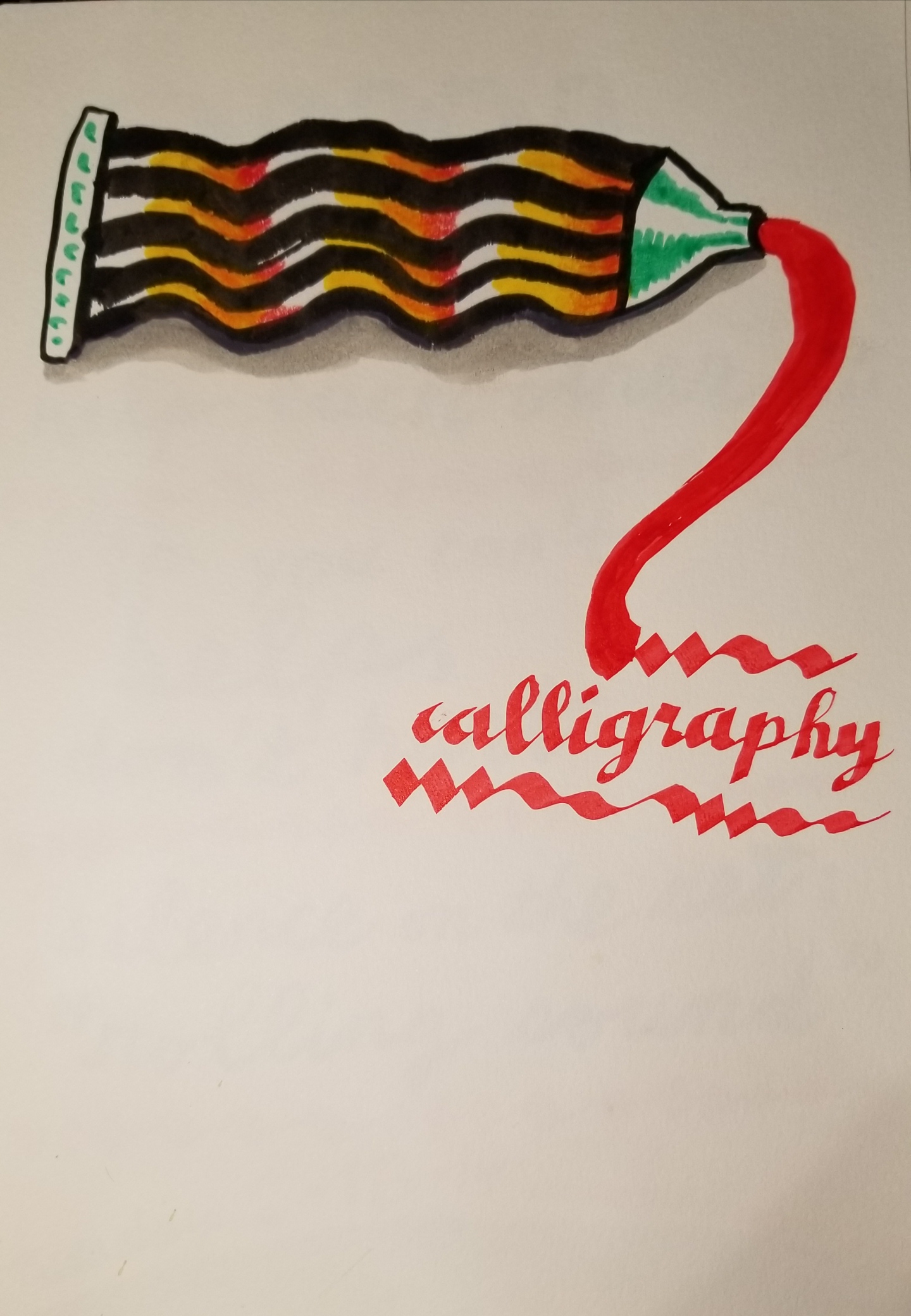

There are things you love to do. You should do them. When things are at their worst, at their scariest, when life on our planet is teetering on the brink of extinction, it is imperative to remember to cherish the things we love and to do them often.
The people we love too, of course, of course, we have to try extra hard to take good care of them. It is more important now than at other times to show them as much mercy and kindness as you have in your heart, and that goes for mercy and kindness toward yourself too in this terrifying, aggravating time. But what I am talking about now is doing the things that make us happiest, that restore us to ourselves. It is super important now to remember them, and do them often.
I love to play music. I am a good guitar player and a limited, though functional piano player. Few things I know compare to the pure joyful relaxation that takes over once the guitar is staying in tune (cold weather, and sudden changes in temperature, can really mess with the strings), the instrument is warm in your hands and the musical sounds emerge as beautifully as you can make them. Take a beat, if you like, swing another beat against it. It’s probably as close as I’ll ever come to taking off and soaring on thermals, or gliding a mile under a perfect ocean.
The words you are reading now, something else that gives me great pleasure to put together. Obviously, I spend time every day doing this. I am compelled, but, also, I love to do it.
Cooking a tasty, healthy meal, something I’ve always liked to do, has taken on more meaning to me during this lockdown as Sekhnet feels up against the daily horrors and it is a comfort to us both to share a fresh meal that is actually good for us. I am starting to love the whole process of making a pot or pan of something good.
Walking is something I’ve always liked to do. Now that I have arthritis in both knees, it has become a necessity for me to walk throughout the day, to avoid pain. An hour or two in nature, breathing in the trees, is always a beautiful thing. I love certain moments of my long daily walk. There is a time, after walking long enough, when the stiffness and soreness in my knees melts away. The pleasure of sitting on a bench after thirty minutes of purposefully striding along — I love it.
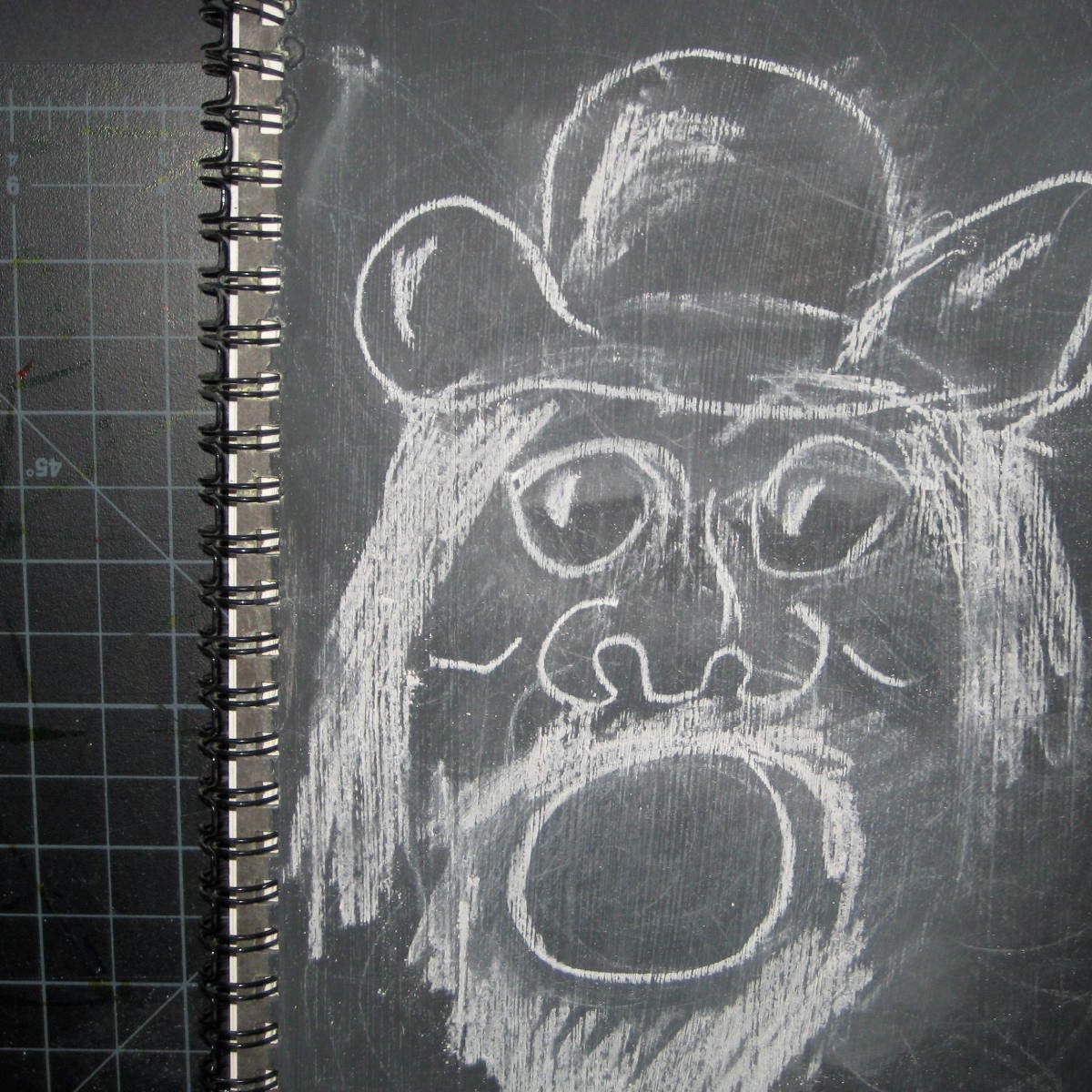
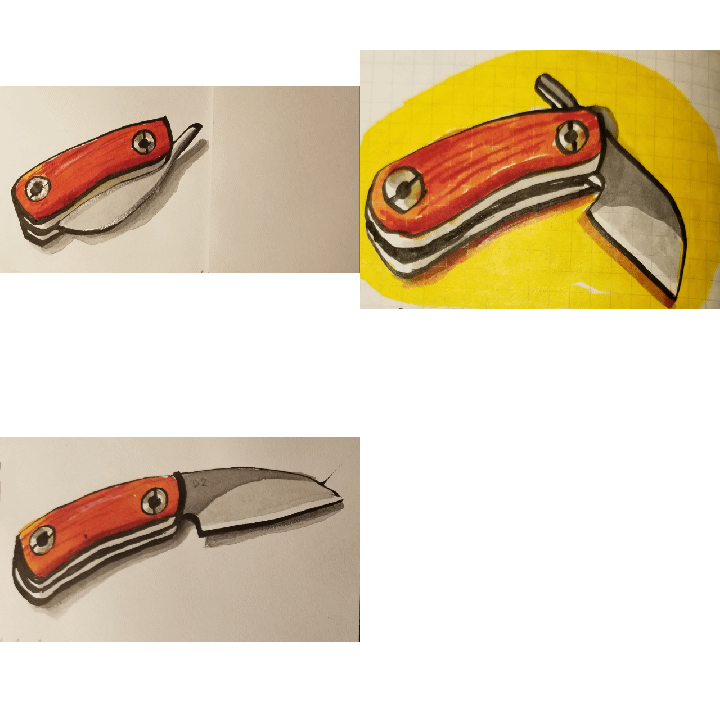
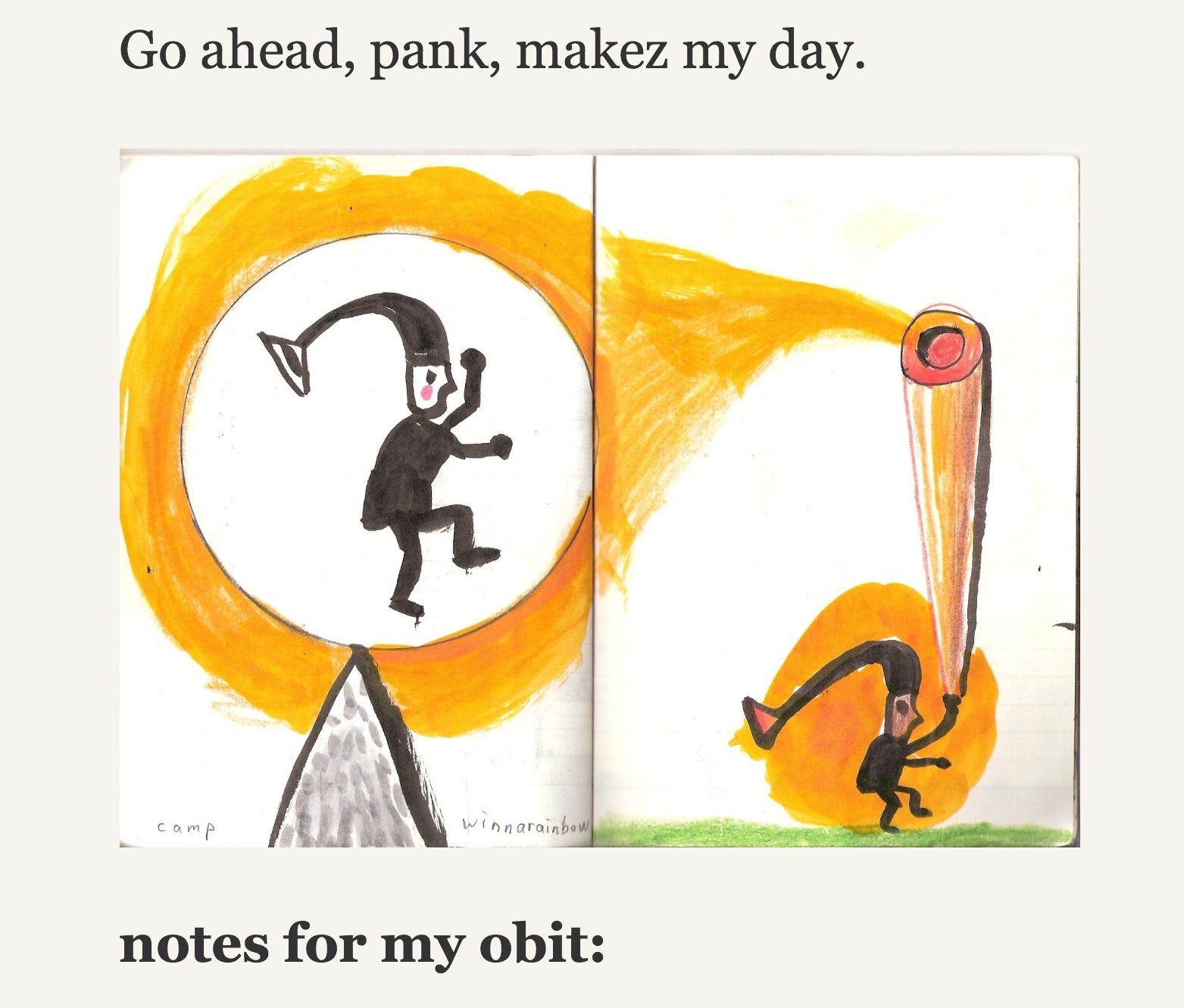
Odd to say, though I’ve always loved to draw, and make all kinds of marks on paper, have always carried a drawing book with me, and several of my favorite pens and pencils, I’ve done virtually no drawing or calligraphy during this pandemic nightmare.
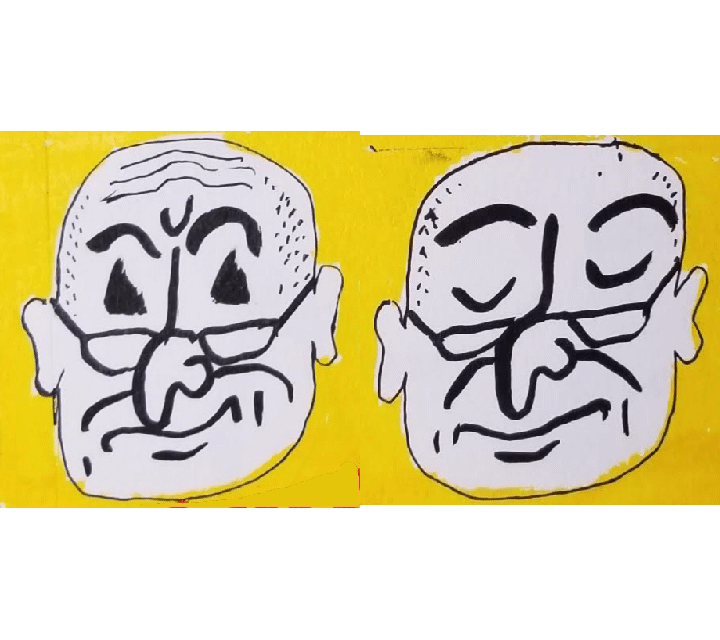
I showed a friend’s super-talented granddaughter how to do simple stop frame animation the other day. Under the mounted camera I drew a simple face and quickly showed her the principle of making animation out of two or more carefully registered drawings (or in this case, two stages of the same drawing).

I explained to her that you can later make the drawing as colorful or detailed as you like, photograph it and add the changes to the animation. (We were working outside in a park, so our art supplies were quite limited). At home afterwards I decided to refine the drawing above to demonstrate this idea to her. You will understand at once, I think, why I decided not to send her the drawing.

Who wants to look into those bizarre, hopeless, death-haunted eyes? Certainly not a sensitive seven year-old who is living through one of the worst periods in recent human history.
Shoot, maybe that’s why I’m not drawing these days. More than in anything else I do, my subconscious emerges most freely in drawings. I can play a stiff version of a beautiful tune on the piano, it’s not great music, but it doesn’t have even a hint of the terror in the face above. Perhaps I’ll try a bit of calligraphy later.
For now, do yourself a kindness. Think of something you love to do, maybe have forgotten about in your overwhelmed concern about the simultaneous and intrusive plagues that are upon us now, and do it. You will thank yourself afterwards, I’m pretty sure. Even if you don’t thank yourself (ingrate!) time is never wasted doing something you love to do.
Note: the title of this piece is probably about as true as any of Mr. Trump’s assertions — this subject is one my thoughts inevitably return to from time to time [1]. Fascinating and terrible at once, it’s hard for me to keep from periodically chewing on the perplexing mystery of losing old friends. I will try to add a few thoughts to a piece I posted the other day called The Complex Difficulty of Human Affairs.
Zora Neale Hurston, toward the end of her 1937 masterpiece Their Eyes Were Watching God, wrote of two women sitting together under the night sky sharing that “oldest of human longings — self-revelation.” The desire to know and make yourself known to another in an authentic way ideally leads to acceptance — you will know all these things I share and give me similar things in return and neither will judge the other. It strikes me as a profound comfort human beings often seek in a world that is often indifferent, in a life that inevitably ends in death.
It is foolish, of course, to seek this profound connection in every relationship. Mutual self-revelation, on more than a minimal scale, is a rare thing. The good news is that good friendship can be based on many things, without any express self-revelation as such. We know each other by our deeds, our mutual willingness to help, our desire not to hurt. When you need my help, I’m there, when I need a hand, you won’t hesitate to lend one.
In thinking about the end of my long correspondence with Karl, a short, politely worded email about the impossibility of continuing our almost daily writing, I have to think about our very different expectations of life. Also, Karl as part of a troubling pattern over the course of the second half of my life — fatal estrangements. As a friend noted recently, finally putting these terminal friendships out of their misery helps me sleep at night. On the other hand, the mystery of why I’ve experienced so many of these fatalities remains. Is it not better to let friendships that have outlived their lives simply drift away?
It is a mild spring-like day outside, and an argument could be made I’d be better off vigorously exercising out there than rattling the keys here in a dim room overlooking Sekhnet’s garden. We each have our own way of doing what we need to do. I’ll take a long walk with Sekhnet when the sun is low in the sky.
I’ve written about my now deceased former friend Mark and his eternal three act tragedy. Mark, a man with high expectations, was compelled to relive the same excitement, deterioration, betrayal pattern in every relationship he ever had. It was easy for me to see, easy for anyone I mentioned it to to recognize, there were countless examples, stories with the identical dramatic arc. Mark had no insight into his need to idealize, criticize, alienate. He lived an unhappy life and died alone, probably of a broken heart, naked in his chair.
Looking at the many friendships I’ve had over the years, relationships that I no longer have, I must recognize the possibility that I am as blind to my role in their inevitable deaths as Mark was to his role in driving people he once loved away. After all, it is not one person who has angrily attacked me for being angry, or considered himself so intolerably provoked by me that he had to strike back hard, or felt the need to use deadly force to defend himself against a detailed list of “intolerable” offenses I insisted on “resolving”.
It could simply be that the many subtle ways I learned to infuriate my father during our hundreds of senseless fights to the death are something I cannot control. I believe, when I reach my breaking point with someone I’ve known for years, that I’m being logical, fair and humane, that I am presenting reasonable needs calmly; the recipient sees only a death ray. I do not discount the possibility that to them I show every aspect of a raging, over-sensitive asshole, though I also don’t accept that view as necessarily true.
I can also see that the people I wind up estranged from fit a certain personality type, not unlike my father on a fundamental level. They are people who will never back down when they feel cornered, no matter how gently one may have “cornered” them. This kind of casting is a feature of the Repetition Compulsion, placing others into the role of a primal trauma-inducer in an attempt to replay the psychological drama to a better outcome. It’s a game for suckers, that, a game we play unconsciously. I can also see, in hindsight, that over my life I’ve chosen many friends for their intelligence, wit and, often subtle, similarity to my combative father’s desperate zero-sum mentality. We both can’t be partially right and come to an understanding based on compromise of any kind — one of us has to die.
There is a small counterbalance to be had, looking at the subsequent lives of people I could no longer maintain friendships with. Raj and his wife finally divorced, his old friend I fell out with years ago (former husband of a woman I recall as Hitler) and Raj are no longer friends, Pavel told me I was by far his closest friend (before I unfairly accused him of insensitivity when he was only being cooly analytical about my vexing medical insurance situation) Karl lives an isolated life in Poland swallowing anger and serving a strong-willed second wife, etc.
I can look at each of these largely unhappy guys and think — we couldn’t help each other when we needed support the most. It happens. It is not the fault of anything but our respective human natures. The miracle is not that we finally went our separate ways, but that we were friends for so many years.
What expectation do I have of the world? To try to be patient listening to and honestly discussing the worries of my mate, without making her feel worse about things that already bother her. To have her listen to my troubles, without rushing to offer solutions before she’s heard the entire problem. To immediately make amends when I know I’ve hurt somebody. I have to admit, I eventually find these things, when they are missing, intolerable.
What expectations does Karl have of the world? I have no idea, but his worldview seem fundamentally more pessimistic than mine. Life is brutish, unfair, short, I suppose. In his case, it strikes me as a characteristically grim Protestant view of our duties to each other here on the earth. Impossible in the end, perhaps, for a humanistic Jew like me to fully grasp and appreciate, just as my outlook must seem absurd to him.
What expectations does someone who will only offer an apology when forced into it have? It seems they’d be unlikely to expect an apology if they were hurt — though perhaps they would expect it more than most. It is largely futile trying to imagine what is in the head and heart of somebody else, unless they work to reveal it to us. In most cases, the inner lives of others are a mystery.
As we can see all around us, people will construct whatever meaning they need to live as they see fit in our troubled world. A candidate they back can lose an election by more than six million votes and they can honestly insist he didn’t lose — the states that returned majorities against him were in on a conspiracy to steal the office from him. Proof or lack of proof do not come into strong convictions that will cause righteous armies to march — they feel the truth of it boiling in their blood.
So it is with people I’ve been close with, who, in several cases, I have had to behead in the end. They will believe, with the irrefutable proof that I wielded the sword that felled our friendship, that I am a vicious and unforgiving hypocrite who talks about not causing harm but who is as destructive as end-stage cancer. In my estimation, they were not capable of the kind of honesty that is a bottom line in my own life: if someone tells you they are hurt, hear them out before dismissing their complaint as the whining of a weak, corrupt, spoiled, hypocrite bastard.
On the other hand, and, of course, I may simply be a whining, weak, corrupt, spoiled, hypocrite bastard. Something like that is very hard to ever know for sure, no matter how certain we may feel in our bones.
[1]
A murdered darling I couldn’t totally delete, I’d originally added: as a dog returneth to his vomit.
Which is part of that great, largely meaningless, proverb:
As a dog returneth to his vomit, so is a fool who repeateth his folly.
A few days ago I read a few pages of that eternal provoker of thoughts, Hannah Arendt’s masterpiece Eichmann in Jerusalem, a book I pick up and open at random from time to time — most of the time finding something I didn’t notice in the previous readings. Read a section on the Israeli judges asking Eichmann, who knowingly and diligently sent countless people to their deaths, about his conscience. Arendt then shows how he actually exercised a kind of conscience, at first (a little) in diverting a trainload of Jews and Gypsies to a ghetto instead of a killing center (they were still using bullets at that point) and then how quickly (four weeks) his conscience reformed itself into a standard loyal Nazi one.
That gave me a fleeting thought about former buddy Karl, American expatriat in Poland (the action on the page had taken place in the Nazi Protectorate, near Lodz) and my childhood friend Raj’s concern a few years back that his childhood friend Karl was becoming a fascist (I’d also noted a slide to the nationalist right in Karl).
Which led me to this thought, in regard to someone like Karl being angry enough to silently write me out of his life forever (for my offense of no longer being friends with Raj, I suppose, since Karl and I never had any argument I can recall). This is that area of human life that makes knowing anything for certain tricky — for we are all very certain of our justifications when we act decisively. When we write somebody off there is seldom any doubt in our mind that our decision was a righteous one.
To Raj, I was heartless not to keep forgiving the inadvertently aggravating things he may have sometimes, even often, done. He was angry that I wouldn’t let an ongoing bygone be a bygone. To me, Raj’s habitual passive aggression was as intolerable as his “I know you are, but what am I?” insistence that he was not doing anything objectionable, that I was the one who was being unreasonable in trying to get him to refrain from doing things that, in his mind, I constantly overreacted to.
Karl seems to have written me off out of simple loyalty to his childhood friend, tartly dismissing whatever we’d observed about the difficulty of dealing with Raj’s neurosis. Karl, in Poland, had little regular contact with Raj and as for their once yearly visits, things were as cool between them as between Karl and any of his other longtime friends in the USA.
I’ve always tended to express my feelings more than most people I know. This leads to my not unfair reputation as a belly-acher, a tendency I’ve tried to dial back in recent years — with mixed results. I get this largely from my mother, I think, this sometimes plaintive expressiveness. I’ve also always had more time and inclination than most people to ponder and more ways to express myself– as well as a greater need to do those things than most. My friends know pretty much exactly how I feel most of the time. I’m interested in their thoughts and feelings too, and I try to listen to them with the same engagement and empathy I hope for from them. Because we are all homo sapiens, this does not always guarantee a good result. That’s where mutual compassion becomes indispensable.
We are lucky if we have one other person in our life who we can safely have this kind of mutually vulnerable exchange with. With a close friend there should never be much mystery about how the other feels about things that are important to us, and it’s a big part of the strength and resilience of a close friendship — managing to listen with engagement even when the other person’s feelings might not be like our own in a similar circumstance.
A rare and extremely valuable thing, that. It goes a long way to reminding each other we’re no more insane than the next person, no matter how shook up we might have felt before discussing the thing, and, importantly, it may be the only assurance we get of that from anyone.
Here’s the thought that dawned on me, taking Karl as the example. He’s very bright, an excellent writer, introspective, sensitive, dry sense of humor, fine piano player (though he rarely plays in recent years). Karl has been married to two women (divorced from the first after her traumatic open infidelity) who are strong-willed, demanding and make all the life decisions. He is very devoted, but also chafes under their tyranny, while not allowing himself to talk about it except in quick, bitter asides — and suffers what he recognizes as regular repressed-rage symptoms from digestive, to migraines, to sometimes crippling nerve pains in back, neck, legs, hands, to other ailments.
What could be more infuriating to a man who constantly swallows his anger than watching somebody else assess an unfair relationship, identify exactly what is intolerable about it, make several attempts to fix it and finally throw up his hands and say “so be it, asshole, adios” ?
I don’t know why the Eichmann pages made me think of this, exactly. The insight about Karl here is not new, it just popped into relief somehow. You can sometimes trace a conflict to a fairly simple root. Karl, of course, will have an equally compelling story behind his brief formal email telling me not to bother writing back, ending an almost daily correspondence of several years.
There is also this about Karl. He is a fine writer who no longer writes (except to confide to his journal), an excellent piano player who doesn’t play. It is not surprising that he might well take a bitter view of a lesser writer (such as myself) who writes a “public” journal every day and although not a good piano player, plays contentedly several times a week.
We’ve had a recent whiff of totalitarianism here in the USA, where we have came sickeningly close to a fascist overthrow of an election that went against a strongman, members of his party looking for ways beyond the law to nullify the clear will of the voters. It inspires nothing but horror in me (horror and a strong desire to stand with others against it). Karl’s drift to the right, his support of a nationalistic autocracy in Poland, seems an apt illustration of Hannah Arendt’s portrait of the ideal supporter of totalitarianism.
The “fascist” angle, Karl’s lurch to the right, seems to confirm to me that an inauthentic emotional life like the internally dishonest one Karl leads is fertile ground for a politics of grievance like Polish Nationalism, whatever the hell that entails. Arendt makes this profound point about those who embrace totalitarianism, they are isolated and emotionally hollowed out, finally incapable of comparing things intelligently and making humane decisions — preferring membership in an orderly, militant hierarchy of (even insane) beliefs to the terrifying uncertainty of their emotional isolation.
This feeling gets stored up for release as hostility, saved for when the friend is in a tight spot. I was in a spot like this when my old friend Pavel expressed his curiously neutral concern when I was angrily flailing, again suddenly and unfairly without the health insurance I’d already paid for, during a pandemic, trying to find the laws governing termination of a policy under the Patient Protection and Affordable Care Act– laws nobody in the world can find, as it turns out.
Karl, Raj and Pavel had something in common, all three spent years in combative relationships with their womenfolk, marriages that ended badly, as so many do. I watched the ugliness up close with Raj, heard tales of an insanely bitter divorce from Pavel and had many examples of subtle one-sided warfare from Karl. Sekhnet and I have our share of conflict, but here’s a funny thing about our relationship — how good it must look to guys who are in constant war with their partners.
Sekhnet is hard-headed. I say this with a mix of admiration and vexation. Sekhnet is as loving a hard-headed woman as you will find anywhere. She is also funny, cute, smart and a great actress in social settings (as many of us are, but she’s really good). From the point of view of somebody battling hourly with his significant other, in a war that will eventually end in an ugly divorce, I seem to have an almost ideal situation that I often seem to be ungrateful for. From their vantage point, watching Sekhnet and me interact, I am a lucky bastard who enjoys a stress-free, relaxed relationship with a supportive, delightful, loving mate with a great sense of humor.
So how intolerable must it be to them that I’m constantly belly-aching about my hard life, while men like Karl manage to manfully keep their fucking mouths shut and don’t trouble others with their personal problems, which are many times worse than my pampered whining about how hard it is being carried from pillow to pillow?
Which leads finally to the fuller answer to my old friend’s good question from the other day — why is it often necessary to kill them in the end?
There comes a point in the frustrating back and forth, after a once close friend’s hostility has become impossible to ignore, after they insist that they love me (Pavel, and his new girlfriend, and Raj and Raj’s wife, all insisted that because they “loved” me that I was being a complete vicious asshole not to forgive them, an assholishness which would justify them hating me if I didn’t immediately forgive them) when I am handed poison to swallow — in Raj’s case that I am wildly oversensitive to imagined “provocation” and an unforgiving monster insanely determined to be right and “win” at any cost, I demur. When poison is splashed into my mouth, I have to spit it out, cat with a hairball style, as I would pantomime for you if we were not interacting on a page.
Part of the process, sometimes, is severing the insistent hand that is holding out the familiar poison, to prevent another attempt to force it on me. It is a move I had to use many times during childhood as I battled my poor bastard of a flailing father, who regenerated more limbs than a thousand embattled crabs and octopuses — a move, ironically, he implied at the end was right and appropriate when somebody is doing that to you. I don’t relish the brutality, but once it reaches the point of irreconcilable war, all attempts at peace dashed, it is preferable to the taste of poison in my mouth and I sleep better once it’s done.
Because a friend called me Mr. Sunshine the other day, with some irony (for one thing, I avoid the sun, I hate that life source which has caused me multiple operations to remove cancers from my nose) I feel an obligation to set out a few reasons to feel hopeful and to act with optimism and determination. Particularly about taking those two senate seats in Georgia, the ones that will allow the democratic process to move forward without the deliberate, cynical obstruction that McConnell and his 51-49 will insist upon.
Terror is scary as hell — obviously, it’s terror. The threat of terror can be terrifying, as it is intended to be. When an angry, powerful person promises an army of 50,000 armed loyalists making sure there’s no (wink wink) “voter fraud” at certain polling places — it’s very scary. It didn’t happen, anywhere really. There were no crowds of Proud Boys standing by, or Bugaloo Boys, or Game Boys, few of the best members of the Klan, very few of the finest of American Nazis. The goon squads, the death squads, the terrifying, bellowing armies of the night did not appear. A beautiful thing, speaking well of our nation, and something to be happy about.
ONE: We withstood the threat of goon squads intimidating voters to support a would-be tyrant (and tens of millions lined up to vote in spite of the threats)
The goon squads were as absent as the predicted rioting, invocation of the Insurrection Act, martial law, counter-insurgency forces deployed in “anarchist jurisdictions” and the rest of a would-be dictator’s terrifying fever dreams. Of course Trump is going to do everything possible to set a thousand shit fires before he leaves office, and will certainly set hundreds, but the very worst did not come to pass, which speaks well of our experiment in democracy here.
TWO: In spite of the relentless pressure on millions of our fellow citizens, there has been no wave of crime during this awful pandemic
The pandemic is terrifying. Under the best government control, it would be a hard road protecting millions from a worldwide disease that is airborne, highly contagious, incurable and potentially deadly. Under our federal government’s laissez-faire approach (that’s French for “let the powerless fuck themselves, ehn?“) a quarter of a million of our fellow citizens who didn’t need to die horrible deaths died unspeakably awful deaths. Our neighbors and loved ones continue to get sick, thousands die. The stress of it is sometimes hard to bear.
We have an administration coming in that will make every effort to have us all follow the best medical advice to control the spread until everyone can be vaccinated, but the beginning of their work could be another 100,000 deaths from now, as the disease continues surging uncontrolled in many parts of the country.
There is only this reason to be hopeful at this moment in regard to the pandemic (yes, the vaccines will be great, too, but in a few months, at the earliest — if you and your loved ones live that long): under incredible pressure, terror and increasing desperation, Americans, particularly ones forced into official poverty and threatened with imminent homeless, have not been committing violent crimes of desperation.
Think of that for a minute, this lack of wild lawlessness says something very good about the basic humanity of our people here. A corollary — people tend to help each other during public emergencies, after catastrophes, when trouble is worst, Americans always have too.
THREE: The incumbent Republican president lost the race in faithfully Republican Georgia. We can get two senators to make it 50-50.
Trump’s open (and clandestine) attempts at nationwide voter suppression, although many and mighty, did not manage to swing the election to the unhinged would-be strong man. In spite of an open criminal conspiracy to suppress mail-in voting, and widely stoked fear about intimidating in-person voters, record numbers lined up, sometimes for 8 hours, to personally cast enough votes to indisputably vote the “You’re Fired” guy out by the largest margin since incumbent Herbert Hoover lost to Franklin Roosevelt in 1932.
In Georgia, where the current governor was elected by a 55,000 vote margin (after purging 107,000 eligible voters who were likely to vote against him — among the more than 500,000 voters he’d purged prior to the gubernatorial election he supervised), where voter suppression is practiced fairly openly, the anti-Trump candidate managed to eke out a victory.
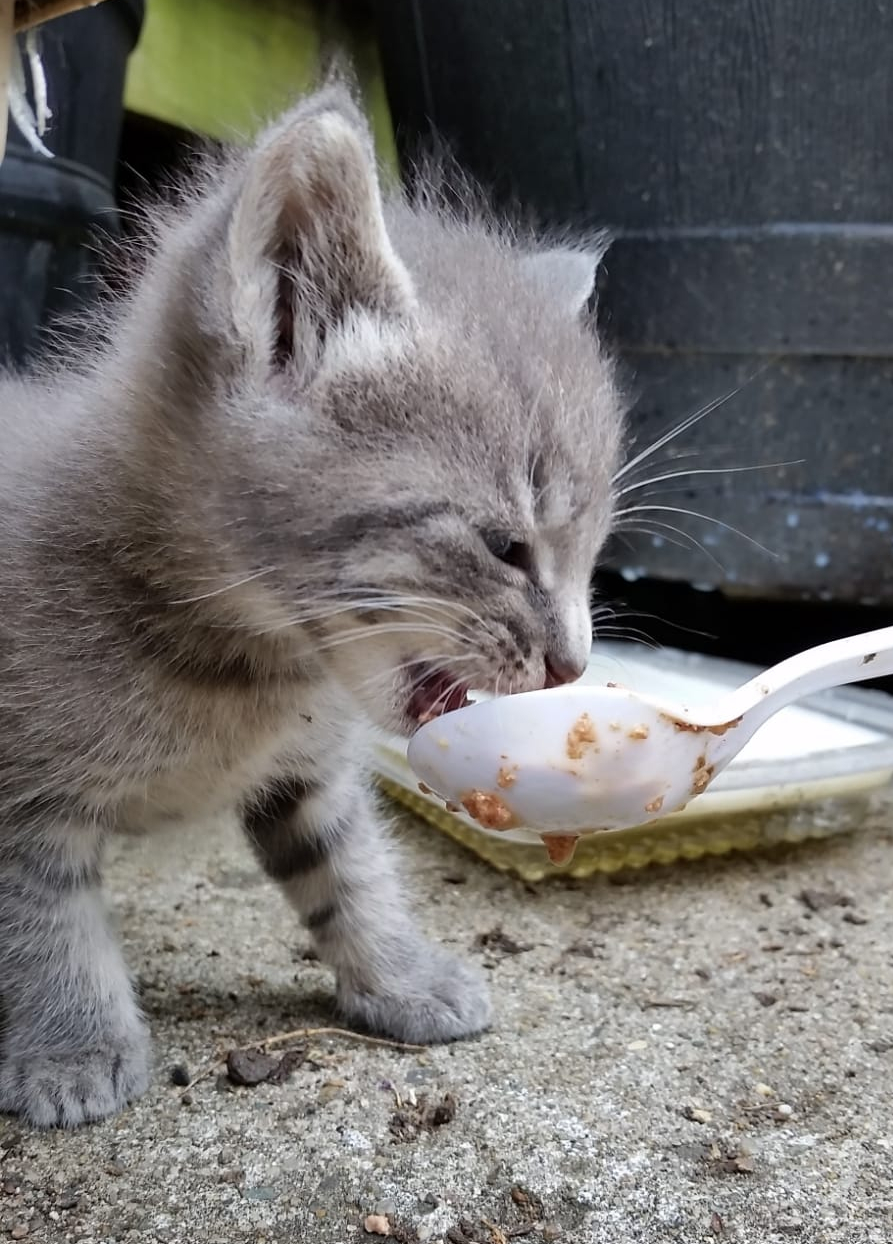
Reason to be optimistic: Americans, including a large contingent of Georgians understand exactly how crucial a 50-50 senate is to the continuation of democracy. Every reactionary, evangelical and racist in the great state of Georgia will be driving people to the polls to vote Republican– millions will go to cast their votes for Jon Ossoff and Reverend Raphael Warnock. Warnock led Loeffler by 7 points on Nov. 3, though he didn’t approach the 50% needed to win in Georgia [1]. Ossoff and Perdue were close, Perdue had a 2% lead (and thankfully 2/10ths of a percent less than the required 50%).
Democracy can win this close runoff in Georgia. There are activists, led by Stacey Abrams (who registered tens of thousands of voters in Georgia) who is mobilizing many of them, bringing out the vote, particularly those voters who never registered. It’s going to be close in Georgia, two votes crucial for democracy or continued corrupt government dysfunction and obstruction.
More on what you and I can do to bring out the vote in Georgia tomorrow.
Love beats hate in the end. Believe it, because subscribing to the opposing view leads inexorably to the end of all hope for anything better, ever. Things that look hopeless often get better, if enough work is done. The work starts now.
[1]
On Nov. 3, Warnock topped a field of 20 candidates running in a “jungle primary” special election that included Loeffler, who Gov. Brian Kemp appointed to fill the Senate seat vacated by Johnny Isakson in late 2019. Warnock received 32.9 percent of the vote, while Loeffler got 25.9 percent. Her main Republican challenger, Rep. Doug Collins, received 19.9 percent.
source
One or two more thoughts about the search for truth, after learning just now from Healthfirst (sic) that my Primary Care Doctor is no longer in my health insurance network and that I need to find a new one, pronto, if I want my “free” annual check up by December 31. Life in America, boys and girls, no reason to get excited… just add finding a new PC to the other doctor I need to find for an unrelated medical situation. The Free Market knows the best way to marginalize these sorts of inevitable externalties, no worries.
I, for example, am not worried (though I am fucking disgusted).
In yesterday’s far-ranging “philosophical” post I may have created some unintended ambiguity about my view of the nature of truth. I said at one point that both faith-based and fact-based arguments are both essentially based on faith, the latter on the faith that facts are necessary to an intelligent debate. The way I left it could leave the impression that I feel there is no difference in how one approaches the question of truth– a narrative that follows as logically as possible from what we can observe and verify or a story based entirely on what we strongly believe. I’d like to clear up any confusion about that now.
While approaching capital “T” truth is a lifetime’s dedicated work, and we each only get as close as we are capable of getting, there are many things in life that are simply true or false. If you are 5’9” and you claim to be 6’3”, there are ways to know (including direct observation) whether your claim is true or false. You can use a tape measure, or we can stand you next to Clyde Frazier, or John Mayer, for example.
It is our human ability to say things that are to our advantage, that are provably not true, that gives rise to the word “liar” and our frequent shunning of such people. There are liars big and small among us, sad to say, and that is something to consider while pursuing truth, if it is your lot to pursue such things. I tried to explain yesterday why it is my sad lot to do this and why my search, my best theories, are based, as much as possible, on demonstrable events and verifiable facts. Arguments I can lay out without distorting the facts I have learned.
It isn’t true, as I may have given the misimpression, that an opinion based on pure faith and an opinion based on logical conclusions drawn from our best observation, verifiable data and controlled experiment, are equally valid. Not at all. The old “you’re entitled to your own opinion, but not your own facts” comes into play.
The argument of a paid spokesman for an oil company must never be given equal weight to the argument of thousands of government and private industry scientists on whether the burning of fossil fuel is a good thing or a destructive thing for the earth. Sadly, in our great American “marketplace of ideas” such, eh, arguments are often fought to a “draw” (let’s all agree to disagree and, now, a word from our sponsor) in the mass media.
Faith is a great thing, a comfort to millions. In addition. no difficult task could ever be sustained, no hope for better days kept alive, particularly during the worst of times, without faith. Life itself, you could argue, is impossible without a certain amount of faith. Of course, faith is also one of those squishy words that mean a few distinctly different things. Much depends on what your faith is based on.
You can have faith in your physical strength, based on your life experience, real comparisons with the strength of others, and know, with perfect faith, that you can carry a load most other people couldn’t lift. If you have done something many times and are comfortable doing it, even if others would be fearful before trying it, your faith is founded in fact-based confidence.
I saw an eight year-old launch himself off a bannister, over concrete, and gracefully complete a backflip in the air, upside down, the top of his little skull pointing directly at the pavement, before flipping to land on his feet, graceful as a cat. It was probably the greatest demonstration of confident faith I’ve ever seen. It is faith based on the proof of direct experience, on the knowledge that you can do this daunting thing. It is a mighty thing. It is different than faith based on pure belief.
Faith, in the sense of a faith-based religious belief, is obedience to a higher will, a surrender, based on a spiritual longing, to a power far greater than yourself, infinitely greater than any human power. I get the appeal of this idea, even as I see, over and over, the dangers this kind of faithful faith in pure faith can lead to.
If you obey a higher power, a power whose mysterious will is often unknowable, and acknowledge your own lowliness, you’ll require an earthly authority of some kind to tell you what this higher power wants of you. It is a central tenet of your faith that obedience and surrender to this power are the highest values in life, and you will willingly do whatever is required, as set out by a faithful intermediary.
Such devoted faith is a beautiful idea if you are directly following the teachings of, say, Jesus Christ. Jesus teaches us to love the meek, be kind to our enemies, wary of the rulers, a generous friend to the helpless and so on. I read on Brett Kavanaugh’s alma mater Georgetown Prep’s website that Jesuits believe that when two people meet it is the spark of the divine in each one that recognizes the divine spark in the other. Two particles of God, infinitely precious, communicating in divine unity, a very beautiful idea of how to treat one another.
My Corsican friend snorted when I repeated that to him and told me to look up the origin of the fucking Jesuits on the internet. Oops. They started as Defenders of the Faith (the One True Faith), the faithful lawyers for the faithful torturers of the Spanish Inquisition. They conclusively explained, with learned legal arguments of great sophistication, the legality, indeed the righteousness, of the auto de fe, the strapado, the rack, Divinely endorsed methods of inflicting agony on infidels. They expertly cited chapter and verse of religious texts and related law, fully justifying torturing and killing in the name of Jesus Christ, the Prince of Peace. Apparently, if you buy their arguments, Jesus loves the screams of despised and terrified heretics as they are burned to death. Who knew?
The civic problem with religious faith is not hard to see looking around at the political activities of various churches in the USA. The American Baptist church split in two in the years before the Civil War. There was a northern, anti-slavery Baptist church and a southern, pro-slavery Baptist church. Each church defended its views based on Biblical verse and Christ’s teachings. You figure that one out. Anyway, after slavery was abolished under secular law, Baptists north and south shook hands and became one church again, as far as I recall.
There are many wonderful things about many people of true religious faith. They are among the most caring people in the world, the best of them. At the same time, honesty requires us to acknowledge that there are many horrible things tolerated in the name of true faith. More blood has been spilled in clashes of faiths than for any other reason.
So when I wrote that on one level a passionate argument based on pure faith and one based on verifiable facts are both, in one way, based on faith, I did not intend to imply that these arguments are somehow equal. You either have faith that facts matter, and the truth is a supreme value that may never be sacrificed in order to win a point, or you have faith that if somebody lies for a greater purpose there is no real sin to that little untruth. There is nothing remotely equivalent about those two kinds of “faith”, though in one sense, yes, they are both based on faith.
The faith that gives someone the right to kill someone else for violating the first person’s faith? We need another word for that kind of “faith”. The Framers of our democracy were wary of this kind of misuse of sacred principles, while they winked at slavery, they built a wall between church and state. The kind of depraved individuals who believe it benefits them to make sure hundreds of thousands more die of this pandemic, in order to weaken the hand of their political enemies in the future — well, any of their millions of devoutly religious Christian political allies, a considerable chunk of the 73,000,000 who, knowing this, turned out to vote for it in record numbers recently — they’re on their way to hell, no matter what they may believe about the righteousness of protecting the unborn and other pious acts.
You know what I’m sayin’?
“I’m searching for truth,” I admitted.
“You poor bastard, I did that to you,” said the skeleton of my father.
Things that make no sense to us can sometimes be explained after enough research and pondering. When you can lay out and understand the reasons behind something perplexing it becomes a little easier to deal with. That’s my belief, anyway. In my experience, there often seems to be a certain relief in understanding how a terrible thing actually works.
I feel like the recent years I spent, hours each day, considering and sorting through every aspect of my father’s troubling life that I could, finally gave me useful insights into his life, into my own. Many of my waking hours, during this present shit-storm of propaganda-directed anger, are spent gathering as many verifiable facts as I can. I use this information to try to construct some kind of reasonable meaning for truly awful things that otherwise make little or no sense.
History, my own and our common human heritage, is indispensable to me in this project. Our lives here are fleeting and often seem meaningless, millions of lives are regularly written off as disposable, but there is a long human history to learn from, as well as our own personal histories. Learning history can lead to the desire to try to do better, become better humans. Which is something, a considerable thing, it seems to me.
I’m aware that my long habit of “study” and pontificating may make me insufferable at times, because not only am I as opinionated in my certainty as my mother was, I feel that keeping myself closely informed (as my father always did) gives my opinions a certain weight. It also creates impatience in me for opinions based on less, or false, information. It’s hard to have a productive discussion, or influence anyone’s thinking, if your own thinking betrays any kind of feeling of superiority. “I know more than you about this so I’m definitely right” is a very weak, invariably maddening, line of persuasion.
A real search for truth requires challenging yourself from time to time, placing your own ideas into the uncomfortable position that they may be wrong. It requires, most difficult for me, considerable humility. A sense that the deeper mystery may never be revealed, no matter how much you come to understand the layers above those deepest ones.
We homo sapiens are fundamentally irrational beings, it would appear, geniuses though we are at self-justification and self-deception. Our lives here are not, as much as we may want to believe it, based mainly on rational considerations taken for reasons we fully understand. To test the proof of this — look at the passionate American fight over the use of personal protective gear during a pandemic.
As for strong opinions based on hard fact — on some level these are not fundamentally all that different from strong opinions based on faith alone. The person of deep religious faith will cite the deep benefits of spiritual faith while the believer in a world ruled by empirical fact will cite the undeniable clarity science and Reason provide. Both human opinion systems, in the end, are matters of faith, on one level. (To be clear, on another level, they are not remotely the same thing)
Do I know, for example, based on logic, with examples for proof of my argument, that there is a workable large-scale economic system better and more humane than the eternal growth model of the “Free Market” system of capitalism that rules the world today? It is not hard to find a dozen contemporary books making excellent, detailed cases for how inhumane this problematic concept of economic freedom really is in practice, how barbarous it is in many of its demonstrable outcomes.
But as I spout my fact-based outrage at a deeply flawed, unsustainable, extractive system that leaves hundreds of millions in desperate poverty so that others can be unimaginably wealthy, do I have a better idea that is actually possible? Our lives here, on many levels, are a mystery. As for someone who will challenge my dissection of the so-called Free Market and demand my better idea (one that comports with human nature, a crucial caveat in any such discussion) — I cannot point to a large scale system that works in the world today that is not based on this idea, on this transactional assessment of human nature and what motivates our behavior. My actual alternative?
“You don’t really have one, do you? Outside of your fond dream of greater justice and a more ‘fair’ distribution of resources and wealth, elimination of poverty and so on, which is a very high-minded idea, and for which I salute you– the world you dream of living in is superior to this one, I’ll grant you,” a kindly neoliberal will counter, when I am done reciting my facts. “But, sadly for us, time is money and both are short at the moment, so, back to your books, genius, back to your idealistic echo chamber with you. Unfortunately for me, I’ve got to go make some money now, so you’ll have to continue enlightening me some other time.”
I can see clearly, in my own case, that a world that made no sense to me — my family life during childhood and beyond — was my initial motivation to seek what was behind a rigid insistence on the demonstrably insane. My sister and I were frequently warned by our angry father that however much we thought we might be winning certain battles, we would inevitably lose the war.
“The war, father? Don’t you always tell us that family is the most important thing in life, the place where we are always safe, the only love we have that we will never lose? How can we four be in permanent war, around the family dinner table, father? Please explain, I’m only a boy, but I truly don’t understand.”
Sadly for my younger sister and me, I somehow did not have this enlightened dispassion within me as a seven year-old. Few of us do. People experience constant, irrational anger from demanding parents all the time. Many convert it into self-doubt, self-hatred and, in some notable cases, a driving ambition to succeed. If a brutal parent doesn’t crush you, you can sometimes convert the restless energy they’ve instilled in you into a billion dollar enterprise, as history shows. Particularly if you have limitless financial help from the tyrant parent that insisted you become a killer instead of the piece of shit you already are.
This search for “truth” is increasingly lonely work for me. Destructive things that are easily seen in others can be impossible to see in ourselves. I lost an old friendship a few years ago because a friend since fourth grade was unable to stop provoking me. He believed I was wrong to feel provoked by his actions, which he always could justify as motivated by his love for me. He believed that as sincerely as I found it intolerable to be constantly provoked.
Each of us eventually took our hurt, and our belief that we had acted with integrity, and went our own ways in the end. There is not that much solace in that kind of “resolution”, but it is better than being pissed on by someone who angrily insists you’re whining about the rain. As I say, we are all masters at self-justification, with a strong bias toward seeing ourselves as right.
I can clearly see the pathology of my recently deceased former longtime friend Mark’s life. I mention it from time to time as the clearest example I know the Repetition Compulsion-– the endless reflexive replaying of an unresolved primal battle. In Mark’s case the form was the identical three act tragedy each time, though superficial details varied. Act one: idealizing an object of love, Act two: mounting disappointment as imperfections are revealed, Act three: an unforgivable betrayal by the one time object of perfect love.
Mark was unable to recognize this inevitable story arc of every relationship he ever had. He relived it over and over, with the same hurt and anger every time. It was painfully frustrating to me that he couldn’t see it, even as we played out a years-long Act two, as my imperfections as a friend became more apparent, more galling, my betrayals more and more inevitable.
“Is this slimy?” Mark’s ex asked me, drawing back slightly, as my heart pounded against her chest. This was several months after he’d rejected her, along with the rest of his small circle of neurotic New York City loser friends, and moved across the country in search of the superior people he dreamed of meeting. The first time she’d stayed over at my place she sent me into my own bed to deal with my youthful passion on my own timetable. The second time, for some reason, she showed up in a clingy, transparent shirt, with no bra.
When she asked if what we were about to do was wrong, what choice did I really have but to reassure her with an immediate, definitive, only slightly quivering “no-o-o-o…”? Few choices I have ever made in life have been so unequivocally right. Still, you know, this was an unmistakable step into act three of Mark’s eternal play.
In each case of a long, close friendship that is no more, I can tell you exactly, step by step, how we came to the impasse that ended it. Most people simply mutually lose touch with people from the distant past they have grown apart from, I kept quite a few in my life. With predictable results, it seems. If you have a circle of fond acquaintances, updated periodically, it is easier not to fall into the illusion that you are intimate friends with somebody just because you’ve known them for decades. True lifelong friends are rare for most of us.
In every case of a friendship that is no more, I can give you a sixty second overview of why I was right to write them off, why they behaved with an unconscionable lack of self-knowledge and empathy. Does this certainty about right and wrong, and what is tolerable and what intolerable, enrich my life in any way? Is it different than Mark’s hideously repeated three act tragedy?
Clearly, I am not the ultimate judge of that — as you wouldn’t be based strictly on my account. On the other hand, nobody else is the ultimate judge, either. We can only do what we believe is right, and almost always will.
If I was writing these kinds of pieces for a sizable book or magazine-buying audience, perhaps reading this to you in a bookstore (all of us wearing masks, and keeping our distance), this daily work of mine would be rational and completely understandable. I’d be a writer, after all, perhaps even some kind of thinker as well, and a reader here or there might be moved or even awakened by some of the ideas I present. On the other hand, a guy with a blahg, who refines a piece for a couple of hours and then hits “publish” … well, you know, literally anybody could do that.
On the other hand, to me, I’m not just anybody, you understand.
It has been said that the mark of a life worth living is being willing to die for your most deeply held beliefs, your principles. This sounds like a profound formulation, but the jury, as far as I can see, is still out on this one. If someone is coming to kill you or someone you love, and you have the means to fight back, by all means, defend yourself and your loved ones, to the death. But it is rarely this simple.
Usually, in matters of principle, there are no lives directly in the balance, but, equally important principles, larger than any individual life, at stake. You can see the problem right away of willingness to die for your beliefs as the mark of a life worth living: the nineteen Al Q’aeda suicide bombers forced those planes into buildings for their deeply held principles, their most fervent beliefs. Does it make them admirable in any way?
My father considered himself a man of principle, and in many ways he was — in the best sense of the word. As he was dying, he exerted himself to take one last principled stand. It was important to him, before he breathed his last, to apologize, at least to his son, for being such a relentlessly combative father. Everything in life was a matter of principle for him, though sometimes the principle was that he was simply emotionally unequipped to do what he knew deep down he should have done.
As a father he believed he was always acting out of love, and duty to his children’s best interests, but he realized, as death came for him quickly, that his black and white view of the world was not only stupid (he lamented missing the nuanced palette of gradations that would have enriched his life), but had exacted a terrible price on those he loved.
“Life is hard enough,” he said, in a dying man’s voice, “and instead of helping you, like a father should, I put even more obstacles in front of you and your sister, made your lives so much harder…” He then apologized for the only time in memory.
The forces of our personality that we can’t see are the ones that bite us the hardest, this also goes for the hidden obstacles in our path, the things that infallibly trip us up. They are truly the most destructive demons we must battle in our effort to learn from our mistakes, to become better people.
In the last few years I’ve made a close study of my father’s life, looking for lessons for my own. I may have stumbled on an important one recently that had been impossible for me to see until the other day. It was a painful thing to realize, for the first time, at 64, and it hit me with some force. It also gives rise to a great irony of my long, solitary attempt to create a meaningful public memorial for my parents and their erased ancestors, as I will try to explain.
My father was an intelligent, well-read man with a grasp of history and a good sense of humor who fought like the devil his entire unhappy life. He believed people cannot change, because he could never change, never hope to heal from or overcome the deeply instilled pain of a childhood of abuse. In the end he had to acknowledge, in the face of my mildness as I listened to his final confession, as I did my best to reassure him, that he’d been wrong to reject the idea of working to change himself in any way.
He resisted the idea that people can work to change themselves as as a matter of principle, mind you. He was honestly looking life in the face, as he saw it, while weak people who indulged in endless therapy were deluding themselves, and the victims of pathetic quacks working in a field where even the supposed experts wildly disagreed about the fundamentals of what worked. His unshakable belief that our inborn traits and traumas mark us for life was always argued as a matter of principle.
It was insane, he insisted, to think that we can meaningfully change our natures, natures unknowable to ourselves that are largely innate and then baked in before our consciousness is even fully formed. It was no doubt sobering to him to see his lifelong adversary standing by his deathbed without any trace of anger or judgment, without recriminations.
We have too many examples of this kind of mad belief in “principle” to need more than a reminder. Look around, everything in public and private life has been reduced to inarguable zero-sum matters of black and white, non-negotiable “principle”. The principle, for example, that liberty itself depends on defense of the personal right to infect whoever you want during a raging pandemic. To insist that everyone take simple, easy to follow, proven effective precautions to slow the spread of a deadly disease, supposedly for the common good, is AN ACT OF INTOLERABLE TYRANNY that must be resisted!
If you are acting on deeply held moral principle there is little room for discussion with unprincipled people, compromise is certainly out of the question. In my father’s case he saw the world, as billions now do, as a raging, merciless war zone; perhaps not an unreasonable view in many ways.
The harder to defend part was his view that the family dinner table, too, was an eternal battlefield, bloody and savage, where in the end, he warned his young children angrily, no matter how many battles they might think they’d won, they would “lose the war”. In the end he would prevail. It was a matter of principle. An insane principle, perhaps, but a principle nonetheless. Also, of course, the bit about losing the war was a self-fulfilling prophecy in many ways.
Fighting in this senseless war of principle every night shaped me in ways I can see and ways I can’t see. I am like a former child soldier, in some deep recess of my soul I was shaped and scarred by the brutality that was a regular feature of my life at the dinner table war zone, night after night. My sister considers that I suffered more than she did, because while she often kept her head down and endured the attacks, I always fought back. I have the opposite view, though both sides of the argument have merit.
I learned how to use my intelligence to cooly inflict maximum harm on the old man when the fighting got ugly. I learned how to provoke him to rage with a slight shift of my mouth, the look in my eyes, a half turn of my torso, an inhalation of breath.
These skills did not serve me well in the world. Confronted by a bully at any point in my now long life, I was helpless, I could not avoid a confrontation in the end. Once I recognized an unreasonable person craving some kind of violent domination I’d eventually smirk and say the very worst possible thing “you’re an unreasonable person, craving some kind of violent domination, you know you’re a weak, contemptible bully, don’t you, asshole?”
It was not in my skill set to smoothly back away from someone who made it clear they wanted to fight for no discernible reason. It is still hard for me to do when suddenly confronted with this behavior, as much as I strive to avoid confrontation with unreasonable people these days.
It turns out a lot of change is possible with hard work, self-acceptance and the blessing of supportive friends, while other, deeper changes are very, very difficult to make.
You can learn to recognize when you are getting angry, what is about to make you angry. You can take steps to resist getting angry, to allow your breathing to calm you a bit, to control your reaction, to not blurt out the regrettable words that can’t be taken back. There are many things you can learn to do to have a less angry, less violent life.
My father may have been right about one thing – you may never be able, once the hateful game is afoot, to lose that provocative set of your mouth, the look on your face, the exaggerated intake of breath that makes someone want to slug you – it’s baked in, it’s yours to keep forever, no matter how hard you might try to disown it.
Once you do any of those angry moves, it instantly proves the point of the person who insists you’re a ruthless killer, no matter how hard you try to deny it, no matter how patient you’ve already been, no matter how much better you might be doing at self-restraint than before.
I can’t help thinking of political oppressors in the same way. Provoke a hurt response and then punish the person for that response. Keep a knee on somebody’s neck for years. When the person gets up, and is angry about the mistreatment, it proves the oppressor’s point. “That’s why I had to keep my knee on your neck. Look how fucking angry you are!” Bill Barr is a master of this particular despicable trick.
Of course, the beauty — and horror — of being human is that anyone can convince themselves that they are only acting for highly principled reasons. It’s the other side – you know, that is doing all the hating, cheating, obstructing, killing, drinking the blood of murdered child sex slaves. We are only doing these things because THE OTHER SIDE IS DOING IT ALREADY! It’s a matter of principle – and survival.
Here’s what hit me hard the other day. I decided at a certain point a few decades back that I will not tolerate abuse in my personal life. I try hard not to abuse anyone’s feelings, and if I do something that I learn hurt somebody, I am quick to try to make amends, first by apologizing. I’d will this to be a universal principle. I saw the other day that this is only a first step, that it really prevents no part of your lowest nature from coming out if the provocation is sufficient. You can read these posts over the years for several examples of fatal fallings out I’ve had with longtime friends and acquaintances. Here are three off the top of my head. Bear in mind that each of these characters has their own version of these dramas that make me as much the irredeemable villain as these may make them appear to be.
I had an acquaintance I used to see once or twice a year. A writer by profession, a great storyteller with a merry aspect, always good for several hours of spinning interesting tales back and forth and having some knowing laughs. We weren’t friends beyond that, but we liked each other. When I was first working on the book about my father we discussed it over dinner and he seemed intrigued. He told me to send him some pages, he’d give me his two cents. I sent him some pages, didn’t hear back, sent a few more, didn’t hear back, asked him about it, didn’t hear back.
Was it unreasonable of me to feel hurt? Probably not. Was it unreasonable of me to expect a working craftsman of a writer who had never published anything of a personal nature to have any meaningful input on my first draft of a highly personal memoir? Maybe yes, maybe no. Writing is writing, you could say.
In my mind, his year-later defensive email that I was being an asshole to hold it against him that he may or may not have ever commented on pages he doesn’t even remember if he ever read, and that if he had read them he’d almost certainly have written back about, was abusive. Perhaps not everybody would interpret this response, or the ones that followed, as abusive. I did. The gloves I’d carefully kept on came off, I ripped him into several bleeding pieces and walked away [1]. Proving to him, as well as to his ex-wife, that I was indeed a vicious, unreasonable asshole. Case closed, end of story.
Many people might have had a different reaction than mine. OK, they might reason, he was the wrong person to ask for this feedback, even if he offered it. OK, we were never really friends, just acquaintances, it was unreasonable of me to expect him to be able to react to these deeply personal pages. OK, he admitted, toward the end, that he was raised to be insanely competitive, maybe these intensely personal pages were something he felt overwhelmed by, that he felt he could not compete against. I don’t know. I do understand now, that only someone raised in a war zone would calmly slash the guy five times with a sharp sword over it, making sure he knew why he was good and dead, before walking away [again– 1].
Same with the longtime musician friend who offered to do me a favor, then changed his mind, then insisted I had no right to ask why he’d changed his mind, then admitted he did it because he’s been harboring a lot of anger and resentment against me and this was his way of telling me “fuck you.” Many people might file this somewhere, lower their expectations, no longer think of the guy as a friend – maybe even write the guy off. Not everybody would feel compelled to cooly and methodically remove each of his limbs and pile them in front of his head and torso in order to ensure he’d be hurt enough to shut the fuck up [2].
One last, most recent one. A very good friend, since late childhood, and I came to (figurative) blows a few months back. He’s a very smart guy with a dark sense of humor and we’d known each other since Junior High School. In hindsight, most of our intimate conversations were about my troubles. He told me once that he doesn’t like to complain about his life. He always seemed to have a good appetite for my troubles, though. In the latest round his efforts to help wound up antagonizing me, several times in a row. The more I tried to explain why, the more he told me I was wrong, not making sense, that he still didn’t understand. The clearer my explanations became, the more he asked me to please explain further, more clearly, since he was finding it impossible to understand what I was talking about.
A game for suckers, no doubt, and by then I should have recognized it and gracefully written him off, reduced my expectations to near zero, preserved what I could of our long friendship, if only for the sake of our mates. Something was rotten here, clearly, but I kept trying to explain what he kept telling me he still couldn’t understand. I kept believing in this mutual good faith effort we were not managing to make.
He got angry a few times, snarled and even hung up on me during a tense conversation after gruffly apologizing, although he really wasn’t sure what I needed an apology for or why the hell I insisted on shoving him into a corner when he’d done nothing any other good friend wouldn’t have done in his situation.
It is what happened last that lingers for me. I eventually saw that this was an emotional impasse I could not get him to understand with his fine and subtle mind. Emotionally, he was unable to recognize or take responsibility for the hurtfulness of his actions. He waited weeks to apologize for his little temper tantrum, and the follow up text that he was done being “reamed” by me, even as he wrote me several long emails attempting to be conciliatory and expressing a desire to do everything possible to save our friendship.
In the end he once again insisted he didn’t understand why or how I could have been so hurt by anything he might have done, though he apologized again, for whatever it might have been. He made an unusual complaint: since my communications had been so mild mannered he’d had a very hard time realizing how much I’d been hurt by his inadvertent acts. If he accidentally stepped on my toe and I didn’t cry out, how could he possibly be expected to know how much it had hurt me? When in the end I did cry out, he was inconsolable.
Again, why bother crying out at that point? It was clear, over and over, that my old friend did not have the emotional bandwidth to understand what was missing in our friendship. He insisted I was his dearest friend ever, that he loved me and would fight to remain friends. It was equally clear that he had much different expectations of a lifelong friendship than I did. My crying out, upon request, by going through several emails and pointing out the seamless folly of our back and forth, struck a fatal blow in the guy. It was unkind and hurtful of me to make it so clear that there was nothing further to discuss, he wrote. In the end, he couldn’t fathom my unprovoked viciousness.
In each of the above cases, an argument could be made that, after all my attempts to be reasonable, I did nothing to regret in writing a suitable ending to each of these dramas. In one, an acquaintance set me up for a cruel disappointment he then blamed me for. The musician friend had a long list of unspoken reasons to tell me, in no uncertain terms, to go fuck myself. My old friend’s limitations only finally overwhelmed me when I was in a tight spot and his inability to empathize kept making it tighter. In each case, not much to salvage, whether or not I insisted on having an unkind last word.
In each case, yes, in the end I was categorical in stating the obvious. I seemingly could not stop myself. The other party felt brutalized by me. All unfortunate, in a better world than this one.
The insight for me is how hard it is to root out this final urge to kill someone who insists on their right to hurt you. Perhaps I am setting an impossibly high bar for myself, but this reminder that I am still helpless against certain specific emotional circumstances, was an unwelcome one.
If someone accuses you of being angry, and you remain mild, and they keep insisting you are irrationally angry, and you start to become frustrated but hold yourself back, and they redouble their efforts to prove you are an implacably angry bastard – well, a wiser person would manage to get out of the loop before he explodes in anger. This trap is one of the obstacles my father apologized for putting in my path. How I never saw it before a few days ago is a mystery to me.
The irony I mentioned about the seeming impossibility of completing the public personal memorial to my parents and their erased ancestors: it seems impossible to me for the very reasons I’ve discussed above. A sense of futility was instilled in my sister and me, from a young age, seeing there was nothing we could do to avoid eternal war with the father who always blamed us as the aggressors.
“I can hear you whining to the fucking shrink about how your parents ruined your life,” our father would predict from time to time. A pretty judgmental way to put it, perhaps, though not unreasonable, given the hard work he was putting in to make it so.
So, granted, my father had many great qualities, along with a few tragic failings, that would make him an excellent protagonist for a memoir. I’ve written at least 1,300 pages of an unwieldy first draft of his story. Granted, the vast majority of my family, on both sides, were lost in the cold fog of history, mere statistics, victims of Hitlerism without names, their mass graves and even the godforsaken hellholes they came from erased from human memory. I’d like to write and leave a living memorial to them, before I fold up my tents here and cash in my chips. The irony?
The obstacles my father unwittingly placed in the way keep me from feeling able to complete this gigantic task I have set myself, a task I have probably already come more than 80% toward completing. So those obstacles will prevent my father, his life, the world he came from, from being memorialized in a book strangers can read, to ponder the difficult, important lessons I’ve been grappling with since I was a young child.
Ironic, eh wot?
[1] to be clear, this bloody act came in the form of a blahg post methodically dissecting and dismissing his maddening if-pology, phrase by phrase
[2] This gruesome dismemberment took the form of three stinging paragraphs, responding to his “personality conflict” conclusion. I corrected it to a worldview conflict — the first paragraph savaged his vanity and materialism, the second disclaimed responsibility for his inferiority complex — the third I don’t recall at the moment, but it was apparently as hurtful as intended.
Moods come and go, and are often subject to actual events in your life. It is good to keep this transience in mind when a painful mood is oppressing you, when it feels like a particularly hard emotion will keep you in its grip forever. Moods feel irrefutable, but the ones produced by raging stress often start succumbing to reason after a good night’s sleep. It’s hard to keep this in mind while the emotion is strong, when it’s hard to even get to sleep, but I think practice may help.
Sekhnet and I recently saved the lives of five tiny feral kittens. They’d been dropped in Sekhnet’s garden by a shrewd mother cat, a cat we didn’t know, who abandoned them to the care of the provider of the neighborhood’s best cat buffet. Once Sekhnet inadvertently allowed one of them to eat. The good looking little cat caught her eye before he left.
The next day the tiny alpha kitten was back, demanding food on behalf of himself and his four larger siblings. He simply would not take no for an answer.
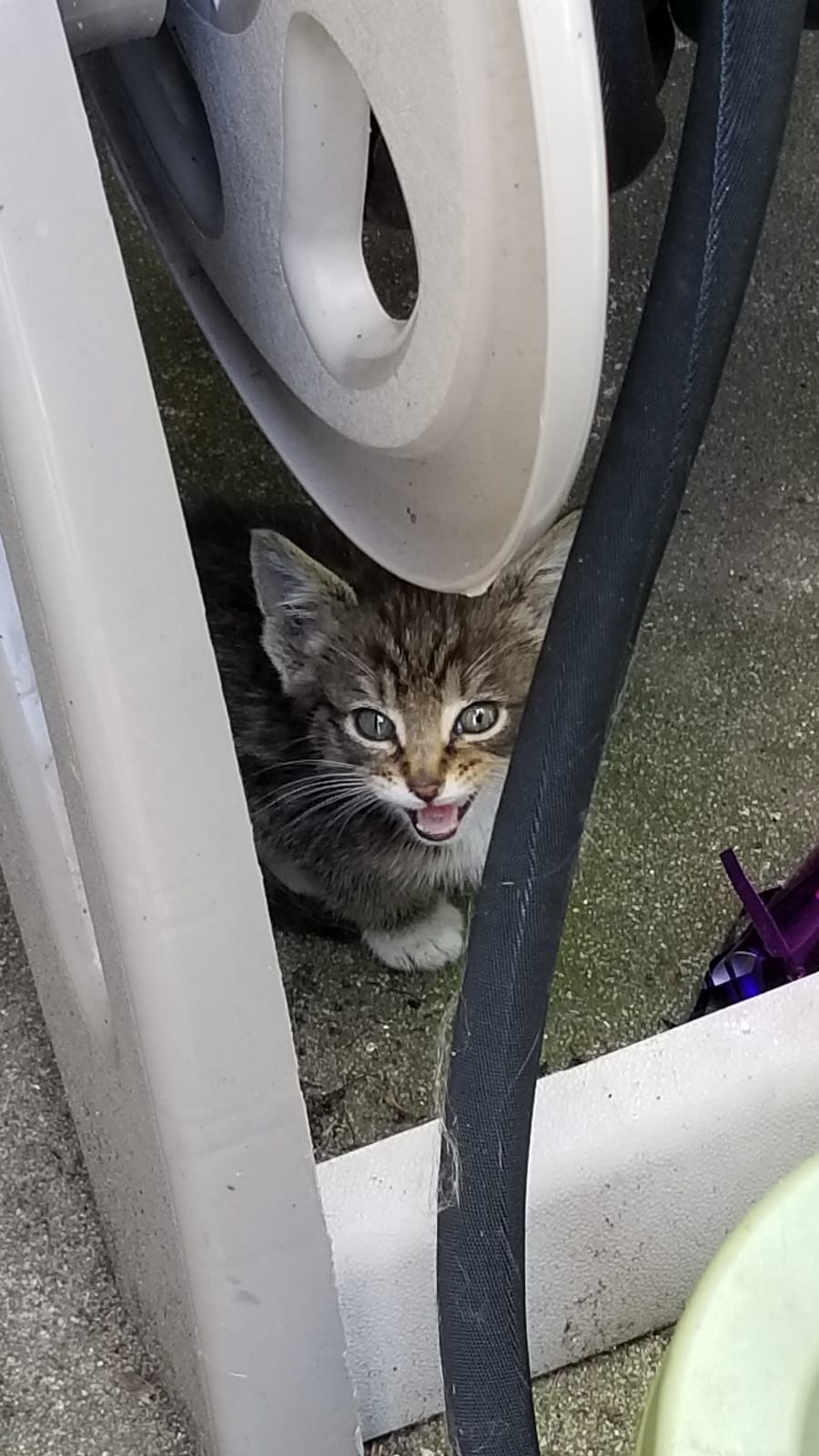
After Alpha made his successful appeal, the others followed. Sekhnet got a good shot of three of his four bothers and sisters, coming out of their hiding place and marching toward the feeding area.
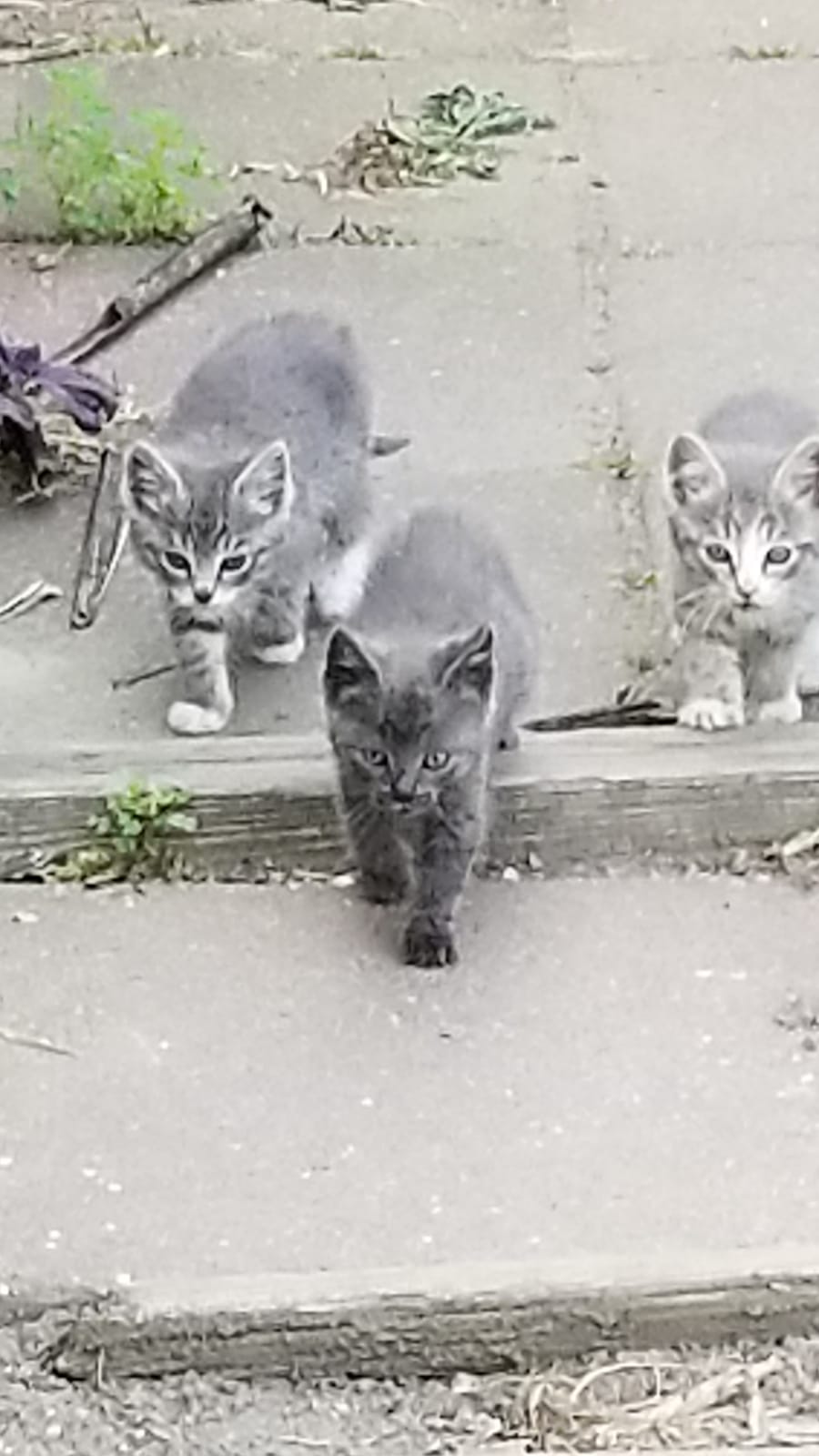
That day they all began eating two hearty meals a day in the garden, exploring and hanging out all over the place, much to the disgust of the five adult feral cats who already lived on, and had fought for control of, that turf. Here they are, led by tiny, indomitable Alpha Mouse, in the male pear tree. Naturally he was the first one up the tree. He’s looking down on them in this shot.
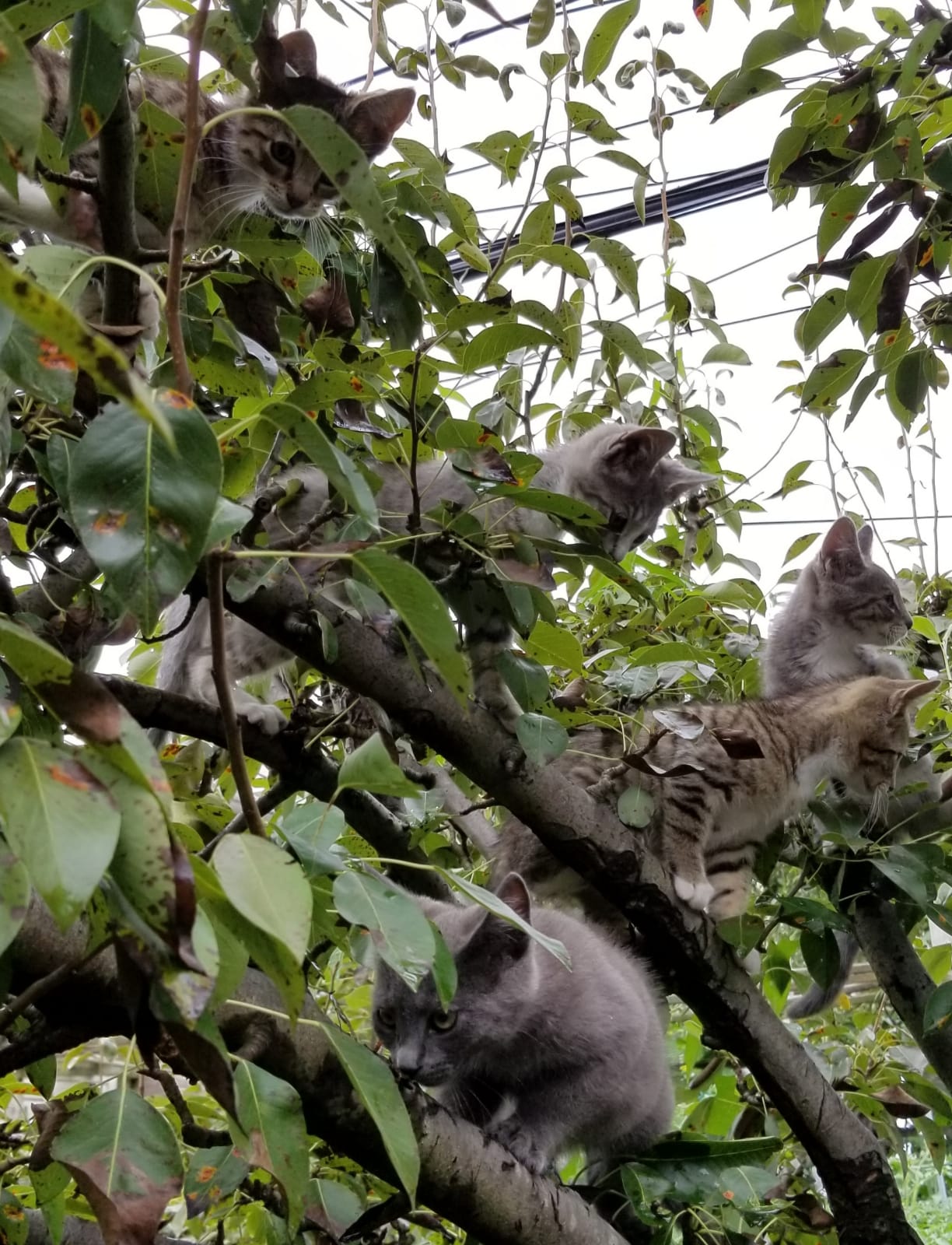
The disorienting pandemic lockdown was on and we took on the saving of these five tiny lives as a kind of mission. Over the years we’d watched dozens of feral cats and kittens we got to know live short, often brutal lives, many of our favorites living only a couple of months. We decided we’d try our best to save these five.
Sekhnet fed and played with them a bit in the garden every day. She took many great photos of the little beauties. I would go out and sit with them late at night, little Alpha didn’t mind being picked up, would sit calmly on my lap from the beginning. They all learned to chase the little cat cookies I’d toss them and eventually to eat them out of our hands. Once the first couple were fairly tame (Alpha’s brother Beta followed in the little leader’s footsteps) Sekhnet designed an ingenious trap, scooped them all up at once and brought them inside where they lived in a large comfortable cage she’d found online. We then set about getting the others used to being picked up and petted. They all took to it quickly.
They were surprisingly happy with the cage, which had several levels and a little workout area where they could take turns pounding a couple of light speed bags. We took them out and handled them one at a time, petted them, won them over, made them all pets. In the end we brought them to a great adoption center we finally found and every one of them was soon adopted as a pet. Naturally Alpha was the first to be adopted, after a very short stay at the shelter, his first day out of quarantine, I think. The rest were all quickly adopted in the days that followed.
We’d done a good deed, we knew we couldn’t keep them around, our plan from the start was to get them adopted to have good lives but we were emotionally devastated that first night, after our friend rented a van and helped us transport them to the shelter in Freeport. They had all come to trust us, and were affectionate and playful, and incredibly cute. We’d grown very attached to having them around. Then they were gone. The house seemed so empty. We cried looking at their many portraits and film clips that first night.
But here is the point I want to make. The pain, though intense, did not last long. By the next day it was much easier, within two days easier still. The good deed we’d done lingered, the painful goodbye to them didn’t. It is something worth remembering when you feel heartbroken sometimes. Painful feelings truly do pass, sometimes surprisingly quickly.
I think of our horror (mine and Sekhnet’s, millions of others were delighted) on election night, at how close the vote was, at the real chance that America’s long experiment in democracy was finally and definitively at an end. At least five million MORE of our countrymen had come out to vote a second time for the most deliberately divisive, untruthful, vindictive, angry, litigious president this nation has ever had. Women, it emerged, had voted for Trump in larger numbers in 2020 than 2016! Women! Hispanic (desculpe me, Latinx) votes seem to have put him over the top in Texas and Florida. The real possibility that this raging winner could win the election and triumphantly rule as lawlessly as he sees fit set Sekhnet to sobbing into her ginger beer. I felt sick too, could not get to sleep.
In the days before the election, as the pandemic continued to rage out of control in most of the country, and new records for infections and deaths were broken day after day, the president confidently (and lyingly) declared victory over the disease that was killing record numbers in the states he won. Mission Accomplished! His maskless crowds roared their approval. On election night the agitated depression we felt was impossible to refute. It was based on the unwanted truth that we are living in a nightmare where the stubbornly reinforced, aggressive stupidity of millions of our fellow citizens, proud “values voters,” impervious to evidence even if it comes up and chokes their family members to death, is unfathomable.
The day after Election Day, as the incoming vote totals were being disputed by a president who had already strongly suggested he was declaring victory, even as he announced his intention to dispute his loss in the 6-3 Supreme Court he’d created, the media (the lying media, die Lügenpresse) was quietly publishing items like these. No longer really headlines, as much as wistful reminders:


I think bitterly that if Trump’s pandemic plan had really worked, letting the pandemic kill millions of “Democrat” voters of color in “Democrat” cities, cutting off needed financial aid to the increasingly large numbers of poor to create mass desperation and massive crime sprees, riots, looting and the need for Bill Barr’s Bureau of Prisons and ICE forces to violently clamp down on “Democrat” cities, (perhaps deploying even the military itself under the Insurrection Act,) he could have proved his wildest “law and order” theory about antifa and anarchy and black rights groups, killed and locked up enough of his enemies to actually win the Electoral College, even if he again lost the “popular vote” by millions. His open conspiracy with political supporter and mega-donor Louis DeJoy, who openly sabotaged the delivery of predominantly Democratic votes, alone, could have won him the election. It could still, unlikely as it now appears.
As the vote counting continues, Trump insisting that counting in areas he leads but is in danger of losing must be halted immediately while demanding recounts in states he has already lost (fair is fair), it looks less and less likely that the president has a path to 270. As my cousin wrote me from the great state of Georgia today:
My point in all this — as Biden gets closer and closer to the 270 needed to win, as horrific as it is that almost 70,000,000 Americans seem to have voted for Donald Trump — and a majority of white women! (maybe the misogynists have a point…) as Trump’s path to the 6-3 Supreme Court seems more and more far-fetched — today feels much different than Tuesday evening.
Biden is far from my idea of an inspirational president, the Democratic party is not anyone’s idea of a meaningful political opposition party. One side radically employs any means necessary to maintain power and force its minority views on the majority of country — and that side is not the corporate Democrats. The Democratic party, as a party, is about as committed to the economic status quo as the Republican party always was. Still, Joe Biden is not Donald Trump — the main reason maybe 75,000,000 of us will have ended up voting for him.
Once he is sworn in, hopefully with a 50-50 Senate where Kamala Harris will be the tie-breaker (though even that modest goal of flipping four Senate seats likely won’t be achieved) we will have to set up committees of correspondence, organize, mobilize, stay in the streets, be smart in messaging, push, push, push. We will still be pushing a reluctant centrist against the dogged resistance of Mitch McConnell and Lindsey Graham — and every single elected and appointed member of their unified, radical party– as sickening as that thought is.
We need to stay positive and proactive, of course. If we push hard enough, you never know. The midterm primaries in 2022 may even feature meaningful Democratic party debates about how to avoid rapidly approaching fatal Climate Catastrophe. The escalating danger of global warming is even further down the page today than the new record COVID numbers, though the threats are equally dangerous. We don’t have much time to fix any of this, and four years have just been worse than just wasted — we need to ride President Biden like the affable, probably well-intentioned donkey he is.
My point though: it feels better today to be an American (for a bare majority of us), and much more hopeful, than it did two days ago.
 gratuitousblahg