Perception management

Sometimes somebody in a disagreement will insist that everything is simply a matter of perspective.  Everyone has their own perception, and different people can see the exact same thing from very different perspectives.   There is a certain universal truth to that.  Think of any work of art that shows the same event from multiple points of view, it appears like a completely different event, depending on whose version you accept.  

It is a small step from the undeniable truth of how our perceptions shape reality to the conviction that no two people can necessarily ever agree on anything that took place, if it aroused strong emotions, since we all see things from our own point of view based on our emotional histories.  The trouble with this view is that it removes the possibility of ever agreeing about anything based on actual events or evidence of any kind that can be agreed on.  It leads to the acceptance of “alternative fact” as well as a perfectly defensible difference of opinion about those ever pliable, transactional “facts”.  It fosters the idea that since everyone’s emotions are always true to them, everyone’s perspective is equally true to them and that persuasion, learning and improving are therefore also strictly subjective matters

An easy way to refute this kind of solipsism is the punch in the face.  If I punch you in the face, I may perceive that you made me do it, you may perceive it was a vicious, unprovoked attack, but we won’t be disputing the actual punch.  If you are susceptible to self-doubt, or if you can acknowledge that you provoked the violence, I may be able to convince you that it was your own goddamned fault I had to sock you, but the fact that I socked you is not a matter of perspective, it objectively took place.  Just look at your bloody nose if you have any doubt.

Take the case of an unappeasable parent. The child finds herself locked in a war she has no insight into, turned into a combatant from before she can even speak. Nothing the child can ever do, even as an adult, can appease someone who is unappeasable.  The parent will insist the kid is the source of all the hostility, tension, anger, misunderstanding, stubbornness, refusal to be reasonable or well-behaved, a plague on the family.  A family friend will likely have a different perspective, caring for both parties and wanting to help both.  Tell the kid their parent is unappeasable and make an enemy of the parent.  Tell the parent it’s not the kid’s fault and you will face the ire of the unappeasable parent now outraged that you are blaming them for the kid’s genetic predisposition to be a provocative, angry, mean, needy little asshole.

It is a tragedy of human history that many of the most angry people in the world are the most adept at blaming their victims.   It is the true genius of homo sapiens (the “wise ape”) to justify our actions, no matter how badly we act.   We can justify them intellectually, when we have facts in our favor, or emotionally, when the facts will not so easily support our hurtful actions.   We never, with no exception I can think of, act not believing that we are right, or at least justified, in doing what we do.  Every act of violence is committed in a moment where the angry person believes 100% that what they are doing is righteous.  After cooling down, many will have regrets about the damage they did, but in the moment of attack they believed in their righteousness absolutely.   That’s what it takes to hurt people, true belief that they fucking deserve it.

A feeling can’t be right or wrong, it is what you truly feel.  The important thing is to analyze the feeling after you calm down, see what in it is reasonable, and to be heeded, and what part is purely your old pain kicking up and making you feel bad again. And if you keep reacting out of pain, and keep inflicting pain with your reactions, and learn nothing from it, you’re just an asshole I’m sorry to say.

What you can healthily accept — and what you must not

You can, and must, accept the imperfections and weaknesses of those you love.  It is easy enough to do.  We all have our faults and we all need to be accepted as the damaged souls we are.   We should also try to do better once we know that certain of our tics are hurtful to someone we love.  

Not everyone is capable of self-reflection and change, sadly, such things terrify some people.  But it’s important to the health and mutuality of intimate relationships to try to do both of those things, when needed.   Criticism from a loved one does not mean repudiation and rejection — it means you need to be aware of the hurtful effects of your actions on someone you care about.   You need to sometimes accept criticism from those you love, it may be fair or unfair, and it can be discussed, but it is brutal, and deadly, to angrily shut down any talk about it.

What you must not accept is blame for the imperfections, weaknesses and vices of those you love.  If the ultimatum below sounds familiar, and does not change no matter how calmly you manage to proceed, walk away:

“As long as you don’t ever criticize me, or show impatience, or raise your voice, or employ mean body language, as long as you accept everything I say as beyond dispute, we will remain dear friends forever.  Once you make me feel bad about myself, even one time, I will show you who the actual irredeemable asshole is in this equation.”

Rest assured that if they set those conditions, and insist on them, that they will make good on their threat, because, no matter how patient you might be able to remain most of the time, we all have our limits and will be pushed to them.  

Once you reach your limit, and start banging your head on the wall, as I found myself doing recently (actually, I picked up a small wooden stool and bopped myself in the forehead with it), the proof is now there for everyone to see — only an irredeemable asshole acts that way after only an hour or two of no-holds-barred conflict over who has a greater right to feel hurt for the last year and over what.

Somebody recently called me a saint because I’ve been trying to remain very patient with two, dear old friends in the face of this kind of ongoing ultimatum.  I told her “I am one very goddamned fucking angry saint, I can tell you for sure.”   While faintly amusing, it was also true.

If you can accept that you must remain eternally patient while those who feel criticized or challenged by you can show immediate anger whenever they feel desperate, I’m not sure what to tell you, except, perhaps, that you need to think it through again.  It is very, very hard, unthinkable, really, to leave people you love — there may be nothing harder to do.  Except, in my experience, it is even harder, and much more destructive, to cling to one-sided relationships where every conflict can only be stopped by assuming the entire fault for it and never again making the other person feel discomfort by talking about anything you need to resolve.  

The damage to yourself of accepting this kind of lack of mutuality is ongoing, and will never stop until you put a stop to it.  Once the cycle of blame, and who has a greater right to be aggrieved, sets in, you cannot change it on your end alone, no matter how sincerely you try to show love.  You must be blamed, and accept all fault, or be destroyed.  If you have friends in common, it will be necessary to destroy your good name among them as well.

It’s as hard as death itself to leave a long, loving relationship that has become corrosive, but harder still is living in a ruthless funhouse where honesty is discarded and angry desperation is turned relentlessly and implacably on you.  I grew up in a house like that, moved out when I was 17, many years ago.   The harm it did has been a long lifetime healing, as far as I have been able to heal.  The echoes of it, whenever I am made the focus of other people’s hurt and anger, extending to a tyrannical insistence that I simply stop fucking talking about what’s bothering me, have become impossible to bear.  

So I recognize now that I am in mourning, having finally, and with extreme reluctance, seen what a healthier person would probably have been able to observe a year ago, ten months ago, six months ago, last month.   It does nobody any kind of favor to carry the heavy cadaver of what was once a loving friendship around, hoping it will begin to breathe again, and smile, and thank you for having undying faith in resurrection.  

And just like physical death, or maybe even more so, the thought of a forever parting can feel unbearable, which is why we cling to things even after we’ve seen over and over they are not as they were.  Even after they have become intensely painful and impossible to stop pondering.

So, mourn I must, as I forgive my understandable slowness to take my leave from an unbearably painful situation.   The only alternative is pretending there is nothing to fix that can’t be fixed by simply not bringing up pain ever again and placidly accepting the entire fault for a deadly impasse I am at best 50% responsible for, and somehow accepting that doing those things will magically restore something, including trust, that is now irretrievably gone.

Accept all the blame and simply act like everything is fine again?   No can do.  Neither should you. 

Authenticity

My niece, when she was a toddler, began using the toilet to urinate.  She was hesitant to do the rest of her business there and her mother asked her why.   “It’s very dangerous!” my little niece apparently said, with great conviction.   The seriousness with which she delivered her answer made it a great laugh line in the family for many years, though we never learned what the actual danger was.   

The last Mother’s Day of my mother’s life, a week or so before she was taken to the hospice to die, was one of the saddest days I can remember.   Her daughter, my sister, had long been operating under the principle that our mother was “kookoo for Cocoa Puffs.”   The phrase harkens back to an ad for sugary cereal that ran for a while when we were kids.   The mascot, a very excitable cartoon bird, apparently a kookaburra (famous for its hysterically laughing call), went wild for the delicious cereal, bouncing off the walls and squawking “kookoo for Cocoa Puffs!” over and over as it freaked out.   Saying our mother was kookoo for Cocoa Puffs was a cute way of saying she was batshit crazy.   When my mother “lost” her wedding ring, her mother’s solid gold bracelet, the one with the little photos of our family lovingly cut out and pasted into sections of a little gold orb that opened and  expanded like an accordian, it was because she was kookoo for Cocoa Puffs.   When my mother was pissy that her daughter and grandchildren never thanked her for anything she bought them, same verdict.

During that last meal with the family, gathered around our dying mother’s kitchen table, many meaningful looks were shot behind the old woman’s back.  She’d say something and eyes would quickly roll, facial expressions would flash all around, silently and constantly, “phew, nuts, eh?”  My sister, her husband and her children were convinced of the old lady’s lost grip on reality.  She was nuts, and they humored her, if barely.In the end my mother started to cry, which they felt proved their point. 

I never found my mother to be the least bit nuts, except when she was in a situation where everyone was pretending.  That shit drove her crazy.  A week or two before she died, a new hospice nurse met her with a small group of hospice workers.  I heard them all laughing from my mother’s bedroom.  When the nurse came out, she said to me, with a big smile,  “whatever else you want to say about her, your mother is sharp as a tack.”

Meanwhile, before an early dinner on that final Mother’s Day, there had been a tense negotiation, for the hours leading up to that carefree meal, with numerous phone calls back and forth, due to a serious, ongoing suicide threat.  A door had been slammed and locked, wailing tears from within, nobody could reason with the inconsolable teenager who’d been humiliated on line, as teenagers are when their friends turn mean.   It had apparently been touch and go for a while, until finally the younger brother quietly talked his way into the room and was able to calm his sister down.   They arrived a few hours later, big smiles on all their faces, with Chinese take-out and the firm conviction that grandma was insane.   It was an excruciating experience.  A few days later a van from the hospice came and took my mother to her deathbed.

I have that same tic my mother had when faced with dishonesty, selectively poor memory, a failure to acknowledge when my feelings are hurt, an insistence that I’m crazy and the people insisting on my insanity are beyond criticism, no matter what they have to do.  After my mother’s funeral I mentioned a historical fact, someone’s prior marriage, that sent my sister into a frenzy.  She desperately made the slashing “ixnay!!! ixnay!!!” gesture across her throat to get me to stop talking.  The prior marriage was, for some reason, a humiliating secret that left my sister no choice but to lie to her daughter about it.   It upset me to be called a liar, and in my confusion I held my tongue.   The next day, when we spoke alone, my sister promised to clear things up afterwards, but put so many conditions on when and how, that it took over a year and then, she explained, the conditions were still never right.   After a year she was hurt and very angry that I still had an issue with being called a fucking liar.  A year!   My fucking insane brother only knows one thing — how to hold a fucking grudge.

My mother’s funeral was more than twelve years ago.  Now, in my sister’s mind — twelve fucking years later my brother is still upset that I inadvertently called him a fucking liar and that there was a slight delay in telling my children the demanding, judgmental asshole hadn’t lied.  Is there no statute of limitations on his insane, prosecutorial bullshit?  What about love?  What about fucking love?  My brother wouldn’t know love if it came up and lied to his face!

Call me kookoo for Cocoa Puffs, but to me love does not include a need to lie whenever necessary, a pass for all hurtful behavior, a license to do whatever you feel you need to do to someone else, whenever you feel hurt or upset, with a lifetime entitlement to unlimited, unconditional understanding, kndness and graciousness.  That’s something, we can all agree, but I’m not sure we can call it love.   

For one thing, it is a one way expectation, since the party insisting on it does not extend the same privileges of unlimited forgiveness to the other.  For another thing, without authenticity, what is there between two people?

Being authentic means being honest.  In an intimate relationship it means being honest while taking care with other people’s pain when they feel they’re not getting what they need from you.  To some people it hurts too fucking much to consider making themselves vulnerable that way.  They tend to believe that we all have our own perspective, our own reality, that nothing anyone you love says is necessarily true or false.  This essential solipsism is untouchably real to someone to whom the pain of rejection is much more terrifying than accepting that we are, on the most basic level, eternally unknowable to each other.   The price of maintaining this kind of solipsistic relationship is very high if you are so kookoo for Cocoa Puffs that you insist on difficult abstractions like honesty, apology when someone is aware they’ve hurt you and so on.   If you can’t love and forgive without conditions, they insist, you are not worth loving.

And, of course, they are completely right.  You certainly will never be able to convince them that they are not, since it is humiliating to them to ever admit being wrong or acting hurtfully.   You know them well enough to know what will make them tense up, set their faces, become cold, whenever they feel you are criticizing them.  You are prying open an unbearably painful primal wound, proceed in the face of resistance only if you want to end things.

Sometimes, even with your best efforts, relationships you love, that have long been a source of comfort and security, will end.  It can be very, very hard to move on, but sometimes it is necessary for everybody.   Sad, and true, as death itself.

Thanksgiving and waking up from a bad dream

We all have many things to be grateful for on Thanksgiving, even if the Thanksgiving story we tell our children is probably mostly bullshit.  Yes, local Native Americans may have shown up with gifts and taught the Pilgrims how to survive the winter in the New World (which was to the natives just the world).   Yes, there may have been generosity shown toward the extreme religious fanatic Puritan Europeans.  The rest, as they say, is history.  A history that can only make us feel bad (as fact deniers always insist), so let us feel good about the things we, personally, have to be thankful for.

When you wake up from a bad dream and see that you are still there, unharmed, that it was only a dream, it is a great relief.  You can feel the well-being of waking from a nightmare throughout your body.  Like you dodged a bullet.   Damn thing could have killed me!   But it didn’t, thank God, it was only a dream.  You wake up to a better day as you shake off the bad dream.

Sometimes things we love in our lives, relationships that go back many years, curdle, turn poisonous.  You try your best to fix them, maybe try beyond the point of reason sometimes.  When you see you can’t fix it, that your efforts to resolve the conflict are not being reciprocated in any way — it is time to stop trying to fix it.  You can only do your part, when there are others involved.  If you do your part and still face hostility, denial, anger and blame then accept the proof that something that was once easy, and fun, and mutually beneficial, is not that way any longer.   Otherwise there will be hard work, on your end, and then, when you’ve done that hard work, even harder work, and after that, harder work still.   At a certain point you have to admit defeat, you cannot change what cannot be changed.  Wake up and smell the future.

The future smells different, something familiar that you loved very much is gone.  This is a sadly familiar human reality, it happens with every death of a loved one, happens to us all and to those we must leave.  Since change is the only constant in life, do not mourn those painful things you have to let go while everyone is alive, beyond the initial period when you are processing the sadness of a death during life.  It is a tragedy, yes, but no worse than a terrible dream, if you have truly done everything in your power to fix what is unbearably broken.  

If you want a little sweetness to make the bitter medicine go down easier, consider that all real growth is accompanied by pain, or at least great discomfort.   You have passed the point of discomfort into pain, and have continued forward with good will in spite of the cost to youself.  Be consoled by your effort and don’t fault yourself for not doing the miraculous.  You exerted yourself to your limits and that is more than most people do.   Take comfort from that.

Part of gratefulness, I think, is recognizing that it is good to finally see a terrible thing you have been unwilling or unable to see for a long time and accepting it as it actually is.  You sleep better once you make peace with something that seems too horrible to imagine.  Better sleep leads to only good things.  Like more gratefulness.

Double Standard redux

If I get mad at you, it’s because you’ve hurt me badly, have never tried to make amends and I have a good goddamned reason to be hurt and angry after months of your denial and defensiveness.  

If you get angry at me, no matter when, it’s because you are being fucking unfair and vicious, for your own sick, irrational reasons.  

What is hard to understand about any of that?  Could it be clearer?

Now, all you have to do is convince the eye witness who loves you that what they saw, what you experienced, actually happened.  Since everyone has their own perspective, aren’t we really all arguing that we’re better than the person who claims we treated them badly, that our point of view is more valid than theirs?  Isn’t everybody just equally right in their feelings?

No.  There are objective things that actually happen prior to and in the aftermath of somebody getting angry.  Focus on those, compare how each party acted.  Things that actually took place won’t lie to you, no matter how emotionally compelling a spin is placed on them.

Trauma

When someone you love acts in a way that activates trauma in you, it’s not just having your feelings hurt.  Trauma is more like being electrocuted.  Chemicals flood your body, fight, duck, flight, run, scream, crawl, what the fucking fuck?!! Help! Help!!!  But, just like when you were helpless earlier in your life, there is no help.  You are back in the exact terrifying moment, facing the  implacable violence that seared the trauma into you when you were too little to protect yourself.   Flung in a disorienting instant back to a time when you were helpless against a brutal force much more powerful than you.   The essence of trauma is that it is terrifying and you must somehow face it alone.  You can’t save yourself from it, and nobody else will either.  Trauma is in a class by itself in terms of psychic pain.

If I accidentally traumatize you by losing control of myself, and find you shaken in your soul, my apology is a first step, at best.  The apology is the beginning of the healing story, not the end. To reassure you I will have to demonstrate better self-control going forward or you will be perfectly right to find my apology worse than meaningless, my threat ongoing. 

You won’t believe my apology, you’ll recall similar angry things I’ve done to you before, particularly if I continue to tell you that any pain you claim I cause you is your own fault, every time, that I only react that way because you make me do it.  The old wife beater’s/bully’s defense, “I wish you hadn’t made me do that to you, why do you keep making me hurt you?”

We are all weak, flawed, imperfect, limited, even disabled in various ways.  Those of us who are not narcissists (who see themselves as either perfect gods or unbearably worthless pieces of shit)  or are otherwise crazy, do our best to be kind, to not do things to others that we hate done to us.  We don’t always succeed, but our goal is to be kind, to listen and reassure people we care about when they are suffering. 

If we’re damaged enough as children we face a mountain of hard work to climb out of the traumas of our past, to avoid replicating them, inflicting them on others, but many spend their lives climbing.

Some traumatized people sincerely believe that change is impossible.  In the cases I’m familiar with it is the immenseness of their pain that convinced them of the impossibility of change. 

None of us are good at sitting with painful feelings.  Without sitting with pain, looking at it carefully, we have no hope of learning how to proceed, outside of keeping busy all the time, running, hopping, jumping, doing anything to avoid being alone with our feelings.  Many people in pain, who have the money, seek a good therapist to help them through the difficult challenge of developing the insight to change harmful behaviors.  A good therapist is a great comfort.

Others just want peace, and calm, and people to accept them exactly as they are, unfixable flaws and all.  And it is also true, if you can’t accept somebody’s weakness, you really can’t be friends with them. Those same people who need unconditional acceptance of their flaws are often very judgmental, have unshakable, harsh opinions of others and are experts at denying or justifying even the most cruel things they may do.  When confronted they will say whatever they need to say in the moment to defend themselves, telling lies they may contradict a moment later in their desperation to avoid feeling blame for acts they may be ashamed of.   They may tell you they were mistaken, that they can’t help it, both understandable human frailties, and that you are being cruel to them, that they simply need to be loved without conditions.

Anger is probably a human’s hardest emotion, up there with grief and fear.  It leads to insensitivity, nastiness, beatings, lynching, mass murder.  Anger is also inevitable when, however patient you try to remain, there is no mercy shown, no understanding given, no acknowledgement of your right to feel hurt by thoughtless treatment.  “You hurt me, too, asshole, what makes that OK?,” is not a recipe for reconciliation.  That kind of response may cause you to raise your voice, say something mean, get ready to fight, no matter how much you may cling to trying to remain mild.  When we are hurt, we need reassurance. If we get stern insistence that we are wrong to be hurt, to need to talk about it, it is the opposite of reassuring.

But some people can’t help themselves.  They may feel bad, on some level, but they are truly unable to resist redoubling the old beating when somebody appeals for their mercy by making themselves vulnerable.  Vulnerability is their worst nightmare.  No mercy for weak, vulnerable, fragile bitches!   Nothing scares someone who is terrified of being vulnerable more than somebody laying their heart bare to them. 

Here is therapist Bessel van der Kolk, with a succinct, insightful description of trauma.

Compromise

Compromise is finding a middle ground that, while it may not solve the worst of the conflict, at least makes things better.  It moves each person toward the other enough that each side can feel they got something they needed.   It is not perfect, in terms of everyone getting everything they want, but a good compromise gives you something essential that you weren’t getting before.  Compromise is a starting point for rebuilding trust. It also restores faith in reason’s (with compassion) ability to solve otherwise intractable problems.  It’s a necessary first step back to healthier relations, once things have deteriorated badly enough to require negotiation.

If your complaint is that you were blamed unfairly, got 100% of the blame when at most 50% was your share, and the blame was insisted on over and over during a year of emotional withdrawal, accusations, threats, framing everything as a war you cannot win (hi, Dad!) a compromise saying “OK, fine, you were only 50% to blame for our little impasse” is probably not enough of a compromise to satisfy you, unless you are very easily satisfied.  For one thing, you have no reason to trust that next time you won’t experience the same thing, with the identical maddening aftermath.

A long, tense negotiation to get what should have been given to you at once, something like the benefit of the doubt based on a long friendship, only after a year of fighting (if you consider months incommunicado to be a form of fighting), is unlikely, after a year of senseless warfare, to produce a compromise to undo the harm of that long war.   Getting an apology from someone, after months stubbornly posed in the same judgmental position, is like getting an expensive get well card a year after you get out of the hospital and are fine.   

Most of us are bad at apologizing.  The most important part of the apology is recognizing the pain you caused somebody else, empathizing with why what you did was hurtful.  If the same thing had been done to me, I’d be hurt too.  Without this crucial component, and telling the other person we were wrong, and asking for forgiveness, a formal apology is a pose for prigs.  The prig [1] can later say “I fucking apologized to you, you unforgiving fuck!” and once again feel like the righteous victim.

An apology that doesn’t recognize the harm done is a poor excuse for an apology.  An apology that does not contain a promise not to repeat the same hurtful behavior is very, very weak tea (piss, actually).  What gives an apology the power to heal is the sincere concession that you would have been just as hurt as the person who is upset about what you did, if the roles had been reversed.   Without this recognition of the other person’s right to be unhappy, you have only the meaningless shell of an apology.

Instead of real apology, many try to argue there is no need for any such thing, since what hurt you wouldn’t have hurt them and is so much water down the drain anyway, so long after the fact.  You see, ha ha, I’m doing it to myself now, it doesn’t hurt!  You see, I am strong and not hurt by things like that, normal people aren’t, you sad weakling.  This “I’m strong and wouldn’t have been hurt by that” line calls to mind Wanda Sykes beautiful takedown of right-wing blowhard Sean Hannity who bragged that he could take being waterboarded, would never be broken by the “enhanced interrogation” technique.  Sykes said “please, I could break Sean Hannity in a minute, just put him in a middle seat in coach, that punk would be singing in sixty seconds.”

As long as a failure of empathy is desperately defended to the death, I’m pretty sure there is no compromise that can bridge the inflamed gulf between two people.   Continuing to assign blame, no matter what, instead of demonstrating real empathy, is a sign that nobody is going to emerge from the negotiation with what they need.   If the party responsible for at least 50% of the hurt puts “fine, I’m 50% responsible, but you’re still wrong, too” on the table, that’s about that for our negotiated compromise.

Be ready to be pleasantly surprised by an offer of real compromise, but remember, too, the real world we live in.

[1] A prig is a person who shows an inordinately zealous approach to matters of form and propriety—especially where the prig has the ability to show superior knowledge to those who do not know the protocol in question. Wikipedia

found notes (circa 2011)

If you badmouth friends, judge them, withhold the benefit of the doubt, keep silent, express grievances, make excuses for all your actions, accuse, blame, lie and stick to your lie, people will eventually begin to avoid you.

Being straightforward, constant and willing to listen is a much better way to resolve conflict.

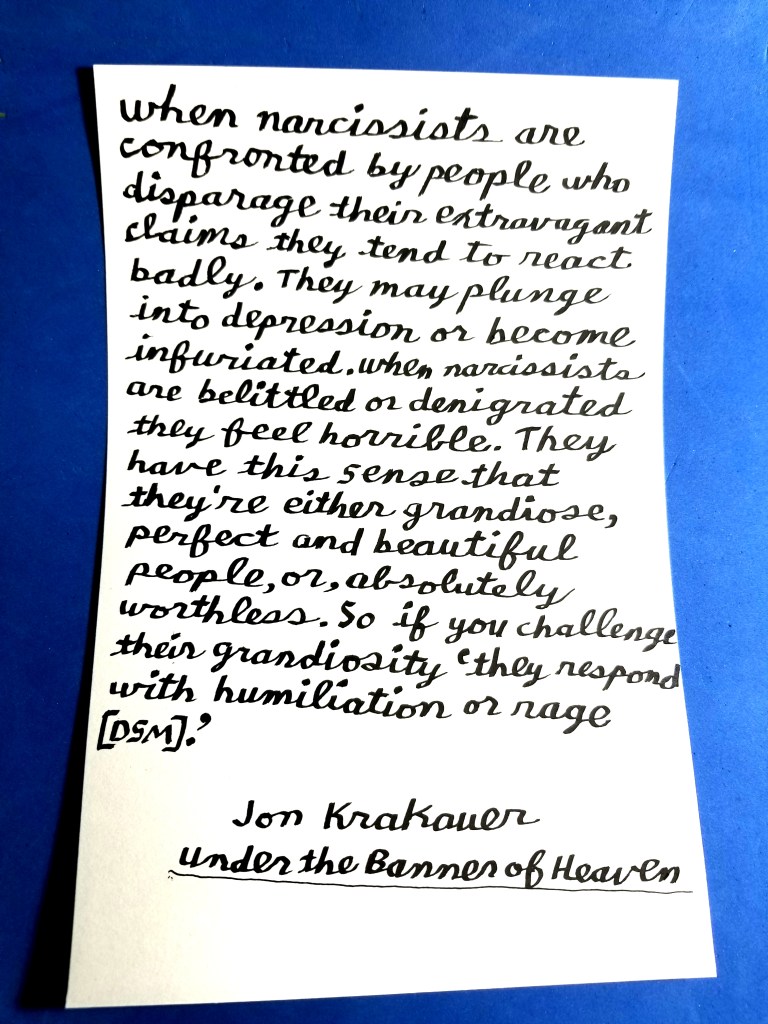
Narcissism is fueled by humiliation

To understand how delicate bragging, strutting narcissists are as they advertise their unique greatness, you have to consider that their stilted worldview is an attempt to escape the unbearable pain of a crushing sense of their worthlessness.

If you have a burning sense of inferiority you must construct the facade of a superman, just to survive. Pick at this facade at your own risk, losers!