One Note Samba

I’ve noticed over and over that in our society the crime of not monetizing things that can bring profit is considered  even more heinous than proposing socialist sounding solutions to long-standing social problems.  It is not hard to notice, as everything around us is being constantly monetized, but every time I see a new example, like a bird hit in the knee with a tiny rubber mallet, I begin to tweet my sour one note samba.
 
“This is just a one note samba,” sings Sekhnet, rolling her eyes and walking into the other room whenever I begin the familiar song.
 
Several sweaty miles through 93 degrees with my laptop on my back the other day I stopped into the lovely mall at 59th and Columbus Circle to use the bathroom and enjoy the air-conditioning.  Last May I stood at a vantage point on the second floor balcony where I photographed out the high glass wall to the statue of Columbus and people coming and going, up and down escalators.  It was a beautiful shot of the city through floor to ceiling windows and a sea of humanity captured against this spectacular backdrop.  I shot a cool stop-motion movie from there and noted it as a great place to take vivid city-scapes.
 
I stood at the same place yesterday and saw with a shudder that some fucking genius has monetized that vast open space, two wide 40 foot tall banners advertising Glaceau Smart Water now block most of the view, though you can still spy Columbus propped on his pillar in the narrow slice of sky visible between them.  If you hold your head just right.
 
They’d be idiots to refuse the half million a year Glaceau pays them to advertise their product in that striking spot.  Why would anyone turn down that kind of money?   What would you rather have, a fucking view few even notice or a half million dollars?  Duh!

Technology as Sodomite

My program, a theory I tested that worked better than I’d hoped (be careful what you hope for), depends on the simple user-friendly, beautifully integrated technology of the macBook, circa 2011, to put kids’ stop-motion animation together.   This technology allows eight year-olds to take hundreds of frames from the SD card of a digital camera and quickly select and input them into a program that automatically puts them into a folder on a laptop computer.   This easily located folder, which can be customized to use any frame as an icon, can then be opened and selected frames dragged into the simple to use program where the frames are edited to make the finished animation.  In another program the kids make a soundtrack, and drag it into the animation with ease.  It’s simple and direct and kids are happy to teach other kids the programs.

It’s true, as my father said, that I’d complain if I was hung with a new rope.  Keep that in mind.

I listened to a friend’s good advice about buying a new state of the art macBook pro and stop struggling to do all these workarounds on multiple devices– emailing an image from the iPad to include as I create my pitch on the one computer I’ve updated to the latest operating system, play it back on the new iPad.  I need to make various marketing materials to get the program up and running as a business.  It made sense to get the new computer, put everything I need on its solid state hard-drive and not be hampered by technological challenges on top of the challenges already stacked up for me to overcome.  I bought the new macBook three weeks ago.

The Devil, of course, loves the details– calls them home, his playground, an aphrodisiac.  The details drive Old Scratch into a frenzy of creativity.

Apple, like all large corporations, is in business to make the largest possible profit.  This is the way of the world, the first rule of the Free Market.   In addition to constantly introducing new products people will have to buy, they tirelessly upgrade their ingenious programs, reconfigure the operating system, redesign their most popular programs and apps.   Sometimes they even eliminate them altogether.  iPhoto, for example, the program that allowed kids to bring frames in that could be instantly found in a folder– gone.  There is likely a way to do something similar, without a doubt, in the program that replaced it, closely resembling the iOS system they use on iPhones and iPads, but it must be figured out.   Similarly, the program where the kids edit the frames, and which has always had a pull-down menu within each frame to make crucial adjustments, Apple designers have eliminated this convenient feature altogether.   Of course, there has to be a way to do it, it’s just not easy to find.  Especially if you get frustrated when you can’t find it mentioned in the help menu.

So, because I can’t solve these vexing problems at the moment, and it is too hot to struggle with them now, I downloaded a great-looking program called iBook Author.  This program allows one to make interactive e-books, something I have long wanted to do.  They can only be used on Apple devices, of course, but it would be a start.  I was excited to try it and try it I did.  I created the first two chapters of a book, with an embedded movie, and wanted to preview it, see how it looks as an e-book.

Happily there is a button that says Preview right at the top.  I clicked it.  I was invited to select a destination from a greyed out list that contained one destination.  That destination, which I could not select, reads: This computer (iBooks for Mac) (Newer version of iBooks needed).

Screen Shot 2015-07-19 at 12.31.50 AM  

The neighbors were treated to a Tourretic outburst that must surely have been unwelcome at that hour, or any hour.  I opened iBooks on the brand new computer I bought three weeks ago and was able to download several e-Books.  I flipped through them, everything worked fine. There was no option to download a newer version of iBooks.  I searched.  All will be revealed, I decided, when I speak to an expert at Apple Care who will guide me through intuitive steps involving holding down the Option key while pressing the smart trackpad with three fingers, for exactly two seconds, and then quickly powering the computer on and off, with an easy switch to the Apple key.  I eventually decided to stop struggling with the willful new computer, shut it down and go to sleep.  

Screen Shot 2015-07-19 at 2.11.06 PM

Sleep took its time.

The Mick on the radio

I was nine or ten, listening to a Yankee game on the radio, when it started to rain and the game was delayed.  A year or two earlier, in 1964, the great Mickey Mantle had his last great year as the Yankees won the pennant right at the end of the season.  1964 was my first season as a Yankee fan and it would be the Yankees’ last pennant for the rest of my childhood.  

I remember watching the celebration on TV, black and white, the guys in their grey baseball undershirts dousing each other with champagne.  Joe Pepitone describing how earlier in the year, before he went on a tear and finally fulfilled his potential (for about the only time in his career) he had been ‘fustrated’.  Mantle poured champagne over him as he was being interviewed.  Everybody laughed.  Mantle later hit a couple of dramatic home runs, a total of three in the World Series to break Babe Ruth’s career record, and the Yankees lost in a dramatic game seven to Bob Gibson and the Cardinals.  David Halberstam wrote a great book about the 1964 season called October 1964, well worth a read if you’re interested in baseball, history and how the world changes.

Mantle was the hero of many boys in New York in those days and I would always take his side in the eternal argument against those who idolized Willie Mays and insisted Say Hey was a better ball player.   Sure Mays was a first ballot Hall of Famer, unquestionably one of the very best ever to play the game, a five tool guy who could do everything on a baseball field and make it look easy.   Mantle’s skills were the equal of Mays’, we’d argue, and he was doing it all on one leg.  Before Mantle got hurt he was faster than Mays, we’d say.  The argument for the Mantle guys was the mythic hero tragedy centering on Mantle’s limitless potential, his heroism in overcoming his disabilities  playing through pain, doing it all on one leg, on crutches, with the clock ticking, a career-ending injury always one play away.   It was a tragic position: imagine what Mantle could do if he had Mays’ health!  In the end their career stats, corrected for longevity, would be virtually identical with Mantle having a slight edge in a couple of categories (slightly better base stealing percentage, for example), Mays in a couple of others.   It was the kind of vehement, futile, idealistic argument kids love to have.

Unbeknownst to us, Mantle was getting drunk virtually every night during his playing days while Willie took care of himself.  The Mick would get shit-faced and fall down, get into fights, wind up in bed with a woman he didn’t recall meeting, was sneaked back into the Yankee hotel by teammates, the loyal press corps helping cover up most of his alcoholic episodes.   We didn’t learn until years after his star-crossed yet magnificent career that he had been his own worst enemy.  

Haunted by his father, Mutt Mantle’s, early death, and the early deaths of his uncles, he believed he was cursed to lead a short life, so why not have as much fun as he could getting shit-faced every night?  The irrefutable logic of the bottle, I suppose. Toward the end of his career, as his skills diminished by the day, he played on a series of very bad Yankee teams.  For one of the few times in their history the Yankees were a second division team, finishing last at least once during my childhood.

One day in 1965 or ’66, (could have been ’67 or ’68), there was a rain delay.   I listened to Rizzuto and Bill White (I think it was White– though it’s unlikely, now that I think about it– White was probably still playing, he played first base on that great 1964 Cardinals team.  Must have been Joe Garagiola) as they stalled, trying to keep fans tuned in during the delay.   Not long afterwards radio networks would cut away from the stadium during rain delays and return to regular programming, but in those days they killed time telling baseball stories and talking about how it looked like it might be clearing up, how the ground crew was about to take off the tarp, until it started raining harder again.  During this particular delay Mickey Mantle came into the broadcast booth and was greeted happily by the broadcasters.  

This was a rare treat, you rarely heard players on the radio, and never during a game.  But there was The Mick, loose and happy as could be, larger than life, talking with his Spavinaw, Oklahoma twang.   The subject of a recent fight on the field between two baseball teams came up.

“You ever been in a fight on the field, Mick?” asked one of the broadcasters.

“Well, I’m not really much of a fighter, you know,” Mick said in his aw shucks way. He was one of the strongest men in baseball, with muscles like few other players, and this disclaimer struck me as a great aw shucks statement.  “There was one time in Detroit that we got into it on the field, somebody got hit and people ran out of the dugouts.  When this happens I look for a friend on the other team, and so I found Norm Cash, me and Norm are buddies, and we kind of held each other and pretended to fight.  I kind of had Norm in a headlock and he says to me “hey, Mick, ever see a picture of your wife naked?” And I say “no.’  And he says “wanna buy some?””  

“We’re going to break for a commercial,” said one of the broadcasters (almost certainly not Rizzuto) quickly.  When they returned there was no sign of Mantle, nor even more than a passing mention of his visit to the broadcast booth.


Perfect Moment

Many years ago, on a sunny summer day, I was on a train heading south from San Francisco to Santa Cruz.  It was the only time I was ever on a train in California.  Outside of San Francisco the train went along the Pacific Ocean for a stretch, before heading slightly inland for the bulk of the trip.  A kid was alone on a basketball court, dribbling the ball against the gigantic blue sky.  I watched him, waiting for him to shoot.  He was about at the foul line, bouncing the basketball, taking his time like an Elmore Leonard character.  

Dribbling the ball, he backed further from the basket, he was now at the top of the key.  A tunnel was coming up and I badly wanted to see the kid take the shot.   As the train speeded toward the opening of the tunnel he sent the ball toward the basket in a high arch.  The ball swished through the net a split second before the darkness hit.   It was like a perfectly cut scene in a movie.  I remember that great feeling of satisfaction, as I smiled in that long tunnel, with the thought that I’d just experienced a perfect moment.

Addiction to Social Media

It’s understandable, friends.  There is a human longing to be connected to…. hang on a second,  I’ve got to send a quick email, excuse me.

What’s the deal with looking at the smart phone every couple of minutes, every few seconds, what’s the …

It is addictive, this feeling of being connected, of having the world at your fingertips. A moment of total control in an out of control world when you stop to make your phone do something cool, smart, informative, interactive.

In elementary school, for me decades ago, when any of this was the domain of the smartest science fiction writers, a teacher described a psychological experiment that has a lesson in it for all of us today…. wait, got a message coming in, hang on.

They hooked an electrode up to the pleasure center of a rat’s brain.  Many rats were hooked up this way.  They had a button to push to give them a jolt of pleasure, the equivalent of an orgasm.   It took the rats a very short time to make the connection between pressing this button and the immediate jolt of pleasure.  

The scientists were not all that shocked to find that every rat died with his or her paw on this button.   There was no reason for them not to keep pressing it and it was irresistible, after all.

I had something more to say, but my phone is now fully charged and I’m thinking of downloading the electrode to the pleasure center app.  I’m sure someone is developing it… hold on, there’s a notification.  

Shoot, just an email, I’d better answer that.

Consolation?

It may be worth keeping in mind: the crazy person is generally the last to see that he is crazy.  This is consolation and worry both and reminds one of the opening assurances of the insane narrator of The Tell-Tale Heart (1843) by Edgar Allan Poe:

 TRUE! — nervous — very, very dreadfully nervous I had been and am; but why will you say that I am mad? The disease had sharpened my senses — not destroyed — not dulled them. Above all was the sense of hearing acute. I heard all things in the heaven and in the earth. I heard many things in hell. How, then, am I mad? Hearken! and observe how healthily — how calmly I can tell you the whole story.

It is impossible to say how first the idea entered my brain; but once conceived, it haunted me day and night. Object there was none. Passion there was none. I loved the old man. He had never wronged me. He had never given me insult. For his gold I had no desire. I think it was his eye! yes, it was this! He had the eye of a vulture –a pale blue eye, with a film over it. Whenever it fell upon me, my blood ran cold; and so by degrees — very gradually –I made up my mind to take the life of the old man, and thus rid myself of the eye forever.

Now this is the point. You fancy me mad. Madmen know nothing. But you should have seen me. You should have seen how wisely I proceeded –with what caution –with what foresight –with what dissimulation I went to work! I was never kinder to the old man than during the whole week before I killed him. And every night, about midnight, I turned the latch of his door and opened it –oh so gently! And then, when I had made an opening sufficient for my head, I put in a dark lantern, all closed, closed, so that no light shone out, and then I thrust in my head. Oh, you would have laughed to see how cunningly I thrust it in! I moved it slowly –very, very slowly, so that I might not disturb the old man’s sleep. It took me an hour to place my whole head within the opening so far that I could see him as he lay upon his bed. Ha! –would a madman have been so wise as this?

Listening and the Woman on the Train

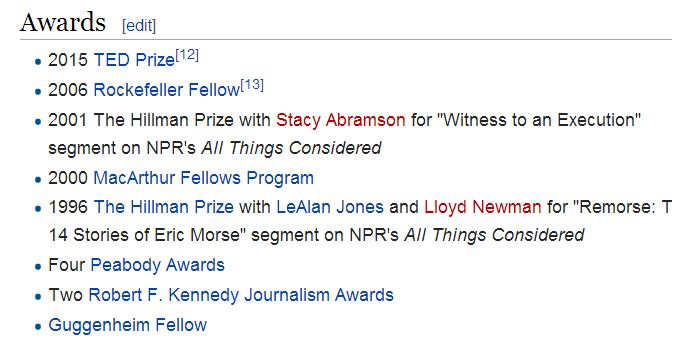
Dave Isay, creator of StoryCorps, a hugely successful oral history project that lets people interview each other about things that are important in their lives, received a million dollar TED prize in 2015 to expand this work.   His 2007 book of transcriptions from StoryCorps interviews, Listening is An Act of Love, was a New York Times bestseller, as were his other books on the subject.   Listen to Isay speak– though he has always been deliberate in keeping his voice out of the recordings of people he gives the mic to– and you will be convinced: really listening to someone is an act of respect, and hearing what they have to say gives them a rare gift.   Isay reports that has seen powerless, invisible people literally straighten their spines, infused with confidence in the face of the rare gift of finally being really listened to.  They shine as they are given the chance to speak, be recorded, and then edit what they have to say into a form that can be heard by anyone in the world.  Their interviews, mundane and extraordinary, full of candor and flashes of off the cuff poetry, all worth hearing, are cataloged in the American Folk Life Center of the Library of Congress.

A preacher in a violent neighborhood in Boston, trying to bring street kids into church, has a revelation one night after a boy who was shot ran to the church. He died 150 yards from the church, struggling to reach it.  Even though the lights were out, said the preacher, and nobody was home.  The preacher realized that if a dying kid runs to the church, the church needed to come at least half way to meet them.  The preacher began to walk the dangerous streets with a group every Friday night from 10 pm until 2 a.m.   Eventually the kids on the corners began talking to him and he discovered what he had suspected from the start, these were not violent monsters, just kids trying to survive.  He said he spoke to some of the brightest, wisest, most creative people he’d ever met, these kids trying to make it on the streets.   His initiative of listening to kids has spread to many cities, changes lives and won him awards.

We do not listen.   We have many good reasons: we are very busy, life is very stressful, we pretty much know what people are going to say, we can’t pay attention to everything, we have to tune out a lot of complete bullshit vying loudly for our attention in a nonstop attempt to sell us things we don’t need, the world is brutal and unfair, nobody fucking listens to us.  Fair enough.

Riding on the A train last night a very thin, artistic looking, slightly grimy young woman let an equally attenuated and dirty looking young man sit in the one seat that was left.  He sat gratefully and she stood over him talking almost without cease.  When the two seats next to me became available the woman moved with alarming quickness to claim them and the man slid in next to her.  The young man was next to me, clutching a nylon bag in his lap, the sharp corner of which protruded dangerously.  “I’m sorry,” he said, when I was first poked by it, but he seemed unable to make the slight adjustment that would have prevented it happening again.  I quickly learned to avoid it.

“I don’t like everybody constantly judging me,” said the haggard looking woman with a good deal of feeling, “I’m so sick of people telling me what they think I should do, people who don’t know anything about me or my life.  I purposely don’t confide in people, and I haven’t told you half of what I am thinking, even though we are very close.  You are about the closest person to me, I would say, but I will never tell you certain things.  I just can’t stand the way people look at me,” she added crossly.   I didn’t look at her, but not because I cared if she could stand it or not.  

The man, speaking with a heavy French or Italian accent, did his best to find out what was bothering the woman, but she was not having it.  “You know, if you don’t tell people what is wrong, what can they do to try to make it better?” he asked.  She had a quick, angry answer to this useless question.

Listening to their conversation,  I was slightly annoyed to be hearing it but also slightly fascinated.  It was like reading a grim but engaging short story about two desperate characters, trying hopelessly to connect but clearly being sucked down a tragic alley ending in rat poison and a decomposing body that would not be found for days. 

Listening carefully is not always the answer to the world’s lack of respect, but it can be.

Ombudsperson

I know it’s a childish thing to expect, particularly after practicing law for ten years, that there would be a fair arbiter you could appeal to to uphold basic fairness.   It’s like expecting there to be a record, and making statements for the record.  You know, when the appeals court looks over the record, you dig, they’ll see I’m right and the judge was wrong.  You think there’s really a record?   Heh.

“Watch out for that weasel,” a colleague once warned me about a certain judge.  “They have a foot switch that turns the recorder on and off so he can edit what goes into the record on the fly.  If the tiny red light on the side of his name plate goes out, you are not being recorded.   So when he takes a long pause and says ‘so, you refuse to answer the question, counselor’, right after you’ve answered the question, he already has his proof of your refusal to answer because what you just said was not recorded for the record.  You have, in fact, already refused to answer, on the record.  So don’t speak unless that red light is on, and ask him why you are off the record if the red light is off.”

“Damn,” I remember thinking, though, on reflection… duh! 

While I was dismayed, and a little angry, to finally learn that there is no corporate Ombudsperson at the Allen Pavilion to visit with a stack of Obamacare bills, some of which I owe, some of which I don’t, some of which have the wrong payment amount demanded in them, one of which is currently in collection, I am not really surprised.   That Ombudsperson would be overwhelmed, her job impossible to keep up with, the billing irregularities under the complex new law are as numerous as the stars in all the galaxies.   The guy at the billing window at the Pavilion tells me I have no idea how many problems patients have been having with multiple erroneous and ridiculously high bills.  

Want to make a record?  A better idea than worrying about that is to simply go fight City Hall.  Or practice until you find your way to Carnegie Hall.  Or go back in a time machine and buy a cheap suit from Robert Hall.   Next guest!