Auto-focus

It would be nice, I think, as the counter ticks 14:51 on its way to zero, to have a session at the start of each day to calibrate the mind, the mood, set the proper tone, remember to be grateful for the many gifts given for free when you open your eyes.  Auto-focus, in a word.  I know people who begin with meditation, or a religious ritual.  I think these are probably good ideas, though the results are mixed.  On the other hand, these guys might be much more nervous, or distracted, without their daily auto-focus sessions.

I mean, if you think about it for even a second, we are still hard-wired to run from predators.  Predators come in every shape and size and our reflexes are designed to twitch us instantly away from danger.  We are tuned to existential threats, and eventually, every life succumbs to one threat or another, no matter our level of vigilance.   The odds are against a focused, calm mind, for any of us.  

I need only scan the sides of this computer screen to survey the odds.  Yes, a clean desk is the sign of an empty mind as often as not, but still.   Beside a bit of dusty metro shelving, between the couch and the wall, we have a five foot pile of file boxes, covered with a dusty tarp and unopened for perhaps five or six years.  Next to them, an expired fax machine, duffle bag with broken zipper (and lifetime warranty, waiting to be sent back for its replacement), expired printer, boxed piece of crap computer guitar/keyboard/mic interface that never fucking worked and cost a lot of money, on top of that glossy box advertising “legendary tone” (the merciless pricks) a pile of beautifully colored foam rectangles, for occasional home animation use.  

Moving toward the computer screen things take a precipitous turn for the worse.  I will spare you a description of the devastation there on the desk top.  An immense tangle of papers, wires, books, headphones, devices, metal cups, sheet music, drawing pads– my goodness, what is that sock doing there?  It seems I did not spare you a description.  I am still surveying the horror of it.  There’s a plastic yogurt container top, clean, but, I mean, what the fuck?  

I had a productive day yesterday, pushing this immense rock several feet up the slippery hill I’ve been straining against for the last year.  I am steady on my legs, riding the bike four out of seven nights a week the last four weeks.  But I can no longer ignore the obvious (ah, I probably can…)– it will help my concentration to organize some of the chaos around me.  

On the other hand, with only fourteen seconds left now and the alarming buzzer about to sound, what can I really say?

Divergent Thinking Challenge (twelve minute time limit)

Image     The Challenge:

Set a timer for 12:00, let it count down.

You must first reduce your goal in life into a catchy motto you can say to someone in an elevator.  It should be short, it should be witty, but not too witty.  If your goal is droll, so much the better, if not, don’t waste words..

While thinking of how to condense your life’s work into a catch-phrase, and being mindful of the timer, imagine a child battling cancer.  This kid, a nine year-old, runs out of the school in a panic, asks you to get him a gun so he can kill himself.  Professes not to care that he will destroy the lives of his parents and cause bitter tears for all who love him.

The kid draws a series of pictures, the stick figure, labeled “me”, under the force of a giant, powerful magnet that is zapping him with rays.  In the next frame the stick figure is broken on top of a bloody pyramid, the magnet is inverted and the power is off.   Everything looks dead.

In the third frame there’s the stick figure, labeled “me”, bent in half, its head on the ground.  In the next frame he is standing.  In the final frame he seems to be exerting a reverse magnetic force and is repelling the magnet.

Our fifth grade interviewer, Elijah, will certainly want to ask about these drawings.

“What are you expressing in this series of frames?” Elijah might ask.   And the suicidal young artist would go into his explanation.

While working on the motto and considering how to proceed with the boy seemingly hell-bent on taking his own life, think of a two year projected budget to fund a project that is vital to your own peace and happiness, and to the peace and happiness of countless others.

Not that there is necessarily much peace and happiness in the remaining 37 seconds.  Geez, I wish I’d starting coming to the point ten minutes ago.  Look, there’s 13 seconds yet, now, eight and, soon enough, the final buzzer.

One Problem with the internet

If your goal is to be mindful, to taste the food you are putting into your body, to understand the effect your words will have before you speak, to be aware of others and their problems, to be calm and present in the moment, you will have already put limits on your use of the internet.

If your goal is to be distracted and/or entertained, to have your views confirmed, to preach to an imaginary choir, the internet is your place.

Know this, though, there is nothing easier to ignore than something on the internet.   Of all forms of communication, e-mail is probably the easiest to ignore.  Like falling off a log, baby.  Yeah, print out that email you sent me, I still never saw it, or if I did, so what?  You never answered that one I forwarded about serotonin levels in decorticated cats.

Sabbath

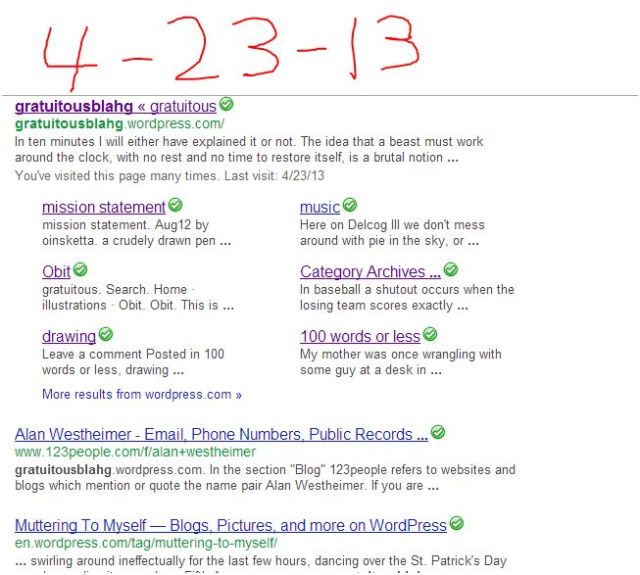
In ten minutes I will either have explained it or not.   The idea that a beast must work around the clock, with no rest and no time to restore itself, is a brutal notion from a hard-scrabble age.  Among enlightened people the importance of relaxation, a pleasurable holiday from the cares of the world, is understood.  

Don’t worry about me, I have one eye on the clock and almost seven and a half minutes to go.

On the sixth day God made Adam, looked at His creation, light and dark, order out of chaos, the living world, the oceans, all the creatures of the oceans, and the sky, and the sky itself, and all the land dwelling animals, reptiles, insects, mammals, the endless ingenious variation and variety.  God looked at His work and smiled and said “Good!” and took the seventh day off.

God rested.  Modeling the proper respect for yourself as a god, taking your rest after a job well-done.  You have worked hard and deserve the day of rest.   Use the day leisurely, to rest, repair yourself, dream, relax your worries.  So few of us actually take a day every week to do this, or even a few hours, except to see a movie, perhaps.

Remember the Sabbath and keep it holy.  One of the Ten Commandments, up there with Honor thy father and thy mother, and Thou shall not kill.

In two minutes I’m going to remember the Sabbath and keep it holy.  I’m going to tune up all the ukuleles and make a chorus of them.  They will play a vamp in the night.  This vamp will be very simple, and will thrum at the pulse of a relaxed heartbeat.   The vamp will have a two part riff that will go over it.  The boys sing the call, the girls sing the response.  Then they switch, then a few one and two note solos.  By then the strings will be well in tune, the beat calm and the notes to sing very clear and obvious.  

Time.

The Law is A Blunt Instrument (10 minute drill)

That’s the nicest way I can put it, by quoting Oliver Wendell Holmes, I think it was.  Again, two seconds on Google is too long for me, as I’ve set the timer for ten minutes and am determined to get on with it.

We’ll go with the Q & A format today:

Do you regret the three years in law school, forty plus thousand in debt and the ten years practicing that miserable (for the subsistence lawyer) profession?

I don’t regret it.  School has always come easily to me, I like books, at least 30% of what I studied was interesting.   The discipline and structure of law, so foreign to my way of thinking and so much the lingua franca of our world, was worth subjecting myself to, I think.   Standing in front of certain judges was a sickening exercise, and I saw up close the corruption of the system.   Shoot, I saw that already in the NYC school system.  Regrettable as the whole adventure was, I don’t really regret it, no.

Are you a hopeless romantic, then?

Hopeless, probably.  Romantic, well, you’d get an argument there from some people.  One person’s romance is the other person’s self-indulgent narcissistic daydream, I suppose.  But we were talking about the law, were we not?

Who are you asking?

Funny!  I didn’t realize you had a sense of humor.  Right, then.  Yes, the law.   What is it about the law that is so disgusting?

Are you asking the questions now, as well as answering zem?

It so would appear, yes, and with less than five minutes left on the clock, it would behoove us to keep things moving.  What is so disgusting about a blunt instrument is to see it used on things it cannot possibly help.  Some wit said if the only tool you have is a hammer the answer to every question will be a hammer.

A hammer?

Yes.  Now, as I was saying, the blunt instrument of Western Law, and probably every kind of law that industrial societies are based on, was designed to protect the property of the wealthy.   If you take a fine-toothed comb over the US Constitution, famed around the world as the blueprint for democratic government, and the first such charter, you will eventually discover three discreet phrases, inserted by lawyers who owned slaves, that make it perfectly legal to import and own ‘such persons as the states shall see fit to admit’ and that, if you own enough of them, your representation in Congress would be enhanced by 60% of the voting power of such creatures, if God had seen fit to give them the vote instead of chains and an angry, poor, sunburned white man to whip them. 

“Pish tosh!”, you say, “ancient history!” as I see 39 seconds left on the clock.  Let me just say this then:  read the Constitution, read The Slaugtherhouse Cases and Cruikshank, observe the almost century-long-sleep of the 13th, 14th and 15th Amendments and have a very nice day, there’s the beeper.

Challenge

It was Mussolini, I believe, who said “what doesn’t kill me makes me stronger.”   I could check this in two seconds on Google, but the point is, they hung the guy and his girlfriend upside down from meathooks in a public thoroughfare, this strong man.   Benito Mussolini, in his arrogance, did some bad things, I understand, in addition to making the trains run on time.  I don’t say he didn’t deserve the meathook, probably he did.  Other people deserve it too, probably.  I can think of several off hand, but none of the ones I’m thinking of will get it.  I can say that with the oracular assurance of a modern day Nostradamus.

What I am driving at is the challenge of making something good out of all this talking to myself.  If someone writes you a check at the end of the week, no matter how lousy the pay, you still get a check, money you can spend to sustain yourself, a bit of validation, no matter how unsatisfactory the amount of money or the actual work may feel to you.  If nobody writes you a check for your work, you may ask yourself questions, things like “what the fuck?” and “who in their right mind would work this hard for no pay?”  or  you might find yourself writing over and over “all work and no pay makes Jack a very exploited and bitter little bastard”.    

“No, no,” you will tell yourself, the very Voice of Reason.  “Nobody will pay unless you make them pay.  It’s the American way, baby.  You just make them pay.  Rugged individual, man.  Nobody wants to pay, they want everything for free.  You just say ‘pay me’ and you look at them very tough, without blinking, stone-faced, and then they swallow, and there’s a stare down, and then, if you’re really good, they pay you.  That’s all, man.  No need to get all philosophical about it.”

“Or,” another voice of reason will chime in, (though not mine), “you can do what most people do– figure out a good or service you can sell for money and sell it.  Use your credentials and work experience, your network of business contacts, for godsakes.  You can make a living most easily by working for an outfit that worries about raising the money to pay you.  Then it’s only a matter of abiding the politics of that particular workplace and you will get paid.”

“It’s called maturity.  You do something you might not necessarily love and you get paid.  That’s why they call it work. It’s what 99% of the world does.”  

I cannot tell you how many times this reasonable Alice Kramden-like lecture has been presented to me patiently by people close to me who have had it up to here with my dreaming and my judgmental complaining.   Look, we torture people and kill children with drones and in other ways, and, yes, we also maintain an apartheid school system virtually unchanged (except for the addition of guns) since Brown v. Board of Education almost sixty years ago, nobody said we were perfect, shut up about it already, we’re trying to enjoy our meal in this nice restaurant.  Go find a leper to kiss and let us eat and drink in peace.

Better, perhaps, if they just spit on me and spare me the lecture.  Then we could duke it out, they’d be surprised, I think, at how tough Ahimsa Man really is.  It hasn’t killed me, after all, it must have made me strong as a meathook.  I tell you what, I wouldn’t want to try me.

But let’s not, as they say, go there.  I was feeling overwhelmed last night and said to myself the exact words my father said to me right before he died.  “I don’t know how to do this…” I said to myself, echoing precisely what my dying father said to me as he tried to figure out how to stop breathing.  Then he did it like a champ, like Rembrandt painting one of those transcendent final self-portraits, like Martin Luther King Jr. giving that speech the last night of his life.  Just goes to show you.  

It’s sad, and it’s funny, that when I woke up seven hours after posting the piece about my father’s death I had a number of emails from WordPress.  When somebody “likes” a blog post an automated email is generated to the blogger telling her or him that somebody “thought your post was awesome”.  The email then suggests you might like to visit the blog of the person who thought your’s was awesome.  And these blogs I visit, every one of them is usually pretty awesome.  

But the funny thing I noticed today was the amazing coincidence that four of the people who thought my piece about the death of my father was awesome have the same great idea for me– become an affiliate marketer in your spare time to generate enough cash to be a globe trotting bon vivant living off your laptop and the constant stream of commissions that will come your way.  It’s awesome, man, seriously.  

I can still write whatever I want, dream whatever I want, be as judgmental and complaining as always, I just have to set up squeeze pages and so forth and drive imaginary traffic to affiliate sites where the affiliates will sell things and send me my commissions.  So easy, I hear, that virtually anyone can do it, and with even a 2% conversion rate you can do this from the beach in Bali or from a sweaty hovel anywhere you choose.    

Although, who am I kidding?  More to the point, who the hell am I writing this to?  And would you get a load of this rogue’s gallery under the Google search for Nostradamus (and who knew he had a brother named Jean?)– what the hell is Psy doing between Hitler and Bonaparte?  “People also search for”?  What?   Really?  People also search for their ass with both hands and wind up scratching  a hole in the ground.

Image

My Father’s Death

When I arrived in Florida, a few days after my father’s sudden hospitalization with undiagnosed end-stage liver cancer, a couple of days before he died, my father told me “you’re the only one who knows what’s going on.”   Although everyone around him knew he was dying, and the look on the Emergency Room doctor’s face had made that unmistakably clear to my sister, who urged me to get on the next plane, he was somehow trying to give me credit he’d often withheld.

“I want to talk to you, I’m gathering my thoughts,” he told me a while later, and I bought him a tiny digital recorder to speak into, if he was moved to speak when nobody was around.  He was beyond writing things down, and though he was an excellent writer, he rarely put pen to paper when he was able to.

We were fortunate to have that conversation, the thoughts he gathered were impressively organized, clearly expressed in that scratchy voice he had at the end.  I don’t know if anyone could have written, edited and delivered those thoughts better.  He always was an excellent speaker, and spoke virtually without notes.  Lucky for us both I have always been a night owl and when I drove over to the hospital at 1 a.m. he was awake and waiting to talk.  Turned out to be the last night of his life, he died before sundown the following day.

I am thinking about my father’s death because of something he said right at the end, it may have been the last thing he said.   We were sitting around his hospital bed, he’d become agitated, grabbed my sister’s hand, and mine, and when he let go I got the nurse and convinced him to take a mild sedative, an anti-anxiety pill, atavan, that a friend of mine is fond of.  I assured him it was fast-acting and would only take the edge off, since he was always very concerned with remaining in control and had never had so much as a beer, let alone a mind-altering pill.  Reassured, and feeling desperate perhaps, he agreed to take it and quickly composed himself.

“I’m feeling much better,” he announced a few minutes later, sounding like his old self.  “Why don’t you all go down and take a break and have a bite to eat downstairs, you’ve been sitting here a long time.  Elie can stay with me, it’s OK.”  My mother, sister, uncle and brother-in-law all got up and went down to the cafeteria.  It was dinner time and outside the sky was turning into a beautiful painting of a Florida sunset.  I recall the silhouettes of palm trees outside the hospital windows becoming more vivid as the light slowly began to fade.  

Two nurses were in the room and one of them said to me “it’s almost time.”  She pointed out that my father’s fingers were turning blue under the fingernails, something to do with the blood no longer delivering enough oxygen to the extremities, apparently a sign that Death is close by.  

“If you pray, now is the time to do it,” said the other nurse.  I told her we were not religious and she took it on herself to sing a Jewish tune she knew.  The African-American woman sang a chorus of Dayenu, a song from the Passover service that indicates we’d be thankful for any fraction of the many blessings God has laid on us. Thinking about it now, the snippet of song was as good a prayer as I could have thought of, though it seemed a bit surrealistic at the time.  She had a nice voice, and carried the tune well, but I remember thinking at the time that it was bizarre.

They helped me take down the railing at the side of the bed so I could sit closer to my father, then silently left the room.  My father looked at me helplessly and said “I don’t know how to do this…”   I assured him that nobody does, that it was OK.  I sat close as he breathed a bit faster for a minute or two, maybe five, perhaps fifteen, and then breathed his last.  His eyes were open, I closed them with two fingers of one hand, like playing a simple chord on the guitar or piano.  It was eerie how natural the movement was.  The nurses returned a moment later and I took the oxygen tube out of my father’s nostrils.  “He won’t be needing this,” I said softly, handing it to them.   I took his glasses and put them in my baritone ukulele case, where they are to this day.

I was amazed at how simple and graceful my father’s last moments were.  I’d been told a day earlier that death by kidney failure, the way terminal liver cancer actually kills you, is an accelerating sleepiness that ends in a usually peaceful death, but it was striking how peaceful that final struggle was.  A friend who read Jewish scripture for years quoted a line from the Talmud, I think, that stated it poetically and true to my father’s death: the moment of death is like lifting a hair off a glass of milk.

“I don’t know how to do this….” rang in my head just now, as I thought of the mountain I am trying to climb, an impossible one, really, for anybody but an exceptional being who is able to recruit exceptional helpers, and I thought to myself, with a sinking feeling “I don’t know how to do this.”   Same phrase.  It struck me.  Now, the same mercy I gave the old man, I extend to myself, if such a thing is possible– “nobody does, it’s OK.”

Either way, there will be the last breath and then darkness.  I’ll be happy to meet angels, and the souls of loved ones who have passed on, but I’m not expecting to.  The only thing to see between now and then is how exceptionally I can climb in whatever time remains for me to climb.

Deep in the Heart of Texas

Just as I was feeling I may have been a little harsh on the State of Texas, I was listening to a podcast from KCRW in Santa Monica, Warren Olney’s news show To The Point.  The show, entitled Are High-Stakes Tests Corrupting Public Education? was broadcast on April 5, 2013.  The theme of the show is stated next to the podcast:

After charges of systematic cheating on standardized testing by administrators and teachers a backlash is growing against standardized testing.

Since there is a growing trend to tie teacher pay to the scores of their students on standardized tests, it is not surprising that some teachers and administrators have been caught cheating.  All it takes, after all, is the eraser on your number two pencil and a pile of student exams.

My sister teaches first grade in Florida, one of the poster states for No Child Left Behind, now called Race to the Top, both of which are based on the Texas assessment model where President George W. Bush’s people got the idea.   Florida is also a “right to work” state, which means, actually “the right to work without a contract or union interference”.  You can get a contract in a “right to work” state, but don’t expect too much about keeping your job to be guaranteed in it.  

My sister, who teaches students from poor and largely illiterate families, many of whom don’t speak English, is graded on the same scale as those who teach the children of the affluent.  There is no curve.  You can imagine her torment, thinking of her pay being tied not to how much she actually teaches her students, which is considerable, but to how well they do on standardized tests, when compared across the nation to every other kid.  Her class, by the way, always has the top scores, by far, in her school.  But she and her students are judged against the scores of students in wealthy neighborhoods in far away states that fare much better in educational outcomes.

Anyway, it will surprise few, I suppose, to hear it stated on Olney’s show, at around 8:10, that Texas leads the nation in money spent on standardized testing and also on the sheer number of tests given.  

It has a wonderful side effect, what one of Olney’s guests called “drill and kill”, this relentless teaching to the test, preparing kids to guess the right answers and learn strategies for gaming these often shabbily designed tests (I speak from experience, having prepared classes for and proctored a number of these), it serves to demoralize the staff and children of schools in poor neighborhoods.  These schools can then be shown to have failed, and closed, and public money can be given to the private sector to operate competitive schools that can succeed.  In the end, to a certain type, privatizing everything is the way to go, since the “free market” (think “right to work”) is the best arbiter of good and bad.

After all, look how well the free market has taken care of controlling health care costs in the USA (leading the world in expense, pretty far down the list in health outcomes), making sure banks and investment houses (which are largely the same thing now) play fairly, guaranteeing a baseline quality of life in the richest country in the world so that no old person ever has to eat dog food (cat food is also a possibility).  

Ach, there I go again, hating our freedom… I really am a one trick pony.  Good night.

Unable to find data

Much as I dislike statements of “fact” that are not backed up with a citation to a credible source, I included one yesterday about Texas leading the USA, and by extension the world, in felony assault on children.   I’d heard the stat cited on Public Radio in NYC some time ago, and it stuck.   The actual show, and time and date of broadcast, is probably noted in the drawing book I was carrying at the time, but there are too many of them to flip through.

I did some on-line research and was unable to find the supporting documentation, or anything resembling it.  Not to say that it’s not true, but a source has been hard to find.

You can read a report on Felony Assault on Children here, but Alberto Gonzales’ Department of Justice has thoughtfully redacted pages 17-67.  It does not appear that there is a state by state breakdown in the report, though under the section on state law there is a defendant demographics table on page 45.   I suppose a Freedom of Information request could be addressed to the DOJ.